Unit 16 · Waves and Optics · 3 teaching hours · 21 min read
Refraction through prisms
What the syllabus asks for 3
- Minimum deviation condition
- Relation between angle of prism, minimum deviation and refractive index
- Deviation in small angle prism
A prism is a block of glass with two plane faces inclined to each other. Because the two faces are not parallel, the two refractions no longer cancel as they did in a slab: the ray leaves in a new direction, bent towards the thick part of the glass. That bending is the angle of deviation, and it turns out to be smallest when the light passes through the prism symmetrically. Measuring that smallest deviation is the standard laboratory method of finding the refractive index of a transparent solid, and it is the basis of the spectrometer.
A = r_1 + r_2, \delta = i_1 + i_2 - A, n = \dfrac{\sin\left(\frac{A+\delta_m}{2}\right)}{\sin\left(\frac{A}{2}\right)} and \delta = (n-1)A for a thin prism. Learn the derivations, not just the results — NEB awards marks for each labelled step.
16.1 Minimum deviation condition
The two faces through which light passes are the refracting surfaces; the angle between them is the refracting angle or angle of the prism, A. Their line of intersection is the refracting edge and the third face is the base. A section perpendicular to the refracting edge is the principal section — every diagram in this chapter is a principal section.
| Symbol | Name | Where it is measured |
|---|---|---|
| A | refracting angle (angle of the prism) | between the two refracting faces |
| i_1 | angle of incidence | first face, in air |
| r_1 | angle of refraction | first face, in glass |
| r_2 | angle of incidence inside | second face, in glass |
| i_2 | angle of emergence | second face, in air |
| \delta | angle of deviation | between incident and emergent directions |
The angle of deviation of a prism is the angle between the direction of the incident ray produced forward and the direction of the emergent ray produced backward. It measures how far the prism has turned the light from its original path.
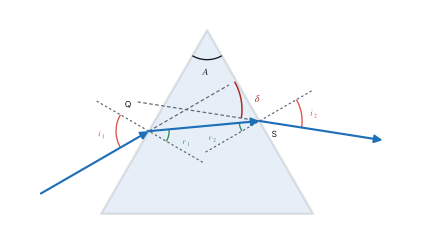
We start from pure geometry in the ray diagram — no optics at all in part (a) — and reach the two equations that every prism question is built on.
Setting up. The ray strikes the first face at Q with angle of incidence i_1 and is refracted at r_1. Inside the glass it travels to S on the second face, meets the normal there at r_2, and emerges at i_2. Let N be the point where the two normals (at Q and at S) cross. A is the refracting angle of the prism, at the vertex where the two faces meet.
Part (a): A = r_1 + r_2
Step 1 — look at the quadrilateral AQNS. NQ is the normal at Q, so it is perpendicular to the first face; NS is the normal at S, so it is perpendicular to the second face. Therefore
Step 2 — add up the four angles of the quadrilateral. They total 360^{\circ}:
Step 3 — subtract 180^{\circ} from both sides:
Step 4 — now look at triangle QNS. Its three angles are r_1 at Q, r_2 at S, and \angle QNS at N, and they add to 180^{\circ}:
Step 5 — compare Steps 3 and 4. Both left-hand sides equal 180^{\circ}:
Step 6 — cancel \angle QNS from both sides:
Part (b): \delta = i_1 + i_2 - A
Step 7 — how much the ray turns at the first face. It arrives along a direction making i_1 with the normal and leaves making r_1 with the same normal, so it has been turned through
Step 8 — how much it turns at the second face. Same argument, in the same rotational sense:
Step 9 — add the two turns. Both bend the ray the same way, so the total deviation \delta (the exterior angle of the triangle formed by the incident ray produced and the emergent ray produced backwards) is their sum:
Step 10 — group the i's and the r's:
Step 11 — replace (r_1 + r_2) by A, using Part (a):
Result.
What it means. The first relation is purely geometrical — it holds whatever the glass is made of. The second says the prism's total bending is shared between the two faces. Together they reduce four unknown angles to two, which is why every prism numerical is solvable.
Conditions used. The ray must lie in a plane perpendicular to the refracting edge (the "principal section"), and it must actually emerge at the second face — if r_2 exceeds the critical angle, there is no i_2 and these relations cannot be used.
How the deviation varies with the angle of incidence
Keep the prism and the colour of light fixed and slowly increase i_1. Each value of i_1 fixes r_1, hence r_2 = A - r_1, hence i_2, hence \delta. Plotting \delta against i_1 gives a curve with a single minimum.
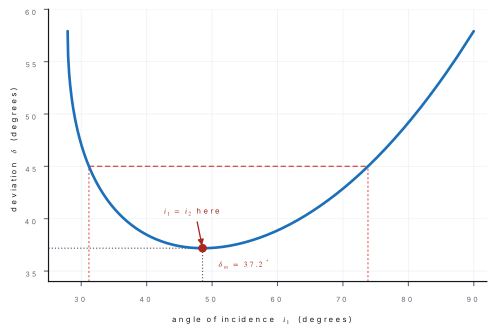
We start from the shape of the \delta–i_1 graph together with the principle of reversibility, and reach the symmetry condition i_1 = i_2, r_1 = r_2.
Step 1 — read the graph. Draw any horizontal line above the lowest point of the curve. It cuts the curve twice. So for every deviation \delta greater than the minimum there are two different angles of incidence that produce the very same deviation. Call them i and i'.
Step 2 — apply the principle of reversibility. If a ray enters at i_1 and emerges at i_2, then reversing its direction sends a ray in at i_2 which emerges at i_1 — along the same path, so with the same deviation \delta.
Step 3 — identify the two roots. Step 2 gives us two angles of incidence with the same \delta, namely i_1 and i_2. Step 1 says there are only two. So the pair in Step 1 must be
Step 4 — now slide the horizontal line down. As \delta decreases towards \delta_m, the two intersection points move towards each other. At the minimum itself the line touches the curve at exactly one point, so the two roots have merged:
Step 5 — carry this inside the prism. Snell's law at each face gives \sin i_1 = n\sin r_1 and \sin i_2 = n\sin r_2. Equal i's therefore force equal r's:
Result. At minimum deviation the ray passes symmetrically, i_1 = i_2 and r_1 = r_2, and therefore the refracted ray inside the prism runs parallel to the base.
What it means. Symmetry is not an extra assumption we make for convenience — it is forced on us by the shape of the curve. This is why the prism formula of the next section is exact, not approximate.
Conditions used. One prism, one colour, and a ray that actually emerges from the second face.
Deviation is a minimum when the ray passes through the prism symmetrically:
and the refracted ray inside the prism is then parallel to the base of the prism.
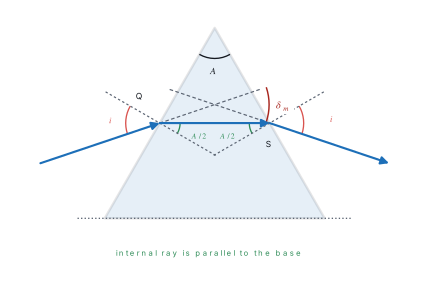
A prism always deviates light — \delta can never be made zero (unlike a parallel-sided slab, where it always is). "Minimum" means the smallest value the deviation can be pushed down to, and it is reached at one particular angle of incidence only.
When no light emerges
At the second face the internal ray meets the glass–air boundary at r_2. If r_2 exceeds the critical angle C the ray is totally internally reflected and never leaves through that face. Since r_1 can never exceed C (its largest value, at grazing incidence i_1 = 90^{\circ}, is exactly C), the smallest possible r_2 is A - C. So light can emerge only if A - C \leq C, that is
For crown glass, C = 41.8^{\circ}, so no light emerges through the second face of a prism whose refracting angle exceeds about 83.6^{\circ}.
16.2 Relation between angle of prism, minimum deviation and refractive index
We start from the two prism relations, add the fact that at minimum deviation the ray passes symmetrically, and reach a formula for n from two measurable angles.
Setting up. At minimum deviation the path through the prism is symmetrical: the ray inside runs parallel to the base, the angle of incidence equals the angle of emergence, and the two internal angles are equal. So
Step 1 — put the equal internal angles into A = r_1 + r_2:
Step 2 — divide both sides by 2:
Step 3 — put the equal external angles into \delta = i_1 + i_2 - A:
Step 4 — add A to both sides:
Step 5 — divide both sides by 2:
Step 6 — apply Snell's law at the first face, where light goes from air into glass:
Step 7 — substitute the expressions for i and r from Steps 5 and 2:
Result.
What it means. This is the prism formula, and it is the standard accurate method for finding n. Everything on the right is an angle, and a spectrometer measures angles to within a few minutes of arc — far more precisely than we could measure a length or a depth. Note also that a larger \delta_m for the same prism means a larger n, which is why violet light (deviated most) has the largest refractive index.
Conditions used. The prism must be set at minimum deviation, so that the path is symmetrical; monochromatic light must be used, since n and \delta_m both depend on colour; and the surrounding medium must be air.
- A labelled diagram with i_1, r_1, r_2, i_2, A and \delta marked.
- The two prism relations quoted or derived.
- The statement of the symmetry condition at minimum deviation, i_1 = i_2 and r_1 = r_2 — usually worth a mark on its own.
- r = A/2 and i = (A+\delta_m)/2, each shown as a separate line.
- Snell's law at the first face, and the final substitution.
On a spectrometer, rotate the prism table slowly while watching the refracted image through the telescope. The image moves one way, stops, and turns back. The turning point is the position of minimum deviation — that "stop and go back" moment is what the examiner wants described.
- From i_1 find r_1 using \sin i_1 = n\sin r_1.
- From A = r_1 + r_2 find r_2.
- From n\sin r_2 = \sin i_2 find i_2.
- From \delta = i_1 + i_2 - A find the deviation.
Reverse the chain if you are given \delta_m: r = A/2, i = (A+\delta_m)/2, then n = \sin i/\sin r. Never mix the two chains in one question.
Problem. The angle of minimum deviation of an equilateral glass prism is 30^{\circ}. Find the refractive index of the glass and the angle of incidence at minimum deviation.
Solution. An equilateral prism has A = 60^{\circ}, and \delta_m = 30^{\circ}.
So n = \sqrt{2} \approx 1.41. The angle of incidence is
and the angle of refraction inside is r = A/2 = 30^{\circ}.
Problem. An equilateral prism is made of glass of refractive index 1.5. Calculate its angle of minimum deviation.
Solution. Here A = 60^{\circ} and n = 1.5. Rearranging the prism formula,
The light must strike the first face at 48.6^{\circ} for this to happen.
Problem. A ray strikes one refracting face of an equilateral prism (n = 1.5) at an angle of incidence of 45^{\circ}. Find the angle of refraction at the first face, the angle of incidence at the second face, the angle of emergence, and the deviation. Compare the deviation with the minimum value found in Example 16.2.
Solution. At the first face,
Using A = r_1 + r_2,
At the second face, glass to air,
The deviation is
This is slightly greater than \delta_m = 37.18^{\circ}, as it must be — and it is only 0.2^{\circ} greater even though i_1 is 3.6^{\circ} away from the symmetric value. Near the minimum the curve is very flat, which is exactly why the minimum position is easy to find on a spectrometer.
16.3 Deviation in small angle prism
A prism whose refracting angle is only a few degrees is called a thin or small-angle prism. For such a prism a beautifully simple result holds.
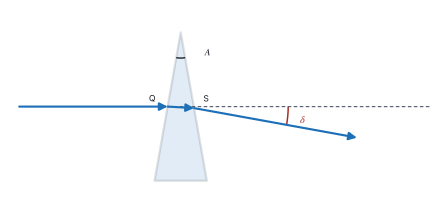
We start from Snell's law at the two faces with all angles small, and reach a deviation formula that no longer contains the angle of incidence at all.
Setting up. The refracting angle A is small (a few degrees) and the ray enters nearly normally. Then A = r_1 + r_2 forces r_1 and r_2 to be small, and Snell's law then makes i_1 and i_2 small too. All four are small angles measured in radians.
Step 1 — Snell's law at the first face:
Step 2 — use the small-angle approximation \sin\theta \approx \theta:
Step 3 — make i_1 the subject:
Step 4 — repeat the same three steps at the second face:
Step 5 — substitute both into \delta = i_1 + i_2 - A:
Step 6 — take out the common factor n:
Step 7 — replace (r_1 + r_2) by A, using the first prism relation:
Step 8 — take out the common factor A:
Result.
What it means. The angle of incidence has vanished from the answer. For a thin prism the deviation is fixed by the prism itself — its angle and its glass — so you do not need to hunt for the minimum-deviation position. And because n depends on colour, so does \delta: this one line is the seed of the whole theory of dispersion.
Conditions used. A must be small (in practice under about 10^{\circ}) and the ray must strike nearly normally, so that \sin\theta \approx \theta is safe in Step 2. For a thick prism or a slanting ray the formula fails and the full prism formula must be used.
Three consequences matter:
- \delta does not depend on i_1. For a thin prism the deviation is essentially the same however the ray is aimed (within small angles), so there is no need to set it at minimum deviation.
- \delta depends on n, and n depends on colour. Violet light, with the larger n, is deviated more than red. This is the origin of dispersion (Unit 18), where the angular dispersion is \delta_V - \delta_R = (n_V - n_R)A.
- Thin prisms add. Two thin prisms placed together with their refracting edges the same way deviate light by \delta_1 + \delta_2; reversing one subtracts. This is how achromatic prism combinations are designed, and how optometrists in Kathmandu correct squint with "prism dioptres".
Problem. A thin prism of refracting angle 5^{\circ} is made of glass of refractive index 1.52. Find the deviation it produces. What angle of prism would be needed to produce the same deviation with glass of n = 1.65?
Solution. For a thin prism,
For the second glass, requiring the same \delta = 2.6^{\circ},
A denser glass needs a smaller refracting angle for the same bending — which is why high-index glass is used where a prism must be kept thin and light.
Chapter summary
- For a prism of refracting angle A: A = r_1 + r_2 and \delta = i_1 + i_2 - A.
- The graph of \delta against i_1 has one minimum. Above the minimum, two angles of incidence give the same deviation; at the minimum they coincide.
- At minimum deviation the passage is symmetrical: i_1 = i_2, r_1 = r_2 = A/2, and the internal ray is parallel to the base.
- Prism formula: n = \dfrac{\sin\left(\frac{A+\delta_m}{2}\right)}{\sin\left(\frac{A}{2}\right)}, with i = \dfrac{A+\delta_m}{2} at minimum deviation.
- Light can emerge through the second face only if A \leq 2C, where C is the critical angle; otherwise total internal reflection occurs inside the prism.
- For a thin prism, \delta = (n-1)A, independent of the angle of incidence, and thin-prism deviations simply add.
Practice questions
Group A — Multiple choice (1 mark each)
- For a prism of refracting angle A at minimum deviation \delta_m, the angle of incidence is [1]aA/2b\dfrac{A+\delta_m}{2}c\delta_m/2dA + \delta_m
- At minimum deviation the ray inside the prism is [1]aparallel to the basebnormal to the basecparallel to a refracting facedalong the base
- The deviation produced by a thin prism of refracting angle 6^{\circ} made of glass of n = 1.5 is [1]a2^{\circ}b3^{\circ}c4^{\circ}d9^{\circ}
- The refractive index of the material of an equilateral prism whose minimum deviation is 30^{\circ} is [1]a1.33b1.41c1.50d1.73
- In a prism, the sum of the two angles of refraction r_1 + r_2 is equal to [1]athe angle of incidencebthe angle of the prismcthe angle of deviationd90^{\circ}
- A ray cannot emerge from the second face of a prism if the refracting angle A is [1]aless than Cbequal to Ccgreater than 2Cdless than 2C
Answers to Group A
1. (b) — from \delta_m = 2i - A.
2. (a) — symmetrical passage makes the internal ray parallel to the base.
3. (b) — \delta = (n-1)A = 0.5\times6^{\circ} = 3^{\circ}.
4. (b) — n = \sin45^{\circ}/\sin30^{\circ} = 1.414.
5. (b) — A = r_1 + r_2.
6. (c) — then r_2 = A - r_1 > C for every r_1, so the ray is totally internally reflected.
Group B — Short answer (5 marks each)
- Define the refracting angle of a prism, the angle of deviation and the angle of minimum deviation. With a labelled diagram, show that \delta = i_1 + i_2 - A. [5]
- Derive the relation n = \dfrac{\sin\left(\frac{A+\delta_m}{2}\right)}{\sin\left(\frac{A}{2}\right)} between the angle of a prism, its angle of minimum deviation and the refractive index of its material. [5]
- Show that for a prism of small refracting angle the deviation is \delta = (n-1)A and is independent of the angle of incidence. [5]
- Calculate the angle of minimum deviation of an equilateral prism made of glass of refractive index 1.6. [5]
- The angle of minimum deviation of a prism of refracting angle 60^{\circ} is 40^{\circ}. Find the refractive index of its material and the angle of incidence at minimum deviation. [5]
Answers to Group B
1. Definitions and derivation as in §16.1.
2. See the derivation in §16.2.
3. See the derivation in §16.3.
4. \sin\left(\dfrac{60^{\circ}+\delta_m}{2}\right) = 1.6\sin30^{\circ} = 0.8, so \dfrac{60^{\circ}+\delta_m}{2} = 53.13^{\circ} and \delta_m = 106.26^{\circ} - 60^{\circ} = 46.26^{\circ} \approx 46.3^{\circ}.
5. n = \dfrac{\sin\left(\frac{60^{\circ}+40^{\circ}}{2}\right)}{\sin 30^{\circ}} = \dfrac{\sin 50^{\circ}}{0.5} = \dfrac{0.7660}{0.5} = 1.532. The angle of incidence is i = \dfrac{A+\delta_m}{2} = 50^{\circ}.
Group C — Long answer (8 marks each)
- (a) Draw the path of a monochromatic ray through a glass prism and prove that A = r_1 + r_2 and \delta = i_1 + i_2 - A. [4](b) Sketch the graph of deviation against angle of incidence, and use it to show that at minimum deviation the ray passes symmetrically. Hence derive the prism formula. [4]
- A ray of light is incident at 40^{\circ} on one refracting face of an equilateral prism of refractive index 1.5. Calculate(a) the angle of refraction at the first face,(b) the angle of incidence at the second face,(c) the angle of emergence, and(d) the angle of deviation. Show that this deviation is greater than the minimum deviation of the same prism. [8]
Answer to Group C question 2
(a) \sin r_1 = \dfrac{\sin 40^{\circ}}{1.5} = \dfrac{0.6428}{1.5} = 0.4285, so r_1 = 25.37^{\circ}.
(b) r_2 = A - r_1 = 60^{\circ} - 25.37^{\circ} = 34.63^{\circ}.
(c) \sin i_2 = 1.5\sin 34.63^{\circ} = 1.5 \times 0.5682 = 0.8522, so i_2 = 58.47^{\circ}.
(d) \delta = i_1 + i_2 - A = 40^{\circ} + 58.47^{\circ} - 60^{\circ} = 38.47^{\circ}.
For the same prism, \sin\left(\frac{60^{\circ}+\delta_m}{2}\right) = 1.5\sin30^{\circ} = 0.75, giving \delta_m = 37.18^{\circ}. Since 38.47^{\circ} > 37.18^{\circ}, the deviation here is indeed above the minimum — as it must be for any angle of incidence other than 48.59^{\circ}.
Practise more: Physics question bank