Unit 5 · Mechanics · 6 teaching hours · 26 min read
Work, energy and power
What the syllabus asks for 6
- Work done by a constant force and a variable force
- Power
- Work-energy theorem; Kinetic and potential energy
- Conservation of Energy
- Conservative and non-conservative forces
- Elastic and inelastic collisions
Newton's laws tell you the force on a body at every instant. Often you do not care about every instant — you only want to know how fast the body ends up, or how much fuel the engine burned. Work and energy answer those questions in one line where dynamics would need a page. This unit builds the idea of work, turns it into kinetic and potential energy, and ends with the one law that survives every situation: energy is conserved.
Three things come up year after year: the work–energy theorem applied to a rough surface, the conservation of energy on a track or pendulum, and one-dimensional collisions. Learn to decide in one glance whether a problem is a force problem or an energy problem — energy is almost always faster.
5.1 Work done by a constant force and a variable force
In ordinary speech "work" means effort. In physics it means something much narrower: a force does work only when its point of application moves, and only the component of the force along the displacement counts.
If a constant force of magnitude F acts on a body while the body undergoes a displacement s, and \theta is the angle between the force and the displacement, the work done by the force is
Work is a scalar. Its SI unit is the joule (J); 1\ \text{J} = 1\ \text{N m}.
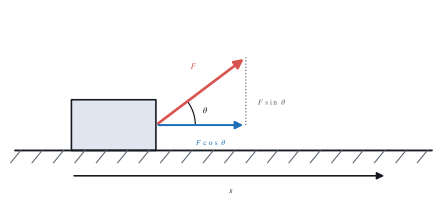
The cosine controls the sign, and the sign is physical:
| Angle \theta | \cos\theta | Work | Example |
|---|---|---|---|
| 0^{\circ} | +1 | positive, maximum | a falling stone and its weight |
| acute | + | positive | pulling a cart with a slanted rope |
| 90^{\circ} | 0 | zero | normal reaction; centripetal force; a coolie carrying a load on level ground |
| obtuse | - | negative | brakes on a moving car |
| 180^{\circ} | -1 | negative, maximum | friction on a sliding block |
A porter on the Ghorepani trail carrying a 40 kg doko horizontally does no work on the load in the physics sense, because the supporting force is vertical and the displacement is horizontal. He tires because his muscles keep contracting and relaxing — that is physiological work, not mechanical work on the load.
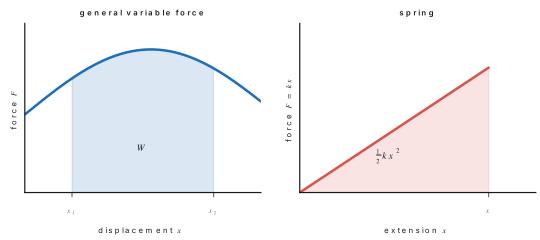
Variable force. Most real forces change as the body moves — the pull of a spring, the drag on a bus, the thrust of a rocket. Split the displacement into strips so narrow that F is effectively constant across each strip, do F\,dx for each, and add:
This is true whatever the shape of the graph. Area above the axis is positive work, area below is negative work.
For a spring obeying Hooke's law the applied force needed is F = kx, a straight line through the origin. Stretching it from 0 to x sweeps out a triangle of base x and height kx:
Problem. A crate of mass 10\ \text{kg} is dragged 10\ \text{m} across a horizontal floor by a rope inclined at 37^{\circ} above the horizontal with a tension of 100\ \text{N}. The coefficient of kinetic friction is 0.2. Take g = 10\ \text{m s}^{-2}, \cos 37^{\circ} = 0.8, \sin 37^{\circ} = 0.6. Find the work done by each force and the final speed if the crate starts at rest.
Solution. Work by the tension:
The vertical component of the tension lifts part of the weight, so the normal reaction is
Friction is f = \mu N = 0.2 \times 40 = 8\ \text{N}, opposite the motion, so
Weight and normal reaction are both perpendicular to the displacement, so each does zero work. Net work = 800 - 80 = 720\ \text{J}. By the work–energy theorem,
5.2 Power
Two labourers carry the same load of bricks to the same roof. One takes ten minutes, the other twenty. Both do the same work; the first is twice as powerful.
Power is the rate of doing work, or equivalently the rate of transfer of energy.
The SI unit is the watt (W): 1\ \text{W} = 1\ \text{J s}^{-1}. Commercial units are the kilowatt (10^{3} W) and the horsepower (1\ \text{hp} = 746\ \text{W}).
If a constant force \vec{F} moves a body at velocity \vec{v}, then in time dt the displacement is \vec{v}\,dt and dW = \vec{F}\cdot\vec{v}\,dt, so
This is the form to use for vehicles: at steady speed the driving force equals the total resisting force, so P = Fv immediately gives the engine power.
The unit on a Nepal Electricity Authority bill, the kilowatt-hour, is a unit of energy: 1\ \text{kW h} = 1000 \times 3600 = 3.6 \times 10^{6}\ \text{J}. "Units consumed" means joules used, not power.
Problem. A pump raises 600 litres of water per minute from a well 20\ \text{m} deep in Chitwan. Taking g = 10\ \text{m s}^{-2} and the density of water as 1000\ \text{kg m}^{-3}, find (a) the useful output power and (b) the input power if the pump is 80\% efficient.
Solution. 600 litres has mass 600\ \text{kg}, delivered in 60\ \text{s}, so the mass lifted per second is \dot{m} = 10\ \text{kg s}^{-1}.
(a) Useful power:
(b) Efficiency \eta = P_{out}/P_{in}, so
5.3 Work–energy theorem; kinetic and potential energy
Energy is the capacity to do work; it is measured in joules, like work. Mechanical energy comes in two forms.
We start from the definition of work and Newton's second law, and reach the result that the work done on a body equals the change in the quantity \frac{1}{2}mv^{2} — which is why we give that quantity the special name kinetic energy.
Setting up. A constant net force F acts on a body of mass m in the direction it is moving. The body's speed rises from u to v while it moves a distance s.
Step 1 — write down the work. The force is along the displacement, so \theta = 0 and \cos\theta = 1:
Step 2 — replace F using Newton's second law. The net force on a constant mass is F = ma:
Step 3 — get as from the equations of motion. The third equation of motion for constant acceleration is
Step 4 — make as the subject. Subtract u^{2} from both sides:
Step 5 — divide both sides by 2:
Step 6 — substitute this into Step 2. This is the key move: it replaces the force-and-distance picture by a speed picture:
Step 7 — multiply the m into the bracket, term by term:
Step 8 — name the two terms. The expression \frac{1}{2}mv^{2} depends only on the mass and the speed at that instant, so it is a property of the state of the body. We call it the kinetic energy:
Step 9 — rewrite Step 7 in that language. With K_i = \frac{1}{2}mu^{2} and K_f = \frac{1}{2}mv^{2}:
Result. The work–energy theorem:
The net work done by all the forces acting on a body equals the change in its kinetic energy. As a special case, a body at rest that is accelerated to speed v has had \frac{1}{2}mv^{2} of work done on it — so that is the energy stored in its motion.
What it means. Positive net work speeds a body up; negative net work (friction, brakes) slows it down. Because K depends on v^{2}, doubling the speed needs four times the work — the reason stopping distances grow so fast with speed.
Conditions used. Steps 1–5 assumed a constant force acting along the motion and a constant mass. The theorem itself is more general: for a varying force you replace Fs by \int F\,dx and reach the same answer. W_{net} must be the work of the net force — friction work included, with its minus sign.
(i) W = Fs with the statement that the force is along the displacement; (ii) F = ma substituted; (iii) v^{2} = u^{2}+2as quoted and rearranged for as; (iv) the substitution, and (v) the final line named as the work–energy theorem in words. If the question says "for a variable force", you must start from W = \int F\,dx instead.
Because p = mv, kinetic energy and momentum are linked by
Potential energy is energy a body has because of its position or configuration. Lifting a mass m slowly through a height h needs an upward force mg through a distance h, so the work stored is
measured from whatever level you choose as zero. For a stretched or compressed spring the stored elastic potential energy is U = \frac{1}{2}kx^{2}, the area found in §5.1.
Only changes in potential energy are physical. Write "taking the ground as U = 0" as the first line of your answer — examiners give credit for it, and it stops sign errors later.
Problem. A block of mass 2\ \text{kg} slides along a rough horizontal surface at 10\ \text{m s}^{-1} and comes to rest. If \mu = 0.25 and g = 10\ \text{m s}^{-2}, how far does it travel? What is the retarding force?
Solution. The only force doing work is friction, f = \mu mg = 0.25 \times 2 \times 10 = 5\ \text{N}, acting backwards. By the work–energy theorem, -fs = 0 - \frac{1}{2}mu^{2}:
The retarding force is 5\ \text{N} and the stopping distance is 20\ \text{m}. Note that the stopping distance goes as u^{2}: double the speed, four times the distance. That is the physics behind highway speed limits on the Mugling road.
5.4 Conservation of energy
Energy can neither be created nor destroyed; it can only be converted from one form to another. The total energy of an isolated system is constant.
When only gravity and other conservative forces act, the mechanical form of the law applies:
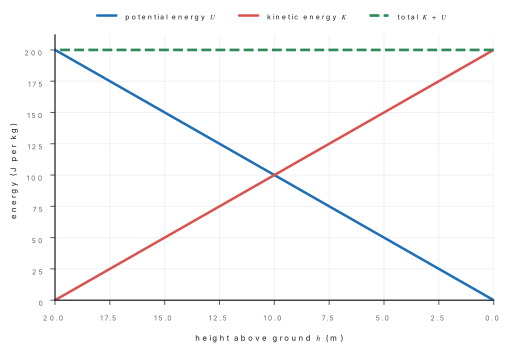
We start with a body of mass m released from rest at a height H, and show that at every point of its fall the sum K + U has the same value mgH.
Setting up. Take the ground as the level where U = 0 (always write this line down). Let the body have fallen to a height h above the ground, so the distance already fallen is H - h.
Step 1 — the potential energy at height h. By definition U = mgh:
Step 2 — find the speed at height h. Apply v^{2} = u^{2} + 2as to the fall so far. It started from rest, so u = 0; the acceleration is g downwards and the distance fallen is (H - h):
so
Step 3 — the kinetic energy at height h. Put this v^{2} into K = \frac{1}{2}mv^{2}:
Step 4 — the 2 and the \frac{1}{2} cancel:
Step 5 — add the two energies:
Step 6 — open the bracket:
Step 7 — the two mgh terms cancel:
Result. At every height h during the fall,
Check the two ends. At the top, h = H: U = mgH and K = 0. At the ground, h = 0: U = 0 and K = mgH, so the landing speed is v = \sqrt{2gH}. The answer mgH is the same at both ends and everywhere in between.
What it means. Potential energy is not destroyed, it is converted: for every joule of U lost, exactly one joule of K appears. Note that h disappeared from the answer — that is the whole content of the conservation law.
Conditions used. Air resistance is neglected (otherwise some energy becomes heat and K + U falls), g is constant over the height H, and the body is released from rest. If it were thrown down with speed u, the constant total would be mgH + \frac{1}{2}mu^{2} instead.
If friction, air resistance or a collision is involved, mechanical energy is not conserved — some is converted to heat and sound. Total energy is still conserved. In that case use the work–energy theorem with the friction work included, not K+U= constant.
5.5 Conservative and non-conservative forces
A force is conservative if the work it does in moving a body between two points is independent of the path taken, and consequently the work it does around any closed path is zero. A potential energy function can be defined for it, with F = -\,dU/dx. A force for which this fails is non-conservative.
Lift a 1 kg bag from the courtyard to the first floor of a house in Bhaktapur. Carry it straight up the stairs, or up to the second floor and back down — the work done against gravity is the same, mgh, because only the change of height matters. Gravity is conservative. Drag the same bag across the floor by a long route and a short route, and friction takes far more energy on the long route. Friction is non-conservative.
| Conservative | Non-conservative | |
|---|---|---|
| Work depends on path? | No | Yes |
| Work in a closed loop | zero | non-zero (usually negative) |
| Potential energy defined? | Yes | No |
| Energy recoverable? | Fully | No — degraded to heat |
| Examples | gravity, spring force, electrostatic force | friction, air drag, viscous force, tension in an inelastic string |
When both kinds act, the work–energy theorem splits as
So the work done by non-conservative forces measures exactly how much mechanical energy is lost.
5.6 Elastic and inelastic collisions
In every collision between two isolated bodies the external forces are negligible during the short contact time, so linear momentum is always conserved. Whether kinetic energy is also conserved decides the type.
| Elastic | Inelastic | Perfectly inelastic | |
|---|---|---|---|
| Momentum | conserved | conserved | conserved |
| Kinetic energy | conserved | not conserved | maximum loss |
| Bodies after impact | separate | separate | move together |
| Coefficient of restitution e | 1 | 0 < e < 1 | 0 |
| Example | collision of gas molecules, alpha particle and nucleus | ball bouncing to a lower height | bullet embedding in a block; mud thrown at a wall |
We start from the two conservation laws — momentum and kinetic energy — and reach formulas for the velocities of both bodies after the collision.
Setting up. Masses m_1 and m_2 move along the same straight line with velocities u_1 and u_2 before impact and v_1 and v_2 after it. All four are signed quantities: rightward positive, leftward negative.
Step 1 — momentum is conserved (no external force during the short contact):
Step 2 — kinetic energy is conserved (this is what "elastic" means):
Step 3 — clear the \frac{1}{2} by multiplying every term by 2:
Step 4 — group body 1 on the left in equation (1). Take the m_1 terms to the left and the m_2 terms to the right:
Take out the common factors:
Step 5 — do the same to equation (2):
Step 6 — factorise both differences of squares using x^{2} - y^{2} = (x-y)(x+y):
Step 7 — divide this by equation (3). The left side of (3) is identical to the first factor on the left here, and the same for the right — so those factors cancel. (This needs u_1 \ne v_1, i.e. a real collision actually happened.)
Step 8 — rearrange (5) into its physical form. Subtract u_2 and v_1 from both sides:
In words: the relative velocity of separation equals the relative velocity of approach. This is the most useful single line in the whole topic.
Step 9 — make v_2 the subject of (5):
Step 10 — substitute this v_2 into the momentum equation (1):
Step 11 — open the bracket:
Step 12 — collect every v_1 term on the right and everything else on the left. Move m_2u_1 across (it becomes negative) and -m_2u_2 across (it becomes positive):
Step 13 — factorise both sides:
Step 14 — divide both sides by (m_1+m_2):
Step 15 — get v_2 the same way. From (5), v_1 = v_2 + u_2 - u_1. Put that into (1):
Step 16 — open the bracket:
Step 17 — collect the v_2 terms on the right and the rest on the left:
Step 18 — factorise the u_2 terms and divide by (m_1+m_2):
Result.
What it means. The outcome depends on the mass ratio, not on how hard the bodies hit. If m_1 = m_2 the first bracket is zero and the bodies simply swap velocities. If m_1 \ll m_2 the first bracket is nearly -1, so the light body bounces straight back.
Conditions used. One-dimensional (head-on) collision; kinetic energy exactly conserved (e = 1); no external force during contact; signs kept consistently. Step 7 also assumed the bodies really did interact (u_1 \ne v_1).
(i) Both conservation equations written down and labelled; (ii) the factorising of the energy equation into a difference of two squares; (iii) the division step with the words "dividing (4) by (3)"; (iv) the relative-velocity result u_1 - u_2 = v_2 - v_1 stated in words — it is often a mark on its own; (v) substitution back into momentum to get both final velocities. Check your answer by putting m_1 = m_2 and seeing the velocities swap.
Three special cases are worth memorising, all with u_2 = 0:
- Equal masses (m_1 = m_2): v_1 = 0, v_2 = u_1 — the bodies exchange velocities. This is the carrom-striker result.
- Heavy hits light (m_1 \gg m_2): v_1 \approx u_1, v_2 \approx 2u_1 — the light body is flung away at twice the speed.
- Light hits heavy (m_1 \ll m_2): v_1 \approx -u_1, v_2 \approx 0 — the light body bounces straight back with almost unchanged speed.
Perfectly inelastic collision. The bodies stick together and move with a common velocity v. Momentum conservation alone fixes it:
and the kinetic energy lost, which appears as heat, sound and deformation, is
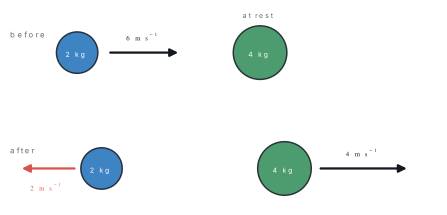
Problem. A body of mass 2\ \text{kg} moving at 6\ \text{m s}^{-1} collides head-on with a stationary body of mass 4\ \text{kg}. Find the velocities after impact if the collision is (a) perfectly elastic, (b) perfectly inelastic, and find the energy lost in (b).
Solution. (a) With u_1 = 6\ \text{m s}^{-1}, u_2 = 0:
The 2\ \text{kg} body rebounds at 2\ \text{m s}^{-1}. Check: momentum before = 12\ \text{kg m s}^{-1}, after = 2(-2)+4(4) = 12 ✓; kinetic energy before = 36\ \text{J}, after = 4 + 32 = 36\ \text{J} ✓.
(b) Sticking together:
Kinetic energy before = 36\ \text{J}; after = \frac{1}{2}(6)(2)^{2} = 12\ \text{J}. Energy lost = 24\ \text{J}, i.e. two-thirds of the original kinetic energy.
Problem. A bullet of mass 10\ \text{g} travelling at 400\ \text{m s}^{-1} embeds itself in a wooden block of mass 1.99\ \text{kg} suspended by a long string. Find the speed of the block just after impact and the height it rises. Take g = 10\ \text{m s}^{-2}.
Solution. The collision is perfectly inelastic, so momentum is conserved during the impact but kinetic energy is not:
After the impact no friction acts, so mechanical energy is conserved during the swing:
The block rises 20\ \text{cm}. This arrangement is the ballistic pendulum, used to measure bullet speeds.
Momentum is conserved in every collision; kinetic energy only in an elastic one. Write the momentum equation for the impact and the energy equation for what happens before or after it — never the other way round.
Chapter summary
- Work by a constant force: W = Fs\cos\theta = \vec{F}\cdot\vec{s}, a scalar in joules. Zero when the force is perpendicular to the displacement.
- Work by a variable force: W = \int F\,dx = area under the F–x graph. For a spring, W = \frac{1}{2}kx^{2}.
- Power P = W/t = \vec{F}\cdot\vec{v}; 1\ \text{hp} = 746\ \text{W} and 1\ \text{kW h} = 3.6\times 10^{6}\ \text{J}.
- Work–energy theorem: W_{net} = \Delta K, with K = \frac{1}{2}mv^{2} = p^{2}/2m.
- Potential energy: U = mgh (gravitational), U = \frac{1}{2}kx^{2} (elastic).
- Conservation of energy: K + U is constant when only conservative forces act; otherwise W_{nc} = \Delta K + \Delta U.
- Conservative forces do path-independent work and zero work round a closed loop; friction and drag do not.
- All collisions conserve momentum. Elastic ones also conserve kinetic energy and give u_1 - u_2 = v_2 - v_1; perfectly inelastic ones lose \frac{1}{2}\frac{m_1m_2}{m_1+m_2}(u_1-u_2)^{2}.
Practice questions
Group A — Multiple choice (1 mark each)
- A coolie carries a load horizontally along a level platform. The work done by him on the load is [1]amghbzerocnegativedmgs
- The area under a force–displacement graph represents [1]apowerbimpulsecwork donedmomentum
- A body of mass m has momentum p. Its kinetic energy is [1]amp^{2}bp^{2}/2mcp^{2}/md2mp^{2}
- Which of the following is a non-conservative force? [1]agravitational forcebspring forcecelectrostatic forcedviscous force
- In a perfectly inelastic collision, the quantity that is not conserved is [1]alinear momentumbtotal energyckinetic energydmass
Answers to Group A
1. (b) — the supporting force is vertical, the displacement horizontal, so \theta = 90^{\circ}.
2. (c) — W = \int F\,dx is exactly the area under the curve.
3. (b) — K = \frac{1}{2}mv^2 and p = mv, so K = p^2/2m.
4. (d) — viscous drag depends on the path and dissipates energy as heat.
5. (c) — momentum and total energy are conserved; kinetic energy is lost to heat and deformation.
Group B — Short answer (5 marks each)
- Define work, energy and power, and state their SI units. Show that the work done by a variable force is the area under the force–displacement graph. [5]
- State and prove the work–energy theorem for a body moving under a constant force. [5]
- Distinguish between conservative and non-conservative forces with two examples of each. [5]
- A car of mass 1000\ \text{kg} moves up an incline of 1 in 20 at a steady 20\ \text{m s}^{-1} against a frictional resistance of 200\ \text{N}. Calculate the power developed by the engine. Take g = 10\ \text{m s}^{-2}. [5]
- A spring of force constant 200\ \text{N m}^{-1} is compressed by 0.10\ \text{m} and used to push a block of mass 0.50\ \text{kg} along a frictionless table. Find the elastic potential energy stored and the speed of the block when the spring returns to its natural length. [5]
Answers to Group B
4. At steady speed the driving force balances gravity component plus friction: F = mg\sin\theta + R = 1000 \times 10 \times \frac{1}{20} + 200 = 500 + 200 = 700\ \text{N}. Then P = Fv = 700 \times 20 = 14000\ \text{W} = 14\ \text{kW}.
5. U = \frac{1}{2}kx^{2} = \frac{1}{2}(200)(0.10)^{2} = 1.0\ \text{J}. All of it becomes kinetic energy: \frac{1}{2}(0.50)v^{2} = 1.0, so v^{2} = 4.0 and v = 2.0\ \text{m s}^{-1}.
1., 2., 3. See §5.1, the derivation box in §5.3, and the comparison table in §5.5.
Group C — Long answer (8 marks each)
- (a) State the principle of conservation of energy. [2](b) Show that for a body falling freely from a height H the sum of its kinetic and potential energies is the same at every point of the fall. [4](c) A stone of mass 0.5\ \text{kg} is dropped from 45\ \text{m}. Find its kinetic energy and its speed when it is 20\ \text{m} above the ground (g = 10\ \text{m s}^{-2}). [2]
- (a) Derive expressions for the final velocities of two bodies undergoing a perfectly elastic head-on collision, and deduce the result for equal masses. [6](b) A 5\ \text{kg} body moving at 4\ \text{m s}^{-1} collides with a stationary 3\ \text{kg} body and they move off together. Find their common velocity and the kinetic energy lost. [2]
Answers to Group C
1. (b) See §5.4: at height h, v^{2} = 2g(H-h) so K = mg(H-h) while U = mgh, giving K+U = mgH everywhere. (c) The stone has fallen 45 - 20 = 25\ \text{m}, so K = mg(H-h) = 0.5 \times 10 \times 25 = 125\ \text{J} and v = \sqrt{2K/m} = \sqrt{500} = 22.4\ \text{m s}^{-1}.
2. (a) See the derivation box in §5.6; for m_1 = m_2 the prefactor (m_1-m_2)/(m_1+m_2) vanishes, so with u_2=0 we get v_1 = 0, v_2 = u_1 — the bodies exchange velocities. (b) v = \dfrac{5 \times 4 + 0}{5+3} = 2.5\ \text{m s}^{-1}. K_i = \frac{1}{2}(5)(16) = 40\ \text{J}, K_f = \frac{1}{2}(8)(2.5)^{2} = 25\ \text{J}, so the loss is 15\ \text{J}.
Practise more: Physics question bank