Exam guide · 18 min read
The NEB Grade 11 Examination: Pattern, Grid and Strategy
Grade 11 is the first year in which the science stream is examined to a fixed national pattern. The paper you sit in the annual examination is built from a public specification: so many questions, of a stated size, spread across the content areas of the CDC syllabus. Because the shape of the paper is known long before the paper is set, a question bank can prepare you for it. This chapter is the map. It shows what each Grade 11 paper is made of, what the marker ticks in a 4-, 5- and 8-mark answer, how to use the other chapters so that the work sticks, and where candidates actually lose marks.
75 — written marks in Physics, Chemistry, Biology, Mathematics, Compulsory English and अनिवार्य नेपाली. 50 — written marks in Computer Science, in a 2-hour paper. 25 — the internal-assessment marks each subject adds. 2.4 — minutes you have for every written mark, in every paper. The rest of this chapter follows from those four numbers.
NEB does not release Grade 11 papers as it does for Grade 12, and this book could not verify any individual Grade 11 question against an official paper. So no question in this book is labelled with a year it supposedly appeared. Where a chapter outline promises "years each appeared", this book gives you something it can stand behind instead: the syllabus weight (teaching hours and marks per area), which is public, and a plain label — practice, model or predicted — on every item. Be suspicious of any list that prints "NEB 2079, Q5" for Grade 11 without showing the paper.
1.1 The specification grid of every Grade 11 science subject
A specification grid (विशिष्टीकरण तालिका) is the table that fixes how a paper is built: how many questions, of what type, carrying what marks, from which content areas. The paper setter cannot ignore it, so only the wording of questions changes from year to year.
1.1.1 The shape of each paper
| Subject | Time | Written | Group A / objective | Group B / short | Group C / long | Internal |
|---|---|---|---|---|---|---|
| Physics | 3 hr | 75 | MCQ 11 × 1 = 11 | 8 × 5 = 40 | 3 × 8 = 24 | 25 |
| Chemistry | 3 hr | 75 | MCQ 11 × 1 = 11 | 8 × 5 = 40 | 3 × 8 = 24 | 25 |
| Biology | 3 hr | 75 | MCQ 5 + 6 = 11 × 1 | 4 × 4 per section = 32 | 2 × 8 per section = 32 | 25 |
| Mathematics | 3 hr | 75 | MCQ 11 × 1 = 11 | 8 × 5 = 40 | 3 × 8 = 24 | 25 |
| Computer Science | 2 hr | 50 | MCQ 9 × 1 = 9 | 5 × 5 = 25 | 2 × 8 = 16 | 25 + 25 practical |
| Compulsory English | 3 hr | 75 | no groups — 8 questions | — | — | 25 |
| अनिवार्य नेपाली | 3 hr | 75 | no groups — 16 questions | — | — | 25 |
Three things deserve a second look.
- Biology is two papers in one script. Section I (Botany) carries 37 marks and Section II (Zoology) 38. Short answers are worth 4, not 5, and there are four 8-mark questions, two per section. Budget time as if the paper were Physics and you will run out.
- Computer Science is half of its subject. The 50-mark written paper sits beside a 25-mark practical and 25 marks of internal assessment, and its two hours go quickly.
- English and Nepali have no objective group. They are series of numbered questions, each testing one skill. Chapters 17 to 22 of this book follow those skills, not Groups A, B and C.
1.1.2 Marks inside Compulsory English
| Q | Skill | Marks |
|---|---|---|
| 1 | Unseen reading comprehension | 15 |
| 2 | Short literary answers (5 × 2) | 10 |
| 3 | Long literary answers (2 × 5) | 10 |
| 4 | Guided writing | 7 |
| 5 | Functional writing (letter, notice, e-mail and the like) | 8 |
| 6 | Free writing / essay | 10 |
| 7 | Grammar (10 × 1) | 10 |
| 8 | Vocabulary (5 × 1) | 5 |
| Total | 75 |
Literature — the stories and poems of the textbook — supplies only 20 marks (Q2 and Q3). The other 55 marks test language, which is why you can improve quickly in English with practice rather than reading.
1.1.3 Marks inside अनिवार्य नेपाली
| कौशल | अङ्क |
|---|---|
| वर्ण पहिचान | ३ |
| वर्णविन्यास | ३ |
| पदवर्ग | २ |
| शब्दनिर्माण | ४ |
| रूपायन-पदसङ्गति | ३ |
| काल-पक्ष-भाव-वाच्य | ५ |
| शब्दस्रोत-शब्दकोश | २ |
| वाक्यान्तरण | ३ |
| पठनबोध | ८ |
| बुँदाटिपोट र सारांश | ५ |
| पाठगत बोध | ८ |
| समीक्षात्मक | ८ |
| स्वतन्त्र रचना | ८ |
| प्रतिक्रिया लेखन | ४ |
| व्यावहारिक लेखन | ४ |
| प्रतिवेदन-टिप्पणी | ५ |
| जम्मा | ७५ |
Twenty of the seventy-five marks are pure grammar and orthography (वर्ण पहिचानदेखि काल-पक्ष-भाव-वाच्यसम्म), and they are the cheapest marks in the paper to rehearse.
1.1.4 Where the marks sit by content area
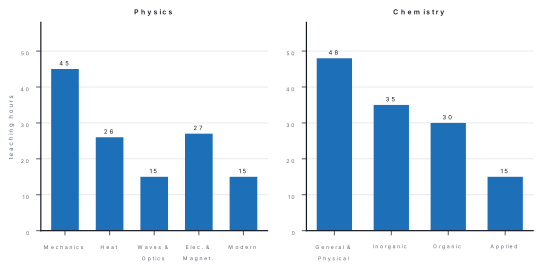
The syllabus assigns teaching hours to each content area, and the grid draws questions in rough proportion. These hours are the best public proxy for weight.
| Subject | Content area | Hours | Share |
|---|---|---|---|
| Physics (128 h) | Mechanics | 45 | 35 % |
| Heat and Thermodynamics | 26 | 20 % | |
| Waves and Optics | 15 | 12 % | |
| Electricity and Magnetism | 27 | 21 % | |
| Modern Physics | 15 | 12 % | |
| Chemistry (128 h) | General and Physical | 48 | 38 % |
| Inorganic | 35 | 27 % | |
| Organic | 30 | 23 % | |
| Applied | 15 | 12 % | |
| Biology (128 h) | Botany (units 1–5) | 64 | 50 % |
| Zoology (units 6–10) | 64 | 50 % |
1.1.5 The time budget: every mark is worth 2.4 minutes
So an 8-mark question deserves about 19 minutes, a 5-mark question 12, a 4-mark question 10 and an MCQ about one minute. You also need time to read and to check, so in practice you work slightly faster than 2.4 and bank the difference.
Problem. Plan the 180 minutes of the Physics paper (11 MCQs, 8 short questions of 5 marks, 3 long questions of 8 marks), leaving 5 minutes to read the paper and 15 minutes to check.
Solution.
Writing time = 180 - 5 - 15 = 160 minutes for 75 marks, so the rate is 160/75 \approx 2.13 minutes per mark.
| Part | Marks | At 2.13 min/mark | Plan |
|---|---|---|---|
| Group A (11 MCQs) | 11 | 23 min | 12 min |
| Group B (8 × 5) | 40 | 85 min | 88 min |
| Group C (3 × 8) | 24 | 51 min | 60 min |
| Total | 75 | 159 min | 160 min |
MCQs take only about 12 minutes, so the minutes saved are moved to the long questions. The plan is deliberately uneven: an 8-mark answer with a derivation and a diagram cannot be written quickly, while an MCQ can.
Problem. The Computer Science paper is 2 hours for 50 marks (9 MCQs, 5 short questions of 5 marks, 2 long questions of 8 marks). Keep 4 minutes to read and 8 minutes to check.
Solution. Writing time = 120 - 4 - 8 = 108 minutes for 50 marks, so 2.16 minutes per mark. Group A: aim for 8 minutes. Group B: 25 \times 2.16 = 54 minutes, about 11 minutes each. Group C: 16 \times 2.16 = 35 minutes, about 17 minutes each. Total 8 + 54 + 35 = 97 minutes, leaving 11 minutes spare for the longest program or flowchart.
1.2 What the examiner rewards in a 5-mark and an 8-mark answer
An NEB script is not given an impression mark. It is marked against a marking scheme that lists scoring points, and the marker ticks them. So the question to ask is never "how much should I write?" but "how many separate scoring points have I made?"
1.2.1 The 5-mark answer
Five marks are normally split into smaller steps, such as 1 + 4, 2 + 3 or 1 + 1 + 3. A numerical question is marked this way:
| Step | Typical marks |
|---|---|
| Correct formula or law stated | 1 |
| Correct substitution with units | 1–2 |
| Correct arithmetic | 1 |
| Final answer with the right unit | 1 |
A wrong final answer with a correct method still collects most of the marks, while a bare right answer with no working may collect only one or two. Write the formula first, every time.
A theory 5-marker (for example "state and explain Boyle's law" or "distinguish between …") wants about five markable statements: a definition, a key condition, a formula or relation, an example, and a diagram where relevant. A "distinguish between" question wants a table with at least four rows, not two paragraphs.
1.2.2 The 8-mark answer
An 8-mark question is a structure, not a longer paragraph:
| Element | Typical marks |
|---|---|
| Definition or statement | 1 |
| Labelled diagram or flow chart | 2 |
| Derivation, mechanism or main body (numbered steps) | 3–4 |
| Numerical or example | 1–2 |
In Physics and Mathematics the 8 marks are often split into parts such as [3 + 3 + 2]; in Chemistry they combine a theory part with a numerical; in Biology they reward a process described in order, with a diagram, and its significance.
- Formula, substitution, answer — in three separate lines, with units.
- Diagram first where the question says "explain with a diagram"; label every part, and use a pencil and ruler.
- Keywords. The marker looks for the standard term ("isothermal", "conjugate", "stomata"). A correct idea in loose words may not be ticked.
- Number your points. A numbered list is easier for a marker to tick than a paragraph.
1.2.3 What the cognitive levels mean
CDC papers are set across four levels: knowledge (recall a fact), understanding (explain in your own words), application (use it in an unfamiliar numerical or situation) and higher ability (analyse, derive, compare). Roughly, MCQs lean on knowledge and understanding, the 5-mark questions on application, and the 8-mark questions on higher ability. Do not spend all your revision on definitions: the larger share of marks goes to the upper levels.
1.3 How to use a question bank: retrieval practice, spacing and timed papers
A bank is not a book to be read. It is a tool for retrieval: pulling an answer out of memory is what makes memory stronger, and re-reading the answer key does not.
1.3.1 The three-pass method
| Pass | What you do | Why |
|---|---|---|
| 1. Attempt | Cover the answer. Write your own answer on paper, against the clock. | Forces retrieval and exposes gaps. |
| 2. Mark | Compare with the model answer and underline what you missed. | Measures the gap by marking points, not feelings. |
| 3. Redo | Two days later, redo only the questions you missed. | Spacing turns a short-term fix into long-term memory. |
1.3.2 A spaced schedule
Study each unit on day 0, day 2, day 7 and day 21. A unit seen four times, with gaps, outlasts the same unit read four times in one night. Keep a one-page ledger: unit, date, score, marks lost, and the reason.
1.3.3 How to use each type of chapter
| Chapter type | How to use it |
|---|---|
| Objective (Chapters 2, 5, 8, 11, 14, 17, 20) | Do one unit at a time, 8 MCQs in 8 minutes. Read the distractor notes: wrong options encode real misconceptions. |
| Subjective (Chapters 3, 6, 9, 12, 15, 18, 21) | Pick a unit; write two 5-mark and one 8-mark answer against the clock; then mark yourself. |
| Model sets and predicted (Chapters 4, 7, 10, 13, 16, 19, 22) | Last four weeks only. Sit each model paper in one sitting, with the exact time. Then work the ranked predicted list from the top down. |
1.3.4 Timed papers
In the last month sit a full paper every week under exam conditions: no phone, a clock, the right number of minutes. The first paper will feel slow and messy. That is its purpose — the mess is what you fix before the hall.
Problem. You have 10 weeks to the examination and four heavy subjects (Physics, Chemistry, Biology, Mathematics). Devise a split.
Solution. Weeks 1–6 are unit passes: each week, one subject's objective and subjective chapters for the units covered, 4 days of attempt, 1 day of redoing misses, 1 day of rest. Rotate so each subject returns every 4 weeks (spacing). Weeks 7–9 are model sets: one model paper of each subject per week, 3 hours each, with marking the next day. Week 10 is the predicted list and the error ledger only: no new questions. Six weeks of passes give each subject about 6 \times 4 / 4 = 6 attempt days, and the three model weeks give each subject at least one full paper.
1.4 The ways candidates actually lose marks
| Fault | Where it costs marks | The fix |
|---|---|---|
| Writing the answer without the formula | Physics, Chemistry, Mathematics numericals | Always write the law, then substitute |
| Dropping units, or mixing cm and m, g and kg | Every numerical | Convert to SI before substituting; carry units through |
| Omitting the diagram | Physics optics and circuits, all Biology | Draw first, label fully |
| Unbalanced chemical equations | Chemistry 5- and 8-markers | Check atoms on both sides; add conditions over the arrow |
| Using a loose term instead of the keyword | Biology, Chemistry definitions | Learn the exact term; underline it |
| Spending 25 minutes on one 5-mark question | Whole paper | Stop at 12 minutes, leave a gap, return |
| Copying a model answer without attempting | Whole preparation | Use the three-pass method |
| Skipping a unit "because it is small" | Group A | Group A is drawn from the whole syllabus; no unit is safe to skip |
| Cramped, unnumbered answers | All papers | Leave a line between answers; number clearly |
| Not reading the whole paper first | All papers | Spend the first 5 minutes marking the questions you can finish |
- Writing g = 10 when the question gives 9.8 (or the reverse); use the value the question states.
- Using T in °C in a gas-law or Stefan-law formula; convert to kelvin.
- Leaving a calculator in degrees when the angle is in radians (or the reverse).
- Mixing up molarity and molality, mass and weight, speed and velocity in a definition.
- Answering a "distinguish between" question with two paragraphs; a table scores more.
1.5 What the bank contains, and the order to use it
| Part | Chapters | Contents |
|---|---|---|
| How to use | 1 | This chapter |
| Physics | 2, 3, 4 | Objective bank; subjective bank; model sets and predicted |
| Chemistry | 5, 6, 7 | Objective bank; subjective bank; model sets and predicted |
| Biology | 8, 9, 10 | Objective bank; subjective bank; model sets and predicted |
| Mathematics | 11, 12, 13 | Objective bank; subjective bank; model sets and predicted |
| Computer Science | 14, 15, 16 | Objective bank; subjective bank; model sets and predicted |
| Compulsory English | 17, 18, 19 | Objective bank; subjective bank; model sets |
| अनिवार्य नेपाली | 20, 21, 22 | वस्तुगत प्रश्नसङ्ग्रह; विषयगत प्रश्नसङ्ग्रह; नमुना प्रश्नसेट |
Use the chapters in the order objective → subjective → model sets. The objective chapter makes you fluent in definitions, units and one-step formulas; the subjective chapter makes you write full answers; the model sets test everything together under time.
Chapter summary
- Science papers carry 75 written marks in 3 hours (Computer Science 50 in 2 hours); internal assessment adds 25 in every subject.
- Physics, Chemistry and Mathematics: Group A 11\times1, Group B 8\times5, Group C 3\times8. Biology: 11 MCQs, 4\times4 short and 2\times8 long in each of Botany and Zoology. Computer Science: 9\times1, 5\times5, 2\times8.
- English has 8 numbered questions (15 + 10 + 10 + 7 + 8 + 10 + 10 + 5); Nepali has 16 skill-based questions.
- Time per mark is 2.4 minutes in every paper; plan about 5 minutes to read and 15 to check.
- A 5-mark answer is marked in steps (formula, substitution, arithmetic, unit); an 8-mark answer is a structure (definition, diagram, body, example).
- Learn by retrieval: attempt, mark, redo after two days; revise each unit on days 0, 2, 7, 21.
- No Grade 11 question in this book is given a past-paper year; labels are practice, model or predicted.
- The commonest marks lost are formula omitted, units dropped, diagram skipped, equation unbalanced and time mismanaged.
Practice questions
Group A — Multiple choice (1 mark each)
- The number of written marks in the Grade 11 Biology paper is [1]a50b64c75d100
- In the Physics paper the total marks of Group B (eight questions) are [1]a24b32c40d48
- The time available per written mark in a 3-hour 75-mark paper is [1]a1.6 minutesb2.0 minutesc2.4 minutesd3.0 minutes
- In Biology, a short answer is worth [1]a2 marksb4 marksc5 marksd8 marks
- Compulsory English Q1 (unseen reading) carries [1]a5 marksb10 marksc15 marksd20 marks
Answers to Group A
1. (c) — 75 written marks, with 25 internal.
2. (c) — 8\times5 = 40.
3. (c) — 180/75 = 2.4.
4. (b) — Biology short answers carry 4 marks; the other science papers use 5.
5. (c) — the unseen passage is 15 of the 75 marks.
Group B — Short answer (5 marks each)
- Compute the minutes available per mark in the Computer Science paper and the time you should give a 5-mark and an 8-mark question. [5]
- List the four elements of a good 8-mark answer and the marks usually given to each. [5]
- Describe the three-pass method of using a question bank. [5]
- State five reasons candidates lose marks in a numerical question, with the fix for each. [5]
Answers to Group B
1. Rate = 120/50 = 2.4 min per mark. A 5-mark question: 5\times2.4 = 12 minutes; an 8-mark question: 8\times2.4 = 19.2 \approx 19 minutes. Reading and checking need time, so work slightly faster, near 2.1 min per mark.
2. Definition or statement (1); labelled diagram or flow chart (2); derivation or main body in numbered steps (3–4); numerical or example (1–2). They total 8.
3. (i) Attempt: cover the answer and write against the clock. (ii) Mark: compare with the model answer and underline what was missed. (iii) Redo: after two days redo only the missed questions. Space the revisits on days 0, 2, 7 and 21.
4. Formula omitted — write the law first. Units dropped — carry units through every line. Mixed units — convert to SI first. Wrong constant — use the value the question gives. Arithmetic slip — recheck the last step and the power of ten.
Group C — Long answer (8 marks each)
- A 3-hour, 75-mark Chemistry paper has 11 MCQs, 8 questions of 5 marks and 3 of 8 marks. Plan the time with 5 minutes to read and 15 to check, and justify why the plan is uneven. [8]
- Explain how the specification grid helps a candidate prepare, and why teaching hours are only a proxy for marks. Use the Physics hours as an illustration. [8]
Answers to Group C
1. Writing time = 180 - 20 = 160 min; rate = 160/75 = 2.13 min per mark. Group A: 11 marks, plan 12 min. Group B: 40 marks, plan 88 min (11 min each). Group C: 24 marks, plan 60 min (20 min each). Total 12 + 88 + 60 = 160 min. Uneven because MCQs are quick, so their spare minutes go to long answers, which need a diagram, a mechanism and a numerical.
2. The grid fixes how many questions of each size appear and from which areas, so a candidate can rehearse the shape of the paper and avoid surprises about time. Physics hours: Mechanics 45, Heat 26, Waves and Optics 15, Electricity and Magnetism 27, Modern 15 (total 128), so Mechanics is about 35 % of teaching time. Hours are only a proxy: the CDC does not publish marks per unit, a short unit can be asked as a whole question, and Group A is drawn from every unit. So prepare in proportion to hours but leave no unit untouched.