Unit 15 · Waves and Optics · 4 teaching hours · 26 min read
Refraction at plane surfaces
What the syllabus asks for 4
- Laws of refraction: Refractive index
- Relation between refractive indices
- Lateral shift
- Total internal reflection
Light changes speed when it crosses from one transparent medium into another, and wherever it meets the boundary obliquely that change of speed makes it change direction. This bending is refraction. It is why a straw in a glass of water looks broken, why a fish in the Bagmati is never quite where it seems to be, why a glass slab shifts an image sideways, and — through total internal reflection — why a thread of glass thinner than a hair can carry telephone calls across Nepal. This unit develops the laws of refraction, the relations between refractive indices, lateral shift and total internal reflection.
Snell's law n_1\sin i = n_2\sin r. Every formula in this chapter — relative refractive index, apparent depth, lateral shift, critical angle — is Snell's law with different things known.
15.1 Laws of refraction: Refractive index
When a ray of light travelling in medium 1 meets a plane boundary with medium 2, part of it is reflected back and part enters medium 2 with a changed direction. The angle between the incident ray and the normal is the angle of incidence i; the angle between the refracted ray and the normal is the angle of refraction r.
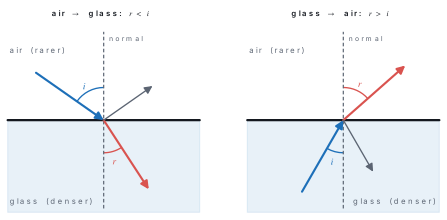
First law. The incident ray, the refracted ray and the normal to the surface at the point of incidence all lie in the same plane.
Second law (Snell's law). For two given media and light of a given colour, the ratio of the sine of the angle of incidence to the sine of the angle of refraction is a constant:
This constant is the refractive index of medium 2 with respect to medium 1.
Why light bends: refractive index and speed
Refraction happens because light travels at different speeds in different media. If v_1 and v_2 are the speeds in the two media, it can be shown that
The frequency does not change on refraction — it is fixed by the source — so if the speed falls, the wavelength must fall in the same ratio.
The absolute refractive index n of a medium is the refractive index of that medium with respect to vacuum:
where c = 3\times10^{8}\ \text{m s}^{-1} is the speed of light in vacuum and v is its speed in the medium. Since v < c always, n > 1 for every material medium. n has no unit.
In terms of absolute refractive indices, Snell's law takes its most useful form:
| Medium | Absolute refractive index n | Speed of light (10^{8} m s⁻¹) |
|---|---|---|
| Vacuum | 1 (exactly) | 3.00 |
| Air (at STP) | 1.0003 | 3.00 |
| Ice | 1.31 | 2.29 |
| Water | 1.33 (= 4/3) | 2.26 |
| Crown glass | 1.52 | 1.97 |
| Dense flint glass | 1.65 | 1.82 |
| Diamond | 2.42 | 1.24 |
A medium of larger n is called optically denser. Optical density is not the same as mass density: turpentine (n = 1.47) is optically denser than water but less dense in kg m⁻³.
Going from rarer to denser (air → glass) the ray slows down and bends towards the normal, so r < i. Going from denser to rarer (glass → air) it speeds up and bends away from the normal, so r > i. A ray striking the surface normally (i = 0) is not bent at all, though its speed still changes.
Problem. A ray of light of wavelength 600\ \text{nm} in air strikes a glass surface at 60^{\circ} to the normal. The refractive index of the glass is 1.5. Find (a) the angle of refraction, (b) the speed of light in the glass, (c) the wavelength and frequency of the light inside the glass.
Solution.
(a) By Snell's law, 1 \times \sin 60^{\circ} = 1.5\sin r, so
(b) n = c/v, so
(c) The wavelength shrinks in the same ratio as the speed:
The frequency is unchanged: f = c/\lambda_{air} = (3\times10^{8})/(600\times10^{-9}) = 5\times10^{14}\ \text{Hz}. Check: v/\lambda_{glass} = (2\times10^{8})/(400\times10^{-9}) = 5\times10^{14}\ \text{Hz} — the same.
15.2 Relation between refractive indices
Three relations follow directly from the definitions and are asked as standard five-mark questions.
We start from Snell's law and the principle of reversibility, and reach three results that let you convert freely between any pair of media.
Part (a): {}_1n_2 = n_2/n_1 = v_1/v_2
Step 1 — Snell's law in its two-medium form. For a ray passing from medium 1 (angle i) into medium 2 (angle r):
Step 2 — make \sin i/\sin r the subject. Divide both sides by n_1\sin r:
Step 3 — name the left-hand side. By definition, \sin i/\sin r for this pair of media is the refractive index of 2 with respect to 1:
Step 4 — bring in the speeds. Absolute index is defined as n = c/v, so n_1 = c/v_1 and n_2 = c/v_2. Substituting:
Step 5 — cancel c and flip the divided fraction:
Part (b): {}_1n_2 \times {}_2n_1 = 1
Step 6 — state the principle of reversibility. If the direction of a ray is exactly reversed, it retraces its own path. So send a ray back from medium 2 along the old refracted ray. It now strikes the boundary at angle r and must emerge along the old incident ray, at angle i.
Step 7 — apply the definition to this reversed journey. The ray now goes from 2 to 1, so the angle in medium 2 is the incidence angle and the angle in medium 1 is the refraction angle:
Step 8 — compare with {}_1n_2 = \sin i/\sin r from Step 3. The right-hand side of Step 7 is the reciprocal of the right-hand side of Step 3:
Step 9 — multiply both sides by {}_1n_2:
Part (c): the chain relation
Step 10 — write each relative index as a ratio of absolute indices, using Part (a):
Step 11 — cancel n_2, which appears once on top and once below:
Step 12 — recognise the right-hand side as {}_1n_3, again by Part (a):
Step 13 — multiply both sides by {}_3n_1 and use Part (b) on the right, since {}_1n_3 \times {}_3n_1 = 1:
Result.
What it means. You only ever need a table of absolute indices; any relative index is a ratio of two of them. Part (b) says glass-with-respect-to-water is the exact reciprocal of water-with-respect-to-glass, and Part (c) says a chain of media closing back on itself multiplies to one — like walking round a loop and returning to the same height.
Conditions used. A single wavelength (since n depends on colour), and media that are transparent and uniform.
_1n_2 always means "the refractive index of 2 with respect to 1", and equals n_2/n_1 — the second subscript goes on top. Getting this upside down turns 1.5 into 0.67 and is the commonest slip in this section.
Refractive index from real and apparent depth
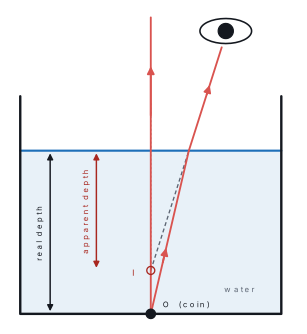
We start from Snell's law applied to a ray leaving the water, and reach a way of measuring n with nothing but a ruler.
Setting up. A coin lies at O, a depth OA vertically below A on the flat surface of water of refractive index n. Take two rays from the coin: OA straight up along the normal, which passes out undeviated, and OQ making a small angle \theta with the normal.
Step 1 — apply Snell's law at Q. The ray goes from water into air, so the water term carries n and the air term carries 1. Let \phi be the angle in air:
Step 2 — make n the subject:
Step 3 — locate the image. The emergent ray bends away from the normal (air is rarer, so \phi > \theta). Produced backwards, it meets the normal OA at a point I above O. The eye receives both rays as if they came from I, so IA is the apparent depth.
Step 4 — use the right-angled triangle OAQ, right-angled at A, with \theta at O:
Step 5 — use the right-angled triangle IAQ, right-angled at A, with \phi at I (the angle at I equals \phi because IQ is the emergent ray and IA is parallel to the normal at Q):
Step 6 — restrict to a nearly normal view. If we look almost straight down, \theta and \phi are both small, and for small angles \sin x \approx \tan x:
Step 7 — replace the sines in Step 2 by tangents:
Step 8 — substitute Steps 4 and 5:
Step 9 — divide the fractions. AQ cancels, and dividing by AQ/OA means multiplying by OA/AQ:
Step 10 — name the two lengths:
Step 11 — how far the coin seems to rise. The shift is the difference of the two depths, and from Step 10, IA = OA/n:
Step 12 — take out the common factor OA:
Result.
What it means. Because n > 1, the apparent depth is always less than the real depth — a pond always looks shallower than it is, which is a genuine danger. Both lengths are measured with a ruler, so this gives a simple laboratory method for n.
Conditions used. The viewing must be nearly normal (Step 6). If you look at the water at a slant, the small-angle step fails and the simple ratio no longer holds. The surface must also be flat and the liquid uniform.
For several liquid layers stacked one above the other, each layer contributes its own apparent depth, so the total apparent depth is \sum t_i/n_i.
Problem. A tank contains water (n = 4/3) to a depth of 12\ \text{cm}, and on top of the water floats a layer of oil (n = 1.6) of thickness 8\ \text{cm}. A coin lies at the bottom. By how much does the coin appear to be raised when viewed from vertically above?
Solution. Each layer is treated separately.
Total apparent depth = 9 + 5 = 14\ \text{cm}, while the real depth is 12 + 8 = 20\ \text{cm}.
The coin appears raised by 6\ \text{cm}.
15.3 Lateral shift
A parallel-sided glass slab (a glass block, a window pane) has two plane faces that are parallel. A ray entering it is refracted twice — once in, once out — and the two refractions cancel in direction but not in position.
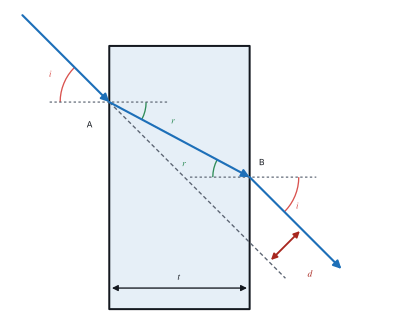
Because the faces are parallel, the normal at B is parallel to the normal at A. The angle of incidence inside the glass at B equals r, so by Snell's law at the second face \sin i' = n\sin r = \sin i, giving i' = i: the emergent ray is parallel to the incident ray. The slab does not change the direction of the light, only its line of travel. That sideways displacement is the lateral shift.
We start by showing the emergent ray is parallel to the incident ray, then find how far sideways it has been pushed.
Setting up. The slab has thickness t and refractive index n. The ray enters at A with angle of incidence i and angle of refraction r, travels inside along AB, and leaves at B with angle of incidence r (inside) and angle of emergence e.
Step 1 — Snell's law at the first face, air into glass:
Step 2 — why the angle inside at B is also r. The two faces are parallel, so their normals are parallel. AB cuts both normals, and alternate angles between parallel lines are equal. So the angle of incidence inside the glass at B equals r.
Step 3 — Snell's law at the second face, glass into air:
Step 4 — compare Steps 1 and 3. Both left-hand sides equal n, so
Step 5 — cancel \sin r and take the inverse sine:
So the emergent ray is parallel to the incident ray: the slab changes the ray's position but not its direction. That is the first part of the Group C question.
Now the shift itself.
Step 6 — define the shift. Produce the incident ray straight on, as if the glass were not there. Drop the perpendicular BN from B onto this undeviated line. Then
Step 7 — find the angle at B in triangle ABN. AN lies along the original direction, which makes angle i with the normal at A; AB makes angle r with the same normal. The angle between them is therefore their difference:
Step 8 — use the right-angled triangle ABN, right-angled at N:
Step 9 — make d the subject:
Step 10 — now find AB. Drop the perpendicular AM from A onto the second face; its length is the thickness of the slab, AM = t. In the right-angled triangle ABM the angle at A is r (both AM and the normal at A are perpendicular to the faces):
Step 11 — make AB the subject:
Step 12 — substitute this into Step 9:
Result.
What it means. A window pane does not distort the direction of what you see, only shifts it a little sideways — which is why you can read through a glass block at an angle without the scene tilting. The shift grows with the thickness t and with the angle of incidence.
Conditions used. The two faces must be parallel (Step 2 fails otherwise — that is why a prism does deviate light), and the same medium (air) lies on both sides.
- Snell's law written at both faces.
- The statement that the angle inside at the second face is r, because the faces are parallel.
- The conclusion e = i, i.e. emergent ray parallel to incident ray.
- The construction of the perpendicular BN and the identification \angle BAN = i - r.
- AB = t/\cos r from the second triangle.
- The final substitution giving d = t\sin(i-r)/\cos r.
Two special cases are worth noting:
- At normal incidence i = r = 0, so d = 0: a slab looked through straight-on shifts nothing sideways.
- At grazing incidence i \to 90^{\circ}, r \to C (the critical angle) and d \to t: the shift is greatest and approaches the thickness of the slab.
For a slab viewed almost normally there is still a shift along the line of sight — the normal shift. It is the same calculation as apparent depth:
so an object seen through a 6\ \text{cm} glass block (n = 1.5) appears 6(1 - 1/1.5) = 2\ \text{cm} nearer than it really is.
Problem. A ray of light strikes a glass slab of thickness 6\ \text{cm} and refractive index 1.5 at an angle of incidence of 60^{\circ}. Calculate the angle of refraction and the lateral shift.
Solution. From Snell's law,
Then i - r = 60^{\circ} - 35.26^{\circ} = 24.74^{\circ}, so \sin(i-r) = 0.4183 and \cos r = 0.8165.
The emergent ray is parallel to the incident ray but displaced sideways by about 3.1\ \text{cm}.
15.4 Total internal reflection
When light goes from a denser medium to a rarer one it bends away from the normal, so r > i. Increase i and r grows faster, until at one particular angle of incidence r reaches 90^{\circ} and the refracted ray grazes along the boundary. Beyond that angle there is no refracted ray at all: all the light is reflected back into the denser medium.
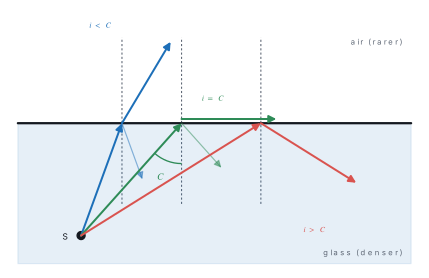
The critical angle C for a pair of media is the angle of incidence in the denser medium for which the angle of refraction in the rarer medium is 90^{\circ}.
Total internal reflection is the complete reflection of light back into the denser medium, which occurs when light travelling in the denser medium strikes the boundary at an angle of incidence greater than the critical angle.
- Light must travel from the denser medium towards the rarer medium.
- The angle of incidence must be greater than the critical angle.
We start from Snell's law at the one special angle where the refracted ray just grazes the boundary, and reach a relation between the critical angle and the refractive index.
Setting up. Light travels in a denser medium of absolute index n_1 and meets a rarer medium of index n_2. By the definition of the critical angle, when the angle of incidence is C the angle of refraction is exactly 90^{\circ}.
Step 1 — write Snell's law for this boundary:
Step 2 — substitute the critical condition i = C and r = 90^{\circ}:
Step 3 — evaluate \sin 90^{\circ} = 1:
Step 4 — divide both sides by n_1:
Step 5 — take the usual case of a denser medium in air. Then n_2 = 1 and we write n_1 = n:
Step 6 — invert to get n from a measured C:
Result.
What it means. A bigger n makes 1/n smaller, so a denser material has a smaller critical angle and traps light more easily — this is exactly why diamond sparkles. Step 4 also explains why total internal reflection can never happen from rarer to denser: then n_2/n_1 > 1, and no angle has a sine greater than 1, so no critical angle exists.
Conditions used. Light must be going from denser to rarer, and one wavelength at a time (since n, and hence C, depends slightly on colour).
| Denser medium (against air) | n | Critical angle C |
|---|---|---|
| Ice | 1.31 | 49.8^{\circ} |
| Water | 1.33 | 48.6^{\circ} |
| Crown glass | 1.52 | 41.1^{\circ} |
| Dense flint glass | 1.65 | 37.3^{\circ} |
| Diamond | 2.42 | 24.4^{\circ} |
The smaller the critical angle, the easier it is to trap light. Diamond has the smallest C of common materials, so light entering a cut diamond is reflected many times inside before it escapes — that is its "fire".
Applications
| Application | How it uses total internal reflection |
|---|---|
| Optical fibre | A glass core of higher n is coated with cladding of lower n; light striking the core–cladding boundary above C is reflected over and over and travels kilometres with little loss. Used for internet backbones and endoscopes. |
| Totally reflecting prism | A 45^{\circ}–45^{\circ}–90^{\circ} glass prism has C = 41.8^{\circ} < 45^{\circ}, so it turns light through 90^{\circ} or 180^{\circ} with no silvering and no loss. Used in periscopes and binoculars. |
| Mirage | Hot air just above a road is less dense, so its n is smaller. Light from the sky curves, is totally internally reflected in the air layers, and the road looks wet. |
| Shine of a diamond | C = 24.4^{\circ}, so most rays entering are trapped and emerge through the top facets. |
| Optical levelling and light pipes | Light follows a bent glass or plastic rod. |
At every boundary a little light is reflected, whatever the angle. That is ordinary partial reflection. Total internal reflection is different: past the critical angle 100 % of the light is reflected because a refracted ray is geometrically impossible. It also cannot happen when light goes from rarer to denser — there is no i for which r can reach 90^{\circ}.
Problem. A fish is at a depth of 2.0\ \text{m} in Phewa Lake (n_{water} = 4/3). Looking up, the fish sees the whole sky compressed into a bright circular window on the surface. Find (a) the critical angle for water and (b) the radius of that window.
Solution.
(a) \sin C = 1/n = 3/4 = 0.75, so
(b) Light can enter the water from the sky only within the cone of half-angle C about the vertical through the fish. On the surface this cone cuts a circle of radius R where
With \sin C = 0.75, \cos C = \sqrt{1 - 0.5625} = 0.6614, so \tan C = 0.75/0.6614 = 1.134. Hence
The window is about 4.5\ \text{m} across; outside it the fish sees only the reflected lake bed.
Chapter summary
- Laws of refraction: incident ray, refracted ray and normal are coplanar; and \dfrac{\sin i}{\sin r} = {}_1n_2 (Snell's law), usually written n_1\sin i = n_2\sin r.
- Absolute refractive index n = c/v; also {}_1n_2 = n_2/n_1 = v_1/v_2 = \lambda_1/\lambda_2. Frequency never changes on refraction.
- Reversibility gives {}_1n_2 = 1/{}_2n_1, and the chain rule gives {}_1n_2 \times {}_2n_3 \times {}_3n_1 = 1.
- n = \dfrac{\text{real depth}}{\text{apparent depth}} for near-normal viewing; apparent shift = t(1 - 1/n), and layers add: apparent depth = \sum t_i/n_i.
- A parallel-sided slab leaves the direction unchanged but displaces the ray laterally by d = \dfrac{t\sin(i-r)}{\cos r}, which is zero at normal incidence.
- Total internal reflection needs light going denser → rarer with i > C, where \sin C = n_2/n_1, or \sin C = 1/n against air.
- Optical fibres, totally reflecting prisms, mirages and the sparkle of diamond are all total internal reflection.
Practice questions
Group A — Multiple choice (1 mark each)
- The refractive index of a medium in which light travels at 2.0\times10^{8}\ \text{m s}^{-1} is [1]a1.33b1.5c1.6d2.0
- When a ray of light passes from glass into air it [1]abends towards the normalbbends away from the normalcis not deviateddis always totally reflected
- The critical angle for a glass of refractive index 1.5 is about [1]a30^{\circ}b42^{\circ}c49^{\circ}d60^{\circ}
- The lateral shift produced by a parallel-sided glass slab is zero when the angle of incidence is [1]a0^{\circ}b30^{\circ}c45^{\circ}d90^{\circ}
- A coin lies at the bottom of a beaker containing water (n = 4/3) 8\ \text{cm} deep. Seen from directly above it appears to be at a depth of [1]a4\ \text{cm}b6\ \text{cm}c8\ \text{cm}d10.7\ \text{cm}
- On passing from air into glass, the quantity that does not change is the [1]aspeedbwavelengthcfrequencyddirection
Answers to Group A
1. (b) — n = c/v = (3\times10^{8})/(2\times10^{8}) = 1.5.
2. (b) — denser to rarer, so r > i.
3. (b) — \sin C = 1/1.5 = 0.667, C = 41.8^{\circ}.
4. (a) — d = t\sin(i-r)/\cos r and i = r = 0 gives d = 0.
5. (b) — apparent depth = 8/(4/3) = 6\ \text{cm}.
6. (c) — frequency is set by the source; speed and wavelength both fall by the factor n.
Group B — Short answer (5 marks each)
- State the laws of refraction of light. Define absolute refractive index and relative refractive index, and write the relation between them. [5]
- Using the principle of reversibility of light, show that {}_1n_2 = 1/{}_2n_1, and hence prove {}_1n_2 \times {}_2n_3 \times {}_3n_1 = 1. [5]
- Derive the relation n = \dfrac{\text{real depth}}{\text{apparent depth}} for a liquid viewed normally from above. [5]
- A ray of light falls at 45^{\circ} on a glass slab 8\ \text{cm} thick of refractive index 1.5. Calculate the angle of refraction and the lateral shift. [5]
- Define critical angle and derive \sin C = 1/n. Explain with a diagram how an optical fibre carries light around bends. [5]
Answers to Group B
1. Laws and definitions as in §15.1; {}_1n_2 = n_2/n_1.
2. See §15.2 (b) and (c). Reversing the ray interchanges i and r, so {}_2n_1 = \sin r/\sin i = 1/{}_1n_2. Writing each relative index as a ratio of absolute indices, {}_1n_2\,{}_2n_3\,{}_3n_1 = \dfrac{n_2}{n_1}\cdot\dfrac{n_3}{n_2}\cdot\dfrac{n_1}{n_3} = 1.
3. See the derivation in §15.2.
4. \sin r = \sin 45^{\circ}/1.5 = 0.7071/1.5 = 0.4714, so r = 28.13^{\circ}. Then i - r = 16.87^{\circ}, \sin(i-r) = 0.2903, \cos r = 0.8819, and
5. Definition and derivation as in §15.4. In a fibre the core has a larger refractive index than the cladding, so light that enters nearly along the axis always meets the core–cladding wall at an angle greater than C and is totally reflected, again and again, following the fibre even round bends.
Group C — Long answer (8 marks each)
- (a) Show that a ray emerging from a parallel-sided glass slab is parallel to the incident ray, and derive an expression for the lateral shift. [5](b) A slab of glass of refractive index 1.5 is 10\ \text{cm} thick. Find the lateral shift when light strikes it at 30^{\circ}. [3]
- (a) Define total internal reflection and state the conditions under which it occurs. Derive the relation between the critical angle and the refractive indices of the two media. [4](b) Calculate the critical angle for a glass–water interface, given n_{glass} = 1.5 and n_{water} = 1.33. [2](c) An optical fibre has a core of refractive index 1.52 and cladding of refractive index 1.48. Find the critical angle at the core–cladding boundary. [2]
Answers to Group C
1. (a) See §15.3. (b) \sin r = \sin 30^{\circ}/1.5 = 0.5/1.5 = 0.3333, so r = 19.47^{\circ}. Then i - r = 10.53^{\circ}, \sin(i-r) = 0.1828 and \cos r = 0.9428, giving
2. (a) See §15.4; \sin C = n_2/n_1 from n_1\sin C = n_2\sin 90^{\circ}.
(b) \sin C = n_{water}/n_{glass} = 1.33/1.5 = 0.8867, so C = 62.5^{\circ}.
(c) \sin C = 1.48/1.52 = 0.9737, so C = 76.8^{\circ}. Any ray meeting the wall at more than 76.8^{\circ} to the normal stays inside the core.
Practise more: Physics question bank