Unit 18 · Waves and Optics · 3 teaching hours · 19 min read
Dispersion
What the syllabus asks for 3
- Pure spectrum and dispersive power
- Chromatic and spherical aberration
- Achromatism and its applications
White light is a mixture. A glass prism bends violet light a little more than red light, so the mixture comes apart into a band of colours — this is dispersion. The same effect that gives a rainbow over the Kathmandu valley also spoils the image in a cheap lens, and most of this unit is about understanding the spoiling and then curing it.
Refractive index depends on wavelength: n_{violet} > n_{red}. Every result here — angular dispersion, dispersive power, chromatic aberration, the achromatic doublet — is that single fact worked through.
18.1 Pure spectrum and dispersive power
Dispersion by a prism
For a prism of small refracting angle A, the deviation of a ray is
Since n is different for each colour, each colour is deviated by a different amount and the emergent beam is spread into a spectrum with red deviated least and violet most.
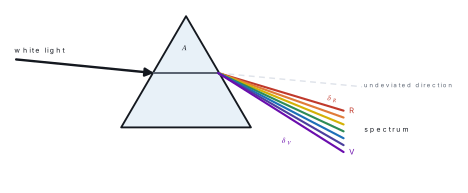
The angular dispersion between the extreme colours is
and the mean deviation is taken as that of yellow, the middle of the spectrum:
The dispersive power \omega of the material of a prism is the ratio of the angular dispersion between two chosen colours to the mean deviation:
It is a pure number (no unit, no dimensions) and depends only on the material, not on the refracting angle of the prism.
We start from the thin-prism deviation formula and reach an expression for \omega in which the prism's own angle A has disappeared.
Step 1 — write the deviation of each colour using \delta = (n-1)A for the same thin prism. The angle A is the same for all three, only n changes:
Step 2 — form the angular dispersion, the spread between the extreme colours:
Step 3 — remove the brackets. The two -A terms cancel:
Step 4 — take out the common factor A:
Step 5 — form the ratio that defines \omega:
Step 6 — cancel A, which appears on the top and on the bottom:
Result.
What it means. Two things follow from Step 6. First, \omega is a ratio of refractive indices, and refractive index is itself a ratio of two speeds, so \omega has no unit and no dimensions. Second, A cancelled, so \omega is a property of the glass alone: a 5^{\circ} prism and a 60^{\circ} prism of the same glass have the same dispersive power, even though their spectra are very different in width.
Conditions used. A thin prism, so that \delta = (n-1)A applies; the same three chosen colours throughout; and yellow taken as the mean colour.
Typical values: crown glass \omega \approx 0.017–0.020, flint glass \omega \approx 0.03–0.05. Flint glass disperses roughly twice as strongly as crown glass for the same mean deviation — the fact on which every achromatic lens is built.
A cancels when you form the ratio. Two prisms of the same glass but angles 5^{\circ} and 60^{\circ} have the same dispersive power even though their spectra are very different in width.
Impure and pure spectrum
If white light from a wide slit simply falls on a prism and then on a screen, the coloured bands overlap: each point of the slit produces its own complete spectrum, displaced from the others. That is an impure spectrum.
A pure spectrum is one in which the light at each point of the spectrum is of a single wavelength, so that no two colours overlap.
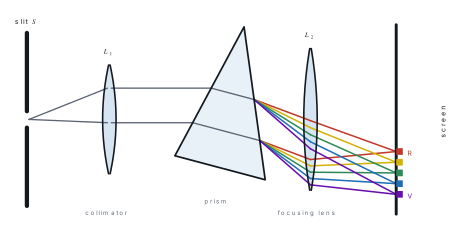
- The source slit must be narrow.
- Light must fall on the prism as a parallel beam (slit at the focus of the collimating lens).
- The prism must be set in the minimum deviation position.
- A converging lens must bring each parallel emergent beam to its own focus on the screen, with the screen in the focal plane.
Problem. A thin prism of angle 5^{\circ} is made of glass for which n_V = 1.532, n_Y = 1.523 and n_R = 1.514. Find (a) the mean deviation, (b) the angular dispersion between violet and red, and (c) the dispersive power.
Solution.
(a) \delta_Y = (n_Y-1)A = (1.523-1)\times 5^{\circ} = 0.523 \times 5^{\circ} = 2.615^{\circ}
(b) \theta = (n_V-n_R)A = (1.532-1.514)\times 5^{\circ} = 0.018\times 5^{\circ} = 0.090^{\circ}
(c) \omega = \dfrac{\theta}{\delta_Y} = \dfrac{0.090}{2.615} = 0.0344
Equivalently \omega = \dfrac{n_V-n_R}{n_Y-1} = \dfrac{0.018}{0.523} = 0.0344 — the same number, and notice A has vanished.
18.2 Chromatic and spherical aberration
An aberration is any departure of a real image from the perfect, sharp, undistorted image predicted by the paraxial theory.
Chromatic aberration
From the lens maker's formula, \dfrac{1}{f} = (n-1)\left(\dfrac{1}{R_1}-\dfrac{1}{R_2}\right). Since n_V > n_R, we get f_V < f_R: a lens focuses violet nearer than red. There is no single image plane, and a white object gives an image fringed with colour.
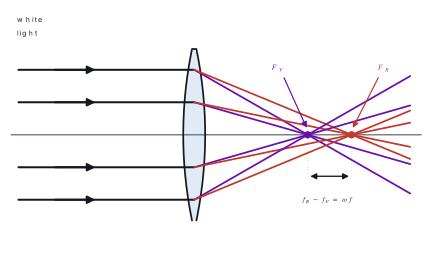
We start from the lens maker's formula applied separately to violet and red light, and reach the remarkably simple result that the gap between the two foci is just \omega f.
Setting up. The lens has a fixed shape, so write
which is the same number for every colour. Only n changes with colour. Let f_V, f_R, f_Y be the focal lengths for violet, red and (mean) yellow light.
Step 1 — lens maker's formula for violet and for red:
Step 2 — subtract the second from the first:
Step 3 — simplify the right side. The two -K terms cancel, then take out K:
Step 4 — combine the left side over a common denominator:
Step 5 — approximate the denominator. For any usable lens f_V and f_R differ by less than about one per cent, so their product is very close to the square of the mean focal length:
Step 6 — substitute that in:
Step 7 — multiply both sides by f_Y^{2}:
Step 8 — get rid of K. The lens maker's formula for yellow gives \dfrac{1}{f_Y} = (n_Y - 1)K, so
Step 9 — split one f_Y off in Step 7 and use Step 8:
Step 10 — recognise the fraction as the dispersive power \omega:
Result.
What it means. The separation of the violet and red foci depends on nothing but the dispersive power of the glass and the mean focal length. So the defect cannot be cured by grinding the surfaces differently — only by changing the glass, or by combining two glasses. A crown-glass lens of f = 20 cm with \omega = 0.018 has its two foci 0.36 cm apart.
Conditions used. A thin lens, paraxial rays, and f_V \approx f_R \approx f_Y so that Step 5 is safe.
Two kinds are distinguished: longitudinal (axial) chromatic aberration, the distance f_R-f_V along the axis, and lateral (transverse) chromatic aberration, the difference in the sizes of the violet and red images on a given screen, which shows up as coloured fringes at the edges of the image.
Spherical aberration
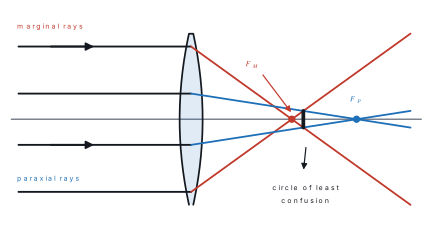
A spherical surface is easy to grind but is not the ideal shape for focusing. Rays striking the marginal (outer) zone of a lens are bent more than the paraxial rays near the axis, so they cross the axis closer to the lens. There is no point at which all rays meet; the smallest patch of light, the circle of least confusion, is where the image is sharpest.
| Chromatic aberration | Spherical aberration | |
|---|---|---|
| Cause | n depends on wavelength | spherical surface, wide aperture |
| Occurs with monochromatic light? | No | Yes |
| Occurs in mirrors? | No | Yes |
| Depends on | dispersive power \omega | aperture and shape of the lens |
| Remedy | achromatic doublet (crown + flint) | stops, crossed lens, plano-convex pair sharing the deviation, parabolic mirror, aplanatic lenses |
Problem. A convex lens of mean focal length 20\ \text{cm} is made of glass of dispersive power 0.03. Find its longitudinal chromatic aberration, and the focal lengths for violet and red light.
Solution. The longitudinal chromatic aberration is
Taking f_Y = 20\ \text{cm} as the mean of the two,
The violet focus lies 6\ \text{mm} closer to the lens than the red one.
18.3 Achromatism and its applications
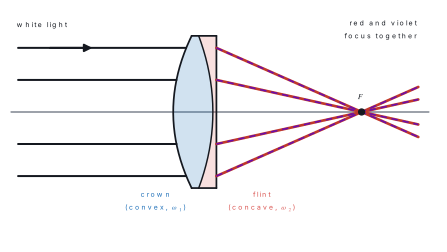
A combination of lenses (or prisms) is said to be achromatic when it brings two chosen colours — usually red and violet — to the same focus, so that the chromatic aberration between them is eliminated.
We start from the rule for two lenses in contact and demand that the combination have the same focal length for violet as for red. That single demand gives the condition.
Setting up. The two lenses have mean focal lengths f_1, f_2 and dispersive powers \omega_1, \omega_2. Write K_1 and K_2 for their shape factors, K = \dfrac{1}{R_1} - \dfrac{1}{R_2}.
Step 1 — lenses in contact add their powers:
Step 2 — write this for violet and for red separately:
Step 3 — impose the achromatic condition. "Achromatic" means the two colours focus at the same place, so F_V = F_R, and therefore 1/F_V = 1/F_R:
Step 4 — move everything to the left and pair up each lens with itself:
Step 5 — work out the first bracket. Apply the lens maker's formula to lens 1 for each colour and subtract, exactly as in the previous derivation:
Step 6 — replace the index difference using the definition of dispersive power. Since \omega_1 = \dfrac{n_{1V} - n_{1R}}{n_{1Y} - 1}, multiplying across gives n_{1V} - n_{1R} = \omega_1(n_{1Y} - 1):
Step 7 — recognise (n_{1Y} - 1)K_1 as 1/f_1, by the lens maker's formula for the mean colour:
Step 8 — repeat Steps 5–7 for the second lens:
Step 9 — substitute both results into Step 4:
Result.
What it means. Dispersive power is always a positive number, so the only way the two terms can cancel is for f_1 and f_2 to have opposite signs: one lens must converge and the other diverge. The colour spread introduced by the first is then undone by the second, while a useful net power survives because the two glasses have different \omega.
Conditions used. Both lenses are thin and in contact, and only two colours (violet and red) are brought together — other colours are still slightly out of focus, a residual defect called the secondary spectrum.
Two consequences follow immediately.
- Dispersive powers are always positive, so f_1 and f_2 must have opposite signs: one lens must converge and the other diverge.
- \dfrac{f_2}{f_1} = -\dfrac{\omega_2}{\omega_1}. To leave a useful net power the two dispersive powers must differ, which is why the pair is made of crown glass (low \omega, convex) cemented to flint glass (high \omega, concave).
Achromatic prism combinations
The same idea applied to prisms gives two useful devices.
| Device | What it must do | Condition |
|---|---|---|
| Achromatic prism combination | deviation without dispersion | (n_V-n_R)A + (n'_V-n'_R)A' = 0 |
| Direct-vision prism | dispersion without deviation | (n_Y-1)A + (n'_Y-1)A' = 0 |
In both, the second prism is inverted with respect to the first, so its contribution has the opposite sign.
"Achromatic" always means the colours must not separate, so the condition is written in terms of the dispersions. "Direct vision" means the beam must come out straight, so the condition is written in terms of the deviations.
Applications
- Achromatic doublet objectives in refracting telescopes, microscopes, binoculars and camera lenses — the standard cure for coloured fringes.
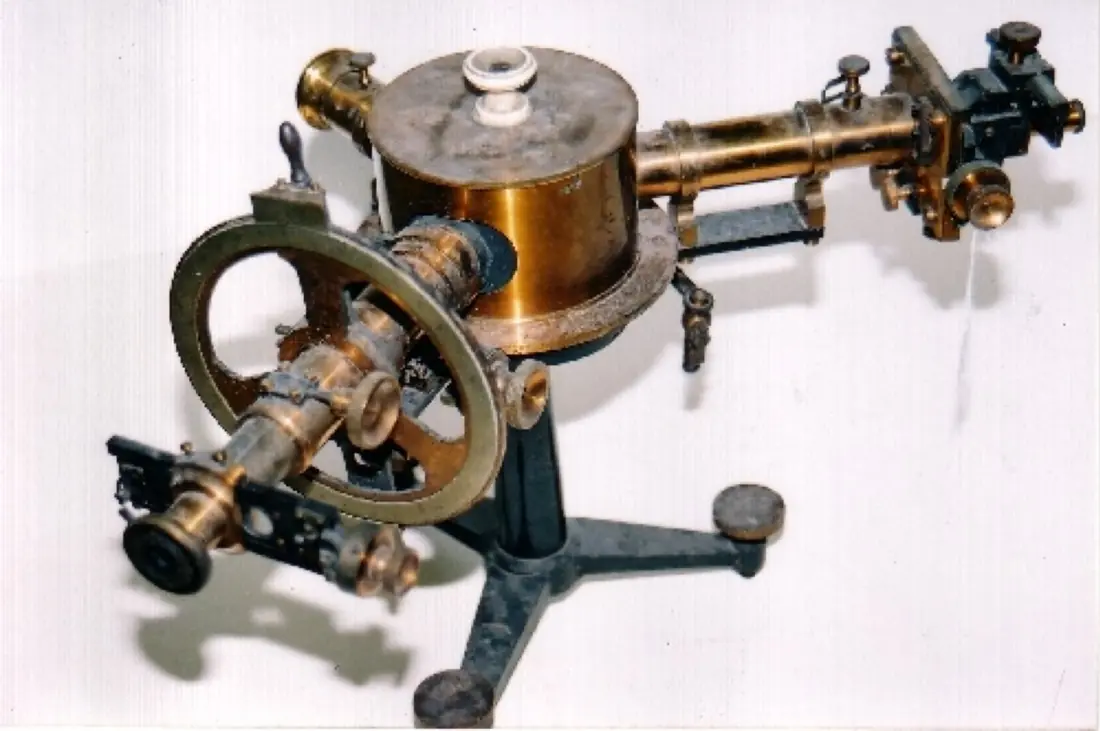
- Direct-vision spectroscopes, in which a train of crown and flint prisms spreads the spectrum while letting the observer look straight at the source.
- Reflecting telescopes avoid the problem completely: a mirror has no dispersion at all, which is why all large research telescopes use mirrors.
- Spectacle and projector lenses, where coloured edges would be objectionable.
Problem. An achromatic doublet of focal length 20\ \text{cm} is to be made by cementing a crown-glass lens (\omega_1 = 0.020) to a flint-glass lens (\omega_2 = 0.040). Find the focal length and the power of each lens.
Solution. The achromatism condition gives
Substituting into \dfrac{1}{F} = \dfrac{1}{f_1}+\dfrac{1}{f_2} with F = 20\ \text{cm}:
and therefore f_2 = -20\ \text{cm}.
Check: \dfrac{1}{10}-\dfrac{1}{20} = \dfrac{1}{20}, so F = 20\ \text{cm}.
Powers: P_1 = 1/0.10 = +10\ \text{D} (crown, convex) and P_2 = 1/(-0.20) = -5\ \text{D} (flint, concave), giving P = +5\ \text{D}.
Problem. A crown-glass prism of refracting angle 10^{\circ} (n_Y = 1.52) is to be combined with a flint-glass prism (n'_Y = 1.65) so that white light passes through the pair without net deviation. Find the refracting angle of the flint prism.
Solution. For no net deviation the two deviations must be equal and opposite, so in magnitude
The flint prism is placed inverted with respect to the crown prism. Because flint has the larger dispersive power, the emergent light is still dispersed — the combination gives dispersion without deviation, which is exactly what a direct-vision spectroscope needs.
Chapter summary
- Dispersion happens because n depends on wavelength, with n_V > n_R; for a thin prism \delta = (n-1)A.
- Angular dispersion \theta = (n_V-n_R)A; mean deviation \delta_Y = (n_Y-1)A.
- Dispersive power \omega = \dfrac{n_V-n_R}{n_Y-1} — dimensionless, a property of the material only. Flint glass has roughly twice the \omega of crown glass.
- A pure spectrum needs a narrow slit, a parallel incident beam, the prism at minimum deviation, and a lens focusing each colour separately on the screen.
- Chromatic aberration: f_V < f_R; longitudinal chromatic aberration = \omega f. Spherical aberration: marginal rays focus nearer than paraxial rays, leaving a circle of least confusion.
- Condition for achromatism of two thin lenses in contact: \dfrac{\omega_1}{f_1} + \dfrac{\omega_2}{f_2} = 0, so one lens must be convex (crown) and the other concave (flint).
- Prism pairs: (n_V-n_R)A + (n'_V-n'_R)A' = 0 gives deviation without dispersion; (n_Y-1)A + (n'_Y-1)A' = 0 gives dispersion without deviation.
Practice questions
Group A — Multiple choice (1 mark each)
- The dispersive power of the material of a prism depends on [1]athe refracting anglebthe angle of incidencecthe material onlydthe height of the prism
- For a prism of small refracting angle A, the deviation is [1]a(n-1)AbnAcA/(n-1)d(n+1)A
- The condition for achromatism of two thin lenses in contact is [1]a\omega_1 f_1 + \omega_2 f_2 = 0b\dfrac{\omega_1}{f_1}+\dfrac{\omega_2}{f_2}=0c\dfrac{f_1}{\omega_1}+\dfrac{f_2}{\omega_2}=0d\omega_1 f_2 = \omega_2 f_1
- Chromatic aberration in a lens is caused by [1]athe spherical shape of the surfacesba large aperturecthe dependence of refractive index on wavelengthdthe thickness of the lens
- Spherical aberration of a lens can be reduced by [1]ausing monochromatic lightbplacing a stop to cut off marginal rayscincreasing the aperturedcementing a flint lens to it
Answers to Group A
1. (c) — A cancels in \omega = (n_V-n_R)/(n_Y-1).
2. (a) — the small-angle result derived from the prism formula.
3. (b) — obtained by setting F_V = F_R for lenses in contact.
4. (c) — n_V > n_R makes f_V < f_R; it persists even with perfect surfaces.
5. (b) — a stop blocks the marginal rays that focus too near the lens. (Option (d) cures chromatic, not spherical, aberration.)
Group B — Short answer (5 marks each)
- What is dispersion of light? Define dispersive power and show that it is a dimensionless quantity independent of the angle of the prism. [5]
- The refractive indices of flint glass for violet, yellow and red light are 1.663, 1.649 and 1.635. Calculate the dispersive power of the glass, and the angular dispersion produced by a flint prism of angle 6^{\circ}. [5]
- Distinguish between a pure and an impure spectrum, and state the conditions necessary for obtaining a pure spectrum. [5]
- Distinguish between chromatic and spherical aberration. State one method of reducing each. [5]
- A convex lens of focal length 25\ \text{cm} is made of glass of dispersive power 0.024. Calculate its longitudinal chromatic aberration and the focal lengths for red and violet light. [5]
Answers to Group B
2. \omega = \dfrac{n_V-n_R}{n_Y-1} = \dfrac{1.663-1.635}{1.649-1} = \dfrac{0.028}{0.649} = 0.0431.
Angular dispersion \theta = (n_V-n_R)A = 0.028 \times 6^{\circ} = 0.168^{\circ}.
5. f_R - f_V = \omega f = 0.024 \times 25 = 0.60\ \text{cm}. Hence f_R = 25.30\ \text{cm} and f_V = 24.70\ \text{cm}.
Group C — Long answer (8 marks each)
- (a) What is achromatism? Derive the condition \dfrac{\omega_1}{f_1}+\dfrac{\omega_2}{f_2}=0 for two thin lenses in contact to form an achromatic combination, and explain why one lens must be converging and the other diverging. [5](b) An achromatic doublet of focal length 30\ \text{cm} is made from crown glass of dispersive power 0.018 and flint glass of dispersive power 0.036. Find the focal length of each lens. [3]
- (a) What is chromatic aberration? Show that the longitudinal chromatic aberration of a thin lens is \omega f. [5](b) For a certain lens the focal lengths for violet and red light are 19.6\ \text{cm} and 20.4\ \text{cm}. Calculate the dispersive power of the glass. [3]
Answers to Group C
1.(b) From \dfrac{0.018}{f_1} = -\dfrac{0.036}{f_2} we get f_2 = -2f_1. Then
so f_1 = +15\ \text{cm} (crown, convex) and f_2 = -30\ \text{cm} (flint, concave).
2.(b) The mean focal length is f_Y \approx \sqrt{f_Vf_R} = \sqrt{19.6\times20.4} = \sqrt{399.84} = 20.0\ \text{cm}. Then
Practise more: Physics question bank