Unit 17 · Waves and Optics · 3 teaching hours · 24 min read
Lenses
What the syllabus asks for 3
- Spherical lenses, angular magnification
- Lens maker's formula
- Power of a lens
A lens is a piece of transparent material bounded by two surfaces, at least one of which is curved. Because the two surfaces refract light one after the other, a lens can gather a diverging bundle of rays back to a point, or spread a parallel bundle out. Spectacles, the camera in a phone, a hand lens, the objective of a telescope on a Pokhara rooftop — all of them are the same three formulas applied over and over.
Three things carry almost all the marks in this unit: a correctly drawn ray diagram with the sign convention respected, the derivation of the lens maker's formula from refraction at two spherical surfaces, and numerical work with P = 1/f in dioptres. Learn those and the unit is done.
17.1 Spherical lenses, angular magnification
Types and basic terms
A spherical lens is bounded by two surfaces that are parts of spheres (a flat face is a sphere of infinite radius). Lenses fall into two families.

| Term | Meaning |
|---|---|
| Centres of curvature C_1, C_2 | centres of the spheres of which the two faces are parts |
| Radii of curvature R_1, R_2 | radii of those spheres |
| Principal axis | the line joining C_1 and C_2 |
| Optical centre O | point inside the lens through which a ray passes undeviated |
| Principal focus F | point where a beam parallel to the axis converges (convex) or appears to diverge from (concave) |
| Focal length f | distance OF |
| Aperture | effective diameter of the lens |
A lens has two foci, one on each side, at equal distances from O when the same medium lies on both sides.
All distances are measured from the optical centre. Distances measured in the direction of the incident light are positive, those measured against it are negative. Heights above the principal axis are positive, below it negative. Hence a real object on the left always has u negative; f is positive for a convex lens and negative for a concave lens.
Image formation
Only two of these three standard rays are needed for any construction:
- A ray parallel to the principal axis passes, after refraction, through the second focus F_2 (convex) or appears to come from F_1 (concave).
- A ray through the optical centre goes straight on, undeviated.
- A ray through the first focus F_1 emerges parallel to the principal axis.
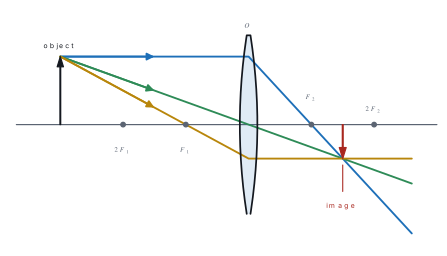
The results are summarised by the thin lens formula, valid with the sign convention above:
and the linear (transverse) magnification
A negative m means the image is inverted (and therefore real); a positive m means erect and virtual.
| Position of object (convex lens) | Image position | Nature | Size |
|---|---|---|---|
| At infinity | at F_2 | real, inverted | point |
| Beyond 2F_1 | between F_2 and 2F_2 | real, inverted | diminished |
| At 2F_1 | at 2F_2 | real, inverted | same size |
| Between F_1 and 2F_1 | beyond 2F_2 | real, inverted | magnified |
| At F_1 | at infinity | real, inverted | highly magnified |
| Between F_1 and O | same side as object | virtual, erect | magnified |
A concave lens is simpler: for every real object it gives a virtual, erect, diminished image between the focus and the lens.
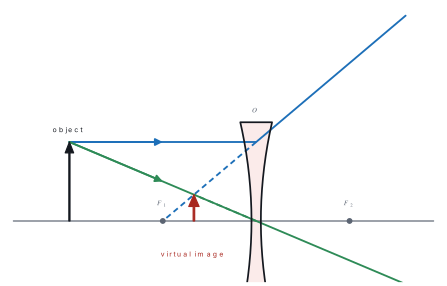
Problem. An object 3\ \text{cm} tall stands 30\ \text{cm} in front of a converging lens of focal length 20\ \text{cm}. Find the position, nature and size of the image.
Solution. With the sign convention, u = -30\ \text{cm}, f = +20\ \text{cm}.
So v = +60\ \text{cm}: the image is 60\ \text{cm} behind the lens, and because v is positive it is real.
The image is inverted and twice as tall: h_i = -2 \times 3 = -6\ \text{cm}, i.e. 6\ \text{cm} tall and upside down.
Angular magnification
How big something looks depends not on its real size but on the angle it subtends at the eye. A lens used as a magnifier does not change the object; it lets you bring the object closer than the near point while still seeing it sharply, so the angle grows.
The angular magnification M of an optical instrument is the ratio of the angle \beta subtended at the eye by the final image to the angle \alpha subtended at the unaided eye by the object placed at the least distance of distinct vision D (D = 25\ \text{cm} for a normal eye):
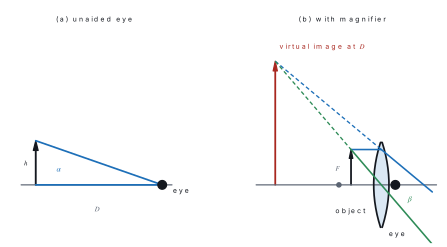
We start from the definition of angular magnification and reach the two standard formulas, one for each way of using a magnifying glass.
Setting up. A simple microscope is a single convex lens of short focal length f. The object has height h, and the eye is held close behind the lens. D is the least distance of distinct vision (the near-point distance, 25 cm for a normal eye). The object is placed between the lens and its focus, so the image is virtual, erect and enlarged.
Step 1 — the angle without the lens. To see the object as big as possible with the bare eye, you bring it to the near point, a distance D away. The angle it then subtends is small, so
Case 1 — final image at the near point (maximum magnification).
Step 2 — where the object must be. The image must be at the near point, so with the sign convention v = -D. Let the object distance be u = -u_0.
Step 3 — the angle with the lens. The eye is at the lens, so it receives the rays at the angle the object subtends at the lens:
Step 4 — form the ratio, by the definition of magnifying power:
Step 5 — cancel h and simplify the divided fraction:
Step 6 — now find u_0 from the lens formula \dfrac{1}{v} - \dfrac{1}{u} = \dfrac{1}{f}, putting v = -D and u = -u_0:
Step 7 — clean up the signs:
Step 8 — move 1/D across:
Step 9 — multiply every term by D, because Step 5 needs D/u_0:
Step 10 — simplify the last term and use Step 5:
Case 2 — final image at infinity (relaxed eye).
Step 11 — where the object must be. For the image to go to infinity, the object must sit exactly at the focus, so u_0 = f.
Step 12 — the angle with the lens is then
Step 13 — form the ratio again:
Step 14 — cancel h:
Result.
What it means. A shorter focal length gives a bigger magnification, which is why a magnifying glass is a strongly curved little lens. The near-point setting gives exactly one extra unit of magnification, but the eye must accommodate, which tires it; the infinity setting is more comfortable for long use.
Conditions used. The eye is close to the lens, all angles are small (so that \tan\theta \approx \theta in Steps 1, 3 and 12), and D = 25 cm for a normal eye.
The near-point setting gives one extra unit of magnification but the eye must accommodate, which tires it; the infinity setting is more comfortable.
Problem. A magnifying glass has focal length 5\ \text{cm}. Taking D = 25\ \text{cm}, find its magnifying power when the final image is (a) at the near point and (b) at infinity. Where must the object be placed in case (a)?
Solution.
(a) M = 1 + D/f = 1 + 25/5 = 6.
(b) M = D/f = 25/5 = 5.
For (a), \dfrac{1}{u_0} = \dfrac{1}{f} + \dfrac{1}{D} = \dfrac{1}{5} + \dfrac{1}{25} = \dfrac{6}{25}, so u_0 = 25/6 = 4.17\ \text{cm} — just inside the focus, as expected.
17.2 Lens maker's formula
A lens refracts light twice, once at each face. So we first need the result for refraction at one spherical surface.
We start from Snell's law at one curved boundary and reach the equation that a single spherical refracting surface obeys. This one result, used twice, gives the whole lens theory.
Setting up. Light travels from a medium of index n_1 into one of index n_2 across a spherical surface of radius R, with pole P and centre of curvature C. A paraxial ray from the axial object O meets the surface at A, a small height h above the axis, and after refraction crosses the axis at I. Let \alpha, \beta, \gamma be the (small) angles that AO, AC and AI make with the axis. Note AC is the normal at A, since a radius is always normal to a sphere.
Step 1 — find the angle of incidence. In triangle AOC, the angle at C is the exterior angle rule applied the other way round: the exterior angle at A (which is i) equals the sum of the two opposite interior angles:
Step 2 — find the angle of refraction. In triangle AIC, \beta is the exterior angle, so it equals the sum of the two opposite interior angles r and \gamma:
Step 3 — make r the subject:
Step 4 — write Snell's law at A:
Step 5 — use the paraxial approximation. A is close to the axis, so i and r are small and \sin\theta \approx \theta:
Step 6 — substitute Steps 1 and 3:
Step 7 — express the three angles as ratios. For a small angle, angle \approx opposite side over adjacent side, and A is practically at P. With the Cartesian convention (u negative for a real object):
Step 8 — substitute these into Step 6:
Step 9 — cancel h, which multiplies every term. (This is the important moment: the answer does not depend on the ray's height, which is why a sharp image forms at all.)
Step 10 — collect the v and u terms on the left and the R terms on the right:
Step 11 — combine the right-hand side over the common denominator R:
Result.
What it means. One equation covers every single curved refracting boundary — the front of a lens, the back of a lens, the cornea of an eye — provided you put in the right n_1, n_2 and the right sign for R. Applied twice in succession it gives the lens maker's formula.
Conditions used. Paraxial rays only (Steps 5 and 7), a surface of small aperture, and all distances measured from the pole P using the new Cartesian convention.
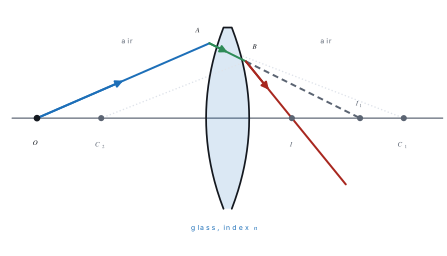
We start from the single-surface equation just derived, apply it twice, and reach the formula that connects a lens's focal length to its shape and its glass.
Setting up. A thin lens of material index n sits in air. Its faces have radii R_1 (the first surface the light meets) and R_2. A real object is at u; the first surface alone would form an image at v_1, which the second surface then uses as its object to form the final image at v.
Step 1 — apply the single-surface equation to the first face. Light goes from air into glass, so n_1 = 1, n_2 = n, radius R_1, image distance v_1:
Step 2 — apply it again to the second face. Now light goes from glass into air, so n_1 = n, n_2 = 1, radius R_2, and the object is I_1. Because the lens is thin, the distance of I_1 from the second surface is still v_1:
Step 3 — add equations (1) and (2). We add rather than subtract because the n/v_1 terms have opposite signs and so will cancel:
Step 4 — cancel the two n/v_1 terms on the left. The intermediate image has now disappeared from the problem entirely:
Step 5 — rewrite (1-n) as -(n-1) so that the same factor appears in both terms:
Step 6 — take out the common factor (n-1):
Step 7 — now specialise to an object at infinity. Then 1/u = 0, and by the definition of focal length the image forms at v = f:
Step 8 — write it out:
Step 9 — recover the thin lens formula. The right-hand side of Step 6 is now known to equal 1/f, so
Result.
What it means. A lens's power comes from two things only: how different its glass is from the surroundings (n - 1) and how sharply its faces are curved. Make either bigger and f gets shorter. Notice also that a lens immersed in a liquid of the same index (n - 1 \to 0) has f = \infty — it becomes invisible and does nothing.
Conditions used. The lens is thin (Step 2 needs the two surfaces to be at effectively the same place), rays are paraxial, light is monochromatic, and the surrounding medium is air.
- The single-surface equation quoted correctly.
- Its application to the first surface, with n_1 = 1, n_2 = n.
- Its application to the second surface, with n_1 = n, n_2 = 1, and the sentence explaining that the lens is thin so the intermediate image distance is unchanged.
- Adding the two equations and cancelling n/v_1.
- Putting u = \infty, v = f to reach the boxed result.
If the lens of index n_l sits in a medium of index n_m the same derivation gives
For a bi-convex lens, R_1 is positive and R_2 is negative, so 1/R_1 - 1/R_2 is a sum of two positive terms. Students who write 1/R_1 - 1/R_2 = 1/20 - 1/20 = 0 for an equiconvex lens have forgotten the convention and get f = \infty.
Problem. An equiconvex lens of glass (n = 1.5) has faces of radius 20\ \text{cm}. Find its focal length in air, and its focal length when the whole lens is immersed in water (n_w = 4/3).
Solution. For an equiconvex lens R_1 = +20\ \text{cm} and R_2 = -20\ \text{cm}, so
In air:
In water:
so f_w = 80\ \text{cm}. The lens is four times weaker in water, because the glass–water index contrast is much smaller than the glass–air one. This is exactly why your eyes cannot focus under water.
17.3 Power of a lens
A short focal length bends light strongly. It is therefore convenient to grade lenses by the reciprocal of the focal length.
The power of a lens is the reciprocal of its focal length expressed in metres:
Its SI unit is the dioptre (D); 1\ \text{D} = 1\ \text{m}^{-1}. A convex lens has positive power, a concave lens negative power.
So f = 50\ \text{cm} = 0.5\ \text{m} gives P = +2\ \text{D}, and f = -25\ \text{cm} gives P = -4\ \text{D}. Combining with the lens maker's formula,
with the radii in metres.
We start by tracing the light through the two lenses one at a time, and reach the focal length of the pair treated as one lens.
Setting up. Two thin lenses of focal lengths f_1 and f_2 are placed in contact, so the distance between them is zero. An object is at u. The first lens forms an intermediate image at v_1; the second lens then uses that image as its own object and forms the final image at v. Let F be the focal length of the equivalent single lens.
Step 1 — apply the lens formula to the first lens:
Step 2 — apply it to the second lens. Its object is I_1, and because the lenses are in contact the object distance for the second lens is the same v_1:
Step 3 — add (1) and (2). Again we add because the 1/v_1 terms carry opposite signs:
Step 4 — cancel the two 1/v_1 terms:
Step 5 — compare with the lens formula for the equivalent lens, \dfrac{1}{v} - \dfrac{1}{u} = \dfrac{1}{F}. The same object gives the same final image, so the left-hand sides are identical:
Step 6 — restate in terms of power, since P = 1/f:
Result.
What it means. Powers add; focal lengths do not. Two +2 D lenses in contact make a +4 D lens. Because a diverging lens has negative power, a +5 D lens combined with a -2 D lens gives +3 D — this is how an optician builds any prescription out of a small stock of lenses. The magnifications multiply, not add, because each lens magnifies what the previous one produced.
Conditions used. Both lenses are thin and in contact (zero separation), rays are paraxial, and the two lenses share the same principal axis. If they are separated by a distance d the extra term below is needed.
If the two lenses are separated by a distance d, the result becomes
In any numerical on lens combinations in contact, convert every focal length to a power in dioptres first, add them algebraically (watch the minus signs), and convert back at the end. It is faster and far less error-prone than adding reciprocals.
Problem. A student in Biratnagar can read comfortably only when the page is at least 50\ \text{cm} from her eye. What spectacle lens will let her read at the normal near point of 25\ \text{cm}? If a protective lens of power -0.5\ \text{D} is cemented to it, what is the power and focal length of the pair?
Solution. The spectacle lens must take an object at 25\ \text{cm} and form a virtual image at her own near point, 50\ \text{cm}, on the same side. So u = -25\ \text{cm} and v = -50\ \text{cm}.
so f = +50\ \text{cm} = 0.50\ \text{m} and
a converging lens, the standard correction for hypermetropia (long sight).
With the protective lens in contact,
Chapter summary
- Thin lens formula \dfrac{1}{v} - \dfrac{1}{u} = \dfrac{1}{f} with linear magnification m = h_i/h_o = v/u, in the New Cartesian convention.
- A convex lens gives a real inverted image for any object beyond F_1, and a virtual magnified one inside F_1; a concave lens always gives a virtual, erect, diminished image.
- Angular magnification M = \beta/\alpha. For a simple microscope, M = 1 + D/f (image at the near point) and M = D/f (image at infinity), with D = 25\ \text{cm}.
- Refraction at one spherical surface: \dfrac{n_2}{v} - \dfrac{n_1}{u} = \dfrac{n_2-n_1}{R}.
- Lens maker's formula: \dfrac{1}{f} = (n-1)\left(\dfrac{1}{R_1}-\dfrac{1}{R_2}\right); in a medium, replace n by n_l/n_m.
- Power P = 1/f (f in metres), unit dioptre; convex positive, concave negative.
- Lenses in contact: \dfrac{1}{F} = \dfrac{1}{f_1}+\dfrac{1}{f_2}, i.e. P = P_1+P_2 and m = m_1m_2; separated by d, P = P_1+P_2-dP_1P_2.
Practice questions
Group A — Multiple choice (1 mark each)
- The power of a lens of focal length -25\ \text{cm} is [1]a+4\ \text{D}b-4\ \text{D}c+0.25\ \text{D}d-0.25\ \text{D}
- A convex lens of focal length 10\ \text{cm} is used as a magnifying glass with the image at the near point. Its magnifying power is [1]a1.5b2.5c3.5d10
- An equiconvex glass lens (n = 1.5) has focal length 20\ \text{cm} in air. Immersed in water (n = 4/3), its focal length becomes [1]a20\ \text{cm}b40\ \text{cm}c60\ \text{cm}d80\ \text{cm}
- For a real object, a concave lens always forms an image that is [1]areal and invertedbvirtual, erect and diminishedcvirtual, erect and magnifieddreal and erect
- A ray directed at the optical centre of a thin lens [1]apasses through the focusbemerges parallel to the axiscemerges undeviateddis totally reflected
Answers to Group A
1. (b) — P = 1/(-0.25\ \text{m}) = -4\ \text{D}.
2. (c) — M = 1 + D/f = 1 + 25/10 = 3.5.
3. (d) — (1.5/1.333-1)/(1.5-1) = 0.25, so f is multiplied by 4.
4. (b) — the emergent rays always diverge, so the image is virtual, erect and smaller.
5. (c) — the two faces are locally parallel there, so the ray is only laterally shifted, and for a thin lens that shift is negligible.
Group B — Short answer (5 marks each)
- Define optical centre, principal focus and focal length of a thin lens. State the three rules used to construct ray diagrams and draw the diagram for an object placed between F_1 and 2F_1 of a convex lens. [5]
- An object 4\ \text{cm} high is placed 25\ \text{cm} from a converging lens of focal length 15\ \text{cm}. Find the position, nature and size of the image. [5]
- Define the power of a lens and its unit. Two thin lenses of powers +5\ \text{D} and -3\ \text{D} are placed in contact. Find the focal length of the combination and state whether it converges or diverges. [5]
- Define angular magnification and show that, for a simple microscope with the final image at the least distance of distinct vision, M = 1 + D/f. [5]
- A double convex lens has faces of radii 20\ \text{cm} and 30\ \text{cm} and is made of glass of refractive index 1.5. Calculate its focal length and power. [5]
Answers to Group B
2. u = -25\ \text{cm}, f = +15\ \text{cm}. \dfrac{1}{v} = \dfrac{1}{15} - \dfrac{1}{25} = \dfrac{5-3}{75} = \dfrac{2}{75}, so v = +37.5\ \text{cm} (real, behind the lens). m = v/u = 37.5/(-25) = -1.5, so h_i = -1.5 \times 4 = -6\ \text{cm}: real, inverted, 6\ \text{cm} tall.
3. P = P_1 + P_2 = 5 - 3 = +2\ \text{D}, so F = 1/2 = 0.5\ \text{m} = 50\ \text{cm}. The power is positive, so the combination converges.
4. See the derivation in §17.3 — the marks are for M = \beta/\alpha = D/u_0, for substituting v = -D in the lens formula, and for the final step D/u_0 = 1 + D/f.
5. Taking the light to meet the 20\ \text{cm} face first, R_1 = +20\ \text{cm}, R_2 = -30\ \text{cm}:
So f = 24\ \text{cm} = 0.24\ \text{m} and P = 1/0.24 = +4.17\ \text{D}.
Group C — Long answer (8 marks each)
- (a) Derive the lens maker's formula \dfrac{1}{f} = (n-1)\left(\dfrac{1}{R_1}-\dfrac{1}{R_2}\right) for a thin lens, starting from the formula for refraction at a single spherical surface. [5](b) A plano-convex lens of glass of refractive index 1.5 has a focal length of 30\ \text{cm}. Find the radius of curvature of its curved face. [3]
- (a) Define angular magnification and derive expressions for the magnifying power of a simple microscope when the final image is formed (i) at the near point and (ii) at infinity. [5](b) A hand lens of focal length 5\ \text{cm} is used by a normal eye. Calculate its magnifying power in both cases and comment on which setting is more comfortable. [3]
Answers to Group C
1.(b) Let light strike the flat face first: R_1 = \infty and R_2 = -R. Then
so R = 0.5 \times 30 = 15\ \text{cm}. (The same answer follows if the curved face is met first, with R_1 = +R, R_2 = \infty.)
2.(b) Near point: M = 1 + D/f = 1 + 25/5 = 6. Infinity: M = D/f = 25/5 = 5. The near-point setting gives the larger magnification, but the eye must accommodate fully and tires quickly; the infinity setting (M = 5) is used for prolonged viewing because the eye stays relaxed.
Practise more: Physics question bank