Unit 13 · Heat and Thermodynamics · 8 teaching hours · 24 min read
Ideal gas
What the syllabus asks for 7
- Ideal gas equation
- Molecular properties of matter
- Kinetic-molecular model of an ideal gas
- Derivation of pressure exerted by gas
- Average translational kinetic energy of gas molecule
- Boltzmann constant; root mean square speed
- Heat capacities: gases and solids
A gas is the simplest state of matter to model, because its molecules are so far apart that for most of the time they do not feel one another at all. That single simplification lets us start from Newton's laws applied to a swarm of tiny balls and end up with the gas laws, with an exact meaning for temperature, and with a prediction of the specific heat capacities of gases and solids. This unit is the bridge between mechanics and heat, and it carries the longest derivation in the Grade 11 course.
Two things appear almost every year: the derivation of p = \frac{1}{3}\rho \overline{c^{2}} (an 8-mark Group C standard), and a numerical on root mean square speed or on C_p - C_v = R. Learn the derivation as a sequence of labelled steps — marks are given step by step.
13.1 Ideal gas equation
Three experimental laws describe how a fixed mass of gas behaves.
| Law | Held constant | Statement | Form |
|---|---|---|---|
| Boyle's law | T | volume varies inversely as pressure | pV = constant |
| Charles's law | p | volume varies directly as absolute temperature | V/T = constant |
| Pressure (Gay-Lussac) law | V | pressure varies directly as absolute temperature | p/T = constant |
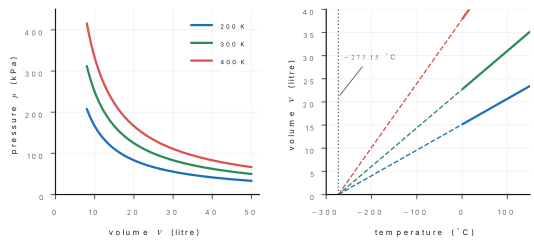
Combining the three gives, for a fixed mass of gas,
Avogadro's law fixes the constant: equal volumes of all gases at the same temperature and pressure contain equal numbers of molecules. Hence for n moles
where R = 8.314\ \text{J mol}^{-1}\text{K}^{-1} is the universal gas constant, the same for every gas. Writing n = N/N_A for N molecules gives the molecular form pV = NkT, and writing n = m/M gives p = \rho RT/M.
An ideal gas is one that obeys pV = nRT exactly at all pressures and temperatures. A real gas approaches this behaviour at low pressure and at temperatures well above its boiling point, where the molecules are far apart and their own volume and mutual attraction can be ignored.
T in pV = nRT is always absolute temperature in kelvin, never °C. And if you use R = 8.314, then p must be in pascal and V in cubic metres — mixing in litres or kPa without converting is the standard way to lose a numerical mark.
Problem. A weather balloon of volume 8.0\ \text{m}^3 is released from Kathmandu, where the pressure is 86 kPa and the temperature 27\ ^\circC. Find its volume at a height where the pressure is 43 kPa and the temperature -33\ ^\circC. Assume the gas inside is ideal and none escapes.
Solution. Convert temperatures: T_1 = 27+273 = 300 K and T_2 = -33+273 = 240 K. Since the mass is fixed,
The pressure drop alone would have doubled the volume; the fall in temperature pulls it back to 1.6 times the original.
13.2 Molecular properties of matter
All matter is made of molecules that are in ceaseless motion and that attract one another when a little way apart but repel strongly when pushed very close together. The separation r_0 at which the force is zero — about 3\times10^{-10} m — is the normal spacing in a solid.
| Property | Solid | Liquid | Gas |
|---|---|---|---|
| Molecular spacing | \approx r_0 | slightly more than r_0 | \approx 10 r_0 |
| Intermolecular force | strong | moderate | negligible |
| Motion | vibration about fixed sites | vibration plus slow drift | free, rapid, random |
| Shape / volume | both fixed | volume fixed, shape not | neither fixed |
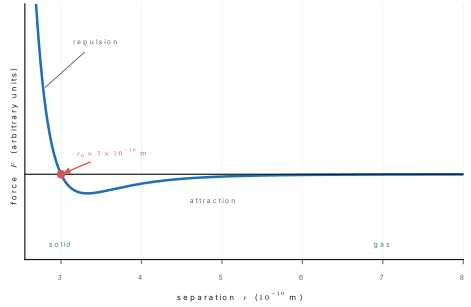
Two numbers are worth memorising. The Avogadro constant N_A = 6.022\times10^{23}\ \text{mol}^{-1} is the number of molecules in one mole, and one mole of any gas occupies 22.4 litres at STP (273.15 K, 101.325 kPa). The mass of a single molecule is m = M/N_A, where M is the molar mass in kilograms per mole.
Molecules are not visible, but their motion is. In 1827 Robert Brown saw pollen grains suspended in water jiggling in a random zig-zag that never stopped. This Brownian motion is caused by the unbalanced bombardment of the grain by the surrounding molecules, and the smaller the grain and the higher the temperature, the more violent the dance — direct evidence that molecules are real and are always moving.
The mean free path is the average distance a molecule travels between collisions,
where d is the molecular diameter and n the number of molecules per unit volume. For air at room conditions \lambda \approx 10^{-7} m — about 300 molecular diameters, which is why a gas molecule suffers some 10^{9} collisions every second yet still spends nearly all its time moving freely.
13.3 Kinetic-molecular model of an ideal gas
- A gas consists of a very large number of identical molecules in continuous random motion.
- The total volume of the molecules is negligible compared with the volume of the container.
- Intermolecular forces are negligible except during a collision.
- Collisions with each other and with the walls are perfectly elastic, so kinetic energy is conserved.
- The duration of a collision is negligible compared with the time between collisions.
- Between collisions a molecule moves in a straight line with constant velocity, obeying Newton's laws.
Two consequences of the model give physical meaning to the two quantities in the gas equation. Pressure is the average force per unit area produced by the continual bombardment of the walls by molecules. Temperature turns out to be a direct measure of the average kinetic energy of the molecules — a result we shall prove in §13.5.
Because the motion is random, no direction is preferred. If u, v, w are the velocity components of a molecule and c^2 = u^2+v^2+w^2, then averaged over all the molecules
13.4 Derivation of pressure exerted by gas
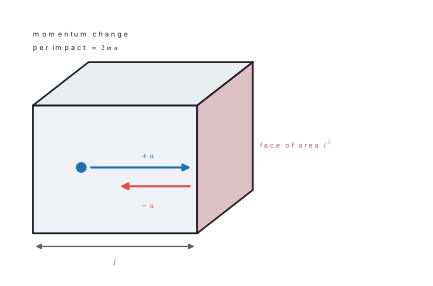
We start from one molecule bouncing off one wall, and reach the pressure of the whole gas. The plan is: momentum given in one hit \to how often the hits come \to force from one molecule \to force from all of them \to pressure.
Setting up. A cube of side l contains N molecules, each of mass m. Take one molecule with velocity components u, v, w along the three axes, and watch the face perpendicular to the x-axis.
Step 1 — velocity after the bounce. The collision is perfectly elastic and the wall is smooth, so only the x-component is reversed:
Step 2 — the molecule's change in momentum. Momentum after minus momentum before:
Step 3 — the momentum given to the wall. By Newton's third law, whatever the molecule loses the wall gains:
Step 4 — how far the molecule travels before it hits this same face again. It must cross to the opposite face and come back:
Step 5 — the time between two hits on this face. Only the x-motion matters for reaching this face, and u does not change in size:
Step 6 — the average force from this one molecule. Newton's second law in momentum form says force is rate of change of momentum:
Step 7 — simplify that fraction. Dividing by 2l/u is the same as multiplying by u/2l:
Step 8 — add up over all N molecules. Let their x-components be u_1, u_2, \ldots, u_N. Forces on the same wall in the same direction simply add:
Step 9 — write the sum using a mean. By definition the mean of the squares is \overline{u^{2}} = \dfrac{u_1^{2}+\cdots+u_N^{2}}{N}, so the sum equals N\overline{u^{2}}:
Step 10 — turn force into pressure. The face has area l^{2}:
Step 11 — replace l^{3} by the volume V of the cube:
Step 12 — bring in the other two directions. For any one molecule, Pythagoras in three dimensions gives c^{2} = u^{2} + v^{2} + w^{2}. Taking means over all molecules:
Step 13 — use the randomness of the motion. No direction is special, so on average the molecules move as much along x as along y or z:
Step 14 — combine Steps 12 and 13. The right-hand side of Step 12 becomes three equal terms:
Step 15 — substitute into Step 11:
Step 16 — recognise the density. The total mass of the gas is mN, so mN/V is the density \rho:
Result.
What it means. Pressure is nothing more than the drumming of molecular impacts. It rises if the molecules are heavier, if there are more of them in the same space, or — most strongly — if they move faster, since the speed enters squared.
Conditions used. Collisions are perfectly elastic; molecules have negligible volume and no forces between them except during collisions; motion is completely random (Step 13); and the container walls are smooth and rigid. The cube is only for convenience — the result holds for a vessel of any shape.
- Momentum change per impact = 2mu, justified by Newton's third law.
- Time between impacts = 2l/u, with the distance 2l explained.
- Force from one molecule = mu^{2}/l using F = \Delta p/\Delta t.
- Summation over N molecules and the introduction of \overline{u^{2}}.
- Division by area l^{2} and the substitution V = l^{3}.
- The randomness argument giving \overline{u^{2}} = \frac{1}{3}\overline{c^{2}} — this step alone often carries a mark.
- The final statement, plus the list of assumptions.
For molecules of speeds 1, 2 and 3 units the mean speed is 2 but \overline{c^{2}} = (1+4+9)/3 = 4.67, whose square root is 2.16. The rms speed is always a little larger than the mean speed; never square the average.
13.5 Average translational kinetic energy of gas molecule
We start from the kinetic-theory result for pV and the ideal gas equation, and reach the statement that temperature is molecular kinetic energy.
Step 1 — the kinetic theory result from section 13.4:
Step 2 — reshape the right side so that a kinetic energy appears. We want \frac{1}{2}m\overline{c^{2}} inside, so write \frac{1}{3} = \frac{2}{3}\times\frac{1}{2}:
Step 3 — name the bracket. \frac{1}{2}m\overline{c^{2}} is the average translational kinetic energy of one molecule; call it \overline{E}:
Step 4 — bring in the experimental gas law. For N molecules, pV = NkT where k is the Boltzmann constant:
Step 5 — cancel N from both sides:
Step 6 — multiply both sides by \frac{3}{2}:
Result.
What it means. The right-hand side contains no m, no p and no V — only the temperature. So at the same temperature a hydrogen molecule and a carbon-dioxide molecule have the same average kinetic energy; the heavy one simply moves more slowly. This is what absolute temperature really measures.
Conditions used. The gas is ideal, and only translational energy is counted (rotation and vibration are extra, and are why C_v differs between gases).
We start from the same two equations, but written for one mole, and reach a formula for molecular speed.
Step 1 — take one mole. Then N = N_A, and the total mass mN_A is the molar mass M:
Step 2 — write the gas equation for one mole:
Step 3 — set the two expressions for pV equal:
Step 4 — multiply both sides by 3:
Step 5 — divide both sides by M:
Step 6 — take the square root. The root of the mean of the squares is, by definition, the rms speed:
Result. Two other forms follow at once, by using p = \frac{1}{3}\rho\overline{c^{2}} and by dividing R/M by Avogadro's number:
What it means. c_{rms} \propto \sqrt{T}, so to double the molecular speed you must quadruple the absolute temperature. And c_{rms} \propto 1/\sqrt{M}, which is why light gases such as hydrogen and helium leak out of a balloon — and out of a planet's atmosphere — faster than heavy ones.
Conditions used. Ideal-gas behaviour; T in kelvin and M in kg mol⁻¹.
The average translational kinetic energy of a gas molecule depends only on the absolute temperature — not on the pressure, the volume or the kind of gas. Heavy molecules simply move more slowly. For one mole the total translational kinetic energy is \frac{3}{2}RT, and at T = 0 it would vanish, which is the kinetic-theory meaning of absolute zero.
Problem. Find the average translational kinetic energy of one molecule of any gas at 27\ ^\circC, and the total translational kinetic energy of one mole at the same temperature. Take k = 1.38\times10^{-23}\ \text{J K}^{-1} and R = 8.314\ \text{J mol}^{-1}\text{K}^{-1}.
Solution. T = 300 K. For one molecule,
For one mole,
That is about 3.7 kJ per mole — the same for helium, nitrogen or carbon dioxide at this temperature.
13.6 Boltzmann constant; root mean square speed
The Boltzmann constant is the gas constant per molecule:
It converts absolute temperature into energy per molecule.
The root mean square speed is the square root of the mean of the squares of the molecular speeds. It was derived step by step in section 13.5:
Use the first form when you know the temperature and the molar mass, and the last when you know the pressure and density. Two conclusions follow at once: c_{rms} \propto \sqrt{T}, so to double the rms speed you must quadruple the absolute temperature; and c_{rms} \propto 1/\sqrt{M} at a given temperature, so hydrogen molecules move four times as fast as oxygen molecules.
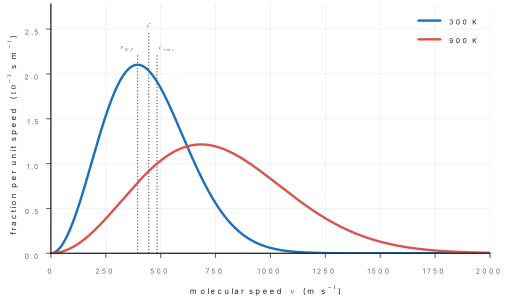
The speeds are spread over a wide range described by the Maxwell distribution. Three speeds are quoted from it: the most probable speed v_{mp} = \sqrt{2kT/m}, the mean speed \bar{v} = \sqrt{8kT/\pi m} and the rms speed c_{rms} = \sqrt{3kT/m}, always in that increasing order, in the ratio 1 : 1.128 : 1.225.
Problem. Calculate the rms speed of oxygen molecules at 27\ ^\circC (M = 32\ \text{g mol}^{-1}). At what temperature will hydrogen molecules (M = 2\ \text{g mol}^{-1}) have this same rms speed?
Solution. With T = 300 K and M = 0.032\ \text{kg mol}^{-1},
For equal rms speeds, 3RT_H/M_H = 3RT_O/M_O, so T is proportional to M:
Hydrogen must be cooled almost to liquid-helium temperatures to slow it down to the speed oxygen has at room temperature.
13.7 Heat capacities: gases and solids
A gas has two molar heat capacities, because it can be heated in two different ways.
C_v is the heat needed to raise the temperature of one mole by 1 K at constant volume; C_p is the heat needed for the same rise at constant pressure. Both are in J mol⁻¹ K⁻¹.
C_p is always the larger. At constant volume the gas cannot expand, so all the heat goes into internal energy. At constant pressure the gas must also push back the surroundings, and the extra heat supplies that work.
We start from the same small temperature rise dT given to one mole of gas in two different ways, and reach the relation between the two molar heat capacities.
Setting up. Take exactly one mole. Heat it once at constant volume and once at constant pressure, in both cases raising its temperature by the same small amount dT. The internal energy of an ideal gas depends only on its temperature, so the same dT always produces the same change dU, whichever path we take. That single fact is the key to the whole derivation.
Step 1 — heat it at constant volume. By the definition of C_v, the heat needed is
Step 2 — no work is done at constant volume. Work is p\,dV, and dV = 0 because the gas cannot expand. So by the first law, dQ = dU + p\,dV reduces to
Step 3 — now heat it at constant pressure. By the definition of C_p:
Step 4 — apply the first law to this second path. Now the gas does expand, pushing back the surroundings:
Step 5 — replace dU using Step 2. This is the step licensed by the "setting up" remark: the same dT means the same dU:
Step 6 — find p\,dV from the gas law. For one mole, pV = RT. Differentiating both sides with p held constant:
Step 7 — substitute this into Step 5:
Step 8 — divide every term by dT:
Step 9 — rearrange:
Result.
What it means. C_p is always the larger of the two, because heating at constant pressure has to pay for the expansion work as well as the temperature rise. The extra amount is exactly R — the same for every ideal gas, monatomic or diatomic, because the work done in expanding depends only on the gas law and not on the molecule's structure.
Conditions used. One mole of an ideal gas, and internal energy a function of temperature alone. For a mass of n moles the relation becomes C_p - C_v = nR if C means total heat capacity; per unit mass it becomes c_p - c_v = R/M.
- Both processes applied to the same dT and the same one mole.
- dU = C_v\,dT, with the reason "no work is done at constant volume".
- The first law written as dQ = dU + p\,dV for the constant-pressure path.
- p\,dV = R\,dT obtained by differentiating pV = RT at constant p.
- The cancellation of dT and the final statement C_p - C_v = R.
The ratio \gamma = C_p/C_v identifies the kind of molecule, because the internal energy depends on how many independent ways a molecule can store energy.
| Gas | C_v | C_p | \gamma = C_p/C_v | Example |
|---|---|---|---|---|
| Monatomic | \frac{3}{2}R = 12.5 | \frac{5}{2}R = 20.8 | 1.67 | He, Ne, Ar |
| Diatomic | \frac{5}{2}R = 20.8 | \frac{7}{2}R = 29.1 | 1.40 | H₂, O₂, N₂ |
(Values in J mol⁻¹ K⁻¹.) A monatomic molecule is a single point and can only move in three directions, so its energy is entirely translational, U = \frac{3}{2}RT per mole, giving C_v = \frac{3}{2}R. A diatomic molecule is a dumbbell that can also rotate about two axes, storing \frac{1}{2}RT more per mole in each, so U = \frac{5}{2}RT and C_v = \frac{5}{2}R.
Solids. In a solid the atoms cannot travel; they vibrate about fixed sites. Each atom vibrating in three dimensions stores 3kT of energy on average — half kinetic and half potential in each of the three directions — so one mole stores U = 3RT and the molar heat capacity is
This is the law of Dulong and Petit: all simple solids have about the same molar heat capacity. It works well: for copper (M = 63.5\ \text{g mol}^{-1}) it predicts c = 3R/M = 24.9/0.0635 = 392\ \text{J kg}^{-1}\text{K}^{-1}, against a measured 385. It fails badly at low temperatures, where every solid's heat capacity falls towards zero — a purely quantum effect that classical physics cannot explain.
Problem. For a certain gas C_p = 29.1 and C_v = 20.8\ \text{J mol}^{-1}\text{K}^{-1}. (a) Find R and \gamma and say whether the gas is monatomic or diatomic. (b) How much heat is needed to raise the temperature of 2.0 mol of this gas by 50 K at constant pressure, and how much at constant volume? (c) Account for the difference.
Solution. (a) R = C_p - C_v = 29.1 - 20.8 = 8.3\ \text{J mol}^{-1} \text{K}^{-1}, and \gamma = 29.1/20.8 = 1.40, so the gas is diatomic.
(b) At constant pressure:
At constant volume:
(c) The difference is 2910-2080 = 830 J. This is exactly the work done by the gas in expanding at constant pressure:
Chapter summary
- Gas laws combine into the ideal gas equation pV = nRT = NkT, with R = 8.314\ \text{J mol}^{-1}\text{K}^{-1} and T in kelvin.
- Kinetic theory assumes many identical molecules of negligible volume in random motion, with no forces except during elastic collisions.
- Pressure of an ideal gas: p = \frac{1}{3}\rho\overline{c^{2}}, equivalently pV = \frac{1}{3}mN\overline{c^{2}}.
- Average translational kinetic energy per molecule is \overline{E} = \frac{1}{2}m\overline{c^{2}} = \frac{3}{2}kT, and per mole \frac{3}{2}RT — independent of the nature of the gas.
- Boltzmann constant k = R/N_A = 1.38\times10^{-23}\ \text{J K}^{-1}.
- Root mean square speed c_{rms} = \sqrt{3RT/M} = \sqrt{3kT/m} = \sqrt{3p/\rho}, so c_{rms}\propto\sqrt{T} and c_{rms}\propto 1/\sqrt{M}.
- Mayer's relation C_p - C_v = R; \gamma = 1.67 for monatomic and 1.40 for diatomic gases.
- Dulong and Petit: the molar heat capacity of a simple solid is about 3R = 25\ \text{J mol}^{-1}\text{K}^{-1}.
Practice questions
Group A — Multiple choice (1 mark each)
- At constant temperature the pressure of a fixed mass of ideal gas is proportional to [1]aVb1/VcV^2d\sqrt{V}
- The rms speed of the molecules of an ideal gas is proportional to [1]aTbT^{2}c\sqrt{T}d1/T
- The average translational kinetic energy of a molecule at absolute temperature T is [1]akTb\frac{3}{2}kTc\frac{3}{2}RTd\frac{1}{2}kT
- For a diatomic gas the ratio C_p/C_v is about [1]a1.33b1.40c1.67d1.00
- According to the law of Dulong and Petit, the molar heat capacity of a simple solid is about [1]aRb\frac{3}{2}Rc3Rd\frac{5}{2}R
Answers to Group A
1. (b) — Boyle's law, pV constant.
2. (c) — c_{rms} = \sqrt{3RT/M}.
3. (b) — per molecule; \frac{3}{2}RT would be per mole.
4. (b) — C_p/C_v = 3.5R/2.5R = 1.40.
5. (c) — 3R \approx 25\ \text{J mol}^{-1}\text{K}^{-1}.
Group B — Short answer (5 marks each)
- State the assumptions of the kinetic molecular model of an ideal gas, and explain on this model what pressure and temperature mean. [5]
- A closed cylinder contains 2.0 g of hydrogen (M = 2.0\ \text{g mol}^{-1}) at 27\ ^\circC. Find (i) the number of molecules present and (ii) the total translational kinetic energy of the gas. [5]
- Define the Boltzmann constant and show that the average translational kinetic energy of a gas molecule is \frac{3}{2}kT. [5]
- Derive Mayer's relation C_p - C_v = R and hence find \gamma for a monatomic gas. [5]
Answers to Group B
1. The six assumptions of §13.3. Pressure is the average force per unit area from molecular bombardment of the walls; temperature is a direct measure of the average translational kinetic energy of the molecules, \overline{E} = \frac{3}{2}kT.
2. (i) n = 2.0/2.0 = 1.0 mol, so N = nN_A = 6.02\times10^{23} molecules. (ii) E = \frac{3}{2}nRT = 1.5\times1.0\times8.314\times300 = 3.74\times10^{3} J.
3. Define k = R/N_A. Then from kinetic theory pV = \frac{1}{3}mN\overline{c^{2}} = \frac{2}{3}N(\frac{1}{2}m\overline{c^{2}}); equating to pV = NkT gives \frac{1}{2}m\overline{c^{2}} = \frac{3}{2}kT.
4. Derivation as in §13.7. For a monatomic gas C_v = \frac{3}{2}R, so C_p = C_v + R = \frac{5}{2}R and \gamma = \frac{5}{2}R \div \frac{3}{2}R = 5/3 = 1.67.
Group C — Long answer (8 marks each)
- (a) State the assumptions of the kinetic theory of gases and derive the expression p = \frac{1}{3}\rho\overline{c^{2}} for the pressure of an ideal gas. [6](b) Hence show that the average translational kinetic energy of a molecule is \frac{3}{2}kT. [2]
- A vessel of volume 0.0249\ \text{m}^3 contains oxygen at 300 K and a pressure of 1.0\times10^{5}\ \text{Pa}. Taking M = 32\ \text{g mol}^{-1}, find(a) the number of moles,(b) the number of molecules,(c) the density of the gas and(d) the rms speed of its molecules. [8]
Answers to Group C
1. Full derivation as set out in §13.4, Steps 1 to 6, followed by the argument of §13.5.
2. (a) n = pV/RT = (1.0\times10^{5}\times0.0249)/(8.314\times300) = 2490/2494 = 1.00 mol.
(b) N = nN_A = 6.02\times10^{23} molecules.
(c) Mass = nM = 1.00\times0.032 = 0.032 kg, so \rho = 0.032/0.0249 = 1.29\ \text{kg m}^{-3}.
(d) c_{rms} = \sqrt{3p/\rho} = \sqrt{(3\times1.0\times10^{5})/1.29} = \sqrt{2.33\times10^{5}} = 483\ \text{m s}^{-1}. (The same answer follows from \sqrt{3RT/M}, as it must.)
Practise more: Physics question bank