Unit 26 · Modern Physics · 6 teaching hours · 25 min read
Recent Trends in physics
What the syllabus asks for 2
- Particle physics: Particles and antiparticles, Quarks (baryons and mesons), leptons (neutrinos)
- Universe: Big Bang and Hubble law, expansion of the Universe, Dark matter, Black Hole, gravitational wave
The last hundred years have pushed physics to both ends of the scale. Downwards, the atom has been opened up to reveal quarks and leptons — particles with no known internal structure. Upwards, the same equations describe a universe 13.8 billion years old, still expanding, and mostly made of something nobody has yet held in a laboratory. This unit tours both frontiers. Much of it is descriptive, but the numbers matter too: Hubble's law, the size of a black hole and the charge of a quark are all things you can be asked to calculate.
Most marks come from definitions, classifications and evidence: the quark content of a proton, why neutrinos are hard to detect, three pieces of evidence for the Big Bang. Learn the tables and the dates. But be ready for short numerical parts as well — adding up quark charges, using v = H_0 d, and putting a mass into R_s = 2GM/c^{2} are all fair game.
26.1 Particle physics
Particles and antiparticles
In 1928 P. A. M. Dirac combined quantum mechanics with special relativity. His equation had negative-energy solutions which he interpreted as a new particle: an electron with positive charge. In 1932 Carl Anderson found it in cosmic-ray tracks in a cloud chamber and named it the positron.
For every particle there exists an antiparticle having the same mass, the same spin and the same lifetime, but opposite electric charge, magnetic moment and other internal quantum numbers (lepton number, baryon number, strangeness).
Antiparticles are written with a bar or the opposite charge sign: antiproton \bar{p}, antineutrino \bar{\nu}, antielectron e^{+}. The antiproton was made in 1955 at the Bevatron. A few particles — the photon, the neutral pion — are their own antiparticles.
Two processes connect matter and energy directly:
- Pair production. A photon passing close to a heavy nucleus converts into a particle–antiparticle pair: \gamma \rightarrow e^{-} + e^{+}. It needs at least 2m_ec^{2} = 1.02\ \text{MeV}; the nucleus is needed to conserve momentum.
- Annihilation. A particle meeting its antiparticle disappears, the whole rest energy becoming radiation: e^{-} + e^{+} \rightarrow 2\gamma, with each photon carrying 0.511\ \text{MeV} — the principle behind the hospital PET scan.
Problem. An electron and a positron, both at rest, annihilate to give two identical photons. Find the energy, frequency and wavelength of each photon. Take m_e = 9.1\times10^{-31}\ \text{kg}, h = 6.63\times10^{-34}\ \text{J s}.
Solution. The total rest energy shared between two photons is 2m_ec^{2}, so each photon gets m_ec^{2}:
Both are gamma rays, emitted back to back so that momentum stays zero.
Classification of particles
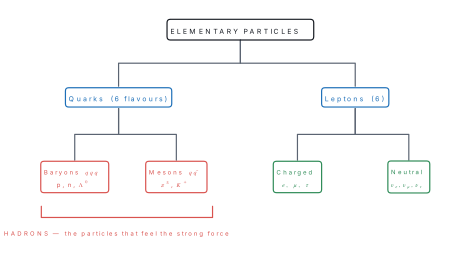
Every particle is either a fermion (matter, half-integer spin, obeys the Pauli exclusion principle) or a boson (force carrier, integer spin). Fermions divide into quarks, which feel the strong force, and leptons, which do not.
| Force | Relative strength | Exchange particle | Range |
|---|---|---|---|
| Strong | 1 | gluon | \sim 10^{-15}\ \text{m} |
| Electromagnetic | 10^{-2} | photon | infinite |
| Weak | 10^{-6} | W^{\pm}, Z^{0} | \sim 10^{-18}\ \text{m} |
| Gravitational | 10^{-39} | graviton (not yet found) | infinite |
Quarks: baryons and mesons
In 1964 Murray Gell-Mann and George Zweig independently proposed that the hundreds of known hadrons are not elementary but are built from a few constituents, which Gell-Mann named quarks. Six flavours are known; the last, the top quark, was found at Fermilab in 1995.
| Generation | Flavour | Symbol | Charge |
|---|---|---|---|
| First | up | u | +\frac{2}{3}e |
| First | down | d | -\frac{1}{3}e |
| Second | charm | c | +\frac{2}{3}e |
| Second | strange | s | -\frac{1}{3}e |
| Third | top | t | +\frac{2}{3}e |
| Third | bottom | b | -\frac{1}{3}e |
Quarks alone carry fractional charge. Each has baryon number +\frac{1}{3} and a property called colour — the "charge" of the strong force. Hadrons come in exactly two combinations:
- Baryons — three quarks, qqq, baryon number +1. Proton = uud, giving charge \frac{2}{3}+\frac{2}{3}-\frac{1}{3} = +1. Neutron = udd, giving \frac{2}{3}-\frac{1}{3}-\frac{1}{3} = 0. The \Lambda^{0} = uds.
- Mesons — a quark and an antiquark, q\bar{q}, baryon number 0. The \pi^{+} = u\bar{d} and the K^{+} = u\bar{s}. All mesons are unstable.
Problem. Using the quark charges in the table, work out the electric charge and the baryon number of (a) the combination uds and (b) the combination u\bar{s}. In each case say whether it is a baryon or a meson and name it.
Solution. Every quark has baryon number +\frac{1}{3}; every antiquark has -\frac{1}{3}. An antiquark also carries the opposite charge to its quark.
(a) uds is three quarks, so it is a baryon. Adding the charges from the table,
A neutral baryon: this is the \Lambda^{0}.
(b) u\bar{s} is one quark with one antiquark, so it is a meson. The s quark has charge -\frac{1}{3}, so \bar{s} has +\frac{1}{3}:
A meson of charge +1: this is the K^{+}.
No free quark has ever been seen. The strong force between two quarks does not weaken with distance, so pulling them apart costs ever more energy until it is cheaper to create a new quark–antiquark pair. You always end up with more hadrons, never a loose quark.
Leptons and neutrinos
Leptons are elementary fermions that do not feel the strong force. There are six, in three generations, each charged lepton paired with its own neutrino.
| Generation | Charged lepton | Rest energy | Neutrino |
|---|---|---|---|
| First | electron e^{-} | 0.511\ \text{MeV} | \nu_e |
| Second | muon \mu^{-} | 105.7\ \text{MeV} | \nu_{\mu} |
| Third | tau \tau^{-} | 1777\ \text{MeV} | \nu_{\tau} |
The neutrino was proposed by Wolfgang Pauli in 1930 to rescue the conservation of energy and momentum in beta decay: the emitted electrons had a continuous range of energies instead of a single value, so an unseen third particle must be carrying the balance away. Its beta-decay role is
n → p + e⁻ + ν̄ₑ
Neutrinos are electrically neutral, have almost no mass and interact only through the weak force and gravity. About 6.5\times10^{14} solar neutrinos cross each square metre of your body every second, and almost none interact; detecting them needs thousands of tonnes of material deep underground. Cowan and Reines finally did so in 1956.
Neutrinos were long assumed massless. Then Super-Kamiokande (1998) and SNO (2001–02) showed that neutrinos change flavour in flight — neutrino oscillation — which is possible only if they have a non-zero mass (Nobel Prize 2015). The tightest direct laboratory limit, from the KATRIN experiment in 2025, is m_{\nu} < 0.45\ \text{eV}/c^{2} — less than a millionth of the electron's mass.
The six quarks, six leptons, the force-carrying bosons and the Higgs boson (found at CERN's Large Hadron Collider in July 2012, mass about 125\ \text{GeV}/c^{2}) form the Standard Model of particle physics.
26.2 Universe
The Big Bang and Hubble's law
Observing distant galaxies in 1929, Edwin Hubble found that almost all of them are moving away from us, and that the recession speed v is proportional to the distance d:
H_0 is the Hubble constant. The speed comes from the redshift of the galaxy's spectral lines; for v \ll c,
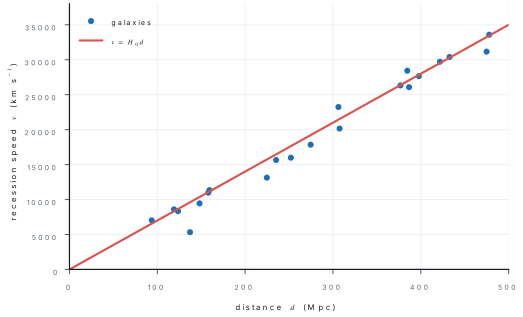
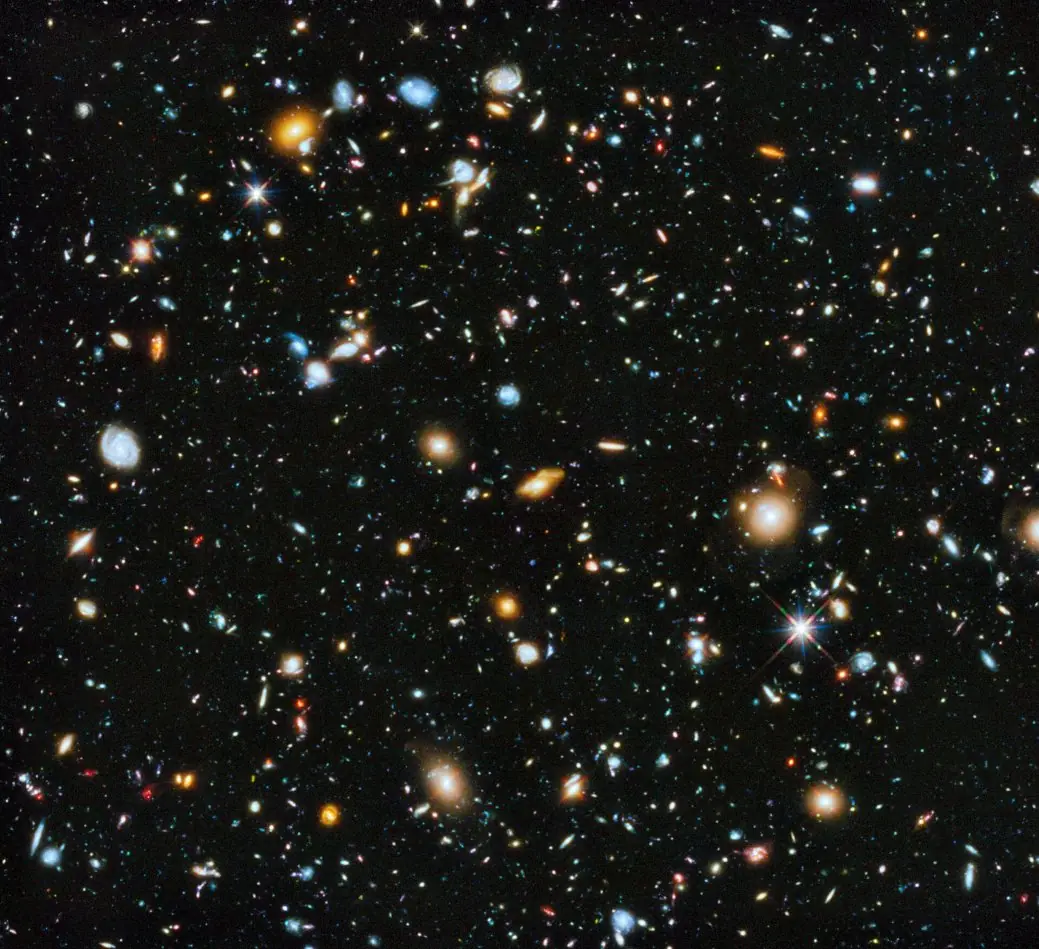
Run the expansion backwards and all the matter was once packed into an extremely hot, dense state. The Big Bang model says the universe began in such a state about 13.8 billion years ago and has expanded and cooled ever since. Three independent observations support it:
| Evidence | What is observed |
|---|---|
| Hubble expansion | every distant galaxy recedes, with v \propto d |
| Cosmic microwave background | a 2.725\ \text{K} blackbody glow from every direction, found by Penzias and Wilson in 1965 — the cooled radiation of the hot early universe |
| Light-element abundance | about 75% hydrogen and 25% helium by mass everywhere, exactly the amount predicted to form in the first few minutes |
Problem. Taking H_0 = 70\ \text{km s}^{-1}\text{Mpc}^{-1} and 1\ \text{Mpc} = 3.086\times10^{22}\ \text{m}, find (a) the recession speed of a galaxy 150\ \text{Mpc} away and (b) the Hubble time 1/H_0 in years.
Solution.
(a) v = H_0 d = 70 \times 150 = 1.05\times10^{4}\ \text{km s}^{-1}, i.e. 3.5\% of the speed of light.
(b) In SI units,
About 14 billion years — close to the measured age of 13.8 billion years.
Galaxies are not flying outwards through space from an explosion at some point. Space itself stretches, carrying the galaxies with it, so every observer in every galaxy sees the same law v = H_0 d. Think of dots on an inflating balloon, not of shrapnel.
Expansion of the universe and dark energy
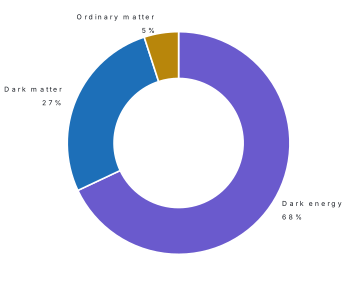
In 1998 two teams found distant Type Ia supernovae to be fainter than expected: the expansion is not slowing under gravity but accelerating. The agent driving it is called dark energy: an unknown energy of empty space that pushes outwards.
The microwave background fixes the present composition of the universe (Planck mission, 2018 values):
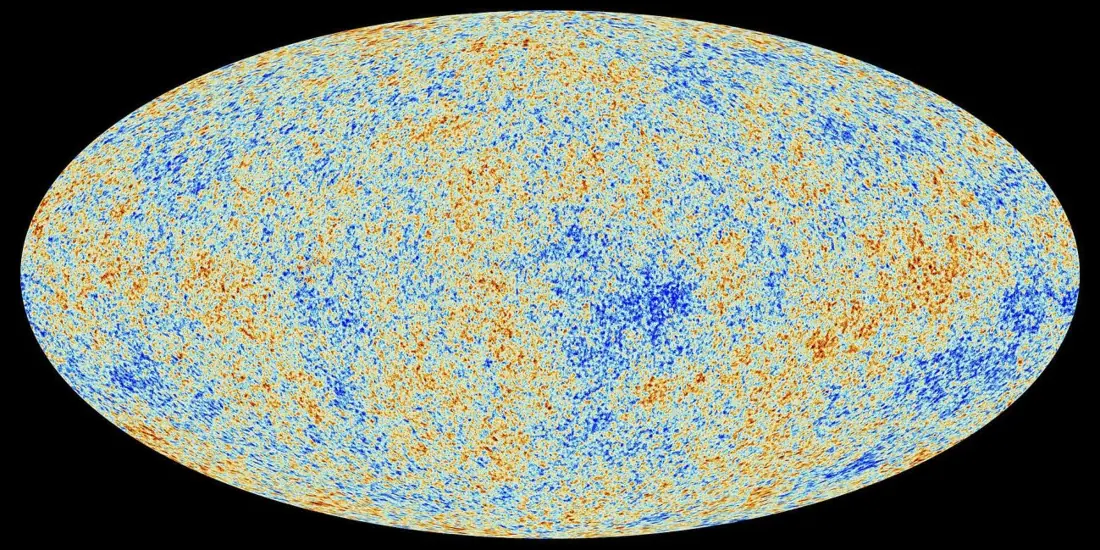
One open problem: the distance-ladder value H_0 = 73.0 \pm 1.0 (SH0ES, 2022) and the microwave-background value H_0 = 67.4 \pm 0.5\ \text{km s}^{-1}\text{Mpc}^{-1} (Planck, 2018) disagree by far more than their error bars. This Hubble tension is still unresolved.
Dark matter
Stars in the outer parts of a spiral galaxy orbit far too fast. To see why that is a problem, work out what speed they should have.
Step 1 — what holds a star in its orbit? A star of mass m moving in a circle of radius r about the centre of its galaxy needs a centripetal force mv^{2}/r, and gravity must supply it. If M(r) is the total mass lying inside radius r, then
Step 2 — cancel m, which appears on both sides (the answer cannot depend on which star we pick):
Step 3 — multiply both sides by r:
Step 4 — take the square root:
Step 5 — apply this outside the bright disc. Out there almost no visible stars are left, so if visible matter were all there is, M(r) would stop growing and settle down to a constant M. Putting a constant into Step 4,
The speed should fall off, in exactly the way Neptune crawls round the Sun more slowly than Mercury.
Step 6 — compare with what is measured. Real rotation curves stay flat: v \approx constant, far beyond the edge of the light. Put v = constant back into Step 3 and make M(r) the subject:
Mass must go on piling up in proportion to r long after the light has stopped. A spiral galaxy needs roughly ten times more of this invisible mass than of the matter we can see.
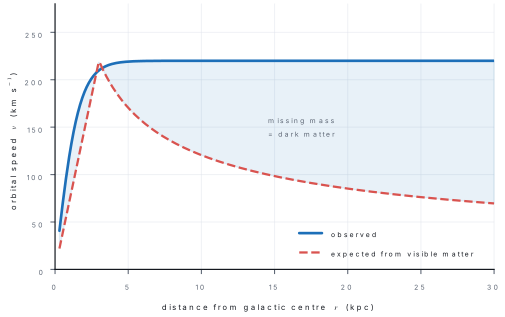
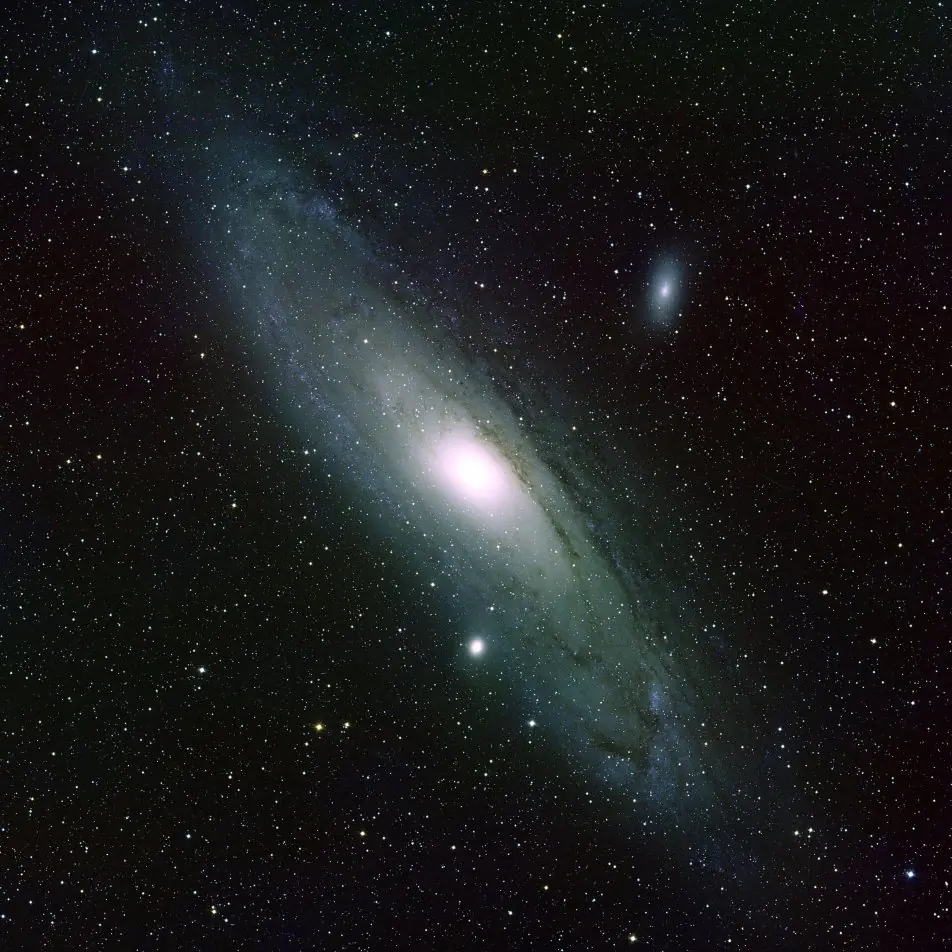
Dark matter is matter that exerts gravitational attraction but neither emits, absorbs nor reflects electromagnetic radiation. It is detected only through its gravity — flat galaxy rotation curves, the speeds of galaxies in clusters (noticed by Zwicky in 1933), gravitational lensing, and the ripple pattern of the microwave background.
It cannot be ordinary matter that merely fails to shine, because the light-element abundances cap how much ordinary matter exists. Leading candidates are weakly interacting massive particles (WIMPs), axions and sterile neutrinos — none yet found, despite decades of searching in underground laboratories.
Black holes
Squeeze a body small enough and its escape velocity reaches the speed of light. Beyond that point nothing at all can leave it.
Step 1 — the condition for escaping. To get away from the surface of a body of mass M and radius R, a projectile of mass m must have just enough kinetic energy to pay off its gravitational potential energy. At the surface the potential energy is -GMm/R; infinitely far away it is zero. So the smallest launch speed v_e satisfies
Step 2 — cancel m from both sides; the escape speed does not depend on what you throw:
Step 3 — multiply both sides by 2:
Step 4 — take the square root:
Step 5 — now shrink the body. Keep M fixed and make R smaller and smaller. v_e grows. Call R_s the radius at which v_e has just reached c:
Step 6 — multiply both sides by R_s:
Step 7 — divide both sides by c^{2}:
This R_s is the Schwarzschild radius.
The Newtonian shortcut gives the right answer for the wrong reason
Light does not slow down as it climbs out of a gravitational field, so the escape-velocity argument above is not strictly valid for light. Karl Schwarzschild obtained the very same formula in 1916 from Einstein's field equations, which is why NEB accepts the short derivation. Quote it — but remember the real reason: inside R_s, every path leads inwards.
A black hole is a region where matter has collapsed to such a density that the escape velocity exceeds the speed of light. Its boundary, at r = R_s, is the event horizon: a one-way surface. Nothing that crosses it can return, so the object is seen only through its gravitational effect on its surroundings.
A star heavier than about 20 solar masses leaves a black hole when its core collapses. Far larger supermassive black holes, millions to billions of solar masses, sit at the centres of galaxies. Evidence includes X-ray emission from gas spiralling into Cygnus X-1; the orbits of stars whipping around an invisible 4.3\times10^{6}\ M_{\odot} object at our galactic centre (Nobel Prize 2020); and direct images from the Event Horizon Telescope — M87* on 10 April 2019 (6.5\times10^{9}\ M_{\odot}, 55 million light-years away) and Sagittarius A* on 12 May 2022, 27,000 light-years away.
Problem. Calculate the Schwarzschild radius of (a) the Sun (M = 2\times10^{30}\ \text{kg}) and (b) the Earth (M = 6\times10^{24}\ \text{kg}). Take G = 6.67\times10^{-11} SI units.
Solution.
(a)
so about 3\ \text{km}: the Sun would have to be squeezed from 7\times10^{5}\ \text{km} to the size of a small town.
(b)
— the Earth squeezed to the size of a marble.
Gravitational waves
General relativity treats gravity as curvature of spacetime. When a massive object accelerates asymmetrically — two black holes spiralling together — that curvature ripples outwards at the speed of light. These gravitational waves are transverse: they alternately stretch and squeeze space in two perpendicular directions.
Einstein predicted them in 1916 and believed they would never be measured, because the strain h = \Delta L/L they produce on Earth is only about 10^{-21}.
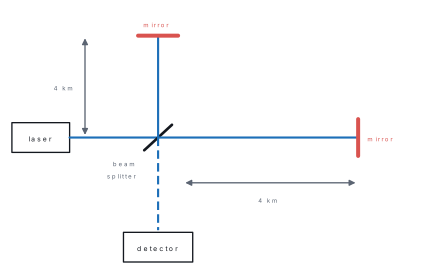
LIGO solved the problem with two Michelson interferometers, at Hanford and Livingston in the USA, with 4\ \text{km} arms. A laser beam is split, sent along both arms, reflected and recombined; if one arm changes length relative to the other, the interference pattern shifts. Two detectors far apart are used so that a local disturbance — a truck, an earthquake — is not mistaken for a wave from space.
Problem. A gravitational wave of strain h = 1.0\times10^{-21} passes through a LIGO arm of length L = 4.0\ \text{km}. (a) By how much does the arm change in length? (b) Compare that with the diameter of a proton, 1.7\times10^{-15}\ \text{m}.
Solution.
(a) The strain is defined as h = \Delta L/L. Multiplying both sides by L,
(b)
The mirrors shift by about one four-hundredth of the width of a proton — and that has to be measured over a 4\ \text{km} baseline. This is why the detection took a century after the prediction.
The first detection, GW150914, was made on 14 September 2015 and announced in February 2016. Two black holes of about 36 and 29 solar masses merged into one of 62 solar masses, roughly 3\ M_{\odot} vanishing as pure gravitational-wave energy in a fraction of a second. The 2017 Nobel Prize followed. In August 2017 the neutron-star merger GW170817 was seen in gravitational waves and gamma rays together, opening multi-messenger astronomy. With Virgo and KAGRA now joining the network, the cumulative LIGO–Virgo–KAGRA catalogue (GWTC-5.0, 2026) lists 391 confirmed events — the count grows with every observing run, so quote it with its date.
Problem. In GW150914 about 3.0\ M_{\odot} of mass was converted into gravitational-wave energy, where M_{\odot} = 2\times10^{30}\ \text{kg}. How much energy was released?
Solution. By Einstein's mass–energy relation,
Briefly, the merger radiated more power than every star in the observable universe combined.
Chapter summary
- Every particle has an antiparticle of equal mass and opposite charge. Pair production needs \geq 1.02\ \text{MeV}; annihilation of e^{-}e^{+} gives two 0.511\ \text{MeV} photons.
- Quarks come in six flavours: u, c, t with charge +\frac{2}{3}e and d, s, b with -\frac{1}{3}e. Baryons are qqq (p = uud, n = udd); mesons are q\bar{q} (\pi^{+} = u\bar{d}). Free quarks are never seen.
- The six leptons are e, \mu, \tau and their neutrinos. Neutrinos are neutral, feel only the weak force, and oscillate between flavours — proof of tiny mass.
- Hubble's law v = H_0 d with H_0 \approx 70\ \text{km s}^{-1}\text{Mpc}^{-1}; the Hubble time 1/H_0 \approx 14 billion years.
- Big Bang evidence: the expansion, the 2.725\ \text{K} cosmic microwave background, and the 75% H / 25% He abundance. Age = 13.8 billion years.
- Space itself expands, with no centre, and ever faster: the universe is 68% dark energy, 27% dark matter, 5% ordinary matter.
- Dark matter is inferred from flat rotation curves, cluster dynamics and lensing; it has never been detected directly. Newtonian orbits give v = \sqrt{GM(r)/r}, so a flat curve means M(r) \propto r.
- Black hole: escape velocity exceeds c; event horizon at R_s = 2GM/c^{2}. Imaged by the Event Horizon Telescope (M87* 2019, Sgr A* 2022).
- Gravitational waves are ripples of spacetime travelling at c, of strain h = \Delta L/L \approx 10^{-21}, detected by km-scale Michelson interferometers; first detection GW150914, 14 September 2015; 391 events in the catalogue by 2026.
Practice questions
Group A — Multiple choice (1 mark each)
- The quark composition of a neutron is [1]auudbuddcu\bar{d}duds
- Which of the following is not a lepton? [1]aelectronbmuoncpiondneutrino
- The cosmic microwave background has a temperature of about [1]a0\ \text{K}b2.7\ \text{K}c27\ \text{K}d273\ \text{K}
- The Schwarzschild radius of a body of mass M is [1]aGM/c^{2}b2GM/c^{2}cGM/2c^{2}d2GM/c
- Flat rotation curves of spiral galaxies are evidence for [1]adark energybdark mattercblack holesdantimatter
Answers to Group A
1. (b) — udd gives \frac{2}{3}-\frac{1}{3}-\frac{1}{3} = 0.
2. (c) — the pion is a meson, made of a quark and an antiquark.
3. (b) — a 2.725\ \text{K} blackbody, found by Penzias and Wilson in 1965.
4. (b) — from \sqrt{2GM/R} = c.
5. (b) — the extra unseen mass keeps the outer stars moving fast.
Group B — Short answer (5 marks each)
- What is an antiparticle? Describe pair production and annihilation, giving the threshold energy for electron–positron pair production. [5]
- Distinguish between baryons and mesons, and show that the quark contents uud and u\bar{d} give the correct charges of the proton and the \pi^{+}. [5]
- Why was the neutrino proposed, and why is it so difficult to detect? What does neutrino oscillation tell us about its mass? [5]
- State Hubble's law. A galaxy is 200\ \text{Mpc} away. Taking H_0 = 70\ \text{km s}^{-1}\text{Mpc}^{-1}, find its recession speed and the fractional redshift z of its spectral lines. [5]
- What is dark matter? Give two pieces of observational evidence for it. [5]
- Show that a star orbiting at radius r inside a galaxy of enclosed mass M(r) has speed v = \sqrt{GM(r)/r}, and explain why a flat rotation curve requires M(r) \propto r. [5]
- A gravitational wave of strain 1.0\times10^{-21} crosses a detector whose arms are 4.0\ \text{km} long. Calculate the change in length of one arm. [5]
Answers to Group B
2. Outline: baryons are three quarks with baryon number +1; mesons are a quark and an antiquark with baryon number 0, and all mesons are unstable. Charges: uud = \frac{2}{3}+\frac{2}{3}-\frac{1}{3} = +1 for the proton; u\bar{d} = \frac{2}{3}+\frac{1}{3} = +1 for the \pi^{+}.
3. Outline: beta-decay electrons emerge with a continuous energy spectrum, so Pauli (1930) proposed an unseen neutral particle carrying off the missing energy and momentum. The neutrino is chargeless and interacts only weakly, so its chance of interacting in a detector is minute. Oscillation between flavours is possible only if at least two neutrino states have non-zero mass.
4. v = H_0 d = 70 \times 200 = 1.4\times10^{4}\ \text{km s}^{-1}.
so the lines are shifted about 4.7% towards the red.
6. Gravity supplies the centripetal force, GM(r)m/r^{2} = mv^{2}/r. Cancelling m and multiplying by r gives v^{2} = GM(r)/r, so v = \sqrt{GM(r)/r}. If v is constant then M(r) = v^{2}r/G, which is proportional to r: mass keeps accumulating outside the visible disc.
7. \Delta L = hL = 1.0\times10^{-21}\times4.0\times10^{3} = 4.0\times10^{-18}\ \text{m}, roughly one four-hundredth of a proton diameter.
1. Outline: an antiparticle has the same mass and spin as its particle but opposite charge and opposite quantum numbers (§26.1). In pair production a photon passing close to a nucleus turns into a particle–antiparticle pair; for e^{-}e^{+} the photon must carry at least 2m_ec^{2} = 1.02\ \text{MeV}, and the nearby nucleus is needed to take up recoil momentum. In annihilation an electron and a positron meet and vanish, and two photons of 0.511\ \text{MeV} go out in opposite directions so that momentum is conserved.
5. Outline: dark matter is matter that has mass and therefore gravitates, but neither emits nor absorbs light, so it is seen only through its gravity (§26.2). Evidence: (i) flat galactic rotation curves — outer stars orbit far faster than the visible mass allows, requiring M(r) \propto r out to large radii; (ii) gravitational lensing by clusters, which bends background light by far more than the luminous mass could; (iii) the speeds of galaxies inside clusters (Zwicky, Coma cluster), which are too high for the cluster to stay bound on visible mass alone.
Group C — Long answer (8 marks each)
- (a) State Hubble's law and explain how it leads to the Big Bang model. [3](b) Give three independent pieces of evidence supporting the Big Bang. [3](c) Show that the Hubble time 1/H_0 for H_0 = 70\ \text{km s}^{-1}\text{Mpc}^{-1} is about 14 billion years, given 1\ \text{Mpc} = 3.086\times10^{22}\ \text{m}. [2]
- (a) Define a black hole and derive the expression for its Schwarzschild radius. [3](b) What are gravitational waves? Describe with a diagram how LIGO detects them, and state one major observation. [5]
Answers to Group C
1.(a) Outline: Hubble's law is v = H_0 d — every distant galaxy recedes with a speed proportional to its distance. Running the motion backwards, every galaxy was at the same place at a time t \approx 1/H_0 ago, which is the Big Bang. The recession is not galaxies flying through space but space itself expanding, so there is no centre.
1.(b) Any three of: the redshift–distance relation itself; the cosmic microwave background at 2.7\ \text{K}, the cooled relic of the hot early universe; the observed abundance of light elements (about 75% hydrogen, 25% helium by mass) predicted by Big-Bang nucleosynthesis; and the fact that distant galaxies look younger than nearby ones.
1.(c) H_0 = \frac{70\times10^{3}}{3.086\times10^{22}} = 2.27\times10^{-18}\ \text{s}^{-1}, so
Dividing by 3.156\times10^{7}\ \text{s per year} gives 1.40\times10^{10}\ \text{years}, about 14 billion years — close to the accepted age of 13.8 billion years.
2.(b) Outline: gravitational waves are ripples in spacetime radiated by accelerating masses, stretching space in one direction while squeezing it in the perpendicular direction (§26.2). Marks for the labelled Michelson interferometer diagram (laser, beam splitter, two 4 km arms with mirrors, detector), for the statement that a passing wave lengthens one arm and shortens the other so the recombined beams fall out of step and the fringe pattern shifts, and for one named observation such as GW150914, the merger of two black holes of about 36 and 29 solar masses detected on 14 September 2015.
2.(a) A black hole is a region whose escape velocity exceeds the speed of light, so no radiation can leave it; its boundary at r = R_s is the event horizon. For the derivation set out step by step, see §26.2. The marks go to: equating kinetic energy with the magnitude of the gravitational potential energy, \frac{1}{2}mv_e^{2} = GMm/R; cancelling m and rearranging to v_e = \sqrt{2GM/R}; and putting v_e = c to obtain
Practise more: Physics question bank