Unit 11 · Heat and Thermodynamics · 6 teaching hours · 21 min read
Quantity of Heat
What the syllabus asks for 6
- Newton's law of cooling
- Measurement of specific heat capacity of solids and liquids
- Change of phases: Latent heat
- Specific latent heat of fusion and vaporization
- Measurement of specific latent heat of fusion and vaporization
- Triple point
Heat is energy that flows from a hotter body to a colder one because of the temperature difference between them. This unit is about counting that energy: how much heat a body must absorb to warm up, how much more it needs to melt or boil, and how quickly a hot body loses heat to the air around it. The unit of every quantity here is the joule, and almost every numerical problem is solved with one sentence — heat lost by the hot bodies equals heat gained by the cold bodies, provided nothing leaks to the surroundings.
Warming without a phase change: Q = mc\,\Delta\theta. Phase change at constant temperature: Q = mL. Heat capacity of a body: C = mc, measured in J K⁻¹.
The water equivalent W of a calorimeter is the mass of water that would need the same heat for the same temperature rise: W = mc/c_w. Adding the calorimeter's water equivalent to the water already inside turns a two-body problem into a one-body problem.
11.1 Newton's law of cooling
Leave a cup of tea on the table in Kathmandu in winter and it cools fast at first, then more and more slowly, finally settling at room temperature. Newton described this behaviour in a law that works well for moderate temperature differences.
The rate at which a body loses heat is directly proportional to the excess of its temperature over that of its surroundings, provided the excess is small and the physical conditions (surface area, nature of surface, movement of the surrounding air) remain unchanged.
If the body is at \theta and the surroundings at \theta_0,
where K depends on the surface area and on the nature of the surface. Since Q = mc\theta for a body of mass m and specific heat capacity c, we may write dQ/dt = mc\,(d\theta/dt), so
The rate of fall of temperature is therefore also proportional to the excess temperature. Note carefully that dQ/dt and d\theta/dt are different things: the first is a power in watts, the second a cooling rate in K s⁻¹.
We start from Newton's law of cooling written as a rate equation, and reach a formula that gives the temperature at any later time.
Setting up. Let \theta be the body's temperature at time t, \theta_0 the temperature of the surroundings, and \theta_1 the body's temperature at t = 0. Newton's law says the rate of cooling is proportional to the excess temperature:
The minus sign is there because \theta is falling, so d\theta/dt is negative while k and the excess temperature are both positive.
Step 1 — separate the variables. We want all the \theta's on one side and all the t's on the other, so divide both sides by (\theta - \theta_0) and multiply by dt:
Step 2 — integrate both sides. The left side is of the standard form \int \frac{dx}{x} = \ln x, with x = \theta - \theta_0 (note \theta_0 is a constant, so d(\theta-\theta_0) = d\theta):
Step 3 — find the constant C from the starting condition. At t = 0 the temperature is \theta_1:
Step 4 — put this value of C back:
Step 5 — collect the two logarithms on the left:
Step 6 — combine them into one, using \ln A - \ln B = \ln(A/B):
Step 7 — undo the logarithm by taking e to the power of each side:
Step 8 — multiply both sides by (\theta_1 - \theta_0):
Step 9 — add \theta_0 to both sides:
Result.
What it means. The excess temperature (\theta - \theta_0) dies away exponentially, halving in equal intervals of time. The body never quite reaches \theta_0 in theory — it only gets closer and closer, which is why cooling looks fast at first and very slow at the end. Step 6 also gives the experimental test: a graph of \ln(\theta - \theta_0) against t is a straight line of slope -k.
Conditions used. The excess temperature must be small (roughly under 30\ ^{\circ}\text{C}), cooling must be by natural convection in a draught-free room, and the surroundings must stay at a steady \theta_0.
- Newton's law written as d\theta/dt = -k(\theta - \theta_0), with the minus sign explained.
- The separation of variables.
- The integration giving a logarithm, with a constant of integration.
- Using t = 0, \theta = \theta_1 to evaluate that constant.
- Taking exponentials to reach \theta = \theta_0 + (\theta_1-\theta_0)e^{-kt}.
- The remark that \ln(\theta-\theta_0) against t is a straight line of slope -k.
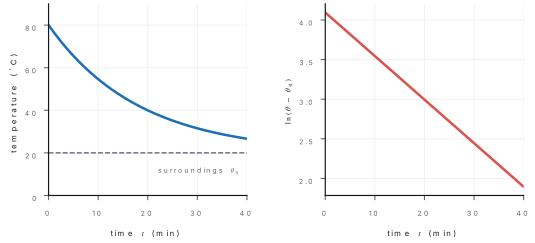
For examination work the differential form is usually replaced by an average form. If a body cools from \theta_1 to \theta_2 in time t, and the fall is not too large, we may take the mean temperature during the interval as (\theta_1+\theta_2)/2:
Problem. A body cools from 60\ ^\circC to 50\ ^\circC in 10 minutes. The temperature of the surroundings is 25\ ^\circC. What will its temperature be after the next 10 minutes?
Solution. Using the average form for the first interval,
so 1 = 30k, giving k = 1/30 per minute.
For the second interval, let the final temperature be \theta:
Multiplying through by 30: 3(50-\theta) = \frac{50+\theta}{2} - 25, i.e. 150 - 3\theta = \theta/2. Hence 150 = 3.5\theta and
The body fell 10\ ^\circC in the first ten minutes but only about 7.1\ ^\circC in the second — cooling slows as the excess temperature drops.
The law holds only for a small excess temperature (in practice up to about 30\ ^\circC) and for a body losing heat mainly by convection in a draught or by forced air flow. For a red-hot body radiation dominates, the loss goes as T^4 (Unit 12), and Newton's law fails badly.
11.2 Measurement of specific heat capacity of solids and liquids
The specific heat capacity c of a substance is the heat required to raise the temperature of unit mass of it by one kelvin: c = Q/(m\,\Delta\theta), in J kg⁻¹ K⁻¹.
Water has an unusually large specific heat capacity, c_w = 4200\ \text{J kg}^{-1}\text{K}^{-1}, which is why lakes such as Phewa Tal change temperature far more slowly than the land around them.
| Substance | c / J kg⁻¹ K⁻¹ | Substance | c / J kg⁻¹ K⁻¹ |
|---|---|---|---|
| Water | 4200 | Copper | 400 |
| Ice | 2100 | Aluminium | 900 |
| Steam | 2010 | Iron | 470 |
| Kerosene | 2100 | Brass | 380 |
Method of mixtures (for a solid)
A known mass m_s of the solid is heated in a steam jacket to a steady temperature \theta_s and then dropped quickly into water of mass m_w in a calorimeter of mass m_c and specific heat capacity c_c, initially at \theta_1. The mixture is stirred and the highest steady temperature \theta_2 is recorded. Then
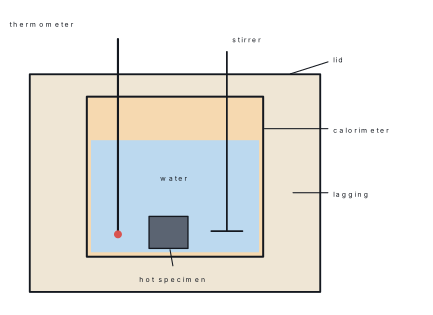
Method of mixtures (for a liquid)
The same equation is used the other way round. A solid of known specific heat capacity is heated and dropped into the unknown liquid; c_s is now known and c_{\text{liquid}} is the unknown. The liquid must not attack the calorimeter and must not boil.
Electrical method
For a liquid it is often easier to supply a measured amount of electrical energy. A heating coil carrying current I at potential difference V for time t delivers Q = VIt joules, so
The advantage is that the heat supplied is known directly from electrical measurements; the disadvantage is that heat losses over a long run can be large, so a cooling correction based on Newton's law of cooling is applied.
Problem. A copper calorimeter of mass 150 g contains 200 g of water at 20\ ^\circC. A metal block of mass 100 g at 100\ ^\circC is dropped in and the final steady temperature is 25\ ^\circC. Find the specific heat capacity of the metal. Take c_w = 4200 and c_{Cu} = 400\ \text{J kg}^{-1}\text{K}^{-1}.
Solution. Heat gained by water and calorimeter:
Heat lost by the metal block:
Equating, 7.5\,c = 4500, so
11.3 Change of phases: Latent heat
Supply heat steadily to a block of ice taken from a deep freeze and record the temperature. The graph is not a straight line: it has two flat steps.
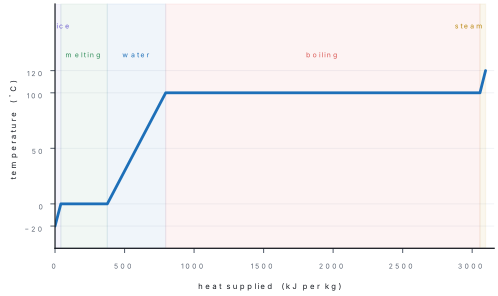
Along the sloping parts the heat raises the kinetic energy of the molecules and the temperature rises. Along the flat parts the heat does something else: it breaks the bonds holding the molecules in place, increasing their potential energy. The temperature does not change at all. Heat absorbed in this way is called latent — Latin for hidden — because a thermometer cannot see it.
Latent heat is the heat absorbed or given out by a substance during a change of phase at constant temperature and constant pressure.
| Change of phase | Name | Heat |
|---|---|---|
| solid → liquid | fusion (melting) | absorbed |
| liquid → solid | freezing | given out |
| liquid → gas | vaporisation (boiling) | absorbed |
| gas → liquid | condensation | given out |
| solid → gas | sublimation | absorbed |
During melting and boiling the substance absorbs a great deal of heat with no temperature change at all. A mistake in the reverse direction is just as common: students forget that condensing steam gives out its latent heat, which is why a steam burn is far worse than a burn from boiling water.
11.4 Specific latent heat of fusion and vaporization
The specific latent heat L of a substance is the heat required to change the phase of unit mass of it at constant temperature: Q = mL, with L in J kg⁻¹.
Two values matter for the NEB paper, both for water at normal atmospheric pressure:
| Quantity | Symbol | Value | Temperature |
|---|---|---|---|
| Specific latent heat of fusion of ice | L_f | 3.34\times10^{5} J kg⁻¹ | 0 °C |
| Specific latent heat of vaporisation of water | L_v | 2.26\times10^{6} J kg⁻¹ | 100 °C |
L_v is nearly seven times L_f. Melting only loosens the molecules so that they can slide past one another; boiling has to separate them completely against the attractive forces and push back the atmosphere while the vapour expands. Both jobs need much more energy than simply unlocking the lattice.
Problem. How much heat is needed to convert 50 g of ice at -10\ ^\circC completely into steam at 100\ ^\circC? Take c_{ice}=2100, c_w=4200, c_{steam}=2010\ \text{J kg}^{-1}\text{K}^{-1}, L_f = 3.34\times10^5 and L_v = 2.26\times10^6\ \text{J kg}^{-1}.
Solution. Work through the stages one by one with m = 0.050 kg.
Warming ice from -10\ ^\circC to 0\ ^\circC:
Melting the ice at 0\ ^\circC:
Warming the water from 0\ ^\circC to 100\ ^\circC:
Boiling the water at 100\ ^\circC:
Total heat required:
Almost three quarters of it goes into the last step alone.
11.5 Measurement of specific latent heat of fusion and vaporization
Both measurements use the method of mixtures, with one extra precaution in each case.
Latent heat of fusion of ice
Small pieces of ice at 0\ ^\circC are dried on blotting paper — wet ice carries water at 0\ ^\circC and makes L_f come out too small — and added to warm water in a calorimeter. The water is started a few degrees above room temperature and finishes a few degrees below it, so that the heat gained from the room in the second half roughly cancels the heat lost in the first half.
If m_i is the mass of ice, W the water equivalent of the calorimeter, \theta_1 the initial and \theta_2 the final temperature:
Latent heat of vaporisation of water
Dry steam at 100\ ^\circC is passed into cold water in a calorimeter. A steam trap between the boiler and the calorimeter catches the water droplets carried over with the steam; without it the measured L_v is too small. The mass m_s of steam condensed is found by reweighing the calorimeter at the end. With \theta_1 and \theta_2 the initial and final temperatures,
Problem. A calorimeter of water equivalent 20 g contains 180 g of water at 35.0\ ^\circC. When 23.4 g of dry ice at 0\ ^\circC is stirred in, the steady temperature becomes 23.0\ ^\circC. Find the specific latent heat of fusion of ice. (c_w = 4200\ \text{J kg}^{-1}\text{K}^{-1}.)
Solution. The calorimeter behaves like an extra 20 g of water, so the cooling mass is 180+20 = 200 g = 0.200 kg.
Heat given out by the water and calorimeter:
Heat taken by the ice, in two stages — melting, then warming the melt water from 0\ ^\circC to 23.0\ ^\circC:
The second term is 0.0234\times96\,600 = 2260\ \text{J}. Therefore
Write the heat-lost side and the heat-gained side as two separate labelled expressions before you equate them. Examiners give method marks for the correct energy balance even when the arithmetic goes wrong, and they cannot give them if they cannot see which term is which.
11.6 Triple point
The temperature at which a substance melts and the temperature at which it boils both depend on pressure. Plotting pressure against temperature gives the phase diagram, whose three curves meet at a single point.
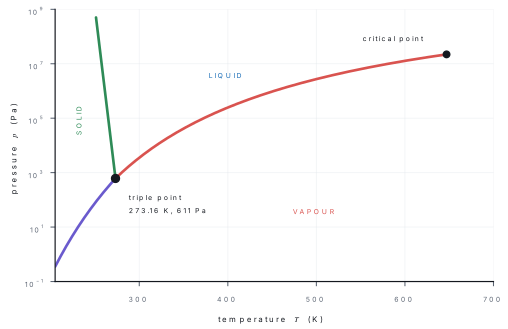
The three curves divide the diagram into solid, liquid and vapour regions. The fusion curve separates solid from liquid, the vaporisation curve separates liquid from vapour and ends at the critical point, and the sublimation curve separates solid from vapour. They meet at one point only.
The triple point of a substance is the single pressure and temperature at which its solid, liquid and vapour phases can coexist in thermal equilibrium.
For water the triple point is at
which is about 0.006 atmosphere. Below that pressure liquid water cannot exist at all: ice warmed at low pressure sublimes straight to vapour. That is exactly how freeze-drying works.
Because the triple point is fixed by nature and can be reproduced in a sealed glass triple-point cell to better than a thousandth of a kelvin, it was chosen as the single fixed point of the Kelvin scale. From 1954 to 2019 the kelvin was defined as 1/273.16 of the thermodynamic temperature of the triple point of water. Since the SI revision of 2019 the kelvin is instead fixed by giving the Boltzmann constant the exact value 1.380649\times10^{-23}\ \text{J K}^{-1}, and 273.16 K has become a very accurately measured quantity rather than a defined one.
Ice melts at 0\ ^\circC under 1 atmosphere of pressure. The triple point is at 0.01\ ^\circC under only 611 Pa. The two differ because dissolved air and the much higher pressure of the atmosphere each lower the melting point slightly.
Chapter summary
- Heat to change temperature: Q = mc\Delta\theta; heat capacity C = mc; water equivalent W = mc/c_w.
- Newton's law of cooling: dQ/dt = -K(\theta-\theta_0), hence \theta = \theta_0 + (\theta_1-\theta_0)e^{-kt}. Valid only for small excess temperature and unchanged surroundings.
- Working form for problems: (\theta_1-\theta_2)/t = k[(\theta_1+\theta_2)/2 - \theta_0].
- Specific heat capacity is measured by the method of mixtures, m_sc_s(\theta_s-\theta_2) = (m_wc_w+m_cc_c)(\theta_2-\theta_1), or electrically, VIt = (m_lc_l+m_cc_c)\Delta\theta.
- Latent heat is absorbed at constant temperature during a phase change: Q = mL. For water L_f = 3.34\times10^5 and L_v = 2.26\times10^6\ \text{J kg}^{-1}.
- L_f is measured with dried ice and L_v with dry steam from a steam trap; both use the same energy balance.
- The triple point is the unique (p,T) at which solid, liquid and vapour coexist. For water: 273.16 K and 611.66 Pa.
Practice questions
Group A — Multiple choice (1 mark each)
- The SI unit of specific latent heat is [1]aJ kg⁻¹ K⁻¹bJ kg⁻¹cJ K⁻¹dJ
- While a solid is melting, the heat supplied to it [1]araises its temperaturebraises its kinetic energy onlycincreases the potential energy of its moleculesdis destroyed
- Newton's law of cooling is best obeyed when [1]athe excess temperature is smallbthe body is red hotcthe body is in vacuumdthe surroundings are heated
- The triple point of water occurs at [1]a273.15 K and 1 atmb273.16 K and 611 Pac373.15 K and 1 atmd273.16 K and 1 atm
- The water equivalent of a calorimeter of mass m and specific heat capacity c is [1]amcbmc_wcmc/c_wdc_w/mc
Answers to Group A
1. (b) — L = Q/m, so joule per kilogram; there is no temperature change, hence no K in the unit.
2. (c) — the bonds are broken, so molecular potential energy rises while the temperature stays fixed.
3. (a) — the law is a linear approximation valid only for a small excess temperature.
4. (b) — 0.01 °C and 611.66 Pa.
5. (c) — the mass of water having the same heat capacity: mc = Wc_w.
Group B — Short answer (5 marks each)
- State Newton's law of cooling and show that the temperature of a cooling body falls exponentially towards that of its surroundings. [5]
- A block of copper of mass 0.4 kg at 100\ ^\circC is dropped into 0.2 kg of water at 20\ ^\circC in a container of negligible heat capacity. Find the final temperature. (c_{Cu}=400, c_w=4200\ \text{J kg}^{-1}\text{K}^{-1}.) [5]
- Define specific latent heat of fusion and of vaporisation, and explain why L_v is much larger than L_f for the same substance. [5]
- Steam at 100\ ^\circC is passed into 0.5 kg of water at 20\ ^\circC in a calorimeter of water equivalent 0.02 kg until the temperature reaches 60\ ^\circC. Find the mass of steam condensed. (L_v = 2.26\times10^6, c_w = 4200\ \text{J kg}^{-1}\text{K}^{-1}.) [5]
Answers to Group B
1. Outline: state the law; write dQ/dt = -K(\theta-\theta_0); put dQ = mc\,d\theta to get d\theta/dt = -k(\theta-\theta_0); separate variables and integrate to \ln(\theta-\theta_0) = -kt + C; apply \theta=\theta_1 at t=0 to obtain \theta = \theta_0 + (\theta_1-\theta_0)e^{-kt}.
2. Heat lost = 0.4\times400\times(100-\theta) = 160(100-\theta); heat gained = 0.2\times4200\times(\theta-20) = 840(\theta-20). So 16\,000-160\theta = 840\theta-16\,800, giving 1000\theta = 32\,800 and \theta = 32.8\ ^\circC.
3. Definitions as in §11.4. L_v > L_f because melting only has to loosen the lattice enough for molecules to slide, whereas vaporisation must separate the molecules completely against their mutual attraction and, in addition, do work pushing back the atmosphere as the vapour expands.
4. Heat gained = (0.5+0.02)\times4200\times(60-20) = 2184\times40 = 87\,360 J. Heat given out by mass m of steam = m[2.26\times10^6 + 4200\times40] = m(2.428\times10^6). Hence m = 87\,360/2.428\times10^{6} = 0.036 kg = 36 g.
Group C — Long answer (8 marks each)
- (a) Define specific latent heat of vaporisation. [2](b) Describe, with the necessary theory and two precautions, how the specific latent heat of vaporisation of water is measured by the method of mixtures. [6]
- 100 g of ice at 0\ ^\circC is dropped into 300 g of water at 50\ ^\circC contained in a calorimeter of water equivalent 25 g.(a) Show that all the ice melts. [3](b) Find the final temperature of the mixture. [5] (L_f = 3.34\times10^5, c_w = 4200\ \text{J kg}^{-1}\text{K}^{-1}.)
Answers to Group C
1. (a) The heat needed to change unit mass of a liquid into vapour at its boiling point without any change of temperature. (b) Steam from a boiler passes through a steam trap into a weighed calorimeter holding a known mass of cold water; record \theta_1, pass steam until the rise is about 20\ ^\circC, record \theta_2, reweigh to get m_s. Theory: m_sL_v + m_sc_w(100-\theta_2) = (m_w+W)c_w(\theta_2-\theta_1). Precautions: use a steam trap so that only dry steam enters; start below and finish above room temperature so the heat exchange with the room cancels; stir continuously; lag the calorimeter.
2. (a) Heat available from the water and calorimeter as they cool to 0\ ^\circC is (0.300+0.025)\times4200\times50 = 0.325\times4200\times50 = 68\,250 J. The heat needed to melt all the ice is 0.100\times3.34\times10^5 = 33\,400 J. Since 68\,250 > 33\,400, all the ice melts and some heat is left over.
(b) Surplus heat = 68\,250 - 33\,400 = 34\,850 J. This warms the whole mixture — 300 g of original water, 100 g of melt water and the 25 g water equivalent, i.e. 0.425 kg — from 0\ ^\circC:
\theta = 34\,850/(0.425\times4200) = 34\,850/1785 = 19.5\ ^\circC.
Practise more: Physics question bank