Unit 9 · Heat and Thermodynamics · 3 teaching hours · 17 min read
Heat and Temperature
What the syllabus asks for 3
- Molecular concept of thermal energy, heat and temperature; cause and direction of heat flow
- Thermal equilibrium and Zeroth law of thermodynamics
- Thermal equilibrium as working principle of mercury thermometer
Put a hot glass of tea on a cold marble table and, after a while, both are lukewarm. Something flowed from one to the other, and it stopped flowing when some property of the two became equal. That "something" is heat; that property is temperature. This short unit separates two words that students use as if they meant the same thing, and then shows that the rule allowing temperature to be measured at all is a law of physics in its own right — the zeroth law.
(1) Heat is energy in transit, temperature is the average molecular kinetic energy. (2) Heat flows from high to low temperature until thermal equilibrium is reached. (3) The zeroth law is what lets a thermometer work at all. Almost every question from this unit is one of these three dressed up differently.
9.1 Molecular concept of thermal energy, heat and temperature; cause and direction of heat flow
Every substance is made of molecules that are never at rest. In a solid they vibrate about fixed lattice positions; in a liquid they vibrate and slide past one another; in a gas they fly freely and collide. Each molecule therefore has kinetic energy, and because the molecules attract one another they also have potential energy.
The internal energy of a body is the total energy of all its molecules — the sum of their kinetic energies (of translation, rotation and vibration) and the potential energy stored in the forces between them. The part of the internal energy that depends on temperature, i.e. the total molecular kinetic energy, is called the thermal energy of the body.
Temperature is not the total energy but the average energy per molecule. For an ideal gas the kinetic theory gives the average translational kinetic energy of one molecule as
where k_{B} = 1.38\times10^{-23}\ \text{J K}^{-1} is the Boltzmann constant and T is the absolute temperature in kelvin. Turn this around and it says something important: temperature is a measure of the average kinetic energy of the molecules of a body.
A flame at 800\ ^{\circ}\text{C} has far higher temperature than a bucket of water at 30\ ^{\circ}\text{C}, but the bucket holds far more thermal energy because it contains enormously more molecules. Temperature is per molecule; thermal energy is total. Never say "this body contains more heat".
Heat is energy that flows from one body to another because of a temperature difference between them. It exists only while it is being transferred: once it has arrived it is no longer heat, it is internal energy of the receiving body. Its SI unit is the joule (J).
Cause and direction of heat flow. When two bodies at different temperatures touch, their surface molecules collide. On average the faster molecules of the hotter body lose kinetic energy in these collisions and the slower molecules of the colder body gain it. The net result is a transfer of energy from the body at higher temperature to the body at lower temperature. So:
- The cause of heat flow is the temperature difference, not a difference in the amount of heat, mass or size.
- The direction of heat flow is always from higher to lower temperature.
- Flow stops when the temperatures become equal — not when the energies become equal.
| Heat | Temperature | |
|---|---|---|
| What it is | energy in transit | measure of average molecular KE |
| SI unit | joule (J) | kelvin (K) |
| Depends on mass? | yes | no |
| Measured with | calorimeter | thermometer |
| Symbol | Q | T or \theta |
| Decides | how much energy moved | which way the energy moves |
Problem. Find the average translational kinetic energy of a molecule of a gas at 27\ ^{\circ}\text{C}, and state the temperature at which this energy would be doubled. Take k_{B} = 1.38\times10^{-23}\ \text{J K}^{-1}.
Solution. T = 27 + 273 = 300\ \text{K}.
Since \bar{E}_{k} \propto T, doubling the energy needs double the absolute temperature: T = 600\ \text{K} = 327\ ^{\circ}\text{C} — not 54\ ^{\circ}\text{C}.
9.2 Thermal equilibrium and Zeroth law of thermodynamics
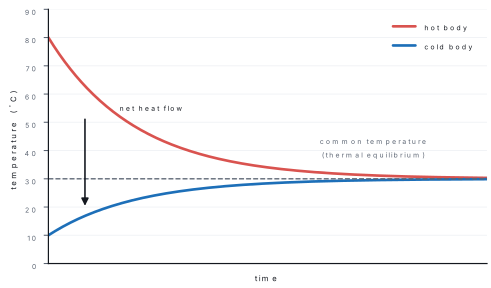
Two bodies placed in thermal contact exchange energy until the net flow becomes zero. They are then said to be in thermal equilibrium, and experiment shows that this happens exactly when their temperatures are equal.
Now suppose body A is in equilibrium with body C, and body B is separately in equilibrium with the same body C. Is A then in equilibrium with B? Experiment says yes, always. This result cannot be deduced from the first or second laws, and it is so basic that it was named the zeroth law after the others had already been numbered.
If two bodies A and B are each separately in thermal equilibrium with a third body C, then A and B are in thermal equilibrium with each other.
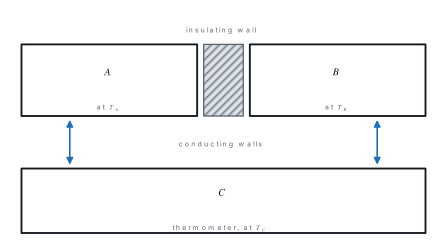
The zeroth law is the licence to use a thermometer. A thermometer is the third body C. We bring it into contact with A and read it, then with B and read it. If the readings agree, the law guarantees that A and B are in equilibrium with each other — so the reading is a genuine property of the state of each body. That property is what we call temperature.
The zeroth law establishes that temperature exists as a measurable physical quantity, and that bodies in thermal equilibrium share a common value of it. Without it, comparing the temperature of Pokhara and Jumla with two different thermometers would have no meaning.
9.3 Thermal equilibrium as working principle of mercury thermometer
Any physical property that changes measurably and reproducibly with temperature can be used to measure temperature. Such a property is called a thermometric property — the length of a liquid column, the pressure of a fixed mass of gas, the resistance of a wire, the e.m.f. of a thermocouple.
| Thermometer | Thermometric property | Useful range |
|---|---|---|
| Mercury-in-glass | length of mercury column | -39\ ^{\circ}C to 357\ ^{\circ}C |
| Alcohol-in-glass | length of alcohol column | -115\ ^{\circ}C to 78\ ^{\circ}C |
| Constant-volume gas | pressure of fixed mass of gas | -270\ ^{\circ}C to 1500\ ^{\circ}C |
| Platinum resistance | electrical resistance | -200\ ^{\circ}C to 1200\ ^{\circ}C |
| Thermocouple | thermo-e.m.f. | -200\ ^{\circ}C to 1600\ ^{\circ}C |
A mercury thermometer is a thin-walled glass bulb joined to a uniform capillary tube of very fine bore, sealed after the air above the mercury has been removed. The bulb holds the mercury; the fine bore makes a small expansion of the mercury produce a long, easily read movement of the thread.
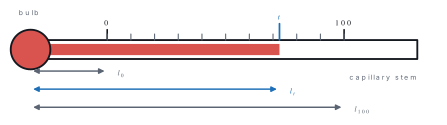
How it works — thermal equilibrium is the whole principle. The bulb is placed in contact with the body whose temperature is wanted. Heat flows between body and bulb until the two reach thermal equilibrium, i.e. until the mercury is at the same temperature as the body. The mercury, having a larger expansivity than glass, has by then moved along the stem to a definite position, and by the zeroth law that position is a measure of the body's own temperature. Note the two conditions hidden in this: the thermometer must be left long enough to reach equilibrium, and it must be small enough that the heat it absorbs does not noticeably change the body's temperature.
Calibration. Two fixed points are used:
- Lower fixed point (ice point): the temperature of pure melting ice at standard atmospheric pressure, marked 0\ ^{\circ}\text{C}; the thread length is l_0.
- Upper fixed point (steam point): the temperature of steam above water boiling at standard atmospheric pressure, marked 100\ ^{\circ}\text{C}; the thread length is l_{100}.
The interval between them is divided into 100 equal parts, which gives the working formula of every two-fixed-point thermometer.
We start from the assumption that the thermometric property changes uniformly with temperature, and reach the formula that converts a reading into a temperature.
Setting up. Let X be whatever property we measure — the length of a mercury thread, the pressure of a gas, the resistance of a wire. Its values are X_0 at the ice point (0\ ^{\circ}\text{C}), X_{100} at the steam point (100\ ^{\circ}\text{C}), and X_t at the unknown temperature t.
Step 1 — assume a straight line. "Uniform change" means X is a linear function of t, so a graph of X against t is a straight line:
Step 2 — how much the property changed for the unknown reading. Subtracting the ice point value:
Step 3 — how much it changed over the whole 100 degrees. The same subtraction with t = 100:
Step 4 — divide Step 2 by Step 3. We divide so that the unknown constant b cancels, and a has already gone:
Step 5 — multiply both sides by 100:
Result. For a mercury thermometer, X is the thread length l, so
What it means. The unknown constants a and b both dropped out, so we never need to know them — two fixed points are enough to read any temperature in between. The fraction is simply "how far along the scale we are", expressed as a fraction of the whole interval.
Condition used. The property must change linearly with temperature over this range. If it does not, two different thermometers will disagree at the same real temperature even though they agree at 0 and 100\ ^{\circ}\text{C}.
The three scales in use are related in exactly the same way — each fraction is "how far along its own scale", and equal fractions mean the same temperature:
- It is a good conductor of heat, so it reaches equilibrium quickly.
- It expands uniformly over a wide range, giving an evenly divided scale.
- It has a wide range: freezes at -39\ ^{\circ}C, boils at 357\ ^{\circ}C.
- Its specific heat capacity is low, so it takes very little heat from the body being measured.
- It is opaque and shiny, so the thread is easy to see.
- It does not wet glass, so none is left clinging to the bore.
Water fails on almost every count: it wets glass, is a poor conductor, is transparent, has a small range and — worst — expands anomalously below 4\ ^{\circ}C, so one length would stand for two temperatures.
A clinical thermometer is the same instrument with the range narrowed to about 35\ ^{\circ}C–42\ ^{\circ}C so that each division can be 0.1\ ^{\circ}C, and with a constriction in the bore just above the bulb. The constriction lets mercury push past while the thread rises but breaks the thread when it cools, so the reading is held until the thermometer is shaken down.
Problem. In a mercury thermometer the mercury thread is 5.0\ \text{cm} long at the ice point and 25.0\ \text{cm} long at the steam point. (a) What temperature corresponds to a thread length of 15.6\ \text{cm}? (b) How long is the thread at normal body temperature, 37\ ^{\circ}\text{C}?
Solution. (a) Using the calibration formula,
(b) Rearranging, l_t = l_0 + \dfrac{t}{100}(l_{100}-l_0) = 5.0 + 0.37\times20.0 = 12.4\ \text{cm}.
Problem. (a) Convert normal body temperature 37\ ^{\circ}\text{C} to the Fahrenheit and Kelvin scales. (b) At what temperature do the Celsius and Fahrenheit scales give the same reading?
Solution. (a) From \dfrac{C}{100} = \dfrac{F-32}{180} we get F = \frac{9}{5}C + 32 = \frac{9}{5}(37) + 32 = 66.6 + 32 = 98.6\ ^{\circ}\text{F}, and K = C + 273.15 = 310.15\ \text{K}.
(b) Put F = C = x:
So -40\ ^{\circ}\text{C} = -40\ ^{\circ}\text{F}.
Problem. A faulty mercury thermometer reads 5\ ^{\circ}\text{C} in melting ice and 95\ ^{\circ}\text{C} in steam. What is the true temperature when it reads 59\ ^{\circ}\text{C}?
Solution. The faulty scale has 90 of its own divisions between the two fixed points, so treat its reading like a thread length:
The divisions are still equal — only the two end marks are misplaced — so the correction is a simple proportion.
Chapter summary
- Internal energy is the total kinetic + potential energy of the molecules; thermal energy is its temperature-dependent (kinetic) part.
- Temperature measures the average molecular kinetic energy: \bar{E}_{k} = \frac{3}{2}k_{B}T with k_{B} = 1.38\times10^{-23}\ \text{J K}^{-1}.
- Heat is energy in transit due to a temperature difference. Its cause is the temperature difference and its direction is always hot \to cold.
- Thermal equilibrium is the state of zero net heat flow, reached when the two temperatures become equal.
- Zeroth law: if A and B are each in equilibrium with C, they are in equilibrium with each other. This is what makes temperature measurable.
- A mercury thermometer works by coming into thermal equilibrium with the body; its thermometric property is the length of the mercury thread, and t = \dfrac{l_t-l_0}{l_{100}-l_0}\times100\ ^{\circ}\text{C}.
- Scale conversion: \dfrac{C}{100} = \dfrac{F-32}{180} = \dfrac{K-273.15}{100}.
Practice questions
Group A — Multiple choice (1 mark each)
- Heat flows from body A to body B when placed in contact because A has [1]amore heatbgreater masschigher average molecular kinetic energydgreater volume
- The law of thermodynamics that makes temperature a measurable quantity is the [1]azeroth lawbfirst lawcsecond lawdthird law
- The temperature at which the Celsius and Fahrenheit scales read the same is [1]a0^{\circ}b-32^{\circ}c-40^{\circ}d100^{\circ}
- The thermometric property of a mercury-in-glass thermometer is the [1]apressure of mercurybresistance of mercuryclength of the mercury columndmass of mercury
- A temperature of 300\ \text{K} is approximately [1]a27\ ^{\circ}Cb300\ ^{\circ}Cc573\ ^{\circ}Cd-27\ ^{\circ}C
Answers to Group A
1. (c) — temperature, i.e. average molecular KE, decides the direction; the total heat content does not.
2. (a) — the zeroth law guarantees a common value shared by bodies in equilibrium.
3. (c) — solving x = \frac{9}{5}x+32 gives x = -40.
4. (c) — the measured quantity is the length of the thread in the uniform bore.
5. (a) — 300 - 273 = 27\ ^{\circ}C.
Group B — Short answer (5 marks each)
- Distinguish between heat and temperature on a molecular basis. Explain why a bucket of warm water can hold more thermal energy than a small flame at a much higher temperature. [5]
- State the zeroth law of thermodynamics and explain how it makes the measurement of temperature possible. [5]
- Explain thermal equilibrium as the working principle of a mercury thermometer, and give four reasons why mercury is preferred to water as a thermometric liquid. [5]
- The mercury thread in a thermometer is 4.0\ \text{cm} long at the ice point and 24.0\ \text{cm} long at the steam point. Find(a) the temperature when the thread is 13.0\ \text{cm} long and(b) the thread length at 65\ ^{\circ}\text{C}. [5]
- Calculate the average translational kinetic energy of a gas molecule at 127\ ^{\circ}\text{C}, and find the temperature in ^{\circ}C at which it is half this value. [5]
Answers to Group B
1. Outline: temperature = average molecular KE (an intensive quantity, per molecule); heat = energy in transit driven by a temperature difference. Thermal energy is the total molecular KE, so it grows with the number of molecules — a bucket of water has of order 10^{27} molecules against a flame's tiny number, so the total wins even though the energy per molecule is much smaller.
4. (a) t = \dfrac{13.0-4.0}{24.0-4.0}\times100 = \dfrac{9.0}{20.0}\times100 = 45\ ^{\circ}\text{C}. (b) l = 4.0 + 0.65\times20.0 = 17.0\ \text{cm}.
5. T = 127+273 = 400\ \text{K}, so \bar{E}_k = 1.5\times1.38\times10^{-23}\times400 = 8.28\times10^{-21}\ \text{J}. Half of this needs T = 200\ \text{K} = -73\ ^{\circ}\text{C}.
Group C — Long answer (8 marks each)
- (a) Explain, on the molecular model, what is meant by thermal energy, heat and temperature, and state the cause and direction of heat flow. [4](b) State the zeroth law of thermodynamics and describe the construction and working of a mercury-in-glass thermometer, showing how it is calibrated between the two fixed points. [4]
- (a) Define thermometric property and name the property used in a constant volume gas thermometer and in a platinum resistance thermometer. [2](b) A faulty thermometer reads 2\ ^{\circ}\text{C} in melting ice and 102\ ^{\circ}\text{C} in steam. What is the true temperature when it reads 77\ ^{\circ}\text{C}? [3](c) At what temperature does the Fahrenheit reading become exactly twice the Celsius reading? [3]
Answers to Group C
2. (a) A thermometric property is any measurable physical property that varies continuously, uniformly and reproducibly with temperature. Gas thermometer: the pressure of a fixed mass of gas at constant volume. Platinum thermometer: the electrical resistance of the platinum wire.
(b) The faulty scale spans 102 - 2 = 100 of its own divisions, so t_{\text{true}} = \dfrac{77-2}{102-2}\times100 = 75\ ^{\circ}\text{C}.
(c) Put F = 2C in F = \frac{9}{5}C + 32: 2C = 1.8C + 32 \Rightarrow 0.2C = 32 \Rightarrow C = 160\ ^{\circ}\text{C}, and then F = 320\ ^{\circ}\text{F}. Check: \frac{9}{5}(160)+32 = 288+32 = 320. ✓
Practise more: Physics question bank