Question bank · 27 min read
Compulsory English: Model Question Sets and Predicted Questions
The English paper is the most regular paper a science student sits: eight questions, the same skills in the same order every year. This chapter sets out the grid, gives two complete model papers with answers, and ends with a ranked list of predicted questions. The prediction rests on one fact only: the grid fixes the question types and the syllabus fixes the texts. Nothing here is a claim about what will appear, and no question is copied from a past paper.
| Q | Marks | Skill |
|---|---|---|
| 1 | 15 | unseen passage |
| 2 | 5 x 2 = 10 | short literary questions |
| 3 | 2 x 5 = 10 | long literary questions |
| 4 | 7 | guided writing |
| 5 | 8 | functional writing |
| 6 | 10 | free writing |
| 7 | 10 | grammar, 10 items |
| 8 | 5 | vocabulary, 5 items |
19.1 Pattern analysis
| Skill | Marks | Share of 75 | Where marks are lost |
|---|---|---|---|
| Reading (Q1) | 15 | 20% | answers that copy half a sentence, vocabulary-in-context |
| Literature (Q2 + Q3) | 20 | 27% | answers with no text detail; a story told but not explained |
| Writing (Q4 + Q5 + Q6) | 25 | 33% | missing format, no paragraphs, off the topic |
| Grammar and vocabulary (Q7 + Q8) | 15 | 20% | careless slips on rules the student knows |
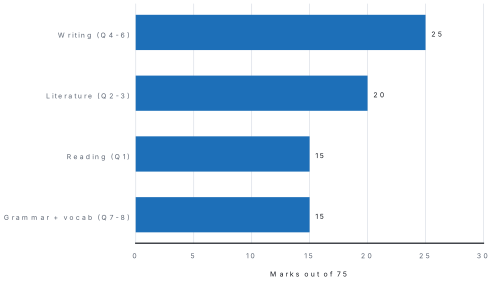
Reading 35 minutes; short and long literary answers 35 minutes; guided writing 20 minutes; letter or notice 20 minutes; essay 30 minutes; grammar and vocabulary 15 minutes; check 15 minutes. Do the grammar items first if you are nervous: they are fifteen sure marks.
19.2 Model Set 1
Question paper
Compulsory English, Grade XI, Model Set 1
Time: 3 hours Full marks: 75 Pass marks: 27
Candidates are required to give their answers in their own words as far as practicable. The figures in the margin indicate full marks. Attempt all questions.
1. Read the following passage and answer the questions that follow. [15]
Many students believe that sleeping less will give them more time to study. Scientists say the opposite. During sleep the brain sorts the information gathered during the day and stores the important parts in long-term memory. A student who studies all night and sleeps for only three hours may remember little the next morning. Teenagers need between eight and ten hours of sleep each night, but surveys show that most get only six or seven.
Lack of sleep has other effects. It makes people irritable and careless, weakens the body's defences against illness, and slows reaction time, which is why tired drivers cause so many accidents. Doctors therefore advise students to keep regular hours, to avoid screens for an hour before bed and to stop drinking tea or coffee in the evening. A short walk in the afternoon also helps the body to sleep better at night. Good sleep is not a waste of time; it is part of studying.
A. Choose the correct answer. (3 x 1 = 3) 1. During sleep the brain (a) stops working (b) sorts and stores information (c) forgets old facts (d) rests completely 2. Teenagers need (a) three to four hours of sleep (b) six to seven hours (c) eight to ten hours (d) twelve hours 3. The word irritable means (a) easily annoyed (b) very happy (c) sleepy (d) clever
B. Write true or false. (3 x 1 = 3) 4. Most teenagers get enough sleep. 5. Tired drivers cause many accidents. 6. Doctors advise students to drink tea just before bed.
C. Answer the questions. (3 x 2 = 6) 7. Why may a student who studies all night remember little the next day? 8. Write two bad effects of too little sleep. 9. What advice do doctors give so that students can sleep well?
D. Find words from the passage that mean the following. (2 x 1 = 2) 10. a set of questions asked of many people to find out their opinions 11. the opposite of strengthens
E. Answer. (1) 12. What does "It" in the sentence "It makes people irritable and careless" refer to?
2. Answer the following questions in two or three sentences each. (5 x 2 = 10)
- Why does the giant build a high wall around his garden?
- What does the speaker promise in the last stanza of "A Red, Red Rose"?
- What does Wasserkopf want from the school in Refund?
- What does Steve Jobs mean by "connect the dots"?
- What does the astrologer tell Guru Nayak about his enemy?
3. Answer the following questions in about 100 words each. (2 x 5 = 10)
- (a) Describe the character of Jonathan Iwegbu in "Civil Peace". [5]
Or(b) Why does Aksionov forgive Makar Semyonitch in "God Sees the Truth, but Waits"? [5] - (a) "Corona Says" is a satire on humankind. Discuss. [5]
Or(b) What does Haldane require from life? [5]
4. Guided writing. [7]
- Write a story of about 150 words from the outline below. Give it a title and a moral.
A lazy student fails the pre-board examination, meets his old teacher and gets advice, starts to study with a timetable, passes the final examination with good marks, thanks the teacher.
5. Functional writing. [8]
- You are Ramesh Karki of Grade 11. Write an application to the Principal asking for two days' leave because of your sister's wedding.
6. Free writing. [10]
- Write an essay of about 250 words on "The Impact of Social Media on Students".
7. Grammar (10 x 1 = 10)
- She ____ (live) in Pokhara since 2015.
- If it ____ (rain) tomorrow, we shall stay at home.
- Add a tag: Let's go for a walk, ____?
- Change into passive: The students are cleaning the classroom.
- Report: "Where do you live?" she asked me.
- Fill in the blank: He is ____ honest man. (a/an/the)
- The boy ____ won the prize is my cousin. (who/which)
- You ____ obey your parents. (should/can)
- Neither of the boys ____ present. (is/are)
- She is afraid ____ snakes. (of/from)
8. Vocabulary (5 x 1 = 5)
- Write the opposite of possible by using a prefix.
- Give a synonym of enormous.
- Write the noun form of decide.
- What does the idiom once in a blue moon mean?
- What does the phrasal verb call off mean?
Answers to Model Set 1
1. (b).
2. (c).
3. (a).
4. False — surveys show most get only six or seven hours.
5. True.
6. False — doctors advise stopping tea and coffee in the evening.
7. During sleep the brain stores the day's information in long-term memory; if the student sleeps only three hours, this does not happen properly, so little is remembered.
8. It makes people irritable and careless, and it weakens the body's defences against illness (also slows reaction time).
9. They advise keeping regular hours, avoiding screens for an hour before bed and not drinking tea or coffee in the evening.
10. surveys.
11. weakens.
12. Lack of sleep.
Q2: Short literary answers
13. He is selfish and wants the garden for himself. He puts up a wall and a notice to keep the children out.
14. He promises to return to her, although he must go away for a while, even if it is ten thousand miles.
15. He wants the school to refund the tuition fees paid for his education eighteen years ago, because he says he learned nothing.
16. He means that we cannot see how events in our lives will fit together while we live them; only when we look back do we see the pattern, so we must trust that they will.
17. He tells Guru Nayak that the man died four months ago, crushed under a lorry, and advises him to go home and never travel south again.
Q3: Long literary answers
18. (a) Jonathan Iwegbu is an optimistic, hard-working and resourceful man. After the Nigerian civil war he counts his blessings: five of six heads in his family are safe, his bicycle has survived and he turns it into a taxi. He restores his small house and sets his family to earn money. He is humble and religious, and says "Nothing puzzles God" about everything that happens. When thieves take the twenty pounds, he accepts the loss and starts the next day's work. His practical hope, not self-pity, helps him survive in a broken country.
Or (b) Aksionov is imprisoned for twenty-six years for a murder he did not commit. In prison he becomes humble and religious and loses the wish for revenge. When he sees that Makar Semyonitch is the true murderer, he first feels anger, but he does not give him away to the governor. When Makar confesses and begs pardon, Aksionov says that God will forgive them both. Forgiving him gives Aksionov peace of heart, and he no longer wishes to go home. The story shows that forgiveness frees the soul even when justice is late.
19. (a) In a satire, the writer mocks human faults to bring change. The speaker, the virus, admits that people hate it, but asks who is the greater killer. It lists human crimes: forests cut, rivers and air poisoned, animals killed and wars that killed millions. It says it makes no difference between rich and poor, or between religions and countries, so it teaches the equality that humans preach but do not practise. While people stayed indoors, the air cleared and animals returned. The accuser has become the accused. The poem ends by asking whether we have learned.
Or (b) Haldane, writing in 1940 in a heroic age of war, says that besides food, water, clothes and shelter he requires four things. The first is work that is hard but interesting, with a decent wage, since happiness is unimpeded activity. The second is freedom, especially of speech, which the libel law limits. The third is health, enough to work and enjoy life, not perfect health. The fourth is friendship. He does not ask for peace and security because he does not expect them in his age. The essay is simple, honest and generous.
Hard Work Wins
Suman was a lazy student of Grade 10 who spent his days playing games. In the pre-board examination he failed in three subjects. Ashamed, he went to his old teacher, Mr Sharma, who gave him a kind but firm talk. "Success comes to those who plan and work," said the teacher. "Make a timetable and follow it."
Suman made a timetable of study, rest and exercise and followed it every day. He asked his teacher about problems he could not solve. Slowly his marks rose.
When the final examination results came out, Suman had passed with a good second division, and his parents were proud. He ran to thank his teacher, who smiled and said, "Your hard work did it."
Moral: Hard work and planning bring success.
                                              Shree Janata Higher Secondary School
                                              Butwal
                                              10 Falgun 2082

The Principal
Shree Janata Higher Secondary School
Butwal

Subject: Application for two days' leave

Respected Sir,

I beg to state that my elder sister's wedding will be held on 14 Falgun at
our home in Palpa, and my family needs me to help with the preparations. I
therefore request you to kindly grant me leave for two days, from 13 Falgun
to 14 Falgun 2082.

I shall complete the notes and the assignments I miss as soon as I return.
I shall be grateful for your kind consideration.

Yours obediently,
Ramesh Karki
Grade 11, Science, Roll No. 12
The Impact of Social Media on Students
Social media, such as Facebook, TikTok and YouTube, has become a part of every student's daily life. Like any tool, it can help or harm.
On the positive side, social media connects students with friends, teachers and experts. Students can watch lessons on YouTube, join study groups and share notes. Young people can also show their talents and learn about the world. During the pandemic, many classes continued through online platforms.
However, there are serious problems. Many students spend several hours scrolling, which leaves less time for study and sleep. Constant notifications break their attention, and results suffer. Some students compare themselves with others and feel anxious or unhappy. There is also the danger of false news, cyberbullying and strangers who misuse personal information.
Students should therefore use social media wisely. They should fix a time limit, switch off notifications while studying, check the source of information before sharing and never share private details. Parents and teachers should guide rather than simply forbid.
In conclusion, social media is a good servant but a bad master. If students use it for learning and keep control of their time, it can be a blessing.
23. has lived (or has been living).
24. rains.
25. shall we.
26. The classroom is being cleaned by the students.
27. She asked me where I lived.
28. an.
29. who.
30. should.
31. is.
32. of.
33. impossible.
34. huge.
35. decision.
36. very rarely.
37. cancel.
19.3 Model Set 2
Question paper
Compulsory English, Grade XI, Model Set 2
Time: 3 hours Full marks: 75 Pass marks: 27
Candidates are required to give their answers in their own words as far as practicable. The figures in the margin indicate full marks. Attempt all questions.
1. Read the following passage and answer the questions that follow. [15]
The Bagmati River flows through the Kathmandu Valley and is sacred to both Hindus and Buddhists. For many centuries people bathed in its water and performed rituals on its banks. But as the population of the valley grew, the river slowly became a drain. Untreated sewage, factory waste and household rubbish were thrown into it, and in the dry season it looked like a black stream.
Some years ago a campaign began in which thousands of volunteers gathered on Saturdays to remove waste from the banks and the riverbed. Sewage pipes were diverted, and walking paths and gardens were built beside the river. The water is still not clean enough for bathing, but families now walk by the river in the evening. The campaign shows that when citizens work together, even a badly damaged river can begin to recover.
A. Choose the correct answer. (3 x 1 = 3) 1. The Bagmati is sacred to (a) only Hindus (b) Hindus and Buddhists (c) only Buddhists (d) Christians 2. The river became a drain because (a) floods came (b) the population grew and waste was thrown into it (c) a dam was built (d) there was a drought 3. The word recover means (a) get worse (b) become well again (c) disappear (d) flow
B. Write true or false. (3 x 1 = 3) 4. Volunteers gather on Sundays. 5. The water is now clean enough for bathing. 6. Walking paths were built beside the river.
C. Answer the questions. (3 x 2 = 6) 7. How did people use the river for many centuries? 8. What did the cleaning campaign do for the river? 9. What lesson does the passage give?
D. Find words from the passage that mean the following. (2 x 1 = 2) 10. dirty water carrying waste from houses and toilets 11. turned in another direction
E. Answer. (1) 12. What does "it" in "it looked like a black stream" refer to?
2. Answer the following questions in two or three sentences each. (5 x 2 = 10)
- Who is "little i" in E. E. Cummings' poem?
- Why do Mrs Hale and Mrs Peters notice the quilt in Trifles?
- What does the narrator find in the small book in "The Oval Portrait"?
- What does Haldane mean by a "heroic age"?
- Why do Jean and Luc visit the same place every Sunday in "Two Little Soldiers"?
3. Answer the following questions in about 100 words each. (2 x 5 = 10)
- (a) What does "The Selfish Giant" teach about selfishness and love? [5]
Or(b) How does Roald Dahl create suspense in "The Wish"? [5] - (a) Discuss "The Gift in Wartime" as an anti-war poem. [5]
Or(b) How does Karinthy make Refund a satire on examinations? [5]
4. Guided writing. [7]
- The table shows the favourite subjects of 100 Grade 11 students. Write a paragraph of about 100 words describing it.
| Subject | Number of students |
|---|---|
| Computer Science | 28 |
| English | 22 |
| Physics | 18 |
| Chemistry | 14 |
| Mathematics | 10 |
| Biology | 8 |
5. Functional writing. [8]
- Write a letter to the editor of a national daily about the problem of uncollected garbage in your locality, and suggest solutions.
6. Free writing. [10]
- Write a memoir of about 250 words on "A Day I Will Never Forget".
7. Grammar (10 x 1 = 10)
- By next year, she ____ (complete) her course.
- If I ____ (be) you, I would apologise.
- Add a tag: She doesn't smoke, ____?
- Change into passive: Someone has stolen my bicycle.
- Report: He said, "I will call you tomorrow."
- ____ Himalayas are in the north of Nepal. (A/An/The)
- This is the house ____ I was born. (where/which)
- He ____ be at home; his car is outside. (must/can't)
- The police ____ arrived. (has/have)
- She is good ____ chess. (at/in)
8. Vocabulary (5 x 1 = 5)
- Write the opposite of legal by using a prefix.
- Give an antonym of generous.
- Write the adjective form of danger.
- What does the idiom a piece of cake mean?
- What does the phrasal verb put off mean?
Answers to Model Set 2
1. (b).
2. (b).
3. (b).
4. False — they gather on Saturdays.
5. False — it is still not clean enough for bathing.
6. True.
7. For many centuries people bathed in its water and performed rituals on its banks.
8. Volunteers removed waste from the banks and the riverbed, sewage pipes were diverted, and walking paths and gardens were built, so the river began to recover.
9. When citizens work together, even a badly damaged river can begin to recover.
10. sewage.
11. diverted.
12. The river (the Bagmati).
Q2: Short literary answers
13. "Little i" is the poet himself as a child of five or six years, seen from the point of view of an adult looking back.
14. They are drawn to small domestic things, which the men call trifles. The badly stitched quilt shows that Mrs Wright was disturbed when she worked on it.
15. He finds the story of the portrait: a painter painted his young wife for weeks and she grew weaker as the picture grew more lifelike, and she died when it was finished.
16. He means a time of wars, revolutions and upheaval in which ordinary safety cannot be assumed, unlike the peaceful age in which he was born.
17. The place near the forest of Champioux reminds these two homesick Breton soldiers of their village, so they go there to eat and to remember home.
Q3: Long literary answers
18. (a) The giant is selfish at first: he builds a wall and a notice to keep the children out of the garden, and winter stays in it while spring, summer and autumn refuse to come. Only when the children creep in through a hole in the wall does spring return. The giant sees how selfish he has been, helps the little boy into the tree and pulls down the wall. Later the same boy takes him to paradise. Wilde teaches that selfishness brings coldness and loneliness, while love and sharing bring happiness.
Or (b) Dahl builds suspense by turning a simple game into a matter of life and death. The boy sets rules: black is a snake, red is burning coal and yellow is safe, and the prize is a puppy. The safe patches become fewer and he moves carefully with arms out. A wide black band stands in his way and he must take a huge stride. The tension grows with each step. The last sentence moves to the garden, where his mother is searching for him, and says nothing of what happened, leaving the reader to imagine the worst.
19. (a) The poem is spoken by a young widow at the grave of her soldier husband. She offers him roses, a ring and her youth. He, in return, has given her the smell of blood on his uniform, his returned body, medals and loneliness. Both lists are called gifts, which is bitterly ironic, because the war has given only injury. The calm voice and plain language make the horror of war more powerful than shouting. The poem ends with no consolation. It shows the private grief behind public heroism.
Or (b) In Refund a former pupil asks the school to return his fees because he learned nothing. He plans to fail an examination, and the teachers, afraid of scandal and a queue of other pupils, plan to pass him. His rudeness is marked as manners and his nonsense answers, such as the Thirty Years' War lasting "exactly seven metres", are praised with long theories. Finally the Mathematics Master traps him, saying that his correct sum is the difficult question, and he passes with distinction. The play shows that certificates can be given for nothing and that schools defend their reputation, not learning.
The table shows the favourite subjects of 100 Grade 11 students. Computer Science is the most popular subject, chosen by 28 students, followed by English with 22. Physics and Chemistry are the favourites of 18 and 14 students respectively. Mathematics, with 10 students, and Biology, with only 8, are the least popular. Computer Science and English together are chosen by half of the students. In summary, the students seem to prefer subjects that are practical and useful for communication and careers.
                                              Ward No. 5, Pokhara
                                              12 Falgun 2082

The Editor
The Kathmandu Daily
Kathmandu

Subject: Uncollected garbage in our locality

Sir,

Through the columns of your esteemed daily, I want to draw the attention of
the municipality to the heap of garbage that has stayed on our street for
nearly two weeks. The rubbish gives off a foul smell, attracts flies and stray
dogs and may cause diseases such as diarrhoea, especially among children.

I suggest that the municipality should collect garbage daily and place bins at
each corner. Residents, too, should separate wet and dry waste and avoid
throwing waste on the road.

I hope that the authorities will take quick action.

Yours faithfully,
Rita Gurung
A Day I Will Never Forget
I was twelve years old when I first stood on the stage of our school hall. It was the annual day, and I had agreed, without thinking, to recite a poem in front of five hundred people.
That morning I could not eat. My hands were cold and my legs felt like water. Behind the curtain, I heard my name called and my heart beat so loudly that I thought the audience could hear it. My English teacher squeezed my shoulder and whispered, "Look at the last row, not at the faces."
I walked to the microphone and for several seconds the poem simply left my head. The hall was silent. Then I looked at the last row, took a breath, and the first line came. By the second stanza my voice was steady, and by the end I even smiled.
When I finished, the hall rang with applause. My mother, sitting in the front row, was wiping her eyes.
I did not win a prize that day, but I won something more important. I learned that fear does not disappear, but it can be controlled. Since then, whenever I must speak in public, I remember the last row of the hall.
23. will have completed.
24. were.
25. does she.
26. My bicycle has been stolen.
27. He said that he would call me the next day.
28. The.
29. where.
30. must.
31. have.
32. at.
33. illegal.
34. mean (or stingy).
35. dangerous.
36. something very easy.
37. postpone.
19.4 Predicted questions
Ranks follow two reasons: how often a skill is asked (every paper asks Q1 to Q8) and how much of the syllabus a text or task can carry. A text ranked low is not unimportant. A text that has just appeared in a past paper is not "used up" either; examiners do not follow a rotation that anyone outside the board knows.
Tier A: practise before anything else
| Rank | Question | Reason |
|---|---|---|
| 1 | A formal letter or an application (Q5) | Functional writing is asked every year, and a letter is the commonest form |
| 2 | An essay on a social or educational topic (Q6) | The free-writing slot is 10 marks and needs only a plan |
| 3 | A story from an outline (Q4) | The guided task is either a story or a chart; the story is worth practising twice |
| 4 | Describing a chart, table or graph (Q4) | The other half of the guided task |
| 5 | A long answer on "Civil Peace", "God Sees the Truth, but Waits" or "The Selfish Giant" | These stories have clear themes and characters, and suit a 5-mark answer |
| 6 | A long answer on "Corona Says" or "The Gift in Wartime" | Poems are asked as theme, tone and device |
| 7 | Question 7: ten grammar items on tenses, conditionals, reported speech and passive | Ten sure marks |
| 8 | Unseen passage (Q1) | A fifth of the marks; vocabulary in context and reference are routine |
Tier B: likely second line
| Rank | Question | Reason |
|---|---|---|
| 9 | "An Astrologer's Day": the surprise ending | The plot depends on a twist, which makes an easy 5-mark question |
| 10 | "Two Little Soldiers": jealousy and loneliness | Theme question with a clear ending |
| 11 | "How to Live Before You Die": the three stories | A natural three-point answer |
| 12 | "What is Poverty?" or "What I Require from Life": the writer's argument | Essays are asked as "what is the main idea" |
| 13 | Trifles: why the women hide the bird | The central dramatic question |
| 14 | Refund or A Sunny Morning: plot and theme | Plays are asked as plot, character and message |
| 15 | "All the World's a Stage": the seven ages | Easy to list; fits a 5-mark answer |
| 16 | A notice, an email or an invitation (Q5) | Alternative functional forms |
| 17 | A memoir or a critical piece (Q6) | Alternative free-writing forms |
Tier C: smaller but still in the syllabus
| Rank | Question | Reason |
|---|---|---|
| 18 | "The Oval Portrait": art and life | A short text; a favourite for 2-mark questions |
| 19 | "The Wish": suspense | Short; suited to a device question |
| 20 | "A Red, Red Rose": similes and hyperbole | A short poem asked for its images |
| 21 | "Who are you, little i?": the child and the sunset | Short and unusual; likely for a 2-mark question |
| 22 | "Sharing Tradition" and the Keilis-Borok essay | Essays with clear theses; ask for the main argument |
| 23 | Q8: prefixes, suffixes, synonyms and idioms | Five marks, rules that repeat |
Week 1: write one letter, one application, one essay, one story and one chart description, and mark each against the models. Week 2: re-read one story, one poem, one essay and one play per day and write a 100-word answer on each from memory; finish by doing a full model set in three hours.
Chapter summary
- The paper is Q1 (15) + Q2 (10) + Q3 (10) + Q4 (7) + Q5 (8) + Q6 (10) + Q7 (10) + Q8 (5) = 75 marks in 3 hours.
- Literature answers need text detail: a name, an event or a quotation, then the point it proves.
- Writing is marked on format and organisation first: a letter has an address, a date, a subject, a salutation, a body and a closing; an essay has an introduction, body paragraphs and a conclusion.
- Do Q7 and Q8 carefully; they are 15 marks for a few minutes of work.
- The rankings above come from the grid and the syllabus; they are guidance for effort, not a promise about the paper.
Practice questions
Short literary questions (2 marks each)
- What does the title "Trifles" mean in the play? [2]
- Why is Jean unhappy in "Two Little Soldiers"? [2]
- How does the poet describe the soldier's returned "gifts" in "The Gift in Wartime"? [2]
Answers
1. "Trifles" means small, unimportant things. The men dismiss the women's interest in kitchen details as trifles, but those details solve the crime.
2. Jean is jealous and lonely because his friend Luc has started to meet a dairymaid, and he feels left out of the friendship.
3. The "gifts" are the smell of blood, the soldier's body, medals and loneliness. Calling them gifts is ironic, because each one is a loss.
Writing tasks
- Write a notice of about 50 words for the school notice board announcing an inter-house quiz competition. [8]
Model answer
              Shree Janata Higher Secondary School, Butwal
                                NOTICE
                                                    15 Falgun 2082

                      Inter-House Quiz Competition

An inter-house quiz competition will be held in the school hall on
Friday, 25 Falgun 2082, at 11 a.m. Each house should send a team of
three students. Interested students should give their names to the house
captain by Wednesday.

                                                    Sunita Rai
                                                    Secretary, Literary Club
A notice is marked for the school name, the word NOTICE, the date, a heading, the what, when, where and who, and the name and post of the writer. Keep it short.