Unit 6 · Literature - Short Stories · 27 min read
Two Little Soldiers
What the syllabus asks for 7
- About the author
- The story
- Characters
- Themes
- Setting, structure and point of view
- Literary devices
- Glossary
Guy de Maupassant's "Two Little Soldiers" follows two homesick young Breton conscripts who spend every Sunday in the same spot outside Paris. A dairymaid begins to share their meal; one of them wins her; and the other walks home and goes over the bridge. The story is on the syllabus because it shows how much a writer can say about jealousy and loneliness while appearing to say almost nothing at all.
Two friends survive exile by sharing one small ritual. When a woman enters that ritual, it cannot be shared any longer — and the friend who is left out has nothing else in the world to hold on to.
6.1 About the author
Guy de Maupassant (1850–1893) was a French writer, born in Normandy and brought up largely by his mother, Laure Le Poittevin, after his parents separated. She was a childhood friend of the great novelist Gustave Flaubert, who took the young Maupassant as a pupil and taught him to observe exactly and to cut every unnecessary word. Maupassant served in the Franco-Prussian War of 1870 and afterwards worked for years as a government clerk in Paris, writing in his spare time.
He became famous overnight in 1880 with "Boule de Suif", a story of the war. In the ten years that followed he produced an astonishing amount of work: around three hundred short stories — among them "The Necklace", "The Piece of String", "Mademoiselle Fifi" and the terrifying "The Horla" — and six novels, including Une Vie (1883), Bel-Ami (1885) and Pierre et Jean (1888). He is usually classed with the Realists and Naturalists, the writers who set out to show life exactly as it is, especially the lives of ordinary and poor people. His health collapsed in his late thirties as the result of disease; he attempted suicide in 1892, was taken to an asylum in Paris, and died there in 1893, aged only forty-two.
Realism is the attempt to show ordinary life truthfully, without heroes, romance or moral lecturing. Naturalism goes further and treats human beings almost as scientific specimens, shaped by their background, their bodies and their circumstances. Maupassant writes in both ways at once.
What is distinctive about Maupassant's voice is its refusal to explain. He reports gesture, weather, clothing and speech, and leaves the emotion to be inferred. He almost never enters a character's head for long, and he never tells the reader what to feel. His endings are famous: a single sentence, often only a few words, which changes the meaning of everything that came before. "Two Little Soldiers" ends in exactly that way.
6.2 The story
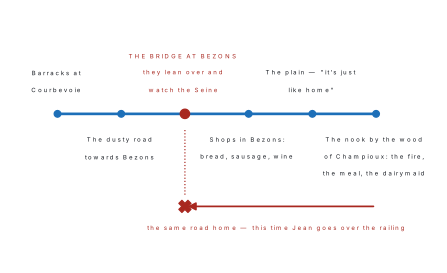
The Sunday walk. Every Sunday, as soon as they are free, two young soldiers leave their barracks at Courbevoie, near Paris, turn right and walk quickly through the town, then slow down on the dusty road towards Bezons. They are small and thin, lost inside capes too big for them, with wide red trousers and a stiff shako on the head; under it are two hollow-cheeked Breton faces with calm blue eyes. They do not talk while they march, because each already knows what the other is thinking. At the edge of the little forest of Champioux they have found a place that reminds them of home, and nowhere else makes them happy.
The bridge and the provisions. They always stop for a few minutes on the bridge at Bezons, leaning over the railing to watch the Seine and the white sails, which remind them of the fishing boats of Brittany. Once across, they buy their lunch — a piece of sausage, a few cents' worth of bread and a quart of wine — and carry it knotted in their handkerchiefs. Only when the village is behind them do they begin to speak. Jean Kerderen carries the food; Luc Le Ganidec cuts a stick and whittles it as he walks. They stop at a large stone that reminds them of a dolmen at home, and Jean says, as he says every week, "It's just like home, just like Plounivon." Maupassant describes their state precisely: they are "contented and sad", carrying the slow sorrow of a captive animal that remembers being free.
The meal. In their usual corner they dig two bricks out of a hedge, light a small fire of dry branches, and roast the sausage on the points of their knives. When the last of the bread and wine is gone they lie down side by side on the grass, silent, hands clasped, their red trousers bright among the wild flowers.
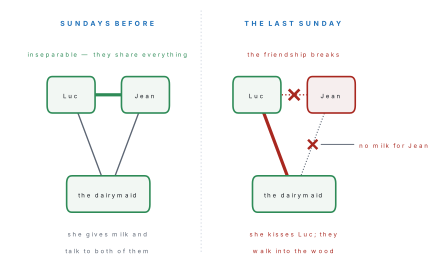
The dairymaid. Towards noon they begin to glance towards Bezons, because the dairymaid will soon pass on her way to milk the one cow in the neighbourhood. They never speak about her; they simply like watching the sun flash on her shining pail. She is a tall, strong, freckled, sunburnt girl of the Paris suburbs. One day she notices that they are always in the same place and speaks to them; the next Sunday she teases them gently about watching the grass grow; and when she comes back with her pail full she offers them milk, saying it will remind them of home. She has guessed right, and both are moved.
Growing friendship. The following week the soldiers decide to bring her a present, and after some discussion buy two sous' worth of red and white sweets, which melt slowly in Jean's pocket before he dares to hand them over. From then on the three of them sit together, telling one another small details about the villages they came from while the cow waits and lows. She begins to eat with them, to sip their wine, and to bring them plums.
The change. Then Luc begins to behave strangely: he obtains leave on a Tuesday and does not return until ten at night, borrows money from a comrade and takes leave again on the Friday. Jean notices, worries, and cannot guess what it means. On Sunday neither of them is hungry. When the girl appears, Luc gets up and walks to meet her; she sets down her pail and kisses him passionately, her arms round his neck, without so much as noticing that Jean is there.
Jean's exclusion. Jean is stunned. He understands at last where his friend went twice during the week, and he feels the particular sting of being deceived by someone he trusted. He watches the two of them go off to the cow — the red trousers of his friend making a scarlet spot against the white road — and then disappear into the wood. He is left staring at a wall of leaves, too weak to stand, wanting to cry and to run away. When they come back, hand in hand like village lovers, the girl kisses Luc again, nods carelessly to Jean, and goes. Maupassant records the cruelty in one short sentence: "She did not offer him any milk that day."
The bridge again. The two soldiers sit on as before, silent, their calm faces showing nothing; the sun shines and the cow lows in the distance. At the usual hour they rise to walk back. Luc whittles a stick, Jean carries the empty bottle and leaves it at the wine merchant's, and they stop on the bridge as they do every Sunday. Jean leans over the railing, further and further, as though something in the water were pulling him. Luc asks whether he wants a drink — and before the words are finished Jean's head has carried the rest of his body over. He falls like a shot. Luc cannot make a sound; he sees the head come up once, then a hand, then nothing. Boatmen recover the body the same day. Back at the barracks Luc, crazed and weeping, stumbles through an account of the accident. The story closes with a single line of the narrator's own: "If he had only known."
6.3 Characters
| Character | Who they are | Role in the story |
|---|---|---|
| Jean Kerderen | A young Breton conscript; carries the provisions | The quieter of the two; the one who is left out, and who dies |
| Luc Le Ganidec | A young Breton conscript; whittles a stick each week | The bolder of the two; speaks first to the girl and wins her |
| The dairymaid | A tall, freckled, sunburnt girl from the Paris suburbs; never named | Kind, ordinary, unaware of the damage she causes |
| The two villages | Plounivon, Kermarivan, the dolmen of Locneuven — home in Brittany | Present only in memory, but the true subject of the soldiers' minds |
Jean Kerderen. Maupassant gives Jean almost no speech and only a few sentences of inner life, yet he is the centre of the story. What we know about him we know from actions: he carries the food; he says every week that the countryside is just like home; he has a sweet tooth and chooses the sweets; he blushes to the tips of his ears when he hands them over. When Luc starts taking leave in the week, Jean worries without being able to guess why. After the kiss he is "dazed, so dazed that he could not understand"; his heart is broken before his mind has caught up. That is the crucial point about him. He is a simple, inarticulate boy who cannot name what has happened to him, cannot complain, and cannot ask for comfort — and so the feeling has nowhere to go. His death is the act of a person with no words.
Luc Le Ganidec. Luc is described from the first as "more daring than his friend", and every important move in the story is his: he answers the girl, he smiles back at her jokes, he takes leave in the week, he walks out to meet her, he goes into the wood with her. Yet he is not a villain. He hides nothing out of cruelty; he is simply young, in love, and completely unaware of what his happiness costs. Maupassant's last line, "If he had only known", is aimed at him, and it makes him a second victim — a boy who will spend the rest of his life not understanding what happened on that bridge.
The dairymaid. She is never named, and that is deliberate: to the story she is less a person than an event. Her kindness is genuine — she offers milk because she has guessed that it will remind them of home — and she has done nothing wrong in preferring one boy to the other. But her last small act, walking past Jean with a careless nod and no milk, is the cruellest moment in the story, precisely because she means nothing by it. Maupassant is showing how ordinary, thoughtless behaviour can destroy someone.
6.4 Themes
Homesickness and exile. The two soldiers are Bretons from a fishing and farming country, dropped into the dusty suburbs of Paris. Everything they enjoy is a substitute for home: a wood that resembles the forest of Kermarivan, a stone that resembles a dolmen, white sails on the Seine that resemble fishing boats, and milk that tastes of the country. Maupassant's simile says it exactly — their sadness is that of "a captive animal which remembers the days of its freedom". The story is about exile before it is about love.
Friendship and its fragility. The friendship is built out of shared silence and shared ritual: the same walk, the same stone, the same bricks in the hedge, the same food, the same hour. It looks unbreakable and is in fact extremely fragile, because it depends entirely on the two of them wanting the same thing at the same time. The moment Luc wants something for himself, there is nothing left to hold the friendship up.
Jealousy, betrayal and exclusion. What destroys Jean is not simply that the girl prefers Luc. It is the secrecy — the Tuesday and Friday leave, the borrowed money, the strangeness he could feel but not explain — and then the public exclusion: the kiss given without even a glance at him, and the milk not offered. Maupassant measures this with objects rather than words. A bottle that once held wine for two and then milk for two is carried home empty.
Inarticulacy: the pain that cannot be spoken. Neither soldier can say anything. Jean does not accuse, weep or ask; he sits with a calm face that betrays nothing while the sun shines and the cow lows. Maupassant's Naturalism is at work here: these are poor, uneducated country boys, and he does not give them a vocabulary they would not have. The silence is why the story is tragic rather than merely sad.
Ambiguity: accident or suicide. The text never says which it is. Jean leans over "as though he had seen something in the stream which hypnotized him"; Luc's report to the barracks calls it an accident; the narrator's closing line, "If he had only known", suggests something a witness could have prevented. Maupassant deliberately leaves both readings open, and the ambiguity is part of the story's power.
6.5 Setting, structure and point of view
Setting. The story moves between two places, one real and one remembered. The real one is the Paris suburbs of the 1880s: a barracks at Courbevoie, a dusty road, a bridge over the Seine at Bezons, a few shops, a plain with clumps of trees, and the small wood of Champioux. The remembered one is Brittany — Plounivon, Kermarivan, the dolmen of Locneuven, the fishing boats. Everything that happens in the first landscape is valued for how closely it imitates the second.
Structure. The shape of the story is repetition and then rupture. Maupassant spends the first half describing what the soldiers do every Sunday, using verbs of habit: they always stop on the bridge, they always find the two bricks, she comes every week. This lulls the reader into the same comfortable rhythm the soldiers depend on. Then one Tuesday breaks the pattern, and the last Sunday reverses it point by point: they are not hungry, the girl does not look at Jean, there is no milk, and the pause on the bridge ends differently. The final line is one sentence standing alone.
Point of view. Third person, and mostly objective — that is, the narrator watches from outside and reports what could be seen and heard. We are told the colour of their trousers and the direction of their eyes, not their thoughts. Twice, briefly, the narration slips inside Jean, to say that he was dazed and that his heart was broken without his knowing why. Those short intrusions are placed exactly where the story needs them. The final line, "If he had only known", is the narrator's own comment — the only judgement in the whole story, and it is left unfinished.
Story-telling that reports only what an observer could see and hear, without entering anyone's mind. It forces the reader to work out feelings from behaviour, which is why Maupassant's stories feel so restrained.
6.6 Literary devices
| Device | Example from the text | Effect |
|---|---|---|
| Simile | Their sadness is that of "a captive animal which remembers the days of its freedom" | Defines the condition of both soldiers in one image: tame, fed, and imprisoned |
| Symbolism | The bridge at Bezons | A place of pause and of looking at flowing water every Sunday; finally the place of death |
| Symbolism | The milk | Kindness and home; withholding it is the story's cruellest act |
| Symbolism | The whittled stick, the two hidden bricks | The tiny rituals that hold an exile's life together |
| Foreshadowing | They lean over the railing to watch the river every single week | Makes the last scene feel inevitable rather than melodramatic |
| Repetition of habit | "always", "every Sunday", "each time" | Builds the rhythm whose breaking is the plot |
| Imagery / colour | The red trousers "making a scarlet spot against the white road" | One bright detail carries Jean's whole view of the betrayal |
| Understatement | "She did not offer him any milk that day." | A small omission stands in place of a scream |
| Irony | The girl's kindness begins the friendship and ends it | Nobody in the story intends any harm, and one boy dies |
| Ambiguous ending | "If he had only known." | Leaves accident and suicide equally possible, and blames no one |
(i) Do not write confidently that Jean "committed suicide". Maupassant does not say so. The examiner wants you to notice the ambiguity and to quote the evidence on both sides — the hypnotised leaning on one hand, Luc's report of an accident on the other. (ii) Do not turn the dairymaid into a villain. She is kind, ordinary and thoughtless. The tragedy is caused by nobody's wickedness, which is exactly Maupassant's point.
6.7 Glossary
| Word / phrase | Meaning |
|---|---|
| barracks | the building where soldiers live |
| conscript | a young man forced by law to serve in the army |
| Breton | belonging to Brittany, a rural region in north-west France |
| cape | a loose sleeveless coat worn over the shoulders |
| shako | a tall, stiff military cap with a peak |
| forced march | marching fast and without rest, as in war |
| dolmen | an ancient stone monument made of large upright stones |
| fishing smack | a small boat used for fishing at sea |
| delicatessen | a shop selling cooked meats and prepared foods |
| bologna | a large smooth sausage |
| sous / cents | small coins of little value |
| to whittle | to cut small pieces off a stick with a knife, for pleasure |
| nook | a small sheltered corner |
| dairymaid | a girl employed to milk cows and handle milk |
| pail | a bucket |
| to tether | to tie an animal to a post so that it cannot wander |
| chitterlings | pig's intestines cooked as food |
| to low | (of a cow) to make a long, deep sound |
| plaintive | sounding sad; like a complaint |
| treachery | betrayal of someone who trusted you |
| dazed | unable to think clearly after a shock |
| unmanned | robbed of strength or courage |
| railing | a fence of metal bars along the edge of a bridge |
Two questions come up again and again: "How does Maupassant prepare us for the ending?" and "Was it an accident or suicide?" For the first, list the habitual details — the weekly pause on the bridge, the leaning over the railing, the repeated word "always" — and show that the ending uses material planted in the first page. For the second, give both readings with evidence and then say plainly that the author leaves it open. Never invent a motive the text does not supply.
Chapter summary
- Guy de Maupassant (1850–1893), French Realist and Naturalist, pupil of Flaubert, author of about three hundred stories including "Boule de Suif" and "The Necklace"; he died in an asylum at forty-two.
- Two young Breton soldiers, Luc Le Ganidec and Jean Kerderen, walk every Sunday from their barracks at Courbevoie, over the bridge at Bezons, to a spot near the wood of Champioux that reminds them of home.
- Their ritual is fixed: the pause on the bridge, the cheap provisions, the hidden bricks, the fire, the sausage, the silence on the grass.
- A dairymaid begins to speak to them, gives them milk "to remind them of home", accepts their two sous' worth of sweets, and joins their Sunday meal.
- Luc secretly takes leave twice in one week; on the next Sunday the girl kisses him in front of Jean, and the two go off into the wood together.
- Jean is stunned and silent; the girl walks past him with a careless nod, and Maupassant notes simply that she did not offer him any milk that day.
- On the walk home they stop on the bridge as always; Jean leans further and further over the railing and falls into the Seine. Boatmen recover the body.
- Luc reports an accident, and the story ends with the narrator's line, "If he had only known."
- Themes: homesickness and exile, fragile friendship, jealousy and exclusion, the pain that cannot be put into words, and an ending deliberately left ambiguous.
Practice questions
Short answer questions (2 marks each)
- Why do the two soldiers go to the same place every Sunday? [2]
- Describe the two soldiers' Sunday meal. [2]
- How does the dairymaid first show kindness to the soldiers? [2]
- What does Luc do during the week that puzzles Jean? [2]
- Why is the sentence "She did not offer him any milk that day" important? [2]
- How does the story end, and what is the last line? [2]
Model answers — short questions
1. Because the place at the edge of the wood of Champioux reminds them of Brittany. The trees recall the forest of Kermarivan, a large stone recalls the dolmen of Locneuven, and the fields look like Plounivon. Being homesick conscripts, they feel happy nowhere else.
2. They buy a piece of sausage, a few cents' worth of bread and a quart of wine in Bezons and carry it wrapped in their handkerchiefs. At their usual corner they take two bricks out of a hedge, light a fire of dry branches and roast the sausage on the points of their knives, then lie on the grass side by side.
3. Seeing that they always sit in the same spot, she speaks to them and teases them gently; then, returning with her pail full, she offers them milk, saying it will remind them of home. She has guessed exactly what they are missing, and both soldiers are moved.
4. He obtains leave on a Tuesday and does not come back until ten at night, and then borrows ten sous from a comrade and takes leave again on the Friday. On Sunday he seems strange and disturbed. Jean notices all this, suspects something, but cannot guess that Luc has been meeting the dairymaid.
5. Because it is the moment Jean's exclusion becomes complete. The milk had been the sign that the girl treated the two friends alike and understood their homesickness; withholding it, with only a careless nod, tells him wordlessly that he is now outside. Maupassant replaces any description of Jean's despair with this one small omission.
6. On the walk home they stop on the bridge at Bezons as they always do. Jean leans further and further over the railing, as if hypnotised by the water, and falls into the Seine; boatmen recover his body the same day. Luc, weeping, reports it at the barracks as an accident, and the story ends with the line "If he had only known."
Long answer questions (5 marks each)
- Discuss "Two Little Soldiers" as a study of homesickness and friendship. [5]
- How does Maupassant prepare the reader for the ending of the story? [5]
- Was Jean's death an accident or suicide? Examine the evidence in the story. [5]
Model answers — long questions
1. Everything the two soldiers value in the story is a substitute for Brittany. They are conscripts from a fishing and farming country, shut up in a barracks at Courbevoie, and their one pleasure is a walk to a wood that resembles the forest of Kermarivan. On the way they stop on the bridge to watch white sails that recall their fishing boats; they halt at a stone because it is like the dolmen of Locneuven; Jean says every week that the fields are just like Plounivon; and the dairymaid's milk is welcome mainly because, as she says, it will remind them of home. Maupassant sums up their condition in a single simile — the slow sorrow of a captive animal that remembers its freedom. Their friendship grows directly out of this exile. They are not friends because they are alike in character; they are friends because they come from the same country and want the same thing at the same moments, which is why they can walk for an hour without speaking. Such a friendship looks solid and is in fact very fragile: it has no words in it, no agreements, no way of handling a disagreement. When Luc begins to want something of his own, the whole structure falls, and Jean, who has nothing else in the world, falls with it.
2. The ending is shocking but not sudden, because almost every element of it has already been planted. The bridge at Bezons is introduced in the third paragraph, and we are told that the soldiers always stop there for several minutes, bending over the railing to watch the Seine. The reader therefore accepts the final pause on the bridge as ordinary, which is precisely why it is dangerous. Maupassant also establishes the men's total silence: they walk for long stretches without a word, and their faces never betray anything, so that when Jean is destroyed we are warned that nothing will be said about it. The last Sunday is then written as a systematic reversal of the habits we have learned — neither of them is hungry, the girl does not glance at Jean, there is no milk, and the walk home is conducted with the empty bottle. Small physical details do the rest: Jean's inability to stand, the "wall of leaves" through which the lovers vanish, the sun and the lowing cow indifferent behind them. By the time Jean leans over the railing "as though he had seen something in the stream which hypnotized him", the reader has all the material needed, and the fall takes one sentence.
3. Maupassant deliberately refuses to decide, and a good answer holds both readings. The case for suicide is strong. Jean has just been shown, in public, that he has lost both his friend and the girl; he is described as dazed, heart-broken, too weak to stand, wanting to run away and never see anyone again; he is a boy with no words for his feelings and nobody to tell them to; and he leans over the railing "further and further", as if hypnotised, at the very moment when he has nothing left. The narrator's closing line, "If he had only known", strongly implies that Luc might have prevented it had he understood — which suits a suicide better than a slip. On the other side, nothing is stated. The text says that Jean's head carried the rest of his body away, which is the language of an accident; Luc, the only witness, reports it as one; and the two of them had leant over that railing every Sunday for months without harm. It is also true to the characters that Jean, who cannot even speak his grief, might not be capable of forming an intention. The ambiguity is the point: Maupassant shows a death that arises naturally out of despair without ever accusing anyone of anything.
Reference to the context
- "It's just like home, just like Plounivon."
(a) Who says this, and to whom? (b) Where are the speakers at this moment? (c) Why does the speaker say it "each time"? (d) What does the line tell us about the two soldiers' lives? [5]
- "If he had only known."
(a) Where does this sentence appear in the story? (b) Who is "he", and what is it that he did not know? (c) What has just happened? (d) Why does Maupassant end the story in this way? [5]
Model answers — reference to the context
1. (a) The words are spoken by Jean Kerderen to his friend Luc Le Ganidec, and Luc agrees with him. (b) They are on the narrow path across the plain between the village of Bezons and the little wood of Champioux, with wheat and oat fields on either side, on their usual Sunday walk from the barracks at Courbevoie. (c) He says it every single week because the whole outing is a ritual of remembering: the two Breton boys come to this place precisely because it resembles their home, and repeating the sentence is part of the pleasure. (d) It tells us that their real lives are elsewhere. They are conscripts far from Brittany, poor, homesick and inarticulate, and they survive by finding substitutes — a wood like Kermarivan, a stone like the dolmen of Locneuven, sails like their fishing boats. Their friendship rests entirely on this shared longing.
2. (a) It is the last sentence of the story, standing alone after Luc's broken report at the barracks. (b) "He" is Luc Le Ganidec, and what he did not know was the state of his friend's mind — that by winning the dairymaid in secret and then kissing her in front of Jean, he had taken away the only thing Jean had. (c) On the walk home the two had stopped on the bridge at Bezons as they always did; Jean leant further and further over the railing, as though hypnotised by the water, and fell into the Seine, where he drowned; boatmen recovered his body the same day. (d) Because it says the least possible and implies the most. It hints that the death could have been prevented, and therefore that it may not have been an accident, without ever stating it; it makes Luc a second victim, condemned to a lifetime of not understanding; and it leaves the reader to supply the grief that no character in the story is able to express.
Practise more: English question bank