Unit 19 · Literature - One Act Plays · 45 min read
A Sunny Morning
What the syllabus asks for 8
- About the authors
- The characters
- The play, step by step
- The shape of the morning
- The two central questions
- Themes
- Humour, irony and technique
- Glossary
Two old people quarrel over a park bench. Within twenty minutes they have discovered that fifty years ago they were lovers — and each decides, separately and silently, not to say so. A Sunny Morning is a comedy that turns, without a single raised voice, into one of the gentlest love scenes in modern drama.
The plot in order (the birds, the quarrel, the snuff, the poem, Maricela, the two lies, the violets); when and how each recognises the other; why neither confesses; the two invented deaths and what they reveal; the humour and irony; the symbols — the sunny morning, autumn, the birds, the violets, the Campoamor verses; and the justification of the title.
19.1 About the authors
Serafín Álvarez Quintero (1871–1938) and Joaquín Álvarez Quintero (1873–1944) were Spanish dramatists — brothers who wrote everything together and never published a line separately. They grew up in Utrera, a small town near Seville in the southern Spanish region of Andalusia, and began writing for the theatre while still very young. In Madrid they became so successful so early that they were known as "the Golden Boys of the Madrid theatre."
Between them they wrote almost 200 plays, nearly all of them depicting the life, manners and speech of Andalusia. Their first stage piece, Gilito, was written in 1889. Their best-known works are the comedies The Flowers (1901), A Sunny Morning (1905) and The Merry Heart (1906), together with the uncharacteristically serious Malvaloca (1912). Several of their plays were translated into English by Helen and Harley Granville-Barker (1927–32), and their complete works appeared in seven volumes as Obras Completas in the early 1950s.
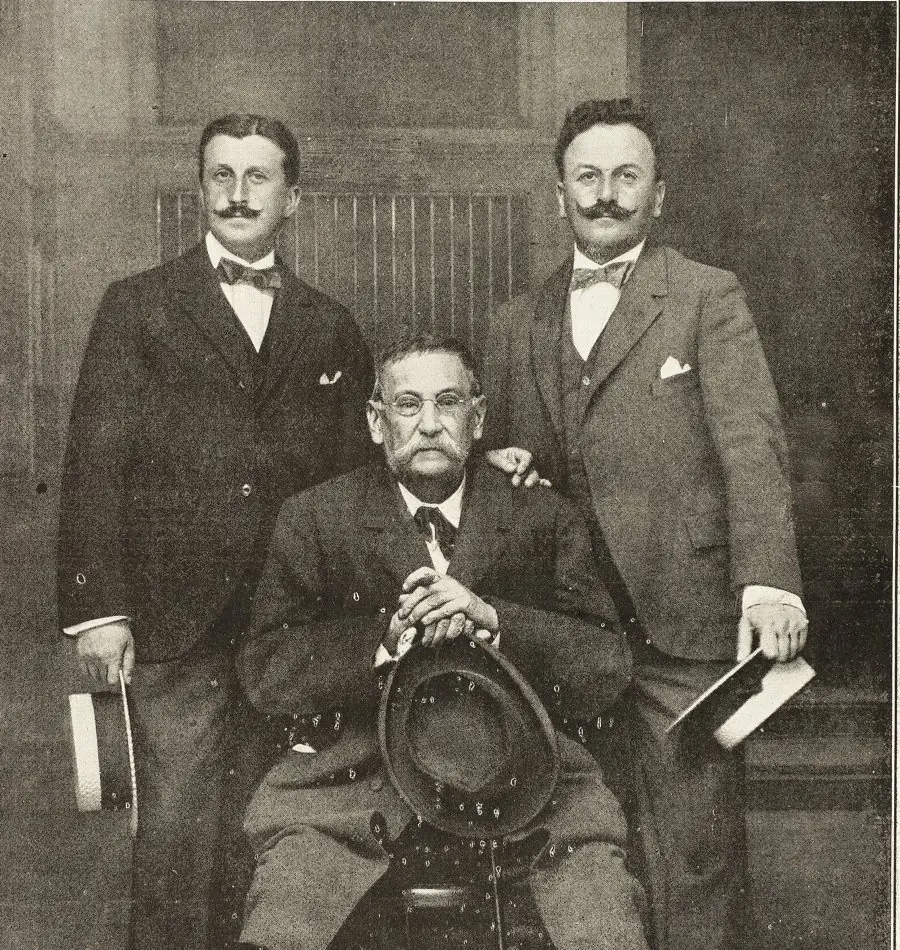
A Sunny Morning (in Spanish, Mañana de sol) was first staged in 1905. The version in your textbook is the English translation by Lucretia Xavier Floyd. It is a paso de comedia — a short comic sketch built on one situation, two characters and a single change of feeling — and it is the brothers' most famous piece outside Spain.
Your textbook prints the names without Spanish accents: Dona Laura, Don Gonzalo, Serafin and Joaquin Alvarez Quintero. In correct Spanish they are Doña, Serafín, Joaquín, Álvarez. Write them as the question paper writes them; both forms are accepted. Don and Doña are respectful titles placed before a first name, roughly like "Sir" and "Madam" — so "Don Gonzalo" means something close to "the gentleman Gonzalo".
19.2 The characters
| Character | Who they are |
|---|---|
| Dona Laura | "a handsome, white-haired old lady of about seventy, refined in appearance", with bright eyes and undimmed wits; once Laura Llorente, "The Silver Maiden" of the villa Maricela |
| Don Gonzalo | "an old gentleman of seventy, gouty and impatient"; once the gallant horseman who fought a duel over her |
| Petra | Dona Laura's maid, about twenty, in love with a park guard |
| Juanito | Don Gonzalo's servant, who "plays havoc with the nursemaids" |
The two servants are not decoration. Petra's guard sends violets and Juanito's flirting keeps him away from the bench; the young lovers' easy, thoughtless courtship runs in the background of a love affair that was destroyed fifty years ago. The violets that end the play come from Petra's romance, not from Laura's.
19.3 The play, step by step
1. The bench and the birds
The scene is "a retired corner of a park in Madrid. Autumn." Dona Laura arrives on Petra's arm, pleased to find "my seat" unoccupied, and sends the girl off to her guard with the instruction not to stay more than ten minutes. She then feeds the pigeons with the tenderness of a woman who has nobody else to talk to: "These are for the spryest, these for the gluttons, and these for the little ones which are the most persistent… That one takes his piece and flies up to that branch alone. He is a philosopher."
That little speech does a great deal of work. It shows her warmth, her humour, her loneliness and her habit of turning everything into a small story — the same habit that will later produce a magnificent lie about a woman drowning in the sea.
2. The quarrel
Don Gonzalo arrives grumbling about priests who are "idling their time away", wants a bench to himself, orders Juanito to "rout them out", and then walks straight through Laura's pigeons. She rebukes him — "You have scared away the birds who were feeding on my crumbs" — and the two fall at once into a delightful bad-tempered duel of words:
- "What do I care about the birds?" / "But I do."
- "This is a public park." / "Then why do you complain that the priests have taken your bench?"
- "Do you use your handkerchief as a shoe brush?" / "Why not?" / "Do you use a shoe brush as a handkerchief?"
He mutters that she is a "senile old lady" who "ought to be at home knitting and counting her beads"; she tells him she is "not going to leave just to please you." Both are showing off, and both are enjoying themselves far more than they admit.
3. The truce: snuff
He calls for his book and puts on "an enormous pair of glasses" plus a reading glass; she says she thought he was taking out a telescope. They boast — he about hunting hares and partridges and a wild boar's head in his study, she about a tiger's skin in her boudoir. Then he offers her a pinch of snuff, they sneeze three times each, and the quarrel is over. Her aside is one of the best lines in the play: "The snuff has made peace between us."
It is worth noticing how the reconciliation is achieved — not by apology or argument, but by a shared physical comedy and a small courtesy. The play's method throughout is to let objects do the work that speeches would do in a lesser piece.
4. The poem
Don Gonzalo reads aloud from Ramón de Campoamor: "All love is sad, but sad as it is, it is the best thing that we know," and then a line he takes to be humorous — "The daughters of the mothers I once loved kiss me now as they would a graven image." Laura laughs; the audience is beginning to be uneasy.
Then he reads a title: "Twenty years pass. He returns." She claims she can read without glasses, takes the book, and recites:
"Twenty years pass. He returns. And each, beholding the other, exclaims — Can it be that this is he? Heavens, is it she?"
Her aside gives the game away to the audience: "I know every word by heart." This is superb dramatic construction. The poem describes exactly what is happening on the bench; the audience understands this before either character does; and the same two lines will come back as the final words of the play.
5. Recognition
Gonzalo mentions Valencia, his native city; Laura mentions a villa near the sea, hidden among lemon and orange trees, called Maricela. He is startled. He remembers the most beautiful woman he ever saw there — "Laura — Laura — Laura Llorente." She is startled in turn, recovers, and says he has reminded her of "my best friend."
From this moment both know, and each believes the other does not. They construct the fiction together: he is speaking of his cousin, she of her friend. Behind that thin screen they reconstruct their own love affair in perfect detail — the window with the red roses, the horseman who tossed up a bouquet each morning and caught the flowers she threw down each afternoon, the merchant her parents wanted her to marry, the insult under the window, the duel at sunrise on the beach.
They even catch each other out: "You seem to know the story well." "And so do you." And two asides confirm what the audience already knows: "This is Laura!" and "Why tell him? He does not suspect."
6. The two lies
Each now has to explain why the lovers never met again, and each invents a magnificent death.
Gonzalo's version: the letters were intercepted by Laura's parents, so she never answered; Gonzalo, "in despair, believing his love lost to him forever, joined the army, went to Africa, and there, in a trench, met a glorious death, grasping the flag of Spain and whispering the name of his beloved Laura." His private comment: "I could not have killed myself more gloriously." Hers: "What an atrocious lie!"
Laura's version: the Silver Maiden waited "days, months, a year", then walked at sunset to the beach, wrote his name on the sand, sat on a rock gazing at the horizon, and was swept out to sea by the rising tide; the fishermen say it was a long time before the waves washed the name away. Her private comment: "You will not get ahead of me in decorating my own funeral." His: "She lies worse than I do."
Then the two asides that tell the truth, and that always get the biggest laugh in performance:
- LAURA: "I will not tell him that I married two years later."
- GONZALO: "In three months I ran off to Paris with a ballet dancer."
7. The violets, and the decision not to speak
The mood softens. They agree the morning has been curious, he admits "I was unreasonable, perhaps", and she asks — "(Sweetly.)" — whether he is coming tomorrow. He promises to bring crumbs for the birds.
Then, with their backs to one another, each makes the same decision in the same words. Gonzalo: "No, no, I will not reveal myself. I am grotesque now. Better that she recall the gallant horseman who passed daily beneath her window tossing flowers." Laura: "No, I am too sadly changed. It is better he should remember me as the black eyed girl tossing flowers as he passed among the roses in the garden."
Petra brings violets from her guard, and a few fall as Laura takes them. The lovers say goodbye "until tomorrow — if it is sunny." And then, "trembling and with a great effort", Don Gonzalo stoops to pick up the fallen violets — and Laura turns and sees him do it. The two asides land together: "Yes, it is he!" — "It is she, and no mistake." They wave, quote Campoamor's two lines to each other, "smile once more, as if she were again at the window and he below in the rose garden," and go out on the arms of their servants.

19.4 The shape of the morning
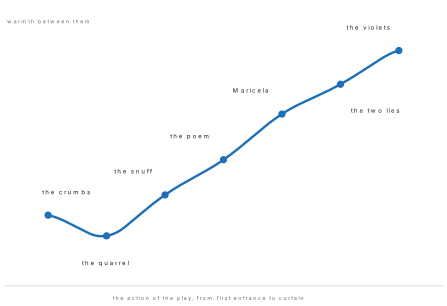
The play is built on one continuous change of feeling, from hostility to tenderness, and every stage of it is produced by a small physical object rather than by a speech.
19.5 The two central questions
When do they recognise each other?
This is the question examiners ask most often, and the answer has to be given in stages, because the play deliberately separates suspecting, knowing and admitting.
- The first tremor comes with the name Maricela, at which Gonzalo is "(Startled.)", and then with Laura Llorente and "The Silver Maiden", at which Laura is startled in her turn. The stage direction says "They look at each other intently."
- Certainty arrives during the story of the duel, and the play marks the exact moment with two asides: Gonzalo's "This is Laura!" and Laura's "Gonzalo!" From here each knows, and each wrongly believes the other has not guessed — "She is entirely innocent", "He does not suspect."
- Mutual, acknowledged recognition is the last beat of the play. Gonzalo stoops painfully for the violets she has dropped; Laura turns and sees; and the asides finally agree — "Yes, it is he!" / "It is she, and no mistake."
So they recognise each other in the middle of the play, but they let each other know it only in the final seconds, and even then without a word spoken directly.
Why do neither of them tell the truth?
Two reasons, and the second is the important one.
Vanity — but a tender kind. Each is ashamed of what age has done. "I am grotesque now," says Gonzalo. "I am too sadly changed," says Laura. Neither can bear to be seen as the ruin of the person the other loved.
Protection of the memory. Look at how both sentences end. Gonzalo: "Better that she recall the gallant horseman who passed daily beneath her window tossing flowers." Laura: "It is better he should remember me as the black eyed girl tossing flowers as he passed among the roses in the garden." Each is protecting not his own dignity but the other person's memory. Confession would cost them both the only beautiful thing they still possess. Their silence is therefore an act of love, not of cowardice — and this is why the ending feels happy rather than sad.
There is a third, smaller reason, and it is comic: each has told an enormous lie about the other's death, and neither can now confess without also confessing the lie.
19.6 Themes
Love survives everything, including the lovers. Fifty years, a duel, a marriage, a ballet dancer in Paris and two elaborate lies have not touched what Laura and Gonzalo felt. The proof is not a speech but an action: a gouty old man bending down, "trembling and with a great effort", for three fallen violets.
Age, and the comedy of it. The play is completely honest about old age — the enormous spectacles, the reading glass, the gout, the dragging feet, the grumbling, the boasting about hunting. But it laughs with them, never at them. The joke is that these two quarrelsome pensioners still have all the energy of twenty-year-olds; they simply spend it on benches and birds instead of balconies and duels.
Illusion as kindness. The lies in this play are not sins. They protect, they flatter, and they preserve. The play quietly argues that what we remember matters as much as what happened, and that it can be right to leave a beautiful memory undisturbed.
Appearance and reality. Almost nothing in the play is what it first appears — the rude old man is a devoted lover, the "cousin" is himself, the "best friend" is herself, the glorious death in Africa was a trip to Paris, and the quarrel is a courtship.
Chance and Providence. "The ways of Providence are strange," says Laura, and "Fate is curious." The entire reunion depends on three priests refusing to give up a bench.
Youth beside age. Petra and Juanito are flirting at the edge of the stage throughout, and the violets that end the play are the young guard's gift. Love looks careless and easy at twenty and costs a great effort at seventy; the play puts both on stage at once.
19.7 Humour, irony and technique
The comedy of bad temper. The opening quarrel is pure comedy of manners: two proud people competing over a public bench, each claiming ownership of what they have just called public property. Gonzalo demands the priests be "routed out" from "that one over there — it is mine", and thirty seconds later insists "the benches here are public property." Laura catches him at it instantly.
Repartee. The dialogue is built on quick reversals in which the second speaker turns the first speaker's own words around: shoe brush and handkerchief; "Yes, kill time. That is all you kill"; the wild boar's head answered by a tiger's skin.
Comic exaggeration. The telescope-sized glasses, the sneezing three times each in alternation, "You must have gone with Columbus in one of his caravels!", and the two competing deaths — which are really a contest in melodrama, as their asides admit.
Dramatic irony, and lots of it. The audience knows who they are long before they admit it; the audience knows both stories are false; the audience knows that each has guessed. So every line carries a second meaning. "The daughters of the mothers I once loved kiss me now as they would a graven image" is read out as a joke by a man who is sitting beside a woman he once loved. "You seem to know the story well" is a trap that the speaker has also walked into. Perhaps the finest touch is Gonzalo's calm "Very sad" when Laura mentions her friend's sad love affair; the affair was his own.
The aside. This is the play's central device, and you should be able to name it. An aside is a remark spoken to the audience which the other characters on stage are supposed not to hear. The Quinteros use asides as a private channel of truth running underneath the public channel of lies, and almost every important fact in the play — the marriage, the ballet dancer, "This is Laura!", "I know every word by heart" — reaches us that way.
Narrated flashback. There is no change of scene and no dramatised memory; the past is delivered entirely through the two characters' talk about "my cousin" and "my friend". This is far more effective than staging it would be, because the reconstruction is also a recognition scene: with every detail they add, they come closer to naming each other.
Foreshadowing through the quoted poem. "Twenty years pass. He returns. And each, beholding the other, exclaims — Can it be that this is he? Heavens, is it she?" The Campoamor lines predict the ending in the middle of the play, and by giving those same lines to the two lovers as the last words of the play the brothers turn a poem the audience has already heard into the curtain line.
Symbolism. - The sunny morning — warmth and late happiness; the play's condition for meeting again is "if it is sunny." - Autumn — the season of the year that matches the season of their lives: beautiful, mild, and late. - The birds and the crumbs — Laura's need to give affection to something. His promise to bring crumbs tomorrow is the play's real proposal of marriage. - The violets — a gift of love passed down from the young couple to the old one; picking them up is the play's one physical act of devotion. - The flowers of the past — the bouquet thrown up to the balcony and thrown back down, which the last stage direction recalls: they smile "as if she were again at the window and he below in the rose garden."
| Device | Example | What it does |
|---|---|---|
| Aside | "In three months I ran off to Paris with a ballet dancer." | Gives the audience the truth the characters are hiding |
| Dramatic irony | "Very sad." (of his own love affair) | Makes ordinary sentences carry a hidden second meaning |
| Repartee | "Do you use a shoe brush as a handkerchief?" | Establishes that these two are equals, and enjoy the fight |
| Foreshadowing | "Twenty years pass. He returns…" | Predicts the ending and later supplies the curtain line |
| Symbol | the violets picked up "trembling and with a great effort" | Proves love survives, without a word of declaration |
| Understatement | "I was unreasonable, perhaps." | Comic apology from a man who chased away the birds |
| Hyperbole | dying "grasping the flag of Spain"; drowning at sunset | Mocks romantic cliché while revealing what each still feels |
| Parallelism | his "I am grotesque now" / her "I am too sadly changed" | Shows the two making the same decision independently |
| Frame | the Campoamor lines heard twice | Turns the whole play into the poem it quotes |
19.8 Glossary
| Word | Meaning |
|---|---|
| atrocious | very bad; shocking |
| boudoir | a woman's private bedroom or sitting room |
| caravels | small sailing ships built in Spain and Portugal in the fifteenth century |
| duel | a fight with weapons between two people to settle a point of honour |
| glutton | a greedy eater |
| gouty | suffering from gout, a painful swelling of the joints |
| graven | carved |
| grotesque | ugly or distorted, in a way that is almost comic |
| indignant | angry at something felt to be unjust |
| Mass | the main service of worship in the Roman Catholic Church |
| parasol | a light umbrella used as a shade from the sun |
| Providence | the power believed to shape human fate; God |
| senora / senor | Spanish for "madam" / "sir" |
| snuff | powdered tobacco, taken by sniffing |
| spry | active and lively, especially in old age |
| threnody | a song of lament for the dead |
An aside is a short remark a character speaks to the audience (or to himself) which the other characters on stage are conventionally unable to hear. A soliloquy is a whole speech delivered by a character alone on stage. A Sunny Morning is built almost entirely on asides; there is no soliloquy in it, so do not use that word in an answer about this play.
The one-sentence answer to "what is this play about?"
It is about two people who recognise each other and choose not to say so, in order to protect the memory each has of the other's youth. Every question about theme, irony, title or ending can be answered from that sentence.
Chapter summary
- A Sunny Morning (Mañana de sol, 1905) is a one-act comedy by the Spanish brothers Serafín (1871–1938) and Joaquín (1873–1944) Álvarez Quintero of Andalusia, translated by Lucretia Xavier Floyd.
- Setting: a retired corner of a park in Madrid, on a sunny autumn morning; a single bench; four characters; continuous action.
- Dona Laura, seventy, is feeding pigeons when Don Gonzalo, seventy and gouty, scatters them. They quarrel over the bench and the birds; a pinch of snuff makes peace.
- He reads Campoamor aloud; she recites "Twenty years pass. He returns…" without glasses, knowing it by heart.
- Mentions of Valencia, the villa Maricela, Laura Llorente and "The Silver Maiden" bring the past back. Speaking of "my cousin" and "my friend", they retell their own love story: the flowers thrown to the balcony, the merchant, the insult, the duel at sunrise.
- Each invents a noble death for the missing lover — his in a trench in Africa, hers in the rising tide — and each privately knows the other is lying. Their asides reveal the truth: she married two years later, he ran off to Paris with a ballet dancer in three months.
- Neither reveals himself. He: "I am grotesque now." She: "I am too sadly changed." Each wants the other to keep the young image.
- Petra brings violets; some fall; Gonzalo stoops "trembling and with a great effort" to pick them up and Laura sees him. "Yes, it is he!" — "It is she, and no mistake."
- They part quoting the poem — "Can it be that this is he?" / "Heavens, is it she?" — and agree to meet again tomorrow, if it is sunny, when he will bring crumbs for the birds.
- Techniques: asides, dramatic irony, narrated flashback, repartee, comic exaggeration, and symbols (sunny morning, autumn, birds, violets, the quoted verses).
Practice questions
Short answer questions (2 marks each)
- What makes Dona Laura think that Don Gonzalo is an ill-natured man? [2]
- Why do neither Dona Laura nor Don Gonzalo reveal their true identities? [2]
- At what point of time do you think Laura and Gonzalo begin to recognise each other? [2]
- When does Dona Laura realise that Don Gonzalo was her former lover? [2]
- Why do Dona Laura and Don Gonzalo spin fictitious stories about themselves? [2]
- How do Dona Laura and Don Gonzalo feel about each other at the end of the play? [2]
- What part do the snuff and the violets play in the action? [2]
Model answers — short questions
1. His behaviour from the moment he enters. He grumbles that the people in the park are "idling their time away", demands a bench to himself, orders Juanito to "rout out" three priests who are sitting on "his" bench, and then walks straight through Dona Laura's pigeons, scattering the birds she is feeding. When she protests he answers, "What do I care about the birds?" and refuses even to speak to her because "we have not met". Her verdict is immediate: "What an ill-natured old man! Why must people get so fussy and cross when they reach a certain age?" She is also, of course, delighted when he fails to get the other bench — which shows she is quite as combative as he is.
2. Because each is ashamed of having grown old, and each wants to protect the other's memory of their youth. The two asides are almost identical in feeling. Gonzalo: "No, no, I will not reveal myself. I am grotesque now. Better that she recall the gallant horseman who passed daily beneath her window tossing flowers." Laura: "No, I am too sadly changed. It is better he should remember me as the black eyed girl tossing flowers as he passed among the roses in the garden." Their silence is therefore not deceit but consideration — each would rather be remembered beautifully than be recognised. A comic reason reinforces it: each has just invented a heroic death for the other's beloved, and confessing now would mean confessing the lie.
3. They begin to recognise each other when the conversation turns to Valencia and the villa Maricela. Gonzalo says he is a native of Valencia; Laura mentions a villa near the sea, hidden among lemon and orange trees, "Maricela" — and the stage direction reads "(Startled.) Maricela?" He then produces the name "Laura Llorente", and it is her turn to be startled: "(Startled.) Laura Llorente?" "They look at each other intently." From that exchange onwards both suspect, and by the end of the duel story both are certain, as their asides show — "This is Laura!" and "Gonzalo!"
4. Laura is certain during the retelling of the duel, when Gonzalo describes "my cousin" hiding in his house, escaping to Seville and then Madrid, and writing letters that were never answered. Her aside "Gonzalo!" comes even earlier, at the words "the gallant lover". But the final, acknowledged realisation comes at the very end, when she turns her head and sees him stooping, "trembling and with a great effort", to pick up the violets she has dropped, and says to herself, "Yes, it is he!" The sequence matters: she knows who he is quite early, but she knows he still loves her only in the last few seconds.
5. For three reasons. First, self-defence — each has to explain why the lovers never met again, and the truth is unflattering: he ran off to Paris with a ballet dancer within three months, and she married someone else within two years. Second, romance — having decided to keep the past beautiful, each decorates it, turning a shabby ending into a glorious death in Africa and a tragic drowning at sunset. Third, competition, which is where the comedy lies: Laura's aside "You will not get ahead of me in decorating my own funeral" shows that once he has told a splendid lie she is determined to tell a better one. Each privately sees through the other: "What an atrocious lie!" and "She lies worse than I do."
6. With deep and undiminished affection, mixed with amusement and a little sadness. They begin as enemies and end unable to bear parting: they agree to meet again tomorrow on the same bench, he promises to bring crumbs for her birds, and he tells her the morning "has been a great honour and a great pleasure." The feeling is proved by actions rather than statements — his painful stooping for the violets, her "(Sweetly.) Are you coming again tomorrow?" — and it is sealed when they quote the Campoamor lines to each other and smile "as if she were again at the window and he below in the rose garden."
7. Both are small objects that carry the whole movement of the play. The snuff ends the quarrel: he offers his box, she accepts, they sneeze three times each, and she says in an aside, "The snuff has made peace between us." It is the hinge of the play — without that shared courtesy the two would never have talked. The violets, brought by Petra from her guard, end the play: as Laura takes them a few fall, and Gonzalo stoops painfully to pick them up. That action reveals his feeling and brings about the final recognition. Together they show the Quinteros' method: feeling is conveyed through objects and gestures rather than declarations.
Long answer questions (5 marks each)
- What is the effect of the flashback in the play, when Dona Laura and Don Gonzalo learn that they were lovers in the past? [5]
- Discuss how the play is built around humour and irony. [5]
- How is the title "A Sunny Morning" justifiable? Discuss. [5]
- Was it wise for Dona Laura and Don Gonzalo to keep their identities secret? What do you predict will happen at their next meeting? [5]
- Write a summary of the play. [5]
Model answers — long questions
1. The flashback in A Sunny Morning is unusual: nothing is staged, no scene changes, and no character steps back in time. The past is delivered entirely through dialogue, and — this is the crucial point — through a disguise. Gonzalo speaks of "my cousin" and Laura of "my best friend", so that the two lovers narrate their own history while pretending it belongs to other people. The effects are several and all of them are dramatic rather than decorative.
It supplies the whole background without stopping the play. In three or four minutes the audience learns of the villa Maricela, the window with the red roses, the girl called "The Silver Maiden", the horseman who threw up a bouquet each morning and caught one each afternoon, the merchant her parents preferred, the insult beneath the window, and the duel at sunrise on the beach. All of it arrives as conversation between two strangers on a bench, so exposition and action are the same thing.
It becomes the recognition scene. Each detail one of them adds is also a clue to the other. "You seem to know the story well." "And so do you." The flashback is therefore not an interruption of the plot but the plot itself: the past is the mechanism by which the present is discovered.
It creates the play's central irony. Because the audience works out the truth before the characters admit it, every sentence of the flashback carries two meanings. When Laura says of her friend, "She was very unfortunate and had a sad love affair," and Gonzalo replies simply "Very sad," we are watching two people discuss their own tragedy with perfect politeness, which is both funny and painful.
It measures the distance travelled. Setting the black-eyed girl at the window and the gallant horseman among the roses beside the white-haired lady with a parasol and the gouty gentleman with a reading glass is what gives the comedy its undertow of sadness, and what makes both of them decide to stay silent.
And it sets up the ending. Because the audience has been shown the bouquet thrown up to the balcony, the final stage direction — they smile "as if she were again at the window and he below in the rose garden" — can restore the whole past in one image, and the violets Gonzalo stoops for are recognisably the same flowers fifty years later.
2. The play is a comedy that keeps turning into a love scene, and the two effects are produced by the same means.
The humour of character. Both old people are vain, quarrelsome and thoroughly enjoying themselves. Gonzalo demands a bench "to himself" in a public park, wants three priests "routed out", and then lectures Laura that "the benches here are public property" — an inconsistency she pounces on at once. He boasts about killing hares and partridges and about a wild boar's head in his study; she answers, "Yes, kill time. That is all you kill," and trumps him with a tiger's skin in her boudoir.
The humour of physical comedy. The "enormous pair of glasses" plus a reading glass, which make Laura say "I thought you were taking out a telescope"; the two of them sneezing three times each in alternation after the snuff; and the old man dragging his feet so that "a carriage would not raise more dust."
The humour of repartee. "Do you use your handkerchief as a shoe brush?" / "Why not?" / "Do you use a shoe brush as a handkerchief?" The dialogue works by reversal, each speaker turning the other's own words round — which is also how we learn that these two are perfectly matched.
Verbal irony is everywhere in the first half. Laura's "You are very polite" to a man who has just refused to listen to her; her delight when he loses the other bench too, "Serves him right for scaring the birds."
Dramatic irony governs the second half and gives the play its depth. The audience knows who these people are long before they say so, so ordinary lines acquire a double meaning: "The daughters of the mothers I once loved kiss me now as they would a graven image", read out as a joke by a man beside the woman he loved; "Very sad", said of his own ruined love affair; "Fate is curious. Here are you and I, complete strangers…" said by a woman who knows they are nothing of the kind. The two elaborate lies are the high point, because each character is simultaneously deceiving, being deceived, and privately seeing through the deception — "She lies worse than I do."
Situational irony frames the whole piece: a quarrel about scattered birds becomes a reunion of lovers, and two people who have spent fifty years apart, when finally given the chance to speak, agree to say nothing.
Finally, and most importantly, the humour is never cruel. The Quinteros laugh at old age — the gout, the spectacles, the boasting, the melodrama — while giving their two old people more dignity and more feeling than most young stage lovers have. That combination of laughter and tenderness is the play's real achievement, and it is why the ending can be funny and moving in the same breath.
3. The title is justified on at least four levels, and a good answer should climb from the literal to the symbolic.
Literally, it names the setting. The opening stage direction reads, "A sunny morning in a retired corner of a park in Madrid. Autumn." Dona Laura's first words are "I am so glad to be here… What a beautiful morning!" and Petra replies that the sun is hot. The entire action takes place on that one morning, in real time, in sunshine.
Structurally, the sunshine causes the plot. It is the sunny morning that brings both old people out of doors, fills the benches, leaves the three priests comfortably settled on the one Gonzalo wants, and so forces him to sit beside the only lady in the park. He says so himself: "The authorities should place more benches here for these sunny mornings. Well, I suppose I must resign myself and sit on the bench with the old lady." Without the sun there is no meeting.
Symbolically, the sun is the warmth that grows between them. The play begins cold — a scattering of birds, insults, "senile old lady" — and ends in a glow of affection. Set against autumn, the season of the play, the sunshine becomes an exact image of what the Quinteros are describing: brightness late in the year, beauty in the season of decline, a last warm day in two long lives.
In the plot's final moments, the phrase becomes the condition of their future. "Good-bye until tomorrow." "Until tomorrow." "If it is sunny." "A sunny morning." The words are repeated four times in nine lines, and by then they mean far more than weather: a sunny morning is now the name of their appointment, their renewed courtship, and their agreement to go on living in the present rather than in the past.
A final point worth making: the title is deliberately light. The play could have been called "The Silver Maiden" or "Twenty Years Pass", and either would have promised a tragedy. "A Sunny Morning" promises a pleasant hour — which is exactly the tone the brothers wanted, and exactly the disguise under which they smuggle in a story about lost love.
4. Was it wise? There are two defensible answers, and the best response weighs both.
The case that they were right to keep silent is the one the play itself endorses. Each explains the decision in terms of the other's happiness: "Better that she recall the gallant horseman"; "It is better he should remember me as the black eyed girl tossing flowers." A confession would have forced two exposures at once — the ruin that age has made of both of them, and the shabby truth about the separation (a marriage two years later, a ballet dancer in Paris within three months). Silence keeps the memory intact and lets a friendship begin without the weight of an old grievance. It also preserves the play's delicacy: what they have agreed to is more intimate than a confession, because each knows, each knows the other knows, and neither needs to say it.
The case that they were wrong is also real. They are seventy, and they have already lost fifty years to a set of intercepted letters and a misunderstanding. An open confession would have allowed them the honest companionship of whatever time remains, instead of a friendship built on two large lies. And lies are inconvenient: if they meet daily, Gonzalo must keep a dead cousin dead and Laura must keep a drowned friend drowned.
On balance, the decision looks wise in the moment and unsustainable in the long run — which is precisely why the play ends where it does.
What will happen tomorrow? A reasonable prediction, grounded in the text:
He will come, and he will bring the crumbs he promised — his own version of the bouquets he once threw to her balcony. They will sit on the same bench, and the quarrelling will continue, but as a game. Neither will make a formal confession straight away; instead the truth will keep leaking out in the same way it did on the first morning — through a remembered name, a line of Campoamor, another slip. Since each now knows that the other knows, the pretence will become a shared joke rather than a defence, and the "cousin" and the "friend" may well go on being discussed for weeks, with both of them enjoying it.
In the end I think the fiction will simply be allowed to fade rather than be broken: they will become inseparable companions of the park bench, and the words "Laura" and "Gonzalo" will be spoken aloud one day without any scene at all. What the play makes certain is the important part — that the two of them have found each other again, and that neither intends to be alone tomorrow.
5. Summary. On a sunny autumn morning in a quiet corner of a park in Madrid, Dona Laura, a refined white-haired lady of about seventy, arrives on the arm of her young maid Petra and settles on what she calls "my seat". She sends Petra off to meet the park guard she is in love with, and amuses herself by throwing bread crumbs to the pigeons, naming them as she feeds them.
Don Gonzalo, an impatient, gouty gentleman of the same age, enters with his servant Juanito, grumbling about idlers and about three priests who have taken "his" bench. Walking about in search of a seat, he scatters Laura's birds. She rebukes him sharply, and the two exchange insults — he mutters that she is a "senile old lady" who should be at home counting her beads, she remarks that he is "very polite" — before he is forced to share her bench. He calls for his book and a huge pair of glasses; she asks whether he is taking out a telescope. Then he offers her a pinch of snuff, they sneeze three times each, and, as she notes in an aside, "the snuff has made peace between us."
He reads aloud from the poet Campoamor, including the lines "Twenty years pass. He returns. And each, beholding the other, exclaims — Can it be that this is he? Heavens, is it she?" Laura recites them without spectacles, privately admitting, "I know every word by heart." Conversation turns to Valencia, and then to a seaside villa called Maricela, where, Gonzalo remembers, there once lived a beautiful girl named Laura Llorente, known as "The Silver Maiden".
Both are startled; both realise who the other is; and both decide to say nothing. Instead, under cover of speaking about "my cousin" and "my best friend", they retell their own love story — the horseman who tossed flowers up to her window, the merchant her parents wanted her to marry, the quarrel and the duel at sunrise on the beach. To explain why the lovers never met again, each invents a splendid death: Gonzalo says his cousin fell in a trench in Africa clutching the flag of Spain, and Laura says her friend walked into the rising tide at sunset after writing his name on the sand. Their asides tell the audience the truth — she married two years later, and he ran off to Paris with a ballet dancer within three months — and each privately recognises the other's lie.
The quarrel is long forgotten. He admits he was unreasonable; she asks sweetly whether he will come again tomorrow; he promises to bring crumbs for the birds. Yet each, with the other's back turned, resolves not to confess: "I am grotesque now", "I am too sadly changed" — each preferring that the other keep the memory of their youth. Petra returns with violets from her guard, and a few fall as Laura takes them. As they part, Don Gonzalo stoops "trembling and with a great effort" to pick up the fallen flowers, and Laura turns and catches him at it. "Yes, it is he!" "It is she, and no mistake." Waving farewell, they quote the poem to each other — "Can it be that this is he?" "Heavens, is it she?" — smile as though she were at her window again and he below among the roses, and leave on the arms of their servants, having agreed to meet tomorrow, if it is sunny.
Reference to the context
- "Yes, you are only twenty. (She sits down on the bench.) Oh, I feel more tired today than usual. (Noticing Petra, who seems impatient.) Go, if you wish to chat with your guard." (i) Who is the speaker? (ii) Who does "you" refer to? (iii) Who is the "guard" the speaker is talking about? (iv) What do these lines reveal about the speaker and about her situation? [5]
- "DONA LAURA: (Indignantly.) Look out! … DON GONZALO: What do I care about the birds? DONA LAURA: But I do. DON GONZALO: This is a public park." (i) Whom is Dona Laura addressing when she says "Look out"? (ii) What was she doing? (iii) Who scared the birds — and are they pet birds? (iv) Where are the speakers at the time of this conversation? (v) Why is this quarrel important to the play as a whole? [5]
Model answers — reference to the context
1. (i) The speaker is Dona Laura, the white-haired lady of about seventy who is the heroine of the play. She has just arrived at her favourite bench in a park in Madrid, leaning on her maid's arm and using her parasol as a walking stick. (ii) "You" refers to Petra, her young maid, who is about twenty years old. Petra has just said, "The sun is hot," and Laura's reply — "Yes, you are only twenty" — means that at twenty one feels the heat, while at seventy one is grateful for it. (iii) The "guard" is the young park keeper whom Petra is in love with and who is waiting for her among the trees. Laura teases her about him a moment later — "He belongs more to you than he does to the park" and "Your head is where your heart is — with the guard." It is this same guard who later sends Laura the bunch of violets that brings about the recognition at the end of the play. (iv) Three things. First, Laura's age and frailty: "I feel more tired today than usual," and she must be helped to her seat. Second, her kindness and humour: she notices Petra's impatience, sends her off to her sweetheart without being asked, and only stipulates ten minutes — she is an indulgent mistress who enjoys young people's happiness. Third, her loneliness: once the maid has gone she is left alone with a bag of bread crumbs and a flock of pigeons, to whom she talks as if they were friends. The play needs all three facts in place before Don Gonzalo arrives, and it establishes them in four lines.
2. (i) She is addressing Don Gonzalo, the impatient old gentleman who has just entered with his servant Juanito, looking for a bench of his own and walking about the park in irritation. At this moment they are complete strangers to each other — or believe they are. (ii) She was feeding the pigeons. Having sent Petra away, she had risen, walked towards the trees and thrown three handfuls of bread crumbs, distributing them with great enjoyment — "These are for the spryest, these for the gluttons, and these for the little ones which are the most persistent" — and had gone back to her seat to watch them eat. (iii) Don Gonzalo scared them, by walking towards the birds with Juanito while hunting for a free bench. No, they are not pet birds: they are the wild pigeons of a public park, which Dona Laura feeds every day and has come to know individually — "that big one is always first! I know him by his big head." That is exactly what makes her claim on them so comic and so touching: she has no legal right to the birds at all, yet they are plainly hers. (iv) They are in a park in Madrid, the capital of Spain — in "a retired corner" of it, beside a bench, on a sunny autumn morning. Dona Laura is seated on the bench she regards as her own; Don Gonzalo is standing near the trees where the pigeons were feeding. (v) Because everything else grows out of it. Dramatically, it is the inciting incident: it forces two strangers into conversation who would otherwise have sat in silence, and it is Gonzalo's failure to find another seat that puts him on her bench. Thematically, it establishes both characters in a few strokes — her warmth and her fighting spirit, his selfishness and his absurd sense of ownership (he complains that the priests have taken "his" bench, and is instantly caught out when he claims that benches are "public property"). And it sets up the play's final reversal: the bad-tempered old man who scattered her birds in the first minutes promises, in the last, to bring crumbs for them himself — which is the play's quiet way of saying that he is in love with her again.
Practise more: English question bank