Unit 30 · Grammar · 15 min read
Prepositions, Adjectives and Adverbs
What the syllabus asks for 6
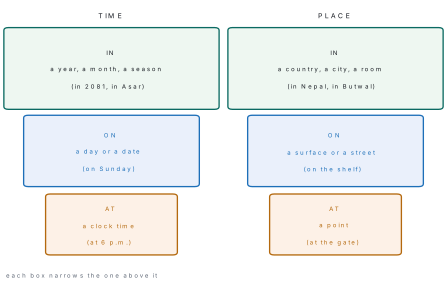
- Prepositions of time
- Prepositions of place and direction
- Prepositions fixed to a word
- Adjectives: kinds and order
- Degrees of comparison
- Adverbs
Prepositions show the relationship of a noun to the rest of the sentence — in time, in space, or in a fixed partnership with a particular verb or adjective. Adjectives describe nouns; adverbs describe verbs, adjectives and other adverbs. Together these three classes supply a large share of NEB Q7: Fill in the blanks with suitable prepositions, Use the correct form of the adjective in brackets, and Choose the correct word. Much of it is memory work, so the tables below are meant to be learnt, not just read.
Some prepositions follow logic — in a city, on Monday, at six o'clock. Others follow habit: depend on, good at, afraid of. The first kind you can work out; the second kind you must memorise as a pair, exactly as you memorise a new word.
30.1 Prepositions of time
| Preposition | Used for | Examples |
|---|---|---|
| at | clock times, festivals, night, noon, midnight | at 5 o'clock, at Dashain, at night |
| on | days and dates | on Sunday, on 15 Baisakh, on my birthday |
| in | months, seasons, years, centuries, parts of the day | in Asar, in the monsoon, in 2081, in the morning |
| by | not later than | Submit the form by Friday. |
| until / till | up to a point, and then it stops | The shop stays open until eight. |
| since | the starting point of a period | She has taught here since 2075. |
| for | the length of a period | She has taught here for six years. |
| during | within a period | It rains heavily during the monsoon. |
| from … to / till | start and end | The class runs from ten to twelve. |
| within | before the end of | Reply within seven days. |
| ago | counting back from now (after the phrase) | He left two hours ago. |
| in (future) | after a period from now | She will return in a week. |
Finish it by six = at any moment before six. Wait until six = go on waiting right up to six. Since is followed by a point in time, for by a length of time. ~~I have lived here since five years.~~ → for five years / since 2076. Also: in the morning but at night; and nothing at all before last, next, this, every: ~~on last Sunday~~ → last Sunday**.
30.2 Prepositions of place and direction
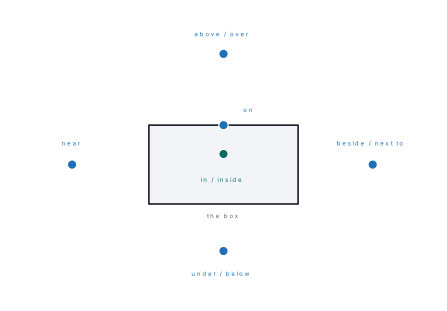
| Preposition | Meaning | Example |
|---|---|---|
| at | a point | Wait at the bus stop. |
| on | a surface, a line | The map is on the wall; Bharatpur is on the Narayani. |
| in | inside an area or container | She lives in Dharan. |
| above / over | higher than (over = directly above or covering) | The plane flew over Everest. |
| below / under | lower than (under = directly beneath) | The boat passed under the bridge. |
| between | among two | Chitwan lies between Nawalpur and Makwanpur. |
| among | among three or more | Divide the sweets among the children. |
| beside | next to | Sit beside me. |
| besides | in addition to | Besides Nepali, he speaks Maithili. |
| across | from one side to the other | They swam across the river. |
| through | in at one end, out at the other | The road runs through a tunnel. |
| into / onto | movement to inside / onto a surface | He jumped into the pond. |
| opposite | facing | The bank is opposite the post office. |
| behind / in front of | at the back / at the front | A jeep was parked in front of the gate. |
| towards | in the direction of | The crowd moved towards the stage. |
| from … to | starting point and destination | The bus runs from Kakarbhitta to Kathmandu. |
30.3 Prepositions fixed to a word
These pairs are learnt by heart. They are the ones NEB sets most often.
Verb + preposition
| depend on | listen to | belong to |
| agree with (a person) | agree to (a plan) | apologise to (a person) for (a thing) |
| believe in | consist of | complain about / to |
| congratulate on | die of / from | insist on |
| laugh at | look after / for / at | object to |
| prevent from | rely on | suffer from |
| succeed in | think of / about | wait for |
Adjective + preposition
| good / bad at | afraid of | interested in |
| famous for | proud of | jealous of |
| angry with (a person) | angry about (a thing) | kind to |
| married to | similar to | different from |
| full of | tired of | keen on |
| responsible for | capable of | aware of |
Noun + preposition: reason for, cause of, solution to, answer to, increase in, effect on, demand for, need for, respect for, invitation to.
These English verbs are transitive: the object follows directly, with nothing in between. The Nepali equivalent often has a postposition, which is why the mistake is so common. ~~discuss about the problem~~ → discuss the problem ~~enter into the classroom~~ → enter the classroom ~~marry with her~~ → marry her (but get married to her) ~~reach at the station~~ → reach the station ~~return back home~~ → return home ~~cope up with the pressure~~ → cope with the pressure ~~request for a leave~~ → request a leave / ask for leave ~~resemble to his father~~ → resemble his father ~~answer to the question~~ → answer the question ~~attack on the village~~ → attack the village (as a verb) Also ~~repeat again~~, ~~join together~~ and ~~revert back~~ say the same thing twice.
30.4 Adjectives: kinds and order
Adjectives come before the noun (a red shawl) or after a linking verb (the shawl is red). When several are used together, English follows a fixed order:
opinion → size → age → shape → colour → origin → material → purpose → NOUN
- a beautiful small old round black Nepali woollen cap
- a lovely little wooden table
Numbers and determiners come before all of these: those two beautiful old temples.
30.5 Degrees of comparison
| Type of adjective | Comparative | Superlative |
|---|---|---|
| one syllable (tall) | taller | the tallest |
| one syllable ending consonant-vowel-consonant (big) | bigger | the biggest |
| ending in -y (easy) | easier | the easiest |
| two or more syllables (careful) | more careful | the most careful |
| good / well | better | the best |
| bad / badly | worse | the worst |
| much / many | more | the most |
| little | less | the least |
| far | farther / further | the farthest / furthest |
Patterns to learn:
- as + adjective + as for equality: Pokhara is as beautiful as Bandipur.
- not as / so … as for inequality: Today is not as cold as yesterday.
- comparative + than: The Koshi is longer than the Bagmati.
- the + comparative, the + comparative: The sooner* you start, the better* it is.
- comparative + and + comparative for change: The queue grew longer and longer.
- one of the + superlative + plural noun: Everest is one of the highest mountains in the world.
- Double comparison. ~~more better~~, ~~most funniest~~ → better, funniest.
- Than, not then. ~~He is taller then me.~~ → taller than I am / than me.
- Latin comparatives take to, not than: senior to me, junior to him, superior to this, inferior to that, prefer tea to coffee.
- Compare like with like. ~~The climate of Pokhara is better than Kathmandu.~~ → … better than that of Kathmandu.
- Use the comparative for two, the superlative for three or more. She is the taller of the two sisters.
30.6 Adverbs
An adverb tells how, when, where, how often or to what degree.
| Kind | Question answered | Examples |
|---|---|---|
| manner | how? | slowly, carefully, well, fast |
| time | when? | yesterday, soon, already, then |
| place | where? | here, upstairs, outside, everywhere |
| frequency | how often? | always, usually, often, sometimes, never |
| degree | how much? | very, quite, rather, too, almost, enough |
Formation. Most adverbs of manner add -ly to the adjective: careful → carefully, happy → happily, true → truly. Some adjectives already end in -ly (friendly, lovely, silly) and have no adverb form; use in a friendly way.
Position. Adverbs of frequency go before the main verb but after the verb be:
- She always comes late. / She is always late.
- I have never been to Rara. (after the first auxiliary)
Enough goes after an adjective or adverb but before a noun: old enough to vote, enough money.
- After a linking verb use an adjective, not an adverb: The soup tastes good. She looks tired. But: She sang beautifully.
- Pairs that change meaning with -ly: hard = with effort / hardly = almost not — He works hard. vs He hardly works. late = not on time / lately = recently. near = close / nearly = almost. most = the greatest / mostly = mainly.
- Too is not very. Too means more than is acceptable: The tea is too hot to drink (I cannot drink it). The tea is very hot (but I can).
- So + adjective; such + (a) + adjective + noun. It was so cold. / It was such a cold night.
Prepositions are usually a gap-fill with no bracket cue, so first ask: is this gap about time, about place, or is it glued to the word before it? If the word before the gap is a verb or an adjective from the lists in 30.3, the answer is the fixed partner, whatever the meaning looks like. Adjective items normally show a cue in brackets — (good), (much) — and a nearby than, the or as tells you which degree to use: than means comparative, the with in/of means superlative, as … as means keep the base form.
Problem. Fill in the blanks: (a) She has been living in Dhangadhi _ 2074. (b) Our team is confident _ winning. (c) Divide the prize money ____ the five players.
Solution.
(a) 2074 is a point in time, not a length, so the answer is since, not for. Answer: since 2074.
(b) Confident is an adjective with a fixed partner. The pair is confident of, and after a preposition the verb takes -ing. Answer: confident of winning.
(c) There are five players, that is more than two, so among — between is used for two. Answer: among the five players.
Problem. Rewrite without changing the meaning. (a) No other peak in Nepal is as high as Everest. (use a superlative) (b) Sarita is the more intelligent of the two sisters. (use not as … as)
Solution.
(a) No other … as high as X means X is higher than all the rest, so the superlative form is required, with the and a following in Nepal. Answer: Everest is the highest peak in Nepal.
(b) If Sarita is the more intelligent, then the other sister is the less intelligent. Turn it round with not as … as, keeping the adjective in its base form. Answer: The other sister is not as intelligent as Sarita.
Problem. Correct: Although he entered into the hall lately, he discussed about the problem more better than any student.
Solution — one fault at a time.
- enter takes no preposition → entered the hall.
- lately means "recently"; the meaning here is "not on time" → late.
- discuss takes no preposition → discussed the problem.
- more better is a double comparative → better.
- than any student would include himself; a comparative comparing one member with the rest needs any other → than any other student.
Answer. Although he entered the hall late, he discussed the problem better than any other student.
Chapter summary
- Time: at a clock time, on a day or date, in a month, season or year; since + point, for + length, by = not later than, until = up to.
- Place: at a point, on a surface, in an area; between two, among more than two; beside = next to, besides = in addition.
- Many verbs, adjectives and nouns have a fixed preposition — learn the pair.
- Discuss, enter, marry, reach, resemble, answer, request, attack take no preposition; avoid return back, cope up with, repeat again.
- Adjective order: opinion, size, age, shape, colour, origin, material, purpose.
- One syllable → -er / -est; two or more → more / most; never both.
- Senior, junior, superior, inferior, prefer take to, not than.
- Adverbs of frequency go before the main verb but after be.
- Hard / hardly, late / lately, near / nearly are different words.
- Too = more than is acceptable; very is only an intensifier.
Practice questions
Fill in the blanks with a suitable preposition (1 mark each)
- The programme will begin ____ ten o'clock. [1]
- We have been waiting ____ the counter for an hour. [1]
- My uncle has lived in Jhapa ____ 2070. [1]
- She is very good ____ mathematics. [1]
- Everything depends ____ the weather on Saturday. [1]
- The money was divided ____ the two brothers. [1]
- He is afraid ____ dogs. [1]
- Please submit the application ____ Friday at the latest. [1]
- ____ Nepali, she also speaks Bhojpuri and English. [1]
- Ilam is famous ____ its tea gardens. [1]
Answers
1. at — clock times take at.
2. at — a bus counter is treated as a point, not an area.
3. since — 2070 is a starting point, so since, not for.
4. at — the fixed pair is good at.
5. on — the fixed pair is depend on.
6. between — between is used for two.
7. of — the fixed pair is afraid of.
8. by — by means not later than that day.
9. Besides — besides means "in addition to"; beside would mean "next to".
10. for — the fixed pair is famous for.
Use the correct form of the word in brackets (1 mark each)
- Everest is the ____ mountain in the world. (high) [1]
- This road is ____ than the one through Mugling. (bad) [1]
- She sings ____ than her sister. (sweet) [1]
- Today is not as ____ as yesterday. (cold) [1]
- He is one of the ____ players in the district. (good) [1]
- The ____ we leave, the better. (soon) [1]
- She drives very ____ . (careful) [1]
- He is ____ than his brother by three years. (senior) [1]
Answers
11. highest — a superlative with the and in the world.
12. worse — the irregular comparative of bad.
13. more sweetly — the verb needs an adverb, and two syllables take more.
14. cold — as … as keeps the base form.
15. best — one of the is followed by a superlative and a plural noun.
16. sooner — the the + comparative, the + comparative pattern.
17. carefully — an adverb is needed to describe drives.
18. senior to (senior … to his brother) — Latin comparatives take to, not than.
Correct the errors in the following sentences (1 mark each)
- We discussed about the new syllabus in the meeting. [1]
- He entered into the office without knocking. [1]
- Please return back my book tomorrow. [1]
- She is more taller than her cousin. [1]
- I have been living here since five years. [1]
- The bus reached at Birgunj at midnight. [1]
- He is very tired to walk any further. [1]
- The soup tastes deliciously. [1]
Answers
19. We discussed the new syllabus in the meeting. — discuss takes no preposition.
20. He entered the office without knocking. — enter takes a direct object.
21. Please return my book tomorrow. — return already means "give back".
22. She is taller than her cousin. — never use more with an -er form.
23. I have been living here for five years (or since 2076). — for goes with a length of time.
24. The bus reached Birgunj at midnight. — reach takes no preposition.
25. He is too tired to walk any further. — too … to shows an impossible result; very cannot be used here.
26. The soup tastes delicious. — after a linking verb use an adjective.
Practise more: English question bank