Unit 15 · Literature - Essays · 39 min read
What I Require from Life
What the syllabus asks for 7
- About the author
- The context of the essay
- The essay, step by step
- The argument
- Themes
- Style and technique
- Glossary
Most people, asked what they want from life, produce a wish-list. Haldane does something harder and much more interesting: he draws a line between what he requires, what he merely desires, and what it would be silly to ask for at all — and then, having settled his own account, he turns round and asks the same question on behalf of everybody else. The result is a very short essay that manages to be a personal confession, a definition of happiness and a political argument at the same time.
Learn Haldane's own summing-up by heart, because almost every question circles back to it: for himself he requires food, warmth, work, liberty, health and friendship; for his society he requires socialism. Then be able to explain the three-way distinction between what he assumes, what he requires and what he only desires, and why he demands adventure for himself but security for others.
15.1 About the author
John Burdon Sanderson Haldane (1892–1964) — always "J.B.S." — was one of the most original scientists of the twentieth century and one of its best popular writers about science. He was born in Oxford, the son of John Scott Haldane, a distinguished physiologist who used the family house as a laboratory and used his son as an assistant from the age of eight. Haldane was educated at Eton and at New College, Oxford, where he took first-class degrees in mathematics and in classics and philosophy, and took his M.A. in 1914.
He enlisted almost immediately, served through the First World War with the Black Watch in France and in Mesopotamia, and was wounded. The war is the hinge of this essay: it is the event that turned his "peaceful age" into a "heroic age". In 1915, while still a soldier, he published his first scientific paper, which demonstrated genetic linkage in mammals.
Afterwards he taught at Oxford, then at Cambridge, then at University College London. With R. A. Fisher and Sewall Wright he founded population genetics, the mathematical study of how genes spread through populations, which reconciled Darwin's theory of natural selection with Mendel's laws of inheritance. He also proposed, in 1929, that life began in a chemical "soup" in the early oceans; he experimented on his own body in the decompression research he did for the Royal Navy; and he wrote a stream of essays that taught ordinary readers what science was for.
Haldane was a declared socialist, Marxist, atheist and humanist. He wrote for the Daily Worker, the British communist newspaper, and served on its editorial board — which is where this essay first appeared. He spent six weeks in Madrid during the siege of the Spanish Civil War, advising the Republican side on protection against air raids. He later broke with the Communist Party. In the mid-1950s — your textbook gives 1956 — he left Britain for India, joined the Indian Statistical Institute in Kolkata, and became a naturalised Indian citizen in 1961. He died of cancer on 1 December 1964, having written a comic poem about his own illness.
His major works include Daedalus, or Science and the Future (1924), Animal Biology with Julian Huxley (1927), The Inequality of Man (1932), The Causes of Evolution (1932), The Marxist Philosophy and the Sciences (1938), Keeping Cool and Other Essays (1940), Science Advances (1947) and The Biochemistry of Genetics (1954).
Do not confuse J.B.S. Haldane, the geneticist who wrote this essay, with his father J. S. Haldane (1860–1936), the physiologist who investigated mine gases and invented the staged decompression tables for divers. Examiners occasionally set a question on "Haldane the scientist"; the one on your syllabus is the son.
Under capitalism, the factories, land and machinery — the means of production — are privately owned, and the owner keeps the profit that the work of others produces. Under socialism, they are owned and controlled in common, by the workers or by the community, and the value created is used for the general good instead of private profit. Haldane's version of the argument in this essay is unusual because it is not economic but personal: he wants for other people the particular freedoms he happens to enjoy himself.
15.2 The context of the essay
The essay was written in 1940 and first published in the Daily Worker. That date and that newspaper explain almost every reference in it. Britain was at war; Hitler and Mussolini were in power; the Spanish Republic had just fallen. Haldane had seen the Madrid siege at first hand and had visited the Soviet Union, and those two experiences stand behind his claims about what is politically possible. The readers he was writing for were working people — which is why the essay is short, plain, and organised as a list they could remember and argue with.
Knowing the audience also explains the tone. Haldane never preaches. He talks about his own toothaches, his own libel worries, his own missing bathing-pool. He establishes himself as an ordinary man with ordinary appetites, and only then asks why other people should not have what he has.
15.3 The essay, step by step
The opening premise
Haldane begins by refusing utopia. He has to accept the universe as it is; he must not require the impossible; and he would do harm rather than good by imagining perfect beings in a perfect world. This single paragraph controls everything afterwards. It is why the essay lists modest, concrete things rather than grand ideals, and why, at the end, he strikes peace and security off his own list as things he is unlikely to get.
A peaceful age and a heroic age
He was born in 1892 into a peaceful age and expected a peaceful life. Since 1914 he has lived in a heroic age — an age of wars, revolutions and upheavals, in which ordinary safety cannot be assumed — and he sees no prospect of living into another age of quiet. The distinction is not about courage but about circumstances: a peaceful age lets a person plan, while a heroic age forces everyone to improvise. His response is neither despair nor nostalgia but practicality: "I must try to make the best of the time in which I live."
The four requirements for himself
Assuming food, water, clothes and shelter as given, he asks for four things.
Work, and a decent wage for it. He borrows Aristotle's definition of happiness — not a sum of pleasures but unimpeded activity — and says he wants work that is hard but interesting, and whose fruits he can see. He admits at once that he is exceptionally lucky, since he can largely choose his own: if he tires of science he can be a war correspondent, write children's stories, or make political speeches.
Freedom. He already has far more than most people, and wants more still, particularly freedom of speech. The example is a joke with a sting in it: he would like to say publicly what he thinks of Lord Blank's newspapers, Mr Dash's pills and Sir John Asterisk's beer, "all of which are poisonous", and the law of libel stops him. The invented names are a way of making the accusation while escaping the law, and they show that the freedom he is describing is absent even in a country that calls itself free.
Health. Characteristically, he does not ask for perfect health. He does not mind an occasional toothache or even an acute illness every seven years; what he wants is to be fit for work and enjoyment in between, and "to die when I can work no longer." Health here is not an end in itself but the condition of useful activity.
Friendship. This is the most original paragraph in the essay. Haldane requires the friendship of colleagues and comrades, and defines it as the society of equals who will criticize me, and whom I can criticize. He therefore cannot be friends with a person whose orders he must obey without criticism, or with one who must obey his; and he finds friendship with people much richer or poorer than himself very difficult. Friendship, in other words, needs equality — which quietly turns a private feeling into a political argument, because a society built on ranks and huge differences of wealth makes real friendship scarce.
Adventure: the personal extra
These four, he says, are general human needs. For himself he adds a fifth: adventure. But he qualifies it twice. Because his life is useful, it would be wrong to risk it for the sake of risk, by mountaineering or motor racing; the adventures he allows himself are experiments on his own body as a physiologist, and taking part in wars and revolutions of which he approves. And love of adventure is not love of thrills: he spent six weeks in besieged Madrid and the only thrill he got there came from reading Rimbaud's poetry. "The satisfaction of adventure is something much more solid than a thrill."
Desires that are not demands
Here the essay makes its sharpest distinction. There are things he likes but does not demand: a room of his own with some books, a motor-car, a daily bath, and, if possible, a garden, a bathing-pool, a beach or a river within reach. He has not got them, "and I bear up quite happily." A requirement is something without which a human life is damaged; a desire is something that would be pleasant. Confusing the two is what makes people miserable.
What he requires for others
The turn comes in one sentence: he gets a good deal of what he wants, but most of his fellows do not enjoy what he regards as essential, "and I cannot be completely happy while they are unhappy." From there he lists what he wants for society, and each item is the public version of one of his private requirements.
He wants every healthy man and woman at work, and blames unemployment on capitalism. He wants workers to see the fruit of their own work in their own and their friends' well-being rather than in profits for others — and gives his own grievance as evidence: he discovers new biological facts and nobody applies them, because although the community would benefit, no individual would profit. He wants workers to control their conditions of work as he controls his own, and answers the objection that work is inevitably dull with a beautiful small argument: when people have time and money to spare, two of their favourite pastimes are hunting and gardening — the work of our paleolithic and neolithic ancestors. Work is not dull by nature; it has been made dull. Hence his slogan: "Freedom should begin in the workshop." He wants everyone as healthy as modern technique allows, and he wants the end of class subjection and sex subjection, since only equality makes fraternity possible, and since the roots of both are economic.
What is deliberately missing
Two obvious things are absent from his list: peace and security. He leaves them out because "it is futile to require things which one is most unlikely to obtain." Fascism exists; fascism, as Hitler and Mussolini say themselves, means war; war is spreading. He does not expect perfect peace while fascism lives. Then comes the most self-critical sentence in the essay: he admits that peace and security are rightful aims, that his own appetite for violent adventure is probably just an adaptation to the times, and that he is "a child of my age, and all the worse for being one." So he demands security rather than adventure for others — he will not ask the world to be as restless as he has been forced to become.
The summing up, and the requirements of death
The conclusion is a single memorable pair of lists: for himself, food, warmth, work, liberty, health and friendship; for his society, socialism. (Notice that the personal list now folds in the food and shelter he had earlier taken for granted, and gives "liberty" for freedom.)
He then adds a postscript on how he would like to die, and chooses Socrates as his model on three grounds: Socrates died for his convictions when he could have saved himself by betraying them; he died at about seventy, still in full possession of his faculties, having finished the work he could reasonably hope to do; and "he died laughing. His last words were a joke." Haldane does not expect all three. Two would do — and then, he says, his friends may lament him but he trusts they will not pity him.
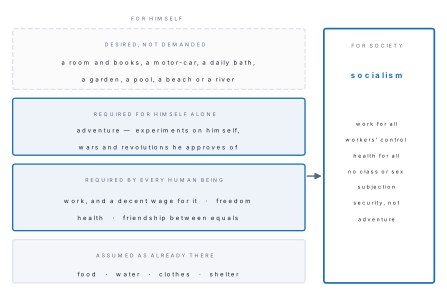
15.4 The argument
Stripped to its bones, the essay runs like this. Premise one: I must ask only for what is possible. Premise two: what a human being genuinely requires is not luxury but work, freedom, health and friendship — and I know this because I have them and can see how much they matter. Premise three: almost nobody else has them, and I cannot be fully happy while that is so. Conclusion: therefore I require socialism for my society, because the reasons other people lack these four things are economic.
The strength of the argument is its method. Haldane does not begin with a political theory and deduce a life from it; he begins with his own life and arrives at a political theory. Each public demand is generated from a private experience — his satisfying work produces the demand for work for all, his control over his own conditions produces "freedom should begin in the workshop", his need for equal friends produces the demand for the end of class and sex subjection. A reader who accepts the personal observations finds the political conclusion already half-made.
Its weakness is one Haldane half-admits. He assumes that the economic cause is the only cause of inequality between classes and between the sexes, and that abolishing class distinctions would bring education and scientific method along with it "almost automatically". That is an assertion about history, not a deduction from his own life, and it rests on what he had seen in Russia and Spain — evidence that later readers judge far more critically than he did in 1940.
15.5 Themes
What a human being actually needs. The whole essay is a filtering operation. It separates need from want, the required from the merely nice, and in doing so tells a reader that happiness is much cheaper than advertising suggests — but that the few things it does require are not optional.
Happiness as activity, not pleasure. Aristotle's phrase, unimpeded activity, is the hidden key to the essay. Haldane does not want rest, comfort or excitement; he wants to be able to work at something hard, and to see the result. That is why he can accept toothache, war and the loss of a bathing-pool without complaint, and why unemployment strikes him as the deepest of social evils.
Equality as the ground of friendship. Haldane's most quietly radical claim is that you cannot be a real friend to someone you must obey, someone who must obey you, or someone far richer or poorer. Human warmth, on this view, is not possible in a steeply ranked society. It is an argument for equality from the heart rather than from the account book.
Work and dignity. Dullness in work is not natural but manufactured. His evidence — that hunting and gardening, the labour of our stone-age ancestors, are our favourite hobbies — is at once funny and serious, and it turns the demand for workers' control from an economic claim into a claim about human nature.
Honesty about oneself. The essay is constantly self-critical. Haldane calls himself exceptionally lucky, admits that his taste for adventure is a symptom of his times rather than a virtue, and refuses to require for others the risk he enjoys. Very few polemical essays concede so much.
Death as part of a life. The Socrates postscript makes death a final requirement rather than an interruption: to die for one's convictions, with work completed and humour intact. It is consistent with everything before it — the essay judges a life by its activity, and therefore judges a death by whether the activity was finished.
15.6 Style and technique
Purpose and mode. The essay is expository and persuasive: it explains a personal position and argues a political one. It is written throughout in the first person, which is the source of both its charm and its rhetorical strategy, since the reader is asked to accept a general claim on the strength of a private confession.
Structure by list. The organisation could not be simpler: a premise, four requirements, one personal extra, a category of non-demands, then the same sequence transposed into the public key, then two omissions, then a summing-up and a postscript. This is why the essay is so easy to remember and so easy to answer questions on.
Language. Short sentences, concrete nouns, no technical vocabulary despite being written by a professional scientist, and no rhetorical inflation. The characteristic Haldane sentence is flat, brief and slightly startling: "Freedom should begin in the workshop."
| Device | Example | What it does |
|---|---|---|
| Anaphora | "I require health… I require friendship…" | Turns the essay into a list the ear can follow and remember |
| Allusion | Aristotle's unimpeded activity; the death of Socrates | Gives a modern political essay the authority of ancient thought |
| Irony / mock names | "Lord Blank's newspapers, Mr Dash's pills, Sir John Asterisk's beer" | Names the guilty while escaping the libel law — and makes the point about censorship by performing it |
| Understatement | "But I have not, and I bear up quite happily" | Shows that a desire lost is not a need denied |
| Antithesis | adventure for himself, "security rather than adventure for others" | Marks the exact limit of his own authority as an example |
| Aphorism | "Freedom should begin in the workshop" | Compresses a whole economic programme into six words |
| Homely evidence | hunting and gardening as our favourite hobbies | Proves a large claim about work with something every reader already knows |
| Self-deprecation | "I am a child of my age, and all the worse for being one" | Disarms the reader's suspicion of a political writer's motives |
Why the ancient philosophers? Haldane, a classicist as well as a scientist, uses Aristotle and Socrates for three reasons. They supply definitions he does not have to argue for — Aristotle tells him what happiness is, Socrates shows him what a good death looks like. They give a communist newspaper article a lineage far older than communism, which makes his demands look like common human sense rather than party doctrine. And they make the essay's underlying claim visible: that the question "what do I require from life?" is not a modern or a political question at all, but the oldest question in philosophy.
15.7 Glossary
| Word | Meaning |
|---|---|
| ancestors | forefathers; those from whom one is descended |
| confer | to grant or bestow a right, title or benefit |
| decent | satisfactory, reasonable, fair |
| enviable | such as to arouse envy; desirable |
| epoch | a long, distinct period of history |
| fascism | a dictatorship built on extreme nationalism and force |
| fraternity | brotherhood; a feeling of kinship between people |
| futile | pointless; incapable of producing any useful result |
| heroic age | an age of wars and upheavals, in which safety cannot be assumed |
| lament | to express deep grief or sorrow |
| libel | a published false statement damaging to someone's reputation |
| neolithic | of the later Stone Age, when farming began |
| paleolithic | of the early Stone Age, when people lived by hunting |
| physiologist | a scientist who studies how living bodies work |
| prospect | a possibility or likelihood of something happening |
| respite | a short rest or relief from something difficult |
| siege | the surrounding of a city or fort to force it to surrender |
| subjection | the state of being under another's power or control |
| unimpeded | not obstructed or hindered |
Work, freedom, health, friends — the four general human needs, in the order Haldane gives them. Add adventure for himself only, and socialism for everybody. If you can write those six words at the top of your answer sheet you already have the skeleton of any long answer on this essay.
Chapter summary
- "What I Require from Life" (1940) is a short first-person essay by the geneticist J.B.S. Haldane, first published in the British communist newspaper the Daily Worker.
- Haldane begins by refusing utopia: he will accept the universe as it is and ask only for what is possible.
- He contrasts the peaceful age into which he was born with the heroic age that began in 1914, and resolves to make the best of the time he actually lives in.
- Assuming food, water, clothes and shelter, he requires four things: work with a decent wage, freedom (especially of speech), health, and friendship between equals. For himself alone he adds adventure — which he distinguishes sharply from a mere thrill.
- He separates desire from demand: a car, books, a bath, a garden are pleasant, and he is content without them.
- Because most people lack what he regards as essential, he requires socialism for his society: work for all, workers' control of industry, health for all, and an end to class and sex subjection. "Freedom should begin in the workshop."
- He deliberately omits peace and security from his own list as unobtainable while fascism lives, admits that his appetite for adventure is a symptom of his age, and demands security rather than adventure for others.
- His summing-up: for himself, food, warmth, work, liberty, health and friendship; for his society, socialism. He closes by naming Socrates' death — for his convictions, with his work done, and laughing — as the most enviable he knows.
Practice questions
Short answer questions (2 marks each)
- How does the writer distinguish between a peaceful age and a heroic age? [2]
- Why does the writer want more freedom of speech than most people? [2]
- According to the writer, what are the four general human needs? [2]
- What is the difference between desire and demand according to the writer? [2]
- Why does the writer demand security rather than adventure for others? [2]
- Why can Haldane not be friends with a person whose orders he must obey? [2]
- Why does the essayist take his references from ancient philosophers? [2]
- Why does Haldane consider the death of Socrates enviable? [2]
Model answers — short questions
1. A peaceful age is one in which ordinary safety can be assumed, so that a person may reasonably plan a quiet life; Haldane was born into such an age in 1892 and expected to live in it. A heroic age is one of wars, revolutions and upheavals, in which nothing can be assumed and everyone must improvise. Haldane says that since 1914 he has been living in a heroic age and sees no prospect of surviving into another peaceful one, so he must make the best of the time he has.
2. Because he already has far more freedom than most people and can see exactly where it stops. He would like to say and write in public what he believes about Lord Blank's newspapers, Mr Dash's pills and Sir John Asterisk's beer — all of which, he says, are poisonous — and the law of libel prevents him. He wants freedom of speech not to indulge himself but to expose things that harm the public, and the invented names show him reporting the problem while still trapped by it.
3. Work, together with a decent wage for it; freedom, especially freedom of speech; health; and friendship — specifically the friendship of equals who can criticize one another. Haldane treats food, water, clothes and shelter as already assumed, and lists adventure separately as a requirement of his own rather than a general human need.
4. A requirement or demand is something without which a human life is genuinely damaged: work, freedom, health, friendship. A desire is something that would be pleasant but whose absence can be borne. Haldane illustrates the difference from his own life — he would like a room of his own with books, a motor-car, a daily bath, a garden or a river nearby, but he has not got them, "and I bear up quite happily." The distinction matters because it stops the essay becoming a wish-list and keeps his political demands modest and defensible.
5. Because he does not trust his own taste for adventure. He admits that peace and security are rightful aims and that his own desire for violent adventure is "probably merely an adaptation to the age in which I live" — a habit forced on him by living through wars, not a virtue. Calling himself "a child of my age, and all the worse for being one," he refuses to impose his own restlessness on everybody else, and asks for others the settled safety he has never had.
6. Because he defines friendship as the society of equals who can criticize one another freely. Where one person must obey another's orders without criticism before or after, criticism in both directions becomes impossible, and so does honesty; what remains is a relation of rank, not friendship. For the same reason he finds friendship with people much richer or poorer than himself very difficult. This is why his private definition of friendship leads directly to his public demand for equality.
7. For three reasons. First, they supply ready definitions he does not need to argue for: Aristotle gives him happiness as "unimpeded activity" and Socrates gives him a model of a good death. Second, they give the essay an authority older and wider than any political party, so that his demands look like ordinary human sense rather than communist doctrine. Third, they show that his question is not a modern or political one at all but the oldest question in philosophy — what does a human being need in order to live well?
8. On three grounds. Socrates died for his convictions when he could easily have saved himself by betraying them; he died at about seventy, still in full possession of his faculties and having completed all the work he could reasonably hope to do; and he died laughing, since his last words were a joke. Haldane does not expect all three conditions, which are very rarely met together, but says that if he can achieve even two he will have done well — and that his friends may lament him provided they do not pity him.
Long answer questions (5 marks each)
- Why does Haldane call himself a socialist? What does he want socialism to achieve, and how does he argue for it? [5]
- What is socialism? How is it different from capitalism? [5]
- Discuss the essay in terms of its language, purpose, subject, point of view and mode of writing. [5]
- What do you require from your life to be happy and satisfied? [5]
- Write an essay about your dream house. [5]
Model answers — long questions
1. Haldane calls himself a socialist three separate times in the essay, and each time he gives a different reason, so that the three together amount to a complete case.
He is a socialist, first, because of unemployment. He wants to see every healthy man and woman at work, and he observes that unemployment, at least in times of depression, is an essential feature of capitalism rather than an accident of it. Since work is the first of his four human requirements, a system that regularly denies it to millions fails at the first hurdle.
He is a socialist, second, because he wants industry controlled by the workers. He controls his own conditions of work to a considerable extent and knows how much that is worth; most work is dull, unhealthy and exhausting, and he believes this need not be so and will not be so after a few generations of democracy in industry. His evidence that work can be pleasant is disarmingly simple: when people have time and money to spare, two of their favourite occupations are hunting and gardening — the work of our paleolithic and neolithic ancestors. Hence his slogan, "Freedom should begin in the workshop."
He is a socialist, third, because he wants others to enjoy the advantages he enjoys himself. He is exceptionally lucky, he says, but cannot be completely happy while his fellows are unhappy. So he also wants health for all, on the scale that human biology demands and modern technique can supply, and the end of class subjection and sex subjection — because equality is the condition of fraternity, and because the main barriers between classes and the main reasons for the subjection of women are economic.
The method of the argument is as important as its content. Haldane does not begin from Marxist theory and deduce a way of living; he begins with the ordinary things that make his own life good, notices that other people are denied them, and asks what is preventing them. He is also candid about the limits of what he expects: socialism will not confer these advantages in an instant, and he will die happy if he merely lives to see the workers in power through most of Europe. A critical reader will note that he assumes, rather than demonstrates, that the causes of inequality are wholly economic, and that his confidence rests on what he saw in Russia and Spain — evidence a modern reader will weigh far more sceptically than he did in 1940.
2. Socialism is a political and economic system in which the means of production — land, factories, machines, mines, transport — are owned and controlled in common, either by the workers themselves or by the state on behalf of the whole community, and in which what is produced is distributed according to need or contribution rather than according to ownership. Capitalism is a system in which those same means of production are privately owned, in which goods and labour are bought and sold in a market, and in which the owner of capital keeps the profit generated by the work of employees.
The differences may be set out under four heads. Ownership: private under capitalism, common or public under socialism. Purpose of production: profit for the owner under capitalism, satisfaction of need under socialism. Distribution: by market outcome and inheritance under capitalism, which produces wide inequalities of wealth, against planned or need-based distribution under socialism, which aims at rough equality. Control of work: decisions are taken by owners and managers under capitalism, whereas socialism in Haldane's version means that workers control their own conditions of work.
Each system is defended by serious arguments. Capitalism's supporters point to competition as a spur to innovation, to the efficiency of prices in matching supply to demand, and to the freedom of individuals to start enterprises and keep what they earn. Socialism's supporters point to unemployment, insecurity, unsafe and degrading work, and the concentration of wealth in few hands. Haldane's own complaint is a good illustration of the socialist case: he discovers new biological facts that nobody applies, because although the community would benefit, no individual would make a profit from the application. Most modern states are in fact mixed economies — private enterprise alongside public education, public health services and regulation — and Nepal's own constitution describes the country as oriented towards socialism while permitting private business.
3. Subject. The essay's subject is stated in its title: what a human being genuinely requires in order to live well. Haldane treats it in two halves — what he requires for himself, and what he requires for the society he lives in — and adds a short postscript on what he would require of his own death.
Purpose. The purpose is double, and the doubleness is the point. On the surface the essay is a piece of self-examination; underneath it is a work of political persuasion written for the readers of a communist newspaper in 1940. By making the political conclusion grow out of the personal confession, Haldane persuades without appearing to argue.
Point of view. It is written wholly in the first person. The pronoun "I" begins most paragraphs, and the authority of the essay rests on the reader's belief that the speaker is honest. Haldane earns that belief by admitting uncomfortable things: that he is exceptionally lucky, that his love of adventure is a defect of his age, that socialism will not deliver quickly.
Mode of writing. It is expository and argumentative, organised as a series of lists rather than as a narrative — premise, four requirements, one personal extra, a class of non-demands, the public transposition of the same items, two deliberate omissions, a summing-up, a postscript. This list structure is what makes so short an essay so easy to remember.
Language. Plain, brief, concrete and unadorned. A professional scientist writing for working readers, Haldane uses almost no technical vocabulary and almost no ornament. His sentences are short and often end in a small shock ("Freedom should begin in the workshop"; "And he died laughing"). He is fond of understatement, of homely evidence such as hunting and gardening, and of a dry humour — the invented names Lord Blank, Mr Dash and Sir John Asterisk let him attack real firms while obeying the law of libel, and demonstrate the censorship he is complaining about in the very act of complaining. The tone throughout is conversational, self-critical and completely without self-pity.
4. (A personal answer; what follows is a model.) Taking Haldane's own method, I would separate what I require from what I merely desire.
I require, first, education and work that uses it. Like Haldane I do not want easy work; I want work that is hard but interesting and whose results I can see. For a Nepali student that means finishing my studies and then finding employment in which my training is actually used — which is why the migration of so many young people to the Gulf and Malaysia for work far below their training seems to me the central problem of my generation.
I require health, and the means of keeping it: clean drinking water, food that is enough and safe, and a health post within reach that is staffed and stocked. Haldane says he wants only to be fit for work and enjoyment in the intervals between illnesses, and that modest standard seems to me the right one.
I require freedom — to say what I think, to read what I choose, to worship or not, and to disagree with those in authority without fear. And I require friendship of the kind Haldane describes: friends who will criticize me and whom I can criticize, which means friends who treat me as an equal.
Beyond these I require two things Haldane was too honest to ask for: peace and security, which in my country means a stable government, roads that survive the monsoon, and the confidence that an earthquake will not destroy my school again.
The things I desire but do not demand are ordinary: a room of my own, a good internet connection, a motorcycle, the chance to travel. I would enjoy them; I can live well without them. Finally, I share Haldane's last requirement — that I should not be satisfied while the people around me lack what I regard as essential, since a comfortable life in an unjust society is not a satisfying one.
5. (A model free-writing answer.)
My dream house. My dream house would not be a mansion. It would stand on the lower slope of a hill above a village, facing east, so that the first sun of the morning came through the windows and the ridge behind kept the worst of the wind off in winter.
It would be built of stone and timber in the local manner, but on a modern frame, because I have seen what an earthquake does to a house built without one. There would be two storeys: a large kitchen and one common room below, where the family eats and visitors sit, and three bedrooms above. Every room would have a window large enough to read by, since nothing makes a house feel poorer than darkness.
In front there would be a courtyard with a tap that runs all year, and beyond it a garden — beans, tomatoes, saag, a lemon tree, and two beehives at the far end. I want the garden more than I want the house. Haldane observed that gardening is one of the two occupations people choose when they have time to spare, and I think he was right about why: it is work whose fruits you can see.
Inside, the room I care about most is the smallest — a study with a table under the window, a shelf of books, and a door that shuts. Somewhere in the house there would be electricity that does not fail, a solar panel on the roof against the days when it does, and a bathroom with hot water.
What would make it a home, though, is not in the plan. It is that the road to it should be passable in the monsoon, that a school and a health post should be within walking distance, and that the people in the next house should be people I can talk to honestly. A fine house in a place with none of these would not be a dream but a kind of exile.
Reference to the context
- "The satisfaction of adventure is something much more solid than a thrill."(a) Where in the essay does this sentence come, and what is being discussed?(b) What distinction is Haldane drawing?(c) What example does he give from his own experience?(d) What does the sentence reveal about his idea of a good life? [5]
- "I want the workers to see the fruit of their own work not in profits for others, but in their own and their friends' well-being."(a) What is Haldane criticizing here?(b) What remedy does he propose?(c) How does his complaint about his own work illustrate the point?(d) How does this sentence connect with his four personal requirements? [5]
Model answers — reference to the context
1. (a) It comes at the end of the paragraph in which Haldane adds adventure to his four general human needs as a requirement of his own. He has just explained that, because his life is useful, it would be wrong to risk it for the sake of risk — by mountaineering or motor racing — and that the adventures he permits himself are experiments on his own body as a physiologist and participation in wars and revolutions of which he approves. (b) He is distinguishing adventure from thrill. A thrill is a momentary rush of excitement, sought for its own sake and gone as soon as it is over. Adventure, as he uses the word, is a serious undertaking with a purpose beyond itself, whose satisfaction lies in having done something that mattered. The word "solid" is doing the work of the sentence: a thrill is thin and vanishes, while the satisfaction of adventure has substance and lasts. (c) He spent six weeks in Madrid during the siege of the Spanish Civil War, in constant danger — and says that the only thrill he got there came from reading Rimbaud's poetry. The joke is deliberate. The most dangerous weeks of his life produced no excitement at all; the excitement came from a book. (d) It shows that Haldane judges experiences by their content rather than by the feelings they produce. This is the same standard he applies everywhere else in the essay: happiness is "unimpeded activity", not a sum of pleasures; health is worth having because it makes work possible; a good death is one with the work finished. He is not an ascetic — he likes books, baths and motor-cars — but he consistently ranks purposeful doing above sensation.
2. (a) He is criticizing the central arrangement of capitalism: that the value produced by the labour of workers is taken as profit by the private owners of the factory or the business, so that the person who does the work does not receive its fruit. Because of this, the connection between effort and benefit — which is precisely what makes work satisfying — is broken for most people. (b) His remedy is socialism, and specifically workers' control: he wants the workers to control their conditions of work as he controls his own to a considerable extent, and to receive the product of their labour in their own and their friends' well-being. He believes that most work is dull, unhealthy and exhausting only because of how it is organised, and that "after a few generations of democracy in industry" this would cease to be true. His formula for it is "Freedom should begin in the workshop." (c) He offers his own grievance as evidence from the other end of the social scale. His main personal complaint, he says, is that his work is not applied: he discovers new biological facts, but no use is made of them, because although the community would benefit, no individual would make a profit from their application. The example is telling because Haldane is not a poor man — he is pointing out that a system organised around private profit wastes the labour even of the fortunate, and wastes discoveries that would help everybody. (d) It is the public form of his first two private requirements. He requires work "of which I can see the fruits", and he requires freedom; this sentence asks for exactly those two things on behalf of everyone else. The whole movement of the essay is visible in miniature here: a personal observation about what makes his own life good is turned outward into a demand about how society should be arranged.
Practise more: English question bank