Unit 3 · Literature - Short Stories · 27 min read
God Sees the Truth but Waits
What the syllabus asks for 7
- About the author
- The story
- Characters
- Themes
- Setting, structure and point of view
- Literary devices
- Glossary
Leo Tolstoy's "God Sees the Truth, but Waits" (1872) tells of a merchant who is convicted of a murder he did not commit and spends twenty-six years in a Siberian prison. It is a story about injustice, but far more about what a man does with injustice once he has stopped expecting help from the world. The title is an old Russian proverb, and the story is Tolstoy's argument that truth and forgiveness may arrive very late — and still be worth waiting for.
Aksionov cannot change his sentence; he can only change himself. The story's climax is not the confession of the real murderer but the moment Aksionov chooses to forgive him, after which "his heart grew light" and he stops wanting to go home at all.
3.1 About the author
Count Lev Nikolayevich Tolstoy (1828–1910), known in English as Leo Tolstoy, was a Russian novelist and moral thinker, and is often called the greatest novelist of the nineteenth century. He was born on the family estate of Yasnaya Polyana, south of Moscow, into the old Russian nobility, and was orphaned as a child. As a young man he served as an artillery officer in the Crimean War, and the Sevastopol Sketches he wrote there began his reputation.
His two enormous novels are War and Peace (1869), about Russian society during Napoleon's invasion, and Anna Karenina (1877). Both belong to Realism — the nineteenth-century movement that tried to show ordinary life exactly as it is, without romantic decoration, and to explain characters by their circumstances.
A style of writing that presents life as it actually is: ordinary people, everyday speech, accurate social detail, and no supernatural or sentimental solutions.
In his fifties Tolstoy passed through a severe spiritual crisis, described in A Confession (1882). He came to reject the Church, private property, the state and violence of every kind, and adopted a simple Christian ethic built on the Sermon on the Mount: love your enemies, judge no one, and do not resist evil by force. This doctrine of non-resistance deeply influenced Mahatma Gandhi, who corresponded with him. After the crisis his writing changed. He produced short moral tales written in the plainest possible Russian — many of them, including this one, for a school reader he compiled — along with The Death of Ivan Ilyich (1886), What Is Art? (1897) and the novel Resurrection (1899). He died in 1910 at a small railway station at Astapovo, having left home at the age of eighty-two.
The voice of the late tales is what you meet here: very short sentences, almost no description, no comment from the author, and a plot arranged so that a moral question is put to the reader rather than answered for them. Tolstoy strips away everything a modern reader might call "style", and the bareness is the point.
3.2 The story
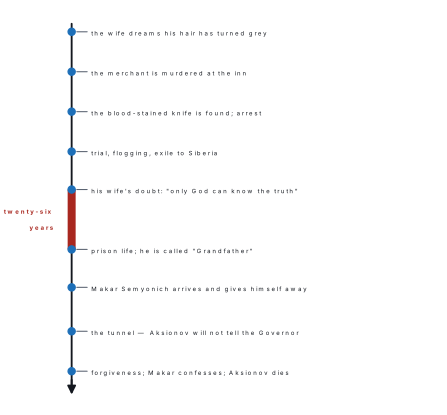
The warning. Ivan Dmitrich Aksionov is a young merchant in the town of Vladimir. He owns two shops and a house, and he is handsome, fair-haired, curly-headed, fond of fun and of singing. He drank heavily as a young man but gave it up after his marriage. One summer he sets out for the fair at Nizhny. As he says goodbye, his wife begs him not to go that day: she has dreamt that he came back from the town and when he took off his cap his hair was grey. Aksionov laughs, calls it a lucky sign, promises presents, and drives away.
The night at the inn. Half-way there he meets a merchant he knows, and the two put up at the same inn, drink tea together and sleep in adjoining rooms. Aksionov is not a late sleeper and wants to travel while it is cool, so he wakes his driver before dawn, pays the landlord and goes on. About twenty-five miles further he stops to feed the horses, orders a samovar and sits in the porch playing his guitar.
The arrest. A troika drives up with an official and two soldiers. The official cross-questions him: where did he spend the night, was he alone, did he see the other merchant this morning, why did he leave before dawn? Aksionov answers everything and finally asks why he is being questioned like a thief. The official replies that the merchant he slept beside has been found with his throat cut, and orders a search. In Aksionov's bag they find a blood-stained knife. Aksionov, who cannot explain it, stammers, turns pale and trembles — and his fear is taken for guilt. He is bound, thrown into a cart and imprisoned. He is charged with murdering a merchant from Ryazan and stealing twenty thousand rubles.
The wife's question. His wife comes to the prison with their small children. Seeing him in prison dress and chains among criminals she faints. When she recovers she tells him her petition to the Czar has been refused, reminds him of her dream — "It was not for nothing I dreamt your hair had turned grey" — and then, stroking his hair, asks the question that destroys him: "Vanya dearest, tell your wife the truth; was it not you who did it?" Aksionov hides his face and weeps. When they have gone he says to himself that only God can know the truth, and that it is to God alone he must appeal. He writes no more petitions, gives up hope and only prays.
Twenty-six years. Aksionov is flogged with the knot and sent to the mines in Siberia. He lives there twenty-six years. His hair turns white as snow, his beard grows long and thin, he stoops, speaks little and never laughs. He learns to make boots, earns a little money and buys The Lives of the Saints; he reads the lessons in the prison church and sings in the choir. The authorities like him for his meekness and the prisoners respect him: they call him "Grandfather" and "The Saint", make him their spokesman, and bring their quarrels to him to judge. No news ever reaches him from home.
Makar Semyonich. A new gang of convicts arrives. One of them, a strong grey man of sixty, says he is from Vladimir and that his name is Makar Semyonich; he claims he was sent to Siberia merely for untying a horse. When Aksionov's own story is told to the newcomers, Makar slaps his knee and exclaims how wonderful it is that they should meet, but refuses to explain why. Questioned, he jokes that the knife must belong to the man in whose bag it was found — and that nobody could have hidden a knife under a sleeping man's head without waking him. That remark tells Aksionov everything. He goes away and lies awake all night, remembering his wife as she was, his little children, himself young and careless with his guitar, the flogging, the chains, the wasted twenty-six years — and his anger against Makar is so great that he longs for revenge even if he perishes for it.
The tunnel. For a fortnight Aksionov cannot sleep or bear to look at Makar. One night he notices earth rolling out from under the sleeping-shelves. Makar crawls out and, seeing he is discovered, admits he has dug a hole under the wall, carrying the earth out in his boots. He threatens to kill Aksionov if he tells. Aksionov answers that he has no wish to escape and no need to be killed, "you killed me long ago", and that whether he informs or not will be as God directs. Next day the tunnel is found. The Governor questions everybody; nobody will betray Makar, who would be flogged to death. Finally the Governor turns to Aksionov, whom he knows to be a truthful man, and asks him directly. Aksionov's lips and hands tremble. He thinks: why should I screen the man who ruined my life? Then he answers, "I cannot say, your honour. It is not God's will that I should tell. Do what you like with me; I am in your hands." No pressure moves him further, and the matter is dropped.
Forgiveness. That night Makar comes and sits on his bed, and whispers, "Ivan Dmitrich, forgive me!" He confesses that he killed the merchant and hid the knife in Aksionov's bag, and that he had meant to kill Aksionov too but heard a noise and escaped through the window. He kneels on the ground, beats his head on the floor and begs to be forgiven, promising to confess so that Aksionov can go home. Aksionov answers bitterly that after twenty-six years he has nowhere to go: his wife is dead and his children have forgotten him. But when he hears Makar sobbing he begins to weep himself and says, "God will forgive you! Maybe I am a hundred times worse than you." At those words his heart grows light, the longing for home leaves him, and he wishes only for his last hour to come. Makar confesses to the authorities in spite of what Aksionov has said; but when the order for Aksionov's release arrives, he is already dead.
3.3 Characters
| Character | Who they are | Role in the story |
|---|---|---|
| Ivan Dmitrich Aksionov | A young merchant of Vladimir; later an old convict called "Grandfather" and "The Saint" | Protagonist; innocent victim who becomes a moral hero |
| Makar Semyonich | A convict of about sixty, also from Vladimir; the real murderer | Antagonist, then penitent; the man Aksionov must forgive |
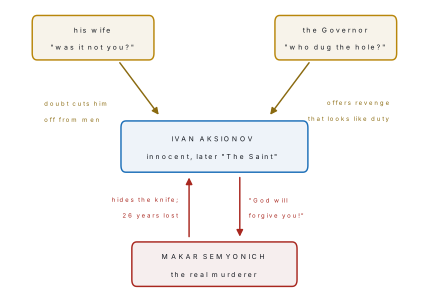
| Aksionov's wife | Unnamed; dreams of his grey hair; mother of several small children | Her single question — "was it not you?" — cuts him off from human help |
| The murdered merchant | A trader from Ryazan who shares the inn | His death sets the plot moving; he never speaks in the story |
| The police-officer | The official who arrives by troika and finds the knife | Represents human justice, which is confident and wrong |
| The Governor | The head of the Siberian prison | Offers Aksionov revenge in a form that would look like duty |
| Fellow prisoners | Convicts who make Aksionov their spokesman and judge | Show what Aksionov has become in twenty-six years |
Aksionov. Tolstoy gives us the young man in one paragraph — handsome, curly-headed, "full of fun", a singer, once fond of drink — so that we can measure what is destroyed. His transformation happens in two stages. The first is despair: after his wife's question he gives up petitions and turns to God, not out of saintliness but because every human door has shut. The second, twenty-six years later, is a genuine choice. When the Governor asks who dug the tunnel, Aksionov holds in his hands the revenge he had longed for, and refuses it. His words — "It is not God's will that I should tell" — cost him nothing less than his last chance of being the man who was right. Notice that his final act is not to claim his innocence but to say, "Maybe I am a hundred times worse than you." That line, not the confession, is the summit of the story.
Makar Semyonich. He is a coward and a liar before he is a penitent. He lets an innocent man serve his sentence for twenty-six years, jokes about the knife in front of the man whose life it ruined, and threatens murder a second time when his tunnel is discovered. What breaks him is not punishment but mercy: he says himself that being flogged with the knot was easier to bear than seeing the old man who could have destroyed him and did not. Tolstoy's point is that Makar is changed by precisely the thing the law cannot supply.
The wife. She appears in only two scenes and is given no name, yet she turns the plot twice. Her dream is a warning the story's hero laughs at, and her question in the prison — asked gently, while she strokes his hair — is the most damaging blow he receives, worse than the flogging. Tolstoy is showing how loneliness is made: a man can survive the courts, but not being doubted by the person who knows him best.
3.4 Themes
Injustice, and what a man does with it. The trial is over in two sentences; Tolstoy is not interested in courtroom drama. He is interested in the twenty-six years afterwards. Circumstantial evidence — a knife, an early departure, a frightened manner — convicts an innocent man, and no appeal works, because his wife's petition to the Czar is refused. From that point the only question the story asks is what Aksionov will become.
Forgiveness as release. Aksionov forgives Makar not when he is calm but when he hears him sob. Tolstoy marks the effect in one plain sentence: "his heart grew light, and the longing for home left him". Forgiveness in this story is not a favour done to the offender; it is the moment the victim stops being a prisoner inside himself. That is why he no longer wants release when release finally comes.
Faith and patience — God sees the truth, but waits. The proverb of the title is the story's structure. The truth is known from the first night; it is simply not spoken for twenty-six years. Tolstoy neither promises that justice will come in time nor denies that it comes at all: the confession is made, and Aksionov is dead. The comfort offered is not rescue but meaning.
Suspicion and the destruction of trust. Two suspicions run the plot. The police-officer suspects Aksionov because he stammers and turns pale; his wife suspects him because of a dream. Neither is malicious and both are catastrophic. Tolstoy quietly shows how easily evidence is read to fit a story people have already decided on.
Revenge refused. Aksionov is offered revenge in a socially respectable form: the Governor, a lawful authority, asks him a direct question, and telling the truth would have been his duty. Tolstoy makes the temptation as strong as possible — one honest sentence would have had Makar flogged nearly to death — precisely so that refusing it means something.
3.5 Setting, structure and point of view
Setting. Nineteenth-century Russia, described with the minimum of detail: the merchant town of Vladimir, the great fair at Nizhny, an inn on the road, and then a convict prison in Siberia. Siberia is not described at all — no cold, no landscape, no work in the mines. Tolstoy deliberately refuses atmosphere, because the story is happening inside a man and scenery would only distract.
Structure. The plot is built as a chain of five decisions, four of them taken by Aksionov: to travel on the day of the dream; to stop petitioning and pray; to keep silent when Makar threatens him; to keep silent when the Governor questions him; and Makar's own decision to confess. The chronology is strictly linear except that twenty-six years pass in about a hundred words. This compression is the story's most striking technical feature: it tells you that the years themselves are not the subject.
Point of view. Third-person limited. The narrator stays close to Aksionov, reporting his memories on the sleepless night and his exact thoughts before he answers the Governor, but never enters Makar's mind — which is why Makar's arrival at the bedside is a surprise. Tolstoy makes no moral comment in his own voice; the proverb in the title does all the commentary the story allows itself.
3.6 Literary devices
| Device | Example from the text | Effect |
|---|---|---|
| Foreshadowing | The wife's dream that his hair had turned grey | Plants the ending in the first page; his hair does turn white, but in Siberia |
| Dramatic irony | Aksionov alone knows who dug the tunnel; the Governor does not | Makes the reader share the weight of a decision the other characters cannot see |
| Situational irony | The order for release arrives after Aksionov's death; his innocence is proved when it can help nobody | Shows that justice and timeliness are different things |
| Symbolism | The blood-stained knife; the grey hair; The Lives of the Saints | Compresses guilt, lost time and spiritual change into single objects |
| Proverb as title | "God sees the truth, but waits" | States the theme without the author having to preach in the text |
| Simple diction and short sentences | "He was flogged with a knot"; "She was dead" | The bareness makes the events feel like facts rather than fiction |
| Contrast | The curly-headed young singer against the stooping old man who never laughs | Measures the cost of the injustice without a word of protest |
| Understatement | "Maybe I am a hundred times worse than you" | Gives the emotional climax to a quiet sentence instead of a dramatic one |
Many students write that the story ends happily because the truth comes out. It does not. Aksionov's wife is dead, his children have forgotten him, and he himself dies before the release order arrives. Tolstoy's consolation is inward: the change in Aksionov's heart, not the change in his sentence. Say so, and say it in the answer's last line.
3.7 Glossary
| Word / phrase | Meaning |
|---|---|
| merchant | a person whose business is buying and selling goods |
| fair | a large temporary market where traders gather to sell |
| spree | a period of wild, uncontrolled enjoyment, usually drinking |
| adjoining | next to, sharing a wall |
| troika | a Russian carriage or sledge pulled by three horses side by side |
| samovar | a metal urn used in Russia for boiling water for tea |
| cross-question | to question someone closely and repeatedly to catch a lie |
| blood-stained | marked with blood |
| betray (someone's manner) | to show something the person wanted to hide |
| petition | a formal written request to an authority |
| Czar (Tsar) | the emperor of Russia |
| flogged with a knot | beaten with a heavy knotted whip, a Russian punishment |
| convict | a person serving a prison sentence |
| Siberia | the vast, cold eastern region of Russia used for prison camps |
| meekness | quiet gentleness; not answering back |
| spokesman | the person chosen to speak on behalf of a group |
| to screen someone | to protect someone by hiding what they have done |
| downcast | looking down; also, sad and discouraged |
| perish | to die |
| to blab | (informal) to tell a secret |
| vengeance | revenge; the punishment you take for a wrong done to you |
| penitent | a person who is truly sorry for a sin and asks forgiveness |
A five-mark question on this story almost always wants the inner plot, not the outer one. Structure your answer as: the wrong done to him — how he responds to it — the moment of temptation — the act of forgiveness — the result of that act. Quote the two short sentences that mark the turning points: "It is not God's will that I should tell" and "God will forgive you!"
Chapter summary
- Leo Tolstoy (1828–1910), Russian realist and moral thinker; "God Sees the Truth, but Waits" (1872) takes its title from a Russian proverb.
- Aksionov, a merchant of Vladimir, ignores his wife's warning dream and travels to the Nizhny fair; a fellow merchant is murdered at the inn.
- A blood-stained knife is found in Aksionov's bag; he is flogged and sent to Siberia for twenty-six years, charged with a murder he did not commit.
- His wife's question, "was it not you who did it?", ends his hope of human help; he stops petitioning and turns to prayer.
- In prison he becomes "Grandfather" and "The Saint"; Makar Semyonich, the real murderer, arrives and gives himself away.
- Aksionov refuses to betray Makar's escape tunnel to the Governor, and later forgives him — "God will forgive you! Maybe I am a hundred times worse than you."
- Makar confesses, but Aksionov dies before the release order arrives.
- Themes: injustice; forgiveness as release; faith and patience; suspicion; revenge refused. Devices: foreshadowing, dramatic and situational irony, symbolism, understatement, extreme plainness of style.
Practice questions
Short answer questions (2 marks each)
- What dream did Aksionov's wife have, and how did he react to it? [2]
- What evidence convinced the police-officer that Aksionov was the murderer? [2]
- Why did Aksionov stop sending petitions to the Czar? [2]
- How did Makar Semyonich betray, without meaning to, that he knew about the murder? [2]
- Why did Aksionov refuse to tell the Governor who had dug the tunnel? [2]
- What happened to Aksionov after Makar confessed to the authorities? [2]
Model answers — short questions
1. She dreamt that he returned from the town and that when he took off his cap his hair had turned completely grey, and she begged him not to start that day. Aksionov laughed at her fear, joked that she was afraid he would go on a spree at the fair, called the dream a lucky sign and drove away.
2. The police-officer found a blood-stained knife in Aksionov's bag. Added to this were the facts that Aksionov had slept in the room next to the murdered merchant, that the house was locked from inside, and that he had left the inn before dawn. His pale face and broken voice were taken as further proof.
3. Because his own wife asked him whether he had really committed the murder. Once the person closest to him doubted him, he decided that only God could know the truth and that it was to God alone he should appeal. He gave up all hope of help from men and simply prayed.
4. He laughed at the idea that anyone could have hidden a knife in the bag under a sleeping man's head without waking him — a detail only the murderer could know. He also exclaimed how wonderful it was that they should meet, and asked how Aksionov had grown so old, but refused to explain his surprise.
5. Telling the truth would have had Makar flogged almost to death, and Aksionov would not take that revenge. He replied that it was not God's will that he should tell, and that the Governor could do as he liked with him. He had also decided, after Makar's threat, to leave the matter "as God shall direct".
6. Nothing that could help him. Makar confessed his guilt in spite of Aksionov's words, but by the time the official order for Aksionov's release arrived, Aksionov was already dead. His innocence was proved only after his death.
Long answer questions (5 marks each)
- Discuss the theme of forgiveness in "God Sees the Truth, but Waits". [5]
- Trace the character development of Ivan Dmitrich Aksionov through the story. [5]
- Justify the title of the story with reference to its events. [5]
Model answers — long questions
1. Forgiveness in this story is not a polite word but a costly act, and Tolstoy builds the whole plot so that we can measure its cost. Aksionov has lost twenty-six years, his business, his wife and his children to a crime he did not commit, and he knows exactly who is responsible. When the escape tunnel is discovered, he is given a perfect revenge: a lawful authority asks him a direct question, and one honest sentence would have had Makar flogged nearly to death, with nobody able to blame the informer. He refuses, saying only, "It is not God's will that I should tell." The second and greater act comes that night. Makar kneels, beats his head on the floor and begs pardon, and Aksionov at first answers bitterly that he has nowhere left to go. Then he hears the man sobbing, weeps himself, and says, "God will forgive you! Maybe I am a hundred times worse than you." Tolstoy records the result in one plain sentence: his heart grew light and the longing for home left him. Forgiveness is therefore shown as something that frees the victim, not the offender. It changes Makar too — he confesses although he has been forgiven — but its first effect is on Aksionov, who no longer needs the freedom he had wanted for twenty-six years.
2. Aksionov begins as a prosperous young merchant of Vladimir: handsome, fair-haired, full of fun, fond of singing, once given to drink but settled since his marriage. He is confident to the point of carelessness, laughing at his wife's dream and promising her presents from the fair. The arrest destroys this man. Frightened and unable to explain the knife, he stammers and trembles, and his very innocence makes him look guilty. The second stage is despair. His wife's question — "was it not you who did it?" — hurts him more than the flogging, and after it he stops writing petitions, gives up hope of human help and turns entirely to prayer. Twenty- six years then pass in a few lines: his hair goes white as snow, he stoops, speaks little and never laughs, learns to make boots, reads The Lives of the Saints, and is called "Grandfather" and "The Saint" by prisoners who bring their quarrels to him to judge. But Tolstoy does not let this saintliness go untested. When Makar arrives, Aksionov's old rage returns so violently that he longs for vengeance even if he should perish for it. His greatness lies in what he does with that rage: he keeps silent before the Governor and then forgives the sobbing man at his bedside. The final Aksionov wants neither revenge nor release, only his last hour.
3. The title is a Russian proverb, and the story is arranged to prove both halves of it. "God sees the truth": from the first night, the truth about the murder exists and is known — by Makar Semyonich, and, in the story's religious sense, by God. No human being sees it. The police-officer is honest and completely wrong; the court convicts on a knife and a frightened face; even Aksionov's wife suspects him. The second half of the proverb is the harder one: "but waits". The truth is not spoken for twenty-six years. During that time an innocent man is flogged, sent to the mines, loses his wife and is forgotten by his children. Tolstoy refuses to soften this. When the truth is finally told, it arrives too late for any earthly repair: Makar confesses, the release order is written, and Aksionov is already dead. The title therefore promises exactly what the story delivers — not rescue, but certainty. What Aksionov gains in the meantime is not justice but peace, and the story suggests that this, and not the pardon, is the real answer to his suffering.
Reference to the context
- "It seems that only God can know the truth; it is to Him alone we must appeal, and from Him alone expect mercy."
(a) Who says this, and when? (b) What has just happened to make him say it? (c) What decision follows from this thought? (d) How does the rest of the story test this belief? [5]
- "God will forgive you! Maybe I am a hundred times worse than you."
(a) Who is the speaker and who is being addressed? (b) What confession has just been made? (c) What effect do these words have on the speaker himself? (d) Why is this moment considered the climax of the story? [5]
Model answers — reference to the context
1. (a) Ivan Dmitrich Aksionov says it to himself in prison, before his trial, just after his wife and children have been sent away at the end of their only visit. (b) His wife had told him her petition to the Czar had been refused, reminded him of her dream, and then asked him gently whether it was not he who had committed the murder. Being suspected by his own wife convinced him that no human being would ever believe him. (c) He decides to write no more petitions. He gives up all hope of help from men and from then on only prays. (d) The rest of the story tests the belief twice. In Siberia he must decide whether to hand Makar to the Governor, and he refuses, leaving the matter to God's will; and at the end the truth does come out, but so late that it cannot restore his wife, his children or his life. The story neither rewards his faith with rescue nor mocks it — it gives him inward peace instead.
2. (a) Aksionov speaks the words to Makar Semyonich, the convict who has come at night and knelt beside his bed in the Siberian prison. (b) Makar has confessed that it was he who killed the merchant from Ryazan and hid the blood-stained knife in Aksionov's bag, and that he had intended to kill Aksionov too but heard a noise and escaped through the window. He begs forgiveness and offers to confess publicly so that Aksionov can go home. (c) Aksionov, who has just told Makar bitterly that he has nowhere to go, hears him sobbing and begins to weep himself. After speaking these words his heart grows light, the longing for home leaves him, and he desires nothing except his last hour. (d) It is the climax because the story's real conflict is inside Aksionov, not in the courts. He had longed for vengeance so fiercely that he was ready to perish for it; here he surrenders the last of it, and places himself lower than the man who ruined him. Everything afterwards — Makar's confession, the release order, Aksionov's death — is consequence rather than struggle.
Practise more: English question bank