Unit 29 · Grammar · 16 min read
Question Tags, Questions and Subject-Verb Agreement
What the syllabus asks for 7
- The four kinds of question
- Yes / no questions
- Wh- questions
- Indirect and embedded questions
- Question tags — the basic rule
- Special tags you must memorise
- Subject–verb agreement: the core rules
This unit covers three closely related things, all of which depend on the auxiliary verb: how questions are formed, how question tags are added, and how the verb agrees with its subject. NEB Q7 almost always carries at least one question tag and one agreement item, usually as Add a suitable question tag, Change into a question, or Fill in the blank with the correct form of the verb. Every one of them is decided by a fixed rule, so these are the easiest marks in the paper.
Questions and tags are both built from the auxiliary (is, are, was, were, have, has, had, will, can, must …). If the sentence has no auxiliary, the verb supplies one: present simple → do / does, past simple → did. Everything else follows.
29.1 The four kinds of question
| Kind | What it asks for | Example |
|---|---|---|
| Yes / no | confirmation | Is the library open on Saturday? |
| Wh- | information | Where does this bus go? |
| Choice (alternative) | one of two given options | Do you want tea or coffee? |
| Tag | agreement with a statement | You are from Dhangadhi, aren't you? |
29.2 Yes / no questions
Rule. Move the auxiliary in front of the subject. If there is no auxiliary, insert do / does / did and put the main verb back into its base form (V1).
| Statement | Question |
|---|---|
| She is working in Qatar. | Is she working in Qatar? |
| They have finished the project. | Have they finished the project? |
| He can speak Newari. | Can he speak Newari? |
| Sita teaches in Biratnagar. | Does Sita teach in Biratnagar? |
| They reached Namche yesterday. | Did they reach Namche yesterday? |
After do, does or did the main verb goes back to V1. ~~Did you went to the temple?~~ → Did you go to the temple? ~~Does she plays the madal?~~ → Does she play the madal? The auxiliary already carries the tense and the person.
29.3 Wh- questions
Rule. Wh-word + auxiliary + subject + main verb.
- Where did you buy this dhaka topi?
- Why has the bus stopped at Mugling?
- How many* students are* attending the extra class?
The subject question exception. When the wh-word is itself the subject, there is no inversion and no do / does / did.
| Question | Type |
|---|---|
| Who broke the window? | subject question — no did |
| Who did you meet at the fair? | object question — did needed |
| What happened in Dharan? | subject question |
| What did the teacher say? | object question |
29.4 Indirect and embedded questions
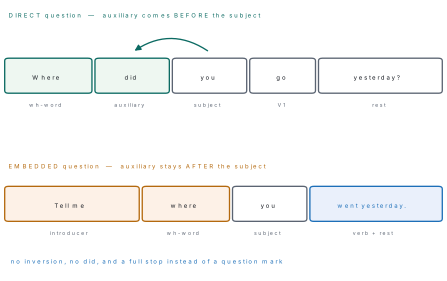
When a question is placed inside another sentence — after Tell me…, I wonder…, Do you know…, Could you tell me… — the word order becomes that of a statement.
| Direct | Embedded |
|---|---|
| Where is the post office? | Could you tell me where the post office is? |
| What does she want? | I wonder what she wants. |
| Did he pass? | Do you know whether/if he passed? |
Note that a yes/no question becomes if or whether, and do/does/did disappears.
~~Could you tell me where is the bank?~~ → Could you tell me where the bank is? ~~I don't know what does he want.~~ → I don't know what he wants. Once the question is inside another sentence, stop inverting.
29.5 Question tags — the basic rule
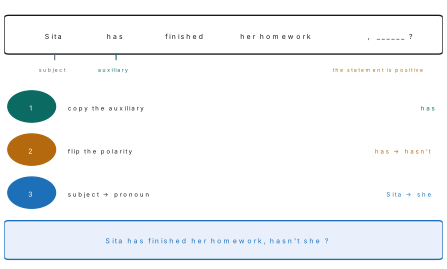
A tag is a short question added to a statement to ask for agreement. Three steps:
- Take the auxiliary from the statement. If there is none, use do / does / did.
- Reverse the polarity. A positive statement takes a negative tag; a negative statement takes a positive tag.
- Use a pronoun for the subject, and keep the same tense.
- Ramesh is studying in Kathmandu, isn't he?
- You haven't paid the fee, have you?
- She works at the health post, doesn't she?
- They went to Lumbini last week, didn't they?
29.6 Special tags you must memorise
| Statement | Tag | Note |
|---|---|---|
| I am late, | aren't I? | never amn't I |
| I am not late, | am I? | |
| Let's go to Nagarkot, | shall we? | suggestion |
| Open the window, | will you / won't you? | imperative |
| Don't shout, | will you? | negative imperative |
| There is no water, | is there? | there repeats as the subject |
| Everyone has come, | haven't they? | everyone/somebody → they |
| Nothing is wrong, | is it? | nothing/nobody is already negative |
| Nobody came, | did they? | |
| This / That is your bag, | isn't it? | this/that → it |
| These / Those are old, | aren't they? | these/those → they |
| He never comes on time, | does he? | never makes it negative |
| She hardly / scarcely / seldom / rarely speaks, | does she? | these words are negative |
| Few students attended, | did they? | few, little are negative |
| It has to be done, | doesn't it? | have to uses do |
| He used to live here, | didn't he? | |
| You had better go, | hadn't you? | |
| Nothing can stop him, | can it? |
- Hidden negatives. Never, hardly, scarcely, seldom, rarely, few, little, neither, no one, nothing already make a sentence negative, so the tag must be positive: He rarely visits us, does he? — not ~~doesn't he~~.
- Pronoun, not the noun. ~~My uncle works in Qatar, doesn't my uncle?~~ → doesn't he?
- Same tense. ~~She came yesterday, doesn't she?~~ → didn't she?
- I am takes aren't I, which is irregular but standard.
29.7 Subject–verb agreement: the core rules
The verb must agree with the subject in number and person. In the simple present, a singular third-person subject takes -s and everything else does not.
Rule 1 — Find the real subject. Words between the subject and the verb do not change the agreement.
- The box of old books is in the store room. (not ~~are~~)
- The teacher, along with all her students, was present.
Phrases like with, along with, as well as, together with, in addition to, including, accompanied by do not make the subject plural.
Rule 2 — and makes a plural subject.
- Ram and Shyam are waiting outside.
But when the two nouns name one thing or one idea, the verb is singular: Bread and butter is my usual breakfast.
Rule 3 — or / nor : the verb agrees with the nearer subject.
- Neither the students nor the teacher was informed.
- Neither the teacher nor the students were informed.
- Either Sita or her brothers have taken it.
Rule 4 — each, every, either, neither, one of take a singular verb.
- Each* of the boys has* a bicycle.
- Every* student and every teacher was* given a badge.
- One of* my friends lives* in Nepalgunj. (plural noun, singular verb)
Rule 5 — Uncountable nouns are singular.
- This information is useful. The news was shocking.
- Mathematics is my favourite subject. (also physics, politics, economics, statistics as subjects, measles, mumps)
Rule 6 — Plural-only nouns take a plural verb, but a pair of makes them singular.
- My trousers are torn. / A pair of trousers is enough.
- These scissors are blunt.
Rule 7 — Collective nouns. Team, family, government, committee, class, jury, crowd, police take a singular verb when the group acts as one, and a plural verb when its members act separately. Police is normally plural.
- The committee has taken a decision. (one body)
- The committee are divided among themselves. (individuals)
- The police have arrested two men.
Rule 8 — Amounts, distances, times and money are one unit, so singular.
- Twenty kilometres is a long walk.
- Rs 500 is not enough for the books.
- Two hours is the maximum time allowed.
Rule 9 — a number of vs the number of.
- A number of* students were* absent. (= many, plural)
- The number of* students is* increasing. (= the figure, singular)
Rule 10 — There is / there are agrees with the noun that follows.
- There is a temple near the bridge.
- There are many temples in Bhaktapur.
Rule 11 — The + adjective as a plural group.
- The poor are the worst affected by inflation.
Rule 12 — In a relative clause, the verb agrees with the antecedent.
- She is one of those students who work hard. (who = students)
- He is the only one of the boys who has passed. (who = one)
Rule 13 — Titles and proper names of one thing are singular.
- The Arabian Nights is a famous collection of tales.
- Losing the third-person -s under pressure. ~~He go to school at nine.~~ → He goes to school at nine.
- Treating information, advice, furniture, luggage, equipment, machinery as plural. ~~These informations are useful.~~ → This information is useful. ~~He gave me many advices.~~ → He gave me a lot of advice.
- Pluralising after one of. ~~One of my friend is a pilot.~~ → One of my friends is a pilot. The noun is plural, the verb singular.
- Making the verb agree with the nearest noun instead of the subject. ~~The quality of the mangoes were poor.~~ → The quality of the mangoes was poor.
- Plural verb after each or every. ~~Each of the students have a book.~~ → Each of the students has a book.
Tags are printed as Add a suitable question tag: followed by a statement and a blank — look for a hidden negative first, then copy the auxiliary. Agreement is usually Fill in the blank with the correct form of the verb in brackets — cross out everything between the subject and the blank with your pencil, and the right form becomes obvious. Question formation is Change into a question or Frame a question to get the underlined part as the answer — if the underlined part is the subject, use who/what with no do/does/did.
Problem. Add a question tag: Hari hardly ever attends the morning class, ____ ?
Solution — step by step.
- Find the auxiliary. There is none; attends is a present simple verb with a third-person singular subject → the auxiliary is does.
- Check the polarity. Hardly ever is a negative adverb, so although the sentence has no not, it counts as negative.
- Flip it. A negative statement takes a positive tag → does.
- Pronoun. Hari → he.
Answer. Hari hardly ever attends the morning class, does he?
Writing doesn't he would be the standard error, because the negative is hidden in hardly.
Problem. Frame questions to get the underlined answers. (a) Sabina won the debate competition. (b) They reached Pokhara at six o'clock.
Solution.
(a) The underlined part is the subject of the sentence. A subject question takes no did and no inversion: simply replace the subject with who and leave the verb exactly as it is. Answer: Who won the debate competition?
(b) The underlined part is an adverbial of time, so the question word is when (or what time). The verb reached is past simple with no auxiliary, so insert did and change the verb back to V1. Answer: When did* they reach* Pokhara?
Problem. Choose the correct verb. (a) The list of candidates (has / have) been published. (b) Neither the principal nor the teachers (was / were) willing to speak. (c) One of the mobiles that (is / are) displayed here (is / are) mine.
Solution.
(a) Cross out the phrase of candidates. The subject is the list, singular. Answer: has been published.
(b) With neither … nor, the verb agrees with the nearer subject, which is teachers, plural. Answer: were willing to speak.
(c) Two verbs, two subjects. Inside the relative clause, that refers to mobiles (plural) → are displayed. The main subject is one, singular → is mine. Answer: One of the mobiles that are displayed here is mine.
Chapter summary
- Questions invert the auxiliary and the subject; without an auxiliary, insert do / does / did and use V1.
- A subject question (Who came?) takes no do / does / did and no inversion.
- An embedded question keeps statement word order and needs no question mark.
- A tag = auxiliary + (n't) + pronoun, with the polarity reversed.
- Memorise: I am → aren't I, Let's → shall we, imperative → will you, There is → is there, everyone → they, nothing → it.
- Never, hardly, seldom, rarely, few, little are negatives and take a positive tag.
- The verb agrees with the real subject, not with the nearest noun.
- Each, every, either, neither, one of + singular verb; a number of + plural, the number of + singular.
- As well as, along with, together with do not make a subject plural.
- Amounts of money, time and distance take a singular verb.
Practice questions
Add a suitable question tag (1 mark each)
- Sarita is preparing for the entrance examination, ____ ? [1]
- You haven't seen my calculator anywhere, ____ ? [1]
- Let's leave for Bandipur early tomorrow, ____ ? [1]
- Nobody informed the head teacher, ____ ? [1]
- I am your class monitor, ____ ? [1]
- He rarely goes to the temple, ____ ? [1]
- Close the door, ____ ? [1]
- There is little milk in the jug, ____ ? [1]
- Everyone has submitted the assignment, ____ ? [1]
- Your brother used to play for the district team, ____ ? [1]
Answers
1. isn't she — positive statement, so a negative tag with the same auxiliary is.
2. have you — a negative statement takes a positive tag.
3. shall we — the fixed tag after Let's.
4. did they — nobody is negative, so a positive tag, and nobody is answered by they.
5. aren't I — the standard irregular tag for I am.
6. does he — rarely is a hidden negative, so the tag is positive.
7. will you — the fixed tag after an imperative.
8. is there — little is negative, and there repeats as the subject.
9. haven't they — everyone takes a plural pronoun they in the tag.
10. didn't he — used to forms its tag with did.
Fill in the blanks with the correct form of the verb in brackets (1 mark each)
- The list of selected students ____ on the notice board. (be, present) [1]
- Each of the girls ____ her own bag. (have) [1]
- Neither Gopal nor his brothers ____ interested in farming. (be, present) [1]
- Twenty kilometres ____ too far to walk in one day. (be, present) [1]
- The news from the border ____ worrying. (be, past) [1]
- A number of passengers ____ waiting at the bus park. (be, past) [1]
- Mathematics ____ easier than she expected. (be, past) [1]
- The police ____ already arrested the suspect. (have) [1]
- One of my cousins ____ in Ilam. (live) [1]
- The teacher, as well as the students, ____ invited to the programme. (be, past) [1]
Answers
11. is — the subject is the list, singular; of selected students does not count.
12. has — each of always takes a singular verb.
13. are — with neither … nor, the verb agrees with the nearer subject brothers.
14. is — a distance is treated as a single unit.
15. was — news is uncountable and singular.
16. were — a number of means "many" and takes a plural verb.
17. was — subjects ending in -ics are singular.
18. have — police takes a plural verb.
19. lives — the subject is one, singular, though cousins is plural.
20. was — as well as does not make the subject plural.
Change the sentences into questions as instructed (1 mark each)
- Sujata teaches English at a school in Hetauda. — Change into a yes/no question. [1]
- They visited the Pashupatinath temple last Saturday. — Change into a yes/no question. [1]
- Bikash repaired the water pump. — Frame a question to get the underlined answer. [1]
- She left the office because she was unwell. — Frame a question to get the underlined answer. [1]
- Where does he live? — Rewrite beginning Do you know … [1]
- Did she pass the test? — Rewrite beginning I wonder … [1]
Answers
21. Does Sujata teach English at a school in Hetauda? — insert does and return the verb to V1.
22. Did they visit the Pashupatinath temple last Saturday? — past simple, so did + V1.
23. Who repaired the water pump? — a subject question, so no did and no inversion.
24. Why did she leave the office? — a reason is asked with why, and did + V1 is needed.
25. Do you know where he lives? — an embedded question keeps statement order and drops does.
26. I wonder whether/if she passed the test. — a yes/no question embeds with if or whether.
Practise more: English question bank