Unit 2 · Literature - Short Stories · 26 min read
The Oval Portrait
What the syllabus asks for 7
- About the author
- The story
- Characters
- Themes
- Setting, structure and point of view
- Literary devices
- Glossary
"The Oval Portrait" is one of the shortest stories Edgar Allan Poe ever wrote — under a thousand words — and one of the most tightly built. A wounded traveller takes shelter in an abandoned castle, notices a portrait of a young woman that seems frighteningly alive, and reads the terrible explanation in a book beside his bed. It is on the syllabus because it shows, in a very small space, how a Gothic writer creates atmosphere, how a frame narrative works, and how a whole argument about art and life can be made in a single closing sentence.
The painter puts life into his canvas by taking it out of his wife. When the picture is finally "Life itself", the living woman is dead. Art and life, in this story, are rivals, and art wins.
2.1 About the author
Edgar Allan Poe (1809–1849) was an American poet, short-story writer, editor and critic. He was born in Boston. His father abandoned the family and his mother died before he was three, and he was taken in — though never legally adopted — by John Allan, a merchant of Richmond, Virginia, from whom he took his middle name. He quarrelled with Allan over money, left the University of Virginia after less than a year, served briefly in the army, and spent the rest of his short life working for magazines, always poor. In 1836 he married his cousin Virginia Clemm; she died of tuberculosis in 1847, after years of slow decline. Poe himself died in Baltimore in 1849, aged forty, in circumstances that have never been explained.
Poe belongs to Dark Romanticism, also called the American Gothic: writing that explores fear, madness, guilt, death and the parts of the mind we do not control. His best-known works are the poems "The Raven" (1845) and "Annabel Lee", and the stories "The Fall of the House of Usher", "The Tell-Tale Heart", "The Masque of the Red Death" and "The Cask of Amontillado". With "The Murders in the Rue Morgue" (1841) he effectively invented the detective story.
Poe's own rule for the short story: every word, incident and detail should work towards one single emotional effect on the reader, and the story should be short enough to be read in one sitting. In "The Oval Portrait" that single effect is dread.
What is distinctive about Poe's voice is its controlled excess. The sentences are long and formal, crowded with unusual words, and they slow the reader down so that the atmosphere has time to thicken. He almost always narrates in the first person, often through a speaker who is ill, frightened or unreliable, so the reader can never be quite sure how much of the horror is in the world and how much is in the narrator's head. He returns again and again to one subject — the death of a beautiful woman — which he once called the most poetical topic in the world. "The Oval Portrait" first appeared in 1842 under the title "Life in Death", and Poe cut it to its present shape in 1845.
2.2 The story
Taking shelter. The narrator is badly wounded — we are never told how — and is travelling with his servant, Pedro. Rather than let his master spend a night in the open, Pedro forces his way into an abandoned château in the Apennine mountains of Italy, a building of "commingled gloom and grandeur". Poe compares it to the castles in the novels of Mrs Radcliffe, a famous writer of Gothic romances, which tells the reader at once what kind of story this will be.
The turret chamber. The two settle in a small room in a remote turret. Its decorations are rich but old and torn: tapestry on the walls, coats of arms, and an unusual number of very lively modern paintings in gilded frames, hung not only on the main walls but in the odd corners created by the château's strange architecture. The narrator says that his "incipient delirium" — the beginning of fever — may be why the pictures interest him so much. He tells Pedro to close the heavy shutters, light the many candles of a tall candelabrum by the bed and open the black velvet bed-curtains, so that he can look at the paintings and read a small book found on the pillow, which describes and criticises them.
Midnight, and the hidden picture. He reads and gazes for hours. At midnight he is unhappy with the position of the candelabrum, and reaches out — carefully, so as not to wake the sleeping Pedro — to move it nearer the book. The result is unexpected. The candles now light a niche of the room that had been in deep shadow behind one of the bed-posts, and he sees a picture he had not noticed: the portrait of a young girl "just ripening into womanhood".
The shock. He glances at it, then shuts his eyes. He does this by instinct, and only afterwards works out why: he wants a moment to be sure his eyes have not deceived him. Looking again, he is fully awake, all drowsiness gone. The picture is only a head and shoulders, painted in the vignette manner — arms, shoulders and the ends of the hair fading into the dark background — in the style of the American portrait painter Thomas Sully, in an oval gilded frame. He lies half-sitting for perhaps an hour, staring, and finally understands what disturbs him. It is not the skill of the painting, nor the beauty of the face, and it is certainly not that he mistook the picture for a living person: the oval frame and the vignette style make that impossible. The secret is "an absolute life-likeliness of expression", which startles, then confuses, then overcomes and terrifies him. Shaken, he moves the candelabrum back so that the portrait falls into darkness again, and reaches eagerly for the book, turning to the entry that explains this picture.
The story in the book. The book tells of a girl of rare beauty, full of laughter, who loved and married a painter. It was an evil hour when she did so, for the painter already had a bride — his Art. She loved everything, and hated only the Art that was her rival, and feared only the brushes and palette that took her husband's face away from her. So when he announced that he wished to paint her, it was terrible news. But she was humble and obedient, and sat for many weeks in a dark, high turret-chamber where light fell on the canvas only from above.
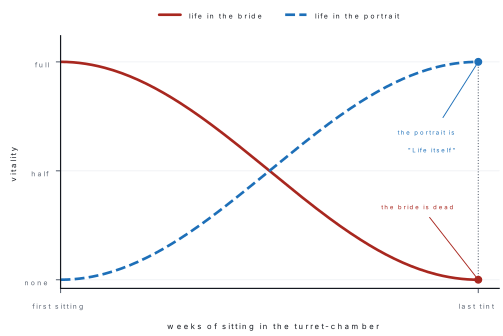
The painting and the death. The painter, wild, moody and lost in his work, laboured day and night and would not see that the ghastly light of the turret was draining the health and spirits of his bride, who faded visibly to everyone except him. She kept smiling and never complained, because she could see how much joy the work gave him. Visitors spoke in low voices of how like her the portrait was, and called it proof both of his skill and of his love. As the work neared its end he allowed nobody into the turret; he had become so wild in his eagerness that he hardly turned his eyes from the canvas even to look at his wife's face; and he would not see that the colours he was spreading on the canvas were being taken from her cheeks. At last only one stroke on the mouth and one tint on the eye remained. The lady's spirit flickered up once more, "as the flame within the socket of the lamp". The brush was given and the tint placed. For one moment the painter stood entranced before his finished work; the next, he grew pale and trembling and cried aloud, "This is indeed Life itself!" Then he turned to look at his beloved. She was dead.
2.3 Characters
| Character | Who they are | Role in the story |
|---|---|---|
| The narrator | An unnamed traveller, "desperately wounded", feverish | Tells the outer story; his fear and his reading frame everything we learn |
| Pedro | His valet (personal servant) | Breaks into the château, lights the candles, then sleeps — a practical man untouched by the horror |
| The painter | A husband of "high renown", passionate, studious, austere, wild and moody | The real antagonist: he kills without meaning to, by not looking up |
| The bride | A young woman of rare beauty, "frolicsome as the young fawn" | The victim; she is never named and never speaks in the story |
| Art (personified) | The painter's first "bride" | The rival who defeats the living wife |
The narrator. He is important not for what he does — he does almost nothing but move a candlestick — but for how he sees. He tells us himself that a delirium is beginning, and Poe leaves it deliberately unclear whether the portrait's dreadful liveliness is a fact or a symptom. His reactions are described with unusual precision: he glances, shuts his eyes, reasons about why he shut them, looks again, lies staring for an hour, and only then names the cause of his terror. That slow, analytical movement is what makes the horror convincing; a hysterical narrator would be much less frightening.
The painter. Poe is careful not to make him a monster. He loves his wife — visitors read the portrait as proof of it — and he never intends her any harm. His crime is a kind of blindness: he "would not see" the light withering her, and he "would not see" that the colours going onto the canvas were coming off her cheeks. The word repeated is see, which is savage irony in a man whose whole profession is looking. He is the type of the obsessed artist, for whom the work becomes more real than the person, and his cry at the end — "This is indeed Life itself!" — is both his triumph and his sentence.
The bride. She is given no name, no dialogue and no choice. Everything we learn about her is in the first few lines of the book's account: beautiful, full of glee, loving all things, hating only the Art that was her rival. Her tragedy is that she is "humble and obedient": she sits for weeks in a dark room, smiling uncomplainingly, precisely because she loves him. Poe's simile for her last moment — her spirit flickering up like a flame in the socket of a lamp just before it goes out — makes her death seem like something quietly used up rather than violently taken.
2.4 Themes
Art demands life, and takes it. This is the story's central claim, and Poe makes it literal, not merely symbolic. The tints spread on the canvas are "drawn from the cheeks of her who sate beside him". As the portrait grows more lifelike, the model grows weaker, until the exact moment of completion is the exact moment of death. The idea also explains the original title, "Life in Death": the life in the picture is the death of the woman.
Obsession and the blindness it causes. The painter is not cruel; he is absorbed. He locks the turret against visitors, works day and night, hardly lifts his eyes from the canvas, and loses the ordinary human power of noticing that someone in the room is dying. Poe is describing a danger he knew from inside — the artist who sacrifices the people around him to the work.
Beauty, death and the woman as object. The wife is turned into a picture, and the picture is more admired than the woman ever was. She is looked at, arranged, copied and hung on a wall; the one thing nobody does is listen to her. It is worth noticing that the portrait survives in a gilded oval frame for years, while she is gone in a single sentence.
Perception, fever and the unreliable eye. The outer story keeps reminding us that its narrator is wounded and half-delirious, that the room is lit by candle-flame, and that a single movement of the candelabrum can make a whole painting appear out of the dark. Poe wants the reader to feel that the boundary between seeing and imagining is thin, and that what frightens us most is what we half-see.
The power of a story told by someone else. The most horrifying part of the tale does not happen to the narrator at all: he only reads it. Poe demonstrates that horror travels through narration, and that an old book, in the right room at the right hour, can be more terrifying than any ghost.
2.5 Setting, structure and point of view
Setting. An abandoned château among the Apennines, at night, in a remote turret; heavy shutters closed, black velvet curtains thrown open, a tall candelabrum burning; rich decorations that are "tattered and antique". Every element is standard Gothic furniture, and Poe openly admits the debt by naming Mrs Ann Radcliffe. Note the deliberate echo: the narrator lies in a turret chamber looking at a portrait, and the portrait was painted in a turret chamber. The two rooms rhyme, which is why the reader feels trapped inside the painting's history.
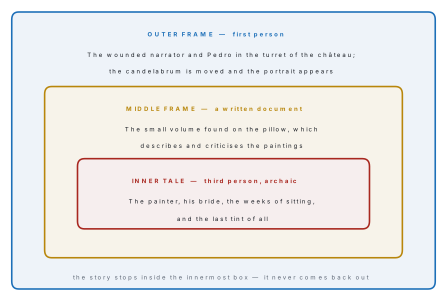
Structure — a frame narrative. The story is built in three layers, like boxes inside boxes: the narrator's night in the château; the small book of criticism found on the pillow; and, inside the book's entry, the painter's tale. Poe never returns to the outer layer. The story ends on the last words of the book — "She was dead!" — with no comment from the narrator at all, and that missing return is what leaves the reader without a safe place to stand.
A story placed inside another story. The outer story (the "frame") introduces a narrator or a document, and the inner story is what that narrator tells or that document contains.
Point of view. The frame is first person: a wounded, feverish "I" whose judgement we are invited to doubt. The inner tale is third person, told in the archaic, formal language of an old book ("And evil was the hour when she saw, and loved, and wedded the painter"), which distances the events and makes them sound like a legend. The shift between these two voices is one of the story's most skilful effects.
2.6 Literary devices
| Device | Example from the text | Effect |
|---|---|---|
| Frame narrative | The narrator reads the portrait's history in a book | Puts distance between reader and horror, then removes the way back out |
| Gothic setting | Abandoned château, remote turret, deep midnight, candlelight, tattered tapestry | Builds dread before anything frightening has actually happened |
| Symbolism | The candelabrum (what light reveals and hides); the oval frame; the dark turret | Turns the physical room into a statement about art, seeing and death |
| Situational irony | The painter's cry, "This is indeed Life itself!", spoken over a corpse | The moment of artistic triumph is the moment of human catastrophe |
| Paradox / oxymoron | The original title, "Life in Death"; a portrait more alive than its model | Compresses the whole theme into two words |
| Personification | Art is the painter's first "bride" and the wife's "rival" | Makes an abstraction into a character who can compete and win |
| Simile | Her spirit "flickered up as the flame within the socket of the lamp" | Makes her death gentle, domestic and inevitable rather than violent |
| Foreshadowing | "Evil was the hour when she saw, and loved, and wedded the painter" | Warns the reader of the ending on the first line of the inner tale |
| Imagery of light and shade | Light "dripped" from overhead onto the canvas; the niche "thrown into deep shade" | Light gives life to the picture and takes it from the woman |
| Unreliable narration | "My incipient delirium, perhaps, had caused me to take deep interest" | Leaves it open whether the terror is in the picture or in the narrator |
2.7 Glossary
| Word / phrase | Meaning |
|---|---|
| château | a large French or Italian country house or castle |
| valet | a manservant who looks after his master personally |
| forcible entrance | going into a building by breaking a door or lock |
| commingled | mixed together |
| sumptuously | richly and expensively |
| turret | a small tower at the corner or top of a large building |
| tapestry | heavy cloth with pictures woven into it, hung on walls |
| armorial trophies | displays of family coats of arms, shields and weapons |
| arabesque | an ornamental design of curling lines and leaf shapes |
| candelabrum | a tall stand holding several candles |
| incipient delirium | fever-madness that is just beginning |
| perusal | careful reading |
| niche | a hollow space set into a wall |
| vignette manner | a portrait style in which the edges fade gradually into the background |
| filigreed | decorated with fine, delicate ornamental work |
| Moresque | in the Moorish (North African / Spanish-Arab) style |
| austere | severe and strict; taking no pleasure in comfort |
| pallet (palette) | the board on which a painter mixes colours |
| reveries | daydreams; states of being lost in thought |
| pined | grew weak and thin from sorrow or longing |
| ardor | burning eagerness or passion |
| in sooth | (old) in truth, truly |
| tremulous | trembling, shaking |
| aghast | struck with sudden horror |
| entranced | held still as if under a spell |
(i) Do not write that the painter murdered his wife. There is no violence in the story; the point is that he never noticed. The horror is neglect, not crime. (ii) Do not write that the narrator thought the portrait was a real woman. Poe explicitly rules this out — the oval frame and vignette style "must have instantly dispelled such idea". What frightens him is the expression, not a mistake.
Most questions turn on one sentence: "This is indeed Life itself!" If you can explain why that line is ironic, why it is the climax, and how the frame narrative delivers it to us second-hand, you can answer nearly anything asked about this text.
Chapter summary
- Edgar Allan Poe (1809–1849), American, a founder of Dark Romanticism and of the detective story; "The Oval Portrait" appeared in 1842 as "Life in Death".
- A wounded narrator and his valet Pedro shelter in an abandoned château in the Apennines and take a small turret room hung with paintings.
- Moving the candelabrum at midnight reveals an oval portrait of a young girl whose "absolute life-likeliness of expression" terrifies him.
- A book on the pillow explains it: a painter married a beautiful girl who hated his Art as her rival, then made her sit for weeks in a dark turret.
- Absorbed in his work, he did not see her fading; the colours he laid on the canvas were drawn from her cheeks.
- At the last brush-stroke he cried, "This is indeed Life itself!", turned to his bride, and found her dead. The story ends there, inside the book.
- Themes: art consuming life; artistic obsession and blindness; beauty and death; the woman as object; the unreliable, feverish eye.
- Devices: frame narrative, Gothic setting, situational irony, paradox, the lamp simile, light-and-shade imagery, unity of effect.
Practice questions
Short answer questions (2 marks each)
- Why did the narrator and Pedro enter the château? [2]
- How did the narrator come to notice the oval portrait? [2]
- What exactly was it about the portrait that terrified the narrator? [2]
- Why did the painter's wife hate Art? [2]
- What does the narrator mean by his "incipient delirium", and why does Poe mention it? [2]
- Explain the irony in the painter's words, "This is indeed Life itself!" [2]
Model answers — short questions
1. The narrator was desperately wounded and could not spend a night in the open air. His valet Pedro therefore broke into an abandoned château in the Apennines so that his master could rest, and they settled in a small room in a remote turret.
2. At midnight the narrator was displeased with the position of the tall candelabrum and reached out to move it so that its light fell better on his book. The candles then lit a niche that had been hidden in shadow by a bed-post, and the portrait appeared in vivid light.
3. It was not the skill of the painting nor the beauty of the face, and he did not mistake it for a living woman. What appalled him was its "absolute life-likeliness of expression" — the picture seemed to be alive, and that impression first startled, then confused and finally overcame him.
4. She hated Art because it was her rival. The painter already had a bride in his Art, and the palette and brushes took him away from her, so that she was deprived of her husband's company and even of his face. When he wished to paint her, she therefore heard it as terrible news.
5. "Incipient delirium" means a fever-madness that is just beginning. Poe mentions it so that the reader cannot be certain whether the portrait is truly uncanny or whether the narrator's sick imagination is at work. This uncertainty deepens the fear and makes the narrator unreliable.
6. The painter believes he has captured life on canvas, and in that instant he has — but the life came out of his wife. He shouts his triumph over a woman who has just died, and the picture is "Life itself" only because she is no longer alive. Success and disaster arrive in the same moment.
Long answer questions (5 marks each)
- Discuss "The Oval Portrait" as a story about the conflict between art and life. [5]
- Explain how Poe uses the frame narrative and the Gothic setting to produce his single effect of dread. [5]
- Sketch the character of the painter. Is he guilty of his wife's death? [5]
Model answers — long questions
1. Poe builds the story on a single idea: that a work of art may be paid for with a human life, and he presents it literally rather than as a figure of speech. The painter already has "a bride in his Art" before he marries; the living wife is therefore a second wife from the beginning, and she knows it, for she hates only the Art which is her rival and dreads the palette and brushes that steal her husband from her. When she begins to sit in the dark turret, the exchange starts. The narrator of the book tells us that the painter "would not see" that the light withered her, and would not see that the tints he spread on the canvas were "drawn from the cheeks of her who sate beside him". Week by week the portrait gains exactly what the model loses, so that the perfection of the one requires the extinction of the other. The two curves meet at the final brush-stroke: the moment the picture becomes "Life itself" is the moment she stops living. Poe's original title, "Life in Death", states the theme directly. The conclusion is not that art is evil but that an art which stops looking at the human being in front of it has already killed something.
2. Poe said that a short story should aim at one single effect, and here that effect is dread. He gets it first from the setting. Everything is Gothic: an abandoned château among the Apennines, "commingled gloom and grandeur", a remote turret, heavy shutters closed against the night, black velvet bed-curtains, tattered antique decorations, and candlelight as the only illumination. He even names Mrs Radcliffe, so the reader recognises the tradition. He then makes light itself the instrument of terror: a single small movement of the candelabrum takes a picture out of the darkness, as though the room had been concealing it. The frame narrative does the rest. We meet a narrator who is wounded and half-delirious, so we cannot fully trust him; inside his story sits an old book, and inside the book sits the painter's tale in archaic, legendary language. Each layer makes the horror older and less escapable. Most importantly, Poe does not come back out. The story ends on the book's last words, "She was dead!", with no return to the turret and no comforting comment from the narrator, leaving the reader shut inside the innermost box.
3. The painter is presented in four words — "passionate, studious, austere" and already wedded to his Art — and every later detail develops them. He is celebrated, "of high renown", and he genuinely loves his wife: those who saw the portrait spoke of it as proof both of his power and of his deep love for the woman he painted so well. Yet he is also "wild, and moody", a man who becomes lost in reveries. As the work advances he shuts everyone out of the turret, works day and night, and barely lifts his eyes from the canvas even to look at the living face he is copying. Poe twice uses the same phrase, that he "would not see" — that the ghastly overhead light was destroying her health, and that his colours were being taken from her cheeks. The repetition is bitterly ironic in a man whose art is seeing. Is he guilty? Not of murder: there is no violence, no intention, and he is appalled at the end. But he is guilty of a moral blindness that amounts to neglect. He had weeks in which any ordinary husband would have noticed, and he chose the canvas over the woman every single day. His cry of triumph over her corpse is his punishment as well as his achievement.
Reference to the context
- "She was a maiden of rarest beauty, and not more lovely than full of glee."
(a) Where in the story do these words occur, and who is being described? (b) Who is reading them, and in what circumstances? (c) What contrast does the line set up with the rest of her story? (d) What does the language of this sentence tell you about the inner narrative? [5]
- "This is indeed Life itself!"
(a) Who says this, and at what moment? (b) What does the speaker mean by it? (c) What does he discover immediately afterwards? (d) Why is this the climax of the story? [5]
Model answers — reference to the context
1. (a) They are the opening words of the entry in the small volume found on the narrator's pillow — the account of the oval portrait — and they describe the young woman in the picture, the painter's bride. (b) The wounded narrator is reading them at midnight, in a turret room of an abandoned château in the Apennines, after the candelabrum's light has accidentally revealed the portrait and frightened him. (c) The line shows her as she was before the painting began — beautiful, laughing, "frolicsome as the young fawn" — which makes the rest of the account unbearable, for that living gaiety is exactly what the weeks in the dark turret slowly take away from her. (d) The formal, old-fashioned phrasing, with its inverted construction and its "And evil was the hour" a line later, shows that the inner tale is told in the voice of an old book rather than of a modern person. That legendary voice makes the events feel distant and fated, which increases their power.
2. (a) The painter says it in the innermost story, at the instant he lays the last brush-stroke on the mouth and the last tint on the eye of his wife's portrait, after many weeks of work in the shut turret. (b) He means that he has succeeded completely: the painted face is no longer a mere likeness but seems to possess life of its own, and for one moment he stands entranced before what he has made. (c) He grows pale, trembling and aghast, turns round to look at his beloved, and finds that she is dead. (d) It is the climax because the two lines of the story meet here. The life the painter has been transferring to the canvas is his wife's life, so the completion of the portrait is necessarily the end of her. The sentence is the story's supreme irony and also its theme in five words, and Poe ends the whole narrative two lines later without another word of comment.
Practise more: English question bank