Unit 28 · Grammar · 16 min read
Relative Clauses and Connectives
What the syllabus asks for 8
- Relative pronouns
- Defining relative clauses
- Non-defining relative clauses
- When the relative pronoun may be left out
- Whose, where, when and why
- Prepositions in relative clauses
- Reduced relative clauses
- Connectives by function
A relative clause is a clause that describes a noun, joined to it by a relative pronoun such as who, which or that. A connective (or linking word) is a word or phrase that joins ideas and shows the relationship between them — addition, contrast, cause, result, purpose. Both belong to the same skill: turning short sentences into longer, better-organised ones. NEB Q7 tests them as Join the sentences using a relative pronoun, Fill in the blank with a suitable connective, or Choose the correct linker from the brackets.
For a relative clause: which pronoun (person or thing, subject or object, possession?) and commas or no commas. For a connective: what relationship the two ideas have, and what kind of word the blank needs — a conjunction, a preposition or an adverb. Most lost marks come from putting an adverb where a conjunction is needed (despite vs although).
28.1 Relative pronouns
| Pronoun | Refers to | Function | Example |
|---|---|---|---|
| who | people | subject | The girl who won the prize is from Ilam. |
| whom | people | object (formal) | The teacher whom we met is retiring. |
| whose | people and things | possession | The boy whose bicycle was stolen is crying. |
| which | things and animals | subject or object | The bus which goes to Jumla leaves at five. |
| that | people or things | subject or object, defining clauses only | The book that you lent me is excellent. |
| where | places | place | This is the village where I was born. |
| when | times | time | I remember the day when the earthquake struck. |
| why | reasons | reason | Tell me the reason why you were absent. |
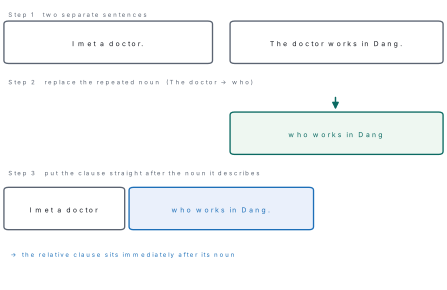
The relative pronoun always stands immediately after the noun it describes.
- The man who lives next door teaches at Padma Kanya Campus.
- Kathmandu, which lies in a valley, has poor air in winter.
28.2 Defining relative clauses
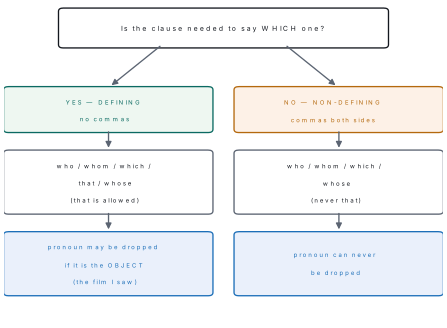
A defining (restrictive) clause tells you which one. Without it the sentence does not identify anything. It takes no commas.
- The students who scored above 80 will get a scholarship. (only those students, not all)
- The trekking route that passes through Ghorepani is the most popular one.
- A blacksmith is a person who works with iron.
In a defining clause, that may replace who or which.
28.3 Non-defining relative clauses
A non-defining clause adds extra information about a noun that is already identified. It is always separated by commas, and that can never be used.
- My father, who retired last year, now keeps bees in Nuwakot.
- Mount Everest, which stands on the Nepal–China border, was climbed in 1953.
- Pokhara, where I spent my childhood, is full of tourists in October.
Compare the pair carefully:
| Sentence | Meaning |
|---|---|
| My brother who lives in Biratnagar is a doctor. | I have more than one brother; this is the Biratnagar one. |
| My brother, who lives in Biratnagar, is a doctor. | I have one brother; he happens to live in Biratnagar. |
- Using that after a comma. ~~Janakpur, that is famous for its temple, …~~ → Janakpur, which is famous for its temple, …
- Keeping the old pronoun as well. ~~This is the man who I met him yesterday.~~ → This is the man whom I met yesterday. The relative pronoun is the object; do not repeat it.
- Separating the clause from its noun. ~~The letter was lying on the table which I wrote.~~ → The letter which I wrote was lying on the table.
28.4 When the relative pronoun may be left out
The pronoun can be dropped only when it is the object of the defining clause, never when it is the subject, and never in a non-defining clause.
| Sentence | Pronoun | May it be dropped? |
|---|---|---|
| The film that we watched was boring. | object | Yes — The film we watched was boring. |
| The film that won the award was Nepali. | subject | No |
| Mira, whom I met in Ilam, has moved. | non-defining | No |
- The mobile (which) I bought in Ratnapark stopped working.
- The man who sold it to me has disappeared. (subject — keep who)
28.5 Whose, where, when and why
whose shows possession and works for people and for things.
- The farmer whose buffalo died has applied for compensation.
- I live in a house whose roof leaks every monsoon.
where, when, why replace a preposition + which.
| Long form | Short form |
|---|---|
| the town in which I grew up | the town where I grew up |
| the year in which he was born | the year when he was born |
| the reason for which she left | the reason why she left |
28.6 Prepositions in relative clauses
The preposition may come at the end (normal English) or before the pronoun (formal English). Before whom and which the formal order is common; that never follows a preposition.
- This is the friend whom I travelled with. → formal: This is the friend with whom I travelled.
- The village which we walked to → the village to which we walked
- Not: ~~the village to that we walked~~
28.7 Reduced relative clauses
A relative clause with be can often be shortened to a participle phrase. This is common in reading passages, so learn to recognise it.
| Full clause | Reduced |
|---|---|
| the man who is standing at the gate | the man standing at the gate |
| the houses which were damaged by the quake | the houses damaged by the quake |
| the first student who arrived | the first student to arrive |
28.8 Connectives by function
| Relationship | Conjunctions (join two clauses) | Adverbs / phrases (usually start a new sentence) | Prepositions (before a noun) |
|---|---|---|---|
| Addition | and, not only … but also | moreover, furthermore, besides, in addition | as well as, along with |
| Contrast | but, although, though, even though, whereas, while | however, nevertheless, on the other hand, on the contrary | despite, in spite of |
| Cause / reason | because, since, as | — | because of, due to, owing to, on account of |
| Result | so, so … that, such … that | therefore, thus, consequently, as a result, hence | — |
| Purpose | so that, in order that, lest | — | to, in order to, so as to, for |
| Condition | if, unless, provided that, as long as | otherwise | in case of |
| Time | when, while, before, after, as soon as, until, since | meanwhile, afterwards, then | during, by, until |
| Example | — | for example, for instance, namely | such as, like |
| Summary | — | in short, to sum up, in conclusion, altogether | — |
Examples of each kind in a sentence:
- Contrast, conjunction: Although the road was blocked, the ambulance reached the hospital.
- Contrast, adverb: The road was blocked; however, the ambulance reached the hospital.
- Contrast, preposition: Despite the blocked road, the ambulance reached the hospital.
- Cause: The flight was cancelled because the weather was bad. / The flight was cancelled because of the bad weather.
- Result: The weather was so bad that the flight was cancelled.
- Purpose: He woke at four so that he could catch the first bus.
- Two joiners in one sentence. Nepali and Hindi allow it; English does not. ~~Although he was tired, but he finished the work.~~ → Although he was tired, he finished the work. / He was tired, but he finished the work. The same applies to ~~Because he was late, so he missed the bus.~~
- Despite / in spite of take a noun, not a clause. ~~Despite he was ill, he came.~~ → Despite his illness, he came. / In spite of being ill, he came. / Although he was ill, he came. Also ~~in spite of~~ never becomes ~~inspite of~~, and despite takes no of.
- Because of takes a noun; because takes a clause. ~~The match stopped because of it rained.~~ → because it rained / because of the rain.
- However is not a conjunction. ~~He tried hard, however he failed.~~ → He tried hard; however, he failed. or He tried hard. However, he failed.
- As well as is not and. The verb agrees with the first subject: Ramesh, as well as his brothers, is going.
Join the following sentences using a relative pronoun — find the noun that appears in both sentences, replace the second occurrence with the right pronoun, and slot the clause in right after the noun. Fill in the blank with a suitable connective — read both halves first and name the relationship (contrast? cause? result?), then check what word class fits: a clause after it needs although/because, a noun after it needs despite/because of, a full stop or semicolon before it needs however/therefore. Never leave the blank filled with and out of habit.
Problem. Join into one sentence: I bought a second-hand laptop. The laptop stopped working after a week.
Solution — step by step.
- Find the repeated noun. laptop appears in both sentences.
- Decide which sentence carries the main idea. The important news is that it stopped working, so that becomes the main clause and the first sentence becomes the relative clause.
- Choose the pronoun. laptop is a thing and is the object of bought, so use which or that.
- Place the clause immediately after the noun.
Answer. The laptop which I bought second-hand stopped working after a week.
Because the pronoun is the object, it may also be dropped: The laptop I bought second-hand stopped working after a week.
Problem. Join, and punctuate correctly: Lumbini attracts thousands of pilgrims a year. Lumbini is the birthplace of the Buddha.
Solution — step by step.
- Repeated noun: Lumbini.
- Is the clause needed to identify it? No — Lumbini is a proper noun and is already fully identified. The clause only adds information.
- Therefore it is non-defining: commas on both sides, and that is forbidden.
- Choose the pronoun: a place treated as a thing → which.
Answer. Lumbini, which is the birthplace of the Buddha, attracts thousands of pilgrims a year.
If the pronoun replaced the place meaning rather than the noun itself, where would be used: Lumbini, where the Buddha was born, attracts thousands of pilgrims a year.
Problem. Rewrite each sentence with the word in brackets, keeping the meaning. (a) Although it was raining heavily, the programme continued. (despite) (b) He missed the bus because he got up late. (because of) (c) The soup was very salty. Nobody could eat it. (so … that)
Solution.
(a) Despite is a preposition, so the clause it was raining heavily must become a noun phrase: the heavy rain. Answer: Despite the heavy rain, the programme continued.
(b) Because of also needs a noun phrase: he got up late → his getting up late or his late rising. Answer: He missed the bus because of his getting up late.
(c) The so … that pattern is so + adjective + that + result clause. Put the adjective salty after so and attach the second sentence with that. Answer: The soup was so salty that nobody could eat it.
Chapter summary
- A relative clause goes immediately after the noun it describes.
- who/whom for people, which for things, whose for possession, where/when/why for place, time and reason.
- Defining clause: identifies the noun, no commas, that allowed, object pronoun may be dropped.
- Non-defining clause: extra information, commas both sides, that forbidden, pronoun never dropped.
- Do not repeat the noun or its pronoun inside the relative clause.
- A connective must match both the relationship and the word class: although + clause, despite + noun, however + new sentence.
- Never use two joiners for one relationship: although … but, because … so are wrong in English.
- As well as does not make a plural subject.
Practice questions
Join each pair of sentences using a suitable relative pronoun (1 mark each)
- I know a girl. The girl speaks four languages. [1]
- This is the house. My grandfather built it in 2020 BS. [1]
- The farmer is worried. His maize crop failed. [1]
- Chitwan is famous for its rhinos. Chitwan lies in the Terai. [1]
- I still remember the day. The earthquake struck on that day. [1]
- That is the shop. I bought my school bag from it. [1]
Answers
1. I know a girl who speaks four languages. — a person as subject of the defining clause.
2. This is the house which/that my grandfather built in 2020 BS. — a thing as object; the pronoun could also be dropped.
3. The farmer whose maize crop failed is worried. — whose shows possession and sits next to farmer.
4. Chitwan, which lies in the Terai, is famous for its rhinos. — a proper noun, so non-defining with commas and never that.
5. I still remember the day when the earthquake struck. — when replaces on which for time.
6. That is the shop where I bought my school bag (or from which I bought…). — where replaces from which for place.
Fill in the blanks with a suitable connective (1 mark each)
- ____ he had studied all night, he could not answer the last question. [1]
- The flight to Lukla was cancelled ____ the bad weather. [1]
- She revised every formula; ____ , she scored full marks in the test. [1]
- Put on a helmet ____ you may be fined at the checkpoint. [1]
- He got up at four ____ he could catch the first bus to Janakpur. [1]
- ____ his poor eyesight, he refused to wear spectacles. [1]
- The room was ____ cold that we could not sleep. [1]
- Nepal exports many farm products, ____ tea, cardamom and ginger. [1]
Answers
7. Although / Even though / Though — a contrast between effort and result, joining two clauses.
8. because of / due to / owing to — a noun phrase follows, so a preposition is needed, not because.
9. therefore / consequently / as a result — a result adverb after a semicolon.
10. otherwise / or else — the second clause states what happens if the first is not done.
11. so that / in order that — purpose, followed by a clause with could.
12. Despite / In spite of — a noun phrase follows, so the preposition form of contrast.
13. so — the so + adjective + that result pattern.
14. such as / namely / for example — introducing examples of the farm products.
Rewrite the sentences as instructed (1 mark each)
- Although he was ill, he attended the meeting. — Rewrite using in spite of. [1]
- Because of the strike, the schools remained closed. — Rewrite using because. [1]
- The tea was too hot for me to drink. — Rewrite using so … that. [1]
- He is poor. He is honest. — Join with a suitable connective of contrast. [1]
- The boy is my cousin. He won the essay competition. — Join with a relative pronoun. [1]
Answers
15. In spite of his illness (or being ill), he attended the meeting. — in spite of takes a noun or gerund.
16. Because there was a strike, the schools remained closed. — because takes a full clause.
17. The tea was so hot that I could not drink it. — too … to becomes so … that with a negative result clause.
18. He is poor but honest (or Although he is poor, he is honest). — a single contrast joiner only.
19. The boy who won the essay competition is my cousin. — subject pronoun who, placed next to boy.
Correct the errors in the following sentences (1 mark each)
- Although he worked hard, but he failed. [1]
- Despite he was tired, he kept walking. [1]
- This is the boy who I met him in Butwal. [1]
- Kathmandu, that is the capital of Nepal, is crowded. [1]
- Because it was raining, so the match was stopped. [1]
- He is the man which helped us during the flood. [1]
- The pen was lying on the desk which my uncle gave me. [1]
Answers
20. Although he worked hard, he failed. — drop but; one contrast joiner is enough.
21. Although he was tired, he kept walking. — a clause follows, so use the conjunction, not despite.
22. This is the boy whom I met in Butwal. — the relative pronoun is already the object; do not add him.
23. Kathmandu, which is the capital of Nepal, is crowded. — that is never used in a non-defining clause.
24. Because it was raining, the match was stopped. — drop so; because alone shows the cause.
25. He is the man who helped us during the flood. — which cannot refer to a person.
26. The pen which my uncle gave me was lying on the desk. — the clause must stand next to its own noun.
Practise more: English question bank