Unit 35 · Writing and Skills · 18 min read
Vocabulary, Sounds, Prefixes, Suffixes and Idioms
What the syllabus asks for 9
- What Question 8 asks
- Sounds and spelling
- Word stress
- Prefixes
- Suffixes, and the spelling rules for adding them
- Building words: prefix + root + suffix
- Synonyms, antonyms and words that are nearly the same
- Idioms and phrasal verbs
- Working out a word you do not know
Question 8 is worth five marks and takes five minutes, which makes it the best-paid question on the paper. It tests vocabulary: the meaning of a word, the word that fits a gap, the opposite of a word, the meaning of an idiom, or a word built from a given root. None of it can be bluffed, but almost all of it can be worked out — English words are made of parts, and the parts have fixed meanings. This chapter is about those parts, and about the sounds and idioms that go with them.
Learning nation alone gives you one word. Learning nation, national, nationality, nationalise, international, nationalism gives you six, and they cost almost no extra effort because they share a root. Every vocabulary hour should end with a family.
35.1 What Question 8 asks
| Item type | Example |
|---|---|
| Meaning in context | What does "insistent" mean in the passage? |
| Word formation | Fill the gap with the correct form of able: his ____ to pay. |
| Opposites | Give the antonym of "scarce". |
| Idiom or phrasal verb | What does "call off" mean? |
| Prefix or suffix | Add a prefix to "regular" to give the opposite. |
Five items, one mark each, no part marks. A near-miss — ability written as able, irregular as unregular — scores nothing, so word class and spelling matter as much as meaning.
35.2 Sounds and spelling
English spelling records how words were said several centuries ago, which is why letters sit in words without being pronounced. The commonest silent letters:
| Silent | Words |
|---|---|
| k before n | know, knee, knife, knock, knowledge |
| w before r, and in some others | write, wrong, wrist, answer, sword, two |
| b after m, and before t | comb, climb, lamb, thumb; doubt, debt, subtle |
| l before f, k, m | half, calf, walk, talk, calm, palm, should, would |
| t between s and l, or in -ten | castle, whistle, listen, fasten |
| h at the start of a few words | hour, honest, honour, heir |
| g before n | sign, design, foreign, gnaw, campaign |
| p before s, n, or in a few others | psychology, pneumonia, receipt, cupboard |
| n after m at the end | autumn, column, hymn, condemn |
A silent letter often reappears when a suffix is added — the g of sign is heard in signature, the n of column in columnist — which is a useful clue that two words belong to the same family.
- their (belonging to them) · there (in that place) · they're (they are)
- its (belonging to it) · it's (it is, or it has)
- your (belonging to you) · you're (you are)
- to · too (also, or excessively) · two (2)
- principal (head of a college; main) · principle (a rule or belief)
- stationary (not moving) · stationery (paper, pens and envelopes)
- complement (something that completes) · compliment (praise)
- weather (rain and sun) · whether (if)
- peace (no war) · piece (a part)
And three pairs that are not homophones but are confused anyway: advice (noun, with an /s/) and advise (verb, with a /z/); loose (not tight) and lose (to misplace); accept (to receive) and except (apart from).
35.3 Word stress
Every English word of more than one syllable has one syllable said louder, longer and higher than the rest. Putting the stress in the wrong place can make a word unrecognisable even when every sound in it is correct.
Two patterns are worth memorising because they are almost exceptionless.
Pattern 1 — the noun/verb shift. In many two-syllable words spelt the same, the noun is stressed on the first syllable and the verb on the second.
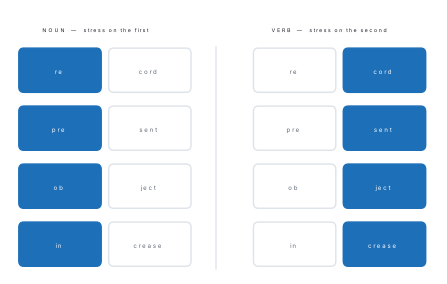
So keep a record but please record it; a sharp increase but prices will increase. The same holds for conduct, conflict, contrast, export, import, object, permit, present, rebel, suspect and progress.
Pattern 2 — the suffix that pulls the stress. Certain endings force the stress onto the syllable immediately before them: -ion, -ity, -ic, -ical, -ial, -graphy, -logy.
| Base | Derived word | Stress |
|---|---|---|
| inform | information | before -ion |
| possible | possibility | before -ity |
| economy | economic | before -ic |
| politics | political | before -ical |
| photograph | photography | before -graphy |
A few endings take the stress themselves: -ee, -eer, -ese, -ique, -esque — hence employee, engineer, Japanese, unique, picturesque. And the ordinary endings -ly, -ness, -ful, -less, -ment, -er, -ing, -ed never move the stress at all: care, careful, carefully, carelessness all keep it on care.
Read each pair aloud, putting the loudness where the bold mark shows.
- The rebels planned to rebel against the king. — noun first, verb second.
- The government will not permit … you need a permit. Careful: here the noun is permit (a document) and the verb is permit (to allow), so the order in the sentence above is verb, then noun — permit then permit.
- Their conduct was poor, though the teacher conducted the class well.
The test: if the word is doing something in the sentence, stress the second syllable; if it is a thing you can put the or a in front of, stress the first.
35.4 Prefixes
A prefix goes in front of a root and changes its meaning. It almost never changes the word class: happy and unhappy are both adjectives.
| Prefix | Meaning | Examples |
|---|---|---|
| un- | not, the reverse of | unhappy, unable, undo, unlock |
| in-, im-, il-, ir- | not | incorrect, impossible, illegal, irregular |
| dis- | not, the opposite of | dishonest, disagree, disappear |
| non- | not (neutral) | non-violent, non-stop, non-fiction |
| mis- | wrongly, badly | misunderstand, misspell, misuse |
| re- | again, back | rewrite, rebuild, return |
| pre- / post- | before / after | preview, prepaid / postgraduate, postpone |
| over- / under- | too much / too little | overwork, overcrowded / underpaid, underfed |
| sub- / super- | under / above, beyond | submarine, subway / supervise, superhuman |
| inter- | between | international, interval, interview |
| trans- | across | transport, transfer, translate |
| anti- / pro- | against / in favour of | antiseptic, anti-clockwise / pro-democracy |
| auto- | self | autobiography, automatic |
| mono-, uni- / bi- / tri- / multi- / semi- | one / two / three / many / half | monologue, uniform, bilingual, tricycle, multipurpose, semicircle |
| micro- / macro- / tele- | small / large / far | microscope, macroeconomics, telephone |
The four negative prefixes in-, im-, il-, ir- are one prefix with four spellings, and the spelling is decided by the first letter of the root:
- im- before b, m, p — imbalance, immoral, impossible, impatient
- il- before l — illegal, illiterate, illogical
- ir- before r — irregular, irrelevant, irresponsible
- in- before everything else — incorrect, invisible, inactive
No rule tells you whether a word takes un-, in- or dis-; that is learnt word by word. Unhappy, not inhappy; incorrect, not uncorrect; dishonest, not unhonest.
35.5 Suffixes, and the spelling rules for adding them
A suffix goes at the end of a root and usually changes the word class.
| Makes a | Suffixes | Examples |
|---|---|---|
| Noun (thing, quality) | -ment, -ness, -tion/-sion, -ity, -ance/-ence, -ship, -hood, -dom, -age, -ism | agreement, kindness, decision, ability, importance, friendship, childhood, freedom, marriage, tourism |
| Noun (person) | -er, -or, -ist, -ian, -ee | teacher, actor, artist, musician, employee |
| Adjective | -ful, -less, -able/-ible, -ous, -ive, -al, -ic, -y, -ish, -en | careful, careless, comfortable, visible, dangerous, active, national, historic, rainy, childish, wooden |
| Verb | -ise/-ize, -en, -ify, -ate | modernise, widen, simplify, activate |
| Adverb | -ly, -wards, -wise | quickly, backwards, clockwise |
Beware of -ly. On an adjective it makes an adverb (quick → quickly), but on a noun it makes an adjective: friend → friendly, love → lovely, cost → costly. She smiled friendly is wrong; She gave a friendly smile is right.
Four spelling rules cover almost every case.
- Drop silent e before a vowel suffix, keep it before a consonant suffix: hoping but hopeful, caring but careful. Keep it after c or g before a or o, to hold the soft sound: noticeable, courageous. Exceptions to learn: truly, argument, ninth.
- y becomes *i after a consonant: happiness, carried, beautiful. But keep y before -ing (carrying) and after a vowel (played, enjoyment). Exceptions: daily, paid, said*.
- Double the final consonant before a vowel suffix when a one-syllable word ends consonant–vowel–consonant (stopping, bigger, runner), and in a longer word only when the stress falls on the last syllable: begin → beginning, prefer → preferred, but offer → offered, visit → visited. British English doubles a final -l whatever the stress: travelled, cancelled.
- -ful has one *l: beautiful, careful, useful — though the adverb has two, beautifully*.
35.6 Building words: prefix + root + suffix
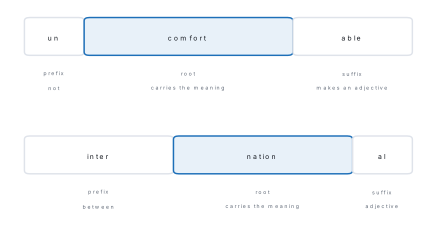
Ask two questions of any new word: what does the prefix do to the meaning? and what class does the suffix make it?
Root: act — "to do".
| Word | Class | Built from | Meaning |
|---|---|---|---|
| act | verb / noun | root | to do; a deed |
| action | noun | act + -ion | the doing of something |
| active | adjective | act + -ive | doing things, busy |
| activity | noun | active + -ity | something done |
| inactive | adjective | in- + active | not doing anything |
| react | verb | re- + act | to act in response |
Now the exam item "Fill the gap: after the operation he remained ______ for a month (act)" answers itself. The gap follows remained, which needs an adjective; the sense is negative; so the answer is inactive — not inaction, which is a noun.
35.7 Synonyms, antonyms and words that are nearly the same
A synonym has a similar meaning (begin / start / commence); an antonym has the opposite (scarce / plentiful). Two warnings.
Synonyms are rarely exact. Slim, thin and skinny all describe a narrow body, but slim is a compliment, thin is neutral and skinny is unkind. Commence is not better than begin, only more formal — and in a story it is the wrong choice.
Some antonyms are made by prefix, others are separate words. Regular → irregular (prefix), but hot → cold (separate word). If the question says add a prefix, it wants the first kind.
| Word | Antonym by prefix | Word | Antonym is a different word |
|---|---|---|---|
| legal | illegal | ancient | modern |
| possible | impossible | scarce | plentiful |
| relevant | irrelevant | shallow | deep |
| obey | disobey | permanent | temporary |
| employment | unemployment | artificial | natural |
Finally, six pairs whose members are not interchangeable, however similar they look:
- affect (verb: to influence) · effect (noun: the result). The rain affected the crop; the effect was severe.
- lie (to rest; lay, lain; no object) · lay (to put down; laid, laid; takes an object). Lie down. Lay the book here.
- sensible (having good judgement) · sensitive (easily hurt or affected).
- among (more than two) · between (two).
35.8 Idioms and phrasal verbs
An idiom is a fixed group of words whose meaning cannot be worked out from the words themselves. You cannot guess it and you cannot alter it: it is beat about the bush, never beat around the shrub.
| Idiom | Meaning |
|---|---|
| a piece of cake | very easy |
| once in a blue moon | very rarely |
| beat about the bush | avoid coming to the point |
| let the cat out of the bag | reveal a secret by accident |
| burn the midnight oil | work or study late into the night |
| hit the nail on the head | say exactly the right thing |
| turn a blind eye | ignore something on purpose |
| under the weather | slightly unwell |
| cost an arm and a leg | be extremely expensive |
| break the ice | make a first meeting less awkward |
| pull someone's leg | tease someone playfully |
A phrasal verb is a verb plus a small word (up, off, after, into) whose meaning is often nothing like the verb alone.
| Phrasal verb | Meaning | Example |
|---|---|---|
| put off | postpone | The meeting was put off till Sunday. |
| call off | cancel | They called off the match. |
| give up | stop doing; surrender | He gave up smoking. |
| look after | take care of | She looks after her grandmother. |
| look up | find in a book or list | Look the word up. |
| get over | recover from | He got over the fever quickly. |
| carry out | perform | They carried out the experiment. |
| run out of | have no more of | We ran out of petrol. |
| take after | resemble (a relative) | He takes after his mother. |
| put up with | tolerate | I cannot put up with the noise. |
Some phrasal verbs can be split by their object and some cannot. Call off the match and call the match off are both correct, and with a pronoun the split is compulsory: call it off, never ~~call off it~~. But look after cannot be split: look after the baby, never ~~look the baby after~~, and look after her, never ~~look her after~~. When in doubt, keep the phrasal verb together — except with a pronoun object, where you must test whether the split sounds right.
35.9 Working out a word you do not know
Unknown words turn up in Questions 1 and 8, and the paper expects reasoning rather than guessing. Four checks, in this order:
- The parts. Irreplaceable = ir- (not) + replace + -able (can be) = "cannot be replaced".
- The class. A word after the is a noun; a word after very is an adjective or adverb. That alone halves the possibilities.
- The signal. That is, in other words, such as, or, a dash or a comma pair — writers often define a hard word immediately after using it.
- The direction. Even without the exact sense, the sentence tells you whether the word is positive or negative. Half a mark's worth of sense beats a blank.
The road was impassable after the landslide, and lorries queued for three days at Krishnabhir.
Parts: im- (not, before p) + pass + -able (able to be) — "not able to be passed". Class: it follows was, so it is an adjective describing the road. Direction: lorries queued for three days, so the sense must be negative. All three agree. The answer is not able to be travelled along; blocked.
Now the same reasoning on a harder word:
Her account of the accident was corroborated by two witnesses who had been standing at the junction.
Parts: nothing familiar. Class: was ____ by — a passive verb. Signal: the agents are two witnesses. Direction: witnesses standing at the junction make her account more believable, not less. So corroborated must mean something like confirmed, supported by evidence — which is exactly right. You reached a correct answer from a word you had never seen.
Chapter summary
- Question 8 is five one-mark items on vocabulary. Word class and spelling must both be right; there are no part marks.
- Silent letters often reappear when a suffix is added (sign → signature), which is a clue to word families.
- Stress matters: two-syllable noun/verb pairs stress the first syllable as a noun and the second as a verb; the endings -ion, -ity, -ic, -ical, -graphy pull the stress onto the syllable before them.
- A prefix changes meaning; a suffix changes word class. The negative prefix is im- before b, m, p; il- before l; ir- before r; in- elsewhere.
- Four spelling rules cover adding suffixes: drop silent e before a vowel suffix, y → i after a consonant, double the final consonant when the stress is at the end, and -ful has one l.
- Synonyms are rarely exact — they differ in formality and in feeling. Some antonyms are made with a prefix, others are separate words.
- Idioms and phrasal verbs are fixed. A pronoun object must split a separable phrasal verb (call it off) but never an inseparable one (look after her).
- An unknown word can be reasoned out from its parts, class, signal words and direction.
Practice questions
Add a prefix to give the opposite (1 mark each)
- ____ regular [1]
- ____ legal [1]
- ____ honest [1]
- ____ patient [1]
- ____ able [1]
- ____ literate [1]
- ____ agree [1]
- ____ mature [1]
Answers
1. irregular — ir- before r.
2. illegal — il- before l.
3. dishonest — learnt, not rule-based; ~~unhonest~~ is wrong.
4. impatient — im- before p.
5. unable — learnt; ~~inable~~ is wrong. (Disable exists but means something different: to make unable.)
6. illiterate — il- before l.
7. disagree.
8. immature — im- before m.
Give the correct form of the word in brackets (1 mark each)
- His ____ to pay the fee delayed his admission. (able) [1]
- The committee reached a quick ____ . (decide) [1]
- She spoke with great ____ . (confident) [1]
- The road is being ____ this year. (wide) [1]
- He answered ____ and sat down. (nerve) [1]
- The plan was ____ from the start. (practice) [1]
- We need a ____ of the whole system. (modern) [1]
- Their ____ lasted forty years. (friend) [1]
Answers
9. inability — a noun after his; the negative prefix for ability is in-.
10. decision — decide + -ion, with the spelling change -de → -sion.
11. confidence — a noun after great.
12. widened — a passive verb: wide + -en, then -ed.
13. nervously — an adverb describing answered: nerve → nervous → nervously.
14. impracticable (or impractical) — an adjective after was, with a negative sense given by from the start.
15. modernisation — a noun after a: modern → modernise → modernisation.
16. friendship — a noun; friendly is an adjective and will not fit after their.
Meanings and usage (1 mark each)
- What does beat about the bush mean? [1]
- What does burn the midnight oil mean? [1]
- Replace the underlined words with a phrasal verb: They cancelled the programme. [1]
- Replace the underlined words: She resembles her father. [1]
- Correct the error: Please look the word after in the dictionary. [1]
- Correct the error: They called off it because of the rain. [1]
- Choose the right word: The principal / principle of the campus addressed us. [1]
- Choose the right word: The bus remained stationary / stationery for an hour. [1]
- Where is the stress in record in Please record the lesson? [1]
- Where is the stress in photography? [1]
Answers
17. To avoid coming to the main point; to talk round a subject.
18. To work or study late into the night.
19. They ~~cancelled~~ → called off the programme (or called the programme off).
20. She ~~resembles~~ → takes after her father.
21. Please ~~look the word after~~ → look up the word (or look the word up) in the dictionary. Look after means "take care of"; the verb needed here is look up, which is separable.
22. They ~~called off it~~ → called it off because of the rain. A pronoun object must come between the verb and the particle.
23. Principal — the head of the campus. Principle is a rule or belief.
24. Stationary — not moving. Stationery is paper and pens.
25. On the second syllable — record — because it is a verb here.
26. On the second syllable — photography — because -graphy pulls the stress onto the syllable before it.
Practise more: English question bank