Unit 27 · Grammar · 17 min read
Conditional Sentences
What the syllabus asks for 10
- The shape of a conditional sentence
- The five types in one table
- Type 0 — the zero conditional
- Type 1 — the real future conditional
- Type 2 — the unreal present conditional
- Type 3 — the unreal past conditional
- Mixed conditionals
- Other ways of expressing a condition
- Leaving out if — inversion
- Unreal forms related to conditionals
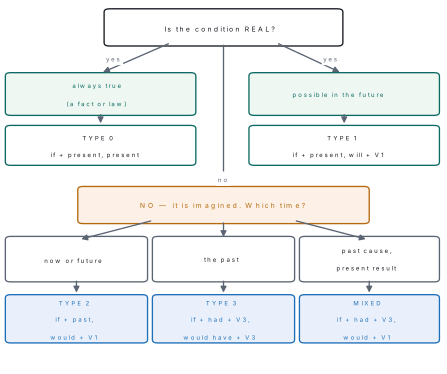
A conditional sentence has two parts: an if-clause stating a condition and a main clause stating the result. The whole system rests on one idea — how real the speaker thinks the condition is. A real condition uses ordinary tenses; an unreal one uses a tense one step further back than the time it refers to. NEB Q7 tests conditionals almost every year, usually as Complete the sentence or Rewrite using "if", and the marker is checking one thing: the correct pair of verb forms across the two clauses.
A conditional is a pair. Learn the two halves together and never write one without the other: Type 1 — if + present, will + V1. Type 2 — if + past, would + V1. Type 3 — if + had + V3, would have + V3. Getting the pairing right is the mark.
27.1 The shape of a conditional sentence
Either clause may come first. When the if-clause comes first, put a comma after it; when it comes second, no comma is used.
- If it rains tomorrow, the picnic will be cancelled. (comma)
- The picnic will be cancelled if it rains tomorrow. (no comma)
This is the commonest conditional error of all. ~~If it will rain, we will stay at home.~~ → If it rains, we will stay at home. ~~If I would have money, I would buy a laptop.~~ → If I had money, I would buy a laptop. ~~If he would have come, we would have won.~~ → If he had come, we would have won. The if-clause carries the tense; the main clause carries the modal. (One exception: will in an if-clause meaning "is willing to" — If you will wait here a moment, I'll fetch the file — is a polite request, not a condition.)
27.2 The five types in one table
| Type | if-clause | Main clause | Use | Example |
|---|---|---|---|---|
| 0 — zero | if + simple present | simple present | a fact, a scientific law, something always true | If you heat ice, it melts. |
| 1 — first | if + simple present | will / can / may / must / imperative + V1 | a real, likely future possibility | If the bus leaves on time, we will reach Pokhara by six. |
| 2 — second | if + simple past (were for all persons) | would / could / might + V1 | unreal or unlikely in the present or future; also advice | If I were the mayor, I would clean the Bagmati. |
| 3 — third | if + past perfect (had + V3) | would / could / might + have + V3 | an impossible, imagined past; regret | If she had studied harder, she would have passed. |
| mixed (3 → 2) | if + past perfect | would + V1 (present result) | a past condition with a present result | If I had taken the scholarship, I would be in Japan now. |
| mixed (2 → 3) | if + simple past | would + have + V3 (past result) | a permanent present condition with a past result | If he were more careful, he would not have broken the screen. |
27.3 Type 0 — the zero conditional
Form. if + simple present, simple present. If can be replaced by when with no change of meaning, which is the test for a zero conditional.
- If you heat water to 100 °C, it boils.
- If the Koshi rises above the danger mark, the barrage gates are opened.
- If you press this switch, the pump starts.
Use it for laws of nature, machines, rules and habits — anything that happens every time.
27.4 Type 1 — the real future conditional
Form. if + simple present, will + V1. Instead of will you may use can, may, might, must, should or an imperative, depending on the meaning.
- If you revise every evening, you will pass easily.
- If the strike continues, the vegetables may rot in the trucks.
- If you see Dipesh at the bus park, tell him to call me. (imperative)
- If it is sunny tomorrow, we can walk up to Sarangkot.
Remember: present tense in the if-clause even though the meaning is future. The same applies after when, as soon as, until, before, after.
27.5 Type 2 — the unreal present conditional
Form. if + simple past, would + V1 (could for ability, might for possibility).
Type 2 does not talk about the past. The past tense is a signal of unreality, not of past time. Use it when the condition is imaginary, impossible, or merely unlikely.
- If I had a motorbike, I would ride to Dhulikhel every Saturday. (I do not have one.)
- If Nepal were on the sea, trade would be much cheaper. (It is not.)
- If she spoke Japanese, she could apply for that job.
Were for all persons. In careful written English the verb be in a type-2 if-clause is were for every subject, including I, he, she, it. This is the old subjunctive, and the NEB marking scheme expects it.
- If I were you, I would apologise to the headmaster.
- If he were here, he would know what to do.
If I were you … is the standard formula for giving advice.
27.6 Type 3 — the unreal past conditional
Form. if + had + V3, would have + V3 (could have, might have).
Type 3 talks about something that did not happen, and imagines the opposite. It carries regret or criticism.
- If we had left an hour earlier, we would have avoided the jam at Koteshwor. (We did not leave earlier, so we did not avoid it.)
- If the doctor had arrived in time, the patient might have survived.
- If you had told me, I could have helped you.
Every type-3 sentence states the opposite of what really happened. Reading it backwards is a good check: If she had studied, she would have passed means she did not study and she did not pass.
27.7 Mixed conditionals
Sometimes the condition belongs to one time and the result to another.
| Mix | if-clause | Main clause | Example |
|---|---|---|---|
| Past condition → present result | if + had + V3 | would + V1 | If I had saved that money, I would have a laptop now. |
| Present condition → past result | if + simple past | would have + V3 | If Kamal were a careful driver, he would not have hit the wall. |
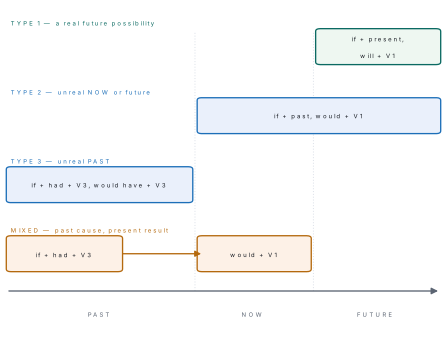
Look for the time words — now, today, still in the result clause signals the first mix; a permanent characteristic in the if-clause signals the second.
27.8 Other ways of expressing a condition
| Expression | Meaning | Example |
|---|---|---|
| unless | if … not | You will fail unless you work harder. |
| provided (that) / providing | only on this condition | You may go provided that you return by six. |
| as long as / so long as | only on this condition | I will lend it to you as long as you take care of it. |
| on condition that | a strict condition | He was released on condition that he report weekly. |
| in case | as a precaution | Take an umbrella in case it rains. |
| suppose / supposing | imagine that | Suppose you lost your citizenship — what would you do? |
| otherwise / or else | if that does not happen | Hurry up, otherwise you will miss the bus. |
| but for | if it were not for | But for your help, I would have failed. |
| without | if there were no | Without water, nothing would grow. |
| if only | a strong wish or regret | If only I had listened to my teacher! |
Unless means "if … not", so a second negative makes the sentence say the opposite of what you mean. ~~Unless you don't hurry, you will miss the bus.~~ → Unless you hurry, you will miss the bus. (= If you do not hurry …) Also note that in case is not the same as if: Take an umbrella in case it rains means take it now, as a precaution; Take an umbrella if it rains means take it only when it is already raining.
27.9 Leaving out if — inversion
In formal English the if can be dropped and the auxiliary moved to the front. This appears in NEB rewriting items.
| With if | Inverted |
|---|---|
| If I were you, I would accept. | Were I you, I would accept. |
| If he had known, he would have come. | Had he known, he would have come. |
| If you should need help, call me. | Should you need help, call me. |
Only were, had and should invert. Never write ~~Did I know…~~ for If I knew.
27.10 Unreal forms related to conditionals
The same backshifted tenses appear after wish, if only, as if, would rather and it's time.
| Structure | Time referred to | Example |
|---|---|---|
| wish + simple past | a regret about now | I wish I knew her address. |
| wish + were | a regret about now | I wish I were taller. |
| wish + would + V1 | annoyance, a wish for change | I wish it would stop raining. |
| wish + past perfect | a regret about the past | I wish I had taken science. |
| if only + past / past perfect | a stronger regret | If only I had listened to my father! |
| as if / as though + past | an unreal comparison | He talks as if he owned the shop. |
| would rather + past | a preference about another person | I'd rather you came tomorrow. |
| it's time + past | it should already be happening | It's time we left for the airport. |
Three common shapes. (i) Complete the sentence: If I had known about the meeting, … — read the if-clause, identify the type from its verb form, then supply the matching main clause. (ii) Choose the correct form with two options in brackets. (iii) Rewrite using "if": a sentence like He did not revise, so he failed becomes a type 3, because both facts are past and you are imagining the opposite. Always flip the polarity: a positive fact becomes a negative condition, and a negative fact becomes a positive one.
Problem. Rewrite using if: Sushma did not set an alarm, so she missed the 6 a.m. bus to Butwal.
Solution — step by step.
- Find the two facts and their time. Fact 1: she did not set an alarm (past). Fact 2: she missed the bus (past). Both are finished past facts.
- Choose the type. We are imagining the opposite of a past fact → type 3.
- Flip the polarity of each fact. "did not set" → had set; "missed" → would not have missed.
- Put them in the type-3 frame: if + had + V3, would have + V3.
Answer. If Sushma had set an alarm, she would not have missed the 6 a.m. bus to Butwal.
Problem. Complete: If I were the principal of this school, …
Solution — step by step.
- Identify the type from the if-clause. were is a simple past subjunctive → type 2, an unreal present.
- Recall the matching main clause. Type 2 pairs with would / could / might + V1 — never will, never would have.
- Write a sensible result in that form.
Answer. If I were the principal of this school, I would build a proper library and would start a science club.
Writing I will build would be a type-1 main clause and would lose the mark; I would have built would be type 3 and refers to the past.
Problem. (a) Rewrite with unless: If you do not submit the form today, your application will be rejected. (b) Rewrite without if: If I had known about the strike, I would have started earlier. (c) Complete: If Bishal had accepted the job in Dubai, he … (be) here today.
Solution.
(a) Unless already means "if … not", so remove the do not and keep the verb positive. Answer: Unless you submit the form today, your application will be rejected.
(b) Type 3 inverts with had: drop if, move had to the front, keep the rest unchanged. Answer: Had I known about the strike, I would have started earlier.
(c) The if-clause is past perfect (a past condition) but today in the result clause points to the present → a mixed conditional. The main clause therefore takes would + V1, and the meaning is negative, because he is in fact here. Answer: … he would not be here today.
Chapter summary
- Type 0: if + present, present — always true.
- Type 1: if + present, will + V1 — a real future possibility.
- Type 2: if + past (were for all persons), would + V1 — unreal present.
- Type 3: if + had + V3, would have + V3 — unreal past, regret.
- Mixed: if + had + V3, would + V1 (past cause, present result); if + past, would have + V3 (present cause, past result).
- Never put will or would in the if-clause.
- A comma follows the if-clause only when it comes first.
- Unless = if … not, so do not add a second negative.
- Were I…, Had I…, Should you… are the inverted forms with if dropped.
- Wish + past = a present regret; wish + past perfect = a past regret; wish + would = annoyance.
Practice questions
Complete the sentences with the correct form of the verb in brackets (1 mark each)
- If you heat iron, it ____ . (expand) [1]
- If it ____ tomorrow, we will postpone the excursion. (rain) [1]
- If I ____ you, I would apologise to her at once. (be) [1]
- If she had left home earlier, she ____ the interview. (not miss) [1]
- If Nepal ____ a seaport, imports would be much cheaper. (have) [1]
- If the villagers ____ the warning, many lives would have been saved. (heed) [1]
- If I ____ the scholarship last year, I would be studying in Japan now. (accept) [1]
- Unless you ____ your fee by Friday, your name will be struck off. (pay) [1]
- I wish I ____ how to swim in the Seti. (know) [1]
- It is time we ____ for the bus park. (leave) [1]
Answers
1. expands — a zero conditional: a physical law, present in both clauses.
2. rains — type 1: the if-clause takes the simple present, never will.
3. were — type 2 uses were for all persons in the if-clause.
4. would not have missed — type 3: had + V3 pairs with would have + V3.
5. had — type 2: an unreal present condition takes the simple past.
6. had heeded — type 3: the main clause would have been saved fixes the type.
7. had accepted — a mixed conditional: past condition, present result now.
8. pay — after unless use the present, and add no second negative.
9. knew — wish + simple past expresses a regret about the present.
10. left — it is time + simple past.
Rewrite the sentences as instructed (1 mark each)
- He did not work hard, so he failed the examination. — Rewrite using if. [1]
- She is not tall, so she cannot reach the top shelf. — Rewrite using if. [1]
- Study regularly, or you will not pass. — Rewrite using unless. [1]
- If I had known your number, I would have called you. — Rewrite without if. [1]
- If I were the mayor, I would widen this road. — Rewrite without if. [1]
- I am sorry I did not choose science in Grade 11. — Rewrite beginning I wish … [1]
- Take some water with you in case the tap is dry. — Rewrite using if. [1]
- But for your help, I would have been fined. — Rewrite using if. [1]
Answers
11. If he had worked hard, he would not have failed the examination. — both facts are past, so type 3, with the polarity flipped.
12. If she were tall, she could reach the top shelf. — an unreal present, so type 2 with were.
13. Unless you study regularly, you will not pass. — unless replaces if … not.
14. Had I known your number, I would have called you. — type-3 inversion with had.
15. Were I the mayor, I would widen this road. — type-2 inversion with were.
16. I wish I had chosen science in Grade 11. — a past regret takes wish + past perfect.
17. Take some water with you if the tap is dry (or in case it is dry) — note in case means as a precaution beforehand.
18. If you had not helped me, I would have been fined. — but for becomes a negative type-3 if-clause.
Correct the errors in the following sentences (1 mark each)
- If it will rain tomorrow, the match will be postponed. [1]
- If I would have money, I would buy a new bicycle. [1]
- If she would have called me, I would have gone with her. [1]
- Unless you don't hurry, you will miss the first bus. [1]
- If I was you, I would not sign that paper. [1]
- If he had studied harder, he would pass the examination last year. [1]
- If you will heat ice, it melts. [1]
- I wish I would have taken the earlier flight. [1]
Answers
19. If it rains tomorrow … — no will in the if-clause of a type 1.
20. If I had money … — type 2 takes the simple past in the if-clause.
21. If she had called me … — type 3 takes had + V3, not would have.
22. Unless you hurry … — unless already means "if not".
23. If I were you … — the type-2 subjunctive is were for all persons.
24. … he would have passed the examination last year. — a past result needs would have + V3.
25. If you heat ice, it melts. — a zero conditional uses the present in both clauses.
26. I wish I had taken the earlier flight. — a past regret takes wish + past perfect.
Practise more: English question bank