Unit 24 · Grammar · 16 min read
Modal Verbs and Semi-modals
What the syllabus asks for 7
- The complete modal table
- Ability: can, could, be able to
- Permission, requests, offers and suggestions
- Obligation, necessity and their negatives
- Degrees of certainty — deduction
- Past forms of modals and what they criticise
- Semi-modals
A modal verb is a helping verb that does not describe an action but colours it: it says whether the action is possible, permitted, necessary, advisable or likely. The nine pure modals are can, could, may, might, will, would, shall, should and must. NEB Q7 tests them in three ways — choose the right modal for a stated function, rewrite a sentence with a modal of the same meaning (It is necessary for you to go → You must go), or correct a sentence in which the modal is followed by the wrong verb form.
- A modal is followed by the bare infinitive — V1 with no to: She can swim**, never ~~can to swim~~ or ~~can swims~~.
- A modal never takes -s in the third person: He must go.
- A modal makes its own question and negative with no do: Can you come? He cannot come. Never ~~Do you can come?~~
- Two modals cannot stand together: ~~He will can do it~~ → He will be able to do it.
24.1 The complete modal table
| Modal | Function | Example | Negative |
|---|---|---|---|
| can | present ability | She can speak four languages. | cannot / can't |
| can | informal permission | Can I borrow your notes? | can't (= not allowed) |
| can | general possibility | Landslides can block the Prithvi Highway. | can't (= impossible) |
| could | past ability | At five he could already read. | couldn't |
| could | polite request / suggestion | Could you pass the file? | couldn't |
| could | present possibility (weak) | He could be at the library. | couldn't (= impossible) |
| may | formal permission | May I come in, sir? | may not |
| may | possibility (about 50 %) | It may rain in the afternoon. | may not |
| may | wish, blessing | May you live long! | — |
| might | weaker possibility (about 30 %) | She might join us later. | might not |
| might | very polite request | Might I make a suggestion? | — |
| will | future, prediction, promise | I will return the book tomorrow. | will not / won't |
| will | willingness, request | Will you help me carry this? | won't (= refuses) |
| will | present habit / characteristic | Boys will be boys. | — |
| would | polite request / offer | Would you like some tea? | wouldn't |
| would | past habit | We would go to the river every Saturday. | wouldn't |
| would | unreal / conditional result | If I had money, I would buy it. | wouldn't |
| shall | offer or suggestion with I/we | Shall we start? | shan't |
| shall | formal obligation in rules | The tenant shall pay by the 5th. | shall not |
| should | advice, mild obligation | You should see a doctor. | should not |
| should | expectation | The parcel should arrive today. | shouldn't |
| must | strong obligation from the speaker | You must submit it by Friday. | must not (prohibition) |
| must | logical certainty | The lights are on — she must be at home. | can't (= certainly not) |
24.2 Ability: can, could, be able to
- can — present or general ability: Nirmala can ride a motorbike.
- could — general ability in the past: My grandfather could walk from Ilam to Fikkal in three hours.
- was/were able to — a single successful act in the past ("managed to"). The fire was spreading, but the neighbours were able to rescue the goats. (could is wrong here, because it means general ability, not one success.)
- be able to supplies the forms a modal cannot make: will be able to, have been able to, to be able to.
English allows only one modal in a verb phrase. ~~She will can join us.~~ → She will be able to join us. ~~He must can finish it.~~ → He must be able to finish it. ~~You should must apologise.~~ → You must apologise / You should apologise.
24.3 Permission, requests, offers and suggestions
| Function | Least formal → most formal | Example |
|---|---|---|
| Asking permission | can → could → may → might | May I leave early today, madam? |
| Giving permission | can, may | You may use the library after four. |
| Refusing permission | cannot, may not, must not | Visitors may not enter the ward. |
| Request | will → can → could → would | Could you lend me Rs 200? |
| Offer | shall, can, would like | Shall I carry your bag? |
| Suggestion | shall we, could, why don't we | Shall we visit Swayambhu on Saturday? |
| Invitation | would like | Would you like to join us for tea? |
Answering a request or permission question keeps the same modal where possible: "May I sit here?" — "Yes, you may." / "Could you help me?" — "Yes, of course." Do not answer Could you…? with Yes, I could; that sounds like a comment on your ability, not an agreement.
24.4 Obligation, necessity and their negatives
| Form | Meaning | Example |
|---|---|---|
| must | obligation the speaker imposes; also an internal duty | You must wear a helmet. |
| have to / has to | obligation from outside — a rule, a law, circumstances | Passengers have to show a ticket. |
| had to | past obligation (there is no past of must) | We had to walk because of the strike. |
| will have to | future obligation | You will have to repeat the test. |
| should / ought to | advice, what is right | You should revise every day. |
| had better | strong advice, with a warning of a bad result | You had better leave now, or you will miss the bus. |
| need to | necessity | I need to renew my licence. |
| be supposed to | expected by a rule or arrangement | We are supposed to be there by nine. |
The negatives carry completely different meanings. This is the single most examined point in the unit.
| Negative | Meaning | Example |
|---|---|---|
| must not / mustn't | prohibition — it is forbidden | You mustn't touch the wires. |
| do not have to / don't have to | no obligation — it is not necessary | It is Saturday, so you don't have to get up early. |
| need not / needn't | no obligation (same as don't have to) | You needn't bring your own lunch. |
| should not | advice against | You shouldn't eat so late. |
| cannot / can't | inability, or "certainly not true" | He can't be in Nepalgunj; I saw him an hour ago. |
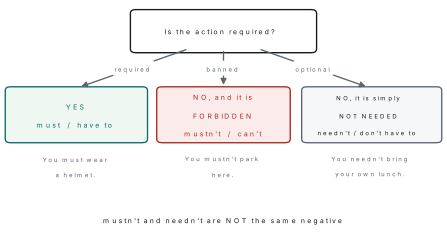
The opposite of You must go is You don't have to go (it is not necessary), not You mustn't go (you are forbidden to go). Q7 items often ask you to rewrite It is not necessary for you to come — the answer is You needn't come or You don't have to come, never ~~You mustn't come~~.
~~You had better to go now.~~ → You had better go now. ~~You ought go now.~~ → You ought to go now. Also note had better refers to the present or future, not the past, in spite of the word had.
24.5 Degrees of certainty — deduction
When a modal expresses how sure the speaker is, the whole set forms a scale.
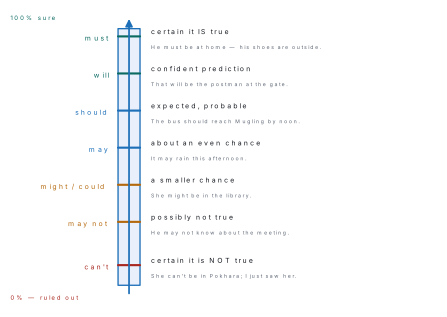
The same scale in the past puts have + V3 after the modal:
| Present deduction | Past deduction | Meaning |
|---|---|---|
| He must be ill. | He must have been ill. | I am sure it was so. |
| She may be at home. | She may have been at home. | Perhaps it was so. |
| They might know. | They might have known. | Perhaps, less likely. |
| It can't be true. | It can't have been true. | I am sure it was not so. |
24.6 Past forms of modals and what they criticise
| Form | Meaning | Example |
|---|---|---|
| should have + V3 | the right thing was not done — regret or criticism | You should have told me earlier. |
| shouldn't have + V3 | a wrong thing was done | She shouldn't have shouted at the porter. |
| ought to have + V3 | same as should have | He ought to have checked the ticket. |
| could have + V3 | it was possible but did not happen | We could have caught the earlier bus. |
| needn't have + V3 | it was done, but it was unnecessary | You needn't have paid; entry was free. |
| didn't need to + V1 | it was unnecessary, so it was not done | I didn't need to buy a ticket, so I walked in. |
| would have + V3 | an unreal past result | I would have come if you had called. |
| must have + V3 | a confident conclusion about the past | The road must have been blocked. |
You needn't have waited — you did wait, and it turned out to be unnecessary. You **didn't need to wait — it was unnecessary, and (normally) you did not wait. The two are not interchangeable, and NEB has set this contrast in Q7.
24.7 Semi-modals
Semi-modals behave partly like modals in meaning but like ordinary verbs in grammar: they change for tense and person, and they need do for questions and negatives.
| Semi-modal | Meaning | Note |
|---|---|---|
| be able to | ability | supplies the missing forms of can |
| have to / have got to | outside obligation | changes tense: had to, will have to |
| need to | necessity | Does he need to come? |
| used to + V1 | a discontinued past habit or past state | I used to cycle to school. Question: Did you use to…? |
| be going to + V1 | intention, or prediction from evidence | She is going to apply for the scholarship. |
| be about to + V1 | on the point of | The programme is about to begin. |
| had better + V1 | strong advice | no to, no tense change |
| would rather + V1 | preference | I would rather walk than wait. |
| be supposed to | expected by rule or plan | You are supposed to wear the uniform. |
| dare / need | can be modal or ordinary verb | He dare not speak / He doesn't dare to speak. |
used to + V1 = a past habit that has stopped: *I used to drink milk tea. be/get used to + V-ing / noun = be accustomed to: I am used to drinking black tea now. The second one keeps the -ing*, and it can be in any tense.
Q7 modal items almost always name the function in brackets or in the instruction: (obligation), (possibility), (prohibition), (advice), (past ability), (request). Match the label to the modal before you write anything: obligation → must/have to; prohibition → mustn't; no obligation → needn't; advice → should/ought to/had better; possibility → may/might/could; certainty → must; impossibility → can't; past ability → could; one past success → was able to.
Problem. Rewrite using a modal: It is not necessary for you to attend the Saturday class.
Solution — step by step.
- Name the function. "It is not necessary" = absence of obligation.
- Pick the modal for that function. Absence of obligation is needn't or don't have to. It is not mustn't, which would mean the class is forbidden.
- Fit the subject and the bare infinitive. you + needn't + attend.
Answer. You needn't attend the Saturday class. (Also correct: You don't have to attend the Saturday class.)
Problem. Express as a deduction: I am sure Anita did not take the bus, because her bicycle is missing.
Solution — step by step.
- Is the statement positive or negative? Negative — "did not take".
- How sure is the speaker? Completely sure. On the certainty scale, "certain it is NOT true" is can't.
- Is the event past? Yes, so add have + V3 after the modal: can't have taken.
- Assemble.
Answer. Anita can't have taken the bus, because her bicycle is missing.
Writing mustn't have taken is wrong: mustn't means prohibition, never negative deduction.
Problem. Correct: When he was young he can run very fast, but now he will not can run at all because he had better to rest his knee.
Solution — step by step.
- he can run in a past sentence. The time is past and the meaning is general ability → could run.
- will not can run. Two modals cannot stand together. Replace the second with the semi-modal → will not be able to run.
- had better to rest. Had better takes the bare infinitive → had better rest.
Answer. When he was young he could run very fast, but now he will not be able to run at all because he had better rest his knee.
Chapter summary
- A modal takes the bare infinitive, never adds -s, needs no do for questions and negatives, and cannot be joined to another modal.
- Ability: can (now), could (past, general), was/were able to (one past success), be able to (all other forms).
- Permission rises in formality: can → could → may → might.
- Obligation: must (from the speaker), have to (from outside), had to (past), should / ought to / had better (advice).
- mustn't = forbidden; needn't and don't have to = not necessary. They are opposites, not synonyms.
- Certainty scale: must (sure it is) > will > should > may > might/could
may not > can't (sure it is not).
- For the past, add have + V3: must have gone, might have gone, can't have gone.
- should have + V3 criticises what was not done; needn't have + V3 says something done was unnecessary.
- Semi-modals — be able to, have to, need to, used to, be going to, had better, would rather, be supposed to — carry modal meanings but behave like ordinary verbs.
Practice questions
Fill in the blanks with a suitable modal verb (1 mark each)
- ____ you please open the window? It is very hot in here. (polite request) [1]
- Students ____ not use mobile phones during the examination. (prohibition) [1]
- You ____ see a doctor if the fever does not come down. (advice) [1]
- My grandmother ____ read without spectacles even at eighty. (past ability) [1]
- It is a holiday tomorrow, so we ____ get up early. (absence of obligation) [1]
- Take an umbrella; it ____ rain in the afternoon. (possibility) [1]
- His bike is at the gate, so he ____ be at home. (certainty) [1]
- ____ I use your dictionary for a moment, sir? (formal permission) [1]
Answers
1. Could (or Would) — the polite request forms.
2. must — must not expresses prohibition.
3. should (or ought to) — advice.
4. could — general ability in the past.
5. needn't (or don't have to) — no obligation, not prohibition.
6. may (or might) — a possibility about the future.
7. must — a confident conclusion from evidence.
8. May (or Might) — the formal permission form.
Rewrite the sentences as instructed (1 mark each)
- It is necessary for you to renew your licence. — Rewrite with have to. [1]
- Smoking is forbidden inside the hospital. — Rewrite with must. [1]
- Perhaps she is waiting at the bus park. — Rewrite with may. [1]
- I am sure he has forgotten the meeting. — Rewrite with must. [1]
- It was a mistake to lend him the money. — Rewrite with shouldn't. [1]
- He managed to swim across the Karnali in spite of the current. — Rewrite with able to. [1]
- I cycled to school every day when I was a child. — Rewrite with used to. [1]
- Why don't we go to Godawari on Saturday? — Rewrite with shall. [1]
Answers
9. You have to renew your licence. — outside necessity.
10. You must not smoke inside the hospital. — mustn't is prohibition.
11. She may be waiting at the bus park. — may + bare infinitive for possibility.
12. He must have forgotten the meeting. — certainty about a past event.
13. I shouldn't have lent him the money. — criticism of a past action.
14. He was able to swim across the Karnali … — one successful past act.
15. I used to cycle to school every day … — a discontinued past habit.
16. Shall we go to Godawari on Saturday? — shall makes a suggestion with we.
Correct the errors in the following sentences (1 mark each)
- She can to speak Maithili and Bhojpuri fluently. [1]
- He must goes to Kathmandu for the interview. [1]
- Do you can help me with this sum? [1]
- Next year I will can drive a car. [1]
- You had better to consult your class teacher. [1]
- You mustn't come to the picnic if you are busy; it is not compulsory. [1]
- He ought go home before it gets dark. [1]
- I am used to get up at five every morning these days. [1]
- She mustn't have taken my umbrella; she was not even here. [1]
- We could rescue the calf from the flooded field yesterday. [1]
Answers
17. She can speak … — a modal takes the bare infinitive, with no to.
18. He must go … — a modal is never followed by an -s form.
19. Can you help me …? — modals form questions without do.
20. Next year I will be able to drive a car. — two modals cannot stand together.
21. You had better consult … — had better takes no to.
22. You needn't come to the picnic … — absence of obligation, not prohibition.
23. He ought to go home … — ought keeps its to.
24. I am used to getting up at five … — be used to is followed by -ing.
25. She can't have taken my umbrella … — negative deduction uses can't have.
26. We were able to rescue the calf … — one successful past act, not general ability.
Practise more: English question bank