Unit 33 · Writing and Skills · 18 min read
Free Writing: Essays, Memoirs and Critical Writing
What the syllabus asks for 8
- What Question 6 asks
- The paragraph: the unit an essay is built from
- The shape of a whole essay
- Four kinds of essay, and how each is organised
- The memoir
- Critical writing
- Language that lifts a free-writing answer
- Checking your own answer
Question 6 gives you ten marks and, for the first time in the paper, no format to copy. You are handed a topic and asked to think. That freedom is why the question is worth the most marks in the writing section, and why it is the one most often thrown away. Free writing is not writing whatever comes; it is writing to a shape you chose before you began. This chapter teaches three of those shapes — the essay, the memoir and the critical response — and the paragraph that all three are built from.
An examiner can tell within three lines whether an answer was planned. Spend five minutes making an outline, twenty writing, and five checking. An outlined answer of 250 words beats an unplanned answer of 400 every time.
33.1 What Question 6 asks
The paper sets a topic — sometimes a choice of two or three — and expects 250–300 words in about thirty minutes. The ten marks are usually divided like this:
| What is marked | Marks | What the examiner looks for |
|---|---|---|
| Content and ideas | 4 | On the topic; real points, not padding; developed, not listed |
| Organisation | 3 | Introduction, body paragraphs, conclusion; linked; one idea per paragraph |
| Language | 3 | Grammar, spelling, punctuation, range of vocabulary and sentence type |
Notice that six of the ten marks have nothing to do with how beautifully you write. They are for having something to say and arranging it. That is the part you can control completely, and it is the part planning fixes.
33.2 The paragraph: the unit an essay is built from
A paragraph is not "about five sentences". It is one idea, stated, supported and closed. Every paragraph in a good essay could be reduced to a single sentence without losing its point — that sentence is the topic sentence, and in exam writing it belongs first.
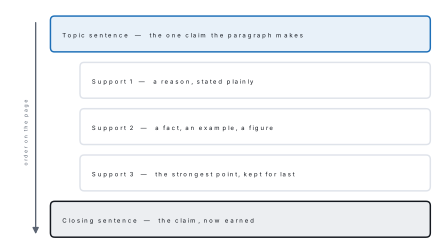
Two faults kill paragraphs. Loss of unity — a sentence that belongs to a different idea wanders in. Loss of coherence — the sentences are all on topic but in no order, so the reader has to do the arranging. Fix unity by deleting; fix coherence by numbering your supports before you write them.
33.3 The shape of a whole essay
An essay is a paragraph enlarged. It opens wide, narrows to a single claim, defends that claim one paragraph at a time, and opens out again at the end.
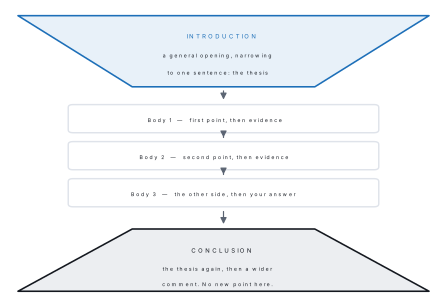
The thesis statement is the single sentence that says what the whole essay will argue. It is not the topic. Load-shedding is a topic; Load-shedding did more damage to Nepal's small industries than to its households is a thesis. Put it at the end of your first paragraph and every later paragraph has a job: defend it.
A workable plan for 250–300 words is five paragraphs: introduction (40 words), three body paragraphs (60 words each), conclusion (40 words). Write the plan as six words, not six sentences:
hook — thesis / cost / jobs / counter: subsidy / restate — call
33.4 Four kinds of essay, and how each is organised
| Kind | It does this | Order | Typical language |
|---|---|---|---|
| Narrative | tells what happened | time order | past tense, then, later, at last |
| Descriptive | makes the reader see a place or person | space order, or general to detail | present or past, adjectives, the five senses |
| Expository | explains, compares, or gives causes | logical: cause then effect, or point by point | present simple, because, therefore, whereas |
| Argumentative | proves a claim and answers objections | claim, reasons, counter-argument, answer | should, must, arguably, however, it follows that |
Read the wording of the question to find which is wanted. Describe asks for the second, Explain why for the third, Do you agree? for the fourth. Writing a narrative when the paper asked you to argue costs content marks however good the story is.
Model answer 33.1 — an argumentative essay (10 marks)
Question: Should mobile phones be allowed in schools? Write an essay of about 250 words giving your opinion.
Mobile Phones in School
Ten years ago a mobile phone in a school bag was unusual; today it is almost the rule. Teachers confiscate them, parents insist their children carry them, and the same argument comes round every year. In my view schools should allow phones on the premises but forbid their use inside the classroom, because a total ban answers a real problem in the wrong way.
The first reason is safety. Many students in our hills travel an hour or more to school, on roads that close after heavy rain and during strikes. A parent who cannot reach a child on such a day is helpless. A phone switched off in a bag costs the school nothing and gives a family a great deal.
The second reason is that a phone is a library. A student who cannot afford a dictionary can carry one; past papers, recorded lectures and news in English are all within reach. Used for twenty minutes with a purpose, the device teaches more than it distracts.
Against this it is argued, fairly, that phones invite cheating, distraction and bullying. These are genuine harms. But a ban does not remove them; it moves them to the corridor and the toilet, where no teacher is watching. A clear rule — phones off and out of sight from the first bell to the last, with the penalty known in advance — protects lessons without wasting what the device can do.
Schools exist to prepare students for a world in which these machines are everywhere. Teaching students when not to use a phone is a better lesson than pretending the phone does not exist.
(288 words)
33.5 The memoir
A memoir is a true piece of writing about a remembered experience and what it came to mean. It is not an autobiography: an autobiography covers a life, a memoir covers one afternoon. Its authority comes from detail only you could know.
Five features mark a memoir:
- First person and past tense. I was eleven. The bus had already gone.
- A narrow slice of time — a day, an hour, a single conversation.
- Concrete sensory detail instead of summary. Not it was frightening, but the handle was cold and my fingers would not close on it.
- A turning point — the moment after which something was different.
- Reflection at the end — the grown writer, looking back, saying what it meant. This last paragraph is what separates a memoir from a story.
Model answer 33.2 — a memoir (10 marks)
Question: Write a memoir of about 250 words about an experience that changed the way you think.
My Grandmother's Radio
The radio in my grandmother's room was the size of a brick and the colour of weak tea. It had one dial, and the dial had a crack in it shaped like a river. Every evening at seven she turned it on, and every evening at seven the room went quiet, even the cousins, even me.
I was nine and I thought the ritual was silly. There was a television downstairs with colour in it. I told her so one evening, standing in the doorway with my arms folded, and I remember being rather pleased with the sentence.
She did not argue. She moved along the bed and patted the space beside her, and I sat because I was nine and it was easier to sit than to keep standing. The news came on. There had been a landslide above Sindhupalchok. The reader said the name of a village, and my grandmother's hand went still on the blanket, and she said, very quietly, your grandfather walked through there in 2018.
I did not understand what I was being told. I understood only that the little brown box was not entertainment; it was how she kept the map of her life in one piece.
I have a phone now that can play a thousand stations, and I use it for almost nothing. What that evening taught me is that a thing is worth what it carries, not what it costs — and that the quickest way to miss what somebody loves is to compare it with something newer.
(263 words)
33.6 Critical writing
Critical does not mean hostile. To write critically about a text is to make a judgement and then show, from the text, why the judgement is fair. The commonest failure is to retell the plot: a summary earns almost nothing, because it proves only that you read the story.
A reliable five-part shape for a critical response:
| Part | Length | What goes in |
|---|---|---|
| Introduction | 2 sentences | Title, author, form, and your overall judgement |
| Summary | 2–3 sentences | Only what a reader needs to follow you — no more |
| Analysis | 2 paragraphs | Theme, character, structure, style, symbol — with short quotations |
| Evaluation | 1 paragraph | What works and what does not, each with a reason |
| Conclusion | 1–2 sentences | The judgement again, in one line |
Two habits make the difference. Quote briefly and exactly — four or five words inside quotation marks, not four lines. And after every quotation, write one sentence beginning This shows… or The effect is…; evidence without comment is not analysis.
Model answer 33.3 — a critical response (10 marks)
Question: Write a critical appreciation of Oscar Wilde's "The Selfish Giant".
Oscar Wilde's "The Selfish Giant" is a short fairy tale that uses the simplest machinery of the form — a garden, a wall, a child — to make a serious claim about selfishness and its cure. It is a slight story that carries a surprising weight.
The Giant returns after seven years, finds children playing in his garden, and walls them out with the notice "TRESPASSERS WILL BE PROSECUTED". Spring never comes to the garden again until the children creep back through a gap, and the Giant, watching a small boy who cannot reach the branches, knocks the wall down himself.
Wilde's chief device is the personification of the seasons. Snow, Frost, the North Wind and the Hail move into the garden like tenants, and the reader understands without being told that the winter is the Giant's own. The wall is equally plain in its meaning, and the plainness is deliberate: this is a fable, and a fable wants its symbol visible.
The weakness of the story is its ending. The boy's return, with "the wounds of Love" on his hands and feet, converts a moral tale into a religious one very abruptly, and some readers find the shift sentimental. Yet the form protects Wilde. A fairy tale is allowed a miracle, and the earlier writing has earned this one.
"The Selfish Giant" is therefore best read not as a children's story with a moral attached, but as a moral argument that has chosen the shape of a children's story because that shape can say hard things gently.
(268 words)
33.7 Language that lifts a free-writing answer
Link your paragraphs. A cohesive device at the start of a body paragraph tells the examiner you know what the paragraph is doing.
| Job | Useful expressions |
|---|---|
| Adding | moreover, in addition, what is more, not only … but also |
| Contrasting | however, on the other hand, nevertheless, whereas |
| Giving cause | because, since, owing to, as a result, consequently |
| Giving an example | for instance, to take one example, such as |
| Conceding | admittedly, it is true that, granted that |
| Concluding | on balance, in short, for these reasons |
Hedge your claims. Every Nepali student wastes time on the internet is easy to disprove and therefore weak. Many students appear to lose more time online than they intend cannot be knocked down. Words that do this work: many, most, tends to, often, appears to, arguably, in general.
Vary your sentences. Three long sentences in a row tire a reader; three short ones sound like a list. Follow a long sentence with a short one. It works.
- Opening with In this modern era of science and technology — say something about your topic instead.
- Closing with Last but not the least — write Finally or, better, name the point.
- ~~Nowadays~~ three times in one essay. Use it once or not at all.
- Listing without developing: There are many advantages. It is cheap. It is fast. It is easy. Four sentences, one mark. Take one advantage and prove it.
- New material in the conclusion. If it matters, it belongs in the body.
- ~~I think~~, ~~I think~~, ~~I think~~. The essay is yours; the examiner knows the opinion is yours. Say I believe once, in the thesis.
- Writing 500 words because more looks better. It does not — it multiplies the errors in the language mark and leaves no time to check.
A well-chosen line from a text or a proverb can sharpen a conclusion. Two of them look like decoration, and a misquoted one costs more than it gains. If you are not certain of the words, paraphrase instead.
33.8 Checking your own answer
Give the last five minutes to this list. Each line is a mark somebody lost last year.
| # | Check |
|---|---|
| 1 | Does the answer have a title? |
| 2 | Is there a thesis sentence at the end of paragraph 1? |
| 3 | Does every paragraph begin with its own topic sentence? |
| 4 | Is there one idea per paragraph — nothing wandering in? |
| 5 | Have I answered the question actually asked (describe, explain, do you agree)? |
| 6 | Is there a counter-argument, if the question asked for an opinion? |
| 7 | Does the conclusion add no new point? |
| 8 | Subject–verb agreement, articles and tense consistent throughout? |
| 9 | Capital letters, full stops, and paragraph breaks clearly visible? |
| 10 | Roughly 250–300 words — not 150, not 500? |
Chapter summary
- Question 6 is worth 10 marks: about 4 for content, 3 for organisation, 3 for language. Plan five minutes, write twenty, check five.
- A paragraph is one idea: topic sentence, supports in a chosen order, closing sentence. Unity and coherence are what the organisation mark measures.
- An essay is a funnel: general opening, a one-sentence thesis, body paragraphs that defend it, a conclusion that widens out and adds nothing new.
- The four kinds — narrative, descriptive, expository, argumentative — are distinguished by their order. Take the kind from the wording of the question.
- A memoir is one remembered slice of time in the first person, built on concrete detail, turning on a single moment, and ending with reflection on what it meant.
- Critical writing is judgement plus evidence. Summarise in three sentences at most; quote briefly; after every quotation, say what it shows.
- Link paragraphs with cohesive devices, hedge large claims, vary sentence length, and avoid the stock openings and closings every examiner has read a thousand times.
Practice questions
Free writing (10 marks each)
- Should Grade 11 students be required to do community work? Write an essay of about 250 words giving your opinion and answering one objection to it. [10]
- Write a memoir of about 250 words beginning I had never seen my father lose his temper before that afternoon. [10]
- Write a critical appreciation of about 250 words of any one poem you have studied this year. [10]
Model answers
1. Full model answer.
Work That Cannot Be Marked
Every Grade 11 student in the country is examined on Nepali, English, mathematics and a science. Not one is examined on whether they are of any use to the street they live on. I believe community work should be a requirement of the grade — not for the credit it would carry, but for the one thing it teaches that no subject on the timetable can.
The first argument is simply that the work needs doing. Blocked drains before the monsoon, a school library with no catalogue, older neighbours who cannot reach a health post: these are small tasks that fail for want of hands, and a class of forty has eighty of them.
The second argument matters more. A student who spends four Saturdays helping in a ward office learns what a municipality actually does, how slowly a form moves, and what it costs somebody to wait. That is civic education, and it cannot be delivered from a textbook.
The usual objection is time. Grade 11 is a demanding year, and adding an obligation to an overloaded student is cruel. The objection is fair, and the answer is to keep the requirement small — twenty hours in a year, counted honestly, not a weekly burden — and to let students choose the work.
Requiring community work will not, by itself, produce better citizens. But it puts every student once inside a problem that is not their own, and almost nobody comes back out unchanged.
(246 words)
2. Plan, then write to it. Setting and the ordinary day before the change (40 words) — the afternoon itself, told slowly, with two or three physical details you can see now: what was in his hands, what the room smelt of, what somebody said (110 words) — the moment his temper broke, in short sentences (50 words) — reflection: what you understood about him, or about adults, that you had not understood at breakfast (50 words). Keep the whole thing to one afternoon; resist explaining his life.
3. Use the five-part shape of §33.6. Introduction: poet, title, form, and your judgement in one clause. Summary: what the poem says, in two sentences. Analysis: choose two features only — say, the central image and the movement of the last stanza — and support each with a quotation of four or five words followed by a sentence beginning This shows…. Evaluation: one thing that works and one that is open to objection, each with a reason. Conclusion: your judgement in a single line. Do not paraphrase the poem stanza by stanza; that is summary, not appreciation.
Organisation and paragraphing (1 mark each)
- Which sentence is the topic sentence? (a) Water was rationed to two hours a day.(b) Last summer was the hardest our town has had.(c) The taps ran dry in Chaitra. [1]
- Tourism is our largest earner. Turn this topic into a thesis statement. [1]
- Which kind of essay does Explain why so many young Nepalis go abroad to work ask for? [1]
- Which kind does Describe the busiest street in your town ask for? [1]
- Name the one thing a conclusion must never contain. [1]
- What separates a memoir from a short story? [1]
- A critical response spends six of its twelve sentences retelling the plot. What mark is at risk, and why? [1]
- Correct the register: Last but not the least, phones are also a big headache for teachers. [1]
Answers
4. (b) — it is the general claim; (a) and (c) are the evidence for it.
5. For example: Tourism is our largest earner, but the money leaves the districts that produce it. A thesis must make a claim that could be argued against.
6. Expository — explain why asks for causes, not opinion.
7. Descriptive — arranged in space order, built on sensory detail.
8. A new point or new evidence. The conclusion restates and widens; it does not add.
9. A memoir is true and ends with the writer's reflection on what the experience meant; a story is invented and ends with the event.
10. The content mark. Summary shows only that the text was read; the marks are for judgement supported by evidence.
11. ~~Last but not the least~~ → Finally, phones ~~are also~~ → create a serious difficulty for teachers. The stock phrase and the vague headache both belong to speech, not to an essay.
Practise more: English question bank