Unit 18 · Literature - One Act Plays · 48 min read
Trifles
What the syllabus asks for 9
- About the author
- The characters
- The play, scene by scene
- The chain of clues
- The characters in detail
- Symbolism
- Setting, structure and technique
- Themes
- Glossary
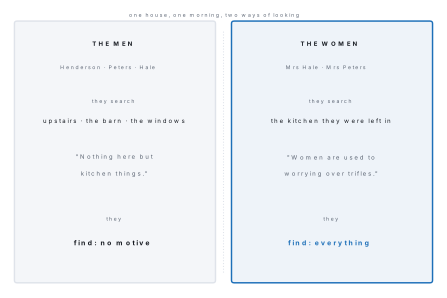
A man has been strangled in his bed. Three men search the house for evidence and find nothing. Two women, left behind in the kitchen among the dirty pans and the sewing basket, find everything — and say nothing. That is the whole of Trifles, and it is one of the most perfectly built one-act plays ever written.
The plot (who found the body, what the women discover, what they do with it); the characters, especially the two women and the absent Mrs Wright; the symbols — the birdcage, the canary, the quilt, the preserves, the cold kitchen; the irony of the title and the dramatic irony that the women know what the men do not; the setting as a cause rather than a background; and the themes — gender, isolation, loyalty between women, and the difference between law and justice.
18.1 About the author
Susan Glaspell (1876–1948) was an American playwright, novelist, journalist and actress. She first became known for her short stories — about fifty were published — and she went on to write nine novels, fifteen plays and a biography. Her work typically explores contemporary social issues such as gender, ethics and dissent, and it is known for deep, sympathetic characters. Her first novel, The Glory of the Conquered, appeared in 1909, and she wrote three best-selling novels: Brook Evans (1928), Fugitive's Return (1929) and Ambrose Holt and Family (1931).
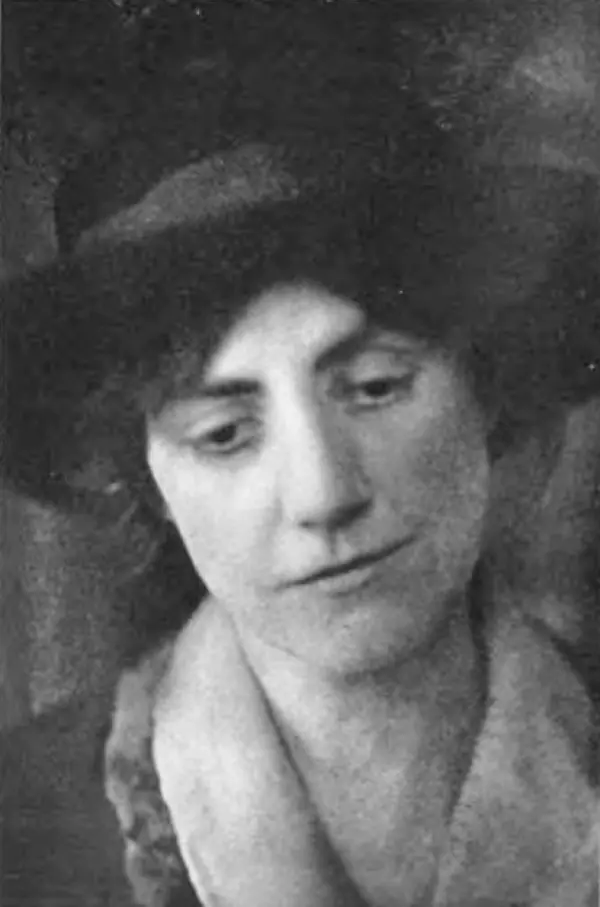
Trifles (1916) was her first play, and it was based on a murder trial she had covered as a young reporter in Des Moines. She wrote it for the Provincetown Players, the small experimental theatre company she had helped to found, and she later rewrote the same material as a short story, A Jury of Her Peers (1917) — a title that says out loud what the play only implies. Her play Alison's House (1930) won the Pulitzer Prize for drama in 1931. Glaspell is recognised today as a pioneering feminist writer and as America's first important modern woman playwright.
As a young newspaperwoman Glaspell reported the trial of a farmer's wife in rural Iowa accused of killing her husband as he slept. What stayed with her was not the legal argument but the farmhouse itself — the cold kitchen, the isolation, the silence of a marriage that no court could enter. When she came to write the play she changed the weapon, the names and the ending, and she made one radical decision that the courtroom could never make: she left the accused woman offstage and let the kitchen speak for her. You may mention the real trial as background; do not treat the play as a report of it.
18.2 The characters
| Character | Who they are |
|---|---|
| George Henderson | the County Attorney; a young man, ambitious, ironic, with "the gallantry of a young politician" |
| Henry Peters | the Sheriff; middle-aged, comfortable, sure that there is "nothing here but kitchen things" |
| Lewis Hale | a neighbouring farmer, who discovered the body and gives the opening narration |
| Mrs Peters | the Sheriff's wife; "a slight wiry woman, a thin nervous face"; begins as the voice of the law and changes completely |
| Mrs Hale | a neighbouring farmer's wife; larger, "more comfortable looking", but disturbed; the play's conscience |
| Minnie Wright | the accused; never appears on stage |
| John Wright | the murdered husband; dead before the play begins |
Neither Minnie nor John Wright is ever seen. Everything the audience knows about the marriage is reconstructed from objects and from what the neighbours remember. This is the boldest thing in the play: it forces the audience to do exactly the detective work the women are doing, so that we convict John Wright and acquit his wife by the same method the County Attorney is too proud to use.
18.3 The play, scene by scene
The play has no act divisions; it runs continuously in the kitchen of the Wright farmhouse. It can be followed in six movements.
1. The kitchen and the entrance
The stage direction sets everything up before a word is spoken: "the kitchen in the now abandoned farmhouse of John Wright, a gloomy kitchen, and left without having been put in order — unwashed pans under the sink, a loaf of bread outside the bread-box, a dish-towel on the table — other signs of incomplete work."
Five people come in. The three men go straight to the stove; the two women "come in slowly, and stand close together near the door." That grouping is the whole play in one picture: the men own the space and take its warmth, the women hover at the edge of it. Mrs Peters is offered the fire and answers, "I'm not — cold," and the hesitation in that dash is the first sign that she is not as composed as she looks.
2. Hale's narration
Lewis Hale tells what he saw the previous morning. He had called to ask John Wright about sharing a party telephone — and he lets slip, without knowing what he is revealing, that Wright had refused because "folks talked too much anyway, and all he asked was peace and quiet", and that he had thought of asking in front of Wright's wife, "though I said to Harry that I didn't know as what his wife wanted made much difference to John." In two sentences the dead man is drawn: a man who wanted no talk in his house and did not consult his wife.
Hale found Mrs Wright rocking, pleating her apron, and answering in flat little sentences: "Is it?"… "He's dead"… "He died of a rope round his neck." When Harry asked how she could have slept through it, she said only, "I sleep sound." Hale tells all this as evidence of guilt; the audience will come to hear it as shock.
3. The men dismiss the kitchen
The County Attorney opens a cupboard and finds the preserves burst by the frost: "Here's a nice mess." Mrs Peters explains that Mrs Wright had been anxious about exactly this. The Sheriff laughs — "Well, can you beat the women! Held for murder and worryin' about her preserves" — and Hale adds the line that gives the play its title: "Well, women are used to worrying over trifles."
The County Attorney then inspects the dirty towel and the pans and asks, "Not much of a housekeeper, would you say, ladies?" Mrs Hale answers stiffly that there is a great deal of work to be done on a farm, and, when he presses, that "those towels get dirty awful quick. Men's hands aren't always as clean as they might be." He calls her "loyal to your sex" — a joke that turns out to be a prophecy. The men then go upstairs and out to the barn, where they expect the evidence to be.
4. The women alone: the first discoveries
Left in the kitchen, the women begin to read the room, though at first they hardly know they are doing it.
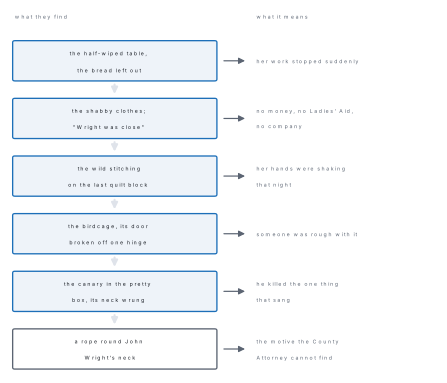
- The bread set to rise and left out of the box; the half-wiped table, one side clean and one side messy: someone stopped in the middle of her work.
- The rocking chair. Mrs Hale is about to sit in it, realises which chair it is, and steps back; the empty chair goes on rocking while both women watch. It is the play's most economical piece of theatre — the absent woman is suddenly present.
- The clothes. Examining the shabby skirt, Mrs Hale remembers: "Wright was close" — that is, mean with money — and that Minnie "used to wear pretty clothes and be lively, when she was Minnie Foster, one of the town girls singing in the choir. But that — oh, that was thirty years ago."
- The apron and shawl Mrs Wright has asked for in jail, which strike Mrs Hale as proof that she is not a murderer: "Asking for an apron and her little shawl. Worrying about her fruit."
Then the quilt. They admire the log-cabin pattern and wonder aloud whether she meant to quilt it or knot it. The men come down, overhear, and laugh; the women look abashed. And immediately after the laughter Mrs Hale finds the block Minnie was working on last: "All the rest of it has been so nice and even. And look at this! It's all over the place! Why, it looks as if she didn't know what she was about!" The two women look at each other, glance at the door — and Mrs Hale quietly unpicks the bad stitching and sews it properly. That is the first act of concealment, and it is done almost without thought.
5. The birdcage and the box
Looking for paper and string, Mrs Peters finds a birdcage with its door broken and one hinge pulled apart. "Looks as if someone must have been rough with it." Mrs Hale remembers a man selling canaries cheap, and remembers too that Minnie "used to sing real pretty herself."
The talk deepens. Mrs Hale admits her own guilt — "I wish I had come over sometimes when she was here… It's a lonesome place and always was" — and describes John Wright precisely: "he didn't drink, and kept his word as well as most, I guess, and paid his debts. But he was a hard man… Like a raw wind that gets to the bone." Of Minnie she says, "she was kind of like a bird herself — real sweet and pretty, but kind of timid and — fluttery. How — she — did — change."
Then, in the sewing basket, the pretty box. Inside, wrapped in silk, is the canary, its neck broken. "Somebody — wrung — its — neck." The stage direction is exact: "Their eyes meet. A look of growing comprehension, of horror."
Everything is now clear. A man who could not bear a sound in his house wrung the neck of the one thing his wife loved; she strangled him with a rope as he slept. The motive the County Attorney needs is lying on the kitchen table.
6. The choice
When the men return, the women lie for the first time. Asked about the empty cage, Mrs Hale says, "We think the — cat got it," and Mrs Peters supports her. Then, alone again, the two speak in the manner of "feeling their way over strange ground": Mrs Peters remembers the boy who killed her kitten with a hatchet, and that if they had not held her back she would have hurt him; she remembers the stillness of the Dakota homestead after her first baby died. Mrs Hale names the other crime: "I wish you'd seen Minnie Foster when she wore a white dress with blue ribbons and stood up there in the choir and sang… That was a crime! That was a crime! Who's going to punish that?" And she states the play's moral discovery in one sentence: "We live close together and we live far apart. We all go through the same things — it's all just a different kind of the same thing."
Mrs Peters, who has been saying "the law is the law" and "the law has got to punish crime", is the one who first tries to hide the box in her bag. Her hands fail her; Mrs Hale snatches it and puts it in her coat pocket. The County Attorney comes back joking — he has just told Mrs Peters that a sheriff's wife is "married to the law" — and asks his little question one last time. Mrs Hale, standing with her hand against the pocket that holds the evidence, gives the last line of the play: "We call it — knot it, Mr Henderson."
18.4 The chain of clues
The women's method is not deduction from a single piece of evidence but the slow assembling of small domestic facts, each meaningless by itself. It is worth setting the chain out, because most examination questions about the play are really questions about one link in it.
18.5 The characters in detail
Mrs Hale is the play's conscience and its memory. She is the one who knew Minnie Foster before her marriage, and therefore the only person on stage who can measure what has been lost. She is blunt with the County Attorney from the start, defending Minnie's housekeeping and her own sex. But her most important quality is guilt: she reproaches herself for having stayed away — "I stayed away because it weren't cheerful — and that's why I ought to have come." Her decision to hide the box is partly an act of justice and partly an attempt to repay a debt she knows she cannot repay.
Mrs Peters is the character who actually changes, and she is therefore the dramatic centre. She enters as an extension of her husband — nervous, correct, repeating that "the law is the law" and "the law has got to punish crime." Three things break her open: the broken birdcage, which makes her remember the boy who killed her kitten and the violence she felt then; the stillness she remembers from Dakota after her first baby died; and the bird itself. The County Attorney's joke that a sheriff's wife is "married to the law" is said over the head of a woman who has, minutes before, tried to smuggle the evidence out in her handbag. Her failure of nerve at the last moment — she cannot touch the dead bird — is what makes her believable: this is a conversion, not a conspiracy.
Minnie Wright exists only in other people's memory and in her own objects. There are two of her. There is Minnie Foster, one of the town girls, who wore a white dress with blue ribbons and sang in the choir; and there is Mrs Wright, thirty years later, in a lonesome house in a hollow, in shabby clothes, with no children, no telephone, no Ladies' Aid, and a caged bird. The play's method is to let the audience feel the distance between those two women, and to understand that somebody travelled it.
John Wright is convicted in half a dozen sentences, none of them hostile. "They say he was a good man." "He didn't drink, and kept his word as well as most, I guess, and paid his debts. But he was a hard man… Like a raw wind that gets to the bone." He refused the party telephone because "folks talked too much anyway." He was "close" with money. This is the play's quietest and most frightening point: a man can be respectable by every public measure and still destroy someone privately, and the law has no name for what he did.
The men as a group — Henderson, Peters and Hale — are not villains. They are competent, jocular, and entirely blinded by their assumption that nothing important happens in a kitchen. The County Attorney is the sharpest of them and the most wrong: he actually stands beside the box of quilt pieces, moves a few things about, and steps back, saying, "No, Mrs Peters doesn't need supervising."
18.6 Symbolism
The birdcage. A pretty enclosure with a door wrenched off its hinge. It is the Wright house, and Minnie is what was kept inside it. The broken door tells two stories at once: a man's violence in getting at the bird, and the fact that something finally got out.
The canary. Minnie "used to sing real pretty herself"; she was "kind of like a bird herself — real sweet and pretty, but kind of timid and — fluttery." The bird is her own lost voice and her one remaining pleasure, bought cheap from a passing salesman. Its wrung neck and John Wright's rope-marked neck are deliberately the same injury; Glaspell makes Mrs Hale say it: "His neck. Choked the life out of him." When Minnie wraps the bird in silk and puts it in her prettiest box, she is burying the last of Minnie Foster.
The quilt. The needlework is Minnie's handwriting; the even blocks are the years of control and the wild block is the night of the murder. And the question the men laugh at — "quilt it or knot it?" — becomes the answer: a quilt is sewn through, but a knot is tied and pulled tight, which is exactly how John Wright died. The last line of the play is a confession that only the women can hear.
The preserves. The frozen, burst jars are Minnie's work of a whole hot summer, destroyed in one cold night — like her life. The men laugh that she worries about them while held for murder; the women understand that a woman who still cares about her fruit has not stopped being herself. The single unbroken jar of cherries that Mrs Hale decides to take her — with the lie that none was lost — is the play's one act of tenderness.
The rocking chair. Mrs Wright was rocking in it when Hale found her, and the empty chair rocks by itself when Mrs Hale touches it. An unoccupied chair that moves is the play's image of a woman who is present everywhere and visible nowhere.
The cold, and the stove. The play opens below zero. The men take the fire; Mrs Peters says "I'm not — cold"; the fruit freezes because the fire went out. Warmth in this play means company and kindness, and the Wright house has run out of both.
18.7 Setting, structure and technique
Setting. The whole play happens in one room, in real time, on a bitterly cold morning in a farmhouse "down in a hollow" where "you don't see the road." The setting is not a background; it is the cause. Isolation is what destroyed Minnie Wright — no telephone, no neighbours, no children, no Ladies' Aid — and the play makes the audience share that isolation by never letting them out of the kitchen. Confining the action to the room the men despise is also the structural joke on which everything depends: the audience is locked in with the evidence.
Structure. Trifles is a model of the well-made one-act play: a single setting, a single continuous action, and a plot in which every step is also a discovery.
- Exposition — the entrance and Hale's narration, which give us the murder.
- Rising action — the men's dismissal of the kitchen, and the women's succession of small finds: the preserves, the bread, the rocker, the clothes, the quilt.
- Climax — the box is opened and the dead canary is found. "Their eyes meet."
- Falling action — the two women talk their way to an understanding, and lie to the men about the cat.
- Resolution — the box goes into Mrs Hale's pocket, and the curtain line is a pun that the men cannot hear.
Dramatic irony. From the moment the box is opened, the audience and the two women know the motive, and the three investigators do not. Every line the men speak afterwards is therefore double: "it's all perfectly clear except a reason for doing it"; "I guess they're not very dangerous things the ladies have picked out"; "a sheriff's wife is married to the law"; "Has the bird flown?" The tension of the last five minutes comes entirely from the audience's fear that one of these casual sentences will accidentally hit the truth.
Irony of the title. Trifles is the men's word — "women are used to worrying over trifles" — and the play spends thirty minutes proving that the trifles are the evidence. The irony is structural, not decorative: the men fail because they use the word.
Dialogue and silence. Glaspell writes rural American speech exactly — "s'pose", "ain't it", "readied-up", "close" for mean. But her real instrument is the pause. The dashes in "How — she — did — change" and "Somebody — wrung — its — neck" do more than any speech could, and the stage directions repeatedly ask the actresses to communicate without words: "Their eyes meet"; "The two women sit there not looking at one another, but as if peering into something"; "her own eyes point the way to where the box is concealed."
Dramatic irony occurs when the audience knows something that one or more characters on stage do not. It creates tension, because we watch people act on incomplete knowledge, and it can create either comedy or dread. In Trifles the audience shares the women's knowledge, so the irony makes us accomplices: we are hiding the box too.
18.8 Themes
The trivialisation of women's lives. The men's error is not cruelty but contempt: kitchens, preserves, sewing and birds are beneath notice. The play answers by making a kitchen the only place where the truth can be found.
Isolation. Minnie Wright had no telephone because her husband liked quiet, no new clothes because he was close, no children, and no visitors because the house was not cheerful. Mrs Hale's cry — "I might have known she needed help!" — extends the charge from John Wright to the whole neighbourhood, and to us.
Law against justice. Mrs Peters begins with "the law is the law" and ends by helping to defeat it. The play does not claim that Minnie is innocent of the killing; it claims that the law is about to try only half of the case. Mrs Hale names the untried half: "That was a crime! That was a crime! Who's going to punish that?"
Female solidarity, and the guilt that produces it. The two women are not friends at the start, and neither of them knows Minnie well. What unites them is the recognition that her life could have been theirs: "We all go through the same things — it's all just a different kind of the same thing." That sentence, not the dead bird, is the real discovery of the play.
The invisible marriage. The play is finally about what cannot be seen from outside a house. John Wright was, in public, a good man. Everything that destroyed his wife happened where no one was looking — which is exactly where the play sets its stage.
| Device | Example | What it does |
|---|---|---|
| Irony of title | "women are used to worrying over trifles" | The despised trifles turn out to be the entire case |
| Dramatic irony | "Well, ladies, have you decided whether she was going to quilt it or knot it?" | The audience holds the answer; the speaker does not |
| Symbol | the canary with its neck wrung | Equates the bird's death with the wife's silencing and the husband's murder |
| Parallelism | "Somebody wrung its neck" / "a rope round his neck" | Makes the punishment fit the crime without a word of comment |
| Pun | "knot it" / "not it" | The curtain line is simultaneously a sewing term, a method of murder and a denial |
| Understatement | "But he was a hard man… Like a raw wind that gets to the bone" | Condemns a man in one simile, with no raised voice |
| Foreshadowing | the empty rocking chair rocking by itself | Announces the absent woman before any clue is found |
| Stage silence | "Their eyes meet. A look of growing comprehension, of horror." | The play's climax happens with no dialogue at all |
| Contrast | men upstairs and in the barn / women in the kitchen | Turns stage geography into the play's argument |
18.9 Glossary
| Word | Meaning |
|---|---|
| abashed | embarrassed or ashamed |
| canary | a small yellow songbird often kept as a pet |
| close | (of a person) mean with money; tight-fisted |
| coroner | the official who investigates deaths not believed to be natural |
| facetiously | in a joking manner, not meant seriously |
| fidgety | restless, unable to keep still |
| homestead | to settle and farm public land granted under the US Homestead Act of 1862 |
| Ladies' Aid | a women's charitable society attached to a church |
| party telephone | a shared telephone line used by several households |
| pleat | to fold cloth into narrow folds |
| preserves | fruit bottled in jars to keep through the winter |
| queer | strange; odd |
| quilt (v.) | to stitch layers of cloth together to make a bed covering |
| resentfully | angrily and unhappily |
| scoffingly | scornfully, mockingly |
| sheriff | in the United States, an elected county officer responsible for keeping the peace |
| tippet | a shawl or scarf, often of fur |
| trifles | things of very little value or importance |
Never write that the women "solve the murder". They do more and less than that. They discover the motive — the thing the County Attorney says he needs — and then they suppress it. The play's subject is not detection but judgement: two ordinary women quietly decide that the law, as it stands, is not competent to try this case, and act on that decision.
Chapter summary
- Trifles (1916) is Susan Glaspell's first play, based on a murder trial she covered as a young reporter in Des Moines; she later rewrote it as the story A Jury of Her Peers.
- John Wright has been strangled with a rope in his bed; his wife Minnie, who says she "slept sound", is in custody. Neither of them appears on stage.
- The Sheriff, the County Attorney and the neighbour Hale search upstairs and in the barn for evidence of a motive and find nothing, dismissing the kitchen as holding "nothing here but kitchen things" and women's "trifles".
- Left in the kitchen, Mrs Hale and Mrs Peters read the room: unfinished work, a burst jar of preserves, shabby clothes, an empty rocking chair, and a quilt whose last block is stitched wildly.
- They find a birdcage with its door broken and then, in a pretty box, the canary with its neck wrung. The motive is complete: a hard, silent husband killed the one thing that sang, and his wife answered in kind.
- Mrs Peters, who begins by insisting that "the law is the law", is changed by memories of her murdered kitten and of the stillness after her baby's death; Mrs Hale is driven by guilt at never having visited.
- The women lie to the men ("we think the cat got it") and hide the box. The closing pun — "We call it — knot it, Mr Henderson" — is a confession the men cannot hear.
- Symbols: the birdcage (the marriage), the canary (Minnie's voice), the quilt (her state of mind, and the method of killing), the preserves (a life's work destroyed in one cold night), the empty rocker, and the cold itself.
- Themes: the trivialising of women's lives, isolation, the gap between law and justice, and the solidarity that grows from the recognition that "we all go through the same things — it's all just a different kind of the same thing."
Practice questions
Short answer questions (2 marks each)
- Do you believe that Mrs Wright killed her husband? Explain. [2]
- Do you think Mr Wright's death would have been uncovered if Mr Hale hadn't stopped by the Wrights' home? [2]
- Why does Mrs Hale think that Mrs Wright's worries about her preserves indicate her innocence? [2]
- How does Mrs Peters' homesteading experience connect her to Mrs Wright? [2]
- How do the women's perspectives on men differ? [2]
- Why is the play called Trifles? [2]
- What do the women do with the dead canary, and why? [2]
Model answers — short questions
1. Yes. The play never shows the killing, but the evidence the women assemble points only one way: the rope was the Wrights' own, there was "no sign at all of anyone having come from the outside", Minnie was in the bed beside him, and the wildly stitched quilt block shows her hands shaking that night. The broken cage and the strangled canary supply the motive — the husband killed the one thing she loved, and she answered with the same injury to his neck. Mrs Hale's protest that "I don't think she did it" is not really a claim about the facts; it is a refusal to let the word "murderer" stand for the whole of what happened in that house.
2. Probably yes, but not so soon, and perhaps not in a way that would have convicted her. The Wrights lived in a lonesome hollow where "you don't see the road", and had refused a party telephone, so news travelled slowly; Minnie herself had notified nobody and was simply sitting in her rocker pleating her apron when Hale arrived. Sooner or later a neighbour, the Ladies' Aid or a delivery would have brought someone to the door. But the delay would have mattered: the kitchen might have been tidied, the bird disposed of, and the story rehearsed. Hale's accidental call on the morning after is what freezes the scene exactly as Minnie left it — which is why the kitchen can be read at all.
3. Because a woman who has just killed her husband and been dragged to jail would not, Mrs Hale reasons, still be anxious about a summer's work in jars — and because the same woman asked for an apron and her little shawl, the small belongings of an ordinary life. "Asking for an apron and her little shawl. Worrying about her fruit." To Mrs Hale these are the concerns of a housewife, not of a criminal. The judgement is of course sentimental rather than logical, and the play knows it: Mrs Hale will shortly find the dead canary. But the observation is still true in a deeper way. Minnie is not a hardened killer; she is an ordinary woman who broke once, and the preserves prove it.
4. Mrs Peters tells how she and her husband homesteaded in Dakota and how her first baby died at two years old, leaving her with no other child: "I know what stillness is." That is the precise link. Minnie Wright lived for thirty years in a silent house with no children and a husband who wanted only "peace and quiet", and the canary was the one sound in it. Because Mrs Peters has herself lived through a stillness that nearly destroyed her, she can imagine what it would be "if there'd been years and years of nothing, then a bird to sing to you… still, after the bird was still." Her own past, not any argument of Mrs Hale's, is what turns the sheriff's wife into Minnie's defender.
5. Mrs Hale judges men freely and is ready to say so aloud. She answers back to the County Attorney about the towels ("Men's hands aren't always as clean as they might be"), resents them "snooping around and criticizing" in another woman's kitchen, and describes John Wright to his neighbours' faces as "a hard man… Like a raw wind that gets to the bone." Mrs Peters begins by excusing the men at every turn — "Of course it's no more than their duty", "they've got awful important things on their minds", "the law is the law" — because she is married to the Sheriff and identifies with his authority. By the end the difference has almost vanished: Mrs Peters is the first to reach for the box. The play measures its own progress by the closing of this gap.
6. The title comes from Hale's dismissive line, "Well, women are used to worrying over trifles," spoken when the men laugh at Mrs Wright for worrying about her frozen preserves. It is deeply ironic, because the trifles the men despise — the preserves, the bread, the quilt, the birdcage and the dead canary — are precisely the evidence that reveals the motive for the murder. The men search the bedroom and the barn and find nothing; the women stay among the trifles and find everything. The title therefore states the men's prejudice and the play's argument in a single word.
7. Mrs Peters first tries to hide the box in the bag she is carrying, but it is too big, and when she opens it she cannot bring herself to touch the bird; Mrs Hale then snatches the box and thrusts it into the pocket of her big coat, where it is when she speaks the last line of the play. They hide it because it is the one thing that would supply the motive the County Attorney says he needs — "something to show anger, or sudden feeling" — and because they have decided, without ever saying so, that a court which would hang Minnie Wright while never trying John Wright is not entitled to the evidence.
Long answer questions (5 marks each)
- What is the main theme of the play? Discuss it with reference to the text. [5]
- Discuss the symbolism used in the play. [5]
- Discuss the setting of the play. Does it have an impact on the theme? [5]
- Analyse Glaspell's use of dramatic irony. What information is crucial to the play? How does the playwright use it to create irony, and what effect does that irony have on the audience? [5]
- "The credibility of a character is determined not only by the character's thoughts and actions but also by what other characters say and think about him or her." Discuss in relation to the characters of Trifles. [5]
Model answers — long questions
1. The main theme of Trifles is the systematic undervaluing of women and of women's knowledge, and the injustice that follows from it. Every other theme in the play — isolation, marriage, law against justice, female solidarity — branches from this one.
The theme is announced in the stage directions before anyone speaks. The men walk in and go straight to the stove; the women "come in slowly, and stand close together near the door." It is stated in words when the Sheriff laughs at a woman "held for murder and worryin' about her preserves" and Hale adds, "women are used to worrying over trifles." It governs the plot: the men search the bedroom, the barn and the windows, and the County Attorney concludes that "it's all perfectly clear except a reason for doing it", while the women, sitting in the room he has dismissed as holding "nothing here but kitchen things", find the reason within half an hour.
The theme then deepens from a joke about housekeeping into something far more serious. What the kitchen reveals is a marriage in which a woman was slowly extinguished: no telephone because "folks talked too much anyway", no money for clothes because "Wright was close", no Ladies' Aid, no children, no visitors, and finally no bird. John Wright committed no offence the law recognises, and Mrs Hale says so with real anger: "I wish you'd seen Minnie Foster when she wore a white dress with blue ribbons and stood up there in the choir and sang… That was a crime! That was a crime! Who's going to punish that?" The play's answer is that nobody will, because the institution that decides what counts as a crime is made up of men who cannot see a kitchen.
Out of that recognition grows the play's third movement: solidarity. Mrs Hale and Mrs Peters are not Minnie's friends; what binds them to her is the discovery that her life is a version of their own — "We live close together and we live far apart. We all go through the same things — it's all just a different kind of the same thing." Having understood that, they do the only thing available to them. They cannot testify, argue or sit on the jury; they can hide a small box. The theme therefore ends not in a complaint but in an action, and in the quiet pun of the last line, which is both a sewing term and a verdict.
2. Glaspell's symbols are all ordinary household objects, which is itself part of the argument: in a world that notices nothing a woman touches, the meaning has to be hidden in plain sight.
The birdcage is the central symbol. It is a pretty container built to keep a singing creature from flying away — an exact image of the Wright marriage — and when the women find it, its "door. It's broke. One hinge is pulled apart." The damage is violent and recent, and it carries two meanings simultaneously: the husband's brutality in getting at the bird, and the fact that something in that house finally broke out of its enclosure.
The canary is Minnie herself. Mrs Hale remembers that Minnie "used to sing real pretty herself" and was "kind of like a bird herself — real sweet and pretty, but kind of timid and — fluttery." When John Wright wrings the bird's neck he is killing the last audible remnant of Minnie Foster, and the symbol is completed by the method of his own death: a rope round the neck. Mrs Hale's flat repetition — "His neck. Choked the life out of him" — with her hand resting on the cage, is the moment the symbol closes.
The quilt works on two levels. As an object it is Minnie's mind made visible: the blocks are "so nice and even" until the last one, which is "all over the place… as if she didn't know what she was about." As a word it produces the play's final irony, since the men's mocking question — quilt it or knot it? — is answered by the murder itself. A knot is pulled tight, and so was the rope.
The preserves stand for a woman's labour and its fragility. A whole summer's work in the hot weather is destroyed in one freezing night because the fire went out, which is a fair description of Minnie's life. The men see only "a nice mess"; Mrs Hale sees the work, and her decision to carry the one surviving jar of cherries to the jail with a comforting lie is the play's single act of pure kindness.
Two smaller symbols matter. The empty rocking chair, which rocks by itself after Mrs Hale touches it, brings the absent woman physically into the room. And the cold — the sub-zero morning, the men crowding the stove, the fire that went out, Mrs Peters' "I'm not — cold" — is the play's constant image for a house, and a marriage, with no warmth left in it.
3. The setting of Trifles is a single room: the kitchen of the Wrights' now abandoned farmhouse, on a bitterly cold morning in rural Iowa, the day after the murder. The play observes the classical unities almost exactly — one place, one continuous action, roughly real time — and every element of the setting is doing thematic work.
The place is remote. The house lies "down in a hollow and you don't see the road", and Mrs Hale calls it "a lonesome place and always was." John Wright had refused a party telephone. There are no children and no near neighbours. This isolation is not atmosphere; it is the cause of the tragedy. A woman cut off from every human contact, married to a man who wanted only "peace and quiet", had nothing left but a canary — which is why killing the canary was enough to kill him.
The room is a kitchen, and the entire structure of the play depends on that choice. By confining the action to the one space the men consider worthless, Glaspell locks the audience in with the evidence and makes them see what the investigators cannot. Had she set the play in the bedroom where the body lay, or in a courtroom, it would have been an ordinary detective piece. Set in the kitchen, it becomes an argument about what counts as knowledge.
The disorder is legible. The opening stage direction lists unwashed pans, a loaf of bread outside the bread-box, a dish-towel on the table, "other signs of incomplete work", and the play later adds a table wiped clean on one half only. To the County Attorney this means "not much of a housekeeper"; to the women it means a woman interrupted in the middle of her morning. The same room supplies opposite conclusions depending on who reads it, and that is the play's subject.
The cold organises the staging. It is below zero; Frank has been sent to make a fire; the men go at once to the stove and keep returning to it; the preserves have burst in the frost. Warmth in this play means human company, and there is none in this house.
So yes — the setting does not merely support the theme, it produces it. The isolation creates the crime, the kitchen creates the irony, the disorder creates the evidence, and the cold supplies the emotional temperature of a marriage.
4. The crucial information is the dead canary with its neck wrung, hidden in the pretty box under the quilt pieces, together with everything that follows from it: that John Wright killed the bird, and that his wife therefore had the motive the County Attorney keeps saying he lacks — "something to show anger, or sudden feeling… a thing that would connect up with this strange way of doing it."
How Glaspell uses it. She gives this knowledge to the two women, and through them to the audience, at the play's midpoint — "Somebody — wrung — its — neck. (Their eyes meet. A look of growing comprehension, of horror.)" — and withholds it from the three investigating men until the curtain. From that moment the play runs on a double track. Every line the men speak means one thing to them and another to us:
- "Has the bird flown?" — asked idly, while the bird lies six feet away, dead.
- "I guess they're not very dangerous things the ladies have picked out," said as he actually disturbs the quilt pieces covering the box and steps back.
- "No, Mrs Peters doesn't need supervising. For that matter a sheriff's wife is married to the law" — said to a woman who has just decided to break it.
- "It's all perfectly clear except a reason for doing it" — said in the presence of the reason.
- And the closing exchange about quilting and knotting, in which the County Attorney asks, as a joke, the one question whose answer is the truth.
The effect. First, suspense: for the last third of the play the audience watches three men move around a small kitchen containing a box they must not open, and every casual gesture is frightening. Second, complicity — this is the important one. Because we learned the secret with the women and at the same moment, we want it kept, and we find ourselves hoping the officers of the law will fail. Glaspell has made the audience part of the jury that acquits Minnie Wright, and she has done it without a single speech of argument. Third, satire: the irony exposes the men's confidence as ignorance, and turns their own catchword, "trifles", back on them. And finally it produces the ending's peculiar quietness. No one is arrested, no one confesses, nothing is explained — the play simply stops on a pun, and the audience is left holding the knowledge.
5. Trifles is the strongest possible illustration of this principle, because its two most important characters are never on stage at all. Minnie and John Wright exist entirely in what other people say, remember and infer — and the play demonstrates that such evidence can be more revealing than direct presence.
John Wright is the clearest case. No one attacks him. The Sheriff's wife reports the common opinion neutrally: "They say he was a good man." Mrs Hale then gives the fullest testimony in the play, and it begins as agreement: "Yes — good; he didn't drink, and kept his word as well as most, I guess, and paid his debts." Only then comes the turn: "But he was a hard man, Mrs Peters. Just to pass the time of day with him — (shivers). Like a raw wind that gets to the bone." Two further details arrive from an unlikely witness — Hale, who admires him — and are all the more damaging for being accidental: Wright refused a telephone because "folks talked too much anyway", and Hale had assumed "what his wife wanted made much difference to John." A man's whole character is established by four neighbours who think they are being fair to him.
Minnie Wright is built the same way, out of memory and objects. Hale's account of the woman rocking and pleating her apron and saying "he died of a rope round his neck" would, by itself, make her a monster. Mrs Hale supplies the other half — the girl in a white dress with blue ribbons singing in the choir, "one of the town girls", thirty years ago — and the credibility of the character lies precisely in the gap between the two reports. Then the objects testify: the shabby skirt, the log-cabin quilt, the jar of cherries, the apron she asks for in jail, the bird in the silk. Because we never hear her defend herself, and because everything we learn comes from people with no reason to lie, the portrait is far more convincing than a confession would be.
The principle also works on the characters who are present. Mrs Peters tells us she believes in the law; her husband tells us she is "married to the law"; the County Attorney jokes that she needs no supervising. All three judgements are wrong, and the play lets us watch them being wrong — which is how we measure her change. Mrs Hale is called "loyal to your sex" by the County Attorney as a mild sneer, and the rest of the play turns that sneer into a description of heroism. And the men are characterised chiefly by what the women observe about them: "I'd hate to have men coming into my kitchen, snooping around and criticizing."
The lesson of the play, then, is also a lesson about reading character in general. Credibility is cumulative. It is built out of many small, indirect, apparently trivial testimonies — which is exactly what the title of the play is about.
Reference to the context
- "MRS. PETERS: (glancing around). Seems funny to think of a bird here. But she must have had one, or why would she have a cage? I wonder what happened to it? MRS. HALE: I s'pose maybe the cat got it." (i) Who does "she" refer to? (ii) What does the word "one" stand for? (iii) What is the full form of "s'pose"? (iv) What do you mean when Mrs Hale says, "the cat got it"? [5]
- "MRS. HALE: Wright was close. … she used to wear pretty clothes and be lively, when she was Minnie Foster, one of the town girls singing in the choir. But that — oh, that was thirty years ago." (i) Why does Mrs Hale refer to Mrs Wright as "Minnie Foster"? (ii) What does her description tell you about Mrs Wright? (iii) What does Mrs Hale mean by "that was thirty years ago"? [5]
Model answers — reference to the context
1. (i) "She" refers to Mrs Minnie Wright, the woman arrested on suspicion of murdering her husband, in whose kitchen the two women are standing. She never appears on stage. (ii) "One" stands for a bird — specifically a canary, of the kind a man had been selling cheap in the district the previous year. Mrs Peters is reasoning from the object to its owner: an empty cage implies a bird. (iii) "S'pose" is a contraction of "suppose", and the line in full would read "I suppose maybe the cat got it." Glaspell writes her farming characters' speech as it is actually spoken — "ain't it", "readied-up", "wouldn't they just laugh" — so that the audience hears an ordinary rural kitchen rather than a stage. (iv) It means that the household cat caught and killed the bird — a completely ordinary explanation. Two things make the remark important. First, it is a guess made in innocence: at this point Mrs Hale genuinely does not know what happened, and Mrs Peters immediately corrects her, because Minnie "didn't have a cat" and was in fact afraid of them. Second, and much more significantly, the same phrase returns later as a lie. After the women have found the strangled canary and the County Attorney asks, "Has the bird flown?", Mrs Hale answers, "We think the — cat got it," while covering the box with quilt pieces. The innocent guess has become the women's first act of concealment, and the audience, who know there is no cat, hear the sentence as a deliberate deception.
2. (i) Because that was her name and her identity before her marriage, and Mrs Hale is deliberately speaking of a different person from the woman now in jail. Using the maiden name is how the play separates the girl who sang in the choir from "Mrs Wright", the silent woman in the shabby skirt; the surname "Wright" itself marks the moment the change began. It is also an act of sympathy: Mrs Hale is the only person in the play who remembers her as anything but a suspect, and by saying "Minnie Foster" she restores to her a self that the investigation has no interest in. (ii) It tells us, first, what Minnie once was: pretty, lively, sociable, dressed well, and — crucially — a singer, standing up in the choir with the other town girls. Second, by contrast, it tells us what she became. The sentence before it — "Wright was close" — supplies the cause: a husband mean with money, so that she could not dress decently, would not join the Ladies' Aid because "you don't enjoy things when you feel shabby", and gradually "kept so much to herself." Third, it prepares the play's central symbol. A woman who sang, shut in a silent house with a caged songbird, makes the dead canary intelligible the moment it is found: "she was kind of like a bird herself — real sweet and pretty, but kind of timid and — fluttery." (iii) It means that the Minnie Foster she is describing has been gone for a whole generation — roughly the length of the Wrights' marriage — and that Mrs Hale is reaching back past thirty years of a life she did not watch closely enough. The phrase carries three things at once: the measure of the change ("How — she — did — change"), the slowness of it, which is what makes it a tragedy rather than an accident; and Mrs Hale's own guilt, since those are the thirty years in which she did not call. The catch in "but that — oh, that was thirty years ago" is the sound of a woman realising how long she has not been paying attention, and it leads directly to her cry a few pages later: "I might have known she needed help!"
Practise more: English question bank