Unit 25 · Grammar · 16 min read
Passive Voice and Causatives
What the syllabus asks for 7
- The five steps of the transformation
- The passive of every tense
- Modals, infinitives and gerunds in the passive
- Verbs with two objects
- Questions, imperatives and other special sentences
- When and why the passive is used
- Causative verbs
Voice tells you whether the subject of the sentence does the action or receives it. In the active voice the doer is the subject (The committee approved the plan); in the passive the receiver becomes the subject (The plan was approved by the committee). NEB Q7 almost always contains one voice item, phrased "Change into passive voice" or "Change into active voice". Causatives — get the house painted, have my hair cut — are the passive's close relative and are tested in the same question.
A verb with no object has nothing to promote to subject. He slept, She arrived, The baby laughed have no passive form. If a question asks you to make an intransitive sentence passive, the answer is that it cannot be done.
25.1 The five steps of the transformation
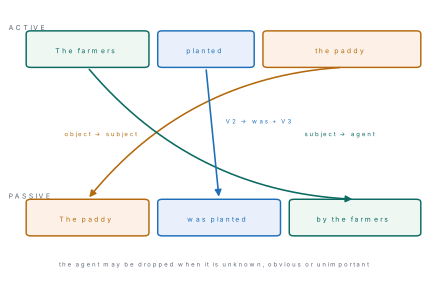
- Find the object of the active sentence. Ask what? or whom? after the verb. No object means no passive.
- Move that object to the front and make it the subject. Change its case if it is a pronoun: me → I, him → he, them → they.
- Change the verb to the matching form of be + the past participle (V3). The be keeps the tense and number of the original verb — the tense never changes in a voice transformation.
- Move the old subject to the end after by, changing its case: I → by me, she → by her, we → by us.
- Decide whether to drop the agent. Leave out by … when the doer is unknown (My purse was stolen), obvious (The thief was arrested), or a vague people / they / somebody (Nepali is spoken here).
25.2 The passive of every tense
Take the active sentence They repair the road and run it through all twelve tenses. S is the new subject.
| Tense | Active | Passive structure | Passive example |
|---|---|---|---|
| Simple present | They repair the road. | S + am/is/are + V3 | The road is repaired. |
| Present continuous | They are repairing the road. | S + am/is/are + being + V3 | The road is being repaired. |
| Present perfect | They have repaired the road. | S + have/has + been + V3 | The road has been repaired. |
| Present perfect continuous | They have been repairing the road. | — | no passive form in normal use |
| Simple past | They repaired the road. | S + was/were + V3 | The road was repaired. |
| Past continuous | They were repairing the road. | S + was/were + being + V3 | The road was being repaired. |
| Past perfect | They had repaired the road. | S + had + been + V3 | The road had been repaired. |
| Past perfect continuous | They had been repairing the road. | — | no passive form in normal use |
| Simple future | They will repair the road. | S + will + be + V3 | The road will be repaired. |
| Future continuous | They will be repairing the road. | — | no passive form in normal use |
| Future perfect | They will have repaired the road. | S + will + have been + V3 | The road will have been repaired. |
| Future perfect continuous | They will have been repairing the road. | — | no passive form in normal use |
The perfect continuous tenses (present, past, future) and the future continuous have no passive in ordinary English, because forms such as has been being repaired are too clumsy to use. If an exam sentence is in one of these tenses, either the question is faulty or you are expected to shift it to the matching simple or perfect passive. Never invent will be being written.
25.3 Modals, infinitives and gerunds in the passive
| Active pattern | Passive pattern | Example |
|---|---|---|
| modal + V1 | modal + be + V3 | You must submit the form. → The form must be submitted. |
| modal + have + V3 | modal + have been + V3 | She should have paid it. → It should have been paid. |
| to + V1 | to be + V3 | He wants to invite her. → She wants to be invited. |
| V-ing | being + V3 | I like people praising my work. → I like my work being praised. |
| have to / used to / going to | + be + V3 | We have to finish it. → It has to be finished. |
25.4 Verbs with two objects
Verbs such as give, send, offer, teach, tell, show, lend, pay, promise, buy, bring take an indirect object (a person) and a direct object (a thing). Either can become the subject, so two passives are possible — and the person one is the more natural.
Active: The principal gave Sarita a certificate.
- Passive 1 (person first): Sarita was given a certificate by the principal.
- Passive 2 (thing first): A certificate was given to Sarita by the principal.
Note that when the thing becomes the subject, the person needs to (or for with buy, make, get): A new bag was bought for the child.
25.5 Questions, imperatives and other special sentences
| Active type | Rule | Example |
|---|---|---|
| Yes/no question | Begin the passive with the auxiliary | Did he write the letter? → Was the letter written by him? |
| Wh- question (object) | Keep the wh- word first | What did you buy? → What was bought by you? |
| Who as subject | Who becomes By whom | Who broke the window? → By whom was the window broken? |
| Whom as object | Whom becomes Who | Whom did they select? → Who was selected by them? |
| Imperative (order) | Let + object + be + V3 | Shut the door. → Let the door be shut. |
| Imperative (request) | You are requested to… | Please help me. → You are requested to help me. |
| Imperative (advice) | Should / must be + V3 | Do not waste water. → Water should not be wasted. |
| Let + object | Let + object + be + V3 | Let him do it. → Let it be done by him. |
The impersonal passive. Sentences beginning People say / They believe / Everyone knows have two standard passives:
People say that he is very rich. → It is said that he is very rich. → He is said to be very rich.
If the that-clause is in an earlier tense, the second form uses to have + V3: People believe that she wrote the letter → She is believed to have written the letter.
25.6 When and why the passive is used
- The doer is unknown: Three motorcycles were stolen from the parking lot.
- The doer is obvious or unimportant: The suspect was released on bail.
- The receiver matters more than the doer: Nepal was struck by a major earthquake in 2015.
- Formal, scientific and official writing, where the process matters more than the person: The sample was heated to 80 °C. Applications must be submitted by Chaitra 15.
- Notices and rules: Visitors are requested not to feed the animals.
Two errors cost most of the marks in this question. (i) ~~The letter is written by him yesterday~~ → was written — the tense of the original must survive. (ii) ~~The song was sung by she~~ → by her — after by the pronoun takes the object form (me, us, him, her, them, whom). Also keep the number right: The books were kept, not ~~was kept~~.
25.7 Causative verbs
A causative says that the subject arranges for something to be done rather than doing it personally. There are two families.
Family 1 — causing a thing to be done (the passive causative).
| Structure | Meaning | Example |
|---|---|---|
| have + object + V3 | arrange a service, neutral | I had my bike serviced at Balaju. |
| get + object + V3 | the same, more informal; also "manage to" | She got her passport renewed. |
| get / have + object + V3 | something unpleasant that happened to you | He had his phone stolen in the bus. |
| want / need + object + V3 | a need | We need the roof repaired before Shrawan. |
The word order is fixed: have/get + the thing + past participle. ~~I had cut my hair~~ (= I cut it myself) is different from I had my hair cut** (= the barber cut it).
Family 2 — causing a person to act.
| Structure | Meaning | Example |
|---|---|---|
| make + person + V1 | force, compel | The teacher made us rewrite the essay. |
| let + person + V1 | allow | My father let me use his laptop. |
| have + person + V1 | give an instruction to someone under you | I had the tailor shorten the trousers. |
| get + person + to + V1 | persuade | She got her brother to drive her to Kalanki. |
| help + person + (to) + V1 | help; to is optional | He helped me carry the sack. |
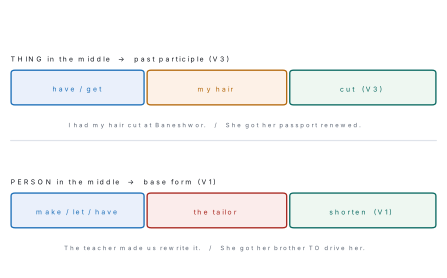
Active: They made him sign the paper. (no to) Passive: He was made to sign the paper. (to appears) This reappearing to is a favourite exam trap. Let has no passive of its own; use be allowed to: He was allowed to go.
Problem. Change into the passive: The municipality has cleared the garbage from the riverbank.
Solution — the five steps.
- Find the object. has cleared what? → the garbage from the riverbank. The head of the object is the garbage.
- Move it to the front. The garbage from the riverbank …
- Change the verb. The active is present perfect (has cleared), so the passive is have/has + been + V3. The new subject garbage is singular → has been cleared.
- Attach the agent. Old subject the municipality → by the municipality.
- Keep or drop the agent? It is specific and informative, so keep it.
Answer. The garbage has been cleared from the riverbank by the municipality.
Problem. Change into the passive: Who wrote this poem?
Solution — step by step.
- Identify the parts. Subject = Who; verb = wrote (simple past); object = this poem.
- The object becomes the subject. This poem …
- Change the verb. Simple past → was/were + V3. Poem is singular → was written.
- The subject who becomes the agent. After by, who becomes whom: by whom.
- Keep it a question. A wh- question begins with the wh- element, so By whom comes first and the auxiliary comes before the subject.
Answer. By whom was this poem written?
(Who was this poem written by? is the informal version and is also accepted.)
Problem. (a) Change into the active: The injured were being carried to the hospital by the volunteers. (b) Rewrite using a causative: A mechanic repaired my scooter yesterday.
Solution.
(a) 1. The agent by the volunteers becomes the subject → The volunteers. 2. The passive verb were being carried is past continuous, so the active is was/were + V-ing → were carrying. 3. The passive subject the injured becomes the object. Answer: The volunteers were carrying the injured to the hospital.
(b) 1. The service was done for me by someone else, so use have/get + object + V3. 2. The time is past, so have becomes had. 3. Order: had + my scooter + repaired. Answer: I had my scooter repaired yesterday. (Or I got my scooter repaired yesterday.)
Chapter summary
- Passive = subject + correct form of be + V3 (+ by + agent). Only transitive verbs have a passive.
- The tense never changes in a voice transformation; only the form of be does.
- Passive forms: is/are + V3 · is/are being + V3 · has/have been + V3 · was/were + V3 · was/were being + V3 · had been + V3 · will be + V3 · will have been + V3.
- The four continuous-perfect and future continuous tenses have no passive.
- Modals: modal + be + V3; past modals: modal + have been + V3.
- Verbs with two objects give two passives; the person-first one is more natural, and the thing-first one needs to/for before the person.
- Imperatives become Let + object + be + V3, or You are requested to ….
- Who → By whom in the passive question; pronouns after by take the object form.
- Causatives: have/get + thing + V3 (a service), make/let/have + person + V1, get + person + to + V1. In the passive, make takes to.
Practice questions
Change the following sentences into the passive voice (1 mark each)
- The students of Grade 11 organised a blood donation programme. [1]
- Sabina is writing an article for the school magazine. [1]
- The government has banned single-use plastic in the valley. [1]
- The flood had damaged three suspension bridges. [1]
- They will announce the results next Sunday. [1]
- You must return the library books by Friday. [1]
- Close all the windows before you leave. [1]
- Who broke this window? [1]
- My uncle gave me a bicycle on my birthday. [1]
- People say that Janakpur is the birthplace of Sita. [1]
Answers
1. A blood donation programme was organised by the students of Grade 11. — simple past → was/were + V3.
2. An article is being written for the school magazine by Sabina. — present continuous → is being + V3.
3. Single-use plastic has been banned in the valley by the government. — present perfect → has been + V3.
4. Three suspension bridges had been damaged by the flood. — past perfect → had been + V3.
5. The results will be announced next Sunday. — the vague agent they is dropped.
6. The library books must be returned by Friday. — modal → modal + be + V3.
7. Let all the windows be closed before you leave. — an imperative order becomes Let … be + V3.
8. By whom was this window broken? — who becomes by whom and moves to the front.
9. I was given a bicycle by my uncle on my birthday. (or A bicycle was given to me …) — two objects, two passives.
10. It is said that Janakpur is the birthplace of Sita. (or Janakpur is said to be the birthplace of Sita.) — impersonal passive.
Change the following sentences into the active voice (1 mark each)
- The fields are ploughed by the oxen every Baisakh. [1]
- A new health post is being built by the ward office. [1]
- The thief had been caught by the neighbours before the police arrived. [1]
- The report will have been submitted by the committee by Chaitra. [1]
- Let the gate be locked at nine. [1]
- By whom was this letter posted? [1]
Answers
11. The oxen plough the fields every Baisakh. — is/are + V3 → simple present.
12. The ward office is building a new health post. — is being + V3 → present continuous.
13. The neighbours had caught the thief before the police arrived. — had been + V3 → past perfect.
14. The committee will have submitted the report by Chaitra. — will have been + V3 → future perfect.
15. Lock the gate at nine. — Let … be + V3 goes back to an imperative.
16. Who posted this letter? — by whom becomes the subject who.
Rewrite the following using a causative structure, or correct the error (1 mark each)
- A carpenter repaired our main door last week. — Rewrite with had. [1]
- The barber is cutting Bibek's hair at the moment. — Rewrite with is having. [1]
- Someone stole my wallet in the micro. — Rewrite with had. [1]
- She persuaded her father to buy a laptop. — Rewrite with got. [1]
- The teacher made us to copy the notes again. — Correct the error. [1]
- We were made clean the whole classroom. — Correct the error. [1]
- He was not let to enter the hall. — Correct the error. [1]
- The road is repairing by the contractor these days. — Correct the error. [1]
- The letter was wrote by my elder sister. — Correct the error. [1]
- This song was sung by she at the Saraswati Puja programme. — Correct the error. [1]
Answers
17. We had our main door repaired last week. — have + thing + V3.
18. Bibek is having his hair cut at the moment. — the causative in the present continuous.
19. I had my wallet stolen in the micro. — have + thing + V3 for something unpleasant.
20. She got her father to buy a laptop. — get + person + to + V1.
21. The teacher made us copy the notes again. — active make takes the bare infinitive.
22. We were made to clean the whole classroom. — passive make takes to.
23. He was not allowed to enter the hall. — let has no passive; use be allowed to.
24. The road is being repaired by the contractor these days. — the passive needs being + V3.
25. The letter was written by my elder sister. — the passive uses V3, not V2.
26. This song was sung by her … — a pronoun after by takes the object form.
Practise more: English question bank