Unit 17 · Literature - Essays · 37 min read
Scientific Research is a Token of Humankind's Survival
What the syllabus asks for 7
- About the author
- The context: the Cold War and the test ban
- The essay, step by step
- The argument in summary
- Themes
- Style and technique
- Glossary
A scientist who spent his working life studying how the earth shakes explains why he chose a badly paid profession, and then tells the one story that answers the question. In 1960, at the worst moment of the Cold War, his mathematics about seismic waves turned out to be the thing that allowed enemies to sign a treaty. That is the essay: a personal defence of science that becomes an argument about whether our species survives.
Three things. The Geneva episode — what the problem was, why seismology solved it, and what the scientists on both sides of the Iron Curtain had in common. The argument that scientists are the most practical people in the world, with the author's own list of examples. And the technique — the quotations that head the sections, the rhetorical question that opens the essay, the first-person narrative used as evidence, and the modest final qualification that science is "not the beginning and the end".
17.1 About the author
Vladimir Isaakovich Keilis-Borok (1921–2013) was a Russian mathematical geophysicist — one of the founders of the modern mathematical study of earthquakes. He was born in Moscow and spent his career at the Institute of Earthquake Prediction Theory and Mathematical Geophysics of the Russian Academy of Sciences, of which he was the director for many years. In later life he also taught at the University of California, Los Angeles (UCLA), in the United States. He was Co-director and founder of the research programme on non-linear dynamics and earthquake prediction at the Abdus Salam International Centre for Theoretical Physics in Trieste, Italy.
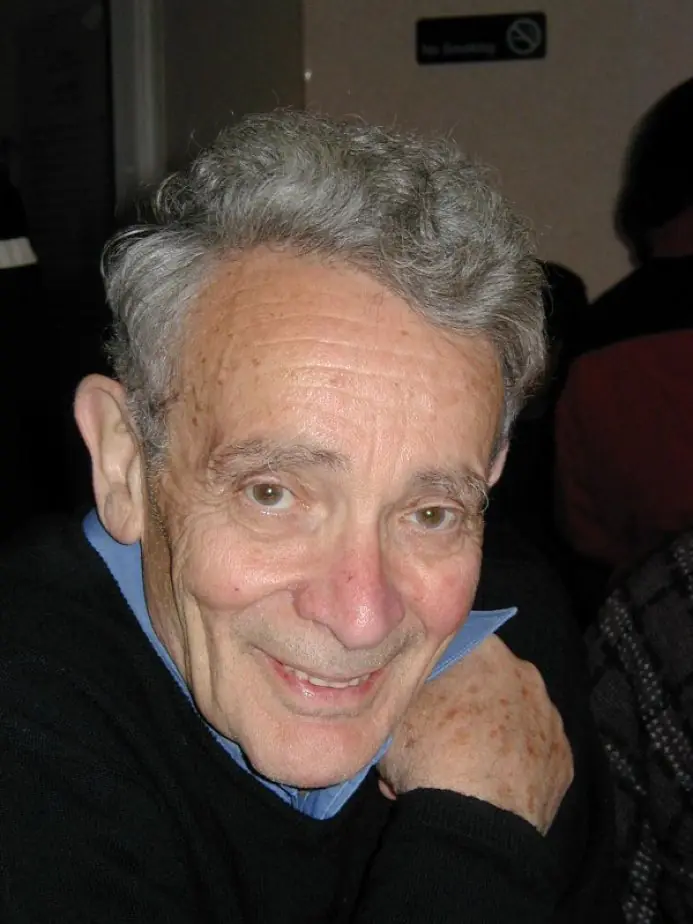
His scientific subject was seismology: the study of the waves that travel through the earth when it moves. That sounds like a narrow, academic speciality — and the essay begins by admitting that the young Keilis-Borok thought of it in exactly that way, as a beautiful mathematical puzzle with no connection to real life. His whole point is what happened next.
In 1960 he was called to Geneva as one of the technical experts advising the negotiations on banning nuclear weapon tests. The scientists' work there fed directly into the treaty process, and this experience shaped everything he believed afterwards about what science is for. He remained convinced, for the rest of his life, that the international community of scientists is one of the few forces holding the world together.
Seismology is the branch of science that studies earthquakes and the waves they send through the earth. A seismic wave is the vibration that travels outwards from the place where the ground breaks or where an explosion goes off. A seismograph is the instrument that records those vibrations as a wiggly line called a seismogram. Reading a seismogram is how a scientist in Moscow can tell that something happened under the ground in Nevada.
Frank Press (1924–2020) was the American geophysicist who quoted Keilis-Borok's work while arguing with the Moscow experts in Geneva — which is how Keilis-Borok found himself summoned there. He later became science adviser to President Carter and President of the US National Academy of Sciences. The second epigraph in the essay — "An instant understanding, the efficiency of thought and action, and a good feeling that comes when the like-minded people work together" — is quoted from him, and it describes exactly the experience the Geneva story goes on to narrate.
17.2 The context: the Cold War and the test ban
After the Second World War the United States and the Soviet Union, with their allies, were locked in a long hostility called the Cold War — "cold" because the two sides never fought each other directly, but armed, spied and threatened without stopping. The boundary between the communist bloc and the West was known as the Iron Curtain. Both sides built and tested nuclear weapons, each test producing a better bomb than the last.
The essay explains the logic of that period with painful clarity. Each superpower had more than enough bombs to destroy the other in a first strike — but the rockets took about twenty minutes to arrive, which was long enough for the victim to launch its own missiles before they landed. So neither side could attack without also dying. This doctrine was called Mutually Assured Destruction, and its acronym, as the author notes with grim satisfaction, is MAD. That single "thin thread" was all that protected the human race.
Because every new test upset the balance further, the three nuclear powers of the time — the Soviet Union, the United States and the United Kingdom — were willing to consider a ban on testing. But a treaty is only worth signing if cheating can be detected, and that is where the scientists came in.
17.3 The essay, step by step
The opening question: "If you are so clever, why are you so poor?"
The essay begins with a popular taunt used as an epigraph, and then turns it into a serious question: why does anybody become a scientist when businessmen, lawyers and doctors earn far more? The author answers by way of Leo Tolstoy, who wrote that a writer is not simply someone who writes but someone who cannot live without writing. The same, Keilis-Borok says, is true of a scientist.
Then comes the list of what a scientist receives in place of money:
- freedom, camaraderie, independence;
- honours and promotions that depend on yourself more than in other occupations;
- and "the overwhelming feeling of uncovering yet another one of nature's mysteries".
Above all, science is "an exciting adventure where major reward comes from the discovery itself." The reward is internal. That claim has to be taken on trust at this stage of the essay — and the rest of the essay is the evidence for it.
1960: the summons
The narrative begins flatly: "It was 1960, the height of the cold war." He is in Moscow, working on the theory of seismic waves, absorbed in the mathematics, giving no thought at all to how it might connect with real life. Note how carefully he establishes his own innocence here; the point of the story depends on it.
Then the summons comes from the President of the Soviet Academy of Sciences, with a message from the Palace of Nations in Geneva, where technical experts of the three nuclear powers were meeting behind closed doors. The letter reveals that an American scientist, Frank Press, had quoted Keilis-Borok's work while arguing with the Moscow experts. The understatement that follows is the best sentence in the essay: "And, to my great surprise, I found myself in Geneva."
The problem, stated formally
The author sets out the difficulty like a mathematician, in two suppositions and a question. Suppose the nuclear powers sign an agreement to stop testing; and suppose one of them breaks it and secretly explodes a bomb underground. How can the others detect the violation?
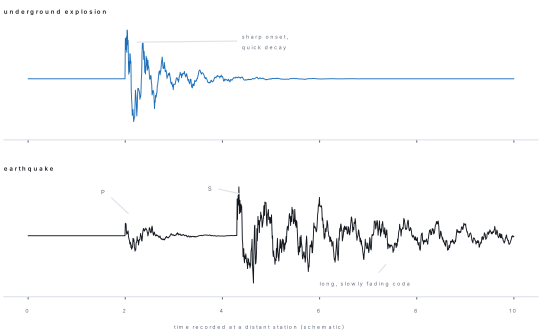
The connection to his own field was direct. An underground nuclear explosion makes the earth tremble in much the same way an earthquake does, and both are recorded as wiggles on a seismogram thousands of kilometres away. So the treaty depended on a single technical question: can you tell the two apart? "Suddenly," he writes, "my theoretical knowledge had a direct application in the area of survival of the humankind."
What the scientists had in common
This is the moral centre of the essay. In an atmosphere of political tension, with the two blocs hostile to each other, experts from opposite sides of the Iron Curtain had to find a solution that "outwardly seemed impossible, given all our differences in cultural background."
What saved them, he says, was a clear and obvious distinction: they were all scientists. They could construct a common language, and he names its three grammatical rules:
- respect for hard evidence;
- undisputable ranking by expertise only — not by rank, nationality or politics;
- persistent self-criticism.
Those three habits, he argues, are what make science international. Because of them the experts produced a solution, and the solution "eventually allowed politicians to reach one of the most important decisions of their times: nuclear test ban."
The episode taught him three lessons, and he lists them in rising order:
- that as a scientist he has people all over the world who think and interact as he does;
- that he need never feel lonely abroad;
- and, above all, "that while there is science, there is hope of survival and well-being for all of us."
Scientists are the most practical people in the world
Keilis-Borok now turns to a prejudice: the "common lore" that a person immersed in science has no practical sense. He concedes the joke — a very great mathematician of our time was sometimes so lost in a problem that he left home wearing shoes from two different pairs — and then reverses it completely.
All new technologies and all new branches of industry, from defence to entertainment, grow out of fundamental research. His examples from the past are antibiotics, electronics, biotechnology, synthetic fibres, the green revolution and genetic forensic diagnosis. His examples of what only basic research can still deliver are new sources of energy, new mineral deposits, efficient defence against terrorism, a cure for cancer and new forms of transport. And he adds a practical note aimed straight at a student: people trained in theoretical physics are head-hunted by financial institutions, and those trained at the frontiers of biology become founders and directors of pharmaceutical companies. "So, knowledge of basic science will give you a head start in whatever career you choose."
The dangers, and where the hope lies
The final movement widens from one man's career to the survival of civilisation. The threats he lists are both natural and man-made: earthquakes, the self-inflicted destruction of megacities, environmental catastrophes, and economic and social crises. A single modern disaster — a massive release of radioactivity from a nuclear waste dump, an earthquake in the middle of a megalopolis, an outburst of mass violence — can cause up to a million casualties, make a large part of the world uninhabitable, trigger a global depression, or set off a war in a "hot" region. And these dangers keep growing although trillions of dollars a year are spent to contain them.
Then the key sentence of the argument: the hope and the responsibility for breaking the stalemate rest "not on the money but on intellectual resources" — even though money is the more popular of the two, as the French proverb says: "Nobody is satisfied with his wealth, everybody is satisfied with his wisdom." Only basic research can create a springboard for a new disaster-preparedness industry.
The ending, and its qualification
After a third epigraph from McGeorge Bundy — "Ours is the time of contest over issues not completely understood" — the essay states its title as a proposition: scientific research is "an exciting venture into the great unknown and the token of humankind's survival", and it is the scientists with their tools who are up to the challenge.
But Keilis-Borok refuses to end on a boast. His last paragraph is a deliberate step backwards: "science is not the beginning and the end." More important for humankind, and for each individual, are the human qualities. Science is their servant: "if humanly used, science is their indispensable guardian and caretaker." The two conditions in that sentence — if humanly used — carry the whole weight of the ending, and they are what separate this essay from simple propaganda for science.
17.4 The argument in summary
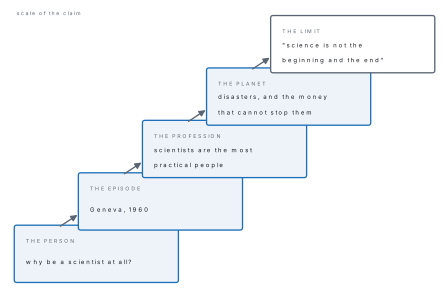
Reduced to its bones, the essay makes four connected claims.
- Science pays in a different currency. Freedom, camaraderie, independence, self-earned advancement, and the pleasure of discovery are the scientist's real wages.
- Science is a universal language. Because it ranks people by expertise alone, respects only hard evidence and criticises itself relentlessly, it allows people who are politically enemies to work together honestly.
- Science is the most practical thing there is. Every industry and every technology begins in fundamental research, however useless that research looks at the time. Keilis-Borok's own seismic theory is the proof: pure mathematics one year, an instrument of world peace the next.
- Science is therefore a condition of survival. Our dangers are now so large that money alone cannot contain them; only intellectual resources can. But science must be humanly used, because human qualities matter more than science itself.
17.5 Themes
Science as a form of international brotherhood. The Geneva story is chosen precisely because the political conditions were as bad as they could be. If Soviet and American experts could build a common language in 1960, the claim is proved at its hardest case.
Pure research and its unexpected uses. The young man who "did not give much thought to how it connects with the real life" becomes the man whose work helps end atmospheric bomb testing. The essay is an argument against judging knowledge by its immediate usefulness.
Intellect against money. This opposition runs from the first line ("If you are so clever, why are you so poor?") to the last movement ("not on the money but on intellectual resources"). The essay begins by conceding that scientists are poor and ends by showing that wealth is the weaker of the two forces.
Survival. The word in the title is not decoration. Nuclear war, earthquakes in megacities, radioactive waste, environmental collapse, mass violence — the essay's list of what could destroy us is long, and its claim is that research is the only reliable defence.
Humility. The last paragraph withdraws just enough of the claim to make the rest believable. Science is a guardian and caretaker, not a master; both words describe a servant who protects.
17.6 Style and technique
Epigraphs. Three quotations are set like headings at the joints of the essay: the popular expression "If you are so clever, why are you so poor?", Frank Press's description of like-minded people working together, and McGeorge Bundy's "Ours is the time of contest over issues not completely understood." Each one opens the section that follows, states its subject in someone else's voice, and lends the author borrowed authority. The Tolstoy comparison works the same way. Together they also quietly demonstrate the essay's own thesis — that thinking is a shared, international activity.
Personal narrative as evidence. The middle of the essay is a story with a date, a place, a named character and a surprise. This is far more persuasive than assertion: instead of claiming that science serves humanity, the author shows one occasion on which it did, and he is careful to make himself an unwitting participant rather than a hero.
Understatement. "And, to my great surprise, I found myself in Geneva." The passive, almost accidental phrasing — as though he had simply looked up and found himself there — conveys astonishment far better than exclamation would, and keeps the scientist modest while the achievement grows.
Concession and reversal. Twice he grants his opponent's point before overturning it: scientists really are poorer than lawyers; scientists really can be absent-minded enough to wear odd shoes. Admitting the weaker case first makes the counter-argument look honest rather than defensive.
Cataloguing. Lists do much of the work — antibiotics, electronics, biotechnology, synthetic fibres, the green revolution, genetic forensics; energy, minerals, defence against terrorism, cancer, transport; earthquakes, megacities, environmental catastrophe, economic and social crisis. The sheer length of each list is the argument.
| Device | Example | What it does |
|---|---|---|
| Rhetorical question | "If you are so clever, why are you so poor?" | Opens with the reader's own objection instead of hiding from it |
| Epigraph / quotation | Tolstoy, Frank Press, McGeorge Bundy, the French proverb | Frames each section and shows thought as a shared enterprise |
| Analogy | a scientist is like Tolstoy's writer, who "cannot live without writing" | Redefines science as a compulsion, not a career choice |
| Anecdote | the 1960 summons to Geneva | Turns an abstract claim into verifiable experience |
| Understatement | "I found myself in Geneva" | Modesty that makes the astonishment more vivid |
| Acronym and irony | "Mutually Assured Destruction," with ominous acronym "MAD" | The abbreviation passes judgement on the policy |
| Concession | "It is true that on occasions a greatest mathematician… wearing shoes from two different pairs" | Disarms the reader before the reversal |
| Catalogue | "antibiotics, electronics, biotechnology, synthetic fibres…" | Accumulated proof that basic research pays |
| Metaphor | "springboard", "thin thread", "guardian and caretaker" | Compresses whole arguments into single images |
| Qualification | "science is not the beginning and the end… if humanly used" | Prevents the essay from becoming propaganda |
17.7 Glossary
| Word | Meaning |
|---|---|
| acronym | a word made from the first letters of a name, e.g. MAD |
| annihilation | complete destruction |
| camaraderie | close friendship and trust among people who work together |
| cold war | intense political, military and ideological conflict without open fighting |
| forensic | relating to scientific methods of investigating crime |
| head start | an advantage at the beginning of a competition or career |
| head-hunted | actively recruited for a job by another employer |
| indisputable | so clearly true that it cannot be argued with |
| Iron Curtain | the political boundary said to divide communist Eastern Europe from the West |
| lore | traditional belief or common talk about a subject |
| megalopolis | a very large city or continuous urban region |
| ominous | suggesting that something bad is going to happen |
| retaliation | a counter-attack; revenge |
| seismic waves | vibrations that travel through the earth after an earthquake or explosion |
| self-inflicted | caused by oneself |
| springboard | something that gives a strong start to an activity |
| stalemate | a deadlock; a situation in which no side can move forward |
| standoff | a situation in which two opposing sides balance each other; a standstill |
| summons | an order to come or appear |
| venture | a new activity that involves risk |
"Science is an exciting adventure where major reward comes from the discovery itself." — for the opening argument. "What saved us was a clear and obvious distinction. We were all scientists." — for the Geneva episode. "If humanly used, science is their indispensable guardian and caretaker." — for the ending. Learn these three and you can answer almost any question on the essay accurately.
Chapter summary
- The essay is by Vladimir Keilis-Borok (1921–2013), a Russian mathematical geophysicist of the Russian Academy of Sciences, later at UCLA, and founder and co-director of the earthquake-prediction programme at the ICTP in Trieste.
- It opens with the taunt "If you are so clever, why are you so poor?" and answers with Tolstoy: a scientist, like a writer, is someone who cannot live without the work. In place of money come freedom, camaraderie, independence, self-earned promotion and the joy of discovery.
- In 1960, at the height of the Cold War, the author was summoned from Moscow to Geneva because the American scientist Frank Press had quoted his work.
- The problem: if the powers ban nuclear tests and one of them cheats with a secret underground explosion, how can the others detect it? The answer lay in seismology — explosions and earthquakes shake the ground differently.
- Experts from both sides of the Iron Curtain succeeded because they were all scientists, sharing a language built on hard evidence, ranking by expertise alone, and persistent self-criticism. Their solution let politicians reach the nuclear test ban.
- The lesson: a scientist is never lonely abroad, and "while there is science, there is hope of survival and well-being for all of us."
- Scientists are the most practical people in the world: antibiotics, electronics, biotechnology, synthetic fibres, the green revolution and genetic forensics all came out of fundamental research, and basic science gives a head start in any career.
- Modern disasters — nuclear waste, an earthquake in a megacity, mass violence — could kill a million people, and trillions of dollars have not contained them. The hope rests "not on the money but on intellectual resources."
- The essay ends with a qualification: science is not the beginning and the end; human qualities matter more, and science, "if humanly used", is their indispensable guardian and caretaker.
Practice questions
Short answer questions (2 marks each)
- What does a scientist get instead of big money? [2]
- What was the problem that the nuclear powers had faced? [2]
- In which area did Keilis-Borok's theoretical knowledge have a direct application? [2]
- What was the important decision that the politicians were able to take as a result of the Geneva talks? [2]
- What are the natural and man-made disasters mentioned by the author? [2]
- The professional addressed as "you" in "If you are so clever, why are you so poor?" refers to a (i) lawyer (ii) doctor (iii) scientist (iv) businessman. Justify your choice. [2]
- The writer says, "I found myself in Geneva." What does it express? [2]
Model answers — short questions
1. Instead of a large income a scientist receives freedom, camaraderie and independence; honours and promotions that depend on his own ability far more than in other occupations; and, above all, "the overwhelming feeling of uncovering yet another one of nature's mysteries." As the essay puts it, science is an exciting adventure in which the major reward comes from the discovery itself — the satisfaction of the work is the payment.
2. The three nuclear powers — the Soviet Union, the United States and the United Kingdom — wanted to ban the testing of new nuclear weapons, but a ban is useless if it cannot be policed. Their problem was therefore one of verification: suppose the powers sign an agreement to stop testing, and suppose one of them breaks it by secretly setting off an underground nuclear explosion — how can the others detect the violation? Underground explosions shake the earth in much the same way earthquakes do, so the difficulty was telling the two apart.
3. In the survival of humankind — specifically, in the detection of secret underground nuclear tests. Keilis-Borok had been working in Moscow on the pure theory of seismic waves, with no thought of any practical use. Because an underground explosion produces tremors similar to those of an earthquake, his theory became the means of distinguishing a cheat's bomb from a natural event, and so made a verifiable test-ban treaty possible.
4. The nuclear test ban. The scientists at Geneva worked out a technical solution to the detection problem, and that solution, in the author's words, "eventually allowed politicians to reach one of the most important decisions of their times: nuclear test ban." The order of events matters: the experts met first, and the political decision followed from what they were able to show could be done.
5. The author names both kinds together as threats to the survival of civilisation: earthquakes (natural), and, as man-made ones, the self-inflicted destruction of megacities, environmental catastrophes, and economic and social crises. He then gives examples of what a single modern disaster could be — a massive release of radioactivity from a nuclear waste disposal site, an earthquake in the middle of a megalopolis, or an outburst of mass violence — any of which could cause up to a million casualties, make a large part of the world uninhabitable, or trigger a global depression or a war.
6. The answer is (iii) scientist. The sentence is the essay's opening epigraph and is immediately explained by the question that follows it: why do some of us still decide to become scientists, "despite the fact that businessmen, lawyers, and doctors enjoy a much higher income"? Lawyers, doctors and businessmen are therefore named as the rich professions and cannot be the "you" of the taunt. The person who is clever but poor is the scientist, and the whole essay is his reply.
7. It expresses surprise, suddenness and a pleasing sense of being carried along by events rather than directing them. The passive construction — he does not say "I went to Geneva" but "I found myself in Geneva" — makes it sound as though he looked up one day and was simply there. It also expresses the essay's larger theme in miniature: a man absorbed in abstract mathematics, with no thought of the real world, is suddenly lifted out of his study and set down in the middle of international politics, because his work turned out to matter.
Long answer questions (5 marks each)
- How does the essayist justify that scientific research is the token of humankind's survival? [5]
- Discuss and illustrate the writer's stand that scientists are the most practical people in the world. [5]
- What can be the purpose of the essayist in using quotations in the essay? Discuss with reference to at least three of them. [5]
- "While there is science, there is hope of survival and well-being for all of us." Explain this statement, and say whether you find science a blessing or a curse. [5]
Model answers — long questions
1. The word token in the title means a sign and a guarantee — something that both shows survival is possible and helps bring it about. Keilis-Borok justifies the claim in three stages.
First, by narrative proof. In 1960 the human race was protected from extinction by nothing better than the arithmetic of Mutually Assured Destruction — a "thin thread", as he calls it, since each superpower could destroy the other and each had twenty minutes in which to retaliate. The one way out was a treaty banning tests, and the treaty was impossible until somebody could tell a secret underground explosion from an earthquake. Seismology answered that question. Research done for pure mathematical pleasure therefore became a direct instrument of survival, and the test ban followed. This is not an argument but a case, and it is the strongest thing in the essay.
Second, by pointing to the community that science creates. The Geneva experts came from opposite sides of the Iron Curtain, with every cultural and political reason to distrust each other, and yet they succeeded, because "we were all scientists" and could build a common language out of respect for hard evidence, ranking by expertise alone, and persistent self-criticism. Science thus supplies the one channel of honest communication that survives when politics has broken down — and a species that can still talk to itself can still be saved. Hence his conclusion: "while there is science, there is hope of survival and well-being for all of us."
Third, by examining the present danger. The threats now are earthquakes in megacities, environmental catastrophe, nuclear waste, mass violence, economic collapse — each capable of a million casualties — and they keep growing although trillions of dollars a year are spent against them. Money, therefore, has already been tried and has failed; what remains is intellectual resource. "The hope and the responsibility for breaking the stalemate rest not on the money but on intellectual resources," and only basic research can create the springboard for a new disaster-preparedness industry.
Finally he guards the claim from overstatement. Science is "not the beginning and the end"; human qualities matter more, and science is only their guardian and caretaker — and only "if humanly used." The token is a promise, not a magic charm: it works if we do.
2. The writer takes up a familiar prejudice — the "common lore" that a person immersed in science has no practical sense — and turns it upside down.
He begins by granting the joke, which is a shrewd move. It is true, he says, that one of the greatest mathematicians of our time was sometimes so lost in a current problem that he left home wearing shoes from two different pairs. Having conceded the comic surface, he asks the reader to look carefully at the other side.
His first illustration is historical: all new technologies and all new branches of industry, from defence to entertainment, stem from fundamental research. He lists the past yield — antibiotics, electronics, biotechnology, synthetic fibres, the green revolution, genetic forensic diagnosis. Each of these began as abstract enquiry and now underlies an entire industry. Antibiotics were not invented by someone looking for a marketable product; electronics came out of the physics of the atom; genetic forensics came out of curiosity about DNA. Nothing could be more practical than the things that make everything else possible.
His second illustration is the future: only basic research can now give us new sources of energy, new mineral deposits, efficient defence against terrorism, a cure for cancer and new forms of transportation. These are exactly the problems the practical world most wants solved, and none of them has a shortcut.
His third illustration is personal and economic, and it is aimed at a student deciding what to study. People trained in theoretical physics are head-hunted by financial institutions; those trained at the frontiers of biology become founders and directors of pharmaceutical companies. "Knowledge of basic science will give you a head start in whatever career you choose."
The unstated illustration, of course, is the author's own story. A man doing mathematics on seismic waves with no thought of the real world turned out to hold the key to a nuclear test ban. Defining "practical" as producing real effects in the world, rather than as looking sensible, the scientist in odd shoes is the most practical person alive, because the work he does while apparently dreaming is what everyone else will be standing on in fifty years.
3. The essay is unusually full of other people's words. There are four that matter: the popular expression "If you are so clever, why are you so poor?"; Tolstoy on the writer who cannot live without writing; Frank Press on the good feeling of like-minded people working together; the French proverb "Nobody is satisfied with his wealth, everybody is satisfied with his wisdom"; and McGeorge Bundy's "Ours is the time of contest over issues not completely understood." They serve several purposes at once.
They organise the essay. Three of them are printed as epigraphs at the joints of the text, each announcing the section it stands before. The popular expression introduces the defence of a poorly paid profession; the Press quotation introduces the Geneva story about collaboration; the Bundy quotation introduces the closing movement about dangers we do not yet understand. They work as signposts in an essay that has no other headings.
They let the author voice the objection without owning it. Beginning with a taunt aimed at himself is disarming: the reader's own scepticism has been spoken aloud, so it no longer has to be defended, and the author can proceed to answer it.
They borrow authority. A geophysicist arguing that scientists are admirable is an interested party. Tolstoy speaking about vocation, an American presidential adviser speaking about uncertainty, and a leading American geophysicist speaking about the pleasures of teamwork are all witnesses from outside the case. The Press quotation is especially well chosen: Press is an American, which makes him the ideal witness for a claim about cooperation across the Iron Curtain.
They give compression and memorability. The French proverb makes the point about money and wisdom in one line that would otherwise need a paragraph, and its irony — everyone thinks himself wise enough and no one thinks himself rich enough — carries the argument further than plain statement could.
And they enact the thesis. The essay claims that thinking is a shared, international, cross-generational activity; a text built out of a Russian novelist, an American scientist, an American statesman and an anonymous French proverb is a small demonstration of that claim.
4. (Explanation followed by a short argued essay.)
Explanation. The sentence is the third and greatest of the lessons Keilis-Borok drew from Geneva. He means that science is a permanent, functioning channel of honest cooperation between human beings, which stays open even when every other channel has closed. In 1960 politics had failed: the two blocs could not trust each other and the world was held together by the threat of mutual extinction. Yet the scientists in that closed room could still work together, because their profession runs on evidence rather than loyalty, ranks people by expertise rather than nationality, and criticises itself without mercy. That shared discipline produced a technical answer, and the answer let the politicians sign. So long as such a community exists, he is saying, there is always somewhere for a solution to come from — not only for war, but for disease, hunger, energy and disaster. "Well-being" matters as much as "survival" in his sentence: science is not merely what saves us from catastrophe but what makes a decent life possible.
Is science a blessing or a curse? The honest answer is that science is neither; it is power, and power takes its character from the hands that hold it. The same understanding of the atomic nucleus produced the bomb that threatened the world in 1960 and the medical isotopes that treat cancer today. The same chemistry gave us fertilisers that feed billions and the pollution that poisons our rivers. The same networks that spread knowledge instantly to a student in Nepal spread lies just as fast.
But the balance, on the evidence, is strongly positive. Science has roughly doubled human life expectancy in a century; it has ended smallpox; it has fed a population that older methods could not have fed; it warns us of earthquakes and storms; it gives an ordinary student access to a library that no king once possessed. Against this, its harms — nuclear weapons, environmental damage, surveillance — are real, but each is a harm of use, not of knowledge. Knowing how the nucleus works does not oblige anyone to build a bomb, and, as Keilis-Borok's own story shows, the same knowledge that made the bomb detectable made the ban on testing possible.
That is exactly why the essay ends as it does. Science is "not the beginning and the end"; human qualities matter more, and science, "if humanly used", is their indispensable guardian and caretaker. A blessing or a curse is therefore the wrong question. The right question is who is using it, and for what — and that is a question about honesty, courage and conscience, not about laboratories.
Reference to the context
- "What saved us was a clear and obvious distinction. We were all scientists. We were able to work out a common language, based on respect to hard evidence, undisputable ranking by expertise only, and persistent self-criticism."(a) Who are "we", and where are they?(b) What had to be "saved", and from what?(c) Explain each of the three foundations of the common language.(d) What did this common language finally make possible? [5]
- Are the following statements true, and why? (i) Money is more powerful than intellectual resources. (ii) Intellectual resources help the survival of humankind. (iii) Basic research is a way of stalling disasters. [5]
Model answers — reference to the context
1. (a) "We" are the technical experts of the three nuclear powers of the time — the Soviet Union, the United States and the United Kingdom — meeting behind closed doors at the Palace of Nations in Geneva in 1960, with the author among them as a Soviet specialist in seismic waves. (b) What had to be saved was, in the first place, the negotiation itself. The experts came from opposite sides of the Iron Curtain, and the political tension of the Cold War hung over their heads; agreement "outwardly seemed impossible, given all our differences in cultural background." Beyond that, what was at stake was the test-ban treaty, and beyond that the human race, since at the time every man, woman and child lived under the threat of annihilation. (c) Respect for hard evidence means that a claim is settled by measurement and not by who makes it, so a Soviet seismogram and an American one can be laid side by side and argued about honestly. Undisputable ranking by expertise only means that authority in the room came from what a person knew, not from rank, nationality or political backing — which is precisely what allowed enemies to defer to each other without humiliation. Persistent self-criticism means that each side was in the habit of attacking its own conclusions before anyone else could, so no one had to defend a weak position out of pride. Taken together the three make a professional culture in which people can be opponents politically and colleagues intellectually at the same time. (d) It made a technical solution possible — a method of distinguishing an underground nuclear explosion from an earthquake — and that solution "eventually allowed politicians to reach one of the most important decisions of their times: nuclear test ban." It also taught the author personally that he had like-minded people all over the world and need never feel lonely abroad.
2. (i) Not true, according to the essay — though the author admits money is the more popular belief. He states plainly that "the hope and the responsibility for breaking the stalemate rest not on the money but on intellectual resources." His evidence is that trillions of dollars a year are already being spent to contain modern disasters by all known techniques, and the dangers keep growing. Money can only buy more of what already exists; when what exists is not enough, only new knowledge can help. He quotes the French proverb — "Nobody is satisfied with his wealth, everybody is satisfied with his wisdom" — to explain why people nevertheless go on believing in money: we always feel short of wealth and never short of wisdom, which is exactly the wrong way round.
(ii) True. This is the essay's central claim and the meaning of its title. Intellect saved the world in 1960, when a piece of pure seismic theory made a nuclear test ban verifiable and therefore signable. Intellect is also the source of everything that has improved human life — antibiotics, electronics, the green revolution — and it is the only resource capable of answering the dangers that now threaten civilisation. Hence: "while there is science, there is hope of survival and well-being for all of us." The author adds one condition, which should be included in a full answer: intellect must be humanly used, since "science is not the beginning and the end" and human qualities matter more.
(iii) True, with a precise meaning of "stalling". To stall a disaster is to hold it off, and that is exactly what basic research does, in two ways. It supplies the means of prediction and detection — the author's own field, earthquake prediction, exists for that reason, and the detection of secret nuclear tests stalled an arms race. And it supplies the means of preparation: "only the basic research can create a springboard for developing new disaster preparedness industry." What it does not do is abolish danger. Earthquakes will still happen; research only decides whether they kill a million people or a hundred. The claim is therefore modest and defensible — research buys us time and warning, which is all that can honestly be promised.
Practise more: English question bank