Unit 12 · Literature - Poems · 20 min read
The Gift in Wartime
What the syllabus asks for 6
- About the poet
- Summary
- Themes
- Form, structure and rhyme
- Poetic devices
- Glossary
A woman stands at a soldier's grave and does what people do at graves: she brings gifts. Then she sets out, item by item, what she has given him and what he has given her in return. The word "gift" is used for both lists, and the whole force of the poem lies in that one word being made to cover roses on one side and blood on the other.
The poem is built on an exchange of gifts between a living woman and her dead soldier. Learn the two lists and learn to explain the irony of calling the second list gifts. Know that the speaker is a widow, the setting is the Vietnam War, the form is free verse, and the poem reaches us in translation.
12.1 About the poet
Tran Mong Tu (Trần Mộng Tú) was born in 1943 in northern Vietnam. After the country was divided in 1954 her family moved to the South, and as a young woman she worked in Saigon for the Associated Press news agency. When Saigon fell in April 1975 at the end of the Vietnam War she left the country and settled in the United States, where she has lived ever since, mainly in Washington State.
She is one of the best-known women poets of the Vietnamese diaspora — the community of Vietnamese people scattered across the world by the war. She writes in Vietnamese, chiefly poetry and short prose, and her work has appeared in Vietnamese-language collections and in English-language anthologies of Vietnamese and Vietnamese-American writing. Her constant subjects are war, exile, memory and the losses carried by women.
"The Gift in Wartime" is her best-known poem in English. It was written in Vietnamese and is read here in translation, which is an important fact for any question on its form: whatever sound-patterns the original had cannot survive the crossing into English, and what does survive is the poem's structure and its images.
The Vietnam War (roughly 1955–1975) was fought between communist North Vietnam and the American-backed South. It killed well over a million Vietnamese people, most of them civilians, and left the country divided for twenty years. Tran Mong Tu's poem was written from inside that war, not looking back at it from safety.
12.2 Summary
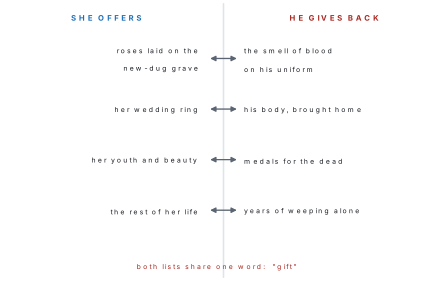
The poem is a dramatic monologue in free verse, spoken by a young widow standing at the grave of the soldier she loved. It is arranged as a series of short stanzas built on one repeated pattern: I offer you this — you give me that. The poem therefore reads like a list of accounts being settled, and it moves in three stages.
Movement 1 — what she offers
She begins with the gifts of the living. She brings roses and lays them on the newly dug grave, and she offers the wedding ring that bound her to him. These are the ordinary objects of love and marriage, and she is giving them to someone who can no longer receive anything. To them she adds herself: her youth, her beauty, her love, and all the years of her life that she will now spend alone. The tone in this movement is tender and formal, like a ritual being performed properly.
Movement 2 — what he gives in return
The pattern then turns over, and the same courteous verb is used for gifts of a very different kind. What the soldier gives her is what war gives: the smell of blood from his uniform, his body brought back from the field, the medals and official honours that are handed to the families of the dead, and the loneliness she must now carry. Every "gift" in this list is an injury dressed in polite language. The speaker never raises her voice — she simply goes on using the word "gift", and lets the reader hear how wrong it sounds.
Movement 3 — the last exchange and the bitter peace
In the closing movement the exchange is completed and the speaker reaches her hardest thought. The dead man is at rest; he has finished with the war, and the earth holds him quietly. She is the one still alive, and being alive is now the harder condition: she must go on counting the days, wearing her grief, and living out a marriage that has nothing left in it but memory. The poem ends without comfort and without anger. The last gift the war has given her is the rest of her life.
12.3 Themes
The cruelty and waste of war. The poem makes no speech against war. It simply sets out what one family received from it, and the list does the arguing.
Love that outlasts death. She is still giving him presents. The marriage continues on one side only, which is both moving and unbearable.
The cost paid by those who survive. The soldier's suffering has ended; hers has only begun. The poem's quietest and sharpest idea is that the living are worse off than the dead.
Women and war. The speaker is a woman at a grave, not a soldier in a field. The poem insists that war's real, long casualty list is made of widows, mothers and children who were never counted as combatants.
Irony as protest. The word "gift" belongs to birthdays and weddings. Forcing it to carry blood, corpses and medals is the poem's central act of protest.
Memory and ritual. Roses, a ring, a grave, honours — the poem is full of ceremonies that are supposed to give meaning to a death and visibly fail to.
The emptiness of official honour. Medals and decorations are handed over as though they balanced the account. In the poem's arithmetic they are worth nothing at all.
12.4 Form, structure and rhyme
Form. The poem is in free verse — short lines of unequal length, no fixed metre, and no rhyme. That is partly a choice and partly a fact of translation: a poem carried from Vietnamese into English loses its original sound-pattern entirely, so what an English reader can study is the structure, the images and the tone.
Rhyme scheme. There is none. Do not attempt to write out an ABAB pattern for this poem; the correct answer in an examination is "free verse, unrhymed", with a sentence explaining that the poem is a translation and that its music comes from repetition rather than rhyme.
Metre. Also none. Free verse has no feet to count, so no line can be scanned into iambs the way Burns's or Shakespeare's can. Instead the poem builds its rhythm out of parallel syntax: the same grammatical shape — I offer you …, you give me … — returning stanza after stanza, like a response chanted in a ceremony. Read aloud, the poem sounds like a ritual precisely because of this repetition.
Structure. The organising shape is an exchange, or a set of accounts. Each stanza places a gift from her against a gift from him. Because the two columns are kept in the same polite language, the reader is forced to compare them, and the comparison is the poem's whole argument. The structure also produces the final turn: once everything has been exchanged, the only thing left to weigh is her own survival.
Tone. Controlled, formal, almost gentle throughout. There is no shouting and no direct accusation. A raised voice would have let the reader off; the calm makes the content unbearable.
What the form does for the meaning. War destroys order, so the poem imposes order: a neat repeating pattern, two matching lists, a quiet voice. The gap between the tidy form and the terrible contents is the poem's meaning.
12.5 Poetic devices
Because the poem is modern and in copyright, the table names the images rather than reprinting the lines.
| Device | Where it appears | Effect |
|---|---|---|
| Irony | the word "gift" used for blood, a corpse and medals | The politeness of the word exposes the horror of the thing; this is the poem's central device |
| Apostrophe | the whole poem is addressed to a dead man as "you" | Makes the reader an eavesdropper at a private grave-side conversation |
| Anaphora / parallelism | the repeated I offer you … you give me … pattern | Gives the poem the rhythm of a ritual and forces the two lists to be compared |
| Symbolism | the roses | Love, beauty and mourning — and, because cut flowers die, the shortness of what she had |
| Symbolism | the wedding ring | A circle that was meant to be unending, handed back to the earth |
| Symbolism | the medals | Official honour offered in place of a life; the poem treats them as worthless |
| Imagery (of the senses) | the smell of blood on the uniform | The most physical detail in the poem; it makes war something you can smell, not read about |
| Metaphor | love and grief described as things that can be handed over | Turns feelings into objects, so that they can be counted and set against one another |
| Personification | war as a giver of presents | The war is made into a person who arrives with gifts, which is the poem's bitterest joke |
| Hyperbole | the whole of her remaining life offered as a single gift | The scale of the offering shows the scale of the loss |
| Juxtaposition | the wedding ring beside the blood | Two images from the two extremes of a life, set side by side without comment |
| Alliteration | the soft repeated consonants of the English version | Keeps the voice quiet and steady; nothing in the sound raises its voice |
| Enjambment | the short lines running on into one another | The speaker's thought cannot be stopped at the line-ends any more than her grief can |
| Understatement | the flat, unemotional listing of terrible things | Restraint that is far more powerful than protest would be |
12.6 Glossary
| Word | Meaning |
|---|---|
| wartime | the period during which a war is being fought |
| offer | to present something to someone as a gift |
| grave | the hole in the ground in which a dead body is buried |
| wedding ring | the ring exchanged at marriage, a symbol of a bond meant to last |
| widow | a woman whose husband has died |
| mourning | grief for someone who has died, and the customs that go with it |
| shroud | the cloth in which a dead body is wrapped for burial |
| medal | a metal decoration given as an official honour, often to soldiers |
| casualty | a person killed or injured in a war or accident |
| diaspora | a people scattered from their homeland and living abroad |
| exile | forced absence from one's own country |
| irony | a gap between what the words say and what is really the case |
| understatement | saying less than the situation deserves, so that the reader supplies the rest |
| anaphora | the repetition of the same words at the beginnings of successive lines |
| parallelism | the repeating of the same grammatical structure for effect |
| apostrophe | direct address to someone absent or dead, or to a thing |
| free verse | verse with no fixed metre and no rhyme |
| translation | the carrying of a text from one language into another |
| monologue | an extended speech by one person |
| futility | complete uselessness; the quality of achieving nothing |
Chapter summary
- "The Gift in Wartime" by Tran Mong Tu (b. 1943, Vietnam; in the United States since 1975) is spoken by a young widow at the grave of her soldier.
- It is built as an exchange of gifts: she offers roses, her wedding ring, her youth and the rest of her life; he gives back the smell of blood, his body, official medals, and a lifetime of mourning.
- The central device is irony — the word "gift" is made to cover both lists — supported by anaphora, symbolism and understatement.
- Form: free verse, no metre, no rhyme scheme, read in English translation; the rhythm comes from parallel syntax, not from feet or rhyme.
- Themes: the waste of war, the cost paid by survivors (especially women), love continuing after death, the emptiness of official honour, and protest by irony rather than by argument.
- The poem's hardest idea is that the dead soldier is at peace while the living widow is not: survival is the heavier burden.
Practice questions
Short answer questions (2 marks each)
- Who is the speaker of "The Gift in Wartime" and whom does she address? [2]
- What gifts does the speaker offer? [2]
- What does she receive in return? [2]
- Why is the title ironic? [2]
- What do the roses and the wedding ring symbolise? [2]
- Comment on the tone of the poem. [2]
- What is the rhyme scheme of the poem, and why? [2]
Model answers — short questions
1. The speaker is a young Vietnamese widow standing at the grave of the soldier she loved. She addresses him directly as "you", although he is dead and cannot answer. The poem is therefore a one-sided conversation, which is part of its sadness.
2. She offers roses, which she lays on his newly dug grave, and her wedding ring. Beyond these objects she offers herself — her youth, her beauty, her love, and all the years of the life she must now live without him.
3. She receives the things war hands out: the smell of blood from his uniform, his dead body returned from the field, the medals and official honours given to the families of the dead, and a lifetime of loneliness and mourning.
4. Because a "gift" is something freely given that the receiver wants, and nothing in the second list is wanted by anybody. Calling blood, a corpse and a medal "gifts" uses the language of love and celebration for the products of killing, and the mismatch is the poem's protest against war.
5. The roses stand for love, beauty and mourning, and — because cut flowers die quickly — for how briefly the couple's happiness lasted. The wedding ring is a circle, a symbol of a bond meant to have no end, and it is now being handed over to a grave.
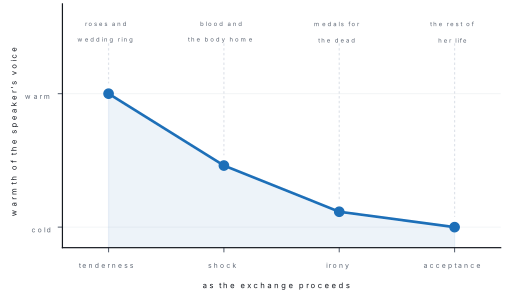
6. The tone is quiet, formal and controlled — tender at first, then bitterly ironic, and finally flat and resigned. The speaker never shouts and never accuses anyone by name. That restraint is deliberate: an angry poem could be argued with, while this calm listing of facts cannot.
7. There is no rhyme scheme: the poem is free verse. Two reasons should be given. First, free verse suits a speaking, grieving voice better than a fixed pattern would. Second, the poem is a translation from Vietnamese, and the sound-patterns of the original cannot cross into English; what survives is the structure and the imagery.
Long answer questions (5 marks each)
- Discuss the use of irony in "The Gift in Wartime". [5]
- "The poem shows that war's worst injuries are done to those who survive it." Discuss with reference to the poem. [5]
- Examine the structure and tone of the poem and show how they carry its meaning. [5]
Model answers — long questions
1. Irony means a gap between what is said and what is actually the case, and this poem is built on one enormous example of it. The word "gift" belongs to weddings, birthdays and festivals; it implies choice, affection and pleasure. Tran Mong Tu takes that word and makes it carry the entire traffic of a war. On one side of the exchange it behaves normally: roses for a grave, a wedding ring, a young woman's love. On the other side the same word is attached to the smell of blood on a uniform, a body brought home from the field, and a medal handed to a widow in place of her husband. Nothing in that second list was chosen, wanted or given out of love, yet the speaker keeps her courteous vocabulary throughout. The effect is far stronger than protest would be. If she called the war murderous, a reader could agree or disagree; because she calls its products "gifts", the reader has to do the arithmetic and arrive at the anger themselves. A second irony closes the poem: the medals, which the state offers as honour and compensation, are shown to be worth nothing beside the life that bought them. The poem never says so directly. It simply places them in the same list as the blood.
2. The poem quietly reverses the usual view that the dead soldier is war's chief victim. He has suffered and died, but his suffering is finished; the earth holds him and he is at rest. The woman at the graveside is the one with a future, and the poem shows exactly what that future contains. She has already given away everything that made her happy — her youth, her beauty, her wedding ring, her love — and received in exchange the smell of blood, a corpse, a decoration and an unending routine of mourning. Her marriage continues, but on one side only: she goes on bringing presents to a man who cannot receive them. The final movement makes the reversal explicit by weighing her survival against his rest and finding survival heavier. This is why the poem is spoken by a woman and set at a grave rather than on a battlefield. Battlefield poems count the dead; this poem counts what the dead leave behind, and finds that the real casualty list — widows, mothers, children — is far longer than the official one and is never published. The soldier's war ended on a particular day. Hers has no end in the poem at all.
3. The poem is written in free verse: short lines, no metre, no rhyme, and a translation's plain English vocabulary. Into that loose form the poet puts a very tight structure. Each stanza sets one of her gifts against one of his, using the same repeated grammatical shape — I offer you …, you give me …. This anaphora does three things. It gives the poem the steady rhythm of a ritual, which suits a grave-side. It forces the reader to compare the two columns, since they arrive in identical packaging. And it builds an expectation that the final movement can break, when the last thing left to weigh turns out to be her own survival. The tone is the poem's other great instrument. It begins tender and formal, as a widow performing the proper ceremonies; it passes through irony as the second list accumulates; and it settles into a flat, exhausted acceptance at the end. At no point does it rise. The restraint is a deliberate strategy: understatement leaves the reader to supply the outrage, and an outrage the reader has produced is far harder to dismiss than one delivered from the page. Structure, then, imposes a neat order on the poem, and that neatness is itself meaningful — it is the desperate tidiness of someone holding herself together at a funeral.
Reference to the context
- The speaker brings roses to lay on a newly dug grave and offers the wedding ring she has worn through her marriage.(a) Who is the speaker and where is she?(b) What do these two objects symbolise?(c) Why does she give presents to someone who cannot receive them? [5]
- In return for her gifts, the speaker says, she has been given the smell of blood from his uniform, his body brought back from the field, and medals for the dead.(a) Who is the giver of these "gifts"?(b) Identify the figure of speech that governs the passage and explain it.(c) What comment does the passage make on official honours for the dead? [5]
Model answers — reference to the context
1. (a) The speaker is a young Vietnamese widow, and she is standing at the freshly made grave of the soldier she loved, during the Vietnam War. (b) The roses stand for love, beauty and mourning; because cut flowers wither within days, they also stand for how short her happiness was. The wedding ring is a circle with no beginning and no end, the symbol of a bond that was supposed to last a lifetime — and she is now returning it to the earth. (c) Because giving is all she has left of the marriage. Ceremony is how human beings hold on to the dead: bringing flowers, keeping anniversaries, speaking aloud at a grave. Her gifts are an act of continuing love, and at the same time the poem shows their futility, since nothing she offers can be received. The one-sidedness of the exchange is exactly what makes the passage painful.
2. (a) The giver is her dead husband — but behind him, and really, the giver is the war itself, which the poem treats as a person arriving with presents. (b) The governing figure is irony. A gift is something freely given that the receiver wants; nothing here is wanted by anyone. By keeping the polite word "gift" for blood, a corpse and a medal, the speaker makes the reader feel the distance between the language and the reality. The passage also uses juxtaposition — the wedding ring of the previous stanza set beside the smell of blood — and strong sensory imagery, since smell is the most physical and inescapable of the senses. (c) It reduces them to nothing. Medals are placed in the same list as the corpse and the blood, as though they were one more thing the war handed over, and no line is spent praising them. The implication is that official honour is a cheap substitute offered by the state in place of a life, and that it does not balance the account by even a little.
Practise more: English question bank