Unit 26 · Grammar · 16 min read
Reported Speech
What the syllabus asks for 8
- The reporting verb and the link word
- The complete backshift table
- Pronoun changes
- Changes of time and place
- Reporting statements
- Reporting questions
- Reporting commands, requests, advice and suggestions
- Reporting exclamations and wishes
Direct speech repeats a speaker's exact words inside quotation marks; reported (indirect) speech puts those words into your own sentence with no quotation marks. NEB Q7 sets one or two items every year, worded "Change into indirect speech" or "Report the following sentence". The change is completely mechanical: pick the right reporting verb, backshift the tense, change the pronouns, and change the words for time and place. Do those four things in that order and the item cannot go wrong.
1. Reporting verb and link. said / told / asked / ordered / requested / exclaimed, plus that, if/whether, a wh- word, or to + V1.
2. Tense. Shift the reported verb one step back into the past.
3. Pronouns. Change them to match the new speaker and listener.
4. Words of time and place. now → then, today → that day, here → there.
26.1 The reporting verb and the link word
| Kind of sentence | Reporting verb | Link | Verb form in the reported clause |
|---|---|---|---|
| Statement | said / said to / told | that | finite verb, backshifted |
| Wh- question | asked / enquired | the same wh- word | finite verb, statement order |
| Yes/no question | asked / enquired | if / whether | finite verb, statement order |
| Command, order | ordered / told / commanded | — | to + V1 |
| Negative command | told / ordered / forbade | — | not to + V1 |
| Request | requested / asked | — | to + V1 |
| Advice, suggestion | advised / suggested | — | to + V1 / that … should |
| Exclamation | exclaimed with joy / sorrow / wonder | that | finite verb, backshifted |
| Wish, prayer | wished / prayed | that | finite verb, backshifted |
said and told are not interchangeable. Told must be followed by a person; said must not be, unless you add to.
- He said that he was tired. ✔ He told me that he was tired. ✔
- He said to me that he was tired. ✔ ~~He told that he was tired.~~ ✘
- ~~He said me that he was tired.~~ ✘
When the reporting verb is in the present, present perfect or future (says, has said, will say), you make no tense change at all — only pronouns and, if needed, place words change.
He says, "I am busy." → He says that he is busy.
26.2 The complete backshift table
When the reporting verb is in the past (said, told, asked), every verb in the reported clause moves one step further back in time.
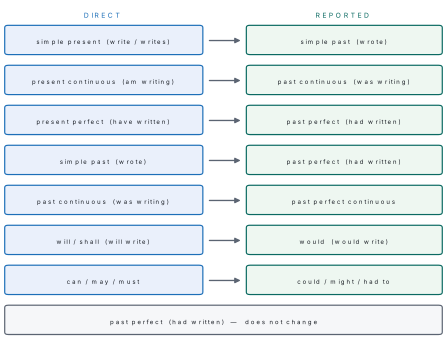
| Direct speech | Reported speech |
|---|---|
| simple present — works | simple past — worked |
| present continuous — is working | past continuous — was working |
| present perfect — has worked | past perfect — had worked |
| present perfect continuous — has been working | past perfect continuous — had been working |
| simple past — worked | past perfect — had worked |
| past continuous — was working | past perfect continuous — had been working |
| past perfect — had worked | past perfect — had worked (no change) |
| past perfect continuous — had been working | no change |
| will / shall | would |
| can | could |
| may | might |
| must (obligation) | had to / must |
| shall (offer) | should |
| should, would, could, might, ought to, used to, had better | no change |
1. A universal truth or a permanent fact. The teacher said, "The earth revolves round the sun." → The teacher said that the earth revolves round the sun.
2. A situation that is still true now. She said, "My brother lives in Dharan." → She said that her brother lives (or lived) in Dharan.
3. A past time clause with a stated past time. He said, "I was born in 2005." → He said that he was born in 2005.
4. Second and third conditionals, and wish clauses, which are already unreal. He said, "If I were rich, I would help them." → He said that if he were rich he would help them.
26.3 Pronoun changes
Pronouns change to keep the meaning from the reporter's point of view. The rule is easy to remember as SON: the Subject of the reporting verb governs the first person, the Object governs the second person, and the third person is Not changed.
| In direct speech | Becomes | Governed by |
|---|---|---|
| I, me, my, mine, myself | he/she, him/her, his/her, his/hers, himself/herself | the speaker |
| we, us, our, ours, ourselves | they, them, their, theirs, themselves | the speaker |
| you, your, yours, yourself | he/she/they, his/her/their…, himself… | the listener |
| he, she, it, they, his, her, its, their | no change | — |
- Ramesh said to Sita, "I will bring your book tomorrow." → Ramesh told Sita that he would bring her book the next day.
- They said, "We have finished our work." → They said that they had finished their work.
26.4 Changes of time and place
| Direct | Reported | Direct | Reported |
|---|---|---|---|
| now | then | today | that day |
| just now | at that moment | tonight | that night |
| ago | before | yesterday | the previous day / the day before |
| here | there | last night | the previous night |
| this | that | tomorrow | the next day / the following day |
| these | those | next week | the following week |
| hence | thence | last week | the previous week |
| thus | so | the day before yesterday | two days before |
| come | go | the day after tomorrow | in two days' time |
Change these words only when the change is needed. If you report a friend's words in the same place on the same day, here and today may stay as they are.
26.5 Reporting statements
Rule. reporting verb (said / told + person) + that + backshifted clause.
- "I am reading the newspaper," said my father. → My father said that he was reading the newspaper.
- Bina said to me, "I have lost my purse in the bus." → Bina told me that she had lost her purse in the bus.
- The guide said, "Annapurna is visible from Poon Hill." → The guide said that Annapurna is visible from Poon Hill. (still true)
That may be left out after say and tell in informal English, but write it in the exam.
26.6 Reporting questions
Two things happen in every reported question: the word order becomes statement order (subject before verb), and the question mark disappears. The helping verbs do, does, did are dropped and their tense goes onto the main verb.
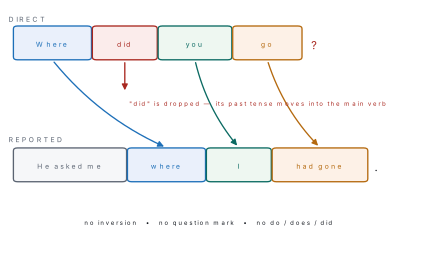
Wh- questions. reporting verb + asked + the same wh- word + statement order.
- "Where do you live?" he asked me. → He asked me where I lived.
- The officer said to her, "Why have you come so late?" → The officer asked her why she had come so late.
Yes/no questions. Use if or whether in place of a wh- word.
- "Have you finished your project?" the teacher asked. → The teacher asked whether I had finished my project.
- She said to him, "Will you come to the picnic?" → She asked him if he would come to the picnic.
Use whether (not if) before or not placed immediately after it, and before a to-infinitive: He asked whether or not I was coming.
26.7 Reporting commands, requests, advice and suggestions
Rule. The imperative becomes to + V1; the negative imperative becomes not to + V1. Choose the reporting verb to match the force of the original.
| Original | Reporting verb | Reported form |
|---|---|---|
| "Shut the gate." | ordered / told | He ordered the guard to shut the gate. |
| "Please help me." | requested | She requested me to help her. |
| "Don't touch the wires." | warned / told | He warned us not to touch the wires. |
| "You should rest." | advised | The doctor advised him to rest. |
| "Let's go to Nagarkot." | suggested / proposed | He suggested going to Nagarkot. / He suggested that we should go to Nagarkot. |
| "Let him come in." | requested / suggested | She suggested that he should be allowed in. |
| "Do come to my house." | invited | She invited me to come to her house. |
A please in the original disappears and becomes the reporting verb requested.
26.8 Reporting exclamations and wishes
Rule. Name the feeling in the reporting verb, then use that + a plain statement. The exclamation mark goes.
| Direct | Reported |
|---|---|
| He said, "What a beautiful sunrise!" | He exclaimed with wonder that it was a very beautiful sunrise. |
| She said, "Alas! I have failed." | She exclaimed with sorrow that she had failed. |
| They said, "Hurrah! We have won the match." | They exclaimed with joy that they had won the match. |
| He said, "Bravo! You have done well." | He applauded me, saying that I had done well. |
| She said, "May God bless you!" | She prayed that God might bless me. |
| He said, "Good morning, sir." | He greeted his teacher respectfully. |
| He said, "Thank you." | He thanked me. |
| She said, "Sorry." | She apologised. |
Note how What a …! and How …! are unpacked: what a beautiful sunrise becomes a very beautiful sunrise, and How cold it is! becomes that it was very cold.
The instruction is "Change into indirect speech" with a single sentence. Work in this order every time: (i) look at the punctuation inside the quotation marks — a question mark, an exclamation mark or a full stop tells you the sentence type; (ii) write the reporting verb and link for that type; (iii) backshift; (iv) fix the pronouns; (v) fix the time and place words. Then read your answer once and check there is no question mark and no quotation mark left.
Problem. Change into indirect speech: Ram said to his sister, "I am going to Kathmandu tomorrow to buy books for you."
Solution — the four changes.
- Reporting verb and link. It is a statement, and there is a listener, so said to → told, and the link is that.
- Tense. am going is present continuous, and the reporting verb said is past → backshift to past continuous: was going.
- Pronouns. I is the speaker Ram → he. you is the listener, his sister → her.
- Time words. tomorrow → the next day.
Answer. Ram told his sister that he was going to Kathmandu the next day to buy books for her.
Problem. Change into indirect speech: The conductor said to me, "Did you buy a ticket at the counter?"
Solution — step by step.
- Sentence type. The question mark and the auxiliary Did at the front make it a yes/no question → reporting verb asked, link if / whether.
- Word order. Reported questions use statement order, so you buy becomes I … buy with no inversion.
- Drop the auxiliary. Did disappears; its past tense goes onto the main verb, which then backshifts one further step: buy → bought → had bought.
- Pronouns. you is the listener, who is me → I.
- Remove the question mark.
Answer. The conductor asked me if (whether) I had bought a ticket at the counter.
Problem. Change into indirect speech: "Don't waste water, children!" said the teacher. "What a precious thing it is!"
Solution — step by step.
- First sentence is a negative command. Reporting verb told (or ordered); the imperative becomes not to + V1: not to waste.
- The addressee children becomes the object of the reporting verb: told the children.
- Second sentence is an exclamation. Reporting verb exclaimed, or better, added, exclaiming. Unpack What a precious thing into a very precious thing and add the link that.
- Backshift the exclamation clause. is → was.
Answer. The teacher told the children not to waste water and exclaimed that it was a very precious thing.
Chapter summary
- Four changes, in order: reporting verb and link → tense → pronouns → time and place words.
- Tell needs a person after it; say does not take one unless you add to.
- No backshift when the reporting verb is present or future, when the statement is a universal truth or still true, when a past time is stated, or in unreal conditionals and wish clauses.
- Backshift ladder: present → past; present perfect and simple past → past perfect; will → would; can → could; may → might; must → had to. Past perfect does not move.
- Statements take that; wh- questions keep the wh- word; yes/no questions take if/whether; commands and requests take to / not to + V1.
- Reported questions use statement word order, drop do/does/did, and lose the question mark.
- Exclamations are reported by naming the feeling: exclaimed with joy / sorrow / wonder that ….
- Pronouns follow SON: first person matches the Subject of the reporting verb, second person matches the Object, third person is Not changed.
Practice questions
Change the following into indirect speech (1 mark each)
- She said, "I am preparing for the NEB examination." [1]
- He said to me, "I saw your brother at Ratna Park yesterday." [1]
- The teacher said, "Water boils at 100 °C." [1]
- Mohan said to Gita, "I will help you with your project tomorrow." [1]
- My mother said, "I have already cooked the dinner." [1]
- "Where are you going?" the policeman asked the boy. [1]
- "Have you ever visited Lumbini?" she asked me. [1]
- The manager said to the clerk, "Bring the file at once." [1]
- "Please lend me your umbrella," said Sunita to her friend. [1]
- The doctor said to the patient, "Don't eat oily food." [1]
- He said, "Alas! I have missed the last bus." [1]
- "What a wonderful view of Machhapuchhre!" said the tourist. [1]
- He said to her, "May you pass with distinction!" [1]
- "Let's visit the Patan Museum," said Anil. [1]
Answers
1. She said that she was preparing for the NEB examination. — present continuous backshifts.
2. He told me that he had seen my brother at Ratna Park the previous day. — simple past → past perfect; your → my; yesterday → the previous day.
3. The teacher said that water boils at 100 °C. — a universal truth is not backshifted.
4. Mohan told Gita that he would help her with her project the next day. — will → would.
5. My mother said that she had already cooked the dinner. — present perfect → past perfect.
6. The policeman asked the boy where he was going. — wh- question, statement order.
7. She asked me if (whether) I had ever visited Lumbini. — yes/no question takes if/whether.
8. The manager ordered the clerk to bring the file at once. — command → to + V1.
9. Sunita requested her friend to lend her her umbrella. — please becomes requested.
10. The doctor advised the patient not to eat oily food. — negative command → not to + V1.
11. He exclaimed with sorrow that he had missed the last bus. — exclamation with Alas!.
12. The tourist exclaimed with wonder that it was a very wonderful view of Machhapuchhre. — What a …! is unpacked.
13. He prayed that she might pass with distinction. — a wish is reported with prayed that and might.
14. Anil suggested visiting the Patan Museum. (or suggested that they should visit …) — Let's is a suggestion.
Change the following into direct speech (1 mark each)
- He told me that he was feeling unwell that day. [1]
- She asked me whether I had finished my homework. [1]
- The guard ordered us not to park there. [1]
- The old man asked the boy where he lived. [1]
Answers
15. He said to me, "I am feeling unwell today." — reverse the backshift and the time word.
16. She said to me, "Have you finished your homework?" — whether signals a yes/no question.
17. He said to us, "Don't park here." — not to + V1 becomes a negative imperative; there → here.
18. The old man said to the boy, "Where do you live?" — the wh- question regains its inversion and do.
Correct the errors in the following sentences (1 mark each)
- He told that he would come on Sunday. [1]
- She said me that she was busy. [1]
- The teacher asked us where were we going. [1]
- He asked me that I had seen the film. [1]
- She asked me if did I need any help. [1]
- He ordered them do not make noise. [1]
- My friend said that he will meet me the next day. [1]
- She said that the sun rose in the east. [1]
Answers
19. He said that he would come on Sunday. (or He told me that …) — tell needs a person after it.
20. She said to me (or told me) that she was busy. — say takes to before a person.
21. The teacher asked us where we were going. — a reported question uses statement order.
22. He asked me if (whether) I had seen the film. — a yes/no question takes if, not that.
23. She asked me if I needed any help. — no did and no inversion in a reported question.
24. He ordered them not to make noise. — a negative command becomes not to + V1.
25. My friend said that he would meet me the next day. — will backshifts to would.
26. She said that the sun rises in the east. — a universal truth keeps the present tense.
Practise more: English question bank