Unit 22 · Grammar · 18 min read
Tenses: Present, Past and Future
What the syllabus asks for 6
- The twelve tenses at a glance
- The present tenses
- The past tenses
- The future tenses and other ways of talking about the future
- Signal words — the fastest way to spot the tense
- Worked transformations
Tense is how an English verb shows time; aspect is how it shows whether the action is finished, still going on, or both. Together they give twelve verb forms, and almost every NEB Q7 paper contains two or three tense items — usually a blank with the base verb in brackets (She ____ in Biratnagar since 2015. (live)) or a sentence to correct. The whole area is learnable because each tense has one fixed structure and a small set of signal words that give it away.
(1) When? past, present or future — that is the tense. (2) Is it in progress? if yes, use a continuous form (be + V-ing). (3) Is it completed before the time we are talking about? if yes, use a perfect form (have/has/had + V3). Answer the three and the form writes itself.
22.1 The twelve tenses at a glance
In the structures below, V1 is the base form, V2 the past form, V3 the
past participle and V-ing the present participle. s/es is added only for
third-person singular subjects (he, she, it, a singular noun).
| Tense | Structure | Example | Main use |
|---|---|---|---|
| Simple present | S + V1 (+ s/es) | Sita goes to college at nine. | habits, routines, general truths, timetables |
| Present continuous | S + am/is/are + V-ing | She is writing her assignment now. | happening now, temporary, fixed near-future plans |
| Present perfect | S + have/has + V3 | I have visited Lumbini twice. | past action with present result; unfinished time |
| Present perfect continuous | S + have/has been + V-ing | It has been raining since morning. | action started in the past and still going on |
| Simple past | S + V2 | We went to Chitwan last year. | a finished action at a finished past time |
| Past continuous | S + was/were + V-ing | He was cooking when I arrived. | an action in progress at a past moment |
| Past perfect | S + had + V3 | The bus had left before we reached. | the earlier of two past actions |
| Past perfect continuous | S + had been + V-ing | She had been waiting for two hours. | duration up to a point in the past |
| Simple future | S + will + V1 | I will call you tomorrow. | prediction, instant decision, promise |
| Future continuous | S + will be + V-ing | At 8 p.m. I will be studying. | in progress at a future moment |
| Future perfect | S + will have + V3 | By 2030 he will have retired. | finished before a future moment |
| Future perfect continuous | S + will have been + V-ing | By May she will have been teaching for ten years. | duration up to a future moment |
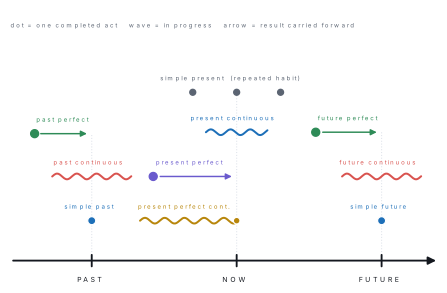
22.2 The present tenses
Simple present
Structure. Subject + V1; add -s/-es for he, she, it and singular nouns. Questions and negatives use do/does + V1.
Rules and uses.
- Habits and repeated actions. Ramesh catches the 7 a.m. bus to Kalanki every day. / We celebrate Dashain in Ashwin.
- General truths and permanent states. The Koshi flows into the Ganges. / Water boils at 100 °C.
- Timetables and scheduled future events. The flight to Simara leaves at 6.15 tomorrow.
- Commentary, instructions and narration of a story's plot. He passes the ball to Kiran, who shoots.
- In time clauses after when, if, before, after, as soon as, until — the future is expressed by the present. I will ring you as soon as the bus reaches Mugling.
The single commonest one-mark loss in Q7. He go to school is wrong; He goes to school is right. Check every present-tense verb in your answer whose subject is he, she, it, a name, or a singular noun. Also remember the -s is gone after does/doesn't: She doesn't go, never ~~doesn't goes~~.
Present continuous
Structure. am/is/are + V-ing.
- Happening at this moment. Look — it is snowing in Jomsom.
- Temporary situation around now. I am staying with my aunt in Lalitpur this month.
- A definite future arrangement. We are flying to Nepalgunj on Sunday.
- A changing situation. The population of Kathmandu is growing fast.
- With always, a complaint about repetition. He is always losing his pen.
Verbs of possession (have, own, belong, possess), thinking (know, believe, understand, remember, mean, agree), feeling (like, love, hate, want, prefer, need) and the senses (see, hear, smell, taste, seem, appear) describe states, not actions, and normally have no -ing form. ~~He is having a car~~ → He has a car. ~~I am agree with you~~ → I agree with you. (agree is a verb, not an adjective) ~~I am knowing the answer~~ → I know the answer. ~~She is wanting a new phone~~ → She wants a new phone. Have can be continuous when it means an activity, not possession: We are having dinner / He is having a bath are both correct.
Present perfect
Structure. have/has + V3.
- A past action whose result matters now. I have lost my citizenship certificate. (so I do not have it now)
- Experience at an unstated time. She has climbed Kala Patthar.
- An action in a period of time that is not yet over — today, this week, this year. We have had three tests this month.
- With just, already, yet, ever, never, so far, recently, lately. The results have just been published.
- With since (a point) and for (a length) when the state continues. He has worked at the bank since 2019 / for six years.
Present perfect continuous
Structure. have/has been + V-ing. It stresses the duration of an activity that began earlier and is still going on (or has just stopped).
- It has been raining since Tuesday. (and it is still raining)
- They have been building the new road for two years.
| Present perfect | Present perfect continuous | |
|---|---|---|
| Focus | the result, the completed amount | the activity and how long it lasted |
| Example | I have read forty pages. | I have been reading all afternoon. |
| Typical words | already, just, yet, twice, ever | for, since, all day, how long |
A finished past time expression — yesterday, last night, in 2018, two days ago, when I was a child — forces the simple past. ~~I have met him yesterday~~ → I met him yesterday. ~~When did you have come?~~ → When did you come? Conversely, since, for + up-to-now, just, already, yet and so far force the present perfect: He has been in Doha since last Dashain.
22.3 The past tenses
Simple past
Structure. Subject + V2 for all persons; questions and negatives use did + V1.
- A finished action at a stated or understood past time. The earthquake struck Nepal on 25 April 2015.
- A sequence of finished past actions in a story. He opened the gate, parked the bike and went inside.
- A past habit, often with used to or would. My grandfather walked to Ilam every week.
Did already carries the past. The main verb goes back to V1. ~~Did you went to Bhaktapur?~~ → Did you go to Bhaktapur? ~~She didn't came.~~ → She didn't come. ~~Where did he bought it?~~ → Where did he buy it? The same rule applies to does and do: ~~Does he plays?~~ → Does he play?
Past continuous
Structure. was/were + V-ing.
- In progress at a stated past moment. At 6 o'clock yesterday I was watching the news.
- A longer background action interrupted by a shorter one — the long one is continuous, the short one is simple past, joined by when or while. While we were crossing the Bagmati bridge, the rain started.
- Two actions going on together, joined by while. Mother was cooking while father was reading the newspaper.
Past perfect
Structure. had + V3, for every subject.
Use it for the earlier of two past actions, when making the order clear matters. The later action is in the simple past.
- The train had already left when we reached the station.
- She told me that she had seen that film before.
- After the guests had gone, we cleared the table.
If the order is already obvious from before or after, the simple past is also acceptable — but the past perfect is never wrong in that position.
Past perfect continuous
Structure. had been + V-ing. It gives the duration of an activity up to a past point.
- He had been driving for nine hours before he stopped at Mugling.
- They had been waiting at the bus park since dawn when the strike was announced.
22.4 The future tenses and other ways of talking about the future
Simple future
Structure. will + V1 (shall is now used mainly with I/we in offers and suggestions: Shall I open the window?).
- Prediction based on opinion. I think Nepal will win the match.
- A decision taken at the moment of speaking. The bell has rung — I will go now.
- Promise, offer, refusal, threat. I will help you with the project.
Future continuous
Structure. will be + V-ing — an action in progress at a stated future moment.
- This time tomorrow we will be travelling to Janakpur.
- Do not ring at eight; she will be teaching then.
Future perfect and future perfect continuous
Structure. will have + V3 / will have been + V-ing. Both need a deadline, usually introduced by by.
- By the end of Chaitra the contractor will have completed the culvert.
- By next July I will have been living in Pokhara for five years.
Three other future forms you must recognise
| Form | Meaning | Example |
|---|---|---|
| be going to + V1 | intention already decided, or a prediction from present evidence | Look at those clouds — it is going to rain. |
| present continuous | a fixed arrangement with a time and place | We are meeting the principal at four. |
| simple present | a timetable or programme | The Sajha bus departs at 6.30. |
After when, until, before, after, as soon as, by the time, if (condition), use the present, not will. ~~I will call you when I will reach home.~~ → I will call you when I reach home. ~~We will start as soon as he will come.~~ → We will start as soon as he comes.
22.5 Signal words — the fastest way to spot the tense
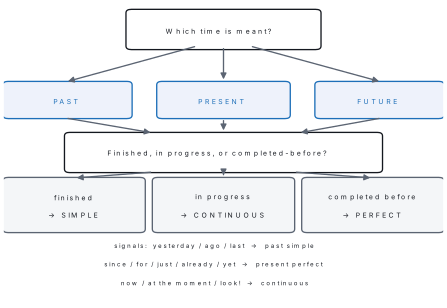
| Signal words | Tense they point to |
|---|---|
| always, usually, often, every day, generally, never (habit) | simple present |
| now, right now, at the moment, look!, listen!, these days | present continuous |
| just, already, yet, ever, never, so far, recently, this week | present perfect |
| since, for, how long, all day (and still going) | present perfect continuous |
| yesterday, last night, ago, in 2015, then, once | simple past |
| while, when (with a longer action), at 5 o'clock yesterday | past continuous |
| before, after, by the time, already (in the past) | past perfect |
| tomorrow, next week, soon, in future | simple future |
| this time tomorrow, at 9 p.m. tomorrow | future continuous |
| by + future time, by then, by the end of | future perfect |
22.6 Worked transformations
Problem. My elder sister ____ in a hospital in Dharan since 2018. (work)
Solution — step by step.
- Read the time marker. since 2018 means the period starts in the past and runs up to now. That rules out the simple past.
- Time = present, reaching back. So the tense must be a perfect present form.
- Is it still going on? Yes — she still works there. With since plus a continuing state, both present perfect and present perfect continuous are used; with a long-term job, the present perfect is the standard answer.
- Fit the subject. My elder sister is third-person singular → has.
Answer. My elder sister has worked (or has been working) in a hospital in Dharan since 2018.
Problem. Join into one sentence using the correct tenses: The doctor arrived. The patient died before that.
Solution — step by step.
- List the two events and put them in real time order. (i) the patient died — earlier; (ii) the doctor arrived — later.
- Rule: the earlier past event takes the past perfect; the later one takes the simple past.
- Choose the joining word. before goes after the later event, or by the time starts the later event.
- Write it.
Answer. The patient had died before the doctor arrived. (Equally: By the time the doctor arrived, the patient had died.)
A common wrong answer is The patient died before the doctor had arrived, which reverses the order and says the arrival was earlier.
Problem. Correct: When I reached the bus park, the bus already left, so I am waiting there for two hours.
Solution — step by step.
- Check clause 1. When I reached — a finished past time. Simple past is correct. Leave it.
- Check clause 2. The bus left before I reached; two past events, the earlier one needs the past perfect: had already left.
- Check clause 3. for two hours, and the waiting happened in the past, up to a past point — so past perfect continuous is wrong (the waiting came after), and the present am waiting is wrong because the whole sentence is past. The waiting was a past duration: waited (simple past) or had to wait.
Answer. When I reached the bus park, the bus had already left, so I waited there for two hours.
Chapter summary
- Tense = time; aspect = simple / continuous / perfect / perfect continuous. Three times × four aspects = twelve forms.
- Structures: V1(+s) · am-is-are + V-ing · have/has + V3 · have/has been + V-ing · V2 · was/were + V-ing · had + V3 · had been + V-ing · will + V1 · will be + V-ing · will have + V3 · will have been + V-ing.
- Third-person singular takes -s in the simple present, and loses it after does/doesn't.
- After did / didn't / does / doesn't, the main verb is always V1.
- A finished past time word (yesterday, ago, last year) forces the simple past; since, for, just, already, yet force the present perfect.
- Stative verbs (have = own, know, like, agree, understand, see, belong) take no continuous form.
- Use the present, not will, after when, until, as soon as, before, after, by the time and in an if-clause of condition.
- Of two past actions, the earlier takes the past perfect.
Practice questions
Fill in the blanks with the correct tense of the verb in brackets (1 mark each)
- My father ____ to the temple every morning before breakfast. (go) [1]
- Look! The children ____ in the rain. (play) [1]
- We ____ each other since we were in Grade Six. (know) [1]
- It ____ heavily since last night, so the road to Nagarkot is closed. (rain) [1]
- The earthquake ____ Nepal on 25 April 2015. (strike) [1]
- While she ____ the vegetables, the power went off. (cut) [1]
- By the time we reached the hall, the programme ____ . (begin) [1]
- This time next week I ____ my SEE certificate from the school. (collect) [1]
- By 2030 the tunnel ____ the journey to Hetauda by two hours. (shorten) [1]
- Water ____ at 100 °C at sea level. (boil) [1]
Answers
1. goes — every morning signals a habit, and a singular subject needs -s.
2. are playing — Look! signals an action happening at this moment.
3. have known — since + a continuing state takes the present perfect (know is stative, so no continuous).
4. has been raining — since last night plus an activity still going on takes the present perfect continuous.
5. struck — a finished action at a stated past date takes the simple past.
6. was cutting — the longer background action interrupted by a shorter one.
7. had begun — the earlier of two past actions takes the past perfect.
8. will be collecting — this time next week marks an action in progress at a future moment.
9. will have shortened — by 2030 is a future deadline, so future perfect.
10. boils — a general scientific truth takes the simple present.
Correct the errors in the following sentences (1 mark each)
- He is having a motorbike and a bicycle. [1]
- I am agree with what the headmaster said. [1]
- Did you saw the match between Nepal and Oman? [1]
- She don't like milk tea in the morning. [1]
- I have met my cousin yesterday at Ratna Park. [1]
- I will telephone you when I will reach Nepalgunj. [1]
- My brother go to the gym three times a week. [1]
- They are knowing the answer but they keep quiet. [1]
- The train already left when we arrived at the platform. [1]
- She is living in Kathmandu since 2016. [1]
Answers
11. He has a motorbike and a bicycle. — have meaning "own" is stative; no continuous form.
12. I agree with what the headmaster said. — agree is a verb, so it needs no am.
13. Did you see the match …? — after did, the main verb returns to V1.
14. She doesn't like milk tea … — a third-person singular subject needs does.
15. I met my cousin yesterday … — yesterday is a finished past time, so simple past.
16. … when I reach Nepalgunj. — no will inside a time clause.
17. My brother goes to the gym … — third-person singular -s.
18. They know the answer … — know is stative.
19. The train had already left when we arrived … — the earlier past action takes the past perfect.
20. She has been living (or has lived) in Kathmandu since 2016. — since + up-to-now needs a present perfect form.
Rewrite as instructed (1 mark each)
- The guests left. Then we cleaned the room. — Join with after, using the past perfect. [1]
- He started teaching in 2014. He still teaches. — Rewrite as one sentence with for. [1]
- It is five years since I last visited Janakpur. — Rewrite beginning I have … [1]
- She will finish the report before Friday. — Rewrite using by Friday and the future perfect. [1]
- I am writing my assignment at the moment. — Rewrite in the past continuous, beginning At nine last night … [1]
Answers
21. After the guests had left, we cleaned the room. — the earlier action takes had + V3.
22. He has been teaching since 2014 (or for more than ten years). — an activity continuing to now.
23. I have not visited Janakpur for five years. — It is … since converts to a present perfect with for.
24. She will have finished the report by Friday. — by + future time takes will have + V3.
25. At nine last night I was writing my assignment. — a past moment needs was + V-ing.
Practise more: English question bank