Unit 32 · Writing and Skills · 18 min read
Functional Writing: Letters, Emails, Applications and Notices
What the syllabus asks for 7
- The forms, and how formal each one is
- The formal letter: the parts and where they go
- Kinds of formal letter, and the envelope
- Emails
- Applications, and the curriculum vitae
- Notices
- Checking your own answer
Question 5 of the NEB paper carries eight marks for functional writing — the everyday written forms an adult actually has to produce: a letter to an office, an email, an application for a job or for leave, a notice on a board. Unlike an essay, each of these has a fixed shape. Half the marks are for putting the right parts in the right places; the other half are for hitting the right level of politeness. Learn the shapes and this becomes the easiest question on the paper.
A brilliant letter written in the wrong format loses the format marks and cannot get them back. Before you write a word, draw the skeleton in your head: where the date goes, where the address goes, which closing goes with which salutation. Then fill it.
32.1 The forms, and how formal each one is
| Form | Written to | Register | Typical length |
|---|---|---|---|
| Formal letter (office, editor, company) | someone you do not know | formal | 120–180 words |
| Application (job, leave, scholarship) | an authority | formal | 120–180 words |
| Email — official | a teacher, an office | semi-formal | 80–140 words |
| Email or letter — personal | a friend, a relative | informal | 100–150 words |
| Notice | everybody, on a board | impersonal | 50 words or fewer |
| Advertisement, invitation | the public | impersonal | very short |
Register is the level of formality. The same message can be written three ways, and choosing wrongly is the commonest reason a well-written answer scores six out of eight instead of eight.
| Function | Formal | Neutral | Informal |
|---|---|---|---|
| Opening | With reference to your advertisement of 12 Bhadra … | I am writing about … | Just a quick note about … |
| Requesting | I should be grateful if you would send … | Could you please send … | Can you send …? |
| Apologising | I regret any inconvenience caused. | I am sorry about the delay. | Sorry about that! |
| Thanking | I am much obliged to you. | Thank you very much. | Thanks a lot! |
| Complaining | I wish to draw your attention to … | I am not happy about … | This is really bad. |
| Closing | I look forward to hearing from you. | I hope to hear from you soon. | Write soon! |
- Myself Ramesh Thapa. → I am Ramesh Thapa / My name is Ramesh Thapa.
- Kindly do the needful. → Please take the necessary action. (office English of a hundred years ago; examiners mark it down)
- Your's faithfully → Yours faithfully — no apostrophe, ever.
- Thanking you used on its own as the close → Thank you. or I look forward to your reply.
- Please reply back → Please reply. Back is already inside reply.
- I request for two days' leave → I request two days' leave or I am applying for two days' leave.
- Contractions (I'm, don't, can't) belong in a personal letter, never in a formal one. Write I am, do not, cannot.
32.2 The formal letter: the parts and where they go
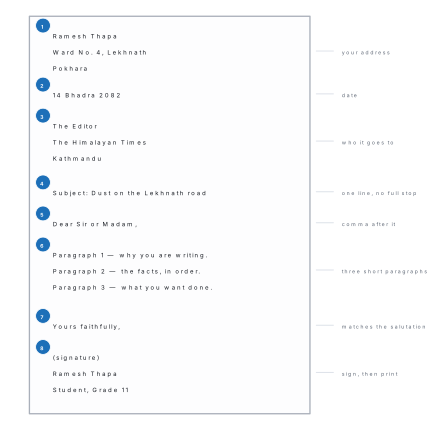
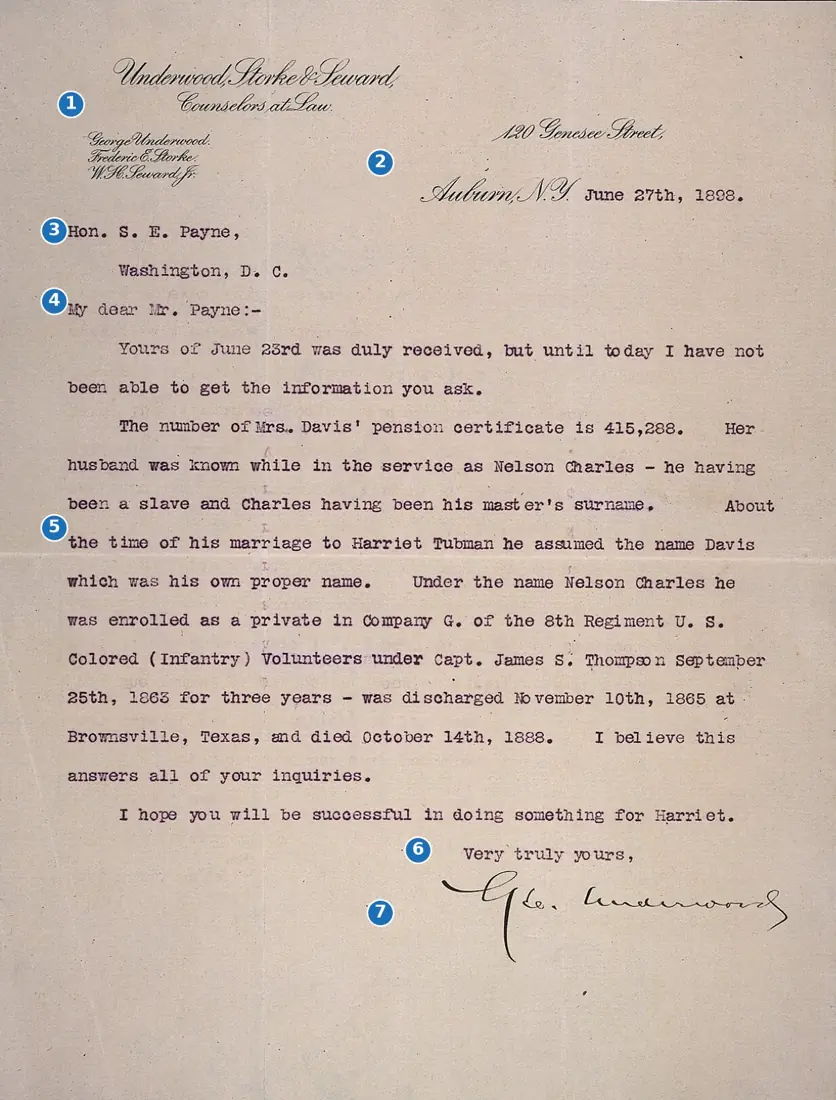
Salutation and close must agree. This is a one-mark point every year.
| You are writing to | Salutation | Close |
|---|---|---|
| someone whose name you do not know | Dear Sir, / Dear Madam, / Dear Sir or Madam, | Yours faithfully, |
| someone whose name you know | Dear Mr Adhikari, / Dear Ms Rai, | Yours sincerely, |
| a friend or a relative | Dear Sabina, / My dear brother, | Yours ever, / With love, |
Only the first word of the close takes a capital letter: Yours faithfully, not ~~Yours Faithfully~~. Write the date in full — 14 Bhadra 2082 or 30 August 2025 — never as 9/12/26, which means two different days in two different countries.
32.3 Kinds of formal letter, and the envelope
A letter of complaint states the facts calmly: what you bought or experienced, when, where, what went wrong, and exactly what you want (a repair, a refund, an apology). Never threaten and never abuse.
A letter to the editor names the problem in the first line, gives two or three concrete details, and ends by asking the authority concerned to act. It is signed with your name and place.
A letter of enquiry asks numbered questions so that the reader can answer each one: Could you please tell me (a) the fee for the whole course, (b) the dates of the next intake, and (c) whether a hostel is available?
A letter of invitation gives the occasion, the date, the time, the place and how to reply.
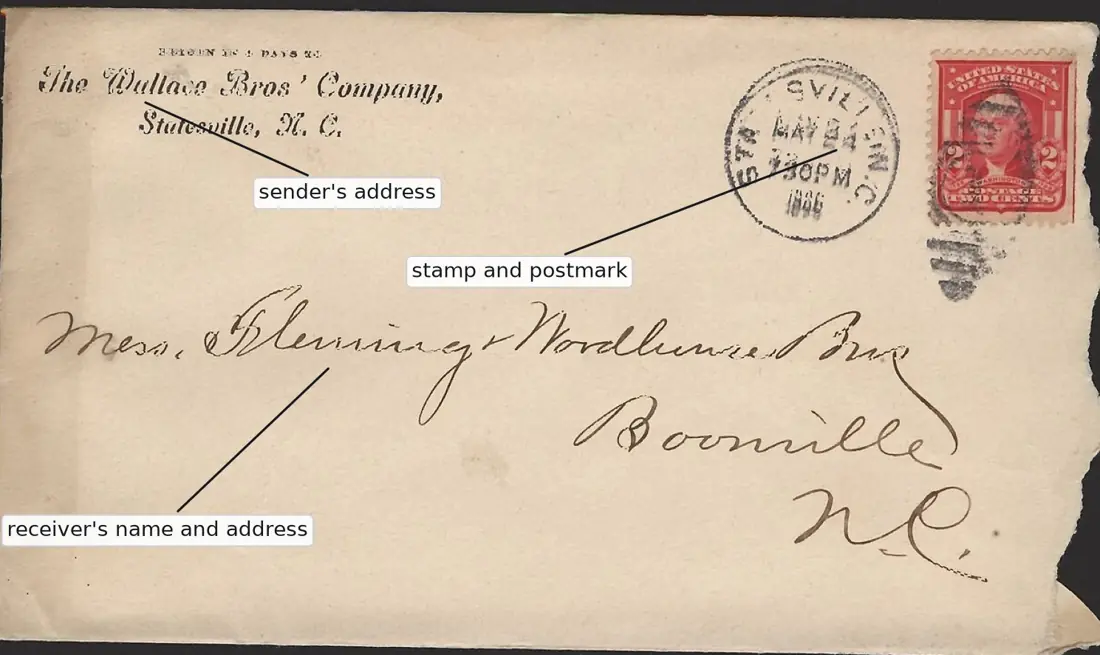
On a Nepali envelope the receiver's block runs, one item to a line: name and title · ward number and street · municipality or rural municipality · district · postal code. The sender's block, in the top left corner, gives the same details in smaller writing, so that the letter can be returned if it cannot be delivered.
32.4 Emails
An email is a letter without the addresses. What it gains instead is a subject line, and that line does most of the work: it tells a busy reader what the message is about before it is opened.
| Field | What goes in it |
|---|---|
| To | the main reader |
| Cc | others who should see it (everyone can see this list) |
| Bcc | others who should see it without the rest knowing |
| Subject | four to eight words, specific: Request for leave, 12–14 Asoj |
| Greeting | Dear Sir or Madam, · Dear Ms Rai, · Hello Anil, |
| Body | short paragraphs; one blank line between them |
| Sign-off | Yours faithfully, / Regards, / Best wishes, + your full name |
- An empty or vague subject line — Hello, Important, Question tell the reader nothing. Name the thing: Application for the post of Office Assistant.
- SMS spelling — u, plz, thnx, gr8, asap have no place in a graded answer.
- No greeting and no name at the end. An email that begins I want leave and ends with nothing is not a complete answer.
- Shouting. A message typed IN CAPITALS reads as anger.
- Forgetting the attachment you promised. If you write Please find my CV attached, say in the answer that it is attached.
32.5 Applications, and the curriculum vitae
A job application has a fixed set of moves. Keep to them and keep it to one page.
- Where you saw the advertisement, and the exact post you want.
- Why you are suitable — your qualification, then your experience, then one skill.
- What you are sending with the letter (CV, certificates, citizenship copy).
- A request for an interview, and thanks.
A leave application to a principal is shorter: the reason, the exact dates, who will cover your work or notes, and the request itself.
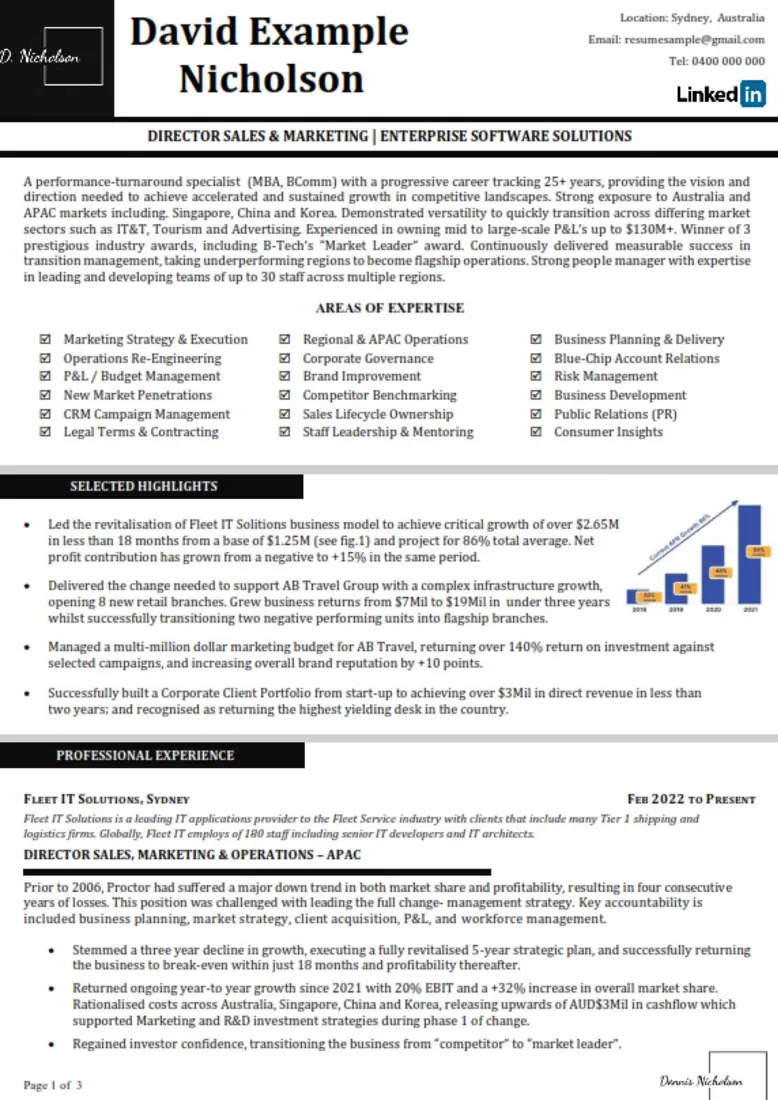
A student's CV is one page, not three. Use these headings:
| Heading | What goes under it |
|---|---|
| Personal details | full name, address, mobile number, email, date of birth |
| Career objective | one sentence: the kind of post you are seeking |
| Academic qualifications | a small table: examination, board, year, division — newest first |
| Work experience | post, organisation, dates, one line on duties |
| Skills | languages, computer skills, driving licence |
| Extra-curricular activities | sport, debate, scouting, volunteering |
| Referees | two people, with their post and contact — ask them first |
32.6 Notices
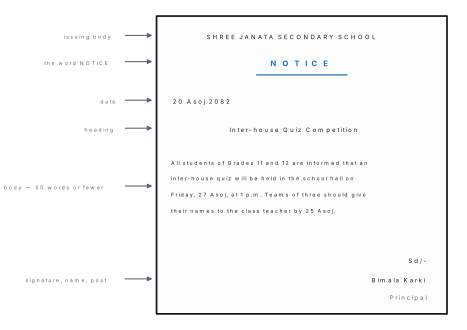
A notice is written to everybody and by an office, so it uses no I and no you. It goes in a box on a board, and the body must be fifty words or fewer.
Model answer 32.1 — a letter to the editor
Question. Write a letter to the editor of a national daily drawing the attention of the authorities to the dust and the broken road in your locality. [8]
Model answer.
Ramesh Thapa Ward No. 4, Lekhnath Pokhara
14 Bhadra 2082
The Editor The Himalayan Times Kathmandu
Subject: Dust and broken road in Lekhnath
Dear Sir or Madam,
Through the columns of your respected daily I wish to draw the attention of the Pokhara Metropolitan City office to the condition of the road that runs from Lekhnath chowk to the campus gate.
The road was dug up for a water pipeline eight months ago and has not been resurfaced since. In the dry season the dust is so thick that shopkeepers must close their shutters by midday, and three of the four schools on this stretch report a rise in chest complaints among their pupils. In the monsoon the same stretch becomes a line of pits in which two motorcyclists have already been injured.
I therefore request the city office to resurface the road before the festival season and, until that is done, to water it twice a day. A reply through your newspaper would reassure several thousand residents.
Yours faithfully,
Ramesh Thapa Student, Grade 11
Why it scores. All eight parts of the skeleton are present and in block style; Dear Sir or Madam is correctly paired with Yours faithfully; the three paragraphs do three separate jobs — why, what, what next; and the complaint is supported by facts rather than by anger.
Model answer 32.2 — an application for a job
Question. An advertisement in The Kathmandu Post of 5 Asoj invites applications for the post of Office Assistant at Everest Trading Pvt. Ltd., Naxal. Write an application for the post. [8]
Model answer.
Sabina Rai Ward No. 9, Dhankuta
8 Asoj 2082
The Manager Everest Trading Pvt. Ltd. Naxal, Kathmandu
Subject: Application for the post of Office Assistant
Dear Sir or Madam,
With reference to your advertisement in The Kathmandu Post of 5 Asoj 2082, I wish to apply for the post of Office Assistant in your organisation.
I passed the Secondary Education Examination in 2080 with a GPA of 3.4 and am at present studying in Grade 11 at Dhankuta Multiple Campus. For the past eight months I have kept the sales register and answered the telephone at a stationery shop in Dhankuta, so I am used to dealing with customers. I can type in both Nepali and English and can work in Word and Excel.
I am enclosing my curriculum vitae, copies of my certificates and a copy of my citizenship certificate. I should be grateful for the opportunity of an interview at any time convenient to you.
Thank you for considering my application.
Yours faithfully,
Sabina Rai
Why it scores. It names the advertisement and its date in the first line, so the reader knows at once which post is meant; qualification, experience and skill come in that order; the enclosures are listed; and the request for an interview is polite without being humble.
Model answer 32.3 — a notice
Question. You are the secretary of the school's eco club. Write a notice in not more than fifty words informing the students about a tree-plantation programme. [8]
Model answer.
SHREE JANATA SECONDARY SCHOOL, BIRATNAGAR
N O T I C E
22 Asoj 2082
Tree-plantation Programme
All students of Grades 9 to 12 are informed that the Eco Club will plant three hundred saplings on the school ground on Saturday, 28 Asoj, from 7 a.m. Students should bring a spade and a water bottle. Names may be given to the class teacher by 26 Asoj.
Sd/- Nirmala Gurung Secretary, Eco Club
Why it scores. The body is 46 words. It is impersonal — students are informed, not I inform you — and it answers what, who, where, when and what to bring. The date, the heading and the signature block are all in their proper places.
32.7 Checking your own answer
| Check | |
|---|---|
| 1 | Sender's address, date, receiver's address — all present and in order? |
| 2 | Subject line: one line, capital on the first word, no full stop? |
| 3 | Does the close match the salutation (Sir → faithfully, Mr Rai → sincerely)? |
| 4 | Is the body in three short paragraphs, one job each? |
| 5 | Any contractions in a formal letter? Expand them. |
| 6 | Any Myself…, do the needful, reply back, Your's? Remove them. |
| 7 | Is a notice inside a box, impersonal, and fifty words or fewer? |
| 8 | Is the signature block signed, then printed, then given a post? |
Chapter summary
- Q5, functional writing, 8 marks: roughly half for format, half for language and register. Fix the skeleton before you write.
- Formal letter, block style, in order: sender's address · date · receiver's address · subject · salutation · three body paragraphs · close · signature, name, post.
- Dear Sir / Madam → Yours faithfully; Dear Mr Rai → Yours sincerely. Only the first word of the close is capitalised.
- Formal register: I should be grateful if you would…, I regret any inconvenience caused, I look forward to hearing from you. No contractions.
- Avoid Myself Ram, kindly do the needful, reply back, Your's faithfully, request for leave.
- An email needs a specific subject line, a greeting, short paragraphs and a signed sign-off; no SMS spelling, no capitals throughout.
- A job application names the advertisement and its date, then qualification, experience, skill, enclosures and a request for an interview.
- A CV for a student is one page: personal details, objective, qualifications, experience, skills, activities, referees.
- A notice is impersonal, boxed, fifty words or fewer, and carries the issuing body, the word NOTICE, the date, a heading and a signature with a post.
Practice questions
Functional writing (8 marks each)
- Write a letter to the manager of a mobile phone company complaining that the handset you bought three weeks ago switches itself off, and asking for a replacement. [8]
- Write an email to your class teacher asking for three days' leave to attend your sister's wedding, and saying how you will cover the lessons you miss. [8]
- You are the head boy of your school. Write a notice in not more than fifty words informing students that the annual sports week has been postponed because of rain. [8]
Model answers
1. Anisha Shrestha, Ward No. 6, Itahari · 12 Kartik 2082 · The Customer Service Manager, Him Mobile Pvt. Ltd., Putalisadak, Kathmandu · Subject: Faulty handset, invoice no. 4417 · Dear Sir or Madam, — Para 1: I bought a Him M20 handset from your Itahari showroom on 18 Asoj 2082; the invoice number is 4417 and the warranty runs for one year. Para 2: From the fourth day the handset has switched itself off without warning, between six and ten times a day, even when the battery is above eighty per cent. Your showroom reset the software on 2 Kartik, but the fault returned the same evening. Para 3: As the handset is within warranty and has failed twice, I request a replacement rather than a further repair. I am enclosing a copy of the invoice and the warranty card, and I look forward to your reply within seven days. Yours faithfully, Anisha Shrestha.
2. Subject: Request for leave, 14–16 Mangsir. — Dear Sir, I am writing to request three days' leave from 14 to 16 Mangsir 2082, as my elder sister's wedding takes place at our home in Gorkha and I am needed there. I have asked Sunita Adhikari to keep a copy of the notes for Physics and English, and I shall complete the laboratory report for Chemistry before I leave. I shall return to class on 17 Mangsir. I should be grateful if you would grant me leave for these three days. Yours faithfully, Prakash Bhandari, Grade 11 "A", Roll No. 17.
3. SHREE BAGMATI SECONDARY SCHOOL · N O T I C E · 3 Falgun 2082 · Annual Sports Week Postponed. All students are informed that the annual sports week, announced for 6 to 10 Falgun, has been postponed because of continuous rain. The new dates will be put up on this board on 8 Falgun. Practice sessions are cancelled until then. Sd/- Rajan Limbu, Head Boy. (44 words.)
Register and format (1 mark each)
- Make this formal: Can you send me the fee details fast? [1]
- Correct: Your's sincerely, Bibek (the letter began Dear Sir,) [1]
- Correct: Myself Sita Poudel and I want two days leave. [1]
- Write a suitable subject line for an email applying for the post of Lab Assistant. [1]
- Correct: Kindly do the needful and reply back soon. [1]
- Rewrite without contractions: I'm afraid I can't attend the meeting. [1]
- What is wrong with this notice line: I want to inform all of you that the picnic is cancelled. [1]
Answers
4. I should be grateful if you would send me the details of the fee at your earliest convenience. — formal request pattern; fast is too blunt.
5. Yours faithfully, Bibek — no apostrophe, and Dear Sir pairs with faithfully, not sincerely.
6. I am Sita Poudel, and I wish to apply for two days' leave. — myself is not a subject; two days' needs the apostrophe.
7. Application for the post of Lab Assistant — specific, four to eight words, no full stop.
8. Please take the necessary action and reply soon. — do the needful is dead office English; back is already inside reply.
9. I am afraid I cannot attend the meeting. — contractions are for informal writing only.
10. A notice is impersonal: there is no I and no you. Write All students are informed that the picnic has been cancelled.
Practise more: English question bank