Unit 7 · Literature - Short Stories · 28 min read
An Astrologer's Day
What the syllabus asks for 7
- About the author
- The story
- Characters
- Themes
- Setting, structure and point of view
- Literary devices
- Glossary
R. K. Narayan's "An Astrologer's Day" takes one evening in the working life of a street fortune-teller who knows nothing whatever about the stars. A single customer arrives, and by the end of the story we discover why this particular fraud is able to tell this particular man the exact truth about his past. The story is on the syllabus as a model of compact plotting: every detail in the opening page turns out, by the last page, to have been necessary.
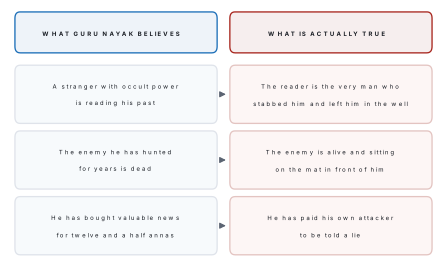
A cheat gives an honest reading, and a man pays his own would-be murderer for the news that his murderer is dead. Narayan builds the whole story on one perfectly placed piece of irony.
7.1 About the author
R. K. Narayan (1906–2001) — Rasipuram Krishnaswami Narayanaswami — was one of the first Indian writers in English to be read all over the world. He was born in Madras, now Chennai, brought up largely by his grandmother, and spent most of his life in Mysore. He began as a schoolteacher and a newspaper reporter before turning entirely to fiction.
His first novel, Swami and Friends (1935), was accepted only because the English novelist Graham Greene read the manuscript and found a publisher for it; the two remained friends for life. In that first book Narayan invented Malgudi, an imaginary small town in south India in which almost all his later work is set. The Malgudi novels include The Bachelor of Arts (1937), The English Teacher (1945), The Financial Expert (1952), The Guide (1958), which won the Sahitya Akademi Award, The Man-Eater of Malgudi (1961) and The Vendor of Sweets (1967). He also wrote many short stories, collected in An Astrologer's Day and Other Stories (1947) and Malgudi Days, and prose retellings of the Ramayana and the Mahabharata. He died in Chennai in 2001.
The fictional south Indian town Narayan invented and used for sixty years. It has its own streets, river, school and Town Hall Road, and it allowed him to write about ordinary Indian life without tying his stories to any real place.
What is distinctive about Narayan's voice is its gentle irony. He writes very plain English, describes small people doing small things — a sign painter, a sweet seller, a guide, a street astrologer — and lets their self-deceptions show without ever mocking them. There is no anger in his satire and no preaching in his morality. He is also a master of the quiet, exact detail, and in a story as short as this one, every detail is doing work.
7.2 The story
The astrologer at work. The astrologer opens his business punctually at midday and spreads out his equipment: cowrie shells, a square of cloth covered with mysterious charts and symbols, a notebook, and a bundle of palmyra writing. His forehead shines with sacred ash and vermilion, his eyes gleam, and a saffron turban is wound round his head. Narayan makes it clear that all of this is stagecraft: these things attract customers "as a bee is attracted to a lotus" — they are the tools of a trade, not of a science.
Where he sits. His place is under a tamarind tree beside a path through the Town Hall Road park, in the middle of a noisy row of sellers: a man selling medicine, a man selling stolen hardware, an auctioneer of cheap cloth, a magician, and a vendor of fried groundnuts. There is no municipal lighting here, so the sellers work by flares, hissing gaslights and smoky lanterns, and the astrologer's own face is lit only by the shifting glare from the groundnut vendor's flare. This half-light, as the story will show, is part of his business.
A fraud with a method. Narayan then tells us plainly that the astrologer knows no more about the stars than any of his customers. What he has instead is a "working analysis of mankind's troubles: marriage, money and the tangles of human ties", a quick eye, a willingness to listen, and the habit of letting the client talk for ten minutes before answering. His success is built on shrewd guessing, flattery and common sense, and his customers go away satisfied. We are also told, in one short paragraph that we do not yet understand, that he had never intended to be an astrologer at all: he had left his village suddenly, without telling anyone, and but for that he would have lived and died a farmer among his fields and cattle.
The last customer. The evening's business has been poor. The astrologer is packing up, about to go home with very little, when a man stops in front of his mat. The astrologer, unwilling to lose a customer, begins his usual patter; the man is aggressive and scornful, and challenges him to say something worth hearing. They argue over the fee and end by making a wager: the stranger will pay a rupee if he is satisfied, and the astrologer must pay back double if he is proved wrong. The astrologer feels uneasy about the bargain and tries to get out of it, but the stranger grips his wrist and holds him to it.
The face in the matchlight. The stranger strikes a match to light a cheroot, and for a moment the flame lights his face. The astrologer sees it, and everything changes. He becomes anxious to escape, offers to call the wager off, and is refused.
The reading. Then he begins to speak, and what he says is not guesswork. He tells the man that he was once left for dead, that a knife had gone through him, and that he was pushed into a well and abandoned there. The stranger is astonished: it is all exactly true, and he pulls up his shirt to show the scar. Finally the astrologer names him — Guru Nayak — and the man is convinced that he is in the presence of real power.
The lie that saves a life. Guru Nayak explains what he is looking for: he has searched for years for the man who attacked him, and he intends to kill him with his own hands. The astrologer tells him he is too late. The man he is hunting, he says, died four months ago in a far-off town, crushed under a lorry. Then he adds a piece of advice: Guru Nayak must go straight home tonight and never travel southward again, or his own life will be in danger — "Never travel southward again, and you will live to be a hundred." Disappointed but satisfied, Guru Nayak throws down a handful of coins, grumbles that he had wanted to kill the man himself, and goes away.
At home. The astrologer reaches home very late. His wife is waiting anxiously at the door with their child. He hands over the money, and she is delighted — she counts it and says she will buy jaggery and coconut for the child, who has been asking for sweets for days. But the astrologer is irritated: the man had promised a rupee and given only twelve and a half annas, cheating him even in this.
The confession. Then he tells her something he has never told her. A great load has gone off him today, he says, because he had always believed he had "the blood of a man on my hands all these years". Years ago, in his village, in a drunken quarrel over gambling, he had stabbed a man, pushed him into a well and run away, certain he had killed him. That, we now realise, was why he left his village without a word, why he came to this town, and why he married her and took up a false trade. Tonight he has discovered that the man is alive — and the man has just paid him to be told that his enemy is dead. Having said all this, the astrologer yawns, remarks that he is sleepy, and goes to bed.
7.3 Characters
| Character | Who they are | Role in the story |
|---|---|---|
| The astrologer | An unnamed street fortune-teller in his village disguise; a farmer's son, a fugitive, a husband and father | The protagonist: a fraud whose one honest reading saves two lives |
| Guru Nayak | A hard, aggressive man who has searched for years for the person who tried to kill him | The customer, the victim and the hunter — and the only person in the story who is deceived |
| The astrologer's wife | A practical, affectionate woman who waits at the door with their child | Represents the ordinary life he built on top of the secret |
| The other sellers | The medicine man, the magician, the auctioneer, the groundnut vendor | Create the noisy, half-lit market world in which the astrologer can hide |
The astrologer. Narayan builds him in three layers. On the surface he is a performer: the ash and vermilion, the saffron turban, the cowrie shells and charts are all "professional equipment", carefully chosen to produce belief. Underneath that he is a shrewd, observant man with no supernatural gift at all, who has studied human beings instead of the stars and knows that most people's troubles come down to marriage, money and family quarrels. Underneath that is a frightened man who has spent years believing himself a murderer. All three layers are visible in the scene with Guru Nayak: he takes the wager out of greed, recognises the face and tries to escape out of fear, and then uses his professional skill with complete coolness to send his enemy away in the wrong direction for the rest of his life. He is not a good man, but he is not a monster either — he is an ordinary person managing the consequences of one terrible night, which is exactly how Narayan sees most people.
Guru Nayak. He is loud, suspicious and violent. He challenges the astrologer rather than consulting him, grips his wrist to hold him to the bargain, and states openly that he means to kill the man he is hunting with his own hands. This aggression is what makes the ending credible: the astrologer cannot confess, because confession would mean death. Guru Nayak is also, unknowingly, the story's biggest loser. He gets a scar, years of searching, a false answer and a warning that will keep him away from the south for the rest of his life, and he pays for all of it.
The astrologer's wife. She appears for only a page, but she gives the story its warmth and its scale. Her pleasure at the money is completely practical — jaggery and coconut for a child who has been asking for sweets — and her horror when she hears what her husband did ("you tried to kill!") is the only moral judgement anyone makes. Through her we see what the astrologer has been protecting: a small, poor, ordinary happiness.
7.4 Themes
Appearance and reality. Almost nothing in the story is what it looks like. A man who claims to read the stars cannot read them; a "reading" that seems supernatural is simple memory; a satisfied customer has been comprehensively cheated; and a fortune-teller who deals in others' futures is running from his own past. Even the setting is double, since the astrologer works in a light that reveals and conceals at the same time.
Irony and chance. The central irony is perfect and needs no comment from the narrator: the only client the astrologer can read truthfully is the one man he should never have met. Around it Narayan arranges smaller ironies — the victim pays the criminal; the criminal is set free from guilt by the man he wronged; and the astrologer complains about being cheated of a few annas by a man he once tried to kill. Chance rules all of it. Had business been better, the astrologer would have packed up before Guru Nayak arrived.
Guilt, and the wish to be free of it. The most human moment in the story is at home, when the astrologer tells his wife that a great load has gone off him today. For years he has believed he had a man's blood on his hands; that belief drove him out of his village, changed his trade and shaped his whole life. Narayan is interested less in the crime than in what carrying it has cost, and in how easily the load lifts once the fact changes.
Survival by wits. The astrologer's profession is a dishonest one, but Narayan shows it as work. The man sits out every day next to other struggling sellers, he studies his customers, and he earns a few annas at a time to feed a wife and child. When his life is in danger, the same skills save him. Narayan neither approves nor condemns; he simply shows how a poor man survives.
Superstition and the people who live off it. The crowd who buy the astrologer's advice want certainty, and they are willing to pay for it. Narayan's satire is gentle: the customers get, in fact, sensible common-sense counsel and go away comforted, and the story's best piece of advice — never travel southward again — is both a complete fiction and the thing that will keep Guru Nayak alive.
7.5 Setting, structure and point of view
Setting. A busy footpath through the Town Hall Road park, under a tamarind tree, in an unnamed south Indian town that readers of Narayan recognise as Malgudi. The time is important: the story runs from midday to night, and almost all of it takes place after dark. Because there is no municipal lighting in that part of the park, the only light comes from the sellers' flares and lanterns, so faces are visible only in flashes. That half-darkness is not decoration. It is what allows the astrologer to work unrecognised for years, and it is a single match that finally betrays his customer's face to him.
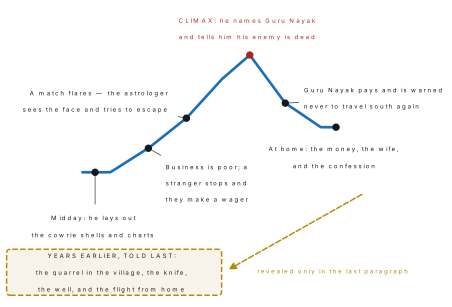
Structure. The story is very tightly built, and it divides into three parts: the description of the astrologer and his trade; the encounter with Guru Nayak; and the short domestic scene at home. Narayan plants his information early and casually — the man's ignorance of astrology, his skill at reading people, and the fact that he left his village suddenly and never meant to do this work at all — and none of it looks important at the time. The twist at the end makes every one of those details snap into place. Notice too that the story's earliest event in time, the stabbing in the village, is the last thing we are told.
Point of view. Third person, following the astrologer, but with the narrator deliberately holding something back. We are allowed to see his uneasiness when the match flares, and his hurry to end the wager, without being told why. This creates suspense honestly: the narrator never lies, he simply postpones. The information is released at last through dialogue with the wife, so that the reader learns the truth in the same breath as she does.
An ending that suddenly reveals information which changes the meaning of everything before it. A fair twist, like Narayan's, is one the reader could have worked out from clues already given.
7.6 Literary devices
| Device | Example from the text | Effect |
|---|---|---|
| Situational irony | The fraud gives a completely accurate reading | The story's central device: he can only be accurate because he is guilty |
| Situational irony | Guru Nayak pays his own attacker to hear that his attacker is dead | The victim finances his own deception |
| Dramatic irony | In the last page the reader knows what Guru Nayak will never know | Makes us complicit with the astrologer |
| Light and darkness | Flares, lanterns, the absence of municipal lighting, the lit match | Concealment and revelation are built into the setting |
| Symbolism | The "professional equipment" — ash, turban, cowrie shells, charts | Appearance manufactured to create belief |
| Foreshadowing | He left his village suddenly; he never meant to be an astrologer | Plants the ending in the opening pages without exposing it |
| Suspense through withholding | His panic when the match is struck, unexplained for two pages | The reader knows something is wrong before knowing what |
| Simile | Customers are attracted "as a bee is attracted to a lotus" | Shows his trade as an entirely natural, mechanical process |
| Understatement | He yawns, says he is sleepy, and goes to bed | The calm closing line measures how far the burden has lifted |
| Gentle satire | The whole business of street astrology | Narayan laughs at the trade without despising the people in it |
(i) Do not say that the astrologer has real powers. Narayan states in the first page that he knows nothing about the stars; the accuracy of the reading has an entirely natural explanation, and missing that is missing the story. (ii) Do not call the ending a coincidence and stop there. It is a coincidence, but the exam answer must go on to show how carefully Narayan prepares for it — the darkness, the match, the unexplained flight from the village — so that it reads as inevitable rather than accidental.
7.7 Glossary
| Word / phrase | Meaning |
|---|---|
| astrologer | a person who claims to foretell the future from the stars and planets |
| cowrie shells | small polished sea shells thrown and read in fortune-telling |
| palmyra | a tall palm whose dried leaves were used for writing in south India |
| vermilion | bright red powder used as a religious mark on the forehead |
| sacred ash | holy ash smeared on the forehead by Hindu devotees |
| saffron | deep orange-yellow, the colour of a holy man's cloth |
| tamarind | a large shade tree bearing sour brown pods |
| flare | an open, smoky flame used as a light by street sellers |
| municipal | belonging to the town council |
| groundnut | peanut |
| cheroot | a cheap cigar with both ends cut off |
| anna | an old Indian coin; sixteen annas made one rupee |
| jaggery | unrefined brown sugar made from cane or palm sap |
| wager | a bet; an agreement to pay if you are proved wrong |
| shrewd | clever at judging people and situations |
| patter | fast, practised talk used to attract or persuade customers |
| occult | secret and supernatural |
| lorry | a truck |
| a load off one's mind | a great relief from worry or guilt |
| tangles of human ties | Narayan's phrase for the confusions of family and love |
Almost every question here is really a question about irony. Whatever you are asked, identify which kind of irony is involved — situational (the fraud who is accurate) or dramatic (the reader knows what Guru Nayak does not) — name it, and then prove it with one detail. Learn three facts for the short questions: what the "professional equipment" consists of, what the wager was, and exactly what advice the astrologer gives at the end.
Chapter summary
- R. K. Narayan (1906–2001), Indian novelist and story writer, creator of the imaginary town of Malgudi; "An Astrologer's Day" is the title story of his 1947 collection.
- The astrologer works under a tamarind tree on Town Hall Road, among other street sellers, lit only by their flares; his ash, vermilion, turban, cowrie shells and charts are pure stagecraft.
- He knows nothing about astrology. He succeeds through observation, flattery and a "working analysis of mankind's troubles: marriage, money and the tangles of human ties".
- A last customer, Guru Nayak, challenges him and they make a wager; a struck match shows the astrologer the man's face and he tries to call the bet off.
- He then tells Guru Nayak, accurately, that he was stabbed, pushed into a well and left for dead, and names him.
- He lies that the enemy died four months ago under a lorry, and warns him never to travel southward again. Guru Nayak pays and leaves.
- At home he gives the money to his wife, complains of being cheated of a few annas, and finally tells her that he had believed for years that he had "the blood of a man" on his hands — he was the attacker.
- Themes: appearance and reality, irony and chance, guilt and relief, survival by wits, and superstition; devices include situational and dramatic irony, light-and-dark imagery, foreshadowing, withheld information and a twist ending.
Practice questions
Short answer questions (2 marks each)
- What does the astrologer's "professional equipment" consist of, and why does he need it? [2]
- How does the astrologer manage to satisfy his customers without knowing astrology? [2]
- What is the wager between the astrologer and Guru Nayak? [2]
- Why does the astrologer try to back out of the bargain after the match is struck? [2]
- What advice does the astrologer give Guru Nayak at the end of the reading, and why? [2]
- Why does the astrologer say that a great load has gone off him? [2]
Model answers — short questions
1. It consists of a dozen cowrie shells, a square piece of cloth covered with mystic charts, a notebook and palmyra writing, together with the sacred ash and vermilion on his forehead and a saffron turban. None of it has any use except display: it makes him look like a holy man with occult knowledge, and so it draws customers to his mat.
2. He relies on shrewd guesswork rather than the stars. He lets the customer talk for about ten minutes first, watches him closely, and then gives advice based on what Narayan calls a working analysis of mankind's troubles — marriage, money and the tangles of human ties. Since his answers are flattering and sensible, the customers go away satisfied.
3. Guru Nayak challenges him to say something worth hearing. They agree that if the astrologer answers his questions correctly he will be paid a rupee, and that if he is proved wrong he must pay back double. Guru Nayak grips his wrist to hold him to the terms.
4. Because the flame of the match lights the stranger's face, and the astrologer recognises the man he stabbed and threw into a well years before in his own village. He realises he is sitting in front of someone who has come to kill him, and he wants to get away before he is recognised in turn.
5. He tells him that the man he has been hunting was crushed under a lorry four months ago in a far-off town, and warns him to go home at once and never travel southward again, promising that he will then live to be a hundred. The advice is a lie, and its purpose is to keep Guru Nayak permanently away from the town where his attacker actually lives.
6. Because he has discovered that Guru Nayak is alive. For years he had believed he had killed a man in his village and had been living with the fear and guilt of it — indeed it was why he ran away, changed his life and became an astrologer. Meeting his victim alive removes that burden at a stroke, and he goes to bed calm enough to yawn.
Long answer questions (5 marks each)
- Discuss the irony in "An Astrologer's Day". [5]
- Sketch the character of the astrologer. What kind of man is he? [5]
- How does Narayan prepare the reader for the twist at the end of the story? [5]
Model answers — long questions
1. Irony is not one feature of this story; it is the whole design. The largest example is situational. The astrologer is an admitted fraud who, as Narayan tells us on the first page, knows nothing whatever about the stars — and yet the reading he gives Guru Nayak is entirely accurate, down to the knife, the well and the man's own name. He can be accurate for one reason only: he is the criminal. A second irony follows immediately. Guru Nayak has spent years searching for the man who tried to kill him, and he pays that very man twelve and a half annas to be told that his enemy is dead; the victim finances his own deception, and goes away pleased. A third is quieter but sharper: the astrologer, who once tried to murder this man, is genuinely annoyed at being cheated of a few small coins by him. There is dramatic irony too, since in the closing scene the reader knows the truth while Guru Nayak never will, and will keep away from the south for the rest of his life on the strength of a lie. Finally there is the irony that the lie does real good: it saves the astrologer's life, prevents a murder, and buys jaggery and coconut for a child. Narayan never points any of this out. He lets the facts sit side by side, which is what makes the ending so satisfying.
2. The astrologer is a poor man living by his wits, and Narayan draws him without either admiration or contempt. Professionally he is a fake, and he knows it. The sacred ash, the vermilion, the saffron turban, the cowrie shells and the charts are described frankly as equipment, chosen because they attract customers as a lotus attracts bees. Yet he is not stupid or lazy: he is genuinely skilled at reading people, he listens before he speaks, and his understanding that most human unhappiness comes down to marriage, money and family quarrels is not a bad working philosophy. Morally he is a mixture. He tried to kill a man in a drunken quarrel over gambling and ran away instead of facing the consequences; he lies to Guru Nayak for his own safety; he is sharp enough, at the end of a terrifying evening, to count his money and complain. But he is also a husband and father supporting a family on a few annas a day, and his relief at learning that he is not a murderer is completely sincere. What finally defines him is competence under pressure. In the space of a few minutes he recognises his enemy, sees that confession means death, and constructs a story that disposes of the danger for ever. He is an ordinary man with an extraordinary secret, which is Narayan's usual subject.
3. Narayan plays fair with the reader. Every fact needed for the ending is supplied early, but none of it is emphasised. In the opening pages we are told plainly that the astrologer has no knowledge of the stars, which is what makes the later accuracy of his reading significant rather than magical. We are also told, almost in passing, that he had never intended to take up this work, that he would otherwise have lived and died a farmer, and that he left his village abruptly without telling anybody — three sentences that mean nothing on a first reading and everything on a second. The setting is arranged with equal care: the park has no municipal lighting, the sellers work by flares and lanterns, and faces are visible only in flashes, so that a man may sit there for years unrecognised. Narayan then uses one struck match, lit for a cheroot, to break that protection at precisely the right moment. The astrologer's reaction is shown but not explained — he suddenly wants the wager cancelled, he is uneasy, he tries to leave — which creates suspense without cheating. Even the wager itself is necessary, since Guru Nayak's grip on his wrist traps him into speaking. When the truth finally comes out in the conversation with his wife, the reader does not feel tricked but enlightened, because the clues were all in plain sight.
Reference to the context
- "a working analysis of mankind's troubles: marriage, money and the tangles of human ties"
(a) Who is being described here? (b) What does the phrase mean? (c) How is this knowledge used in his trade? (d) Why is this description important for the story's ending? [5]
- "Never travel southward again, and you will live to be a hundred."
(a) Who says this, and to whom? (b) What has the speaker just told the listener? (c) Why does the speaker give this particular advice? (d) Bring out the irony of the words. [5]
Model answers — reference to the context
1. (a) The astrologer, who sits under a tamarind tree on Town Hall Road and earns his living telling fortunes, although he has no knowledge at all of astrology. (b) It means that instead of studying the stars he has studied people, and has learned that nearly every trouble a customer brings him concerns a marriage, a question of money, or a quarrel within a family. (c) He uses it as a system. He lets the client speak for about ten minutes, observes him closely, and then produces answers that fit one of those three categories, delivered with confidence and a little flattery, so that the customer leaves satisfied and pays. (d) It is essential preparation for the ending. Because Narayan has established that the man is a fraud with no occult powers whatever, his astonishingly exact reading of Guru Nayak cannot be explained as magic. The reader is therefore forced to look for a natural explanation, and finds it in the confession at home.
2. (a) The astrologer says it to his last customer of the evening, Guru Nayak, just before the man pays him and leaves. (b) He has told him, correctly, that he was once stabbed, thrown into a well and left for dead, and has named him; then he has told him a lie — that the man he has been hunting for years died four months ago, crushed under a lorry in a distant town. (c) Because Guru Nayak has said openly that he means to kill his attacker with his own hands, and the attacker is the astrologer himself. Sending the man home for good, with a solemn warning never to come south again, is the only way to make sure they never meet a second time. (d) The irony is double. The advice is entirely false as prophecy and yet entirely true as prediction: if Guru Nayak stays away he really will live longer, because the man he wants to kill is the man giving him the advice. And the warning is paid for by the person it is designed to deceive, who walks away grateful to his own would-be murderer.
Practise more: English question bank