Unit 23 · Grammar · 16 min read
Articles, Determiners and Quantifiers
What the syllabus asks for 6
- The noun phrase and the order of determiners
- The indefinite article: a and an
- The definite article: the
- The zero article — where students actually lose the mark
- Demonstratives and possessives
- Quantifiers
A determiner is the little word that opens a noun phrase and tells you how much of the noun is meant and which one: the, a, an, this, my, some, every, three, much. The three articles — a, an and zero (no article at all) — are the part Nepali learners lose most marks on, because Nepali has no article system. NEB Q7 tests articles almost every year, usually as a fill-in-the-blank passage or as an error-correction item where an article is missing or wrongly present.
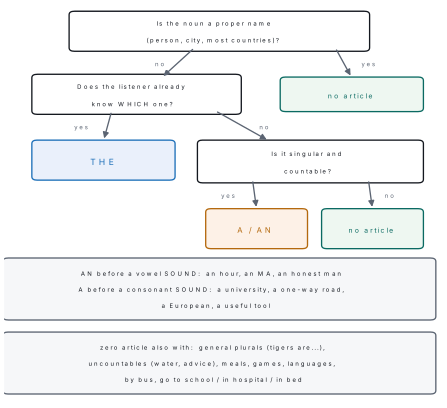
(1) Is the noun countable and singular? If yes, it must have a determiner — a/an, the, my, this, one… A bare singular countable noun is almost always an error. (2) Does the listener already know which one? If yes, use the; if not, use a/an.
23.1 The noun phrase and the order of determiners
Determiners come in three positions, and they always appear in this order before the adjectives and the noun:
pre-determiner → central determiner → post-determiner → adjective(s) → noun
| Slot | Words | Example |
|---|---|---|
| Pre-determiner | all, both, half, double, such, what | all the students |
| Central determiner | a, an, the, this, that, these, those, my, your, his, some, any, no, every, each, either, neither | all the students |
| Post-determiner | one, two, three…, first, next, last, many, few, several | all the first ten students |
| Adjective | any descriptive word | all the first ten hard-working students |
Two central determiners cannot stand together. You cannot write ~~the my book~~ or ~~a this pen~~; say my book, this pen, or a book of mine.
23.2 The indefinite article: a and an
Use a/an before a singular countable noun that is mentioned for the first time or is one of many.
The a/an rule is about sound, not spelling. Use an before a vowel sound and a before a consonant sound.
| Write a | Because the sound is | Write an | Because the sound is |
|---|---|---|---|
| a university | /juː/ — a y sound | an umbrella | /ʌ/ — a vowel |
| a European tourist | /jʊə/ | an hour | /aʊ/ — the h is silent |
| a one-rupee coin | /wʌn/ — a w sound | an honest officer | silent h |
| a useful book | /juː/ | an heir | silent h |
| a historic day | /h/ is pronounced | an MA in English | "em" — a vowel sound |
| a B.Ed. graduate | "bee" | an SLC certificate | "ess" |
| a unique idea | /juː/ | an X-ray machine | "eks" |
Uses of a/an:
- First mention. A tourist asked me for directions. The tourist was from Japan.
- One of a class / a job. My sister is an engineer. Nepal is a landlocked country.
- "One" with numbers and measures. Rs 500 a kilo, twice a week, 80 kilometres an hour.
- In exclamations with what. What a beautiful view of Machhapuchhre!
- Before a singular noun standing for the whole class. A cow is a domestic animal.
A singular countable noun almost never stands alone. ~~He is teacher.~~ → He is a teacher. ~~I bought book yesterday.~~ → I bought a book yesterday. ~~She went to shop.~~ → She went to a shop / to the shop. ~~My father is farmer in Dang.~~ → My father is a farmer in Dang. Before writing any singular countable noun, ask: a, the, or a possessive?
23.3 The definite article: the
Use the when the listener can identify which one you mean. Ten situations cover nearly every exam item.
- Second and later mentions. I saw a snake near the shed. The snake was nearly two metres long.
- Only one of its kind in the world or in the context. the sun, the moon, the sky, the earth, the equator; the headmaster of our school.
- Made definite by a following phrase or clause. the* boy who won the prize, the capital of Nepal***.
- Superlatives and ordinals. Everest is the highest peak. She was the first woman to climb it.
- Rivers, seas, oceans, mountain ranges, groups of islands, deserts, canals, gulfs. the Koshi, the Bagmati, the Bay of Bengal, the Himalayas, the Mahabharat range, the Sahara, the Maldives.
- Countries whose names are plural or contain a common noun. the United States, the Netherlands, the United Kingdom, the Philippines, the Republic of India.
- Newspapers, historic buildings, monuments, ships, organisations. The Kathmandu Post, the Dharahara, the Taj Mahal, the United Nations.
- Nationalities and adjectives used as plural nouns. the Nepalese, the Chinese, the rich, the poor, the blind, the unemployed.
- Musical instruments and inventions. She plays the madal. The telephone changed communication.
- A singular noun standing for a whole class or species. The tiger is disappearing from the Terai.
23.4 The zero article — where students actually lose the mark
The hardest part of the system is knowing when to use no article at all. Learn these categories; they are what NEB error-correction items are built from.
| Use no article before | Examples | But note |
|---|---|---|
| Plural countable nouns in a general sense | Students need books. Tigers are endangered. | the students = particular ones |
| Uncountable nouns in a general sense | Water is life. Honesty pays. She gave advice. | the water in this jug |
| Names of people, most countries, cities, single mountains, single lakes, continents | Sita, Nepal, Pokhara, Everest, Rara, Asia | the Himalayas, the Netherlands |
| Languages and school subjects | He speaks Nepali. She studies economics. | the Nepali of the hill region |
| Meals | We had lunch at one. | the dinner she cooked |
| Days, months, festivals, seasons (general) | on Friday, in Baisakh, during Tihar | the Dashain of 2021 |
| Games and sports | They play volleyball. | — |
| Means of transport with by | by bus, by plane, by foot (also on foot) | on the 7 a.m. bus |
| Places used for their purpose | go to school, in hospital, at church, in bed, to court, in prison | go to the school (= the building) |
| Titles followed by a name | President Poudel, Doctor Sharma, Uncle Hari | the President of Nepal |
| Abstract nouns in general | Knowledge is power. Life is short. | the life of a porter |
| Two nouns joined as a pair | hand in hand, day by day, from door to door | — |
This pair is a favourite Q7 item. My brother goes to school. — he is a student; the purpose is study. My father went to the school to meet the teacher. — he went to the building. The same contrast works for hospital (as a patient / to the building), prison, church, college and bed.
23.5 Demonstratives and possessives
| Determiner | Singular | Plural | Note |
|---|---|---|---|
| Near | this | these | this book, these books |
| Far | that | those | that hill, those hills |
| Possessive | my, your, his, her, its, our, their, Sita's | same | never with another central determiner |
This/that also refer to time: this week (now), those days (then).
23.6 Quantifiers
A quantifier tells you how much or how many. The choice depends on whether the noun is countable, uncountable, or either.
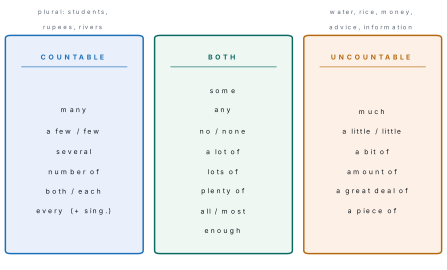
many / much / a lot of
- many + plural countable: How many students appeared for the SEE?
- much + uncountable: There is not much water in the tank.
- a lot of / lots of / plenty of + either, and preferred in positive statements: We had a lot of rain in Shrawan.
In modern English much and many are normal in questions and negatives, while a lot of is normal in positive statements. He has much money sounds odd; write He has a lot of money.
few / a few / little / a little
This pair of pairs is tested constantly. The article changes the meaning.
| Form | Goes with | Meaning | Example |
|---|---|---|---|
| a few | plural countable | some, a small number — positive | I have a few friends in Dharan, so I am never lonely. |
| few | plural countable | hardly any — negative | Few students passed, so the teacher was worried. |
| a little | uncountable | some, a small amount — positive | There is a little sugar left; we can make tea. |
| little | uncountable | hardly any — negative | There is little hope of finding them alive. |
Quite a few means "a fairly large number", not a small one.
some / any
Use some in positive statements and in offers or requests that expect yes; use any in negatives and most questions.
- I bought some apples at Kalimati.
- I did not buy any mangoes.
- Would you like some tea? (offer)
- Any student may enter the competition. (= it does not matter which)
each / every / all / both / either / neither
| Word | Noun form | Verb | Meaning |
|---|---|---|---|
| each | singular | singular | separately, of two or more |
| every | singular | singular | all together, of three or more |
| all | plural / uncountable | plural | the whole group |
| both | plural | plural | the two together |
| either | singular | singular | one or the other of two |
| neither | singular | singular | not one and not the other of two |
- Each* of the four houses has* a separate gate.
- Every* student was* given a form.
- Neither* of the answers is* correct.
- Both* the roads lead* to Bhaktapur.
After one of / each of / either of / neither of / none of / some of, the noun must be plural, while the verb stays singular. ~~One of my friend lives in Butwal.~~ → One of my friends lives in Butwal. ~~Each of the boy were punished.~~ → Each of the boys was punished. Also: all/most/some of the students — the the is needed after of when you mean a particular group.
Three shapes recur. (i) Fill in the blanks with a/an/the or leave blank — a short passage of three or four sentences; the first mention takes a/an and every later mention takes the. (ii) Correct the sentence — look first for a missing a before a singular countable noun, then for a wrong the before a general plural. (iii) Choose the correct alternative — usually few/a few or much/many. Read the whole sentence for the positive-or-negative feel before choosing.
Problem. Yesterday I saw _ old man near Bagmati bridge. _ man was carrying heavy sack of rice.
Solution — step by step.
- Blank 1. old man is singular countable, first mention. Article needed. The sound at the start of old is a vowel → an.
- Blank 2. Bagmati is a river, and rivers take the.
- Blank 3. The man has already been mentioned, so the listener knows which man → The.
- Blank 4. sack is singular countable, first mention; heavy begins with a consonant sound → a.
Answer. Yesterday I saw an old man near the Bagmati bridge. The man was carrying a heavy sack of rice.
Problem. Choose: (Few / A few) people attended the meeting, so it was cancelled.
Solution — step by step.
- Check the noun. people is plural countable → the pair is few / a few (not little).
- Read the result clause. so it was cancelled tells us the number was not enough — a negative meaning.
- Match the meaning. Negative, "hardly any" → few. A few would mean "some came", which does not explain a cancellation.
Answer. Few people attended the meeting, so it was cancelled.
Problem. Correct: The honesty is the best policy, and the poor of our country need an information about their rights.
Solution — step by step.
- The honesty. Honesty is an abstract uncountable noun used in a general sense → no article.
- the best policy. A superlative takes the. Correct as it stands.
- the poor. An adjective used as a plural noun for a class takes the. Correct.
- an information. Information is uncountable, so it can take no a/an and no plural → information, or a piece of information if one item is meant.
Answer. Honesty* is the best policy, and the poor of our country need information* about their rights.
Chapter summary
- A singular countable noun needs a determiner: a/an, the, a possessive or a demonstrative. A bare singular countable noun is almost always an error.
- a/an = first mention or one of a class; the = the listener knows which one.
- an goes before a vowel sound (an hour, an MA), a before a consonant sound (a university, a one-rupee coin).
- the with: second mention, unique things, superlatives, ordinals, rivers, seas, mountain ranges, plural country names, newspapers, nationalities, instruments.
- No article with: general plurals, general uncountables, names, languages, subjects, meals, games, festivals, by + transport, and places used for their purpose (go to school, in hospital, in bed).
- many/few/a few + plural countable; much/little/a little + uncountable; some/any/a lot of/plenty of with both.
- a few and a little are positive ("some"); few and little are negative ("hardly any").
- After one of / each of / neither of, the noun is plural and the verb singular.
Practice questions
Fill in the blanks with a, an, the or leave blank where no article is needed (1 mark each)
- My uncle is ____ honest officer in the district court. [1]
- ____ Koshi floods the eastern Terai almost every monsoon. [1]
- She is studying for ____ MA in English at Tribhuvan University. [1]
- ____ tiger is disappearing fast from the Terai forests. [1]
- My younger brother goes to ____ school at half past nine. [1]
- Everest is ____ highest mountain in the world. [1]
- We travelled to Janakpur by ____ bus. [1]
- He earns about Rs 700 ____ day as a mason. [1]
- ____ honesty is respected everywhere. [1]
- There was _ accident at Koteshwor, and _ driver ran away. [1]
Answers
1. an — honest begins with a vowel sound because the h is silent.
2. The — river names take the.
3. an — MA is read "em-ay", beginning with a vowel sound.
4. The — a singular noun standing for a whole species takes the.
5. (no article) — go to school for the purpose of studying.
6. the — superlatives take the.
7. (no article) — by + means of transport takes no article.
8. a — a here means "per".
9. (no article) — an abstract uncountable noun in a general sense.
10. an … the — first mention takes an; the driver is identified by the accident just mentioned.
Choose the correct alternative (1 mark each)
- Only (few / a few) candidates answered all the questions, so the pass rate was low. [1]
- There is (little / a little) rice left, so we can cook khichadi tonight. [1]
- How (much / many) sisters does Kamala have? [1]
- He does not have (much / many) money to pay the hostel fee. [1]
- (Each / Every) of the two candidates was given ten minutes. [1]
- (Neither / None) of my two brothers has a driving licence. [1]
- I did not buy (some / any) vegetables at the market. [1]
- (All / Every) the students of Grade 11 attended the orientation. [1]
Answers
11. few — the result clause is negative, so "hardly any".
12. a little — a positive meaning: enough to cook with.
13. many — sisters is plural countable.
14. much — money is uncountable, and the sentence is negative.
15. Each — each of is used with two or more; every of does not exist.
16. Neither — neither is used for exactly two.
17. any — negatives take any.
18. All — every cannot be followed by the; all the students is correct.
Correct the errors in the following sentences (1 mark each)
- He is teacher in a government school at Dhangadhi. [1]
- One of my friend has gone to Qatar for work. [1]
- The water is essential for all living things. [1]
- She gave me an advice about choosing a faculty. [1]
- My mother was admitted in the hospital for three days last month. [1]
- Nepal lies between the India and the China. [1]
- Each of the students were given a certificate. [1]
- I met an university professor at the seminar. [1]
Answers
19. He is a teacher … — a singular countable noun needs an article.
20. One of my friends has gone … — after one of, the noun is plural.
21. Water is essential … — an uncountable noun used generally takes no article.
22. She gave me advice (or a piece of advice) … — advice is uncountable.
23. … was admitted to hospital … — in/to hospital as a patient takes no article.
24. Nepal lies between India and China. — singular country names take no article.
25. Each of the students was given a certificate. — each of takes a singular verb.
26. I met a university professor … — university begins with the consonant sound /j/.
Practise more: English question bank