Unit 21 · Grammar · 17 min read
Word Classes, Contracted Forms and Dictionary Use
What the syllabus asks for 8
- The eight word classes
- Nouns: countable, uncountable and the forms Nepali learners mix up
- Pronouns
- Verbs: main, auxiliary and the five forms
- Adjectives and adverbs
- Words that change class
- Contracted forms
- Using a dictionary
Every word in English belongs to a word class (also called a part of speech),
and the class decides where the word may stand in a sentence and what shape it may
take. Question 7 of the NEB paper is ten one-mark grammar items, and several of
them turn on class: you are asked to put the right form of a word in a blank
(The ____ of the bridge took two years. (construct)), to identify what a word is
doing, or to correct a sentence in which a noun has been used where an adjective
was needed. This chapter also covers contracted forms — tested in rewriting and in
dialogue-completion items — and how to pull grammar information out of a
dictionary, which is what the CDC syllabus means by "dictionary use".
Q7 gives you ten separate one-mark sentences. There are no part-marks. A sentence is either fully right or fully wrong, so the tiny things — a final -s, an apostrophe, an article — are the whole mark. Read every item twice before writing.
21.1 The eight word classes
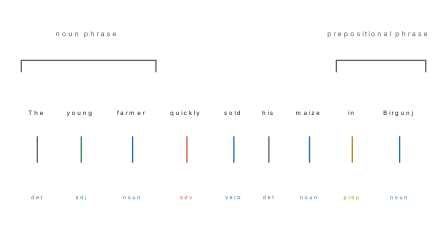
English words sort into eight classes. Learn the class, the question it answers, and one test that identifies it.
| Class | What it does | Test | Examples |
|---|---|---|---|
| Noun | names a person, place, thing, idea | can follow the / a | Pokhara, student, honesty, rice |
| Pronoun | stands in place of a noun | can replace a whole noun phrase | he, them, ours, which, myself |
| Verb | states an action or a state | can change tense (walk / walked) | run, is, seem, arrive, believe |
| Adjective | describes a noun | fits "a very ____ thing" | cold, Nepali, useful, tall |
| Adverb | describes a verb, adjective or another adverb | answers how / when / where / how often | slowly, yesterday, here, very |
| Preposition | shows relation of a noun to the rest | is followed by a noun phrase | in, on, at, between, despite |
| Conjunction | joins words, phrases or clauses | sits between the two joined parts | and, but, because, although |
| Determiner | limits or points to a noun | comes before the noun, before adjectives | the, this, my, some, three |
Interjections (Oh! Alas! Hurray!) are usually counted as a ninth, minor class.
21.2 Nouns: countable, uncountable and the forms Nepali learners mix up
A countable noun can be counted, so it has a plural and takes a/an in the singular: a book, two books; a rupee, five hundred rupees. An uncountable noun cannot be counted directly, has no plural, and never takes a/an: water, rice, money, furniture, luggage, information, advice, news, work, equipment, homework, traffic, weather, progress, machinery, scenery.
- Right: She gave me some useful information about the scholarship.
- Right: The teacher gave us three pieces of advice.
- Right: There is heavy traffic on the Ring Road every morning.
To count an uncountable noun, use a partitive: a piece of information, a bit of advice, an item of news, a glass of water, a kilo of rice, a sack of cement.
These are the single commonest noun errors in Nepali student writing, because the Nepali equivalents are countable. English does not pluralise them. Write much information / a lot of information, not ~~many informations~~; a piece of advice, not ~~an advice~~; furniture, not ~~furnitures~~. The same goes for luggage, equipment, machinery, scenery, poetry, staff (as a mass), bread, hair (on the head) and work.
Some nouns are plural in form and take a plural verb: scissors, trousers, spectacles, clothes, goods, belongings, premises, cattle, police. Say The police have arrested him, not ~~has~~.
Some look plural but are singular: news, mathematics, physics, economics, politics (as a subject), measles, innings. Say The news is good.
Possessive nouns. Add 's to a singular (Sita's bag, the boy's shoes) and just an apostrophe to a regular plural (the students' hostel, the teachers' room). Irregular plurals take 's: the children's park, the women's college.
21.3 Pronouns
| Type | Forms | Example |
|---|---|---|
| Subject | I, we, you, he, she, it, they | They live in Dharan. |
| Object | me, us, you, him, her, it, them | Ram invited us. |
| Possessive adjective | my, our, your, his, her, its, their | This is my notebook. |
| Possessive pronoun | mine, ours, yours, his, hers, theirs | This notebook is mine. |
| Reflexive | myself, ourselves, yourself, yourselves, himself, herself, itself, themselves | She cut herself. |
| Relative | who, whom, whose, which, that | the man who called |
| Demonstrative | this, that, these, those | Those are my books. |
| Indefinite | someone, anybody, nothing, each, either, none, all | Everyone was present. |
Its is a possessive adjective; it's is a contraction of it is or it has. They are never interchangeable.
- The tiger licked its paw. (possessive — no apostrophe)
- It's raining in Kathmandu again. (= it is)
21.4 Verbs: main, auxiliary and the five forms
Every regular verb has five forms. Learn them as a row, because tense, passive and perfect constructions all pick one of them.
| Base (V1) | -s form | Past (V2) | Past participle (V3) | -ing form |
|---|---|---|---|---|
| walk | walks | walked | walked | walking |
| write | writes | wrote | written | writing |
| go | goes | went | gone | going |
| bring | brings | brought | brought | bringing |
| take | takes | took | taken | taking |
| choose | chooses | chose | chosen | choosing |
| lie (recline) | lies | lay | lain | lying |
| lay (put down) | lays | laid | laid | laying |
Auxiliary verbs (be, do, have) help a main verb build a tense, a question, a negative or a passive. Modal auxiliaries (can, may, must, should …) add meaning such as ability or obligation; they are Unit 24.
Transitive verbs take an object (She wrote a letter); intransitive verbs do not (The baby slept). Only transitive verbs can be made passive.
Nepali learners often add a preposition English does not want: ~~discuss about~~ → discuss the problem; ~~return back~~ → return; ~~cope up with~~ → cope with; ~~request for~~ → request (but ask for); ~~order for~~ → order; ~~emphasise on~~ → emphasise; ~~investigate about~~ → investigate; ~~reach at~~ → reach; ~~enter into a room~~ → enter a room; ~~marry with~~ → marry; ~~resemble to~~ → resemble; ~~comprise of~~ → comprise. And the reverse: ~~explain me~~ → explain to me; ~~listen the radio~~ → listen to the radio.
21.5 Adjectives and adverbs
An adjective modifies a noun; an adverb modifies a verb, an adjective or another adverb. Many adverbs are made by adding -ly, but not all: fast, hard, late, early, well, straight are both adjective and adverb with no -ly.
- He is a careful driver. → He drives carefully.
- The Koshi is a dangerous river in August. → It floods dangerously fast.
Beware the pairs whose -ly form means something different: hard (with effort) vs hardly (almost not); late vs lately (recently); near vs nearly (almost). She worked hard ≠ She hardly worked.
21.6 Words that change class
The same spelling often serves two classes. What decides the class is the job the word is doing in that sentence, not the word itself.
| Word | As noun | As verb | As adjective |
|---|---|---|---|
| water | The water is cold. | Water the plants. | a water pump |
| light | Turn on the light. | Light the lamp. | a light bag |
| well | He drew water from the well. | Tears welled up. | I am well. |
| fast | He kept a fast on Ekadashi. | Muslims fast in Ramadan. | a fast bus |
This matters because Q7 often gives you a cue word in brackets and expects you to convert it: (decide) → decision / decisive / decisively.
| Verb | Noun | Adjective | Adverb |
|---|---|---|---|
| decide | decision | decisive | decisively |
| succeed | success | successful | successfully |
| know | knowledge | knowledgeable | knowledgeably |
| strengthen | strength | strong | strongly |
| advise | advice | advisable | advisably |
| apply | application | applicable | — |
| develop | development | developed / developing | — |
| please | pleasure | pleasant | pleasantly |
Problem. Fill in the blank: The ____ of the Melamchi project changed Kathmandu's water supply. (complete)
Solution — four steps.
- Find the slot. The blank comes after The and before of. A slot after a determiner is a noun slot.
- Confirm with the verb. The sentence already has a finite verb, changed. So the blank is not the verb; it is the subject head noun.
- Build the noun from the cue. complete → noun completion.
- Check number and article. Singular, definite: The completion.
Answer. The completion of the Melamchi project changed Kathmandu's water supply.
Writing completed would give a subject with no head noun; writing completely would put an adverb after the, which is impossible.
21.7 Contracted forms
A contraction joins two words and replaces the missing letters with an apostrophe. Contractions belong to speech and informal writing — dialogue, personal letters, emails to friends. Keep full forms in essays, formal letters and applications.
| Full form | Contraction | Full form | Contraction |
|---|---|---|---|
| I am | I'm | I have | I've |
| you are | you're | we have | we've |
| he is / he has | he's | I had / I would | I'd |
| she is / she has | she's | you will | you'll |
| it is / it has | it's | they will | they'll |
| we are | we're | I shall / I will | I'll |
| they are | they're | let us | let's |
| is not | isn't | was not | wasn't |
| are not | aren't | were not | weren't |
| do not | don't | does not | doesn't |
| did not | didn't | have not | haven't |
| has not | hasn't | had not | hadn't |
| cannot | can't | could not | couldn't |
| will not | won't | would not | wouldn't |
| shall not | shan't | should not | shouldn't |
| must not | mustn't | need not | needn't |
| ought not | oughtn't | am not (question) | aren't I? |
Three points that carry marks:
'sis ambiguous. He's gone = he has gone; He's angry = he is angry. Expand it by looking at what follows: a past participle means has.'dis ambiguous too. I'd finished = I had; I'd like tea = I would.- Two irregular spellings: will not → won't (not ~~willn't~~) and shall not → shan't.
The apostrophe replaces the missing letters, so it goes where they were: do not → do n't → don't, not ~~do'nt~~. And never write ~~amn't~~ — in a question English uses aren't I? (I'm late, aren't I?).
21.8 Using a dictionary
A dictionary entry is not only a meaning. It carries four pieces of grammar you need for Q7 and Q8.
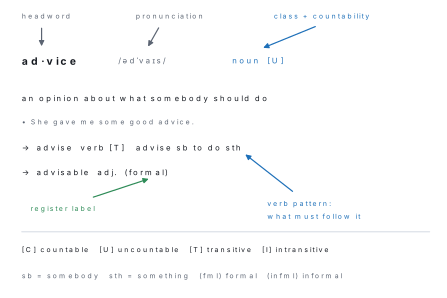
How to read the entry.
- Headword and syllables. ad·vice shows where the word breaks at a line end and where the stress may fall.
- Pronunciation is in IPA between slashes. The mark ˈ comes before the stressed syllable: /ədˈvaɪs/ is stressed on the second syllable.
- Word class label, with [C] or [U] for nouns and [T] or [I] for verbs. This one label tells you whether an advice is possible. It is not.
- Verb pattern, e.g. advise sb to do sth, succeed in doing sth, prevent sb from doing sth. Copy the pattern exactly and the preposition errors in §21.4 disappear.
- Register label: (formal), (informal), (old-fashioned), (offensive), (British/American). Useful in Q8 vocabulary items that ask for a word of the same meaning "in formal English".
Words are listed in alphabetical order, letter by letter to the end of the word: cheap, check, cheek, cheer, cheese. The guide words at the top corners of a printed page show the first and last headword on it, so you can find a page without scanning every entry.
When Q7 gives (construct) or (happy), ask two questions in this order:
(1) Which class does the slot need? — look at what stands immediately before
and after it. (2) Which form of the cue is that class? Only then write. Blanks
after the / a / my / some need a noun; blanks after be / seem / become or
before a noun need an adjective; blanks modifying a verb need an adverb.
Problem. Rewrite formally: They've told us they won't come, so we'd better start without them.
Solution — step by step.
- Mark every apostrophe: They've, won't, we'd.
- Expand each, deciding the ambiguous ones from what follows. They've + past participle told = they have. won't = will not (irregular). we'd + better = we had (the fixed phrase is had better).
- Rewrite, keeping everything else unchanged.
Answer. They have told us they will not come, so we had better start without them.
Problem. State the word class of each underlined word: Unfortunately, the bus from Pokhara arrived very late because of the landslide.
Solution.
| Word | Test applied | Class |
|---|---|---|
| bus | follows the determiner the; is the thing doing the arriving | noun |
| arrived | carries the tense; can become arrives / will arrive | verb |
| late | tells us when about the verb arrived; not describing a noun | adverb |
| because | joins the main clause to the reason that follows | conjunction |
Note that late would be an adjective in the late bus, where it describes the noun. Always test the word in its own sentence.
Chapter summary
- The eight classes are noun, pronoun, verb, adjective, adverb, preposition, conjunction and determiner; class is decided by the job the word does in that sentence, not by its spelling.
- Uncountable nouns — information, advice, furniture, luggage, equipment, news, work, traffic — have no plural and take no a/an; count them with a piece of.
- Every verb has five forms: V1, -s, V2, V3, -ing. Learn irregulars as a row.
- Only transitive verbs have objects, and only transitive verbs can be made passive.
- Do not add prepositions English does not want: discuss, return, reach, enter, marry, resemble, emphasise, comprise take a direct object.
- Contractions replace missing letters with an apostrophe: 's = is/has, 'd = had/would; won't and shan't are irregular; its ≠ it's.
- A dictionary entry gives class, countability [C]/[U], transitivity [T]/[I], verb pattern and register — all the grammar a Q7 item can test.
Practice questions
Fill in the blanks with the correct form of the word in brackets (1 mark each)
- The ____ of the new bridge over the Trishuli took eighteen months. (construct) [1]
- She spoke ____ about the problems of her village. (passion) [1]
- His ____ to help the flood victims impressed everyone. (will) [1]
- The medicine is not ____ for children under five. (advise) [1]
- Tourism has ____ the economy of Pokhara. (strength) [1]
- We were given very little ____ about the scholarship. (inform) [1]
- The teacher explained the lesson ____ so that everyone understood. (clear) [1]
- Dashain is the most widely ____ festival in Nepal. (celebrate) [1]
Answers
1. construction — a noun is needed after The and before of.
2. passionately — an adverb modifying the verb spoke.
3. willingness — a noun is needed as the subject head after His.
4. advisable — an adjective is needed after the linking verb is.
5. strengthened — the slot after has needs a past participle (verb).
6. information — an uncountable noun after the quantifier very little.
7. clearly — an adverb telling us how he explained.
8. celebrated — a past participle used as an adjective before the noun festival.
Correct the errors in the following sentences (1 mark each)
- He gave me many useful informations about the college. [1]
- We discussed about the flood relief programme for two hours. [1]
- The police has arrested the two suspects. [1]
- Please return back my dictionary tomorrow. [1]
- She is my best friend and I like her advices. [1]
- The bus reached at Butwal at seven o'clock. [1]
- My uncle has bought two new furnitures for the shop. [1]
- The dog wagged it's tail when it saw the child. [1]
- He could not cope up with the pressure of the examination. [1]
- Can you please explain me this rule once more? [1]
Answers
9. He gave me much useful information about the college. — information is uncountable, so no plural and no many.
10. We discussed the flood relief programme for two hours. — discuss is transitive; it takes no about.
11. The police have arrested the two suspects. — police is a plural noun.
12. Please return my dictionary tomorrow. — return already means "give back"; back is redundant.
13. … I like her advice. — advice is uncountable; for units say pieces of advice.
14. The bus reached Butwal at seven o'clock. — reach takes a direct object, arrive takes at/in.
15. … two new pieces of furniture … — furniture is uncountable.
16. The dog wagged its tail … — possessive its has no apostrophe.
17. He could not cope with the pressure … — the verb is cope with, not cope up with.
18. Can you please explain this rule to me once more? — explain cannot take an indirect object without to.
Rewrite as instructed (1 mark each)
- I've never seen such a crowd at Pashupatinath. — Rewrite using full forms. [1]
- She is not coming because she does not feel well. — Rewrite using contractions. [1]
- He's finished his homework. — Expand the contraction correctly. [1]
- We'd rather travel by bus. — Expand the contraction correctly. [1]
- I am late, ____ I? — Complete with the correct contracted question form. [1]
- The students hostel is behind the library. — Insert the apostrophe correctly. [1]
Answers
19. I have never seen such a crowd at Pashupatinath. — 've is always have.
20. She isn't coming because she doesn't feel well. — standard negative contractions.
21. He has finished his homework. — 's before a past participle is has.
22. We would rather travel by bus. — the fixed phrase is would rather.
23. aren't — English uses aren't I? because amn't does not exist.
24. The students' hostel is behind the library. — plural possessive: apostrophe after the -s.
Identify the word class of the word in bold (1 mark each)
- The light in the classroom was too dim. [1]
- Please light the lamp before the puja begins. [1]
- He carried a light bag up to Sarangkot. [1]
- She hardly ever visits her village now. [1]
- The shop is between the bank and the post office. [1]
- Although it was raining, the match continued. [1]
Answers
25. Noun — it follows the determiner The and is the subject.
26. Verb — it is the imperative, the action being ordered.
27. Adjective — it describes the noun bag.
28. Adverb — ever modifies the verb visits (frequency).
29. Preposition — it relates the noun phrase the bank and the post office to the shop.
30. Conjunction — it joins a subordinate clause to the main clause.
Practise more: English question bank