Unit 14 · Literature - Essays · 37 min read
How to Live Before You Die
What the syllabus asks for 6
- About the author
- The speech
- What the speech argues
- Themes
- Style and technique
- Glossary
This is not an essay written at a desk. It is a speech, delivered out loud to several thousand people on a summer afternoon, by a man who had been told a year earlier that he had a few months to live. Steve Jobs told the graduating class of Stanford University three stories from his own life — no statistics, no advice list, no famous quotations except one on a book cover — and left them with four words. The speech has since been watched tens of millions of times, and the reason it works is worth studying as carefully as the message itself.
Be able to name the three stories — connecting the dots, love and loss, death — and say in one sentence what each teaches. Then be able to state the single argument they add up to: your time is short, so spend it on work you love and on a life that is genuinely your own. Questions on style will ask about the personal-narrative technique, the tripartite structure and the two mottos, "Don't settle" and "Stay Hungry. Stay Foolish."
14.1 About the author
Steven Paul Jobs (1955–2011) was an American businessman, inventor and designer, and the co-founder of Apple Inc. He was born in San Francisco to an unmarried graduate student who gave him up for adoption, and was brought up in California by Paul and Clara Jobs — a machinist and a bookkeeper, the "working-class parents" of the first story.
He enrolled at Reed College in Portland, Oregon, in 1972 and left after one semester, though he stayed on the campus for about eighteen months sitting in on classes that interested him. In 1976, with his friend Steve Wozniak — the "Woz" of the speech — he founded Apple, and in 1984 the company released the Macintosh, the first widely sold computer with a graphical screen, a mouse and beautiful typefaces. In 1985, after a disagreement with the chief executive he had himself recruited, the board of directors sided against him and Jobs left the company he had started.
The next eleven years produced the second half of his career. He founded NeXT, a computer company; he bought a small computer-graphics division and turned it into Pixar, which made Toy Story (1995), the first full-length computer-animated film; and he married Laurene Powell. In 1996 Apple bought NeXT, and in 1997 Jobs returned to Apple as its head. The products that followed — the iMac, the iPod, iTunes, the iPhone (2007) and the iPad (2010) — changed how the world listens to music, carries a telephone and reads. Fortune magazine named him the most powerful person in business in 2007.
In 2003 he was found to have a tumour of the pancreas. He recovered from the surgery described in the third story and worked for eight more years. He resigned as chief executive in August 2011 and died on 5 October 2011.
In American universities, commencement is the graduation ceremony, so called because it marks not the end of study but the beginning of adult working life. A distinguished guest is invited to give a short speech called the commencement address. Jobs delivered this one at Stanford University on 12 June 2005. Part of its charm is the irony he admits in his second sentence: the speaker never graduated from college himself.
Stanford calls it the 2005 Stanford Commencement Address. The title used in your textbook, "How to Live Before You Die", is the name under which the video was later published as a TED talk. They are the same speech. Many students also know it as the "Stay Hungry, Stay Foolish" speech, from its closing words.
14.2 The speech
The opening frame. Jobs begins by disarming his audience. He says he is honoured to be at a commencement at one of the finest universities in the world, then immediately admits that he never graduated from college and that this is the closest he has ever come to a college graduation. He announces his plan in a sentence a child could follow: three stories from his life, "That's it. No big deal." Having set that low expectation, everything that follows exceeds it.
The first story: connecting the dots
Jobs dropped out of Reed College after six months, but stayed on as a "drop-in" for another eighteen months. To explain why, he goes back to before his birth. His biological mother, a young unmarried graduate student, arranged for him to be adopted by a lawyer and his wife, who changed their minds at the last moment because they wanted a girl. A couple on the waiting list were telephoned in the middle of the night — "We have an unexpected baby boy; do you want him?" — and said, "Of course." When his biological mother learnt that the adoptive mother had never finished college and the adoptive father had never finished high school, she refused to sign the papers, and relented only when the couple promised that the child would one day go to college.
Seventeen years later he did go — to a college almost as expensive as Stanford, paid for out of his parents' entire savings. After six months he could not see the value of it: he had no idea what he wanted to do, and no idea how college would help him find out. So he dropped out and trusted that things would work out. It was frightening, and it also freed him. He stopped attending required classes that bored him and began dropping in on ones that interested him. He slept on friends' floors, returned Coke bottles for the five-cent deposit to buy food, and walked seven miles across town every Sunday night for one good meal at the Hare Krishna temple. His verdict on all this is three words long: "I loved it."
The example he gives is the famous one. Reed at that time taught perhaps the finest calligraphy in the country; every poster and every drawer label on the campus was beautifully hand-lettered. Freed from the required curriculum, Jobs took a calligraphy class and learnt about serif and sans-serif typefaces, about the spacing between letter combinations, about what makes typography great. It had, he says, no hope of any practical application in his life.
Ten years later, designing the first Macintosh, all of it came back, and they built it into the machine. The Mac became the first computer with beautiful typography — multiple typefaces, proportionally spaced fonts — and since Windows copied the Mac, it is likely that no personal computer would have had them if Jobs had never dropped in on that one class.
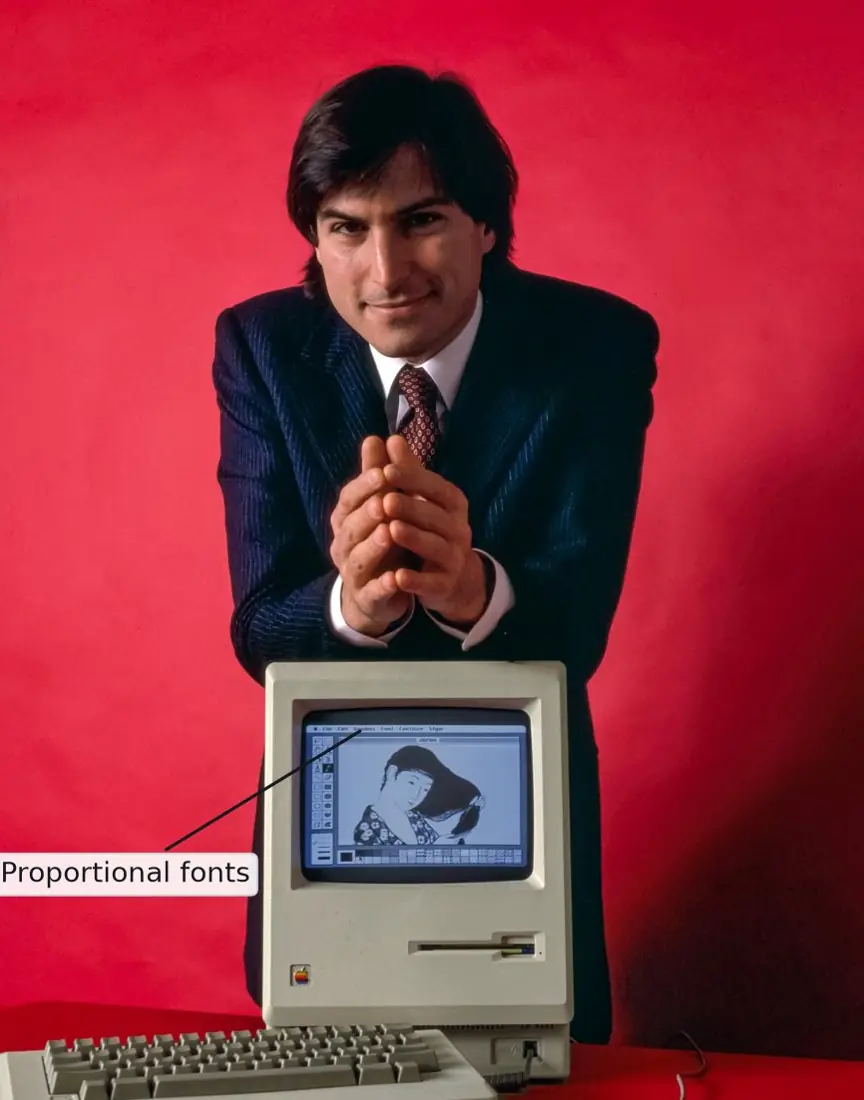
The lesson is stated as a general law: you cannot connect the dots looking forward, only looking backward, so you have to trust that they will somehow connect in your future — "your gut, destiny, life, karma, whatever." Notice that Jobs does not claim the dots will connect. He claims that believing they will is the only workable way to live forward, and that for him it "has made all the difference."
The second story: love and loss
He was lucky, he says, to find early what he loved doing. He and Wozniak started Apple in his parents' garage when he was twenty; in ten years it grew from two people to a two-billion-dollar company with over four thousand employees. They had just released the Macintosh, and he had just turned thirty. And then he was fired.
Jobs asks the obvious question — how can you be fired from a company you started? — and answers it plainly. Apple had hired someone he thought very talented to run the company with him; after a year their visions of the future diverged; there was a falling out; and the board of directors sided with the other man. "So at 30 I was out. And very publicly out." What had been the focus of his entire adult life was gone, and it was devastating.
He describes the months that followed without softening them. He felt he had let the previous generation of entrepreneurs down — that he had "dropped the baton" as it was passed to him. He apologised to David Packard and Bob Noyce for failing. He thought about leaving Silicon Valley altogether. Then something slowly dawned on him: he still loved the work. Being rejected had not changed that. "I had been rejected, but I was still in love."
What followed is the reversal. The heaviness of success was replaced by the lightness of being a beginner again, and the five years after his dismissal were among the most creative of his life: NeXT, Pixar, Toy Story, and his marriage to Laurene. Then Apple bought NeXT, Jobs returned, and NeXT's technology became the foundation of Apple's revival. Getting fired, he concludes, was the best thing that could have happened to him — "awful tasting medicine, but I guess the patient needed it."
From this he draws his second rule, and it is the most quoted passage of the speech: find what you love. Work will fill a large part of your life, and the only way to be truly satisfied is to do work you believe is great; the only way to do great work is to love what you do. If you have not found it, keep looking, and do not settle.
The third story: death
At seventeen Jobs read a sentence to the effect that if you live each day as if it were your last, one day you will certainly be right. For thirty-three years afterwards he looked in the mirror each morning and asked whether, if this were the last day of his life, he would want to do what he was about to do; whenever the answer was "No" too many days running, he knew something had to change.
Remembering that he will soon be dead is, he says, the most important tool he has ever found for making big choices, because external expectations, pride and the fear of embarrassment or failure all fall away in the face of death, leaving only what actually matters. It is also the best defence against the fear of loss: "You are already naked. There is no reason not to follow your heart."
Then the story turns personal and frightening. A year before the speech, a scan at half past seven one morning showed a tumour on his pancreas — an organ he says he could not have identified. The doctors told him it was almost certainly incurable and that he had three to six months. He was advised to go home and get his affairs in order, which he translates for his young audience with terrible plainness: tell your children in a few months everything you expected to have ten years to tell them; arrange things so that it is as easy as possible for your family; say your goodbyes.
He lived with that sentence all day. That evening a biopsy was taken with an endoscope, and the cells proved to be a rare form of pancreatic cancer that surgery could cure. He had the operation and, in 2005, was well. The episode lets him speak about death with authority rather than as an idea: he has been closer to it than an intellectual concept allows.
The conclusion he draws is the boldest claim in the speech. Nobody wants to die, he says; even people who want to go to heaven do not want to die to get there. And yet death is the destination everyone shares, and that is as it should be, because "Death is very likely the single best invention of Life." It is life's change agent: it clears out the old to make room for the new. The graduates in front of him are the new; before long they will be the old and will be cleared away in their turn. He apologises for the drama and insists on the truth of it.
From that comes his last set of instructions, addressed straight to the graduates: your time is limited, so do not waste it living someone else's life; do not be trapped by dogma, which is living with the results of other people's thinking; do not let the noise of others' opinions drown out your own inner voice; and above all have the courage to follow your heart and intuition, which already know what you truly want to become.
The ending
Jobs closes with an object rather than an argument. The Whole Earth Catalog, created by Stewart Brand in Menlo Park in the late 1960s, was one of the bibles of his generation — made with typewriters, scissors and Polaroid cameras, "sort of like Google in paperback form, 35 years before Google came along," idealistic and full of tools and ideas. On the back cover of its final issue, beneath a photograph of an early-morning country road, were the words "Stay Hungry. Stay Foolish." Jobs says he has always wished that for himself, and now wishes it for the graduates. He repeats the four words and thanks the audience.
14.3 What the speech argues
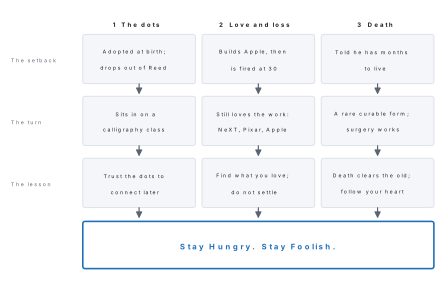
Read as an argument rather than as three anecdotes, the speech makes one claim in three movements.
A life cannot be planned forward, only understood backward. The calligraphy story is not really about fonts. It is a demonstration that the most useful thing Jobs ever learnt was something he chose for no reason except that he liked it, and whose value was invisible for a decade. If that is how a life actually works, then the sensible response is not to plan harder but to follow curiosity and trust.
What survives failure is what you love. The second story tests the first. Jobs lost the thing his whole adult identity was built on, in public, at thirty. What he did not lose was the love of the work — and because that survived, the career could be rebuilt. Loving the work is therefore not sentiment; in Jobs's account it is the only thing durable enough to build on.
Death is what makes the first two urgent. Without the third story the speech would be pleasant encouragement. The third supplies the pressure. If time is genuinely limited and the end is genuinely certain, then living out other people's expectations is not merely unsatisfying, it is a waste of the only span you get. The three stories are therefore a single chain: trust yourself, because you can only understand your path afterwards; do what you love, because that is what lasts; and do it now, because you will die.
Jobs defines the word himself, and his definition is worth memorising because the examiners like it: dogma is "living with the results of other people's thinking." A dogma is a belief accepted as true without being tested — inherited rather than examined. He does not ask his audience to reject tradition; he asks them not to let inherited conclusions do their thinking for them.
14.4 Themes
Failure as a beginning. Every one of the three stories runs through a disaster: a broken adoption, a dropped-out degree, a public sacking, a death sentence from a doctor. In each case the disaster turns out to be the doorway. This repetition is the engine of the speech; it teaches resilience by demonstration rather than by exhortation.
Following your own voice. The word "intuition" appears at both ends of the speech — in the first story, where curiosity and intuition lead him into the calligraphy class, and in the third, where heart and intuition "somehow already know" what a person wants to become. Against them Jobs sets dogma, external expectations and "the noise of others' opinions."
Love of work. Jobs makes an unusual claim: that excellence is a by-product of love rather than of discipline. "The only way to do great work is to love what you do." The practical instruction that follows — keep looking, don't settle — is the part most useful to an eighteen-year-old choosing a subject.
Mortality as a clarifier. Death in this speech is not frightening but useful — a tool, a change agent, an editor that strikes out everything inessential. For a young audience this is a deliberately uncomfortable idea, and Jobs knows it: "Sorry to be so dramatic, but it is quite true."
Curiosity and chance. The Coke bottles, the seven-mile walk, the Hare Krishna temple, the drawer labels at Reed — the speech is full of small accidental things that turned out to matter. Its quiet suggestion is that a life open to accident gathers more useful material than a life tightly planned.
14.5 Style and technique
The tripartite structure. Three stories, announced in advance, delivered in order, each ending in a rule. Grouping in threes is among the oldest devices in rhetoric because it is the smallest number that creates a pattern; by the third story the audience knows the shape and can concentrate on the content. Announcing the plan at the start ("Today I want to tell you three stories") also relieves the listeners of wondering where the speech is going.
Personal narrative rather than advice. Jobs never says "you should be resilient." He tells what happened to him and lets the audience draw the conclusion — and because the events are verifiable and unflattering (dropping out, sleeping on floors, being sacked, being frightened by a scan), the speaker earns the right to advise. A young audience that would resist a lecture accepts a story. This is why the technique is so effective: it converts a sermon into testimony.
Plain, concrete diction. Coke bottles, a garage, drawer labels, a brick, an endoscope, a country road. Abstract nouns are rare and are always cashed out in objects. Even the biggest idea in the speech is given in the plainest possible English: "You are already naked."
Direct address. The pronoun shifts from I to you at exactly the moments where the lesson lands — "You've got to find what you love", "Your time is limited". The stories are his; the instructions are theirs.
| Device | Example from the speech | What it does |
|---|---|---|
| Anaphora (repeated opening) | "Don't be trapped by dogma… Don't let the noise of others' opinions…" | Hammers the final instructions into a rhythm the ear remembers |
| Antithesis (balanced opposites) | "you can't connect the dots looking forward; you can only connect them looking backward" | Turns a life-lesson into a memorable, quotable shape |
| Paradox | "Death is very likely the single best invention of Life" | Shocks the audience into re-examining an idea they had filed away |
| Metaphor | "Sometimes life hits you in the head with a brick" | Makes an abstract setback physical and sudden |
| Extended metaphor | "awful tasting medicine, but I guess the patient needed it" | Recasts a humiliation as treatment, so failure reads as cure |
| Personification | Death as "Life's change agent" that "clears out the old" | Gives death a job, turning a terror into a mechanism |
| Understatement / bathos | "That's it. No big deal. Just three stories." | Lowers expectation and makes the speaker likeable before he asks for trust |
| Rhetorical question | "How can you get fired from a company you started?" | Voices the audience's own objection so it can be answered |
| Allusion | The Whole Earth Catalog, "Google in paperback form" | Bridges his generation and theirs in a single comparison |
| Epigram / motto | "Stay Hungry. Stay Foolish." | Compresses the whole speech into four portable words |
Why the ending works. Jobs finishes with words that are not his own. Having spent fifteen minutes urging his listeners to find their own voice, he hands them a motto he received from somebody else — and by telling them exactly where it came from, he shows the very process he has been recommending: take what you love from wherever you find it, and carry it forward. "Hungry" means never satisfied with what you already know; "Foolish" means willing to look ridiculous by trying what sensible people would not.
14.6 Glossary
| Word | Meaning |
|---|---|
| calligraphy | the art of decorative handwriting or hand-lettering |
| commencement | the graduation ceremony at which degrees are conferred |
| dogma | a principle or belief accepted as true without question |
| drop-in | one who attends classes without being an enrolled student |
| endoscope | a thin instrument passed into the body to look inside it |
| entrepreneur | a person who starts and runs a business, taking the risk |
| generation | all the people born and living at about the same time |
| intuition | knowing something immediately, by feeling rather than reasoning |
| naively | in a way that shows lack of experience or judgement |
| pancreas | an organ behind the stomach that helps digestion |
| proprietor | an owner of a business |
| relent | to give way at last; to change one's mind and agree |
| renaissance | a rebirth or revival |
| sedated | made calm or unconscious with a drug |
| serif | the small finishing stroke at the end of a letter's main stroke |
| typography | the design and arrangement of printed or displayed type |
| unwed | not married |
Dots, Love, Death — in that order. Then attach one image to each: a calligraphy pen, a garage, a mirror. If you can see the three images you can rebuild the whole speech in an examination hall, because each image carries its setback, its turn and its lesson with it.
Chapter summary
- "How to Live Before You Die" is Steve Jobs's commencement address to Stanford University, delivered on 12 June 2005 by a speaker who never graduated from college himself.
- It has a tripartite structure: three autobiographical stories, announced in advance, each ending in a rule for living.
- Story one, connecting the dots: adopted at birth, Jobs drops out of Reed College, sits in on a calligraphy class with no practical use, and ten years later builds that typography into the Macintosh. Lesson — trust that the dots will connect, because you can only join them looking backward.
- Story two, love and loss: he builds Apple from a garage, is publicly fired at thirty, and finds that his love of the work has survived. NeXT, Pixar and a return to Apple follow. Lesson — find what you love, and don't settle.
- Story three, death: a wrong diagnosis of incurable pancreatic cancer, one day lived under sentence, then a curable tumour and successful surgery. Lesson — remembering that you will die clears away pride, fear and other people's expectations.
- The three lessons form one argument: your time is limited, so do work you love and live a life that is genuinely your own.
- Its power comes from personal narrative rather than advice, from plain concrete diction, from antithesis and paradox, and from direct address at the points where the lesson lands.
- It closes on four borrowed words from the back cover of the last Whole Earth Catalog: "Stay Hungry. Stay Foolish."
Practice questions
Short answer questions (2 marks each)
- What is the story about Steve Jobs' birth? [2]
- What does he mean when he says, "you can't connect the dots looking forward; you can only connect them looking backward"? [2]
- What happened when Steve Jobs turned 30? [2]
- What does he mean by "don't settle"? [2]
- Explain: "You have to trust in something — your gut, destiny, life, karma, whatever." [2]
- Explain: "Your time is limited, so don't waste it living someone else's life." [2]
- What does the slogan "Stay Hungry. Stay Foolish." mean? [2]
Model answers — short questions
1. His biological mother was a young unmarried graduate student who decided to give him up for adoption, insisting that he be adopted by college graduates. The lawyer and his wife who were to take him changed their minds at the last moment because they wanted a girl, so a couple on the waiting list were telephoned in the middle of the night and asked whether they wanted "an unexpected baby boy." They said, "Of course." Because the adoptive mother had never finished college and the father had never finished high school, his biological mother refused to sign the papers, and relented only when they promised the boy would one day go to college.
2. He means that the usefulness of an experience is almost never visible at the time, and becomes clear only years afterwards when it turns out to have fed into something else. His own calligraphy class had no apparent purpose when he took it and became essential a decade later. Since you cannot know in advance which experiences will matter, you cannot plan a life logically forward; you can only follow curiosity and trust that the pieces will fit.
3. He was fired from Apple, the company he had founded. Apple had grown in ten years into a two-billion-dollar company with over four thousand employees and had just released the Macintosh. The executive Jobs had recruited to run the company with him came to disagree with him about the future, they had a falling out, and the Board of Directors sided with the other man. Jobs was dismissed publicly, and found that the focus of his entire adult life had gone.
4. "Don't settle" means: do not accept second-best work, or a job you merely tolerate, simply because looking for the right one is difficult or slow. Jobs compares the search to a search for love — you will recognise the right thing when you find it — and insists that until you find it you should keep looking rather than making do. Settling, in his view, guarantees that you will never do great work, since great work only comes from loving what you do.
5. He is admitting that his advice cannot be proved. Since you cannot see ahead, following curiosity instead of a plan requires an act of faith in something — instinct, fate, the divine order, karma. Jobs deliberately offers a list rather than a single name, so that listeners of any religion or none can accept the point. What matters to him is not which belief you hold but that you have enough confidence in your own path to act on it before its value is proved.
6. He means that the shortness of life makes borrowed living wasteful. Most people spend their days meeting other people's expectations, following inherited opinions, and fearing disapproval — but the time so spent is subtracted from the only life they will ever have. Since the span is fixed and unknown, Jobs argues, the only rational course is to follow your own heart and intuition rather than somebody else's plan for you.
7. They were the farewell words on the back cover of the final issue of The Whole Earth Catalog, and Jobs adopts them as his own wish for the graduates. To "stay hungry" is to remain unsatisfied — to keep wanting to learn and to make, instead of resting on what you have already achieved. To "stay foolish" is to keep the courage to attempt what sensible, experienced people would dismiss, and to risk looking ridiculous. Together they describe a life of continuing curiosity and continuing nerve.
Long answer questions (5 marks each)
- "Death is very likely the single best invention of Life." Discuss Jobs' third story and say how far you agree with this claim. [5]
- Jobs contends that you have to love what you do in order to do great work. Do you agree? Argue with reference to the speech. [5]
- Which style of speech does Jobs use to persuade his audience, and why is his personal-narrative technique so effective? [5]
- One of Jobs' mottos was "Think different". Can thinking differently make a person succeed, and what are its difficulties? What makes a visionary different from a fortune teller? [5]
Model answers — long questions
1. The third story moves from an idea to an experience. As a boy of seventeen Jobs read that a person who lives each day as though it were his last will one day be right, and for thirty-three years he used it as a daily test in the mirror. He then describes the morning a scan showed a tumour on his pancreas, the doctors' verdict of three to six months, and the instruction to "get his affairs in order" — which he translates as saying goodbye to his children. The reversal comes that evening, when a biopsy shows a rare curable form of the disease.
Out of this he makes his claim. Death is the destination everyone shares, and it is a good thing rather than a cruelty, because it is "Life's change agent": it clears out the old to make room for the new. The graduates in front of him are the new, and in time they will be cleared away in their turn. The practical value of remembering this is that "all external expectations, all pride, all fear of embarrassment or failure" fall away in the face of death, leaving only what is genuinely important, and that a person who expects to die has nothing left to lose — "You are already naked."
The claim is defensible if it is read as being about usefulness rather than comfort. Death gives a life its shape and its urgency; without a limit there would be no reason to choose one thing over another, and no renewal between generations. It is also true that fear of embarrassment loses most of its force when measured against mortality. Against this, one may object that Jobs speaks as a man who survived: for those who lose a parent or a child, death is not a well-designed mechanism but a bereavement, and telling the grieving that death is an invention of life would be an insult. A fair conclusion is that the line is true as a rule for living and false as a consolation — it is excellent advice about how to spend a life, and no help at all in losing one.
2. Jobs' claim is that work will fill a large part of anyone's life, that the only way to be truly satisfied is to do what you believe is great work, and that the only way to do great work is to love what you do. If you have not found it, he says, keep looking and don't settle; you will know it when you find it, as with any matter of the heart.
The speech supports the claim with evidence rather than assertion. The calligraphy class was chosen purely because Jobs found it fascinating, with no prospect of use, and it produced the one feature that distinguished the Macintosh. More importantly, love of the work is what survived his sacking: "I had been rejected, but I was still in love." Because that remained, the five years that followed became the most creative of his life. The argument is therefore that love of work is not a pleasant extra but the load-bearing part of a career — the thing that keeps a person going when reputation, money and position have all been taken away.
There is much to agree with here. Great work demands years of unrewarded effort, and only genuine interest will sustain attention through the boring middle of any difficult task; a person who dislikes the work will do the minimum, which is exactly what excellence is not. One may still qualify the claim in two ways. First, love often follows competence rather than preceding it: many people grow to love a subject only after becoming good at it, so "keep looking" may sometimes be worse advice than "stay longer." Second, the freedom to hold out for beloved work is not evenly distributed — a student supporting a family cannot simply refuse to settle, and Jobs, speaking at Stanford, addressed the most fortunate audience in the country. The honest position is that Jobs is right about what produces great work, but that his advice assumes a freedom of choice not everyone has; for most people the practical version is to find what can be loved within the work available.
3. Jobs uses the personal narrative or autobiographical style: instead of arguing a thesis, he tells three true stories from his own life and lets each one end in a rule. The speech is informal, conversational and plainly worded, is organised in a tripartite structure announced in advance, and moves steadily from private experience to direct second-person instruction.
The technique is effective for several reasons. It establishes the speaker's right to advise: a man who slept on friends' floors, returned bottles for their deposits, was publicly sacked at thirty and was told he had months to live is not lecturing the graduates from above. It disarms resistance, since a young audience that would reject a sermon will listen to a story. It makes abstractions concrete — resilience is not defined but shown, in a garage, a board meeting and a hospital room. It builds trust by admitting weakness: the second sentence of the speech concedes that he never graduated from college, and the second story admits public failure and apology. And the pattern itself does work, because after the first story the audience can predict the shape and so listens for the meaning.
The language reinforces all this. Jobs prefers short sentences and concrete nouns — Coke bottles, a brick, an endoscope, a country road — and keeps his biggest ideas in the plainest words: "You are already naked." He uses antithesis to make a lesson portable ("looking forward… looking backward"), paradox to startle ("Death is very likely the single best invention of Life"), anaphora to drive the closing instructions home, and a single four-word motto to carry the whole speech away with the listener. The result is a speech that persuades by testimony rather than by argument, and is remembered because it was felt before it was analysed.
4. Jobs' company campaigned under the slogan "Think different", and the speech is that slogan turned into autobiography. Thinking differently clearly can produce success: every one of Jobs' achievements began with a refusal of the ordinary view. Staying at Reed as a drop-in rather than a student, believing that a calligraphy class belonged inside a computer, and building a company in a garage were all unconventional choices, and the last two reshaped an entire industry. Independent thinking finds the openings that conventional thinking has already searched and abandoned; it is also the only way to do something no one has done before, and therefore the only way to be first.
The difficulties are serious and the speech does not hide them. Different thinking looks like foolishness while it is happening — nobody at Reed could have told Jobs his lettering class was valuable. It attracts opposition: Jobs was outvoted by his own board and dismissed from his own company. It carries real risk of failure, and of public failure, which is why he speaks of apologising to David Packard and Bob Noyce and of wanting to run away. It costs security, since the unconventional route rarely has a salary attached, and it demands that a person hold a belief for years without evidence, which is exactly why Jobs says you have to trust "your gut, destiny, life, karma, whatever."
A visionary is someone who sees clearly what does not yet exist but could, and then works to bring it about. The difference from a fortune teller is the difference between making and predicting. A fortune teller claims knowledge of a future that is fixed and outside his control, offers no reasoning that can be checked, and does nothing to bring the future about; his predictions are unfalsifiable and cost him nothing. A visionary makes no claim to know the future — Jobs insists the dots cannot be connected looking forward — but forms a judgement about what people will need, stakes his time, money and reputation on it, and builds the thing that makes the prediction true. The Macintosh did not come true; it was made true, by ten years of work. Vision is therefore accountable and laborious where fortune-telling is neither.
Reference to the context
- Read the extract and answer the questions that follow. "We have an unexpected baby boy; do you want him?" They said: "Of course."(a) Who was the baby boy?(b) What does 'do you want him?' mean?(c) Who does 'they' refer to?(d) Why does Jobs choose to begin his first story here? [5]
- Jobs ends the speech with the words printed on the back cover of the last issue of The Whole Earth Catalog.(a) What was The Whole Earth Catalog?(b) Why does Jobs compare it to Google?(c) Why does he choose to end his own speech with somebody else's words? [5]
Model answers — reference to the context
1. (a) The baby boy was Steve Jobs himself, newly born in San Francisco in 1955 to an unmarried graduate student who had decided to give him up for adoption. (b) It is the adoption agency's telephone call in the middle of the night, asking whether the couple will take the child. Put plainly, it asks whether they will accept a baby they had not been expecting and become his parents — a question about a whole life, asked in six ordinary words. The bluntness of the phrasing, "do you want him", is what gives the line its force: a human being is being offered like an unclaimed parcel. (c) 'They' refers to Paul and Clara Jobs, the working-class couple on the adoption waiting list who became his parents and who later spent their entire savings on his college fees. (d) He begins here for three reasons. First, it answers the question he has just asked — why he dropped out — because the promise his parents made, that he would one day go to college, is what sent him to an expensive one in the first place. Second, it is the earliest possible example of his thesis: his whole life turned on a stranger's late-night decision that could not have been foreseen, which is precisely what "you can't connect the dots looking forward" means. Third, it wins the audience. A speaker who opens by telling several thousand graduates that he was an unwanted baby has made himself human before he makes any demand on them.
2. (a) It was a large American publication created by Stewart Brand in Menlo Park, California, in the late 1960s — a catalogue of tools, books and ideas for people who wanted to build and learn things for themselves. Jobs calls it "one of the bibles of my generation." It was produced with typewriters, scissors and Polaroid cameras, long before personal computers or desktop publishing existed. (b) Because its purpose was the same: it gathered in one place, for anyone who opened it, the information and tools needed to do almost anything — "sort of like Google in paperback form, 35 years before Google came along." The comparison is a bridge between two generations. His listeners of 2005 have never seen the Catalog, but they use a search engine every day, so the analogy tells them instantly what it was and why it mattered. (c) Partly because the words are better than any he could invent: four syllables a side, balanced, memorable, and open enough to mean something to every listener. But the choice also demonstrates his argument. He has spent the speech urging the graduates to follow their own voice, and he ends by showing what that looks like in practice — you take what you love from wherever you find it, acknowledge where it came from, and carry it forward to the next generation. Ending on a farewell message from a publication that had "run its course" also fits the third story exactly: the old is cleared away, and what was good in it is passed to the new. Finally, by repeating the words as his wish for the graduates, he turns a printed sign-off into a personal blessing.
Practise more: English question bank