Unit 16 · Literature - Essays · 40 min read
What is Poverty?
What the syllabus asks for 7
- About the author
- The context
- The essay, paragraph by paragraph
- The definition Parker arrives at
- Themes
- Style and technique
- Glossary
This is the most uncomfortable text in your course, and it is meant to be. It is a definition essay whose writer refuses to define from the outside. Instead of telling you what poverty is, she makes you smell it, hear it and stand in it — and then, in her last line, she turns the whole essay round and asks a question about you rather than about her.
Two things. First, the content: poverty as Parker defines it is not a lack of money but a permanent condition of dirt, illness, tiredness, shame and hopelessness, and she answers, one by one, the three solutions comfortable people offer — welfare, schools, health clinics. Second, the technique: the anaphora ("Poverty is…"), the direct second-person address, the piling-up of concrete sensory detail, the two metaphors of acid and chisel, and the closing question. Almost every question on this text is about one or the other.
16.1 About the author
Almost nothing is known about Jo Goodwin Parker, and this chapter will not invent anything.
What is known is this. In 1971 George Henderson, a professor at the University of Oklahoma, was preparing a book called America's Other Children: Public Schools Outside Suburbia. He received this essay in the post from West Virginia, in the southern United States. It was signed "Jo Goodwin Parker" and it came with a request that no byline — no author's biography — be printed with it. No further information about the essay or its sender was ever discovered.
So the honest position is the one your textbook takes. The author may have been a woman describing her own life exactly as she had lived it; she may have been a writer or social worker who had adopted the voice of such a woman in order to be heard. Nobody knows. Jo Goodwin Parker remains a mystery, and the essay is printed with no biographical data at all.
Some study guides on the internet supply Parker with a birth date, a husband's name and a life story. All of it is fabricated. If an examination question asks about the author, the correct and complete answer is: the writer is anonymous, the essay reached its editor from West Virginia in 1971 with a request for no byline, and nothing further is known. You can then add the more interesting point — that the anonymity is part of the essay's meaning.
Why the anonymity matters. A named author invites the reader to judge the person: is she reliable, is she deserving, did she bring it on herself? An unnamed one cannot be judged, only heard. The voice in this essay is therefore not one woman's case history but the voice of a whole class of people who, as the last paragraph says, are "all around you". It is also a demonstration of the essay's own final claim: the poor are silent, and this is what it sounds like when one of them speaks.
16.2 The context
The essay belongs to the United States of the 1960s and early 1970s. President Johnson had declared a "War on Poverty" in 1964, and the whole country was arguing about welfare payments, food programmes and whether the poor deserved help. Parker is writing into that argument from the inside, from a house eight miles outside a town in the rural South, on seventy-eight dollars a month for a family of four.
Two features of that world must be understood before the essay makes sense. There was no free national health service; a clinic meant a journey and a bill. And welfare was not a right quietly transferred to a bank account but a favour applied for in person, in an office, in front of strangers — which is why the paragraph on asking for help is the emotional centre of the essay.
16.3 The essay, paragraph by paragraph
The opening: "Listen to me"
Parker does not begin with a definition. She begins with an instruction. She places herself physically in front of the reader — dirty, smelling, with rotting teeth — and demands two things: listen, and listen without pity. Pity, she says, she cannot use. She asks the reader to put on her worn-out shoes instead. The whole strategy of the essay is announced here: the reader is not an audience but a person being addressed, accused and enlisted.
Poverty is a smell
The second paragraph builds the world through one sense. It is the smell of a mattress stained with dirt and illness, of urine, of milk gone sour because the refrigerator has not worked for a long time, of spoiling food, of long-cooked onions (onions are cheap), of the outdoor privy, of rotting garbage. And each detail is closed with the same small, devastating explanation: the refrigerator costs money to fix; she could bury the garbage, but a shovel costs money.
Poverty is being tired
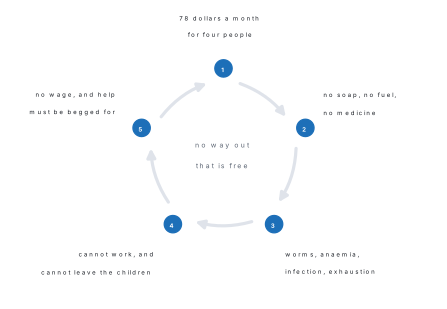
Now the body. She has always been tired. At the hospital, after her last baby, she was told she had chronic anaemia from a poor diet, a bad case of worms, and needed an operation. She listened politely — "the poor are always polite" — and said nothing about there being no money for iron pills, better food or worm medicine. Then the arithmetic that traps her: she once earned twenty-two dollars a week, and decent care for three children cost twenty. When she left them with "Granny", she came home to a baby whose unchanged nappy took the skin with it, one child playing with broken glass and another alone at the edge of a lake. She quit her job. Working made her poorer and endangered her children; not working keeps her poor. This paragraph is the essay's proof that poverty is a trap, not a choice.
Poverty is dirt
Here she answers the comfortable reader directly: anybody can be clean. She explains housekeeping without money. Breakfast is grits without margarine, or cornbread without eggs — which has the advantage of using few dishes. The dishes are washed in cold water without soap, because even the cheapest soap must be saved for the baby's nappies. Hot water is a luxury, because fuel costs money whether it is wood or electricity. She once saved for two months to buy a jar of Vaseline for her cracked hands and the baby's rash; by the time she had the money, the price had gone up two cents, and she went without. She looks far older than she is.
Poverty is danger
Cold nights are spent awake watching the fire, because one spark on the newspaper that covers the walls would burn a sleeping child. In summer, gnats and flies settle on the baby's tears; the window screens are torn and the rent is so low she knows they will never be mended. Insects are in the food, the nose, the eyes. Rain is a disaster because nappies will not dry. The paragraph ends in one of the essay's compressed paradoxes: "Poverty is cooking without food and cleaning without soap."
Poverty is asking for help
The tone changes from description to procedure, and Parker uses the second person throughout, so that it is the reader who walks round the block four or five times before going in. You find the office. You are told the person you have reached is not the person you need. You tell your story — spilling "the whole shame of your poverty all over the desk" — and discover it is the wrong office, and must start again. You are told to wait, and you do not really hear the reason through the shame and despair. Nothing here is about money at all; it is entirely about humiliation.
Poverty is remembering
Only now does she tell her life. She left school in junior high because "nice" children were cruel about her clothes and her smell. Her mother told the attendance officer she was pregnant — she was not — so that she could work. She had jobs off and on, never long enough to learn anything. She married young, and for a time had a small house with hot water and everything the reader has. Her husband lost his job; the unemployment insurance ran out; their things were repossessed; they moved back to this house, which gets worse every week because nothing is ever fixed. Three years, three babies. After the last one she ended the marriage herself — it had been a good one, but she asks the reader whether they could go on bringing children into this dirt, and whether they have ever considered what birth control costs. There were no goodbyes; she hopes he escaped, because he could never rise while they dragged him down. It is a devastating paragraph precisely because there is no self-pity in it.
The figures
Then she gives the number: seventy-eight dollars a month for four people, and that is the most she can ever get. Twenty dollars goes on rent and most of the rest on food — grits, cornmeal, rice, milk, beans. The electricity is rationed, because every unit used is food not bought. That is why there is no soap, no needles and thread, no hot water, no aspirin, no worm medicine, no shampoo — "None of these things forever and ever and ever."
Poverty is looking into a black future
Her children have no future she can see. Respectable children will not play with her boys, so they will find friends who steal; she can already see them behind prison bars instead of the bars of her poverty, or escaping into alcohol and drugs. For her daughter, the best she can imagine is a life like her own.
The three official answers
Parker now takes the three things a comfortable reader is about to say, and answers each one.
There are schools. Yes — but her children have no extra books, magazines, pencils, crayons or paper, and, most important, no health. They have worms, infections, pink-eye all summer; they sleep on the floor or in her one bed; they are not starving but they are malnourished. There is no surplus commodities programme where she lives — the county said it cost too much — and although there is a school lunch programme, two of her children will already be damaged before they ever reach school.
There are health clinics. Yes — and they are in the towns, eight miles away. She could walk sixteen miles there and back; her small children cannot. A neighbour will drive her, but expects payment "one way or another" — and Parker lets the reader work out what that means. Then she turns the knife: you know this neighbour. He is the large man at the petrol station, the barbershop and the corner store, complaining about the government wasting money on immoral mothers of illegitimate children.
There is welfare. She has already shown what applying for it costs in shame, and what it pays.
The verdict, the dream and the demand
Two metaphors deliver the judgement: poverty is an acid that drips on pride until all pride is gone, and a chisel that chips at honour until honour is gone. Then a challenge — some readers say they would do something in her situation, and perhaps they would, for the first week or the first month, "but for year after year after year?"
The dream that follows is almost unbearably modest: money for the right food, worm medicine, iron pills, toothbrushes, hand cream, a hammer and nails and a bit of screening, a shovel, paint, sheeting, needles and thread; money to pay a fare into town; and "oh, money for hot water and money for soap." She also dreams of a welfare office as decent as other government offices, with enough staff, where you tell your story once and are not made to prove your poverty over and over again.
The final paragraph is the turn. She has come out of her despair to speak. She did not come from another place or another time: others like her are all around you. And she asks not for pity but for anger — anger that will make you help her, anger that will make you tell other people about her. Then the last two sentences: "The poor are always silent. Can you be silent too?"
16.4 The definition Parker arrives at
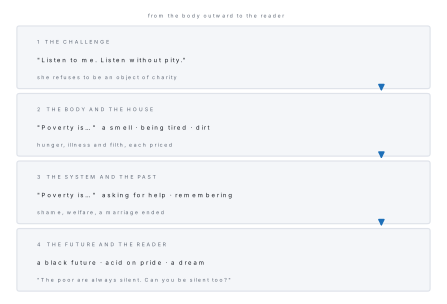
The essay is formally a definition essay, and it does produce a definition — but not the one a dictionary would give. Poverty, for Parker, is not a shortage of money; money is only the mechanism. Poverty is:
- a physical condition — dirt, smell, insects, cold water, rotting teeth, worms, anaemia, permanent tiredness;
- a trap — every escape route costs more than she has, so that working makes her poorer than not working;
- a social humiliation — being pitied, being suspected, being made to prove her need again and again;
- the slow destruction of pride and honour — the acid and the chisel;
- and a sentence passed on her children, who will inherit it.
Notice how the definition is built. She never writes "poverty means…". She writes "Poverty is being tired", "Poverty is dirt", "Poverty is asking for help", and lets forty concrete details do the defining. It is definition by accumulation.
16.5 Themes
Poverty as a total condition, not a lack of cash. Every detail in the essay converts money into something else: a shovel, a jar of Vaseline, two cents, hot water, a bus fare, a night's sleep. The essay's real subject is what the absence of these does to a body and a mind over years.
Shame and the cost of asking. Parker devotes more space to the welfare office than to hunger. The message is that a system which helps people while humiliating them has not finished the job — a point she makes positively in her dream, where the office is decent and you tell your story once.
Prejudice as the real obstacle. The large man at the petrol station is the essay's only fully drawn character apart from the narrator, and that is deliberate. He is comfortable, respectable, idle enough to spend his days talking, and he is the source of the opinion that keeps her poor. Her greatest obstacle is not the weather or the price of soap but what other people believe about her.
Inheritance. The children carry the theme forward. They have no books and no health; they will be damaged before they reach school; the boys will drift to theft or drink; the daughter's best prospect is her mother's life. Poverty in this essay reproduces itself.
Dignity and the refusal of pity. The first paragraph rejects pity and the last demands anger. Between them the narrator never once asks to be felt sorry for. She asks to be believed, and then to be acted on.
Silence and voice. "The poor are always polite. The poor always listen." Both sentences describe the same silence, and the essay exists to break it. The final question transfers the choice to the reader.
16.6 Style and technique
Anaphora. Most paragraphs open with the same two words: Poverty is. The repetition does three jobs at once. It holds a very disorderly experience in a clear shape; it makes the essay a definition by insisting each time that this, too, is what the word means; and it builds a rhythm like hammer blows, so that the accumulation itself becomes the argument.
Direct address. The essay is written to someone: "You ask me what is poverty?", "You can say in your clean clothes coming from your clean house", "I bet you know my neighbour." The reader is given a clean house, clean clothes and comfortable opinions, and then made to occupy the narrator's shoes. In the welfare paragraph the pronoun switches entirely to "you", so that it is the reader who circles the block and spills the shame on the desk.
Concrete sensory detail. Parker almost never uses an abstract noun where an object will do. Sour milk, fly specks, a dried nappy, broken glass, a two-cent rise in the price of Vaseline, newspaper on the walls. Each detail is small enough to be believed and specific enough to be unforgettable, and several carry their own arithmetic — twenty-two dollars against twenty, seventy-eight dollars against a month.
Paragraph development. The pattern is remarkably consistent: a short declarative topic sentence ("Poverty is dirt"), then a challenge or a question, then a run of concrete examples, then a flat closing line that gives the reason — almost always that the thing costs money. That final turn is what converts description into argument.
Metaphor, used sparingly. For most of its length the essay avoids figurative language, which is why the two metaphors near the end land so hard: poverty as acid dripping on pride, and as a chisel chipping at honour. Both are images of slow, mechanical, unstoppable wearing away — exactly the point she has been making about time.
| Device | Example | What it does |
|---|---|---|
| Anaphora | "Poverty is being tired… Poverty is dirt… Poverty is asking for help" | Turns an accumulation of misery into an ordered definition |
| Second-person address | "Put yourself in my dirty, worn out, ill-fitting shoes" | Removes the reader's safe distance |
| Rhetorical question | "but for year after year after year?" | Exposes the emptiness of easy sympathy |
| Metaphor | "Poverty is an acid that drips on pride" | Shows the damage as gradual and chemical, not sudden |
| Parallelism | acid on pride / chisel on honour | Doubles the blow and makes the pair memorable |
| Paradox | "cooking without food and cleaning without soap" | Compresses an impossible daily situation into six words |
| Irony | the neighbour who complains about "immoral mothers" while demanding payment "one way or another" | Convicts the respectable of the vice they denounce |
| Repetition | "over and over and over again"; "forever and ever and ever" | Makes the reader feel duration, which is her central point |
| Understatement | "I listened politely — the poor are always polite" | Hides fury under good manners, which is more damning than anger |
| Closing question | "The poor are always silent. Can you be silent too?" | Transfers responsibility from the writer to the reader |
16.7 Glossary
| Word | Meaning |
|---|---|
| antihistamines | medicines used to treat allergies |
| anemia (anaemia) | a shortage of healthy red blood cells, causing weakness |
| chisel | a steel tool with a cutting edge, used to cut away at stone or wood |
| chronic | long-lasting; continuing over a long period |
| commodities programme | a government scheme distributing surplus food to the poor |
| diaper | a nappy; cloth or paper worn by a baby |
| enslave | to make a slave of; to take away someone's freedom |
| grits | coarsely ground maize boiled into a porridge, a cheap food of the American South |
| illegitimate | born to parents who are not married |
| immoral | not conforming to accepted standards of right behaviour |
| malnutrition | poor health caused by food that lacks the right nutrients |
| oleo | oleomargarine; cheap margarine used instead of butter |
| pink-eye | conjunctivitis, an infection of the eye |
| privy | an outdoor toilet |
| repossessed | taken back by the seller because the instalments were not paid |
| stench | a strong, very unpleasant smell |
| surplus | more than is needed; left over |
| Vaseline | petroleum jelly, used on cracked skin |
How to quote this essay in an answer
You do not need long quotations. Three short ones will carry almost any answer: "Listen without pity" for her refusal of charity, "Poverty is an acid that drips on pride" for the moral damage, and "The poor are always silent. Can you be silent too?" for the ending. Name the device each time — refusal of pity, metaphor, rhetorical question — and you have technique as well as content.
Chapter summary
- "What is Poverty?" (1971) is an anonymous American definition essay sent from West Virginia to the editor George Henderson with a request that no author's biography be printed. Nothing is known about "Jo Goodwin Parker".
- The narrator is a young woman, made old by hardship, living eight miles from town with three children on seventy-eight dollars a month.
- She defines poverty not as a lack of money but as a total condition: a permanent smell, permanent tiredness, dirt that cannot be washed away without soap or hot water, insects, illness, and danger.
- Working made her poorer — twenty-two dollars a week against twenty dollars for childcare — and left her children injured, so she had to stop. Poverty is a trap, not a choice.
- Asking for help costs shame: the wrong office, the repeated story, the waiting, "the red cloud of shame."
- She answers the three usual solutions. Schools cannot help children who have no books and no health; clinics are eight miles away and the lift must be paid for "one way or another"; welfare is seventy-eight dollars and a humiliation.
- Her greatest obstacle is prejudice, embodied in the respectable neighbour who complains about immoral mothers while demanding a price for a car ride.
- Poverty is "an acid that drips on pride" and "a chisel that chips on honour". Her dream is soap, hot water, worm medicine and a welfare office where you tell your story once.
- Technique: anaphora ("Poverty is…"), second-person address, relentless concrete detail, sparing metaphor, and a closing rhetorical question — "The poor are always silent. Can you be silent too?" — which demands anger rather than pity.
Practice questions
Short answer questions (2 marks each)
- What is poverty according to Parker? [2]
- How is poverty difficult for Parker's children? List some specific examples. [2]
- How does Parker try to obtain help, and what problems does she encounter? [2]
- Why does Parker ask the reader to listen without pity? [2]
- Explain: "Poverty is looking into a black future." [2]
- What does Parker mean by "The poor are always silent"? [2]
- Why did Parker give up her job? [2]
Model answers — short questions
1. For Parker, poverty is not simply a shortage of money but a whole condition of life. It is a smell that never leaves the house; it is being always tired, with anaemia, worms and no money for medicine; it is dirt, because soap, hot water and fuel all cost money; it is insects, torn screens and a fire that must be watched all night; it is the shame of asking for help; and it is an acid that wears away pride and a chisel that chips away honour. Above all it is a trap from which every exit costs money she does not have.
2. Her three children suffer in body, in schooling and in prospects. They have worms, infections and pink-eye all summer; they are not starving but they are malnourished; they sleep on the floor or in her single bed; the baby's skin came away with a dried nappy, another child played with broken glass and the eldest was left alone at the edge of a lake. At school they have no extra books, magazines, pencils, crayons or paper — and two of them, she says, will already be damaged before they ever get there. Looking ahead she expects her sons to drift into theft, alcohol or drugs, and for her daughter "at best, there is a life like mine."
3. She goes to the welfare office. She circles the block four or five times before she can make herself go in, and goes only because she thinks of her children. Inside, everyone is busy; the person who eventually comes out is never the person she needs; and after telling her whole story — "spilling the whole shame of your poverty all over the desk" — she is told this is the wrong office and must begin the process again somewhere else, where it is no easier. Finally she is told to wait, and cannot take in the reason because of the shame and despair. The problems are therefore not only bureaucratic delay but repeated humiliation, and the payment at the end is seventy-eight dollars a month for four people.
4. Because pity is useless to her — "I cannot use your pity." Pity lets the listener feel kind while changing nothing, and it places the poor person below the listener as an object of charity rather than beside them as a person with a case. What Parker wants instead is first understanding ("Listen with understanding… put yourself in my shoes") and finally anger — anger that will make the reader act and speak on her behalf. The refusal of pity at the start and the demand for anger at the end frame the whole essay.
5. It means that Parker can see her children's future and it is as hopeless as her present. Respectable families will not let their children play with her sons, so the boys will attach themselves to boys who steal, and she can already picture them "behind the bars of their prison instead of behind the bars of my poverty"; or they will escape into alcohol or drugs and be enslaved by them. For her daughter the best she can imagine is a repetition of her own life. The sentence states the essay's bleakest theme — that poverty is inherited — and the word "black" carries no hope of dawn.
6. She means that poor people do not complain, do not protest and are never heard. Earlier she has explained why: "the poor are always polite. The poor always listen" — they accept a doctor's advice they cannot afford without saying so, because objecting is dangerous and useless, and because shame keeps them quiet. Their silence is what allows comfortable people to believe whatever they like about them. This is why the essay exists: it is one of the silent speaking. And because the next sentence is "Can you be silent too?", the phrase also becomes a challenge — she has broken her silence, and the reader no longer has an excuse for keeping his.
7. Because working cost more than it earned and endangered her children. She was making twenty-two dollars a week, while a good nursery school for three children cost twenty dollars a week, so almost nothing remained. When she left the children with "Granny" instead, she came home to find the baby covered with fly specks in a nappy that had not been changed — so hardened that when it came off, bits of the baby's flesh came with it — one child playing with a sharp piece of broken glass and the eldest alone at the edge of a lake. The episode is her central proof that poverty is a trap rather than laziness.
Long answer questions (5 marks each)
- Why are people's opinions and prejudices Parker's greatest obstacles? [5]
- How does Parker discount the usual solutions society offers for poverty — welfare, education and health clinics? [5]
- What writing strategy does Parker use at the beginning of most of her paragraphs? How does she develop each paragraph, and how does the final paragraph use questions to involve the reader? [5]
- Using adjectives that highlight the futility of the situation, write a short definition essay on "Growing up in Poverty", imitating Parker's style. [5]
Model answers — long questions
1. Money, food and medicine are all things Parker could be given. Opinions cannot be, and it is opinions that decide whether she is given anything at all. That is why she calls them, in effect, her greatest obstacle.
The prejudices are named one by one in the essay. The first is that cleanliness is a matter of will: "Anybody can be clean," says the reader in clean clothes, coming from a clean house — and Parker has to spend a whole paragraph explaining that soap, hot water and fuel are purchases, not decisions. The second is that the poor are lazy. Her answer is arithmetic: she worked for twenty-two dollars a week when childcare cost twenty, and the children were injured and neglected while she did it. The third is that the poor are immoral and deserve what they get, and this is the one she attacks hardest, through the only other character she draws in the whole essay — the large man who spends his days at the gas station, the barbershop and the corner store "complaining about the government spending money on the immoral mothers of illegitimate children," and who is also the neighbour who will drive her to the clinic but "expects to get paid, one way or another." In two sentences she convicts the respectable of exactly the vice they denounce.
These opinions are obstacles in the most practical sense. They decide how much welfare is voted and how the office treats her; they are why she must prove her poverty over and over again, and why asking for help costs so much shame; they are why her county decided a surplus commodities programme cost too much; they are why respectable children will not play with her sons, which in turn decides the company the boys will keep. The other hardships wear down her body; prejudice wears down her pride and closes the exits. This is also why the essay's final demand is for anger rather than money — anger is what changes an opinion, and opinion is what has to change first.
2. Parker deals with the three standard answers in turn, and in each case her method is the same: she agrees that the thing exists, and then shows that it cannot reach her.
Welfare. She does not deny that help is available — she is receiving it. She attacks it on two grounds. The first is the amount: seventy-eight dollars a month for four people, of which twenty goes on rent and almost all the rest on grits, cornmeal, rice, milk and beans, with electricity rationed because every unit used is food not bought. That is why there is no soap, no aspirin, no worm medicine, no shampoo, "none of these things forever and ever and ever." The second, and to her the worse, is the cost in dignity: circling the block before going in, the wrong person, the wrong office, the whole shame spilt across a desk, the waiting, the proving of her poverty again and again. Her dream is not for a larger cheque alone but for an office as decent as other government offices, with enough staff, where you tell your story once.
Education. "But you say to me, there are schools. Yes, there are schools." The concession is followed by the destruction. Her children have no extra books, no magazines, no pencils, crayons or paper — and, most important of all, no health. They have worms and infections and pink-eye; they sleep on the floor; they suffer from malnutrition even though they are not hungry. A school lunch programme exists, but two of her children will already be damaged by the time they reach school, and there is no surplus commodities programme in her county because it was judged too expensive. Her point is that schooling can only work on a child who arrives fed, rested and well; poverty has already disabled the remedy before it is applied. She adds, drily, that she does remember what she was taught about health at school, and that it does not do much good.
Health clinics. Again the concession: yes, there are clinics — "and they are in the towns." She lives eight miles out. She could walk sixteen miles there and back; her small children cannot. The neighbour with the car will take her, but expects payment "one way or another," and that neighbour is the respectable man who denounces immoral mothers. So the clinic is real, free at the point of entry perhaps, and completely inaccessible.
Taken together, the three refutations make one argument. Society's solutions are designed for people who already have the minimum — transport, health, decency of treatment, time. Poverty removes precisely those things, so that the poorer a person is, the less able she is to use the help that exists. It is not that the remedies are absent; it is that they are out of reach.
3. The opening strategy. Parker begins most of her paragraphs with the same two words — "Poverty is". "Poverty is being tired." "Poverty is dirt." "Poverty is asking for help." "Poverty is remembering." "Poverty is looking into a black future." "Poverty is an acid…" This is anaphora, and there is a clear recurring pattern: each paragraph is a fresh, complete definition of the same word. The effect is threefold. It imposes order on an experience that is otherwise shapeless; it keeps reminding the reader that the essay is answering the question in its title; and the hammering repetition makes the accumulation itself feel like an argument, as though the word had to be defined again and again because no single definition could hold it. A second, connected strategy is the frequent opening concession — "But you say to me, there are schools" — which allows her to voice the reader's objection before demolishing it.
Paragraph development. Each paragraph is then built the same way: a short flat topic sentence; a challenge or a question to the reader; a run of small, exact, physical details; and a closing sentence that supplies the reason, which is almost always that the thing costs money. "I could bury it, but where is the shovel? Shovels cost money." What makes each paragraph memorable is the quality of those details. They are specific enough to be checked — the refrigerator that has not worked, the onions that are cheap, the two-cent rise in the price of Vaseline after two months of saving, the dried nappy that took the baby's skin with it, the twenty-two dollars against the twenty. They also work through the senses, especially smell and touch, which are the senses a comfortable reader can least easily ignore. And the tone is level throughout: she never raises her voice, which makes the facts do all the work.
The final paragraph. The questions at the end change the reader's position from spectator to participant. Throughout the essay Parker has used the second person to place the reader in her shoes; now she uses it to place a demand on them. She tells them she did not come from another place or another time, and that "others like me are all around you" — so the problem is local and present, not distant. She asks them to look at her "with an angry heart", defining the anger precisely: "anger that will help you help me. Anger that will let you tell of me." Then the closing pair: "The poor are always silent. Can you be silent too?" This is a rhetorical question, and it is unanswerable in the reader's favour. To say yes is to admit indifference; to say no is to accept a duty. Because the essay has spent its whole length establishing that she has no voice and the reader has one, the question also transfers the work: she has broken her silence at the cost of describing her own degradation, and the only decent response is for the reader to break his.
4. (A model imitation. Notice the repeated opening, the second-person address, the concrete detail and the flat closing reason.)
Growing up in Poverty
You ask me what it is to grow up poor. I will tell you. Do not be sorry for me. Look instead, and remember.
Growing up in poverty is a cold, dark, endless morning. It is waking on a thin mat in a room shared with four others, in clothes you also slept in, because there is only one set and it must last. It is walking an hour to school on an empty stomach because the tea is finished and the flour is for the evening.
Growing up in poverty is being hungry in a room full of books. The teacher speaks, and you hear him, but your head is light and the words slide off. You are not stupid. You are hungry. Nobody in that room knows the difference.
Growing up in poverty is shame. It is the torn shoe you keep behind the other foot. It is the fee you cannot pay, read out in front of the class. It is the friend's house you never invite anyone back from. Shame is cheap; it is the one thing poverty gives you in plenty.
Growing up in poverty is waiting. Waiting for the remittance that is late. Waiting for the health post to have the medicine. Waiting for a father who went to the Gulf when you were six and writes that he will come next year, and next year.
Growing up in poverty is a narrow, fixed, inherited future. Your father dug; you will dig. Your mother left school at twelve; your sister will leave at twelve. The land is too small to divide again, so somebody must go, and it will be you.
Some of you say you would study anyway, and work anyway, and rise anyway. Perhaps you would — for a term, or a year. But for year after year after year, on an empty stomach, in a torn shoe, with nobody at home who can read your homework?
I am not asking for your sympathy. I am asking you to look at the boy at the back of your own classroom, the one who is always tired, and to stop calling him lazy.
Reference to the context
- "Poverty is an acid that drips on pride until all pride is worn away. Poverty is a chisel that chips on honour until honour is worn away."(a) Identify the figure of speech and explain both images.(b) Why are the two sentences built in exactly the same way?(c) What challenge does Parker put to the reader immediately afterwards?(d) Why does she place these lines near the end of the essay? [5]
- "I have come out of my despair to tell you this… The poor are always silent. Can you be silent too?"(a) Where does this come, and what has just preceded it?(b) What does she mean by saying she did not come from another place or another time?(c) What does she ask of the reader, and how does it differ from what she rejected at the start?(d) What is the effect of ending on a question? [5]
Model answers — reference to the context
1. (a) Both sentences are metaphors. In the first, poverty is an acid dripping on pride: acid does not strike, it falls drop by drop and eats away the surface it lands on, silently and without a sound, until nothing is left. In the second, poverty is a chisel chipping at honour: a chisel works by many small blows, each of which removes a little, until the shape of the thing is gone. Both images say the same thing in different materials — that poverty destroys a person not by one great disaster but by continuous small erosion over years. Neither image allows for resistance: you cannot argue with acid. (b) They are built identically — the same grammar, the same rhythm, the same closing phrase "until all/until … is worn away" — which is parallelism. The repetition doubles the force, makes the pair easy to remember, and, most importantly, enacts the very thing being described: the second sentence wears at the reader exactly as the first one did, so the form imitates the content. The pairing of pride with honour also widens the claim from how a person feels about herself to how she stands in the eyes of others. (c) She immediately turns on the reader: some of you say that you would do something in my situation, and maybe you would — "for the first week or the first month, but for year after year after year?" The challenge is aimed precisely at the comfortable listener's confidence that character would save him. Her answer is that character is exactly what is being dissolved, and that no one's survives indefinitely. (d) Because by this point she has earned them. For most of the essay she has refused figurative language and given nothing but hard physical fact — sour milk, fly specks, two cents, seventy-eight dollars. The reader therefore trusts her as a witness, and the two metaphors arrive as a verdict on evidence already heard, rather than as decoration. They also lift the argument from the physical to the moral at exactly the moment she needs to: she is about to ask for anger rather than charity, and anger is a moral response.
2. (a) These lines are the last paragraph of the essay. They follow the modest dream — money for soap and hot water, for worm medicine and a shovel and needles and thread, and for a welfare office where you tell your story once and are not made to prove your poverty over and over again. The essay therefore ends by moving out of description altogether and speaking directly to the reader. (b) She means that she is not a historical example or a foreign case study, and that the reader cannot file her away as somebody else's problem. "Others like me are all around you": the poverty she has described is happening now, in the reader's own country, within walking distance of the reader's own clean house. The sentence blocks the last available escape route, which is distance. (c) She asks for anger — but a very precisely defined anger: "anger that will help you help me. Anger that will let you tell of me." It is not rage for its own sake but the emotion that produces action and speech. This is the exact opposite of what she forbade in her first paragraph, where she said "Listen without pity. I cannot use your pity." Pity looks down and does nothing; anger stands level and acts. The essay therefore begins by refusing one emotion and ends by demanding another, and the whole body of the text is the evidence that justifies the swap. (d) Ending on a rhetorical question does three things. It reverses the direction of the essay: for eleven paragraphs the reader has been examining her life, and in seven words she is examining his. It makes evasion impossible, because both answers convict — to say yes is to confess indifference, to say no is to accept a duty. And it exploits the parallel she has just drawn: the poor are silent because they have no choice, while the reader would be silent by choice, which is a far worse thing. Because the essay stops there, with no reassurance and no conclusion, the question is left with the reader rather than with the writer — which is precisely where she wants it.
Practise more: English question bank