Unit 20 · Literature - One Act Plays · 48 min read
Refund
What the syllabus asks for 7
- About the author
- The characters
- The play, step by step
- The double trap
- Themes
- Satire, humour and technique
- Glossary
A man walks into his old school eighteen years after leaving it and asks for his tuition fees back, on the grounds that he was taught nothing. To prove it, he sets out to fail an examination on purpose. The school, to protect its reputation, sets out to make sure he passes. Refund is a farce built on that single absurd collision — and it is one of the sharpest attacks on examinations ever put on a stage.
Wasserkopf's demand and his reason for it; the staff's counter-plan ("we agree beforehand that they are correct"); the four examinations — the question, the ridiculous answer and the learned excuse in each; the Mathematics Master's double trick; the final reversal and the closing boast; the satire on the education system; and a character sketch of Wasserkopf.
20.1 About the author
Fritz Karinthy (1887–1938) — in Hungarian, Frigyes Karinthy — was a Hungarian satirical writer. He excelled as a novelist, short story writer, poet, essayist and playwright. Deeply interested in the natural sciences, he studied to be a teacher but became a journalist and joined the literary periodical Nyugat ("West"), the most important Hungarian literary magazine of its day.
Strongly philosophical and humanistic in his outlook, he raised his powerful voice against the barbarism and horrors of the First World War. Among the works that won him wide recognition are That's How You Write (1912), a celebrated collection of literary parodies; Please Sir (1916), a comic book about schooldays; Professor; and Journey around My Skull (1939), the extraordinary account of his own brain operation.
Two of those titles matter for this play. That's How You Write shows Karinthy's gift for parody — imitating a serious style so exactly that it collapses into absurdity, which is precisely what the four masters do when they "explain" a nonsensical answer in learned language. And Please Sir, his book about schooldays, shows how long he had been thinking about classrooms, examinations and the war of nerves between master and pupil.
Refund was written in 1938. It was adapted by the American playwright Percival Wilde for a general audience, and the version in your textbook is Wilde's. The play brings out Karinthy's extraordinary sense of parody and word play, and it is full of humour arising from an extraordinarily absurd situation.
Your textbook prints Fritz Karinthy, using the German form of his first name, because the play reached English through German. His real name was Frigyes Karinthy. Write whichever the question paper uses; both refer to the same man. His setting is Hungarian too — the fees are counted in crowns and heller, the Hungarian currency of the period, and the Hungarian money that Leaderer is speculating on in the opening story is the same currency, "down seventy points".
20.2 The characters
| Character | Who they are |
|---|---|
| Wasserkopf | A bearded man "somewhat under forty", carelessly dressed, "energetic and decided". A former pupil of the school, jobless and broke, who has come to demand his fees back |
| The Principal | Thirty years a schoolmaster; terrified of scandal and of the newspapers; also teaches physical culture |
| The Mathematics Master | The shrewdest of the staff. Invents the plan to pass Wasserkopf whatever he says, and springs the final trap. Nicknamed "old stick-in-the-mud" |
| The Physics Master | Explains the world by the law of conservation of energy; chews his thumbs; was nicknamed "cannibal" |
| The History Master | Nervous, slow to think of a question; nicknamed "numskull" by Wasserkopf |
| The Geography Master | Calm and "imperturbable"; the only master who is never rattled; called "hypocrite" and "nitwit" |
| The Servant | Announces Wasserkopf at the beginning and throws him out at the end |
| The Staff | The chorus of masters who cry "Agreed! Agreed!" and "Bravo!" |
A farce is a comedy built on an improbable situation, fast action and exaggerated characters, aiming purely at laughter. A satire uses ridicule to attack a real abuse and to demand reform. A parody imitates a serious style so closely that it becomes ridiculous.
Refund is all three at once. The situation is farcical; the target — an examination system that awards certificates for nothing — is satirical; and the four masters' explanations are perfect parodies of academic reasoning.
Wasserkopf is German for "water-head" — a medical word for a head swollen with fluid, and an everyday insult meaning an empty-headed fool. Karinthy has given his hero a name that means "blockhead", and the whole play is about whether the school can be made to admit it. It is worth mentioning in a character sketch.
20.3 The play, step by step
1. The visitor with a beard
The Principal is at his desk when the Servant announces a caller. The little exchange that follows sets the tone of the entire play. Not a parent, since it isn't office hours; not a pupil, because "He has a beard"; and when the Principal anxiously asks whether the man looks stupid or intelligent, the Servant answers "Fairly intelligent, I'd say, sir" — to which the Principal replies with relief, "Good! Then he's not a school inspector."
That is the first joke, and it is also the play's thesis in one line: the school is an institution that assumes its own inspectors are stupid, and its chief concern is not teaching but not being found out.
2. The demand
Wasserkopf enters, remains standing, and announces himself. The Principal does not remember him. "You were probably glad to forget me," he says, and then states his business: "As a former pupil of this school I want you to refund the tuition fees, which were paid you for my education eighteen years ago."
His reason is a piece of simple consumer logic: "Because I didn't get my money's worth, that's why! This certificate here says I got an education. Well, I didn't. I didn't learn anything and I want my money back."
The idea is not his own, and he says so with wonderful bitterness — it is "such a good idea that I didn't get it out of my own head, thanks to the education I got here, which made nothing but an incompetent ass out of me."
3. Where the idea came from
The idea came from his old classmate Leaderer. Wasserkopf, just fired and "quite broke", met Leaderer in the street hurrying to the broker's to collect money made speculating in foreign exchange. Wasserkopf did not know what foreign exchange was; Leaderer explained that Hungarian money was down seventy points and he had "made the difference"; and when Wasserkopf still could not see how one makes money when money falls, Leaderer said: "Wasserkopf, if you don't know that, you don't know a damn thing. Go to the school and get your tuition fees back."
The detail is important for a good answer. Wasserkopf's sense of failure is not abstract: he has been sacked, he is penniless, and he has just met a schoolfellow who is getting rich by something Wasserkopf cannot even understand. His demand is part grievance and part desperation. He threatens to complain to the Ministry of Education, refuses to leave, and asks for the one thing that will prove his case: "Give me an examination and tell me what I ought to do. Call in the masters and let them say."
4. The conference
The Principal, alarmed, summons the staff and rehearses his speech before they arrive — "It is unprecedented. In the thirty years that I have been a schoolmaster I have never heard of anything like it."
The masters react exactly in character, and this is one of the funniest passages in the play. The Physics Master declares the case perfectly natural: "The law of conservation of energy proves that any given pupil will lose, in any given period, as much knowledge as a teacher can drill into his head in another period of like duration." The History Master begins on the Bourbons, who "learned nothing and forgot nothing". The Mathematics Master wants to know whether the refund is to carry simple or compound interest. The Geography Master asks only, "Where is the fellow, anyhow?"
Then the Mathematics Master produces the plan on which the rest of the play turns:
"The object is to prevent him from failing, because if he fails he succeeds… We will ask him questions. Whatever his answers, we agree beforehand that they are correct."
His reason is purely institutional: "If he fails, tomorrow there will be two more former pupils, and the next day a dozen." The school is not defending its teaching. It is defending itself against a queue.
5. Marks for nothing
Wasserkopf enters without waiting to be shown in, hat over one ear, hands in pockets, and greets the bowing staff with "Who the hell are you? Sit down, you loafers!" — and the stage direction tells us he "grins, waiting to be thrown out".
He is not thrown out. The Mathematics Master repeats the insult to his colleagues as an order, seats them, and congratulates Wasserkopf on his grasp of "the patriarchal manners which we impress upon everybody in this institution", since here "teachers and pupils are on a footing of perfect equality". Marks: Manners: Excellent.
The pattern is now set, and four more grades are awarded for nothing at all:
- He refuses a chair — "To hell with a seat! I'll stand." — and is given Physical Culture: Excellent for his splendid physical condition.
- He sits down at once to avoid the trap — Alertness: Very Good.
- Perseverance: Unusual. Logic: Excellent.
- He snaps "Get on with your questions!" — Ambition: Boundless.
Notice what Karinthy is doing. Before a single subject has been examined, the school has already turned rudeness into manners, obstinacy into perseverance and greed into ambition. Marks, the play suggests, do not describe the pupil; they describe what the institution needs to believe.
6. The four examinations
Each of the four subject examinations has the same three-part shape: a question, an insulting or nonsensical answer, and a magnificent learned explanation proving the answer right.
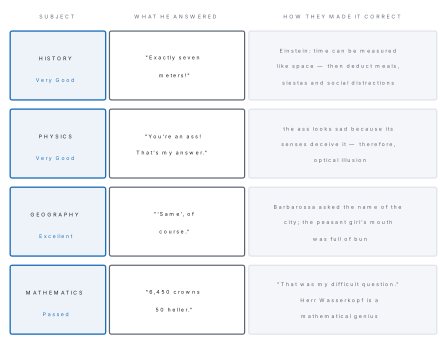
History. Asked how long the Thirty Years' War lasted, Wasserkopf nearly blurts out "Thirt—", catches himself, and after much thought answers in triumph: "Exactly seven meters!" The History Master, swallowing manfully, rules the answer correct, and the Mathematics Master supplies the theory — Einstein, Planck, the quantum theory, relativity: time is as real as space and may be measured like anything else, so a year may be represented by a metre. The History Master then does the arithmetic of the joke: fighting took place only half of each day, which halves thirty to fifteen; the combatants had to eat, reducing fifteen to twelve; deduct siestas, peaceful diversions and non-warlike activities, and the Mathematics Master adds "social distractions" — leaving exactly seven. Grade: History: Very Good.
Physics. Asked whether clocks in church steeples really become smaller as you walk away from them or merely appear to, Wasserkopf answers that clocks always get larger when he walks away from them, and finishes: "you give me a pain in the neck. You're an ass! That's my answer." The Physics Master, furious, controls himself and constructs the most outrageous justification in the play: the ass looks sad; the ass has no imagination, so its illusions must be illusions of the senses; therefore the candidate, by naming the ass, has drawn attention to a creature whose melancholy proves that apparent shrinking with distance is an optical illusion. Grade: Physics: Very Good.
Geography. Asked what city "of the same name" is the capital of the German province of Brunswick, Wasserkopf objects that the answer is part of the question and replies "'Same', of course." The Geography Master — the only master who never loses his temper — instantly produces a legend: the Emperor Barbarossa, on riding into the city, asked a peasant girl with her mouth full of bun what the city was called, and she answered "Same to you, sir"; the Emperor laughed and never called Brunswick anything else. He then "winks solemnly at his colleagues". Grade: Geography: Excellent.
Mathematics. Only one subject is left, and the Mathematics Master announces two questions, "One of them is easy; the other is hard." The easy one is a deliberate nonsense: given the speed of light and the distance of Sirius, find the circumference of a one-hundred-and-nine-sided regular polyhedron whose surface coincides with that of the hip pocket of a State railway employee whose wife has been deceiving him for two years and eleven months with a regimental sergeant-major of hussars. Wasserkopf answers "two thousand six hundred and twenty nine litres. Exact. No fractions."
And the Mathematics Master says no. The correct figure is 2,628 litres. "I refuse to pass the candidate. Mark him 'Failure.'"
7. The double trick, and the end
Wasserkopf bounds up in delight — "I told you so!" — and the Mathematics Master calmly agrees that his request is now reasonable: "Now that I have satisfied myself he cannot pass our examination it is his right to recover the money which was paid us. … How much do we owe you, Herr Wasserkopf?"
And Wasserkopf, "greedily, forgetting everything else", performs the finest piece of mental arithmetic in the play. Six years at the school; three years at 150 crowns quarterly, total 1,800; three years at 400 crowns semi-annually, total 2,400, and 2,400 and 1,800 is 4,200; examination fees 250 crowns 95 heller; certificates, documents, books and stamp taxes 1,241 crowns 43 heller; incidentals, stationery and notebooks 786 crowns 12 heller — grand total 6,450 crowns 50 heller. "Knock off the heller and call it crowns."
The Mathematics Master checks every figure with pencil and paper, says "Exactly!", offers his hand, and springs the trap: "I congratulate you! That was my difficult question." The easy question was a fraction out of the way; the difficult one — how much the refund should be — was exactly correct. "Herr Wasserkopf is a mathematical genius."
The Principal then rises and delivers the verdict: Wasserkopf "has passed with distinction in every subject, and has again shown that he is entitled to the certificate we awarded him on his graduation." The staff accept "a large share" of the congratulations for themselves, for having taught him so excellently. And then, with an eloquent gesture: "get out before I have you thrown out!"
The masters round on him — "So I'm a numskull, am I?" "I'm a cannibal?" "Hypocrite? Nitwit? Ass? Me?" "Old stick-in-the-mud?" — the Servant seizes him by the collar and the seat of his trousers and rushes him off, and the Principal beams at his staff with the last line of the play:
"In the future it will be our proudest boast that in this school a pupil simply cannot fail!"
Add the figures Wasserkopf reads out and the sub-totals in your textbook do not come out exactly — the printed running totals differ from the sum of the parts by a few crowns. This is a misprint in the reprinting, not a puzzle for you to solve. In an examination, quote the grand total as the text gives it — 6,450 crowns 50 heller, "knock off the heller and call it crowns" — and do not lose time trying to correct the intermediate sums. What matters for the answer is that the Mathematics Master checks the figures and says "Exactly!"
20.4 The double trap
The plot of Refund is a contest of cunning in which each side sets a trap and the man who is finally caught is the one who came to catch.
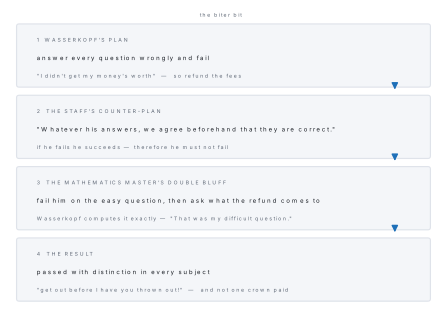
The structure is what critics call the biter bit — the trickster tricked. Its comic force depends on three reversals, each sharper than the last: Wasserkopf expects to be thrown out and is given "Excellent" instead; he expects to be passed and is failed; and he expects, at last, to be paid, and is thrown out after all.
20.5 Themes
Education that certifies without teaching. This is the central theme. The school's answer to a man who says he learned nothing is not to examine what he knows but to sign a paper saying he knows it. The certificate is the play's real subject: Wasserkopf brings his old one back — "Since I'm bringing back the leaving certificate you gave me I suppose I can get along without another one" — and at the end the Principal declares that he "is entitled to the certificate we awarded him on his graduation." Nothing has been taught, nothing has been learned, and the paper is confirmed.
The institution protects itself, not the truth. Every decision in the play is made for the school's reputation. The Principal's first worry is a school inspector, his second is "Suppose it gets into the newspapers", and the Mathematics Master's argument is that a single refund will bring "two more former pupils, and the next day a dozen". "This is a good school. It is our duty to see that nothing ever injures its reputation" is said, deadpan, while the staff are conspiring to falsify an examination.
Education and employment. Wasserkopf's grievance is one every student recognises: he paid for six years of schooling and cannot keep a job. "You took my money and you taught me nothing. Now I'm no good for anything, and I can't do the things that I should have learned in school." The play does not fully endorse him — he is lazy, rude and dishonest — but it refuses to dismiss the complaint either.
Learning treated as a purchase. Wasserkopf's logic is that of a customer returning defective goods, and Karinthy gets much of his comedy out of it: fees, interest, crowns and heller, "my money's worth". The play raises, without answering, the uncomfortable question of whether education can be bought at all — and whether a pupil who did nothing has any claim on the seller.
Knowledge versus cleverness. The final irony is that Wasserkopf really does have an ability: he can calculate six years of fees in his head, to the heller, faster than the mathematics teacher can check them. He has, as the Mathematics Master says, "pursued advanced studies in the school of life". What the school failed to do was notice it.
Language as a disguise. Relativity, the quantum theory, Planck, Einstein, "apperceptive powers", "the law of conservation of energy" — the masters use learned vocabulary the way a conjuror uses a cloth. The play is a warning that impressive words can be used to prove absolutely anything.
20.6 Satire, humour and technique
The central irony is a perfect reversal of purpose. A man tries as hard as he can to fail and cannot; a school that ought to want its pupil to pass tries as hard as it can to avoid refunding him. Both get the opposite of what they set out for, and the final boast — "in this school a pupil simply cannot fail!" — is meant as praise by the Principal and lands on the audience as an indictment.
Parody. Each master's explanation is a faultless imitation of academic argument: a premise, a chain of deductions, a confident conclusion — applied to nonsense. The History Master's deduction of meals and siestas from thirty years, and the Physics Master's proof by way of a sad donkey, are parody at its best, because the form of the reasoning is entirely correct.
Word play. Karinthy builds two whole examinations out of words: "Same" as the name of a city, which turns a grammatical ambiguity in the question into a right answer, and "Seven meters", which answers a question about time with a measure of length. The Geography Master's Barbarossa legend even supplies a second pun inside the first, since the girl's "Same to you" is a greeting, not a name.
Comic exaggeration and absurdity. The mathematics question about the hip-pocket of a railway employee whose wife has been unfaithful for two years and eleven months is deliberate nonsense, and so is Wasserkopf's answer in litres to a question about circumference. The Mathematics Master then rejects it by one litre in two and a half thousand — "his error amounted to less than a tenth of a percent, in the total, but it was an error" — which is a precise satire on examiners who fail candidates on trifles.
Farcical stage business. The Physics Master whispering "Thirty years" and the Geography Master holding up ten fingers three times, while the candidate indignantly reports them for making him cheat; the masters surrounding a colleague to congratulate him on an absurdity; the Physics Master sinking into his chair "completely exhausted"; and the Servant seizing Wasserkopf "by the collar and the seat of his trousers".
Insult as dialogue. Almost every line Wasserkopf speaks is an insult — loafers, long-eared asses, numskull, cannibal, hypocrite, nitwit, whiskered baboon, old stick-in-the-mud. The comedy lies in the masters' swallowing them, and the explosion at the end, when all four at once round on him, is funny precisely because it has been dammed up for the whole play.
Character-tag comedy. Each master is a single trait enlarged: the Physics Master explains everything by conservation of energy, the History Master by the Bourbons, the Mathematics Master by interest and calculation, and the Geography Master is unshakeable. The stage direction says plainly that they are "characteristic figures whose eccentricities are exaggerated" — the method of farce, not of realism.
Unity and economy. One room, one continuous hour, eight characters, a single problem and a single line of action. The play obeys the classical unities exactly, which is what allows so much to happen in so little time.
| Device | Example | What it does |
|---|---|---|
| Situational irony | he fails on purpose and passes with distinction | Turns the whole plot into an attack on examinations |
| Verbal irony | "in this school a pupil simply cannot fail!" | Praise from the speaker; condemnation to the audience |
| Parody | the ass is sad, therefore optical illusion | Mocks learned reasoning by copying its form exactly |
| Pun | the capital of Brunswick is "Same" | Shows that a question can be answered without knowledge |
| Category error | a war lasting "seven meters" | Time answered in length — the play's best-known joke |
| Exaggeration | the hip-pocket polyhedron question | Marks the examination itself as nonsense |
| Meaningful name | Wasserkopf, "water-head" | Names the hero a blockhead before he speaks |
| Dramatic reversal | failed, then passed, then thrown out | "The biter bit": three reversals in five minutes |
| Aside-like winks | the Geography Master "winks solemnly at his colleagues" | Keeps the audience inside the conspiracy |
20.7 Glossary
| Word | Meaning |
|---|---|
| apperceptive | showing conscious perception with full awareness |
| ascribe | to attribute a cause or characteristic to something |
| Barbarossa | Friedrich Barbarossa (1122–1190), Holy Roman Emperor; the name means "red beard" |
| Bourbons | members of the royal family that ruled France, Spain and Naples at various times |
| broke | having no money at all |
| Brunswick | the historical English name for the German city of Braunschweig |
| by hook or crook | by any method possible |
| cannibal | a person who eats the flesh of other human beings |
| checkmate | to defeat someone completely (from chess) |
| concur | to be of the same opinion; to agree |
| crown / heller | the Hungarian currency of the period; a heller is a coin of small value |
| disquieted | anxious or worried |
| eloquent | well spoken; expressive; effective |
| Herr | German form of address for a man, like "Mr" |
| hussar | a light horseman of a European cavalry regiment |
| hypocrite | a person who pretends to have virtues or beliefs he does not hold |
| imperturbably | calmly; without being upset or disturbed |
| incessant | continuing without pause |
| melancholy | sad, without any obvious cause |
| nitwit | a silly or foolish person |
| numskull | a very stupid person |
| old stick-in-the-mud | a person who avoids new or exciting ideas |
| plough (me) | old school slang for "fail me in an examination" |
| rot | nonsense; also, a decline in standards |
| truculent | aggressive; eager to quarrel |
| unprecedented | never having happened before |
| waive | to choose not to insist on something |
- The demand — "Because I didn't get my money's worth, that's why!"
- The conspiracy — "Whatever his answers, we agree beforehand that they are correct."
- The verdict on the school — "In the future it will be our proudest boast that in this school a pupil simply cannot fail!"
Almost any question on this play can be answered by building around these three quotations.
Chapter summary
- Refund (1938) is a one-act farce by the Hungarian satirist Fritz (Frigyes) Karinthy (1887–1938), adapted for English-speaking audiences by Percival Wilde.
- Wasserkopf, a bearded man under forty, jobless and broke, returns to his old school after eighteen years and demands his tuition fees back, saying he learned nothing and is now good for nothing.
- The idea came from his old classmate Leaderer, who was making money speculating in foreign exchange and told Wasserkopf that if he did not understand how, he should go and get his fees back.
- Wasserkopf demands a re-examination to prove he knows nothing, and threatens the Ministry of Education.
- The Principal calls a staff conference. The Mathematics Master proposes the plan: "Whatever his answers, we agree beforehand that they are correct" — because "if he fails he succeeds", and one refund would bring a queue of others.
- Before any subject is examined, his rudeness earns Manners: Excellent, his refusal of a chair Physical Culture: Excellent, and his sitting down Alertness: Very Good, along with Perseverance, Logic and Ambition.
- History: the Thirty Years' War lasted "exactly seven meters", justified by Einstein and by deducting meals, siestas and social distractions — Very Good. Physics: "You're an ass!", justified by the ass's sad look and optical illusion — Very Good. Geography: the capital of Brunswick is "Same", justified by the Barbarossa legend — Excellent.
- Mathematics: the Master's absurd "easy" question is answered with 2,629 litres, declared wrong by one litre, and Wasserkopf is marked Failure — but the "difficult" question is how much the refund should be, and when Wasserkopf calculates 6,450 crowns 50 heller exactly, he is declared a mathematical genius and passed.
- The Principal announces that Wasserkopf has passed with distinction in every subject, congratulates the staff on having taught him so well, and orders: "get out before I have you thrown out!" The Servant throws him out.
- The closing line is the play's whole satire: "In the future it will be our proudest boast that in this school a pupil simply cannot fail!"
Practice questions
Short answer questions (2 marks each)
- Why does Wasserkopf demand a refund of his tuition fees from the school? [2]
- Why does Wasserkopf consider himself good for nothing? [2]
- What did the teachers decide to do when Wasserkopf asked for a refund? [2]
- Why did Wasserkopf give ridiculous answers, and why did the teachers accept these answers? [2]
- How does the Mathematics Master describe Wasserkopf's character? [2]
- How did the teachers outwit Wasserkopf? [2]
- What is the final judgment on Wasserkopf's demand for a refund? [2]
Model answers — short questions
1. Because he believes the school took his money and gave him nothing in return. He had studied there for six years, eighteen years ago, and holds a leaving certificate saying he was educated; but he has just been dismissed from his job, he is penniless, and he cannot do anything. As he puts it, "Because I didn't get my money's worth, that's why! This certificate here says I got an education. Well, I didn't. I didn't learn anything and I want my money back." The immediate push came from his old classmate Leaderer, who was making money on foreign exchange and told him that if he did not even understand how, he should go and get his tuition fees back.
2. Because his life has proved it to him. He has been "fired from my last job", he is "quite broke", and he says plainly, "If I get a job I can't keep it." His meeting with Leaderer was humiliating: a schoolfellow was growing rich by speculating on the fall of Hungarian money, and Wasserkopf could not even follow the explanation. He blames the school for it — "You took my money and you taught me nothing. Now I'm no good for anything, and I can't do the things that I should have learned in school" — and says bitterly that his education "made nothing but an incompetent ass out of me."
3. They decided to conspire to make him pass. The Mathematics Master saw the danger at once: "The object is to prevent him from failing, because if he fails he succeeds." So the staff agreed to stick together, ask easy questions, and — the key sentence — "Whatever his answers, we agree beforehand that they are correct," with the Mathematics Master as the judge of what counted as correct. His motive was not educational but institutional: if Wasserkopf got his money, "tomorrow there will be two more former pupils, and the next day a dozen", and the school would face a "pedagogical scandal".
4. Wasserkopf gave ridiculous answers deliberately, in order to fail on purpose, because failing was the only way to prove his claim that the school had taught him nothing and so recover his fees. He announces the plan openly: "Ask me questions, professors — I mean, long-eared asses! I'd like to see you get a single correct answer out of me," and "two times two is five, and I make up my own multiplication tables as I go along." The teachers accepted the answers because of their prior agreement, and because each of them, once cornered, could invent a learned justification — Einstein and relativity for "seven meters", optical illusion and the sad donkey for "You're an ass!", and the Barbarossa legend for "Same". They were protecting the school's reputation, not judging his knowledge.
5. He describes Wasserkopf, before the examination begins, as "a sly, crafty individual, who will try to get the better of us — and his money back — by hook or crook", a man who has "pursued advanced studies in the school of life" and must be checkmated. After the examination he reverses the description completely and calls him a "mathematical genius", because Wasserkopf worked out the total of six years of fees, to the last heller, entirely in his head. Both descriptions are accurate, and together they make the play's point: the man is genuinely able, and the school never noticed.
6. By using his own greed against him. The Mathematics Master first pretended to do exactly what Wasserkopf wanted — he rejected the answer of 2,629 litres because the correct figure was 2,628, and declared, "I refuse to pass the candidate. Mark him 'Failure.'" He then agreed that the refund was now Wasserkopf's right and asked, innocently, "How much do we owe you, Herr Wasserkopf?" Wasserkopf, "greedily, forgetting everything else", rattled off the entire account to the heller — 6,450 crowns 50 heller. The Master checked it, shook his hand and said, "I congratulate you! That was my difficult question." By answering it perfectly, Wasserkopf had passed mathematics, and with it the whole examination.
7. His demand is rejected completely. The Principal announces that "Herr Wasserkopf has passed with distinction in every subject, and has again shown that he is entitled to the certificate we awarded him on his graduation," and the staff accept "a large share" of the congratulations for having taught him so excellently. Since he has proved that his education was sound, there is no ground for a refund. The Principal then drops the courtesy entirely — "get out before I have you thrown out!" — and the Servant seizes him by the collar and the seat of his trousers and rushes him off the stage. He leaves without a single crown.
Long answer questions (5 marks each)
- What is the theme of the play Refund? Discuss. [5]
- Sketch the character of Wasserkopf. [5]
- The play is a satire on the present-day education system. Do you think that our education system does not prepare students for life? Discuss. [5]
- Our education system focuses on memorisation rather than creative thinking. Do you think the knowledge imparted by education may not have practical relevance in one's day-to-day life? Who do you blame for this? [5]
- Most students want to learn just for the examination rather than for knowledge. Do you think a certificate will help them in their future career? [5]
Model answers — long questions
1. The theme of Refund is the failure of an education system that issues certificates instead of giving knowledge, and then defends itself rather than admit it. Several strands run out of that centre.
Education as a commodity that was never delivered. Wasserkopf's case is the case of a dissatisfied customer: he paid, in crowns and heller, for six years of schooling, and got nothing usable. "Because I didn't get my money's worth, that's why!" The play gives his grievance real weight — he has lost his job, he cannot keep another, and a classmate is growing rich by something he cannot even understand.
The certificate as a lie. The paper says he was educated; Wasserkopf says he was not; and the school's response is not to teach him, or even to test him, but to reissue the paper. The last thing the Principal does before throwing him out is to certify that he "is entitled to the certificate we awarded him on his graduation." Nothing has changed except the volume of praise.
Institutional self-protection. Every decision in the play is taken to protect the school's reputation. The Principal fears the inspector and the newspapers; the Mathematics Master fears a queue of claimants — "if he fails, tomorrow there will be two more former pupils, and the next day a dozen"; and the sentence "This is a good school. It is our duty to see that nothing ever injures its reputation" is spoken while the staff are falsifying an examination.
The emptiness of marks. Before any subject is examined, rudeness has been marked "Manners: Excellent", refusing a chair has earned "Physical Culture: Excellent", and greed has become "Ambition: Boundless". Karinthy's point is that grades record what the institution needs to say, not what the pupil can do.
Learning versus cleverness. The deepest irony is saved for the end. Wasserkopf really does possess an outstanding ability — he calculates six years of fees in his head, to the heller, faster than the mathematics teacher can verify them. He is, as the Master finally says, a "mathematical genius" who has "pursued advanced studies in the school of life". The school spent six years on him and never found it.
The play therefore has two targets, not one: a system that certifies without teaching, and a system that cannot see ability when it is standing in front of it.
2. Wasserkopf is one of the great comic creations of the modern one-act stage — not a hero, not quite a villain, and completely convincing.
Appearance and manner. The stage direction introduces him as a bearded man "carelessly dressed, somewhat under forty", who is "energetic and decided". He enters the conference room without waiting to be shown in, hat over one ear, hands in his pockets, "most truculent", and stares insolently at the staff.
Aggressive and insulting. His first words to the bowing masters are, "Who the hell are you? Sit down, you loafers!" — and the stage direction adds that he "grins, waiting to be thrown out", so the rudeness is calculated. He calls the teachers long-eared asses, numskull, cannibal, whiskered baboon, hypocrite, nitwit and old stick-in-the-mud, and gleefully reminds the Physics Master that it was he who tied the string across the aisle to trip him up.
Bitter and self-pitying. Underneath the aggression is real defeat. He has been sacked, he is broke, and he believes his life was ruined by six wasted years. His bitterest line is aimed at himself as much as at the school: the education he received "made nothing but an incompetent ass out of me."
Greedy and shameless. He is frank about the fact that money, not justice, is his object: "If I were a rich man I'd tell you to keep them… But I'm not a rich man, and I need the money." He intends to buy Leaderer a present out of the proceeds, and he threatens the Ministry of Education within minutes of arriving.
Cunning — but not cunning enough. He is quick, watchful and hard to trap. When he realises that standing up has earned him marks he sits down instantly: "You caught me once, didn't you? Well, you won't do it again. From now I'll have my ears open." He even reports the Physics Master for prompting him. Yet it is precisely his greed that defeats him: the moment money is mentioned he forgets his guard, and the Mathematics Master takes him.
Genuinely able. This is the point most students miss, and it lifts the character out of farce. His mental arithmetic is faultless, instantaneous and verified on paper by a professional mathematician. He also has a sharp, inventive wit — "Same" and "seven meters" are not stupid answers but clever ones.
Verdict. His very name, Wasserkopf, means "water-head", or blockhead, and the joke of the play is that it is wrong. He is coarse, dishonest and greedy, and he deserves to be thrown out; but he is also the sanest voice in the room, and the uncomfortable question he asks — what exactly did six years and 6,450 crowns buy? — is never answered by anyone.
3. Refund is set in a Hungarian school of the 1930s, but every Nepali student recognises it, which is itself an argument that the satire still bites.
Where the play fits our situation. Karinthy attacks three things: teaching that produces no usable ability, examinations that can be passed without knowledge, and institutions that defend their reputation instead of their standards. All three are familiar. A student may complete school with a good grade sheet and still be unable to write a job application, keep accounts, read a contract, use a spreadsheet, wire a plug, or explain how a bank loan works. Every year thousands of certificate holders leave for foreign employment to do work for which their certificates are irrelevant. Wasserkopf's complaint — "I can't do the things that I should have learned in school" — is heard in Nepali households constantly.
Where the criticism is fair. Our syllabus is wide but shallow; much of it is learned for one paper and forgotten within a month. Practical, project and laboratory work is often reduced to a formality. Career guidance is rare. And because schools are judged publicly by their pass percentages, there is a temptation — exactly the Principal's temptation — to protect the result rather than the learning.
Where the criticism is unfair. Three things must be said in the school's defence. First, Wasserkopf is not a reliable witness: nothing in the play suggests he ever worked, and a pupil who learns nothing is not always the victim of a teacher who taught nothing. Second, education is not only vocational training. The ability to read a paragraph carefully, to argue without shouting, to follow an argument in another language, to handle proportion and percentage — these do prepare a person for life, even though no employer asks for them by name. Third, much of what Wasserkopf wanted, such as knowing how foreign exchange works, is learned after school, by anybody willing to ask.
My own view. The education system prepares students for examinations well and for life only partly, and the gap is caused less by bad teachers than by a structure in which everything that is not examined is quietly abandoned. The remedy is not to abolish examinations but to change what they reward — projects, spoken work, practical problems, real writing — together with serious career counselling and work experience. Until then, Karinthy's play will keep being funny, which is the least comfortable thing about it.
4. Does memorisation dominate, and is the knowledge impractical? To a large extent, yes. Most of our examinations can be passed by reproducing remembered material, so that is what students rationally do. The result is knowledge that exists only in the form in which it was memorised: a student can state a definition of interest and not calculate the interest on a real loan; can recite the parts of a flower and not identify one in the field; can list the causes of soil erosion and not connect them with the hillside behind the house. Karinthy dramatises this exactly — his masters can produce impressive learned language (relativity, the quantum theory, the law of conservation of energy) that explains nothing whatever, and that is what unapplied knowledge sounds like.
But the accusation must be kept in proportion. Memorisation is not the enemy of thinking; it is its raw material. Nobody thinks creatively in a subject whose basic facts they do not hold in their head — multiplication tables, vocabulary, formulae, dates, the shape of a map. The real complaint is not that we memorise, but that we stop at memorising.
Who is to blame? No single party, and it is worth naming them honestly.
The examination system carries the largest share. It is the tail that wags the dog: what is tested is taught, and what is not tested is dropped. As long as papers reward reproduction, teaching will train reproduction.
Curriculum and textbook design comes next — courses that are too long for the time given force teachers to cover rather than teach, and coverage is always memorisation.
Teachers share it, though often without choice: large classes, little training in active methods, and pressure to produce results.
Schools and their managements share it, and this is Karinthy's chief target — institutions whose reputation depends on pass percentages have an interest in results rather than in learning.
Parents and society share it, for measuring children by grade sheets and by the prestige of a faculty rather than by what they can do.
And students share it too. Wasserkopf, we should notice, never claims to have worked; he claims to have paid. A student who learns only what is set for the examination has made the same bargain as the school.
The honest conclusion is that blame is distributed, and so is the remedy: change the questions we ask in examinations, shorten and deepen the syllabus, train and support teachers, and stop treating the certificate as the purpose of the exercise.
5. Will a certificate earned only for the examination help in a career? Up to a point, and that point comes early.
What a certificate does do. It is a passport. It is required to apply, to sit a selection test, to enrol in the next course, to obtain a licence, to go abroad for study or work. Without it, doors do not open at all, however able the candidate. That is a real and practical value, and no student should be told to despise it.
What a certificate cannot do. It cannot keep the job it helped to obtain. This is precisely Wasserkopf's position: he holds a leaving certificate from a well-regarded school and says, "If I get a job I can't keep it." The certificate opened doors for eighteen years and closed them again each time, because what follows selection is work, and work tests the thing itself and not the record of it. Employers interview, set practical tasks, watch a probation period, and ask for references. A certificate obtained by cramming survives none of these.
The play's warning to both sides. Karinthy's ending is the sharpest possible statement of the case. Wasserkopf leaves the school "passed with distinction in every subject", carrying a second endorsement of his certificate — and he is thrown out by the collar, as poor, as jobless and as unemployable as when he came in. The paper improved; the man did not. That is what learning only for the examination buys.
A practical conclusion for a student reading this book. Get the certificate; it is necessary. But treat it as evidence of learning, not as a substitute for it, and add to it the things no paper records — a language you can actually speak, a skill you can demonstrate, work you have really done, and the habit of asking how something works. Wasserkopf, ironically, had such a gift all along: a head for figures that astonished a professional mathematician. Had he ever thought to develop it instead of demanding a refund for it, the play would have had a different ending.
Reference to the context
- "It's possible I've changed. What the hell…! Your class records will show I've got a right to come here." (i) Who is the speaker, and whom is he speaking to? (ii) Why does the speaker say these words? (iii) Where is the speaker at this moment? [5]
- "THE STAFF: (bowing, heartily) How do you do? / WASSERKOPF: Who the hell are you? Sit down, you loafers! (He grins, waiting to be thrown out) / THE PRINCIPAL: How dare you —" (i) What ought the response to "How do you do?" to be? (ii) Is Wasserkopf's response polite enough to the staff? (iii) How does Wasserkopf rebuke the staff? (iv) What does the Principal mean by "How dare you —"? [5]
- Explain the following line from the play: "Because I didn't get my money's worth, that's why!" [5]
Model answers — reference to the context
1. (i) The speaker is Wasserkopf, the bearded, carelessly dressed man of under forty who has come back to his old school after eighteen years. He is speaking to the Principal, who has just risen from his desk and asked what he can do for him. (ii) He says them because the Principal, when told the name "Wasserkopf", has shaken his head and said flatly, "No" — he does not remember him at all. Wasserkopf offers the passage of time as an explanation ("It's possible I've changed"), swears in irritation, and then appeals to the one thing that cannot forget him: the school's class records, which will show that he really was a pupil there and therefore that he has a legitimate claim on the institution. The words are the opening move of his case; a moment later he states the claim itself — a refund of the tuition fees paid for his education eighteen years ago. There is also hurt behind the sentence. He adds, "You were probably glad to forget me," which tells us he was not a successful or popular pupil, and his grievance is partly the grievance of a man who was written off. (iii) He is in the Principal's office in a high school, standing in front of the flat-topped desk at which the Principal was seated when the play opened. He has just been shown in by the Servant, and he "remains standing" — a small detail that matters, because later his refusal to sit down will be awarded "Physical Culture: Excellent".
2. (i) "How do you do?" is a formal greeting, not a real question. The correct response is to repeat the same words — "How do you do?" — or to give some equivalent courtesy such as "Good morning, gentlemen" or "Pleased to meet you", usually with a bow or a handshake. No account of one's health is expected or wanted. (ii) No. It is as impolite as it is possible to be. The staff have risen and bowed to him "heartily", which is more courtesy than a former pupil could expect, and he answers a formal greeting with an obscenity and an order. The discourtesy is also deliberate — the stage direction says he "grins, waiting to be thrown out", which shows that the rudeness is a tactic. If the staff throw him out, he can go to the Ministry of Education; if they lose their tempers during the examination, so much the better for him. (iii) He rebukes them by refusing to recognise them as persons worth greeting — "Who the hell are you?" — and then by commanding them like servants: "Sit down, you loafers!" A loafer is an idler, so he is accusing the entire teaching staff of being lazy and useless, which is the substance of his complaint against the school put into a single word. It is the first of a long series of insults; he goes on to call them long-eared asses, and the individual masters numskull, cannibal, whiskered baboon, hypocrite, nitwit and old stick-in-the-mud. (iv) "How dare you —" is the beginning of an angry rebuke, broken off. The Principal means: How do you have the impudence to speak to respectable teachers in that manner in my school? He is about to order Wasserkopf out, which is exactly what Wasserkopf wants; and that is why the Mathematics Master interrupts him with "Please!" and turns the insult into a compliment, declaring that Wasserkopf has tactfully shown his approval of the school's "patriarchal manners" and awarding him "Manners: Excellent". The unfinished sentence is therefore a small but crucial piece of plotting: it marks the exact moment when the staff's conspiracy takes over the play.
3. The line is Wasserkopf's answer to the Principal's question, "Why do you want it back?", and it is the thesis of the whole play compressed into eight words.
Its literal sense. Wasserkopf is treating his schooling as a purchase. Fees were paid over six years; in exchange the school undertook to educate him; the goods were defective; he wants his money returned. He goes on immediately to state the evidence: "This certificate here says I got an education. Well, I didn't. I didn't learn anything and I want my money back."
Why he believes it. The proof, for him, is his life. He has just been dismissed from his job; he is "quite broke"; "If I get a job I can't keep it"; and he has just been humiliated in the street by a classmate who is making money on foreign exchange while Wasserkopf cannot even understand what foreign exchange is. His summary of the transaction is blunt: "You took my money and you taught me nothing. Now I'm no good for anything, and I can't do the things that I should have learned in school."
What Karinthy is doing with it. Three things. First, it turns education into a commercial contract, which is the joke of the play — and the satire lies in the fact that the school cannot find an honest answer to it. Second, it puts the certificate on trial: a document certifies that something was delivered, and the man holding it says it was not. Third, it is the line that forces the school to reveal itself, because instead of examining what Wasserkopf knows, the staff agree in advance that whatever he says is right.
The irony. By the end of the play the sentence has been turned inside out. The school "proves" that he did get his money's worth — he passes with distinction in every subject — and he is thrown out by the collar without a crown, exactly as poor and as unemployable as when he arrived. Nothing about him has improved except his grade sheet, which is Karinthy's final comment on what a certificate is worth.
Practise more: English question bank