Unit 31 · Writing and Skills · 19 min read
Guided Writing: Stories from Outlines, Charts and Graphs
What the syllabus asks for 6
- What the guided-writing question asks
- Turning an outline into a story
- The language of narrative
- Reading a chart, a graph or a table
- The language of describing data
- Checking your own answer
Question 4 carries seven marks for writing that is guided — the material is handed to you and your job is to turn it into continuous English. Two kinds come up year after year: outline notes to be expanded into a story, and a chart, graph or table to be described. Neither asks you to invent facts. Both ask you to dress fixed information in sentences a stranger could follow without seeing the original.
Every point in the outline, and every important figure in the chart, must appear in your answer — and nothing that is not in the material should appear at all. Candidates lose far more marks for dropping a point than for a small grammar slip.
31.1 What the guided-writing question asks
The instruction is usually Develop a readable story with the help of the given outlines and give a suitable title to it, or Study the chart/graph/table given below and write a short description of it.
| What the examiner gives marks for | Marks |
|---|---|
| Content — every outline point used, every key figure quoted, nothing invented | 3 |
| Organisation — paragraphing, sequence, connectives, a title where asked | 2 |
| Language — grammar, spelling, punctuation, range of vocabulary | 2 |
Length: 150–200 words is enough for either task. Spend about fifteen minutes on it. A very long answer is not rewarded; a short answer that misses two outline points is punished twice, once for content and once for organisation.
31.2 Turning an outline into a story
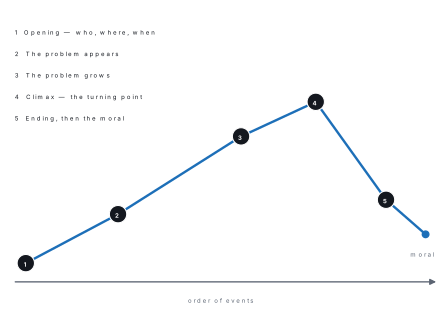
An outline is a skeleton; each note is one event in three or four words. Six steps, in order:
- Read all the notes first — you must know the ending before you choose the opening sentence.
- Fix the frame the notes leave out: a name, a village, a season, a time of day.
- Choose tense and person and keep them — simple past, third person, unless the notes say I.
- Expand each note into two to four sentences: what he was doing, what he saw, what he felt, what he did next.
- Paragraph by stage, not by note: opening, development, climax, ending.
- Title and moral last. Three to six words for the title, and it must not give the ending away; one sentence for the moral, only if the question asks.
| Outline note | What it has to become on the page |
|---|---|
| a poor farmer | a name, a village, how he earns, what he owns — 2 sentences |
| finds a bag of money | where he was, what he saw, what he felt, what he did — 3 sentences |
| refuses the reward | what is said, in direct speech, by both people — 2 sentences |
31.3 The language of narrative
Tenses. The backbone is the simple past. Use the past continuous for what was already going on (The sun was setting when he reached the bridge), and the past perfect for anything that happened before that (He had never seen so much money). Keep direct speech in whatever tense the speaker would really use.
| Purpose | Connectives and openers |
|---|---|
| Opening | One winter morning, Long ago, It was the first day of Asar, |
| Sequence | then, after that, next, soon afterwards, a moment later, the following day |
| Sudden event | suddenly, all at once, without warning, before he could speak |
| Contrast | but, however, even so, on the other hand |
| Reason and result | because, since, so, as a result, therefore |
| Closing | at last, in the end, finally, from that day on |
Direct speech. One line of dialogue lifts a story out of the ordinary, and the punctuation is worth a mark on its own.
- Ramesh said, "I will bring the money tomorrow." — comma before the speech, capital letter inside, full stop inside** the closing marks.
- "*Where is my bag?" asked Sabina. — the question mark stays inside; asked* is not capitalised.
- Tense drifting. He opened the gate and sees a snake. → …and saw a snake. Choose the past and stay there.
- Copying the notes. Poor farmer goes to market and finds bag. is note form, not a sentence. Every note must be rewritten as a full sentence with an article and a finite verb: The poor farmer was walking to the market when he found a cloth bag.
- A missing article. ~~He found bag on road.~~ → He found a bag on the road. Nepali has no article, so this slip is easy to make and easy for the examiner to see.
- A moral that does not fit. If the notes end with an act of honesty, the moral is about honesty — not "unity is strength" borrowed from another story.
Model answer 31.1 — a story from an outline
Question. Develop a readable story with the help of the outlines given below and give it a suitable title. [7] A poor farmer of Dang — walks to the weekly market — finds a cloth bag on the path — opens it, full of money — nobody around — takes it to the police post — a schoolteacher claims it — offers a reward — the farmer refuses — the teacher pays the school fees of the farmer's daughter — moral.
Model answer.
A Bag on the Path
Khagendra Chaudhary was the poorest man in his village in Dang. He owned half a bigha of land, two goats and a bicycle that had lost its bell. Every Thursday he walked five kilometres to the weekly market with a basket of vegetables on his head.
One Thursday morning, while he was crossing the dry stream near the school, his foot struck something soft. It was a red cloth bag, tied at the neck. He untied it and sat down heavily on a stone. The bag was full of thousand-rupee notes. He looked up and down the empty path; there was nobody at all. For a long moment he thought of his leaking roof and of his daughter's unpaid fees.
Then he tied the bag again and walked to the police post at the bazaar. The head constable counted the notes twice and wrote the amount in a register.
By evening the owner had come — Mr Poudel, the mathematics teacher, who had been carrying the salary of every teacher in the school. He held out five thousand rupees.
"Please keep this," he said. "You have saved my job."
"I only returned what was not mine," Khagendra answered. "A man cannot take payment for that."
The next week the school register showed that the fees of Khagendra's daughter had been paid for the whole year.
An honest man may be poor, but he is never cheap.
Why it scores. Every outline point appears, in order; the invented frame (a name, Dang, a Thursday) contradicts nothing. The simple past runs throughout, there are four paragraphs and two lines of direct speech, and the moral grows out of the last event instead of being stuck on.
31.4 Reading a chart, a graph or a table
| Visual | What it is good at showing | First thing to look for |
|---|---|---|
| Bar chart | comparing separate quantities | the tallest bar and the shortest bar |
| Line graph | change over time | the overall direction, and any turning point |
| Pie chart | parts of one whole (always 100 per cent) | the largest slice and the smallest slice |
| Table | exact figures, often two variables at once | the row or column with the extreme value |
Before writing, answer three questions from the title and the axis labels: what is measured?, in what units and of what total?, and over what period or for which groups? Then mark the highest value, the lowest and the overall trend. Those three go into your second sentence, and they are the difference between a description and a list.
31.5 The language of describing data
| Meaning | Verbs | Noun form |
|---|---|---|
| goes up | rose, increased, grew, climbed, went up, doubled | a rise, an increase, growth |
| goes down | fell, dropped, declined, decreased, halved | a fall, a drop, a decline |
| no change | remained steady, stayed the same, levelled off | no change, stability |
| goes up then down | peaked at, reached a peak of | a peak |
| How much / how fast | Adverbs (after the verb) | Adjectives (before the noun) |
|---|---|---|
| a lot | sharply, dramatically, considerably | a sharp, dramatic, considerable rise |
| a little | slightly, marginally | a slight, marginal fall |
| evenly | steadily, gradually | a steady, gradual increase |
Comparing and estimating. twice as many as · three times more than · the highest / the lowest · followed by · whereas · compared with · about, roughly, nearly, just over, just under · a quarter, a third, half, two-thirds.
The four-sentence plan. Almost every data description fits this shape:
- Say what the visual shows, in your own words — never copy the title. The bar chart compares … / The table presents …
- Give the overview: the largest, the smallest, the general direction.
- Give the details, in two or three sentences, grouping similar figures and quoting numbers with their units.
- Close in one sentence, restating the pattern. Add no opinions and no reasons unless the question asks for them.
- Copying the title as sentence one. Paraphrase it. Pass percentage of Grade 11 English, 2077–2081 becomes The chart shows how the pass rate in Grade 11 English changed over five years.
- The wrong preposition after the noun. It is an increase in the number, a rise of 12 per cent, a fall from 62 to 58. ~~increase of the number~~ is wrong.
- Explaining instead of describing. The pass rate rose because the teachers worked harder invents a cause the chart cannot show.
- Mixing tenses. Data from finished years takes the past tense; a chart with no dates takes the present.
- Percent and percentage. Use per cent after a number (40 per cent) and percentage after the (the percentage of girls).
Model answer 31.2 — describing a bar chart
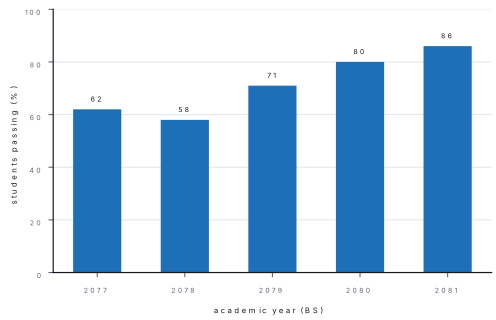
Question. Study the bar chart given above and describe it in about 150 words. [7]
Model answer.
The bar chart compares the percentage of students who passed Grade 11 English at one secondary school in each of the five academic years from 2077 to 2081 BS.
Taken as a whole, the pass rate improved a great deal over the period, climbing from 62 per cent to 86 per cent — a rise of 24 percentage points. The best year was the last one, 2081, and the weakest was 2078.
The only fall came at the start. Between 2077 and 2078 the figure dropped four points, from 62 to 58 per cent, the lowest point on the chart. After that the trend was upward every year. The sharpest rise came in 2079, when the pass rate jumped thirteen points to 71 per cent; growth then slowed, with nine more points in 2080 and six in 2081. In short, after one poor year the school recovered steadily, and by 2081 more than four students in five were passing.
Why it scores. Sentence 1 paraphrases the title; sentence 2 gives the overview with the highest and lowest values. Every figure is quoted with its unit, and dropped, jumped, gained replace a fourfold repetition of increased. The last sentence restates the pattern and invents no reason.
Model answer 31.3 — describing a pie chart
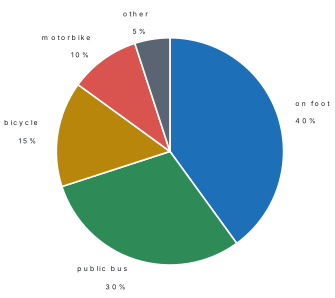
Question. The pie chart above shows the means of transport used by 200 students of a college in Kathmandu. Write a description of it. [7]
Model answer.
The pie chart shows how two hundred students of a Kathmandu college travel to their campus each day, with the share taken by each means of transport given as a percentage.
Walking is by far the commonest choice. Two students in five, that is 40 per cent or eighty students, come on foot, and this slice is larger than any other. The public bus comes second at 30 per cent, or sixty students. Together these two cheap options account for 70 per cent of the whole college.
The remaining three groups are much smaller. Fifteen per cent, or thirty students, cycle, and ten per cent, twenty students, ride a motorbike — half as many as those who cycle. Only 5 per cent, ten students in all, use some other means such as a car or a taxi, the smallest slice of the chart. Overall, seven students out of ten either walk or take a bus.
Why it scores. It turns every percentage into a number of students, which shows that the whole of 200 has been understood; it groups the three small slices instead of listing them flatly; and it uses half as many as and by far the commonest rather than repeating more and less.
31.6 Checking your own answer
Give yourself two minutes at the end and run down this list. Each line is a real mark.
| Check | |
|---|---|
| 1 | Is every outline note used, in order — or every main figure quoted? |
| 2 | Is there a title, if the question asked for one? |
| 3 | Is the whole answer in one tense, apart from direct speech? |
| 4 | Three or four paragraphs, not one block? |
| 5 | Are a, an and the in front of the singular countable nouns? |
| 6 | Do plural subjects have plural verbs (the figures show, not shows)? |
| 7 | Are the numbers copied correctly, with units and the words per cent? |
| 8 | Any opinion, cause or fact not in the material? Delete it. |
| 9 | Is the answer between 150 and 200 words? |
The marker reads your answer once against the outline or the chart, ticking each point as it appears. A point that never appears cannot be credited later, however good the English is. Take the notes in order, and if time runs short, finish the remaining ones in short plain sentences rather than leaving them out.
Chapter summary
- Guided writing (Q4, 7 marks) supplies the material; you supply the sentences. Content 3, organisation 2, language 2. Write 150–200 words in about 15 minutes.
- A story from an outline: read all the notes first, invent a who / where / when, write in the simple past and third person, expand each note into two to four sentences, paragraph by stage, title and moral last.
- Direct speech: comma before the speech, capital letter inside, punctuation inside the closing marks, and a new line for each new speaker.
- Describing data: paraphrase the title, give an overview with the highest and lowest values, then the details with figures, then one closing sentence.
- Change verbs — rose, climbed, doubled / fell, dropped, halved / remained steady, levelled off — with sharply, steadily, gradually, slightly.
- It is an increase in the number, a rise of 12 per cent, a fall from 62 to 58.
- Describe, never explain: no causes and no opinions unless the question asks.
Practice questions
Guided writing — stories from an outline (7 marks each)
- Develop a readable story from the outlines below and give it a suitable title. [7] A woodcutter cutting a tree by a river — his axe falls into the water — sits and weeps — a fairy appears — brings up a golden axe — he refuses it — a silver axe — refuses again — his own iron axe — accepts it — the fairy gives him all three — moral.
- Develop a readable story from the outlines below and give it a suitable title. [7] Two friends travelling through a forest — a bear appears — one climbs a tree without warning the other — the second lies flat and holds his breath — the bear sniffs his ear and goes away — the first friend asks what the bear whispered — the answer — moral.
Model answers
1. The Honest Woodcutter. Hari Bahadur was a woodcutter who lived alone in a hut above the Trishuli. One morning he was cutting a sal tree that leaned over the water when the head of his axe flew off the handle and sank into the river. The axe was the only thing he owned that earned him money, and he sat down on the bank and wept. As he wept, a fairy rose out of the water and asked him why. When he had told her, she dived and came up holding an axe of gold. "Is this yours?" she asked. "No," said Hari Bahadur, "mine was only iron." She dived again and brought up an axe of silver, and again he shook his head. The third time she brought up his own worn iron axe, and he took it gladly. The fairy was so pleased with his honesty that she gave him the gold and the silver axes as well. Honesty is rewarded, even when nobody is watching. (Notes to check: every point is used in order; past tense throughout; a title; two lines of direct speech; the moral matches the last event.)
2. The Bear and the Two Friends. Mohan and Suresh set out together to cross the forest between their village and the district headquarters. They had promised to stand by each other whatever happened. Halfway through the forest a large bear came out of the bushes and onto the path in front of them. Without a word to his friend, Mohan ran to the nearest tree and climbed it. Suresh could not climb, so he threw himself flat on the path, shut his eyes and held his breath, for he had heard that a bear will not touch the dead. The bear came up, sniffed at his ears and his face for a long minute, and walked away. When it was gone, Mohan climbed down, laughing. "What did the bear whisper in your ear?" he asked. Suresh stood up and dusted himself. "He advised me," he said, "never again to travel with a friend who leaves me in danger." A friend in need is a friend indeed.
Guided writing — charts, graphs and tables (7 marks each)
- The table below shows how 120 students of Grade 11 in one college spend an average weekday. Describe the information in about 150 words. [7]
| Activity | Boys (hours) | Girls (hours) |
|---|---|---|
| Sleeping | 8 | 8 |
| At college | 6 | 6 |
| Studying at home | 2 | 3 |
| Household work | 1 | 3 |
| Mobile and television | 4 | 2 |
| Games and outdoor play | 3 | 2 |
Model answers
3. The table compares how the boys and the girls of Grade 11 in one college use the twenty-four hours of an ordinary weekday. Both groups spend exactly the same time on the two largest items: eight hours asleep and six hours at college, which together take up more than half the day. The differences lie in the remaining six hours. Girls study an hour longer at home than boys, three hours against two, and they do three times as much household work — three hours compared with one. Boys use the extra time for entertainment. They spend four hours on a mobile phone or in front of the television, twice the two hours the girls spend, and one hour more than the girls on games and outdoor play. Overall, the girls' day is the busier of the two, while the boys have about five hours of leisure to the girls' three.
Short guided-writing skills (1 mark each)
- Rewrite as a full sentence: poor farmer walk to market early morning. [1]
- Punctuate: where have you been all day asked her mother [1]
- Correct: The number of students are increasing every year. [1]
- Correct: The graph shows an increase of the number of tourists. [1]
- Replace the repeated word: Sales increased in 2019, increased in 2020 and increased again in 2021. [1]
- Rewrite without giving a reason: The pass rate fell in 2078 because of the lockdown. [1]
Answers
4. The poor farmer walked to the market early in the morning. — a finite past verb, the articles the, and in before the morning.
5. "Where have you been all day?" asked her mother. — question mark inside the marks, no capital on asked.
6. The number of students is increasing every year. — the number of is singular.
7. …an increase in the number of tourists. — increase takes in before the thing that grows.
8. Sales increased in 2019, rose further in 2020 and climbed again in 2021. — vary the verb; repetition costs language marks.
9. The pass rate fell in 2078. — a description reports what the chart shows and nothing more.
Practise more: English question bank