Unit 1 · Literature - Short Stories · 28 min read
The Selfish Giant
What the syllabus asks for 7
- About the author
- The story
- Characters
- Themes
- Setting, structure and point of view
- Literary devices
- Glossary
"The Selfish Giant" is a literary fairy tale by the Irish writer Oscar Wilde, first published in his 1888 collection The Happy Prince and Other Tales. On the surface it is a simple story for children: a giant shuts children out of his garden and winter never leaves it. Underneath, it is a carefully built parable about selfishness, repentance and love, with a clear Christian allegory in its closing pages. It opens the Grade 11 course because it teaches you to read a short, easy text on two levels at once — the story, and what the story stands for.
A heart closed by selfishness freezes everything around it; a heart opened by love brings life back. The Giant's garden is not really a garden — it is his own soul, and the weather in it reports the state of his heart.
1.1 About the author
Oscar Wilde (1854–1900) was an Irish poet, playwright, novelist and critic. He was born in Dublin to a distinguished family — his father a surgeon, his mother a poet and Irish nationalist — and studied classics at Trinity College Dublin and then at Magdalen College, Oxford. At Oxford he came under the influence of the critics John Ruskin and Walter Pater, and became the best-known spokesman of Aestheticism, the late-Victorian movement whose slogan was "art for art's sake": the belief that a work of art does not have to teach a moral lesson, and that beauty is valuable in itself.
A literary and artistic movement of the late nineteenth century which held that the purpose of art is beauty rather than instruction, morality or usefulness.
Wilde's fame rests mainly on his plays, which are still performed everywhere: Lady Windermere's Fan (1892), An Ideal Husband (1895) and above all The Importance of Being Earnest (1895), a comedy built almost entirely out of brilliant one-line jokes. His only novel is The Picture of Dorian Gray (1890), about a young man whose portrait ages while he does not. He wrote two books of fairy tales — The Happy Prince and Other Tales (1888), which contains "The Selfish Giant", and A House of Pomegranates (1891) — partly for his own two sons, Cyril and Vyvyan.
In 1895, at the height of his success, Wilde was tried and sentenced to two years' hard labour. In prison he wrote the long confessional letter published as De Profundis, and after his release the poem The Ballad of Reading Gaol (1898). He died poor and ill in Paris in 1900, aged forty-six.
What is distinctive about his voice? In the plays and the novel it is the epigram — a short, polished, surprising sentence that turns an accepted idea upside down. In the fairy tales the voice changes completely. Here Wilde writes short sentences joined by "and", in the plain, dignified rhythm of the Bible and of old folk tales. Nature speaks. Objects have feelings. The effect is gentle on the surface and severe underneath: almost every one of these tales is about someone who learns generosity too late, or at a great price.
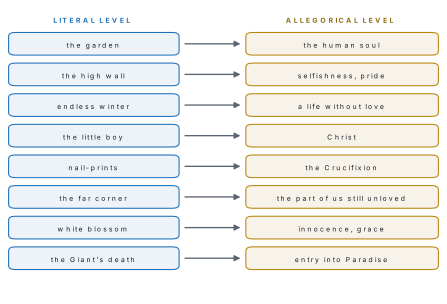
Students often write that this is a simple tale teaching children to share. That answer will not earn full marks. Wilde wrote a parable: the little boy with nail-prints in his hands and feet is Christ, the garden is the human soul, and the ending is about salvation, not about good manners. Read both levels.
1.2 The story
The garden as it was. Every afternoon, walking home from school, the village children played in the Giant's garden — soft green grass, flowers "like stars", twelve peach-trees that blossomed pink and pearl in spring and bore fruit in autumn, and birds singing so sweetly that the children stopped their games to listen. "How happy we are here!" they said.
The wall. One day the Giant came back. He had spent seven years with his friend the Cornish ogre and returned only because he had said everything he had to say — "his conversation was limited". Finding children in his garden he roared at them, and they ran. "My own garden is my own garden," he said, and built a high wall round it with a notice-board: TRESPASSERS WILL BE PROSECUTED. Wilde adds one flat verdict: "He was a very selfish Giant."
The endless winter. Now the children had nowhere to play; the road was dusty and stony, so they walked round the outside of the wall and talked about the garden inside. When Spring came to the rest of the country, this garden stayed frozen. The birds would not sing where there were no children and the trees forgot to blossom. One flower put its head out, saw the notice-board, felt sorry for the children and went back to sleep underground. Snow and Frost were delighted and decided to live there all year; they invited the North Wind, who blew the chimney-pots down, and he invited the Hail, who rattled on the roof three hours a day until most of the slates broke. Summer never came. Autumn gave golden fruit to every garden but this one — "He is too selfish," she said.
The linnet and the corner. One morning the Giant heard lovely music. It was only a little linnet singing at his window, but he had not heard a bird there for years. The Hail stopped, the North Wind ceased roaring, and a sweet perfume came in. Looking out, he saw that the children had crept in through a hole in the wall and were sitting in the branches; every tree had a child in it and had covered itself with blossom. Only the farthest corner was still winter. There a very small boy stood crying under a tree, too little to reach the branches, although the tree bent them down as low as it could.
The Giant's change. The Giant's heart melted. "How selfish I have been!" he said; "now I know why the Spring would not come here." He went down to lift the boy into the tree and break the wall. The other children saw him and fled, and the garden turned to winter again — all but the little boy, whose eyes were too full of tears to see him coming. The Giant lifted him gently into the tree. It broke at once into blossom, the birds returned, and the boy flung his arms round the Giant's neck and kissed him. Seeing this, the children came running back, and Spring came with them. The Giant took a great axe and knocked down the wall, and the people going to market at twelve found him playing with the children in the most beautiful garden they had ever seen.
The years after. That evening the little boy had gone; nobody knew where he lived and none of them had seen him before. The children came every afternoon after that, but the boy the Giant loved best was never seen again. Years passed and the Giant grew old and feeble, sitting in a huge armchair to watch the games. "The children are the most beautiful flowers of all," he said. He no longer hated winter, knowing it was "merely the Spring asleep".
The last morning. One winter morning he saw, in the farthest corner, a tree covered with white blossoms, its branches golden and silver fruit hanging from them, and beneath it the little boy. He ran out in joy, but close up his face went red with anger: there were the prints of two nails on the child's palms and two on his little feet. "Who hath dared to wound thee?" he cried; "tell me, that I may take my big sword and slay him." The child answered, "Nay! but these are the wounds of Love." A strange awe fell on the Giant and he knelt. The child smiled and said, "You let me play once in your garden, to-day you shall come with me to my garden, which is Paradise." That afternoon the children found the Giant lying dead under the tree, covered all over with white blossoms.
1.3 Characters
| Character | Who they are | Role in the story |
|---|---|---|
| The Giant | Owner of the castle and the garden; selfish at first, loving at the end | Protagonist; the only character who changes |
| The little boy | A tiny child, too small to climb the tree; later shown with nail-prints | Christ figure; the agent of the Giant's change and of his salvation |
| The children | Village schoolchildren who used the garden as a playground | Represent innocence, joy and life; their presence is the spring |
| The Cornish ogre | The Giant's friend, whom he visited for seven years | Never appears; shows the company the Giant kept and how little he had to say |
| Snow, Frost, North Wind, Hail | The winter weathers, personified as guests | The tenants selfishness invites in; the punishment the Giant chooses without knowing it |
| The linnet | A small songbird outside the window | The first sign of grace; what wakes the Giant |
| The trees and flowers | Personified plants | They refuse to blossom without the children — nature takes the children's side |
The Giant. He is not a villain in the ordinary sense. He is stupid rather than cruel — his "conversation was limited", and his whole moral argument is one childish sentence repeated: "My own garden is my own garden." His selfishness is the ordinary human kind: he has a legal right, and he uses it without once asking what it costs anybody else. Notice that his punishment is not sent from outside. He builds a wall to keep the children out, and the wall keeps Spring out too; when the birds and blossom go, he is the one left sitting at a cold window complaining that the weather is late. His change begins not with an argument but with pity — he sees one small child who cannot reach the branches and cannot stop crying. From that moment he acts: he lifts, he knocks down the wall, he gives the garden away. By the end he has become the opposite of what he was, and the proof is that he prefers the children to his flowers.
The little boy. He is the smallest and weakest figure in the story and the most powerful. He cannot climb; he needs to be picked up. He is the one child who does not run away from the Giant — because he is blinded by tears, which is Wilde's quiet way of saying that love does not calculate. His kiss, not any sermon, melts the Giant. On his second and final appearance the nail-prints on his hands and feet identify him as the crucified Christ, and his words — "these are the wounds of Love" and the promise of "my garden, which is Paradise" — turn the whole tale into a parable of redemption. Note also the exchange in which the allegory is made explicit: the Giant once let the child play in his garden, and so the child now takes him into his.
The children. They work as a group, not as individuals, and none of them is named. They are what makes a place alive: where they are, there is blossom and birdsong; where they are not, there is frost. Their fear of the Giant is important too. When he first comes into the garden to help, they run, and winter returns instantly — a reminder that a reputation for cruelty outlives the cruelty, and that trust has to be rebuilt.
1.4 Themes
Selfishness punishes itself. Nobody sentences the Giant. He fences in what he loves and discovers that he has fenced out everything that made it worth loving. The clearest sign is the sentence in which he sits at the window of a cold white garden and says he cannot understand why Spring is so late. He is not being punished by the weather; he is the weather. Autumn's one line of explanation — "He is too selfish" — is the story's moral centre.
Love and repentance can restore what was lost. The turn happens in a single paragraph: the Giant's "heart melted", he names his own fault ("How selfish I have been!"), and he immediately does something about it. Wilde is careful about the order — first the feeling, then the confession, then the axe that knocks down the wall. Real repentance in this story is an action, not a mood.
Childhood, innocence and joy. Wilde repeatedly ties life itself to children. The birds "did not care to sing" in a garden with no children; the trees forget to blossom; and the old Giant's last judgement on his beautiful garden is that "the children are the most beautiful flowers of all". Innocence in Wilde's tales is not weak — it is the force that changes adults.
Walls, exclusion and property. The wall and the notice-board (TRESPASSERS WILL BE PROSECUTED) bring the language of law and ownership into a fairy tale. The Giant is perfectly within his rights, and that is the point: a right can be exercised in a way that destroys the person holding it. The flower that sees the notice-board and goes back to sleep is a small, sharp joke at the expense of legal language.
Christian allegory: sacrifice, forgiveness and Paradise. The final movement lifts the story out of the nursery. The child who cannot be found, who returns after many years, who carries the wounds of the nails and calls them "the wounds of Love", and who leads the old man into a garden that is Paradise, is unmistakably Christ. The Giant's death is not a tragedy but a reward: he dies under the tree, covered in white blossom — the colour of innocence — at the moment of winter, because for him winter is now only "the Spring asleep".
1.5 Setting, structure and point of view
Setting. The story happens in no named country and no named year — a castle, a garden, a village school, a market at twelve o'clock. This vagueness is deliberate: it is the setting of a fairy tale or a parable, so that the events feel like they could belong to anyone. The important setting is inside the garden, and it changes with the Giant's heart. Three states are worth distinguishing: the shared garden (all four seasons working normally), the walled garden (permanent winter), and the restored garden (spring, and finally a single tree in miraculous blossom in midwinter).
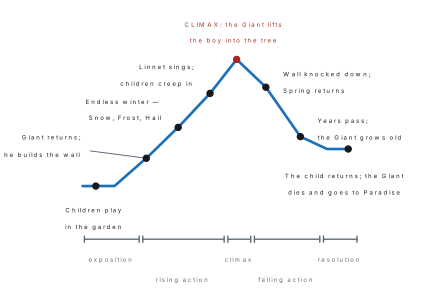
Structure. The tale falls into four movements: (i) the garden before the Giant's return; (ii) the wall and the long winter; (iii) the morning of the linnet, the little boy, and the knocking down of the wall — the climax; (iv) a coda covering many years, ending with the child's return and the Giant's death. The last movement is what makes it a work of literature rather than a moral fable: the problem is solved at the climax, and Wilde keeps writing, because the story he actually wants to tell is about what the Giant is given in the end.
Point of view. A third-person omniscient narrator tells the story — a voice that can enter the Giant's thoughts ("his heart melted"), report what the Snow and the Autumn say, and pass judgement in its own person ("He was a very selfish Giant."). The register is deliberately simple, with many short sentences beginning "And". At the very end the language shifts into archaic, biblical English — hath, thee, thou, Nay — which signals to the reader that we have moved from a tale to a sacred story.
1.6 Literary devices
| Device | Example from the text | Effect |
|---|---|---|
| Personification | Snow "covered up the grass with her great white cloak"; the Frost "painted all the trees silver"; Autumn refuses to give fruit | Turns weather into characters who take sides, so that nature itself judges the Giant |
| Symbolism | The wall; the notice-board; the garden; the twelve peach-trees; the farthest corner | Lets a very short story carry a large moral argument without preaching |
| Allegory | The little boy with nail-prints; "my garden, which is Paradise" | Converts the whole tale into a Christian parable of sacrifice and salvation |
| Irony | The Giant sits in a frozen garden wondering why Spring is late; the notice threatens to prosecute trespassers, yet the Giant becomes the prisoner | The victim of the wall turns out to be the man who built it |
| Foreshadowing | The one corner that stays winter; the boy who cannot be found afterwards and whom nobody has ever seen | Prepares the reader for the final revelation, so the ending surprises without cheating |
| Imagery (colour and season) | Pink and pearl blossom, silver trees, golden branches, silver fruit, white blossoms | Makes the moral states visible: bright colour for love, grey and white for a closed heart |
| Pathetic fallacy | The weather in the garden exactly matches the Giant's feelings | Compresses the character's inner life into one image the reader can see |
| Repetition and parallel structure | "How happy we are here!" becomes "How happy we were there"; "Who hath dared to wound thee?" said twice | Marks change over time and raises the emotional pitch at the climax |
| Biblical diction | hath, thee, thou, Nay, "a strange awe fell on him" | Lifts the ending from fairy tale to scripture |
A story in which the characters, places and events stand for something else — usually moral, political or religious ideas — so that the whole narrative can be read twice, literally and figuratively.
1.7 Glossary
| Word / phrase | Meaning |
|---|---|
| ogre | a cruel, man-eating giant in folk tales |
| gruff | rough and unfriendly in sound; said of a deep, harsh voice |
| trespassers | people who enter someone's land without permission |
| prosecuted | taken to court and punished under the law |
| notice-board | a flat board on which a public warning or message is displayed |
| linnet | a small brown European songbird |
| casement | a window that opens on hinges, like a door |
| slates | thin flat pieces of grey stone used to cover a roof |
| frost | a thin white layer of ice formed on cold surfaces |
| hail | frozen rain falling as small balls of ice |
| cloak | a loose outer garment without sleeves, worn over the shoulders |
| feeble | very weak, especially from old age |
| to steal up | to move towards someone quietly and secretly |
| his heart melted | he suddenly felt pity and love instead of hardness |
| awe | a feeling of deep respect mixed with wonder and slight fear |
| marvellous | astonishing; causing wonder |
| hath / thee / thou / art | old forms of has / you (object) / you (subject) / are |
| nay | an old word for no |
| Paradise | Heaven; the garden of perfect happiness in Christian belief |
| riotous blossom | (of a tree) covered thickly and suddenly with flowers |
When a question asks "why does Spring not come to the Giant's garden?", give both levels in two sentences. Literal: the children are shut out, so the birds do not sing and the trees do not blossom. Symbolic: the Giant's heart is closed, and the garden's weather mirrors his heart. Examiners award the second sentence.
Chapter summary
- Oscar Wilde (1854–1900), Irish, leader of Aestheticism; "The Selfish Giant" comes from The Happy Prince and Other Tales (1888).
- A Giant returns after seven years with the Cornish ogre, drives the children out of his garden, walls it and posts TRESPASSERS WILL BE PROSECUTED.
- Spring, Summer and Autumn never come; Snow, Frost, North Wind and Hail settle in — the Giant's selfishness becomes his own punishment.
- A linnet's song and the sight of one small crying boy melt the Giant's heart; he lifts the boy into the tree, breaks down the wall and gives the garden to the children.
- The boy disappears. Years later he returns with nail-prints in his hands and feet, calls them "the wounds of Love", and takes the dying Giant to Paradise.
- Themes: selfishness punishes itself; love and repentance restore life; the value of childhood innocence; walls and exclusion; Christian sacrifice and salvation.
- Devices: personification of the seasons, pathetic fallacy, symbolism of the wall and garden, situational irony, Christian allegory, biblical diction at the close.
- Structure: four movements, third-person omniscient narration, with the real climax followed by a long coda covering many years.
Practice questions
Short answer questions (2 marks each)
- Why did the Giant build a wall around his garden? [2]
- Who lived in the garden all the year round after the wall was built, and why were they pleased? [2]
- What made the Giant realise how selfish he had been? [2]
- Why did the little boy not run away when the Giant came into the garden? [2]
- What did the Giant mean when he said that winter was "merely the Spring asleep"? [2]
- What were the wounds on the little boy's hands and feet, and how did he explain them? [2]
Model answers — short questions
1. The Giant came home after seven years and found the village children playing in his garden. He believed that "my own garden is my own garden" and would allow nobody but himself to enjoy it, so he built a high wall and put up a notice-board warning that trespassers would be prosecuted.
2. The Snow and the Frost stayed all year, and they invited the North Wind and then the Hail. They were pleased because Spring had forgotten the garden, which left them free to live there permanently and spoil it — the Snow covering the grass, the Frost silvering the trees, the Hail breaking the roof slates.
3. One morning he heard a linnet singing and looked out to see the children sitting in the blossoming trees, having crept in through a hole in the wall. In one corner a tiny boy was crying because he could not reach the branches. That sight made the Giant's heart melt and he said, "How selfish I have been!"
4. He did not run because his eyes were so full of tears that he simply did not see the Giant coming. On the symbolic level, his staying suggests that innocent love does not fear, and it is this one child who remains who becomes the means of the Giant's change and salvation.
5. He meant that winter is not death but a pause: the flowers are only resting under the ground and will come back. It shows how much he has changed — the man who once complained that Spring was late can now wait patiently, because he has learned that love, like spring, returns.
6. There were the prints of two nails on his palms and two on his little feet — the marks of the Crucifixion. When the Giant angrily demanded who had dared to wound him, the child answered, "Nay! but these are the wounds of Love," identifying himself as Christ, who was wounded out of love for humankind.
Long answer questions (5 marks each)
- "The Selfish Giant" is far more than a children's story. Discuss the story as a Christian allegory. [5]
- Trace the change in the Giant's character from the beginning of the story to his death, and explain what brings that change about. [5]
- How does Wilde use the garden and the seasons to show the inner condition of the Giant? [5]
Model answers — long questions
1. On the surface Wilde tells a simple tale, but its details point steadily towards Christian teaching. The garden stands for the human soul; the high wall with its legal notice stands for selfishness and pride; and the endless winter stands for a life from which love has been shut out. The turning point is caused by the weakest character in the story, a child too small to climb a tree — an echo of the Gospel idea that the least are the greatest. When the child returns at the end, the allegory becomes explicit: he bears the prints of two nails on his hands and two on his feet, and when the Giant demands the name of the person who wounded him, he answers that "these are the wounds of Love". This is Christ crucified, and his wounds are voluntary. His final words make the exchange plain: because the Giant once let him play in his garden, he will now take the Giant to his own garden, "which is Paradise". The Giant's death is therefore not a punishment but a reward, and the white blossom that covers his body is the colour of forgiveness and innocence. Read this way, the story is about repentance, grace and salvation, not merely about learning to share.
2. At the start the Giant is selfish, ignorant and lonely. He has spent seven years with the Cornish ogre and has nothing left to say; his only moral idea is the possessive sentence "my own garden is my own garden". He drives the children out, walls the garden, threatens the law, and Wilde ends the paragraph with a blunt verdict: "He was a very selfish Giant." His punishment is automatic — the garden freezes — yet he is too dull to see the cause, and sits at the window wondering why Spring is late. The change is brought about by two small things, a linnet's song and the sight of one crying boy who cannot reach the branches. Pity does what argument could not. He admits his fault, lifts the boy into the tree, takes an axe to his own wall, and gives the garden to the children for ever. In old age he is a different man: gentle, patient, no longer hating winter, and valuing the children above his flowers. The love he receives from the child — first a kiss, and finally the promise of Paradise — completes a change that began in pity and ended in humility, for he kneels before the child at the last.
3. Wilde makes the garden a picture of the Giant's inner life, so that the reader can see his moral state. While the children are welcome, all four seasons work: blossom in spring, fruit in autumn, birds in the trees. The moment he builds the wall, the garden is cut off from the ordinary year and locked into a single season. Nature is personified to make the judgement clear — the birds "did not care to sing" where there were no children, the trees "forgot to blossom", and Autumn refuses fruit with the words, "He is too selfish." Snow, Frost, the North Wind and the Hail move in as guests, so that the Giant's chosen isolation is staffed by cold, noise and damage. This is pathetic fallacy: the weather carries the feeling. When the children creep back, blossom returns tree by tree, and the one corner that stays frozen marks the one part of the Giant not yet reached by love. At the end the garden goes beyond nature altogether: in midwinter a single tree stands in white blossom with golden branches and silver fruit — no longer a report on the Giant's heart but a promise of Paradise.
Reference to the context
- "My own garden is my own garden."
(a) Who says this, and to whom? (b) What action follows immediately from this statement? (c) What does the sentence reveal about the speaker's character? (d) How does the story finally answer this claim? [5]
- "Nay! but these are the wounds of Love."
(a) Who speaks these words, and in reply to what question? (b) What are the wounds referred to? (c) Explain the significance of this line in the story. (d) What happens immediately afterwards? [5]
Model answers — reference to the context
1. (a) The Selfish Giant says it, speaking to himself in the presence of the children he has just frightened away from his garden, immediately after returning from seven years with the Cornish ogre. (b) He at once builds a high wall all round the garden and puts up a notice-board reading TRESPASSERS WILL BE PROSECUTED. (c) The repetition of "my own" in a single short sentence shows a mind that can think only in terms of ownership. He is not cruel so much as narrow: he has a legal right and never asks what using it will cost the children. The flat statement that follows — "He was a very selfish Giant" — confirms the narrator's judgement. (d) The story answers him by showing that the wall shuts out Spring as well as the children, so the owner loses the very thing he was guarding. Later he reverses the sentence himself: "It is your garden now, little children," he says, and knocks the wall down with an axe.
2. (a) The little boy — the Christ figure — speaks them, in answer to the Giant's furious question, "Who hath dared to wound thee?", asked twice when he saw the marks on the child. (b) The wounds are the prints of two nails on the palms of the child's hands and two on his small feet: the marks of the Crucifixion. (c) The line turns the fairy tale into a Christian allegory. The Giant assumes the wounds are an injury to be avenged with his big sword; the child corrects him by saying they were accepted willingly, out of love. Love in this story is therefore not comfortable feeling but sacrifice, and the Giant — who learned love from this child years before — is being shown its full meaning. (d) A strange awe falls on the Giant and he kneels before the child, who smiles and says that because the Giant once let him play in his garden he shall today come to the child's garden, which is Paradise. That afternoon the children find the Giant lying dead under the tree, covered all over with white blossoms.
Practise more: English question bank