Unit 1 · Literature - Short Stories · 50 min read
Neighbours
What the syllabus asks for 8
- About the author
- The story
- Characters
- Themes
- Setting, structure and point of view
- Style and literary devices
- Glossary
- Textbook exercises
"Neighbours" is a very short story by the Australian writer Tim Winton. A young, newly married couple move into an inner-city street full of European migrants, find everything about it strange, and then — over the course of one year and one pregnancy — stop being strangers themselves. Almost nothing dramatic happens: a vegetable patch is dug, a henhouse falls down, ducks are killed, a baby is born. The whole story is about the distance between people and how it quietly closes, and it opens the Grade 12 course because it teaches you to read a text in which the meaning is carried by small actions rather than by speeches.
Language is not the same thing as understanding. The couple never learn a word of Macedonian or Polish, and the neighbours never learn to explain themselves; yet within a year they are one community, because they have dug, cooked, butchered, waited and rejoiced together. Winton's point is that human warmth crosses barriers that words cannot.
1.1 About the author
Timothy John Winton (born 1960) is an Australian novelist and short-story writer, born in Perth and brought up in Perth and in the small coastal town of Albany in Western Australia. He began publishing extraordinarily young. He wrote his first novel, An Open Swimmer, while still an undergraduate; it won The Australian / Vogel Literary Award for an unpublished manuscript and appeared in print in 1982, when he was twenty-two. The prize made him a professional writer at an age when most writers are still students, and he has written full time ever since.

Winton has won the Miles Franklin Literary Award, Australia's leading prize for fiction, four times: for Shallows (1984), Cloudstreet (1991), Dirt Music (2001) and Breath (2008). Cloudstreet, a big, warm novel about two poor families sharing one rambling house in Perth, is often voted Australia's best-loved novel. Two of his books, The Riders (1994) and Dirt Music, were shortlisted for the Booker Prize. He has also written a great deal for younger readers — That Eye, the Sky (1986), Lockie Leonard, Human Torpedo (1990), The Bugalugs Bum Thief (1991) and The Deep (1998). Away from his desk he is a well-known environmental campaigner, closely associated with the successful campaign to protect Western Australia's Ningaloo Reef.
Three things in Winton's style matter for this story. First, he writes about ordinary, unliterary people — the kind of Australians who rarely appeared in serious fiction before him. Second, his prose is plain, short and physical: he gives you smells, sounds and actions, and almost never tells you what a character feels. Third, place is a character in his work; the street, the weather and the season do much of the emotional work that dialogue does in other writers. All three are visible in "Neighbours", a story of barely twelve hundred words in which nobody makes a speech and nobody has a name.
The Nepali textbook's headnote says that "Neighbours" is taken from Migrants of Australia, edited by Harwood Lawler. That book and editor could not be verified in any library catalogue while these notes were being written. What is certain is that "Neighbours" is one of the stories in Winton's first collection of short fiction, Scission (1985), and that is the safer thing to say in an examination. Either way, the date places the story in the 1980s, when Australia had officially adopted multiculturalism and post-war migrant families from southern and eastern Europe were long settled in the inner suburbs of its cities.
1.2 The story
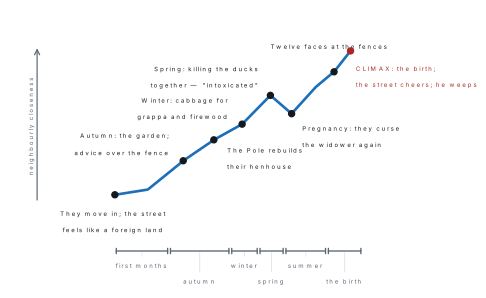
Arrival and unease. When they first move in, the young couple are "wary of the neighbourhood". The street is full of European migrants and the newly-weds feel "like sojourners in a foreign land". On the left lives a Macedonian family; on the right, a widower from Poland. Their own house is small, but its high ceilings and paned windows give it the feel of an elegant cottage, and from his study window the young man can see out over the rooftops and used car yards to the Moreton Bay figs in the park where they walk their dog — a docile, moulting collie the neighbours regard with caution.
A year of small offences. The couple have grown up in the "expansive outer suburbs where good neighbours were seldom seen and never heard", so an inner-city street is a shock: spitting, washing, watering at daybreak. The Macedonians "shouted, ranted, screamed", and it takes the newcomers six months to realise that the family are not murdering each other but merely talking. The Polish widower spends his days hammering nails into wood and pulling them out again; his yard fills with salvaged lumber which he adds to but never builds with. The disapproval runs both ways. The Macedonians raise eyebrows at the late hour at which the newcomers get up, and the young man senses their judgement of a household in which the wife goes out to work while the husband stays at home to write a thesis. He for his part watches with disgust as the little boy next door urinates in the street and sprays the cat from the back step, and is made nervous by the shaved-headed child standing at the fence with "only his cobalt eyes showing".
Autumn: the garden. The thaw begins over vegetables. The couple clear the rubbish from their backyard and turn and manure the soil "under the open and measured gaze of the neighbours", planting leeks, onions, cabbage, Brussels sprouts and broad beans. The garden brings the neighbours to the fence with advice about spacing, hilling and mulching. The young man resents the interference — but, tellingly, "he took careful note of what was said". His wife is bolder: she runs a hand over the child's stubble, and "the big woman with black eyes and butcher's arms" gives her a bagful of garlic cloves to plant.
The henhouse. The couple build a henhouse and the neighbours watch it fall down. The Polish widower then slides through the fence uninvited and rebuilds it for them. Winton adds one flat sentence which is the heart of the whole story: "They could not understand a word he said."
Winter: exchange. As autumn merges into winter, with vermilion sunsets and sudden dark dusks smelling of wood smoke, the couple find themselves smiling back. They give away heads of cabbage and accept gifts of grappa and firewood. The young man works at his thesis on the development of the twentieth century novel, cooks the dinners and listens to his wife's stories of eccentric patients and hospital incompetence. In the street they no longer walk with their eyes lowered — and they feel "superior and proud" when their own parents visit and cast shocked glances across the fence.
Spring: the ducks. They keep big, silent muscovy ducks through the winter, and in the spring the Macedonian family teach them to slaughter, pluck and dress the birds. Everyone sits round on blocks and upturned buckets telling "barely understood stories", the men butchering and the women plucking as custom demands. "In the haze of down and steam and fractured dialogue", the couple feel intoxicated. The cat toys with severed heads, the child pulls the cat's tail, and the newcomers find themselves shouting — that is, behaving exactly like the neighbours whose noise had appalled them six months before.
The pregnancy. The pregnancy is unplanned and stuns them; their friends do not have children until years after marriage, if at all. Tension returns for a while. The Polish widower at last begins to build with his hoarded wood, sinking posts and pouring cement at dawn; the couple curse him behind his back and the husband suspects him of deliberate antagonism. His wife is sick in the mornings; his hay fever wears him down. But the street takes the pregnancy over. The deli man presses chocolates on her and cigarettes on him, which he stores at home, not being a smoker. Italian women offer names. Greek women stop her in the street, pull her skirt up and feel her belly and tell her it is bound to be a boy. The woman next door knits a suit complete with booties and beanie. The young woman feels, in Winton's beautifully unsorted list, "flattered, claustrophobic, grateful, peeved". And when the young man is on the point of complaining about the noise of the almost-finished two-car garage — built by a man with no car — the Polish widower comes over with a barrowful of wood scraps for their fire.
The birth. Labour comes abruptly. The young man abandons the twentieth century novel for the telephone; the midwife arrives; he runs about "making statements that sounded like queries" while his wife blacks the stove and supervises him. Going outside for more wood in the last light of the day, he sees faces at every fence — he counts twelve — and the Macedonians wave and call out what sounds like their best wishes. The night passes in contractions, ice, liverwurst and the midwife's crooning. Then the pushing: his wife bears down in a squat until the floor trembles, and he feels "the power of her, the sophistication of her". A boy is born and goes straight to the breast, trailing cord and vernix, with one eye on his father.
The last line. The baby loses the nipple and cries. The young man hears shouting outside, goes to the back door, and sees on the Macedonian side of the fence "a small queue of bleary faces" looking up and cheering. He begins to weep. "The twentieth century novel had not prepared him for this."
1.3 Characters
| Character | Who they are | Role in the story |
|---|---|---|
| The young man | A postgraduate student writing a thesis on the twentieth century novel; stays at home, cooks, keeps the garden | Protagonist and centre of consciousness; the one whose prejudice we watch dissolve |
| The young woman | His wife; works at a hospital and tells stories of eccentric patients; later pregnant | Braver and quicker than her husband; makes the first physical gesture of friendship |
| The Macedonian family | The household on the left — loud, large, watchful; includes the shaven-headed little boy and the big woman with "butcher's arms" | The street's warmth and its noise; they teach the couple gardening and butchery and cheer the birth |
| The Polish widower | The old man on the right, alone, endlessly hammering and unhammering nails | Gives most and receives least; his wordless help is the story's purest act of neighbourliness |
| The little boy | The Macedonians' son; urinates in the street, sprays the cat, watches through the fence | A test of the young man's tolerance; the first neighbour the young woman touches |
| The midwife | Attends the birth at home | Marks the birth as a domestic, communal event rather than a medical one |
| The couple's parents | Visit and "cast shocked glances across the fence" | Show how far the couple have already travelled; the prejudice they have left behind |
The young man. He is intelligent, well-meaning and quietly snobbish, and Winton is merciless about it without ever saying so. Look at his verbs in the first half: he senses disapproval, watches in disgust, resents the interference, assumes why the child's head is shaved, suspects the widower of antagonising him on purpose. He is a reader of novels, and he treats the street as a text to be interpreted at a distance. Yet the same paragraph that records his resentment records that "he took careful note of what was said" — the crack through which the street gets in. His pride is exposed in one devastating sentence: he and his wife feel "superior and proud" when their parents are shocked by the neighbours, which means that even his tolerance is, at that stage, a way of feeling better than somebody. Only at the very end, weeping at the back door, is he stripped of commentary altogether.
The young woman. She has less page-space and more courage. She is the one who runs a hand over the child's stubble — a small, physical, unasked-for act of affection that instantly earns a bag of garlic cloves. She is also the one who does the hardest work in the story, and Winton's account of the birth deliberately transfers all the heroic vocabulary to her: she is "assaulting some unseen barrier" until "it was smashed and she was through". Her own feelings about the neighbourhood's attention are honestly mixed — "flattered, claustrophobic, grateful, peeved" — which keeps her human rather than saintly.
The Polish widower. The most moving figure in the story and the one we know least. He is old, alone, and occupies himself with work that produces nothing: nails in, nails out; a pile of lumber added to but never used. When the couple's henhouse collapses he does not ask permission — he "slid through the fence uninvited" and simply rebuilds it, and they cannot understand a single word he says. Note the arc of his hoarded wood. He finally begins to build with it in the spring, and the noise makes the couple curse him; what he is building turns out to be a two-car garage for a man with no car, which is absurd and rather sad; and the offcuts of that absurd project arrive at their door as firewood at the exact moment the young man is composing a complaint. He is Winton's argument in one person: neighbourliness is not a feeling you have, it is something you carry through a fence.
The Macedonian family. They begin as noise and end as a choir. Everything the couple first dislike about them — loudness, bluntness, bodily frankness, no respect for privacy — turns out to be the same quality as their generosity. The duck-killing scene is the turning point, because there the couple do not merely receive help but join in, sitting on upturned buckets, telling half-understood stories and finally shouting themselves. By the last page the Macedonians are the people standing at the fence at dawn, cheering a baby that is not theirs.
1.4 Themes
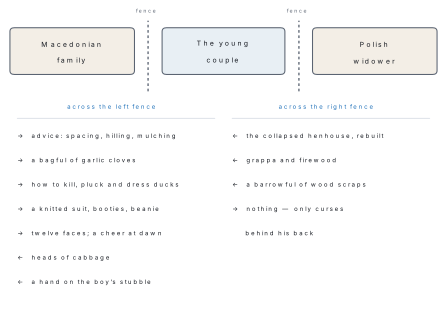
Community across language. The story's central claim is that people can belong to each other without a shared language. Not one line of dialogue is exchanged across the fences in the whole story; what crosses is garlic, cabbage, advice, grappa, firewood, labour, a knitted suit and finally a cheer. Winton underlines this by making the two most generous acts completely wordless — the rebuilt henhouse ("they could not understand a word he said") and the barrowful of wood scraps.
The presence, and the deliberate public acceptance, of several distinct cultures within one society, in place of an expectation that minorities should abandon their culture and become indistinguishable from the majority. Australia adopted multiculturalism as official policy in the 1970s, and Winton's street — with Macedonian, Polish, Italian and Greek families in it — is what that policy looked like on the ground.
Prejudice and its slow correction. The couple's prejudice is not hatred; it is the mild, educated, condescending kind, which is much harder to see in oneself. Winton corrects it not with an argument but with time and proximity. Notice that he is even-handed: the migrants judge the couple too, for rising late and for letting the wife earn the money.
Book learning against lived experience. The young man is writing a thesis on the twentieth century novel, a form famous for irony, alienation and the lonely inner life. The story keeps setting that project against what is happening outside his study window, and the last line settles the contest: the novel "had not prepared him for this."
Birth, the body and the shared event. The final third of the story is insistently physical — vomiting, ice, liverwurst, sweat, a squat, cord and vernix. Winton's point is that the great human events are of the body and cannot be experienced privately. The birth of one baby is attended by a midwife, a father and, across two fences, a whole street.
Belonging and the outsider. Everyone in the street was once a newcomer. The couple's journey from "sojourners in a foreign land" to weeping members of the neighbourhood is, in miniature, the migrant experience itself — which is why the story can be read as being as much about the Macedonians and the Pole as about the Australians.
1.5 Setting, structure and point of view
Setting. An unnamed inner suburb of an Australian city — the Moreton Bay figs and the street of post-war European migrants suggest Perth or Sydney — some time in the late twentieth century. The setting is not background: the smallness of the houses, the shared fences and the backyards big enough for a vegetable patch, a henhouse and ducks are the physical conditions that force these people into each other's lives. Winton contrasts it explicitly with the "expansive outer suburbs where good neighbours were seldom seen and never heard" — the space that buys privacy and sells loneliness.
Structure. The story has no chapters and no scene-breaks, but it is very tightly organised by the seasons: the couple arrive, then autumn brings the garden, winter the exchange of gifts, spring the ducks and the pregnancy, summer the neighbourhood's celebration, and the year closes with a birth. The vegetable cycle and the human one run in parallel; things planted in autumn and a child conceived in autumn come to fruition together. This is why the story feels complete despite having almost no plot.
Point of view. Third person, past tense, but limited almost entirely to the young man — a technique called free indirect style, in which the narrator's words take on the character's attitudes without quotation marks. When we read that the little boy's head "was shaved regularly, he assumed, in order to make his hair grow thick", the guess is the young man's, not the narrator's, and the small phrase "he assumed" quietly warns us that he is inventing explanations for people he does not know. Because we see the street through his eyes, our prejudice is corrected at the same speed as his.
Namelessness. Nobody in the story is named. There is "the young man", "the young woman", "the Macedonian family", "the Polish widower", "the little boy". A name is something you learn from somebody who can tell it to you; across these fences no names can be exchanged, so the narration honestly withholds them. The effect is to make the story representative — this is any young couple, in any migrant street, anywhere — and it gives the closing scene its force, because these strangers behave like family without ever having been introduced.
1.6 Style and literary devices
| Device | Example from the story | Effect |
|---|---|---|
| Understatement | "They could not understand a word he said." | Placed straight after the widower rebuilds their henhouse; the flatness makes the kindness enormous |
| Irony | The last line: "The twentieth century novel had not prepared him for this." | The man who studies modern literature is educated by a street he once looked down on |
| Free indirect style | "The child's head was shaved regularly, he assumed, in order to make his hair grow thick." | Lets us hear the young man's prejudice in the narrator's voice, and to judge it |
| Sensory imagery | "vermilion sunsets", "the smell of wood smoke", "the haze of down and steam" | Builds the street physically instead of describing emotion |
| Catalogue / list | "leeks, onions, cabbage, Brussels sprouts and broad beans"; "flattered, claustrophobic, grateful, peeved" | Lists of things suggest abundance; the list of feelings admits that emotion is mixed |
| Symbolism | The fence; the Polish widower's hoarded lumber; the vegetable garden | The barrier that everything must cross; a life of unused effort; growth through shared labour |
| Metonymy | "Italian women", "Greek women", "twelve faces" | People are known by group and by body part before they are known as individuals |
| Motif of sound | Shouting mistaken for murder; roosters; the crooning midwife; the final cheering | The story is organised by noise — the thing the couple first hate and finally join |
| Structural parallel | The garden planted in autumn; the child conceived in autumn | Both come to harvest at the same moment |
| Short simple sentences | "Labour came abruptly." "A boy, she said." | Speed and plainness at the emotional peak; Winton refuses to decorate |
1.7 Glossary
| Word | Meaning |
|---|---|
| sojourner | a person who stays somewhere temporarily; a visitor who does not belong |
| wary | cautious and slightly distrustful |
| migrant | a person who has moved from one country to another to live |
| Macedonian | from Macedonia, in south-eastern Europe |
| widower | a man whose wife has died |
| paned window | a window divided into small panels of glass |
| Moreton Bay fig | a large spreading fig tree native to eastern Australia |
| moulting | shedding hair or feathers |
| collie | a breed of long-haired sheepdog |
| expansive | wide and spread out; here, the roomy outer suburbs |
| rant | to talk loudly, angrily and at length |
| salvaged lumber | timber rescued from demolished buildings and re-used |
| manure (v.) | to enrich soil with animal dung |
| hilling | drawing soil up round the stems of growing plants |
| mulching | covering soil with straw or compost to keep in moisture |
| stubble | very short hair, like the stumps left in a harvested field |
| henhouse | a small shed in which hens are kept |
| vermilion | brilliant red with a touch of orange |
| grappa | a strong Italian brandy distilled from grape skins |
| muscovy | a large, silent duck originally from South America |
| dress (v.) | to clean and prepare a killed bird or animal for cooking |
| down (n.) | the soft fine feathers under a bird's outer feathers |
| intoxicated | drunk; here, light-headed with happiness |
| deli | delicatessen — a shop selling cooked meats, cheeses and imported foods |
| claustrophobic | feeling trapped in a closed or crowded space |
| peeved | mildly annoyed |
| liverwurst | a soft German sausage made from liver |
| croon | to hum or sing softly and soothingly |
| contraction | the tightening of the womb's muscles during labour |
| mottled | marked with irregular patches of colour |
| vernix | the greasy white coating on a newborn baby's skin |
| bleary | tired and blurred with sleep |
If you are asked what happens in "Neighbours", resist the urge to say "nothing". Say instead that the plot is a change of relationship, and prove it with the sequence of objects that cross the fence: advice, garlic, a rebuilt henhouse, cabbage, grappa, a knitted suit, a barrow of firewood, a cheer. Examiners reward the candidate who can show the movement with evidence rather than the one who only asserts that the couple "became friendly".
1.8 Textbook exercises
Understanding the text
a. Describe how the young couple's house looked like.
The house was small, but it did not feel mean: its high ceilings and paned windows gave it "the feel of an elegant cottage". It stood in a crowded inner street between a Macedonian family on the left and a Polish widower on the right. From the young man's study window one could look out over the rooftops and the used car yards to the Moreton Bay figs in the park where the couple walked their collie. Behind it lay a backyard which was full of rubbish when they arrived and which they later cleared, manured and planted as a vegetable garden, and in which they built a henhouse and kept muscovy ducks.
b. How did the young couple identify their neighbours in the beginning of their arrival?
Not by name — nobody in the story has one — but by nationality and by noise. They knew only that "next door on the left lived a Macedonian family" and "on the right, a widower from Poland". Beyond that they identified them by the sounds and habits that reached them over the fence: spitting, washing and watering at daybreak; a family that "shouted, ranted, screamed" so alarmingly that it took six months to understand they were merely talking; and an old man who spent his days hammering nails into wood and pulling them out again beside a growing stack of salvaged lumber. In other words they identified their neighbours as types and noises, which is exactly how strangers are identified everywhere.
c. How did the neighbours help the young couple in the kitchen garden?
When the couple cleared the backyard in the autumn and turned and manured the soil, the neighbours watched with an "open and measured gaze" and then came to the fence to offer practical advice about spacing, hilling and mulching. The young man resented this interference, but "he took careful note of what was said". The big Macedonian woman with black eyes and butcher's arms went further and gave the young wife a bagful of garlic cloves to plant, after the wife had run a hand over her son's shaved head. Their help with the garden was quickly followed by the Polish widower's help with the henhouse: when the couple's own attempt collapsed, he slid through the fence uninvited and rebuilt it.
d. Why were the people in the neighbourhood surprised at the role of the young man and his wife in their family?
Because the couple's arrangement reversed what the migrant families took to be the natural division of work between husband and wife. The young woman went out to a job at a hospital and earned the household's money, while the young man stayed at home writing a thesis on the twentieth century novel, cooking the dinners and looking after the garden. To neighbours brought up in conservative European villages a man who stayed indoors while his wife worked looked idle, and the impression was made worse by the late hour at which the couple got out of bed, at which the Macedonians "raised eyebrows". The young man could feel their disapproval without a word being said.
e. How did the neighbours respond to the woman's pregnancy?
With an enthusiasm that was collective, physical and quite without reserve. Before long "the whole neighbourhood knew", and people "smiled tirelessly" at the couple. The man in the deli gave her chocolates and gave him packets of cigarettes which he kept at home, not being a smoker. Italian women offered names for the baby. Greek women stopped the young woman in the street, pulled up her skirt, felt her belly and assured her it was bound to be a boy. The woman next door knitted the baby a complete suit with booties and beanie. On the night of the labour twelve faces watched from the fences and the Macedonians called out what sounded like their best wishes, and when the child was born a small queue of bleary faces was still there, cheering. The young woman's reaction to all this is honestly recorded as mixed: she felt "flattered, claustrophobic, grateful, peeved".
f. Why did the young man begin to weep at the end of the story?
Because several overwhelming things arrive at once and he has no words for any of them. He has just watched his wife give birth — an act of strength he calls "the power of her, the sophistication of her" — and seen his newborn son look at him with one eye. Then, going to the back door, he finds that the neighbours he once watched with disgust and suspicion have sat up the whole night at the fence and are cheering for his child. His tears are relief and joy, but they are also gratitude and a kind of shame, because he has understood in that moment that he belongs to these people and that his learning gave him no way of expecting such a thing. Winton says exactly this in the next sentence: "The twentieth century novel had not prepared him for this."
g. Why do you think the author did not characterize the persons in the story with proper names?
Several reasons work together. First, it is realistic: names are exchanged in conversation, and these households cannot converse, so the young man through whose eyes we see never learns them. Second, it makes the characters representative — "the young man", "the young woman", "the Macedonian family", "the Polish widower" could be any such people in any such street, so the story becomes a statement about migration and neighbourliness in general rather than an anecdote about particular individuals. Third, it quietly reproduces the way prejudice sees: strangers are first perceived as categories — a nationality, an age, a pair of cobalt eyes at the fence — and only later as persons. Finally, it sharpens the ending: people who never learned each other's names nonetheless behave like family, which is precisely Winton's point.
Reference to the context
a. The story shows that linguistic and cultural barriers do not create any obstacle in human relationship. Cite some examples from the story where the neighbours have transcended such barriers.
The story is built out of such examples, and almost all of them are actions rather than words.
- The neighbours come to the fence to teach the couple about spacing, hilling and mulching their vegetables; the young man understands the gardening even while resenting the advice.
- The young wife runs a hand over the little boy's stubble, and is immediately answered with a bagful of garlic cloves — a gesture repaid with a gift, with no sentence spoken.
- The Polish widower slides through the fence uninvited and rebuilds the collapsed henhouse, and Winton adds the decisive sentence: "They could not understand a word he said." Help needs no grammar.
- The couple give away heads of cabbage and receive grappa and firewood — a working economy of gifts across two fences.
- The Macedonian family teach them to slaughter, pluck and dress the muscovy ducks, and the whole group sits on blocks and upturned buckets telling "barely understood stories"; in that "haze of down and steam and fractured dialogue" the couple feel intoxicated and find themselves shouting like everybody else.
- Greek women feel the young woman's belly in the street and predict a boy; Italian women offer names; the woman next door knits a suit with booties and beanie.
- The Polish widower arrives with a barrowful of wood scraps for their fire at the very moment the young man is preparing to complain about his noise.
- On the night of the birth twelve faces wait at the fences, the Macedonians call out "what sounded like their best wishes", and at dawn "a small queue of bleary faces" cheers the baby.
Taken together these show that the barrier was never language. What the couple lacked at first was not vocabulary but willingness; once they were willing to dig, kill ducks and accept firewood, they were understood perfectly.
b. The last sentence of the story reads "The twentieth-century novel had not prepared him for this." In your view, what differences did the young man find between twentieth-century novels and human relations?
The twentieth-century novel — the thing he has been writing about for a year — is famously a literature of the inner life: of irony, detachment, alienation, the isolated consciousness observing a world it cannot join. It taught him to watch, to interpret and to judge, and the first half of the story shows him doing exactly that from behind his study window: sensing disapproval, feeling disgust, resenting interference, suspecting motives. It is a private art, read alone and written alone.
What he meets at the end is the opposite of all this in four ways. It is physical rather than mental — sweat, ice, a squat, a cord, vernix — and no amount of reading prepares a man for the body. It is communal rather than private: the most intimate night of his life is attended by a midwife and watched over by twelve strangers at a fence. It is wordless, whereas his whole training is in words; the people who share the moment with him cannot even tell him what they are shouting. And it is unironic — pure, unqualified joy, of a kind the sceptical modern novel is rather embarrassed by. So the sentence is not a rejection of literature. It is an admission that his particular literary education had trained him for solitude and irony, and life has just handed him company and joy.
c. A Nepali proverb says "Neighbors are companions for wedding procession as well as for funeral procession." Does this proverb apply in the story? Justify.
Yes, the proverb applies closely, though the story dramatises only the joyful half of it.
The proverb's real claim is that in the great events of life it is your neighbours, not your distant relatives or chosen friends, who are actually present, because they are the ones near enough to come. Winton's story proves this exactly. The couple's own friends belong to a class that postpones children "until several years after being married — if at all", and their parents appear only to "cast shocked glances across the fence". The people who are physically there when the birth comes are the Macedonians and the Pole: twelve faces at the fences in the last light of the day, and a queue of bleary faces still cheering at dawn. That is the janti, the wedding party, of the proverb — the neighbours who turn out for a celebration that is not theirs.
The funeral half is not shown, since nobody dies in the story, but the story gives us its equivalent in the form of trouble willingly shared: the henhouse rebuilt without being asked, firewood carried over in a barrow, garlic given for nothing, the long patient tolerance of a noisy, sick, sleepless household next door. These are the small burdens the proverb has in mind. One might add that the proverb also implies a duty, and by that measure the couple are at first poor neighbours — they curse the widower behind his back and give him nothing in return — which is part of what makes the ending a moral resolution and not merely a happy one.
d. The author has dealt with an issue of multiculturalism in the story. Why do you think multiculturalism has become a major issue in the present world?
Multiculturalism has become unavoidable because people have become mobile on a scale that has no precedent. Work, education, war, persecution and climate disaster move millions of people across borders every year, and modern transport and communication make it possible to live in one country while remaining attached to another. Cities everywhere are therefore now made of many languages, religions and diets at once, exactly like Winton's street with its Macedonian, Polish, Italian and Greek households.
This raises real questions that every society must answer. Should newcomers be expected to give up their language, dress and religion in order to be accepted, or should the state protect their right to keep them? Who gets the jobs and the housing? Whose festivals become public holidays, and whose history is taught in school? Where these questions are handled badly the results are racism, segregation, riots and the rise of politicians who win votes by blaming migrants. Where they are handled well, societies gain enormously — in food, music, languages, skills and trade.
Nepal is not an outside observer of this debate. It is itself a multicultural state of well over a hundred languages and many ethnic groups and religions, and it is also a country from which a very large number of young people migrate for work to the Gulf, Malaysia, Korea, India and the West, where they become "the Macedonians" of somebody else's street. Winton's story is therefore doubly useful to a Nepali reader: it shows how a majority may learn to accept its migrant neighbours, and it shows how a migrant family may be seen before it is known.
Reference beyond the text
a. Write an essay on Celebration of Childbirth in my Community.
Celebration of Childbirth in My Community
In my community a birth is never a private matter. From the moment it is known that a woman is expecting, the household begins to be visited, and by the time the child arrives an entire neighbourhood has taken an interest in it. Like the street in Tim Winton's "Neighbours", we do not think a baby belongs only to its parents.
The care begins before the birth. Elder women advise the expectant mother on what to eat and what to avoid, and she is excused from heavy work. After the delivery the new mother — the sutkeri — is looked after for several weeks. She is kept warm, given soups flavoured with jwano (ajwain), ghee and warming spices, and usually a female relative moves in to cook and wash so that she can rest and feed the baby. Neighbours arrive with fruit, eggs, milk and money, and nobody comes empty-handed.
The first formal ceremony is the nwaran, the name-giving, held on the eleventh day in most Hindu families. A priest reads the horoscope, purification is performed, and a name is chosen from the syllable indicated by the child's birth-star, although the name the family actually uses every day is often a quite different pet name. Many communities also keep a sixth-night observance for the goddess who is believed to write the infant's fate. Months later comes the pasni, the rice-feeding, at around six months for a boy and five for a girl, when the baby is dressed in new clothes and fed its first grain of rice by the maternal uncle, and a tray of objects — a book, a pen, coins, a little soil — is placed before the child so that everyone may guess at its future from whatever it grabs. Songs, a large meal, and a photograph of a startled infant in unfamiliar finery complete the day. Customs differ from community to community, and a Newar, Tharu, Gurung, Madhesi or Muslim household in Nepal will each mark the birth differently.
What all of these share is a conviction that a child is welcomed by a group and not merely registered by a family. That is also the discovery made by Winton's young man, who goes to his back door expecting silence and finds his neighbours cheering in the dark.
b. Do the people in your community respond with similar reactions upon the pregnancy and childbirth as depicted in the story? Give a couple of examples.
Yes — in several respects the resemblance is striking, and in one or two it is not.
The first similarity is the loss of privacy. In the story the whole neighbourhood knows about the pregnancy before it has been announced, people smile "tirelessly", and Greek women stop the young woman in the street, pull up her skirt and feel her belly. Anyone who has been pregnant in a Nepali town or village will recognise this instantly. Elderly neighbours ask direct questions about the pregnancy that would be unthinkable in a Western city; hands are laid on the stomach without permission; and complete strangers offer confident predictions about the sex of the child, exactly as the Greek women do.
The second similarity is the flood of practical gifts and advice. The deli man presses chocolates on the young woman, the woman next door knits a suit with booties and beanie, Italian women propose names. In my community the equivalents are bags of fruit, eggs and ghee, knitted caps, and firm instructions about what the sutkeri must eat; and the naming of the child is treated as everybody's business, with the priest, the grandparents and any number of aunts all having opinions.
The third similarity is the one the story ends on: the community turns out. The twelve faces at the fences and the queue of bleary faces cheering at dawn are matched by the crowd that fills a Nepali house at the nwaran and the pasni.
There are differences too. Winton's birth takes place at home with a midwife and the husband present throughout, rubbing his wife's back and feeding her ice; in most Nepali families today the delivery happens at a hospital or birthing centre, and the husband is more often outside the door than inside the room, with the mother's own mother or mother-in-law in the supporting role. And the young woman's mixed feelings — "flattered, claustrophobic, grateful, peeved" — describe very accurately something a Nepali daughter-in-law may feel but is rarely free to say.
Chapter summary
- "Neighbours" is a very short story by the Australian writer Tim Winton (b. 1960), collected in Scission (1985); the Nepali textbook's attribution to Migrants of Australia could not be verified.
- A young, newly married Australian couple move into an inner-city street of European migrants and at first feel "like sojourners in a foreign land".
- The neighbours are a loud Macedonian family on one side and a solitary Polish widower on the other; the couple find their noise, habits and watchfulness offensive, and the neighbours in turn disapprove of a household where the wife earns and the husband stays at home.
- The barrier begins to fall over a vegetable garden in autumn, and falls completely when the Polish widower rebuilds their collapsed henhouse although "they could not understand a word he said".
- The story is organised by the seasons: garden in autumn, gifts in winter, duck-killing and the pregnancy in spring, the neighbourhood's celebration in summer, and the birth at the close.
- Nobody in the story is given a name, which makes the characters representative and reflects the fact that names cannot be exchanged across a language barrier.
- It is told in third person limited point of view through the young man, in free indirect style, so that the reader's prejudices are corrected at the same pace as his.
- The central themes are community across language, the slow correction of mild prejudice, the inadequacy of book learning before lived experience, and birth as a shared, physical event.
- The climax is wordless: twelve faces at the fences, a cheer at dawn, and a man weeping at his back door because "the twentieth century novel had not prepared him for this."
Practice questions
Short answer questions (2 marks each)
- Why did the newly-weds feel "like sojourners in a foreign land" when they first moved into the street? [2]
- What did the Polish widower do with his salvaged lumber for most of the story, and what did he finally build with it? [2]
- How did the couple's own parents react to the neighbourhood, and how did the couple feel about that reaction? [2]
- What did the Macedonian family teach the couple in the spring, and how did the couple behave during it? [2]
- Why did the little boy next door make the young man nervous at first? [2]
- What did the young man see when he went outside for more wood on the evening the labour began? [2]
Model answers — short questions
1. Because the street was full of European migrants whose language, habits and noise were completely unfamiliar to them. They had grown up in the "expansive outer suburbs where good neighbours were seldom seen and never heard", so the daybreak watering, the spitting and the shouting of the Macedonian family made them feel that they, and not the migrants, were the outsiders.
2. For most of the story he did nothing with it: he hammered nails into wood only to pull them out again, and added to the stack of salvaged timber in his yard without ever building with it. In the late spring he finally began to sink posts and pour cement, and by late summer he had almost completed a two-car garage — although he owned no car.
3. The parents visited and "cast shocked glances across the fence" at the migrant neighbours. The couple, who had themselves been wary only months before, felt "superior and proud" — which shows both how far they had moved and that their tolerance was at that stage still a way of feeling better than somebody else.
4. They taught them to slaughter, pluck and dress the muscovy ducks the couple had kept through the winter. Everyone sat on blocks and upturned buckets, the men butchering and the women plucking, telling "barely understood stories"; the couple felt intoxicated in the haze of down and steam, and "found themselves shouting" — behaving at last exactly like the neighbours whose noise had once appalled them.
5. Because the boy behaved in ways the young man found crude and could not interpret — he urinated in the street and sprayed the cat from the back step — and because of the way he watched. He would stand at the fence with "only his cobalt eyes showing", so that the young man was observed by a child he could neither see properly nor speak to.
6. In the last light of the day he saw faces at each fence, watching the house — he counted twelve of them. The Macedonian family waved and called out what sounded like their best wishes. It was the first sign that the whole street was keeping watch with him through the night.
Long answer questions (5 marks each)
- "Neighbours" describes a friendship built almost entirely without words. Trace the stages by which Winton builds it, and explain what he is arguing about human relationships. [5]
- Discuss the importance of the seasonal cycle in the structure and meaning of "Neighbours". [5]
- Examine the fence as the central image of the story, and show how Winton uses the young man's point of view to expose and then correct his prejudice. [5]
Model answers — long questions
1. Winton builds the friendship in stages, and every stage is an action rather than a conversation. It begins in mutual suspicion: the couple are "wary", the street feels like "a foreign land", and it takes six months for them to realise that the Macedonians are talking and not murdering each other. The first contact is made over work — the couple dig and manure their backyard under "the open and measured gaze" of the neighbours, who come to the fence with advice about spacing, hilling and mulching, and the young man, while resenting the interference, "took careful note of what was said". The first physical contact follows: the young wife strokes the little boy's stubble and is given a bagful of garlic cloves. The decisive moment is the henhouse. It falls down, the Polish widower slides through the fence uninvited and rebuilds it, and Winton lets the silence speak: "They could not understand a word he said." After that the exchange becomes routine — cabbages out, grappa and firewood in — and reaches its high point when the couple join the duck-killing, sitting on upturned buckets in "fractured dialogue" and ending by shouting themselves. The pregnancy makes the street a single household, and the birth completes the process with a cheer from people who cannot say what they mean. Winton's argument is that community is not made of shared opinions, shared language or even shared culture; it is made of shared work, shared food and shared waiting. Understanding follows intimacy rather than producing it.
2. The story has scarcely any plot, and the seasons supply the shape that plot would otherwise give. The couple arrive and endure a period of unmarked, unhappy months; then autumn arrives with the digging and planting of the vegetable patch, which is the first occasion for contact. Winter, with its "vermilion sunsets" and the smell of wood smoke, is the season of exchange — cabbages for grappa and firewood — and the season in which the ducks are kept. Spring brings the killing of the ducks, the full entry of the couple into the life of the street, and the beginning of the pregnancy; the Polish widower's hoarded lumber also finally begins to be used. Summer is the season of the neighbourhood's public celebration of the coming child, and the year ends with the birth. The seasonal frame does three jobs. It makes the story's slowness meaningful, since the change in these people is organic and cannot be hurried any more than a crop can. It produces a sustained parallel between the vegetable garden and the human one, so that things planted in autumn and a child conceived in autumn come to fruition together. And it lends the ending a sense of natural completion: a full turn of the year has been made, and the arrival of new life is presented as the season's own work rather than as a plot twist.
3. The fence is the story's governing image. It is a literal wooden boundary between three backyards, but everything that matters in the story is defined by its relation to that boundary. At first the fence is where misunderstanding is manufactured: it is where the shaven-headed boy stands with "only his cobalt eyes showing", where eyebrows are raised at the newcomers' habits, and where the young man watches his neighbours as if they were specimens. Then it becomes a counter over which goods pass — advice, garlic cloves, cabbages, grappa, firewood, a barrowful of scraps. The Polish widower's great act is precisely a violation of it: he "slid through the fence uninvited". And at the close the fence is lined with twelve faces, and then with a cheering queue, so that the barrier has become the place where the community gathers. Winton exposes the young man's prejudice by telling the story through his eyes in free indirect style, letting us hear his assumptions in the narrator's own voice: the boy's head "was shaved regularly, he assumed, in order to make his hair grow thick". That small phrase "he assumed" lets us catch him inventing explanations for people he has never spoken to. The same technique records his disgust, his resentment and his suspicion that the widower is antagonising him on purpose — and then, by giving us no commentary at all in the final paragraph, it drops him into an experience he cannot analyse. He simply weeps. The correction is complete because the instrument of judgement has been taken away from him.
Reference to the context
- "It took six months for the newcomers to comprehend the fact that their neighbours were not murdering each other, merely talking."
(a) Who are the "newcomers" and who are the "neighbours" referred to here? (b) What had led the newcomers to such a conclusion? (c) What does the detail of "six months" suggest? (d) How does the couple's relationship with this noise change by the end of the story? [5]
- "The twentieth century novel had not prepared him for this."
(a) Who is "him" and what is "this"? (b) What is his connection with the twentieth century novel? (c) Explain the irony of the sentence. (d) What does the sentence contribute to the theme of the story? [5]
Model answers — reference to the context
1. (a) The "newcomers" are the young, newly married Australian couple who have just moved into the street; the "neighbours" are the Macedonian family living immediately on their left. (b) The Macedonians conducted ordinary family conversation at a volume the couple had never encountered: they "shouted, ranted, screamed". Having grown up in quiet outer suburbs "where good neighbours were seldom seen and never heard", the couple could only interpret such noise as violence. (c) Six months is a long time to be wrong about something so simple, and Winton chooses the figure deliberately. It measures the depth of the couple's isolation — in half a year they had not asked a single question or crossed the fence once — and it shows that prejudice is not corrected by proximity alone but only by contact. It also makes the reader's own first judgement suspect. (d) The change is complete and is deliberately marked in the same terms. At the duck killing in spring, in "the haze of down and steam and fractured dialogue", the couple "found themselves shouting" — they have joined the noise instead of decoding it. At the end, the noise that wakes the young man is the neighbours cheering his son, and it makes him weep.
2. (a) "Him" is the young man, the husband and new father; "this" is everything he has just lived through — his wife's labour and the birth of his son, and then the discovery that his migrant neighbours have waited all night at the fence and are cheering at dawn. (b) He is a postgraduate student who has spent the whole story writing a thesis on the development of the twentieth century novel; it is mentioned at every stage, and it is what he abandons "for the telephone" when labour begins. (c) The irony is double. First, a man whose profession is the study of modern human experience is completely unprepared for the most ordinary human experience there is. Second, the education he thought made him superior to his neighbours — he and his wife had felt "superior and proud" — turns out to be exactly what left him unequipped, while the "uneducated" migrants knew without being told how to garden, how to build, how to deliver kindness and how to welcome a child. (d) It states the story's theme in a single line. Winton is contrasting a private, ironic, verbal, intellectual way of meeting the world with a communal, physical, wordless one, and declaring the second the more real. It also completes the young man's character arc: having spent the story interpreting people from behind a window, he ends it unable to interpret anything and simply weeping, which in this story is a sign not of failure but of arrival.
Practise more: English question bank