Unit 2 · Literature - Short Stories · 50 min read
A Respectable Woman
What the syllabus asks for 8
- About the author
- The story
- Characters
- Themes
- Setting, structure and point of view
- Style and literary devices
- Glossary
- Textbook exercises
"A Respectable Woman" is a very short story by the American writer Kate Chopin. A wife on a Louisiana sugar plantation is annoyed to hear that her husband has invited an old college friend to stay; she then finds the quiet, unimpressive guest disturbing in a way she had not expected, and spends one night on a garden bench discovering something about herself. Nothing is confessed and nothing is done. Everything in the story happens inside Mrs. Baroda's mind, and the last three sentences leave the reader with a question that has been argued over for a hundred and thirty years.
A woman discovers a desire that her position as "a respectable woman" does not permit her to name, let alone act upon. Chopin neither condemns her nor excuses her; she simply shows the struggle, and then ends the story on a line that can be read two opposite ways. The subject is not adultery but self-knowledge — and the cost of the roles society hands to women.
2.1 About the author
Kate Chopin (1850–1904) was an American novelist and short-story writer. She was born Katherine O'Flaherty in St. Louis, Missouri, to an Irish immigrant father and a mother from an old French-Creole family. Her father was killed in a railway bridge collapse when she was five, and she grew up in a household run entirely by women — her mother, grandmother and great-grandmother — which is worth remembering when you read her fiction about female independence.
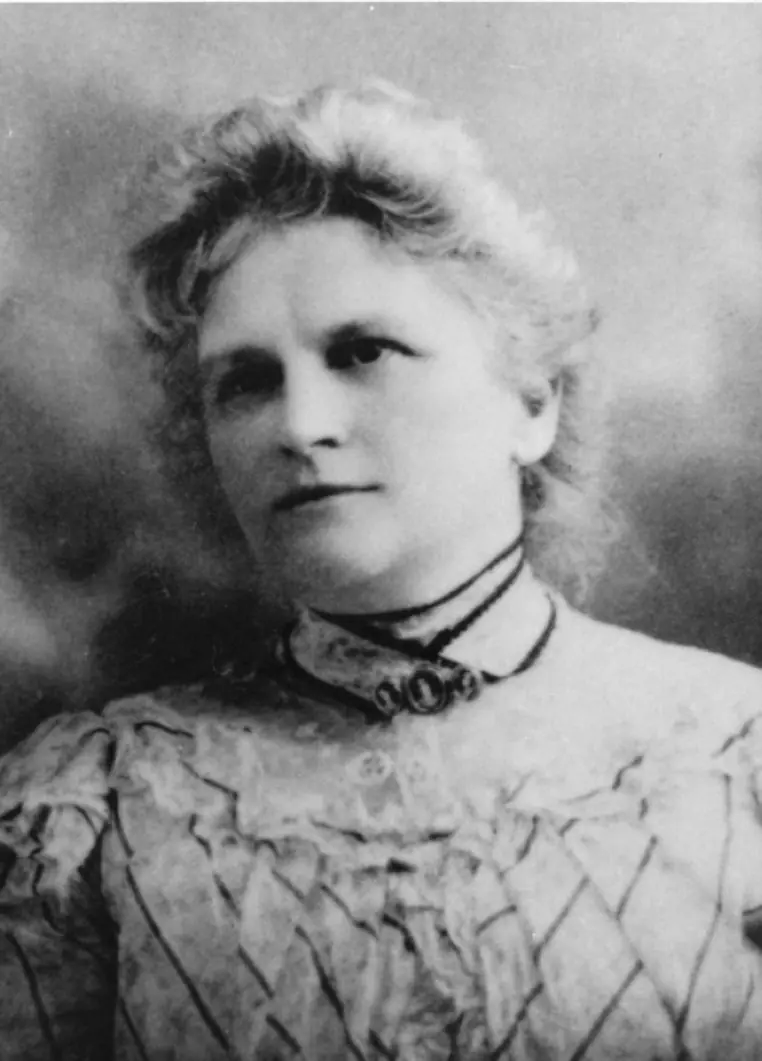
In 1870 she married Oscar Chopin and moved to New Orleans, and later to the village of Cloutierville in Natchitoches Parish, deep in the Louisiana cotton and sugar country. She had six children. When Oscar died of malaria in 1882 she was left with his debts, ran the plantation store herself for a time, and then returned to St. Louis, where she began to write in her late thirties. Her first novel, At Fault, appeared in 1890. Two collections of stories, Bayou Folk (1894) and A Night in Acadie (1897), made her reputation as a local colour writer — a recorder of the speech, dress and customs of Louisiana's Creole and Cajun communities. She wrote more than a hundred stories in all, among them "Désirée's Baby", "The Story of an Hour" and "A Respectable Woman".
Her second novel, The Awakening (1899), is the book she is now famous for. Its heroine, Edna Pontellier, leaves her husband's house, takes a lover and finally walks into the sea, and reviewers in 1899 attacked the book as morbid and indecent. Chopin's writing career effectively ended; a third collection was dropped by her publisher, and she published almost nothing more before her death of a brain haemorrhage in 1904. From the 1950s onward critics rediscovered her, and The Awakening is now a standard text in American literature.
The Nepali textbook's headnote needs three corrections, and examiners will accept the accurate version.
- Chopin was born in 1850, not 1851.
- The Awakening was published, by Herbert S. Stone of Chicago, in 1899. It was savaged by reviewers, not suppressed by its publisher. What did happen is that her publisher then cancelled her planned third story collection, A Vocation and a Voice — which is probably the source of the confusion.
- "A Respectable Woman" was first published in the magazine Vogue on 15 February 1894 and collected in A Night in Acadie (1897). The Awakening and Other Short Stories (2005) is a modern reprint anthology, not the book Chopin wrote it for.
One further fact is useful. Gouvernail is a recurring Chopin character. He appears again in the story "Athénaïse" (1896) and once more, briefly, in The Awakening (1899) — always the same quiet, kindly, slightly melancholy journalist, and always a man who awakens something in a married woman without ever pursuing her.
2.2 The story
The unwelcome guest. Mrs. Baroda is "a little provoked" to learn that her husband Gaston expects his friend Gouvernail to spend a week or two on the plantation. The couple have entertained a great deal through the winter and have spent much of it in New Orleans in "various forms of mild dissipation"; she is looking forward to rest and to an "undisturbed tete-a-tete with her husband". She has never met Gouvernail, who was Gaston's college friend and is now a journalist, but she has "unconsciously formed an image of him": tall, slim, cynical, in eyeglasses, hands in his pockets. And on that evidence — which is no evidence at all — "she did not like him".
The man who arrives. The real Gouvernail is slim enough, but not very tall and not at all cynical; he wears no eyeglasses and does not keep his hands in his pockets. To her own surprise, "she rather liked him when he first presented himself" — and cannot explain why. He is nothing like the brilliant man Gaston had described. He sits "mute and receptive" before her chatty eagerness and her husband's "frank and wordy hospitality". His courtesy is perfect, yet he makes "no direct appeal to her approval or even esteem" — he simply does not need her good opinion, which is what unsettles her.
Days on the portico. Settled in, Gouvernail likes to sit on the wide portico in the shade of a big Corinthian pillar, smoking lazily and listening to Gaston talk about sugar planting. "This is what I call living," he says, with deep satisfaction, as the warm scented air comes across the cane field. He makes friends with the dogs. He does not care to fish and shows no eagerness to shoot grosbecs. In other words he wants nothing, and a hostess whose whole social skill lies in supplying what guests want is left with nothing to do.
Piqued. Puzzled at first, Mrs. Baroda soon becomes piqued — irritated in her vanity. She tries leaving the two men alone; Gouvernail "took no manner of exception to her action", which is worse. So she does the opposite and "imposed her society upon him", walking with him to the mill and along the batture, "persistently" trying "to penetrate the reserve in which he had unconsciously enveloped himself". That one word unconsciously is important: he is not withholding himself from her; he simply has no idea she is trying.
The quarrel with Gaston. "When is he going — your friend?" she asks. "For my part, he tires me frightfully." Gaston cannot understand it: the man gives her no trouble. "No. I should like him better if he did," she answers — a reply that gives away more than she knows. Making a bit of toilet together in her dressing-room, Gaston takes her pretty face between his hands and tells her, laughing, that she is "full of surprises, ma belle", and that she is making "a commotion" over poor Gouvernail, "the last thing he would desire or expect". She resents the word hotly, and retorts, "unconciliated", that Gaston had called his friend clever and a man of ideas. Gaston explains that he is clever but "run down by overwork". She announces that she will go to the city in the morning to have her spring gowns fitted, and asks to be told when Mr. Gouvernail has gone.
The bench. That night she sits alone on a bench beneath a live oak at the edge of the gravel walk. She has never known her thoughts "to be so confused", and can gather from them only "the feeling of a distinct necessity to quit her home in the morning". She hears footsteps on the gravel and sees in the darkness only "the approaching red point of a lighted cigar" — she knows it is Gouvernail, because her husband does not smoke. She hopes to stay hidden, but her white gown gives her away. He throws away his cigar and sits down beside her, "without a suspicion that she might object", and hands her the white scarf her husband has sent out. She takes it with a murmur of thanks and lets it lie in her lap.
The voice in the dark. Gouvernail says something ordinary about the night air, and then, half to himself, quotes Walt Whitman: "'Night of south winds — night of the large few stars! Still nodding night —'". She makes no reply to this "apostrophe to the night", which "was not addressed to her". Then his reserve melts, and he talks freely and intimately "in a low, hesitating drawl that was not unpleasant to hear" — about the old college days with Gaston, about "keen and blind ambitions and large intentions", and about what is left to him now: "a philosophic acquiescence to the existing order — only a desire to be permitted to exist, with now and then a little whiff of genuine life, such as he was breathing now."
The temptation. Chopin then writes the sentences on which the whole story turns. Mrs. Baroda's mind "only vaguely grasped what he was saying. Her physical being was for the moment predominant." She is not listening to his words but "drinking in the tones of his voice". She wants to reach out in the darkness and touch his face or his lips with her fingertips; she wants to draw close and whisper against his cheek — "she did not care what — as she might have done if she had not been a respectable woman." And then the beautiful, exact reversal: "The stronger the impulse grew to bring herself near him, the further, in fact, did she draw away from him." As soon as she can do it without obvious rudeness she gets up and leaves. Gouvernail, entirely unaware, lights a fresh cigar and finishes his apostrophe to the night.
The battle fought alone. She is greatly tempted to tell her husband — "who was also her friend" — about "this folly that had seized her", but does not: "Besides being a respectable woman she was a very sensible one; and she knew there are some battles in life which a human being must fight alone." She takes an early train to the city the next morning and does not come back until Gouvernail has left the house.
The last three sentences. Gaston wants the friend back in the summer, and gives up the idea against his wife's "strenuous opposition". Then, before the year ends, she proposes "wholly from herself" that Gouvernail visit them again. Her husband is surprised and delighted: "I am glad, chere amie, to know that you have finally overcome your dislike for him; truly he did not deserve it." And she answers, laughing, after pressing a long tender kiss on his lips: "Oh, I have overcome everything! You will see. This time I shall be very nice to him."
2.3 Characters
| Character | Who they are | Role in the story |
|---|---|---|
| Mrs. Baroda | Mistress of a Louisiana sugar plantation; young, attractive, sociable, used to being the centre of a room | Protagonist; the entire story is her inner conflict |
| Gouvernail | Gaston's old college friend; a journalist, "run down by overwork", quiet and self-contained | The catalyst — he does nothing, and that is exactly the point |
| Gaston Baroda | Her husband; a sugar planter, frank, affectionate, talkative, trusting | Represents the comfortable, secure marriage that the temptation threatens; also its blindness |
| Aunt Octavie | Mrs. Baroda's aunt in the city; mentioned only | Her respectable escape route |
| The dogs, the cigar, the white scarf | Objects that carry meaning | Gouvernail's ease, his presence in the dark, and the husband's unwitting part in the scene |
Mrs. Baroda. She is not a wicked woman and not a weak one; she is a woman who has never before met a situation her social training could not handle. Notice that her difficulty begins in vanity, not in love. She dislikes Gouvernail before she has seen him, on the strength of an imagined portrait. She likes him on sight and cannot say why. She is annoyed that he does not need her attention, and the word Chopin chooses is precise: she is "piqued". Only on the bench does the annoyance reveal what it really was. Chopin's most daring sentence is not about love at all but about the body — "Her physical being was for the moment predominant" — and the desire she records is specific and physical: to touch his face, to whisper against his cheek. What stops her is a single phrase from the story's title: she would have done it "if she had not been a respectable woman". And then she behaves with real strength. She does not confess, does not flirt, does not run into anybody's arms; she removes herself from the house and fights it alone, because "she knew there are some battles in life which a human being must fight alone." Whether she wins it is precisely what the last line refuses to say.
Gouvernail. He is the stillest character in the story and the most disturbing. He wants nothing. He will not fish, will not shoot, makes no effort to charm, and "made no direct appeal to her approval or even esteem". Chopin is careful to tell us that he is not shy — "in no sense a diffident man, for he was not a self-conscious one" — his silences are moods, not disabilities. When he does talk on the bench, what he says is quietly sad: youthful ambition has come to nothing and all he asks now is "to be permitted to exist, with now and then a little whiff of genuine life". He is entirely innocent. He has no idea that Mrs. Baroda is struggling beside him, throws away his cigar without a thought, quotes Whitman to the night rather than to her, and lights a fresh cigar when she goes. That innocence is what makes the story so uncomfortable — the crisis is one person's, and the other party never knows it happened.
Gaston Baroda. Generous, cheerful and completely trusting. He teases his wife affectionately, takes her face in his hands, calls her ma belle and chere amie, and reads her irritation as a charming unpredictability: "Even I can never count upon how you are going to act under given conditions." He is also the unconscious author of the bench scene — it is he who sends the scarf out into the garden with Gouvernail. His trust is admirable, but Chopin lets us see its other face: he does not know his wife at all, and at the end he is delighted by a sentence whose meaning he has completely misread.
2.4 Themes
Desire and respectability. The title is the theme. "Respectable" is a social word, not a moral one: it describes how a woman is seen. Mrs. Baroda's impulse is not checked by love for her husband or by conscience but by an identity — she is a respectable woman, and respectable women do not do this. Chopin's quiet radicalism is to present the impulse itself as natural and the restraint as external.
The inner life is the real life. Almost nothing happens outwardly: a guest visits, a wife goes shopping, a guest leaves. The story insists that the important events of a life may leave no trace at all in its history.
Self-knowledge. Mrs. Baroda learns three things she did not know: that she can be attracted to a man who makes no attempt to attract her; that her body can overrule her mind; and that some things cannot be shared even with a loving husband. This is the "awakening" that Chopin would enlarge into a whole novel five years later.
Marriage, trust and its limits. The Barodas' marriage is happy, affectionate and, at its centre, uninformed. Chopin does not suggest that Mrs. Baroda should have confessed; she suggests that a marriage can be warm and still leave a woman completely alone with the thing that matters most to her.
The freedom the guest represents. Gouvernail is a man with no plantation, no wife and no ambition, who asks only for "a little whiff of genuine life". To a woman whose days are made of gowns, guests and hospitality, that unowned life is itself an attraction.
A kind of nineteenth-century American fiction devoted to the speech, manners, dress and landscape of one particular region. Chopin's Louisiana details — the portico with Corinthian pillars, the sugar field, the batture, the grosbecs, the French phrases ma belle, chere amie, tete-a-tete — are local colour; but in her best work the region is only the surface, and the subject underneath is the inner life of women.
2.5 Setting, structure and point of view
Setting. A sugar plantation in Creole Louisiana in the 1890s: a large house with a wide portico and Corinthian pillars, a mill, a gravel walk, live oaks, a batture along the river, and New Orleans a train ride away. The setting does real work. It is enclosed — a household in which the same three people meet at every meal — and it is hot, scented and languid, which is why the air "caressed him with its warm and scented velvety touch". The climax could only happen where it does: outdoors, in the dark, out of sight of the house.
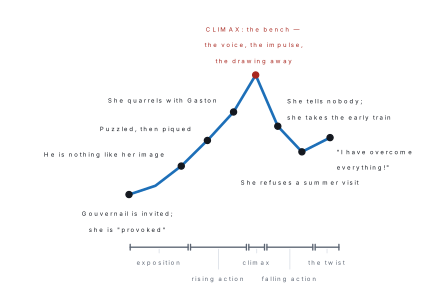
Structure. The textbook headnote is right that the story follows the classical pattern exactly — exposition (the invitation and her prejudice), rising action (her puzzlement, her pique, the quarrel with Gaston), climax (the bench), falling action (her silence and her flight to the city), resolution (her proposal that he return). What is unusual is that every stage is internal, and that the resolution resolves nothing.
Point of view. Third person limited, tied to Mrs. Baroda, and much of it in free indirect style, so that her judgements reach us in the narrator's voice: "she did not like him", "he tires me frightfully". Because we are locked inside her head we know what Gouvernail cannot know and what Gaston never learns — and because we are locked inside her head, we are denied the one piece of information we want at the end, since she does not tell us what she means.
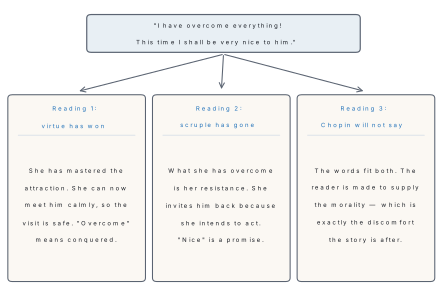
The ending. "I have overcome everything!" is the most discussed sentence Chopin ever wrote after the last line of The Awakening. It is a genuine ambiguity — Chopin has arranged the words so that both readings are fully available — and in an examination you should present the possibilities rather than pretending to certainty.
2.6 Style and literary devices
| Device | Example from the story | Effect |
|---|---|---|
| Irony (situational) | She dislikes the man she has never met and is drawn to the man who ignores her | Overturns her confidence in her own judgement — and the reader's |
| Free indirect style | "he tires me frightfully"; "she did not like him" | Her opinions arrive in the narrator's voice, so we share them before we question them |
| Antithesis | "The stronger the impulse grew to bring herself near him, the further, in fact, did she draw away" | One sentence containing the whole conflict; desire and restraint measured against each other |
| Symbolism | The lighted cigar; the white gown and white scarf; the darkness | His unconscious presence; her visible "respectability"; the concealment that makes feeling possible |
| Literary allusion | Gouvernail's quotation from Whitman's "Song of Myself" | Whitman was the great American poet of the body and of frank desire; the allusion says what the characters cannot |
| Euphemism / omission | "she did not care what"; "this folly that had seized her" | Her own language refuses to name the desire, enacting her repression |
| Sensory imagery | Air that "caressed him with its warm and scented velvety touch"; "the approaching red point of a lighted cigar" | The setting itself is made sensuous, so the climax feels inevitable |
| Foreshadowing | "I should like him better if he did [give me trouble]" | She has already, without knowing it, confessed what she wants |
| Understatement | "There was some talk of having him back during the summer" | A whole year of resistance compressed into one flat sentence |
| Open ending | "I have overcome everything!" | Transfers the moral judgement from the author to the reader |
2.7 Glossary
| Word | Meaning |
|---|---|
| provoked | annoyed, mildly irritated |
| plantation | a large estate growing a single crop, here sugar cane |
| dissipation | amusement and indulgence; frivolous social pleasure |
| tete-a-tete | (French) a private conversation between two people |
| a man about town | a fashionable man who lives a social, public life |
| cynical | distrustful of other people's motives; sneering |
| mute | silent |
| receptive | willing to listen and take in |
| exacting | demanding; hard to satisfy |
| esteem | respect and good opinion |
| portico | a roofed porch with columns at the entrance to a house |
| Corinthian | an ornate style of Greek column with carved leaves |
| velvety | soft and smooth to the touch |
| grosbec | (Louisiana French) the night heron, shot as game |
| piqued | irritated in one's pride or vanity |
| batture | the low alluvial land between a river and its levee |
| reserve | a habit of keeping one's thoughts and feelings to oneself |
| toilet (n.) | the process of washing and dressing |
| ma belle / chere amie | (French) "my beautiful one" / "dear friend" |
| cravat | a broad strip of cloth worn round the neck |
| commotion | a fuss; noisy excitement |
| unconciliated | not won over; still annoyed |
| live oak | a large evergreen oak of the American south |
| discern | to make out; to perceive with difficulty |
| apostrophe | a passage addressed to an absent person or a thing |
| baneful | harmful |
| diffident | shy, lacking confidence |
| constitutional | belonging to one's basic nature |
| acquiescence | quiet acceptance without protest |
| whiff | a brief breath or trace of something |
| predominant | dominant; in control for the moment |
| folly | foolishness |
| strenuous | vigorous; energetic |
Do not write that Mrs. Baroda "falls in love with Gouvernail" or that she "has an affair". Neither is in the text. What the text gives you is a physical impulse, lasting a few minutes on a bench, which she resists and never mentions. Similarly, do not state flatly what the last line means. The strongest answer sets out both readings, gives the evidence for each, and says why Chopin left it open.
2.8 Textbook exercises
Understanding the text
a. Why was Mrs. Baroda unhappy with the information about Gouvernail's visit to their farm?
For two reasons, one practical and one entirely imaginary. Practically, she was tired of company. She and Gaston had "entertained a good deal during the winter", with much of the season passed in New Orleans "in various forms of mild dissipation", and she was now looking forward to "a period of unbroken rest" and an "undisturbed tete-a-tete with her husband". A guest staying a week or two would destroy exactly the quiet she wanted. But she was also prejudiced against a man she had never seen. He was Gaston's college friend, now a journalist, and "in no sense a society man or 'a man about town'" — so she had "unconsciously formed an image of him in her mind", picturing him tall, slim and cynical, with eyeglasses and his hands in his pockets, "and she did not like him". Chopin makes the point gently: the dislike had no object, only a portrait she had painted herself.
b. How was Gouvernail different from Mrs. Baroda's expectation?
At every point. He was slim, but "he wasn't very tall nor very cynical; neither did he wear eyeglasses nor carry his hands in his pockets" — and, contrary to everything she had decided in advance, "she rather liked him when he first presented himself". Nor was he the brilliant, clever, idea-filled man Gaston had described. He sat "rather mute and receptive" before her chatty eagerness and her husband's wordy hospitality; his manners were faultless, yet "he made no direct appeal to her approval or even esteem". He was happy to sit on the portico smoking and listening to Gaston talk about sugar, saying with deep satisfaction "This is what I call living"; he made friends with the dogs; he did not care to fish and showed no eagerness to shoot grosbecs. She had expected a performer and found a man who wanted nothing from her — which was far harder to deal with.
c. How does Mrs. Baroda compare Gouvernail with her husband?
Chopin never sets the two men side by side in a formal comparison; the contrast emerges from Mrs. Baroda's reactions. Gaston is frank, "wordy", hospitable and energetic — a working sugar planter who proposes fishing and shooting, teases his wife, takes her face in his hands and calls her ma belle. Gouvernail is quiet, passive and physically idle, content to sit in the shade of a pillar. Gaston is, as Chopin puts it at the crucial moment, her husband "who was also her friend": she knows him completely. Gouvernail is a reserve she cannot "penetrate". One small detail measures the distance between them: she can identify the approaching figure in the dark by the red point of a cigar, "for her husband did not smoke". Intellectually she takes her husband's side against Gouvernail — Gaston says he is clever and a man of ideas, and she cannot see it. Emotionally, on the bench, the comparison reverses without her ever stating it: it is the stranger's voice, not her husband's, that makes her "physical being" predominant.
d. Why and how did Mrs. Baroda try to change Gouvernail's solitary habits?
She tried because his self-sufficiency puzzled her and then wounded her vanity. After a few days she "gave over being puzzled and remained piqued", because a man who needed nothing from his hostess gave her no role to play. Her method had two stages. First she withdrew, leaving her husband and her guest "for the most part, alone together" — a hint that a polite guest was expected to notice and protest. When she found that "Gouvernail took no manner of exception to her action", she reversed the tactic completely and "imposed her society upon him", going with him on his idle strolls to the mill and his walks along the batture. In Chopin's phrase, she "persistently sought to penetrate the reserve in which he had unconsciously enveloped himself". The adverb is the sting: he was not shutting her out, and never noticed the campaign.
e. How does Gaston disagree with his wife on Gouvernail's character?
When she complains that the guest "tires me frightfully", Gaston is baffled, because by any ordinary standard Gouvernail is the perfect visitor: "I can't understand; he gives you no trouble." Her answer — "No. I should like him better if he did" — strikes him as merely one of her charming inconsistencies, and he tells her, laughing, that she is "full of surprises, ma belle" and that "even I can never count upon how you are going to act under given conditions". He accuses her, in a word she hotly resents, of "taking poor Gouvernail seriously and making a commotion over him, the last thing he would desire or expect". Where she finds Gouvernail dull and disappointing, Gaston insists he is genuinely clever and a man of ideas, and explains the quietness away entirely: "the poor fellow is run down by overwork now. That's why I asked him here to take a rest." Gaston's reading of his friend is, in fact, accurate; his reading of his wife is not.
f. Why is Gaston surprised with his wife's expression towards the end of the story?
Because her behaviour reverses itself twice and he can account for neither reversal. Having disliked Gouvernail from before his arrival and left home rather than stay in the house with him, she then opposes so "strenuously" a second visit in the summer that Gaston gives up the idea. Yet before the year is out she proposes, "wholly from herself", that Gouvernail should come again. Her husband is "surprised and delighted" — surprised because nothing has happened, so far as he knows, to change her mind, and delighted because he is fond of his friend. He explains it to himself as the natural end of a groundless prejudice: "I am glad, chere amie, to know that you have finally overcome your dislike for him; truly he did not deserve it." Her reply, given laughingly after a long, tender kiss — "Oh, I have overcome everything! You will see. This time I shall be very nice to him" — surprises him again by its warmth and its odd emphasis. The reader is surprised for a quite different reason: Gaston does not know about the bench, and we do.
Reference to the context
a. What is the cause of conflict in Mrs. Baroda's mind? What role does Mrs. Baroda 'being a respectable woman' play in the story?
The conflict is between a sudden, physical desire for her husband's guest and the identity she has been brought up to inhabit. It builds in three stages. It begins as injured vanity — Gouvernail neither needs nor courts her good opinion, and she is "piqued". It becomes curiosity — she cannot understand him, and pursues him along the batture trying to "penetrate the reserve". It becomes, on the bench in the darkness, desire: "Her physical being was for the moment predominant." She wants to touch his face and lips with her fingertips and to whisper against his cheek, and Chopin states the obstacle in the same sentence — she might have done it "as she might have done if she had not been a respectable woman". The result is the story's finest line, in which the conflict is measured: "The stronger the impulse grew to bring herself near him, the further, in fact, did she draw away from him."
The phrase "a respectable woman" functions in three ways.
First, it is the brake. What stops her is not love of her husband, not religion and not conscience, but a social identity; Chopin is careful to locate the restraint outside her feelings.
Second, it is an isolation. Precisely because she is respectable she cannot speak of the episode, even to the husband "who was also her friend"; respectability requires that the struggle be invisible, and so she must fight "one of those battles in life which a human being must fight alone".
Third, it is ironic, and the irony deepens at the close. If respectability is only a matter of appearance, then a woman who feels everything and shows nothing remains, publicly, entirely respectable — and the final line lets us wonder whether the title describes a virtue or merely a reputation.
b. Sketch the character of Gouvernail and contrast it with Gaston.
Gouvernail is a journalist, Gaston's old college friend, "run down by overwork" and invited to the plantation to rest. Physically he is slim and unremarkable. Temperamentally he is quiet, passive and entirely without vanity: he sits mute before his hostess's chatter, makes "no direct appeal to her approval or even esteem", and is perfectly content on the portico with a cigar and somebody else's conversation. Chopin is careful to distinguish his quietness from shyness — he is "in no sense a diffident man, for he was not a self-conscious one", and his silences are "not constitutional, but the result of moods", which is why they melt on the bench. Underneath he is a disappointed man. Of the "keen and blind ambitions and large intentions" of his college days nothing is left but "a philosophic acquiescence to the existing order — only a desire to be permitted to exist, with now and then a little whiff of genuine life". He is also completely innocent in the story's crisis: he sits down beside Mrs. Baroda "without a suspicion that she might object", quotes Whitman to the night rather than to her, and lights a fresh cigar when she leaves.
Gaston Baroda is his opposite in almost every particular. He is a landowner, not a wage-earner; active, not idle; frank and "wordy" where his friend is silent; sociable, hospitable and affectionate, taking his wife's face between his hands, teasing her and calling her ma belle and chere amie. Where Gouvernail wants nothing, Gaston enjoys everything — his plantation, his guest, his marriage. He does not smoke; his friend's cigar is the very thing that identifies the stranger in the dark.
The contrast has a purpose. Gaston represents the known, warm, secure world Mrs. Baroda already possesses; Gouvernail represents an unowned life she has never imagined. Yet they share one quality, and it is the saddest note in the story: neither man has any idea what is happening to her. Gaston misreads her as charmingly unpredictable; Gouvernail does not read her at all.
c. Why does Mrs. Baroda not disclose her feelings towards Gouvernail to her husband?
Chopin gives the reason directly, and it is worth quoting because it is the story's moral centre: "Besides being a respectable woman she was a very sensible one; and she knew there are some battles in life which a human being must fight alone."
Several things are folded into that. Practically, she judges that telling him would do harm and no good: the impulse lasted minutes, nothing happened, and a confession would poison her husband's oldest friendship and her own marriage for the sake of relieving her feelings. Psychologically, she understands that sharing a temptation is a way of handing it to someone else to solve, and that this one is hers. Socially, respectability forbids even the naming of such a feeling; note that she cannot name it in her own thoughts either, calling it only "this folly that had seized her". And there is something more troubling underneath. She was "greatly tempted" to tell Gaston — the same verb Chopin has just used of the desire itself — which suggests that confession would have been a second kind of self-indulgence. Her silence is therefore genuine strength, and at the same time the exact price of her respectability: it makes her, on the most important night of her inner life, completely alone in a happy marriage.
d. The last three sentences of the story bring a kind of twist. After reading these three sentences, how do you analyze Mrs. Baroda's attitude towards Gouvernail?
The three sentences are Gaston's pleasure at her change of mind, his assumption that she has "finally overcome your dislike for him", and her laughing reply: "Oh, I have overcome everything! You will see. This time I shall be very nice to him." They are built to be read in at least two opposite ways, and a good answer presents both.
The optimistic reading — she has mastered herself. A year has passed. She has removed herself from the house, refused a summer visit, and fought the battle alone; now she judges that she is safe, and is generous enough to restore her husband's friendship with his oldest friend. On this reading "everything" means the attraction itself, "very nice to him" means no more than ordinary courtesy, and the long tender kiss she gives Gaston first is evidence that her marriage has won. The word "overcome" in its plainest sense means conquered.
The disturbing reading — she has mastered her scruples. She emphasises "everything", not "my dislike", correcting her husband's guess; the year of "strenuous opposition" suggests she was not safe at all; and the proposal comes "wholly from herself". On this reading what she has overcome is her resistance, "You will see" is a promise, and "I shall be very nice to him" is a quiet declaration of intent — delivered, with real irony, immediately after kissing her husband.
Why it matters. Chopin has arranged the words so that both are fully available and neither can be proved, and this is deliberate rather than careless. By 1894 an American magazine story was expected to reward virtue plainly. Chopin instead hands the verdict to the reader, so that whichever reading you choose reveals your own assumptions about what a respectable woman is likely to do. That is the real twist: the story tests us rather than Mrs. Baroda. It is also consistent with the rest of her work — five years later, in The Awakening, she would refuse in the same way to tell the reader how to judge Edna Pontellier.
Reference beyond the text
a. The entry of an outsider into a family has been a recurring subject in both literature and films. Narrate a story, real or imaginative, where an outsider's arrival destroys the intimate relationship between the husband and the wife and causes a break-up in the marital relationship without direct fault of anyone.
The Lodger
Ramesh and Sabina had been married eleven years and had, as everyone in the neighbourhood agreed, nothing to complain of. He taught mathematics at the campus; she ran a small tailoring business from the front room of their house in Dharan. They had a daughter of nine. When the upstairs flat fell vacant, it was Ramesh who suggested letting it to Nabin, a photographer newly transferred from Kathmandu, and Ramesh who carried his boxes up the stairs.
Nabin was an easy tenant and a pleasant man. He paid on time, mended the gate without being asked, and in the evenings sat on the steps developing his pictures and answering the daughter's endless questions. He was not handsome and he did not flirt. What he had — and what nobody in that house had had for years — was time. He noticed things. He noticed that the woman downstairs had an eye for colour that was wasted on school uniforms, and he said so, once, in the ordinary way, and went back to his photographs.
Sabina thought about the remark for three days.
Nothing happened. That is the whole point of the story. She did not fall in love with Nabin; she fell in love with the version of herself that a stranger had accidentally described. She began to take on design work she had once refused. She began to talk at dinner about things other than the shop, and to notice that her husband, tired after six hours of teaching, answered in single words. Ramesh, for his part, noticed only that his wife had become restless, and that she laughed more readily on the stairs than at the table. He said nothing, because there was nothing to accuse anybody of, and a man who complains of a lodger who has done no wrong looks small.
So the silence grew instead of the quarrel. When Nabin was transferred back to Kathmandu after fourteen months, the two of them stood at the gate and waved, and then went inside to a house that was suddenly very quiet. It was three years before they separated, and when people asked why, neither of them could give a reason. There was none to give. An outsider had walked through their lives without touching anything, and by the light of his passing each of them had seen how long they had stopped looking at the other.
(Chekhov's "About Love" turns on the same subject: Alyokhin and Anna Alekseyevna, the wife of a friend, love each other for years, say nothing, and part — and the story's sadness lies in the fact that nobody behaves badly.)
b. Mrs. Baroda makes an expectation about Gouvernail even before meeting him. Suppose you are a mature girl/boy and your family members are giving you pressure for getting married. Write in about 200 words describing what qualities you would like to get in your future husband/wife.
What I Would Look For
My family has begun to ask when I intend to marry, and to describe candidates to me the way Mrs. Baroda described Gouvernail before she had met him — height, complexion, salary, family. Her mistake is the one I would most like to avoid: she built a portrait and decided to dislike it, and the real man turned out to be nothing like the picture.
So I would begin with temperament rather than a list. I would want someone kind — not merely polite in company, but considerate when tired and when nobody is watching. I would want someone honest, because a marriage in which difficult things cannot be said becomes, as Chopin's story shows, a very lonely place. I would want respect between equals: my partner's work should matter as much as mine, and household duties and money should be shared rather than assigned by custom.
Beyond that I would hope for a sense of humour, patience with my family and mine with theirs, some curiosity about the world, and the ordinary ability to apologise.
I am less concerned with caste, complexion or salary. Those can be listed in advance; character cannot. It can only be discovered by meeting a person with an open mind — which is exactly what Mrs. Baroda failed to do.
Chapter summary
- "A Respectable Woman" is a short story by the American writer Kate Chopin (1850–1904), first published in Vogue on 15 February 1894 and collected in A Night in Acadie (1897).
- Mrs. Baroda is annoyed that her husband Gaston has invited his old college friend Gouvernail, a journalist, to stay on their Louisiana sugar plantation, and has already decided to dislike a man she has never met.
- The real Gouvernail is quiet, undemanding and entirely uninterested in impressing her, which first puzzles her, then leaves her "piqued".
- The climax comes at night on a bench beneath a live oak: Gouvernail sits beside her, quotes Whitman to the darkness and talks about his lost ambitions, and she finds that "her physical being was for the moment predominant" and longs to touch him.
- She resists — "the stronger the impulse grew... the further, in fact, did she draw away" — tells nobody, and leaves for the city on the early train.
- She does not confess to her husband because "there are some battles in life which a human being must fight alone".
- A year later she herself proposes that Gouvernail visit again, and tells Gaston, "I have overcome everything! ... This time I shall be very nice to him" — a line that can mean either that she has conquered the attraction or that she has conquered her resistance to it.
- The themes are desire against respectability, the reality of the inner life, self-knowledge, and the limits of even a loving marriage.
- The technique is third person limited point of view with free indirect style, a classical plot shape applied to an entirely internal action, and a deliberately open ending.
Practice questions
Short answer questions (2 marks each)
- What picture of Gouvernail had Mrs. Baroda formed before meeting him, and how accurate was it? [2]
- Why did Mrs. Baroda become "piqued" with her guest? [2]
- How did Mrs. Baroda recognise Gouvernail in the darkness of the garden? [2]
- What did Gouvernail say about his own life as he sat on the bench? [2]
- What reason does the narrator give for Mrs. Baroda's decision not to tell her husband? [2]
- What part does Gaston unknowingly play in bringing about the bench scene? [2]
Model answers — short questions
1. She had "unconsciously formed an image of him in her mind", picturing him tall, slim and cynical, wearing eyeglasses and carrying his hands in his pockets — and on that basis she decided that she did not like him. The picture was almost entirely wrong: he was slim, but not very tall and not at all cynical, and he wore no eyeglasses and did not keep his hands in his pockets.
2. Because he asked nothing of her. She could not understand him, and when she deliberately left him alone with her husband he "took no manner of exception" to it. A hostess whose importance depends on being needed found herself unnecessary, and the injury to her vanity turned her puzzlement into irritation.
3. She could see nothing in the dark but "the approaching red point of a lighted cigar", and she knew from that alone that it must be Gouvernail, "for her husband did not smoke". Her own white gown then revealed her to him.
4. He spoke of his college days with Gaston and of "the days of keen and blind ambitions and large intentions", and said that all that was left to him now was "a philosophic acquiescence to the existing order — only a desire to be permitted to exist, with now and then a little whiff of genuine life, such as he was breathing now."
5. That she was sensible as well as respectable, and "she knew there are some battles in life which a human being must fight alone." Telling Gaston would have relieved her own feelings at the cost of his peace and his oldest friendship.
6. It is Gaston who invites Gouvernail in the first place, and it is Gaston who sends Gouvernail out into the dark garden with his wife's white scarf. The husband thus arranges, in perfect innocence and out of simple kindness, the one encounter that threatens his marriage.
Long answer questions (5 marks each)
- Discuss "A Respectable Woman" as a study of the conflict between natural desire and social respectability. [5]
- Examine Chopin's use of point of view and of the open ending, and explain what she gains by them. [5]
- "Gouvernail does nothing at all, and that is why the story works." Discuss his role. [5]
Model answers — long questions
1. The story sets a natural impulse against an acquired identity and shows the identity winning — at a price. Chopin prepares the ground carefully. Mrs. Baroda's interest in Gouvernail is not presented as love; it grows out of vanity, because he does not court her good opinion, and then out of curiosity, as she tries "to penetrate the reserve in which he had unconsciously enveloped himself". On the bench, in darkness, with a voice speaking Whitman's lines about the night, the feeling becomes unmistakably physical: "Her physical being was for the moment predominant," and she wants to touch his face and lips and to whisper against his cheek — she "did not care what". Chopin then names the restraint precisely: she would have done it "if she had not been a respectable woman". This is a social category, not a moral one, and that is the story's quiet daring. The conflict is then compressed into a single antithesis: "The stronger the impulse grew to bring herself near him, the further, in fact, did she draw away from him." The cost of the victory is measured in the next paragraph. Because respectable women may not even name such feelings, she cannot tell the husband "who was also her friend", and must fight "one of those battles in life which a human being must fight alone". Chopin neither condemns the desire nor celebrates the restraint. She shows a woman locked out of her own marriage by a word — and then, with the last line, declines to tell us whether the lock held.
2. Chopin tells the story in the third person but stays entirely inside Mrs. Baroda, and much of it is written in free indirect style, so that the character's judgements reach us as if they were the narrator's: "she did not like him", "he tires me frightfully". This has three consequences. First, we adopt her prejudice before we examine it, and are therefore surprised along with her when Gouvernail turns out to be likeable — the reader is caught out in exactly the way she is. Second, it makes the crisis visible. Nothing happens on the bench that an observer would notice; the whole event is a movement of feeling, and only an interior viewpoint could record it. Third, and most cunningly, it controls what we are allowed to know. We know what Gouvernail cannot know and what Gaston never learns, which gives the final scene its dramatic irony — a delighted husband misreading his wife in front of a reader who has more information than he does. But the same device creates the famous ambiguity of the ending. Because the narration reports Mrs. Baroda's speech without entering her mind at that moment, "I have overcome everything! ... This time I shall be very nice to him" can mean that she has conquered the attraction or that she has conquered her resistance to it. Chopin had spent the whole story telling us what her heroine felt; by withholding it at the last moment she forces the reader to supply the verdict, and whichever verdict we supply tells us more about our own assumptions than about Mrs. Baroda. In a magazine world that expected virtue to be rewarded visibly, that refusal was itself a bold act.
3. Gouvernail's passivity is the mechanism of the entire story. He does not flirt, does not flatter and does not pursue; Chopin states flatly that he "made no direct appeal to her approval or even esteem". He will not fish or shoot, he is happy to sit on the portico with a cigar listening to somebody else, and when his hostess withdraws he "took no manner of exception". Had he made the smallest advance, the story would have become a conventional tale of a predatory guest, and Mrs. Baroda's struggle would have been merely a struggle against him. Because he does nothing, everything that happens must come from inside her, and the story becomes what Chopin wanted: a study of a woman discovering herself. His indifference is also the precise cause of the trouble, since it is his self-sufficiency that wounds her vanity and sets her pursuing him along the batture. His innocence is maintained to the end — he sits down beside her "without a suspicion that she might object", quotes Whitman "half to himself" in an apostrophe that "was not addressed to her", and lights a fresh cigar as she escapes. He never learns that anything occurred. At the same time Chopin makes him more than a device: the disappointed man who asks only "to be permitted to exist, with now and then a little whiff of genuine life" is a real and rather touching figure, and it is his weariness, not any charm, that moves her. He is the still centre of the story, and all its motion is measured against him.
Reference to the context
- "The stronger the impulse grew to bring herself near him, the further, in fact, did she draw away from him."
(a) Who is "she" and who is "him"? (b) Where and when does this happen? (c) What is the impulse referred to, and what restrains it? (d) Comment on the construction of the sentence and its importance in the story. [5]
- "Oh, I have overcome everything! You will see. This time I shall be very nice to him."
(a) Who speaks these words, to whom, and on what occasion? (b) What had the listener just said? (c) Give two possible meanings of the word "everything". (d) Why do you think the author ends the story here? [5]
Model answers — reference to the context
1. (a) "She" is Mrs. Baroda, mistress of the plantation; "him" is Gouvernail, her husband's old college friend, who is staying with them as a guest. (b) It happens at night in the garden, on a bench beneath a live oak at the edge of the gravel walk, where she had gone to sit alone with her confused thoughts and where Gouvernail has joined her, bringing a scarf sent by her husband. (c) The impulse is physical desire: she has stopped listening to his words and is "drinking in the tones of his voice", and she wants to reach out in the darkness and touch his face or lips with her fingertips and to whisper against his cheek. What restrains her is stated in the previous sentence — she would have done it "if she had not been a respectable woman", that is, her social identity rather than her conscience. (d) The sentence is built on antithesis and balanced comparatives — "the stronger... the further" — so that the two opposing forces are measured against each other inside a single clause, and the interpolated "in fact" gives it the tone of a discovery rather than a judgement. It matters because it states the story's whole conflict in one line and explains all her subsequent behaviour: her flight to the city, her year of "strenuous opposition", and the impossibility of telling even her husband. It also prepares the ending, since a woman who retreats hardest when she is most tempted may still be retreating when she says she has "overcome everything".
2. (a) Mrs. Baroda speaks them to her husband Gaston, laughing and after pressing "a long, tender kiss" upon his lips, about a year after Gouvernail's visit, on the occasion of her own unexpected proposal that he should be invited again. (b) Gaston had just said that he was glad she had "finally overcome your dislike for him", adding that "truly he did not deserve it" — assuming, as he has throughout, that her objection was a groundless prejudice. (c) "Everything" may mean (i) the attraction itself, so that she is announcing that she has mastered her feelings and is now safe enough to receive him as an ordinary guest; or (ii) her own resistance — the scruples, the respectability and the year of opposition — so that the invitation is issued with a very different intention, and "I shall be very nice to him" becomes a promise rather than a courtesy. Notice that she corrects her husband's word "dislike" with the much larger word "everything", which is what makes the second reading possible. (d) Chopin ends here because the story's subject is the reader's judgement as much as Mrs. Baroda's conduct. To continue would be to settle the question, and settling it would turn a study of a woman's inner life into a simple moral tale of either virtue rewarded or virtue lost. By stopping at the ambiguity she leaves the heroine her privacy, keeps the dramatic irony intact — Gaston is delighted by a sentence he has misunderstood — and obliges each reader to decide what a "respectable woman" is likely to do, thereby testing the very assumption the title raises.
Practise more: English question bank