Unit 21 · Grammar · 17 min read
Question Tags and Questions
What the syllabus asks for 5
- Building a regular tag
- The complete paradigm, irregulars included
- Yes/no questions and wh-questions
- Indirect (embedded) questions
- The mistakes Nepali speakers make most
A question tag is the short question fixed to the end of a statement — You are from Palpa, aren't you?** It is the single most predictable item in NEB Q7, because a tag is not written from feeling: it is calculated from the statement in front of it. Questions proper — yes/no questions, wh-questions and indirect questions — are equally mechanical once the word order is fixed in your mind. This unit gives you the complete paradigm, including every irregular tag the board has ever set.
(1) Which operator? Repeat the auxiliary or modal from the statement; if there is none, supply do / does / did. (2) Which polarity? Positive statement → negative tag; negative statement → positive tag. (3) Which pronoun? Replace the subject with the matching personal pronoun. Operator + polarity + pronoun, in that order, and the tag is finished.
21.1 Building a regular tag
The tag has exactly two words (three if you spell out the negative): an operator and a pronoun. The operator must be the same tense and person as the verb in the statement.
| Statement | Operator found | Polarity needed | Tag |
|---|---|---|---|
| She is waiting outside. | is | negative | isn't she? |
| They were not invited. | were (negative) | positive | were they? |
| Hari has passed the test. | has | negative | hasn't he? |
| We can meet on Friday. | can | negative | can't we? |
| You will help me. | will | negative | won't you? |
| He should apologise. | should | negative | shouldn't he? |
| The bus left early. | none → did | negative | didn't it? |
| Sita teaches at Amar Campus. | none → does | negative | doesn't she? |
| The boys play football. | none → do | negative | don't they? |
| She didn't come. | did (negative) | positive | did she? |
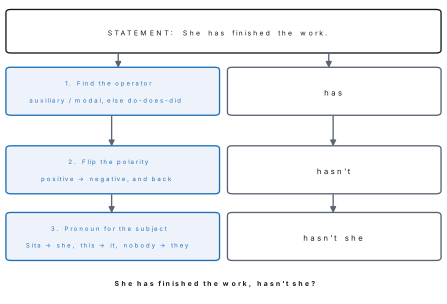
Contraction is compulsory in a negative tag. Write isn't he?, not is not he? The only exception is the formal first person: I am right, am I not? is correct but old-fashioned; the ordinary form is aren't I?
21.2 The complete paradigm, irregulars included
Learn this table. Everything the examiner can set is in it.
| Type of statement | Example | Tag | Why |
|---|---|---|---|
| I am + complement | I am your monitor, | aren't I? | amn't does not exist in standard English |
| I am not | I'm not late, | am I? | ordinary flip |
| Let's (suggestion) | Let's plant a tree, | shall we? | let's = a proposal, so shall we |
| Let us / Let me (asking permission) | Let me explain, | will you? | you are addressing a second person |
| Affirmative imperative | Open the window, | will you? (also won't you? / can you? / would you?) | a command turned into a request |
| Negative imperative | Don't be late, | will you? | negative imperatives keep will you |
| There is / are / was | There is a mistake here, | isn't there? | there is the grammatical subject |
| There aren't | There aren't any seats, | are there? | ordinary flip |
| Nobody / no one / none | Nobody phoned, | did they? | the word is negative; the pronoun is they |
| Everybody / somebody / anyone | Everyone has left, | haven't they? | plural pronoun they for a singular verb |
| Nothing | Nothing is impossible, | is it? | nothing takes it, and is already negative |
| Everything / something | Something is wrong, | isn't it? | it for a thing |
| This / That | This is your seat, | isn't it? | this / that → it |
| These / Those | Those are his books, | aren't they? | these / those → they |
| have to / has to | We have to pay today, | don't we? | have to behaves like a full verb |
| had better | You'd better rest, | hadn't you? | 'd = had |
| would rather | You'd rather walk, | wouldn't you? | 'd = would |
| used to | He used to smoke, | didn't he? | past habit, so did |
| ought to | We ought to help, | oughtn't we? / shouldn't we? | both accepted |
| need (modal) | You needn't worry, | need you? | modal need repeats itself |
| must (obligation) | You must attend, | mustn't you? | repeat the modal |
| must (deduction) | He must be ill, | isn't he? | the real verb is be |
| Negative adverbs | She hardly ever complains, | does she? | hardly makes it negative |
| I think / suppose + clause | I think he is honest, | isn't he? | the tag follows the inside clause |
| I don't think + clause | I don't think she will come, | will she? | the negative is transferred forward |
| one as subject | One should keep one's word, | shouldn't one? (shouldn't we?) | formal one |
| Exclamatory statement | What a lovely morning it is, | isn't it? | tag follows the hidden statement |
never, hardly, hardly ever, scarcely, barely, seldom, rarely, few, little, no, none, nobody, no one, nothing, neither, nowhere — a statement containing any of these is negative, so it takes a positive tag. But a few and a little are positive: He has a little money, hasn't he / doesn't he?**
Never use isn't it? as an all-purpose tag. This is the commonest Nepali English habit and it is marked wrong every time. ✗ He is coming tomorrow, isn't it? → ✓ He is coming tomorrow, isn't he? ✗ You have finished, isn't it? → ✓ You have finished, haven't you? Watch the apostrophe-d and apostrophe-s. 's is is or has; 'd is had or would. He's gone, **hasn't he? but He's a pilot, isn't he? Mind the polarity. Two negatives is wrong: ✗ She can't swim, can't she? → ✓ She can't swim, **can she? Tag the subject, not the nearest noun. Sita's brother works in Qatar, doesn't he? — the subject is brother, not Sita.
Intonation carries meaning the printed page cannot. Said with a falling tone, a tag asks for agreement (It's hot today, isn't it?); said with a rising tone, it is a genuine question (You locked the gate, didn't you?).
21.3 Yes/no questions and wh-questions
Yes/no questions put the operator in front of the subject. If the statement has no auxiliary, do / does / did is supplied — and the main verb returns to the base form.
- She is in Grade 12. → Is she in Grade 12?
- They have submitted the form. → Have they submitted the form?
- He works in Doha. → Does* he work* in Doha? (not ~~does he works~~)
- The train left at six. → Did* the train leave* at six?
Wh-questions put the question word first and then invert exactly as above:
wh-word + operator + subject + main verb + rest?
| Question word | Asks about | Example |
|---|---|---|
| who | a person (subject or object) | Who called you? |
| whom | a person (object, formal) | Whom did you meet? |
| whose | possession | Whose bag is this? |
| what | a thing, an action | What do you want? |
| which | a choice from a known set | Which route is shorter? |
| when | time | When did the class start? |
| where | place | Where are you going? |
| why | reason | Why didn't you inform me? |
| how | manner | How did you reach Jumla? |
| how many / how much | number / quantity | How many students passed? |
| how long / how often / how far / how old | duration / frequency / distance / age | How long have you waited? |
When the question word is itself the subject, there is no inversion and no do / does / did: the verb simply follows the wh-word. Someone broke the window. → Who broke the window? (not ~~who did break~~) Something happened. → What happened? The red team won.* → Which team won? Compare the *object question, which does invert: You met someone. → Whom did you meet? / Who did you meet?
Two more patterns worth knowing:
- Preposition at the end is normal in ordinary English: Who are you waiting for? The formal alternative moves it forward: For whom are you waiting? Never write ~~For whom are you waiting for?~~
- What … like? asks about character or quality; How …? asks about health or progress. What is your new teacher like? — She is strict but kind. / How is your mother? — She is better, thank you.
21.4 Indirect (embedded) questions
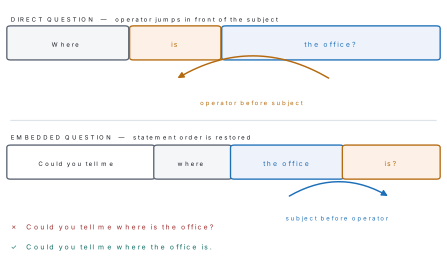
When a question is put inside another sentence — after Could you tell me…, Do you know…, I wonder…, Please tell me… — the inversion is undone. The embedded part goes back to statement order, and do / does / did disappears.
| Direct question | Embedded in a longer sentence |
|---|---|
| Where is the bus park? | Could you tell me where the bus park is? |
| What time does the bank open? | Do you know what time the bank opens? |
| Why did she resign? | I wonder why she resigned. |
| Has the result been published? | Do you know whether/if the result has been published? |
| Is this seat free? | May I ask if this seat is free? |
A yes/no question needs if or whether as the link; a wh-question keeps its own wh-word and needs no that.
21.5 The mistakes Nepali speakers make most
| ✗ Wrong | ✓ Right | The rule broken |
|---|---|---|
| He is a teacher, isn't it? | He is a teacher, isn't he? | the tag pronoun must match the subject |
| You are coming, no? | You are coming, aren't you? | no? is not an English tag |
| Let's go, will we? | Let's go, shall we? | let's takes shall we |
| Sit down, shall you? | Sit down, will you? | imperatives take will you |
| I am your friend, isn't it? | I am your friend, aren't I? | the I am irregular |
| Nobody helped him, didn't they? | Nobody helped him, did they? | nobody is already negative |
| There is no water, isn't there? | There is no water, is there? | no makes the statement negative |
| What you are doing here? | What are you doing here? | a direct question must invert |
| Why you did not come? | Why didn't you come? | did + base form, inverted |
| Who did write this poem? | Who wrote this poem? | subject questions take no did |
| Tell me where is the library. | Tell me where the library is. | no inversion when embedded |
| Do you know what is the time? | Do you know what the time is? | same rule |
| Does he plays cricket? | Does he play cricket? | after does, the base form |
| She didn't came, did she? | She didn't come, did she? | after didn't, the base form |
Problem. Add a question tag: Your brother seldom writes to you, ____ ?
Solution — step by step.
- Look for the operator. writes is a simple present verb with no auxiliary, so the operator must be supplied: the subject your brother is third person singular, so does.
- Decide the polarity. There is no not, but seldom means "almost never". A statement containing seldom, rarely, hardly, scarcely, barely or never counts as negative, so the tag must be positive.
- Choose the pronoun. Your brother is a male person → he.
Answer. Your brother seldom writes to you, does he?**
A student who ignores seldom writes doesn't he? and loses the mark.
Problem. Add a question tag: I don't think the shop is open on Saturday, ____ ?
Solution — step by step.
- Find the clause the tag really belongs to. With I think / I suppose / I believe / I expect, the tag is taken from the inside clause, not from I think. The inside clause is the shop is open on Saturday.
- Check where the negative sits. English moves the negative forward to the reporting verb: I don't think it is open means I think it is not open. So the inside clause is being treated as negative.
- Build the tag from the inside clause with the polarity already used up. Operator is, subject the shop → it, and because the negative has been counted once, the tag stays positive.
Answer. I don't think the shop is open on Saturday, is it?**
Problem. Bishnu bought a second-hand laptop in Bhotahity last week. (a) Ask about the person who bought it. (b) Ask about the thing he bought. (c) Rewrite (b) beginning Could you tell me …
Solution.
(a) The question word replaces the subject, so there is no inversion and no did, and the verb keeps its past form. Answer: Who bought a second-hand laptop in Bhotahity last week?
(b) Here the question word replaces the object, so the sentence must invert: what + did + subject + base form. Answer: What did Bishnu buy in Bhotahity last week?
(c) Embedding removes the inversion and the did, and the verb takes back the tense that did was carrying. Answer: Could you tell me what Bishnu bought in Bhotahity last week?
Chapter summary
- A tag = operator + pronoun, opposite in polarity to the statement, same tense and person as its verb.
- No auxiliary in the statement → supply do / does / did.
- Negative tags are always contracted: isn't he, doesn't she, won't they.
- Irregulars to memorise: I am → aren't I; I'm not → am I; Let's → shall we; Let me/us (permission) → will you; imperative → will you; There is → isn't there; Nobody/Everybody → they; Nothing/This/That → it; used to → didn't; had better → hadn't; have to → don't; ought to → oughtn't/shouldn't.
- Never, seldom, rarely, hardly, scarcely, barely, few, little, no, none make a statement negative, so the tag turns positive.
- With I think / I suppose, the tag comes from the inside clause; with I don't think, the tag is positive.
- Direct questions invert: (wh-) + operator + subject + base verb.
- A wh-word that is the subject takes no do/does/did: Who wrote it?
- Embedded questions drop the inversion and the do, and yes/no questions inside them need if / whether.
Practice questions
Add suitable question tags (1 mark each)
- Your sister works at Bir Hospital, ____ ? [1]
- I am the shortest in the class, ____ ? [1]
- Let's leave for Pokhara at five, ____ ? [1]
- Switch off the fan before you go, ____ ? [1]
- There is no electricity in the hostel, ____ ? [1]
- Nobody informed the principal, ____ ? [1]
- Everybody has paid the examination fee, ____ ? [1]
- He used to live in Ilam, ____ ? [1]
- We had better book the tickets today, ____ ? [1]
- She hardly ever misses her morning walk, ____ ? [1]
- Don't tell anyone about this, ____ ? [1]
- I don't think he has read the notice, ____ ? [1]
Answers
1. doesn't she? — no auxiliary, third person singular, so does; flip to negative.
2. aren't I? — the fixed irregular for I am in a positive statement.
3. shall we? — let's proposes something, so the tag is shall we.
4. will you? — an imperative takes will you (also won't you?).
5. is there? — no electricity makes it negative, so the tag is positive, with there as subject.
6. did they? — nobody is negative and is replaced by they.
7. haven't they? — everybody takes a singular verb but the pronoun they.
8. didn't he? — used to is a past form, so the operator is did.
9. hadn't we? — the 'd in had better is had.
10. does she? — hardly ever makes the statement negative.
11. will you? — negative imperatives also take will you.
12. has he? — the tag follows the inside clause, and the negative has already been used by don't think.
Correct the errors in the following sentences (1 mark each)
- The programme starts at ten, isn't it? [1]
- She can't drive a car, can't she? [1]
- Let's take the night bus, will we? [1]
- Please close the gate, shall you? [1]
- Nothing was stolen, wasn't it? [1]
- Where he has gone since morning? [1]
- Who did break this window? [1]
- Can you tell me when does the library open? [1]
- Does your father works in a bank? [1]
- Why you did not attend the meeting? [1]
Answers
13. The programme starts at ten, doesn't it? — the subject is a thing, so it, not isn't it.
14. She can't drive a car, can she? — a negative statement takes a positive tag.
15. Let's take the night bus, shall we? — let's always takes shall we.
16. Please close the gate, will you? — imperatives take will you.
17. Nothing was stolen, was it? — nothing is negative, so the tag is positive.
18. Where has he gone since morning? — a direct question inverts the operator and the subject.
19. Who broke this window? — who is the subject here, so no did.
20. Can you tell me when the library opens? — an embedded question keeps statement order.
21. Does your father work in a bank? — after does, the base form.
22. Why didn't you attend the meeting? — the operator must come before the subject.
Rewrite as instructed (1 mark each)
- Sarita completed the project in three weeks. — Ask a question about the person who completed it. [1]
- Sarita completed the project in three weeks. — Ask a question about the time taken, beginning How long … [1]
- Where is the ticket counter? — Rewrite beginning Could you tell me … [1]
- Has the result been published? — Rewrite beginning Do you know … [1]
- You met someone at the airport. — Ask about the person, using whom. [1]
- I wonder why she resigned. — Rewrite as a direct question. [1]
Answers
23. Who completed the project in three weeks? — a subject question: no did, and the verb keeps the past form.
24. How long did Sarita take to complete the project? — did + base form after the wh-phrase.
25. Could you tell me where the ticket counter is? — the embedded clause returns to statement order.
26. Do you know if (whether) the result has been published? — a yes/no question needs if or whether when embedded.
27. Whom did you meet at the airport? — an object question inverts and uses did + base form.
28. Why did she resign? — un-embedding restores the inversion and moves the tense onto did.
Practise more: English question bank