Unit 14 · Literature - Essays · 35 min read
Marriage as a Social Institution
What the syllabus asks for 7
- About the author
- The essay: shape and argument
- The essay, part by part
- Marriage across cultures: America and Nepal
- Style and devices
- Glossary
- Textbook exercises
Ask a class why people marry and the answers will be about love, family and happiness. Steven Nock, an American sociologist, asks a different question: what is a marriage? His answer, in this passage from his book Marriage in Men's Lives, is that a marriage is never just two people. It is a relationship that comes with rules, expectations and helpers already attached — laws, religion, custom, relatives — which existed before the couple met and will exist after they are gone. Those rules limit the couple, but they also protect and guide them. Nock's essay is the most academic in your book, but it has a clear line of argument and a very small number of ideas, and the ideas are easy to remember once you have seen them laid out.
Five ideas, in this order. (1) A marriage is an institution: culturally patterned and tied to education, the economy and politics. (2) It has soft boundaries — rules from outside the couple that mark marriage off from other relationships. (3) Durkheim's argument: marriage benefits men by restraining desires that would otherwise never be satisfied. (4) Cohabitation gives freedom but no template; marriage supplies one. (5) Marriage is social capital — an asset that exists only in relationships — and normative marriage in America has six dimensions. Short questions ask for one of these ideas in two or three sentences; the long question is nearly always the six dimensions or "marriage as an institution".
14.1 About the author
Steven L. Nock (the textbook's heading and contents page print the first name as "Stephen") was born on 11 March 1950 and died in January 2008. (Your textbook says 26 January; some other sources say 20 January. Learn only "January 2008".) He was Commonwealth Professor of Sociology at the University of Virginia, one of the best-known American scholars of marriage and the family. He wrote university textbooks on the sociology of the family and many articles on the causes and consequences of change in American families — on privacy, unmarried fatherhood, cohabitation, commitment, divorce and marriage. He also worked as a consultant to the federal Department of Health and Human Services on family policy.
His best-known book, Marriage in Men's Lives (Oxford University Press, 1998), asks why married men behave differently from unmarried men. It is based on survey data from thousands of American men followed year by year from 1979, and it won the American Sociological Association's William J. Goode Book Award in 1999 for the most outstanding contribution to family scholarship. (The textbook prints the name as "Good".) The essay in your book is an extract from Chapter 2, which is also titled "Marriage as a Social Institution". Nock's central finding is that the expectations attached to marriage — that a husband will be a provider and a father — shape how married men see themselves and how they act.
The textbook's short note before the essay speaks of "the national marriage debate" and of "programs that have strengthened marital relationships, lowered divorce rates, reduced out-of-wedlock births". None of this is discussed in the passage you have been given. The passage is a piece of theory about what marriage is. In answers, use the passage itself — and do not repeat the headnote's remark that Nock thinks marriage and parenthood "are private matters"; the passage argues that marriage is exactly not purely private, because society's rules shape it.
14.2 The essay: shape and argument
The passage is a sociological (expository) essay. It does not tell a story; it defines a term, borrows the authority of two earlier scholars, and builds an argument in five steps. The steps are the best way to remember it.
| Step | Paragraphs | What Nock says |
|---|---|---|
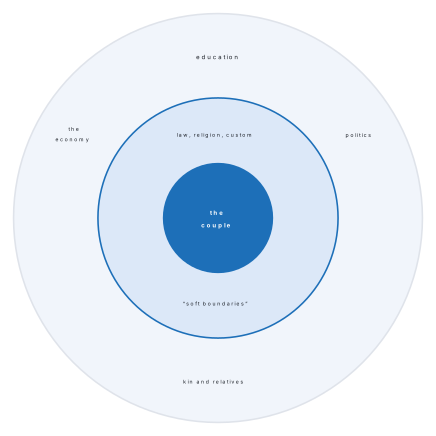
| 1. Marriage is an institution | 1 | It is "much more than the sum of two spouses": a relationship defined by legal, moral and conventional assumptions, culturally patterned and joined to education, the economy and politics. Its rules set "soft boundaries". |
| 2. Marriage gives structure to men's lives | 2–3 | Durkheim: marriage restrains limitless desires and gives men "moral equilibrium". |
| 3. Marriage versus cohabitation | 4–7 | Unmarried partners are free but must invent everything; married couples inherit a pattern, backed by law, religion and custom. There is not even a word for "partner". |
| 4. Marriage is a form of capital | 8–9 | Social capital = networks bound by trust; marriage builds kin ties and obligations; it is "an individual asset" that exists only in relationships. |
| 5. Normative marriage | 10 | Six dimensions define the ideal; even when actual marriages depart from it, it acts as social control. |
14.3 The essay, part by part
Part 1 — "much more than the sum of two spouses"
Nock's first sentence is his thesis. A marriage is not simply a private feeling between two people. It is "a relationship defined by legal, moral, and conventional assumptions". Conventional here means "according to convention", that is, according to what a society has agreed is the normal way to do things.
He then makes a distinction. We can imagine many kinds of close personal tie between two adults, but the range of marriages is much narrower, because marriage is an institution. An institution, in sociology, is an established pattern of rules and roles that a society keeps in place: the family, education, the economy, politics, religion. Marriage is "culturally patterned and integrated into other basic social institutions, such as education, the economy, and politics". Because of this, it has rules that "originate outside any particular union of two spouses" and that set "soft boundaries" round the relationship. These are "the commonly understood allowable limits of behavior that distinguish marriage from all other kinds of relationships". They are soft because nobody is arrested for crossing them — they are enforced by opinion, custom and law together, and they bend. And married couples are "heirs to a vast system of understood principles that help organize and sustain their lives": a legacy, not just a contract.
An established, relatively permanent pattern of social relationships, rules and roles, that meets a basic human need and is passed on from generation to generation. Marriage, the family, education, religion, the economy and the state are all institutions.
Part 2 — Durkheim and the "organ of society"
Why does marriage matter to men? Nock's first explanation is "an old argument", made about a century earlier by the French sociologist Émile Durkheim (1858–1917), whose book Suicide (1897) showed that marriage protected people against suicide.
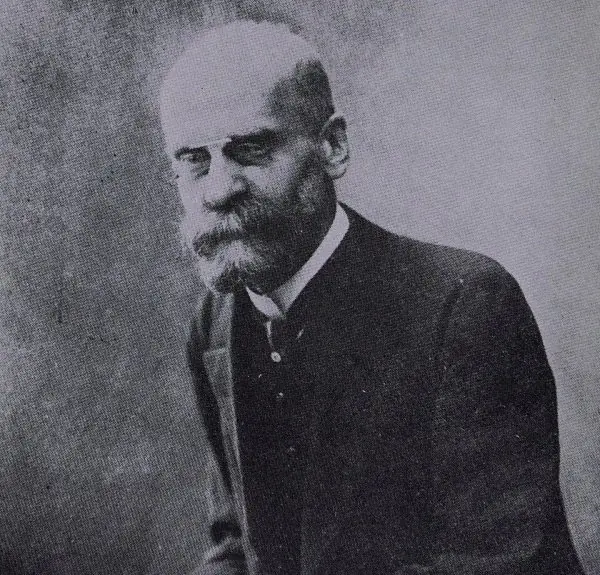
Durkheim's reasoning, as Nock reports it, goes like this. In advanced societies the basic necessities — food, housing, clothing — are more or less available to everyone. Desire therefore moves on to well-being, comfort, luxury and prestige. But these wants have no natural limit: sooner or later "the appetite for such rewards becomes sated" — and then it demands more. One of the central problems of modern society is therefore setting legitimate limits on desire, and Durkheim believed this can be done only by social institutions such as marriage. Marriage is "an organ of society" which restrains a man's otherwise uncontrollable impulses, and that is how it benefits him.
Nock quotes Durkheim at length. The core of the quotation is that marriage, by tying a man to one partner for life, gives his need for love "a strictly definite object" and "closes the horizon". This produces "moral equilibrium": he cannot seek satisfaction elsewhere "without transgressing his duty", so he limits his desires, and the discipline "makes it his duty to find his happiness in his lot, and by doing so supplies him with the means". In plain words: a man who knows exactly what is expected of him, and what is closed to him, is calmer and less restless than a man who is free to want anything.
Equilibrium means balance. A person who wants everything is always off balance, because there is always something more to want. Durkheim's idea is that limits — marriage, work, community — give a person a fixed centre from which to live. (Durkheim's own word for the opposite state, in which social rules no longer guide a person, was anomie. That word is not in your passage; use it only as background.)
Part 3 — marriage versus cohabitation
Nock now meets an objection. "Two people may enjoy a harmonious and happy life without the benefit of marriage." Many Americans think that unmarried cohabitation offers something marriage cannot: freedom from the rules, because there are no widely accepted boundaries round cohabitation. Cohabiting partners "have tremendous freedom" to decide everything: how to deal with each other's parents, whether to take holidays together or apart, whether to pool money or keep separate accounts. The parents of a cohabiting couple must also create a relationship "with little guidance" — should the couple be treated as a married pair?
Married couples face some of the same decisions, Nock admits. But "married spouses have a pattern to follow". For most matters of domestic life "marriage supplies a template — what cohabiting couples lack". Cohabiting couples are "exempt from the vast range of marriage norms and laws". Notice the double edge: the freedom of the cohabiting couple is exactly the absence of the help that the married couple has.

Nock then imagines what a married man can say: "I am your husband. You are my wife. I am expected to do certain things for you, and you likewise. We have pledged our faithfulness. We have sworn to forego others. We have made a commitment to our children. We have a responsibility and obligation to our close relatives, as they have to us." These, he stresses, "are not simply personal pledges. They are also enforceable. Others will expect these things of the couple. Laws, religion, and customs bolster this contract." So even a simple introduction — "I would like you to meet my wife" — "says a great deal".
Compare the unmarried couple. What conventional assumptions can be made about them? What are the limits to behaviour? To whom is each person obliged? Whom can they count on in need? And how does one finish the sentence "I would like you to meet my ___"? The lack of a word for such a partner "clearly indicates how little such relationships are governed by convention". In Nock's blunt conclusion, such a relationship "is not an institution".
Part 4 — marriage as a form of "capital"
Nock next argues that marriage is "a form of 'capital' just as surely as any other resource", borrowing a definition from the American sociologist James S. Coleman (1988):
| Kind of capital | Where it is found | How tangible |
|---|---|---|
| Physical capital | tools, buildings, machines, money — "embodied in observable material form" | "wholly tangible" |
| Human capital | skills and knowledge acquired by an individual | "less tangible" |
| Social capital | "in the relations among persons" | "less tangible yet" |
Just as physical and human capital "facilitate productive activity", so does social capital. Nock's version: it "consists of extensive networks of individuals linked by bonds of trustworthiness and trust". It is produced in relationships "predicated on the belief (i.e., trust) that obligations will be incurred and repaid".
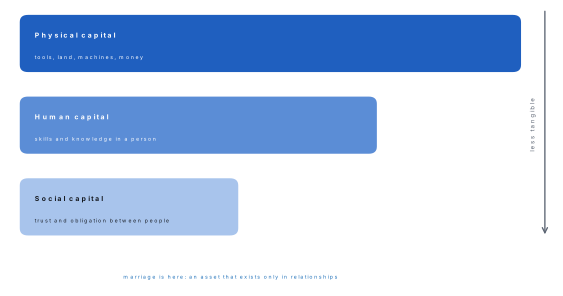
How does marriage produce it? "Through their marriages, husbands and wives become connected to new kin (and friends of new kin)." Kinship ties made by marriage "are extensively woven with threads of obligations": in need, one may call on relatives and expect help, and the "enduring nature of kinship obligations means that such debts persist". Social capital also "embeds individuals in networks that channel valued knowledge and information", sustained by social norms and social sanctions (honour, status) that "facilitate certain actions and constrain others". Nock's conclusion for this part: "the institution of marriage is an individual asset. Although intangible, it is no less important than other assets, yet more difficult to sustain (or accumulate) because it exists only as relationships with others."
Part 5 — normative marriage and its six dimensions
The last paragraph pulls the argument together. The "soft boundaries of marriage distinguish it qualitatively from all other forms of relationships". To understand how marriage affects spouses, one must therefore consider the rules that define it — and Nock restates six dimensions that define normative marriage in America:
| No. | Dimension | In plain words |
|---|---|---|
| 1 | Entered voluntarily | both people choose it freely |
| 2 | By mature adults | not children or those unready |
| 3 | Heterosexual | between a man and a woman |
| 4 | Husbands as principal earners | the husband is expected to be the main provider |
| 5 | Sexual faithfulness by both partners | fidelity is expected of both |
| 6 | Married partners will become parents | marriage is expected to lead to children |
These are the ideals. "Although many marriages depart from these ideals, the ideals still constitute the core of normative marriage as it is expressed in law, religion, and custom." Normative marriage — marriage as a society says it should be — "is a form of social control, a way by which behaviors and aspirations are channeled appropriately". It is "a force greater than the individuals involved because it represents the collective sentiments of others". Much of the meaning of marriage in men's lives, says Nock, "will be found in these rules", and the six premises "provide a definition of marriage that will inform the rest of this work".
Normative means "setting a standard of how things should be". Normative marriage is not the average marriage. Many real marriages depart from one or more of the six dimensions, and Nock says so. His point is that the ideal still shapes everyone's expectations, and that is where its power lies. Also remember that the essay was written about America in the 1990s; the law has since moved on (for example, the US Supreme Court held in 2015 that same-sex couples have the right to marry), and Nepal's marriage law and customs are different again. The exam question is about what Nock says.
14.4 Marriage across cultures: America and Nepal
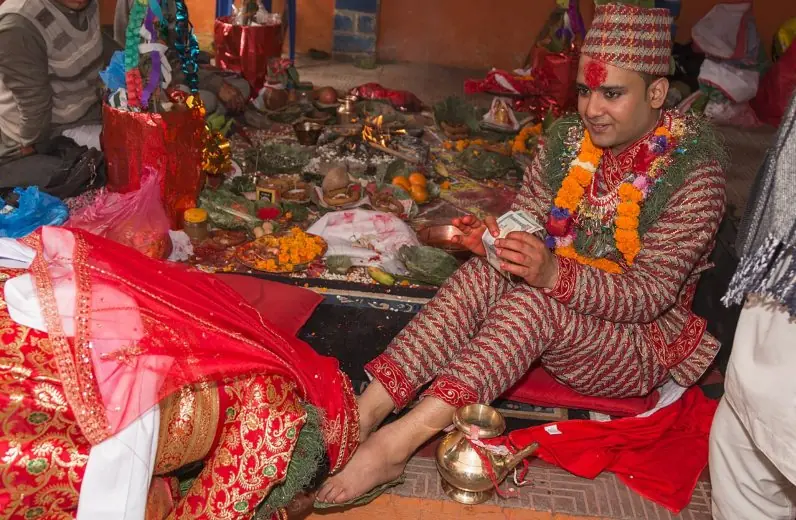
Two of the textbook's exercises ask you to compare marriage in different cultures, so it helps to have the comparison ready. Nock describes the American ideal. Marriage in Nepal is no less an institution — in Nock's sense, it is if anything more embedded in family, religion and custom — but many of its features are different.
| Feature | Normative marriage in America (Nock) | Marriage in Nepal (common practice) |
|---|---|---|
| Choice of partner | free personal choice, usually based on love | traditionally arranged by the two families, often through a go-between; love marriages and choices with the family's consent are increasingly common |
| The couple and the family | a matter between two adults; the couple sets up its own home | a bond between two families; the couple often lives in a joint family with the husband's parents |
| Ceremony | civil or religious ceremony, often short | long, ritual-filled ceremonies that differ by community (Hindu, Newar, Kirat, Tharu, Sherpa and others), with a feast for the community |
| Gender roles | husband as principal earner (the ideal in the essay) | husband as head of the household is the traditional ideal, but women's work and education are changing this |
| Money at marriage | no equivalent expectation | gifts at marriage (daijo, dowry) have long been a custom, but taking dowry is a criminal offence under the Muluki Criminal Code of 2074 |
| Legal age | set by state law | the Muluki Civil Code of 2074 (2017) sets the minimum age at 20; child marriage is an offence |
| Divorce | legally simple; common | legally possible, but carries social stigma in many communities |
The similarities matter as much as the differences. In both countries marriage is public (a ceremony, witnesses, registration), it creates duties to a wider family (Nock's "kinship ties … woven with threads of obligations"), it is supported by law, religion and custom, and it is expected to lead to children. The Nepali case therefore supports Nock's main claim: a marriage is never only two people.
14.5 Style and devices
Definition and thesis first. The first paragraph states the thesis and defines the key terms (institution, soft boundaries). The rest of the essay develops it. This top-down order is typical of academic writing.
Appeal to authority and citation. Nock supports his argument by quoting Durkheim (1951: 270–71) and Coleman (1988: S100–S101). The bracketed author–date references are the academic convention; they tell the reader where to check.
Comparison and contrast. Marriage is contrasted with cohabitation on every point: freedom against template, private promise against enforceable contract, the word "wife" against the missing word for a partner.
Rhetorical questions. In the paragraph on the unmarried couple, four questions in a row ("What, if any, are the conventional assumptions …? To whom is each obligated? Whom can this couple count on …?") lead the reader to feel the emptiness of an unregulated relationship before Nock names it.
Hypothetical example. The man introducing "my wife" and the couple who cannot complete the sentence "my …" are imagined, not reported — a teaching device that turns an abstract idea into a scene.
Metaphor. The essay is full of hidden images. Organ of society (society as a body); capital (relationships as wealth); template (a pattern to copy); threads of obligations (kinship as woven cloth); soft boundaries (limits that give but do not break); closes the horizon (desire as a horizon that keeps receding).
Formal register. Abstract nouns (affiliations, cohabitation, trustworthiness), long sentences with subordinate clauses and linking words (therefore, thus, in short) create an objective, scholarly tone. The writer mostly says "one must consider", not "I feel".
Repetition of key terms. Rules, boundaries, institution, capital, norms return again and again, so that the reader ends up thinking in Nock's vocabulary.
14.6 Glossary
| Word | Meaning |
|---|---|
| institution | an established, lasting pattern of rules and roles in a society (here, marriage) |
| affiliation | a close connection or association |
| conventional | following the accepted customs of a society |
| boundaries | dividing lines; limits |
| heir | a person who inherits something (here, marriage's "system of understood principles") |
| appetite | a strong desire, not only for food |
| sated | fully satisfied; having had enough |
| unrestrained | not held back or controlled |
| impulses | sudden urges to act without thinking of the results |
| salutary | beneficial; producing a good effect (here, of discipline) |
| transgressing | going beyond a limit set by law, morality or custom |
| cohabitation | living together as partners without being married |
| template | a pattern to be followed |
| forego | to go without; to give up |
| bolster | (verb, as used in the essay) to support and strengthen; the textbook gives only the noun meaning, "a long pillow" |
| tangible | able to be touched; real and visible |
| intangible | not able to be touched; existing but not physical |
| kin | relatives; family by blood or marriage |
| sanctions | rewards and penalties that make people follow social rules (here, honour, status) |
| normative | setting a standard of how things should be |
| voluntarily | by free choice |
| fidelity | faithfulness to a partner |
14.7 Textbook exercises
Before you read
a. What types of marriages are in practice in your culture?
Answers differ by community; a Nepali student might write: In my culture the commonest kind is the arranged marriage, in which the two families choose, propose and agree, usually after consulting the boy and girl. Love marriage, in which the couple choose each other and the families later approve, is growing, especially in towns. Some communities also have elopement followed by later acceptance, and traditional customs of their own — for example the Newar Ihi ceremony for girls, or Kirat and Tharu wedding rites. Whatever the type, the wedding is a public event witnessed by relatives.
b. Do you think marriages are different from culture to culture?
Yes. Cultures differ in how partners are chosen (love or family arrangement), in ceremonies and dress, in age at marriage, in the role of relatives and in the expected roles of husband and wife. Yet everywhere marriage is recognised by the community and creates duties. The forms vary; the fact that it is a social institution does not.
Understanding the text
a. According to the author, what is marriage?
According to Nock, marriage is "much more than the sum of two spouses". It is a relationship defined by legal, moral and conventional assumptions — an institution with rules that come from outside the couple and that separate marriage from all other relationships.
b. How is marriage an institution?
Because it is culturally patterned and integrated into other basic social institutions such as education, the economy and politics. Its rules do not originate in any one couple; they are shared, understood by everyone, and supported by law, religion and custom.
c. What are the rules that a marriage has?
The essay says marriage has rules that "originate outside any particular union" and set soft boundaries: the commonly understood limits of behaviour that distinguish marriage from other relationships. In practice they include the mutual pledges of a husband and wife — faithfulness, commitment to their children, responsibility to close relatives — and the six dimensions of normative marriage (voluntary, mature, heterosexual, the husband as principal earner, sexual fidelity, parenthood). These rules are backed by laws, religion and customs.
d. Why does marriage matter to men?
Following Durkheim, Nock says marriage provides structure to men's lives and organises their ambitions. Desires for comfort, luxury and prestige have no natural limit, and marriage, as an "organ of society", restrains uncontrollable impulses. By tying a man to one partner and one set of duties, it gives him a "moral equilibrium" and the means to find happiness in his lot.
e. What is one of the central problems in modern society?
Setting legitimate boundaries round human desires. Once food, housing and clothing are available, people want well-being, comfort, luxury and prestige; but the appetite for these rewards, once sated, returns — so society needs institutions such as marriage to limit it.
f. What does social capital consist of?
Social capital "consists of extensive networks of individuals linked by bonds of trustworthiness and trust." It exists in the relationships among people, is produced where people believe that obligations will be incurred and repaid, and is maintained by norms and sanctions such as honour and status.
g. What is normative marriage? Explain.
Normative marriage is marriage as a society's laws, religion and customs say it ought to be. In America Nock finds six dimensions: it is entered voluntarily, by mature, heterosexual adults, with the expectation that the husband will be the principal earner, that both partners will be sexually faithful, and that they will become parents. Real marriages may depart from these ideals, but the ideals remain the core standard. Normative marriage is a form of social control that channels behaviour and aspiration, and "a force greater than the individuals involved" because it expresses the collective sentiments of others.
Reference to the context
a. Discuss six dimensions that define normative marriage in America.
Nock says that the "soft boundaries" of marriage rest on six dimensions. First, marriage is entered voluntarily: it is a free personal choice, not compulsion. Second, it is entered by mature adults; maturity is presumed to be a requirement. Third, it is heterosexual, a union of a man and a woman. Fourth, the husband is expected to be the principal earner, the provider for the family. Fifth, both partners are expected to be sexually faithful, so marriage is a relationship of exclusive commitment. Sixth, married partners are expected to become parents. Nock admits that "many marriages depart from these ideals", but the ideals still form the core of normative marriage "as it is expressed in law, religion, and custom". Together they distinguish marriage from cohabitation and other relationships, and they work as social control, guiding people's behaviour and hopes. (Remember that this describes American norms at the time of writing and that some of them have since changed.)
b. Do marriages differ according to culture? How is your marriage practice different from marriage in America?
Yes — marriage is universal but its rules vary. In America, as Nock describes it, marriage is a free choice by two mature adults, usually made for love; the husband is expected to be the main earner; and the couple typically sets up a separate home. In my culture in Nepal, marriage is more often arranged by the families, sometimes with the couple's consent; it is a union of two families as well as two people; and the couple often lives with the husband's parents in a joint family. Our weddings are long public rituals — priests, fire or other sacred symbols, relatives and a community feast — and the law fixes the minimum age and forbids dowry. Yet the resemblances are also clear: in both, marriage is publicly recognised, supported by law, religion and custom, and expected to lead to parenthood. That is what Nock means when he says that marriage is an institution.
Reference beyond the text
a. Write an essay on the marriage practice in your own culture.
Model essay (about 250 words; adapt it to your own community).
Marriage in Our Culture. Marriage is one of the most important events in the life of a Nepali family. In my community, it is usually arranged by the two families. A go-between or relatives suggest a match; the families compare the young people's education, background and, often, their horoscopes; and after discussion the proposal is accepted. Nowadays the boy and girl are consulted, and love marriages, approved later by the family, are becoming common in towns.
The wedding itself is a public ritual. The groom arrives in a procession with musicians and relatives; a priest conducts the ceremony before a sacred fire; the couple exchange vows, take seven steps together, and the groom applies red sindoor to the bride's hair-parting. Guests are fed, and the bride goes to her husband's home, where she is welcomed with ritual. In many families the couple lives with the husband's parents. Other communities — Newar, Kirat, Tharu, Sherpa and so on — have their own songs, clothes and rites.
Some practices deserve reform. Dowry is a crime but is still demanded in some places, and child marriage is forbidden yet occurs in remote areas. Still, at its best, marriage in our culture binds two families in a web of mutual help, which is exactly what sociologists mean when they call it an institution.
b. Is marriage a social institution? Discuss.
Yes. A social institution is an established pattern of rules and roles, recognised by a whole society and passed on across generations. Marriage meets that test. It is culturally patterned: every society has recognised forms of marriage, with ceremonies and duties. It is integrated with other institutions — the law regulates the age, registration, property and divorce; religion blesses it; the economy treats the married couple as a household; the education system and politics assume families. It has rules from outside the couple — Nock's "soft boundaries" — such as fidelity and commitment to children and relatives, and these are enforceable by law, custom and opinion. It gives the couple a template to follow, unlike cohabitation, which has no widely accepted pattern and not even a word for a partner. And it produces social capital: ties with new relatives that carry trust and obligation. For all these reasons, marriage is much more than the private agreement of two people; it is a social institution.
Chapter summary
- Steven L. Nock (1950–2008), Commonwealth Professor of Sociology at the University of Virginia, wrote Marriage in Men's Lives (Oxford University Press, 1998); this essay is taken from its second chapter, "Marriage as a Social Institution".
- A marriage is "much more than the sum of two spouses": a relationship defined by legal, moral and conventional assumptions; it is an institution, culturally patterned and integrated into education, the economy and politics.
- Its rules originate outside the couple and set soft boundaries — the commonly understood limits that distinguish marriage from all other relationships.
- Durkheim's argument: desires for comfort, luxury and prestige never end; marriage, "an organ of society", restrains a man's impulses, gives him structure and a "moral equilibrium".
- Cohabitation gives freedom but no template, no enforceable pledges, and not even a word for a partner; marriage supplies a pattern backed by law, religion and custom.
- Marriage is social capital: networks bound by trust, obligations to kin — "an individual asset" that exists only in relationships.
- Normative marriage in America has six dimensions: voluntary; mature adults; heterosexual; husband as principal earner; sexual fidelity; parenthood. It is a form of social control.
- Style: definition and thesis first; authority (Durkheim, Coleman); contrast; rhetorical questions; hypothetical example; metaphors of organ, capital, template and thread.
Practice questions
Short answer questions (2 marks each)
- In what way is marriage an institution? Explain. (NEB 2079, Set E) [2]
- Is marriage different from other networks of relation? Give a reason. (NEB 2081, Set B) [2]
- Why does marriage matter to men? (NEB 2081, Set C) [2]
- Do you think marriage is a social institution? Why, or why not? Explain briefly. (NEB 2080, Set G) [2]
- What does Nock mean by "soft boundaries"? [2]
- According to Durkheim, how does marriage restrain men's desires? [2]
- Why does the lack of a word for an unmarried partner matter in Nock's argument? [2]
- How is marriage a form of social capital? [2]
Model answers — short questions
1. Marriage is an institution because it is culturally patterned and integrated into the other basic institutions of society — education, the economy and politics. Its rules come from outside the couple and are supported by law, religion and custom, so the marriage of any one couple follows a pattern that everyone understands.
2. Yes. Friendship and other personal ties have few rules, but marriage is defined by legal, moral and conventional assumptions that originate outside the couple and mark it off from all other relationships. Married people know what they owe each other, their children and their relatives, and others expect the same of them.
3. Following Durkheim, marriage matters to men because it gives structure to their lives and organises their ambitions. By restraining uncontrollable desires and tying a man to one partner and one set of duties, it gives him a "moral equilibrium" and a sense of purpose.
4. Yes, marriage is a social institution. It is culturally patterned, joined to education, the economy and politics, governed by rules that come from society rather than the couple, and backed by law, religion and custom. Unlike cohabitation, it gives the couple a template and creates binding obligations to kin and children.
5. "Soft boundaries" are the rules, originating outside a particular couple, that set the commonly understood limits of behaviour which distinguish marriage from all other relationships. They are "soft" because they are enforced by custom, opinion and law together rather than by force, and they allow variation within them.
6. Durkheim held that, once basic needs are met, human desire for comfort, luxury and prestige is limitless. Marriage, "an organ of society", restrains it: it binds a man to one partner "forever", "assigns a strictly definite object to the need for love, and closes the horizon". He restricts his wants to what is permitted and so finds moral balance.
7. Because it shows that such a relationship is not governed by convention. Married people can say "my wife" or "my husband" and everyone knows what is meant; there is no common word for an unmarried partner because society has not agreed on the rules. To Nock this suggests that cohabitation "is not an institution".
8. Social capital is a network of people linked by trust and obligation. Through marriage, husbands and wives gain new kin and friends of kin, bound by obligations that last; in need, they can call on relatives for help. This asset exists only in relationships and is therefore "an individual asset" that is intangible but valuable.
Long answer questions (5 marks each)
- Discuss the six dimensions of normative marriage in America. (NEB 2079, Set A) [5]
- Describe marriage as a social institution, with reference to Nock's essay. (Model) [5]
- Compare marriage and cohabitation as Nock presents them. Which does he think gives more to its partners, and why? [5]
- Explain Durkheim's argument about marriage and men as it is used in the essay, and say whether you think it is convincing. [5]
Model answers — long questions
1. Nock writes that marriage is defined by "soft boundaries", and in the last paragraph he restates the six dimensions that define normative marriage in America. First, marriage is voluntary: two people enter it by choice. Second, it is entered by mature adults, not by children. Third, it is heterosexual, between a man and a woman. Fourth, husbands are expected to be the principal earners. Fifth, both partners are expected to be sexually faithful. Sixth, married people are expected to become parents. Nock adds that many marriages depart from these ideals, but they remain "the core of normative marriage as it is expressed in law, religion, and custom". Normative marriage is a form of social control: it channels behaviour and aspirations and is "a force greater than the individuals involved" because it expresses the collective sentiments of others. The six dimensions are therefore the definition with which Nock proceeds in the rest of his book.
2. Nock's first claim is that marriage is "much more than the sum of two spouses". It is a relationship defined by legal, moral and conventional assumptions, and it is an institution: culturally patterned and integrated into education, the economy and politics. Its rules originate outside any particular couple and set soft boundaries that distinguish it from all other relationships. Married couples are "heirs to a vast system of understood principles". A husband and wife pledge faithfulness, commitment to children and responsibility to relatives, and these pledges are "enforceable", supported by laws, religion and customs. Marriage also generates social capital: bonds of trust and obligation with new kin. By contrast, an unmarried couple has no template and not even a word for a partner, so its relationship "is not an institution". Marriage is thus a social institution, not only a private arrangement.
3. Cohabitation offers freedom: there are no widely accepted boundaries, so each couple decides how to treat each other's parents, whether to share holidays, how to handle money. But it also offers no guidance: the partners, their parents and friends must invent the relationship, with no established expectations, no agreed word to introduce a partner, and no enforceable obligations. Marriage offers a template — "a pattern to follow" for domestic life — with pledges of faithfulness and commitment that law, religion and custom support. It also supplies kin networks and social capital. Nock concludes that marriage gives its partners more: it structures their lives, organises their ambitions and connects them to a wider community, while cohabitation gives only the freedom to start from nothing. The price is that marriage limits freedom, but Durkheim's argument is that such limits are good for people.
4. Durkheim argued, about a century before Nock, that once basic needs are met, human desires turn to comfort, luxury and prestige, and these have no natural limit; once one appetite is satisfied another appears. Modern society therefore needs institutions to set "legitimate boundaries" on desire, and marriage does so for men. By binding a man to one partner for life, marriage "assigns a strictly definite object to the need for love, and closes the horizon"; he cannot seek other satisfactions without "transgressing his duty", so he limits his wants and finds "moral equilibrium". The argument is persuasive in part: people do find peace in clear commitments, and unlimited choice can make them restless. But it treats marriage as benefiting men mainly by restraint, and it does not say what marriage does for women or for unhappy couples, so a modern reader may want to qualify it.
Practise with these lines. "A marriage is much more than the sum of two spouses." "Marriage supplies a template — what cohabiting couples lack." "Social capital … exists in the relations among persons." For each, be ready to say: who is speaking or being quoted, what comes just before, what the line means in plain words, and how it supports the argument that marriage is an institution.
Practise more: English question bank