Unit 27 · Grammar · 15 min read
Reported Speech
What the syllabus asks for 5
- The tense shift
- Pronouns, time words and place words
- Reporting each type of sentence
- When the tense does not shift
- Say, tell, speak, ask
Direct speech gives a speaker's exact words inside quotation marks: Sita said, "I am busy today." Indirect or reported speech gives the same message in the reporter's own frame: Sita said that she was busy that day. Turning one into the other is a mechanical operation, and the examiner sets it every year. Four things may change — the reporting verb and link word, the pronouns, the tense, and the words of time and place — and a fifth thing, the word order of questions, changes too. Work through them in that order every single time and the transformation becomes almost automatic.
- Remove the inverted commas, the comma after the reporting verb and the question or exclamation mark.
- Choose the reporting verb and the link word according to the type of sentence (that / if / whether / a wh-word / to + verb).
- Change the pronouns to fit the new speaker and listener.
- Move the tense one step back — unless the reporting verb is in the present or future, or the words state a universal truth.
- Change the words of time and place (now → then, here → there, tomorrow → the next day).
27.1 The tense shift
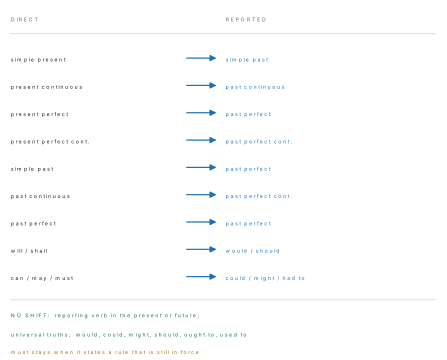
| Direct | Reported |
|---|---|
| "I write letters." | He said that he wrote letters. |
| "I am writing." | He said that he was writing. |
| "I have written." | He said that he had written. |
| "I have been writing." | He said that he had been writing. |
| "I wrote a letter." | He said that he had written a letter. |
| "I was writing." | He said that he had been writing. |
| "I had written." | He said that he had written. (no change) |
| "I will write." | He said that he would write. |
| "I shall write." | He said that he would (or should) write. |
Modals in reported speech
| Direct | Reported | Example |
|---|---|---|
| can | could | "I can swim." → She said she could swim. |
| may (permission / possibility) | might | "You may go." → He said I might go. |
| must (obligation) | had to | "You must leave." → He said I had to leave. |
| must (rule still true, or deduction) | must | He said that water must boil at 100 °C. |
| shall (future) | would | "We shall win." → They said they would win. |
| shall (suggestion, offer) | should | "Shall I carry it?" → He asked whether he should carry it. |
| will | would | "I will help." → He said he would help. |
| no change: would, could, might, should, ought to, used to, had better, would rather, need not | "You should rest." → She said I should rest. |
27.2 Pronouns, time words and place words
Pronouns — the rule. First person (I, we, my, our, us) changes to agree with the subject of the reporting verb. Second person (you, your) changes to agree with its object. Third person (he, she, they, it) does not change.
He said to me, "I have finished your work." → He told me that he had finished my work.
| Direct | Reported | Direct | Reported |
|---|---|---|---|
| now | then | here | there |
| today | that day | this | that |
| tonight | that night | these | those |
| yesterday | the previous day / the day before | come | go |
| tomorrow | the next day / the following day | bring | take |
| last night | the previous night | hence | thence |
| next week | the following week | thus | so |
| last month | the previous month | ago | before |
| the day before yesterday | two days before | just | then |
"I met him here yesterday," she said. → She said that she had met him there the previous day.
27.3 Reporting each type of sentence
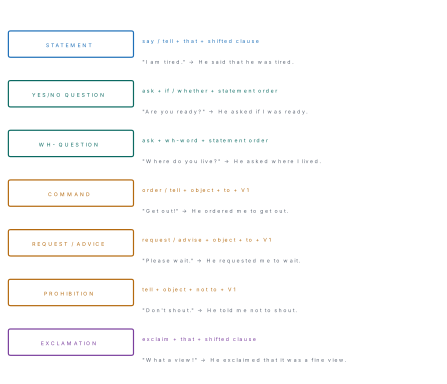
Statements
Use said when there is no listener mentioned, told when there is.
| Direct | Reported |
|---|---|
| He said, "I am ill." | He said that he was ill. |
| He said to me, "I am ill." | He told me that he was ill. |
| She said, "We won the match." | She said that they had won the match. |
Questions
Three things happen: the reporting verb becomes ask / enquire / want to know; the question changes to statement word order; and do, does, did disappear.
| Direct | Reported |
|---|---|
| He said, "Are you coming?" | He asked whether / if I was coming. |
| He said, "Do you like tea?" | He asked whether I liked tea. |
| He said, "Where did you go?" | He asked where I had gone. |
| She said, "What is your name?" | She asked what my name was. |
| "Who broke the glass?" he asked. | He asked who had broken the glass. (a subject question keeps its order) |
Commands, requests and advice
The imperative becomes an infinitive: reporting verb + object + to + base verb. A negative imperative takes not to.
| Direct | Reporting verb | Reported |
|---|---|---|
| "Stand up," the teacher said to us. | order / command / tell | The teacher ordered us to stand up. |
| "Please lend me your pen," he said. | request | He requested me to lend him my pen. |
| "You should see a doctor," she said. | advise | She advised me to see a doctor. |
| "Don't touch the wires," he said. | warn / tell | He warned me not to touch the wires. |
| "Let's go for a walk," she said. | suggest / propose | She suggested going for a walk. / She proposed that we should go for a walk. |
| "Let him come in," he said. | — | He said that he might come in. |
Exclamations, wishes and fixed expressions
| Direct | Reported |
|---|---|
| "What a beautiful garden!" he said. | He exclaimed that it was a very beautiful garden. |
| "Alas! I have lost my purse," she said. | She exclaimed with sorrow that she had lost her purse. |
| "Hurrah! We have won," they said. | They exclaimed with joy that they had won. |
| "May you live long!" he said. | He prayed that I might live long. |
| "Good morning," she said to him. | She greeted him. |
| "Thank you," he said to her. | He thanked her. |
| "Yes," he said. | He replied in the affirmative. / He agreed. |
| "No," he said. | He replied in the negative. / He refused. |
27.4 When the tense does not shift
- The reporting verb is in the present, present perfect or future. He says that he is busy. · She has told me that she will come.
- Universal truths and permanent facts. The teacher said that the earth revolves round the sun. He said that Kathmandu is the capital of Nepal.
- The verb is already past perfect — there is no further step back.
- Second and third conditionals, and wish clauses, which are already unreal. "If I were rich, I would travel," he said. → He said that if he were rich, he would travel. "I wish I knew the answer," she said. → She said she wished she knew the answer.
- Modals that have no past form: would, could, might, should, ought to, used to, had better, would rather, need not.
- A past tense tied to a stated past time, where a shift would sound absurd: He said that he was born in 2005.
✗ He said me that he was ill. → ✓ He told me or ✓ He **said to me. ✗ He told to me the truth. → ✓ He told me the truth. (tell takes no to before the listener) ✗ He asked me that where I was going. → ✓ He asked me where I was going. (never use that with a wh-word or with if / whether) ✗ He asked where was I going. → ✓ He asked where I was going. (reported questions take statement order) ✗ He asked if I am free? → ✓ He asked if I was free**. (no question mark in reported speech) ✗ He said that he will come the next day. → ✓ …that he would come the next day. (backshift after a past reporting verb)
27.5 Say, tell, speak, ask
| Verb | Pattern | Example |
|---|---|---|
| say | say (to somebody) that … | He said to me that he was late. |
| tell | tell somebody that … (no to) | He told me that he was late. |
| tell | also: tell a lie / the truth / a story / the time | Don't tell lies. |
| speak | speak to somebody · speak a language | I spoke to the principal. |
| ask | ask somebody about / for something | She asked for water. |
Problem. Report: Ramesh said to me, "I bought this book here yesterday and I am reading it now."
Solution — follow the five steps.
- Reporting verb and link word. There is a listener (to me), so said to me becomes told me, and the link word is that.
- Pronouns. I refers to the subject Ramesh → he. There is no you.
- Tense. bought (simple past) → had bought; am reading (present continuous) → was reading.
- Time and place. here → there; yesterday → the previous day; now → then.
- Other pointers. this book → that book.
Answer. Ramesh told me that he had bought that book there the previous day and that he was reading it then.
Problem. Report: "Where are you going? Don't forget your umbrella," my mother said to me.
Solution — report each sentence in its own pattern.
- The first sentence is a wh-question. Reporting verb → asked; link word → the wh-word where; word order becomes statement order (I was going); you → I; are going → was going. → My mother asked me where I was going
- The second is a negative imperative. Reporting verb → told (or reminded); pattern → object + not to + base verb; your → my. → and told me not to forget my umbrella
- Join them with and, keeping the object me in both.
Answer. My mother asked me where I was going and told me not to forget my umbrella.
Problem. Report: The teacher said, "The sun rises in the east, and I told you this yesterday."
Solution — decide clause by clause.
- First clause: a universal truth. The sun rises in the east is always true, so the present tense is kept.
- Second clause: an ordinary past statement. told shifts to had told.
- Pronouns. I → he (the teacher); you → us (assuming the reporter was in the class).
- Time word. yesterday → the previous day; this → that.
Answer. The teacher said that the sun rises in the east and that he had told us that the previous day.
A universal truth stays in the present even though everything around it shifts.
Chapter summary
- Reported speech changes the reporting verb and link word, the pronouns, the tense, the time and place words, and the word order of questions.
- Backshift: present → past, past → past perfect, will → would, can → could, may → might, must → had to. The past perfect does not move.
- No backshift after a present or future reporting verb, for universal truths, for unreal conditionals and wish, and for would, could, might, should, ought to, used to.
- Pronouns: first person follows the subject of the reporting verb, second person follows its object, third person is unchanged.
- Statements take that; yes/no questions take if / whether; wh-questions keep their wh-word; imperatives become to + base verb, with not to for negatives.
- A reported question has statement word order, no do / does / did, and no question mark.
- say that / say to somebody that / tell somebody that — tell never takes to before the listener, and that is never used with a wh-word or if.
- Exclamations use exclaim with joy / sorrow that; greetings, thanks, yes and no have their own reporting verbs.
Practice questions
Change into indirect speech (1 mark each)
- He said, "I am writing a letter." [1]
- She said to me, "I saw your brother yesterday." [1]
- The guide said, "The Himalayas lie to the north of Nepal." [1]
- "Are you free this evening?" he asked me. [1]
- The teacher said to the boys, "Why are you making noise?" [1]
- "Please give me a glass of water," the old man said to her. [1]
- "Don't play on the road," my father said to us. [1]
- "What a lovely morning it is!" she said. [1]
- He said, "I shall go to Pokhara tomorrow." [1]
- "May God bless you!" the priest said to the pilgrims. [1]
Answers
1. He said that he was writing a letter. — present continuous → past continuous.
2. She told me that she had seen my brother the previous day. — said to me → told me; saw → had seen; your → my; yesterday → the previous day.
3. The guide said that the Himalayas lie to the north of Nepal. — a permanent geographical fact does not shift.
4. He asked me whether (if) I was free that evening. — yes/no question → whether; this evening → that evening.
5. The teacher asked the boys why they were making noise. — wh-word kept, statement order, no question mark.
6. The old man requested her to give him a glass of water. — request → requested + object + to + base verb.
7. My father told us not to play on the road. — negative imperative → not to + base verb.
8. She exclaimed that it was a very lovely morning. — exclamation → exclaimed that, with very replacing what a.
9. He said that he would go to Pokhara the next day. — shall (future) → would; tomorrow → the next day.
10. The priest prayed that God might bless the pilgrims. — an optative is reported with prayed that + might.
Correct the errors (1 mark each)
- He said me that he was busy. [1]
- She told to me that she would come. [1]
- He asked me that where I lived. [1]
- She asked me what was my name. [1]
- He said that he will meet me the next day. [1]
- The teacher said that the earth moved round the sun. [1]
- He asked me if I am ready? [1]
- She told me to not open the window. [1]
Answers
11. He told me that he was busy. (or He said to me that…)
12. She told me that she would come. — tell takes no to before the listener.
13. He asked me where I lived. — no that with a wh-word.
14. She asked me what my name was. — statement order.
15. He said that he would meet me the next day. — backshift after a past reporting verb.
16. The teacher said that the earth moves round the sun. — a universal truth stays in the present.
17. He asked me whether (if) I was ready. — no question mark, and the tense shifts.
18. She told me not to open the window. — not comes before to.
Change into direct speech (1 mark each)
- He told me that he had finished his homework. [1]
- She asked me where I had put the keys. [1]
- The officer ordered the peon to bring the file at once. [1]
- He exclaimed with sorrow that he had failed the test. [1]
Answers
19. He said to me, "I have finished my homework." — the past perfect becomes the present perfect.
20. She said to me, "Where have you put the keys?" — restore question order and the question mark.
21. The officer said to the peon, "Bring the file at once." — the infinitive becomes an imperative.
22. He said, "Alas! I have failed the test." — with sorrow signals the interjection Alas!
Practise more: English question bank