Unit 12 · Literature - Poems · 55 min read
Soft Storm
What the syllabus asks for 10
- About the poet
- The poem's world: Thamel and Kesharmahal
- The poem, stanza by stanza
- Paraphrase in plain English
- Central idea and themes
- Form and structure
- Imagery, figures of speech and sound devices
- Tone
- Critical appreciation
- Glossary
A storm that is soft is not a storm at all — and that contradiction, sitting in the title and repeated more than a dozen times inside the poem, is the whole argument. Abhi Subedi watches a city in a violent decade: hungry children under the trees at Kesharmahal, a child running with a transistor radio looking for his mother, a man beaten for no reason in front of his family, a blood-stained shirt lying in a far corner. He does not become angry. He becomes soft. The poem is about what a decent person turns into when the times are indecent and there is nothing to be done except see clearly and write it down.
The oxymoron — "soft storm", "soft gale" — and what it achieves, because the textbook asks it directly. The anaphora: the phrase I became soft opens stanza after stanza, eight times exactly, with three more variations. The form: nine stanzas, 106 lines, free verse, no rhyme, no metre. The two Nepali place names, Thamel and Kesharmahal, which are the only ones in the poem. The four witnessed scenes — the hungry children, the forlorn child with the radio, the man beaten "by nobody for no reason", the blood-stained shirt. And the ending, where the public storm shrinks to something private: "My soft storm / dances in ripples / of your uneasy lake."
12.1 About the poet
Abhi Subedi (born 1945) is a poet, playwright, critic, translator, essayist and columnist, and one of the central figures in modern Nepali literature. He was born in Sabla village, Terhathum district, in the eastern hills — which is worth remembering when you read a poem so completely set in Kathmandu. He is a hill boy writing about the capital.
He taught in the Central Department of English at Tribhuvan University for around forty years, and a great many of Nepal's English teachers, including possibly your own, were taught by him or by his students. He writes in both Nepali and English, which is unusual and important: his English is not a translation of a Nepali mind but a second instrument of the same mind.
His poetry collections include Manas (1974), Chasing Dreams: Kathmandu Odyssey (1996) and Shabdara Chot (1997). His plays include Dreams of Peach Blossoms (2001) and Fire in the Monastery (2003) — titles that tell you a good deal about him, since both set something delicate (blossoms, a monastery) against something destructive (dreaming in a hard time, fire).
He has been President of the Literary Association of Nepal (LAN) and has written a weekly column for many years. As a critic he has worked on Nepali literature in English, on translation, and on Nepal's image in Western writing.
The textbook does not say when "Soft Storm" was written or where it was first published. It lists Chasing Dreams: Kathmandu Odyssey (1996) among Subedi's collections, and some guides therefore state that this poem comes from that book. That attribution is not confirmed by the textbook and you should not assert it. What the poem itself gives you is internal evidence — "violent history", "war memories", a man beaten for no reason, a blood-stained shirt — which points to the decade of Nepal's armed conflict (1996–2006) and its aftermath. Write "the poem clearly belongs to Nepal's conflict years" rather than naming a publication you cannot verify.
12.2 The poem's world: Thamel and Kesharmahal
Two place names appear in this poem and no others, and both are in the same few hundred metres of Kathmandu.
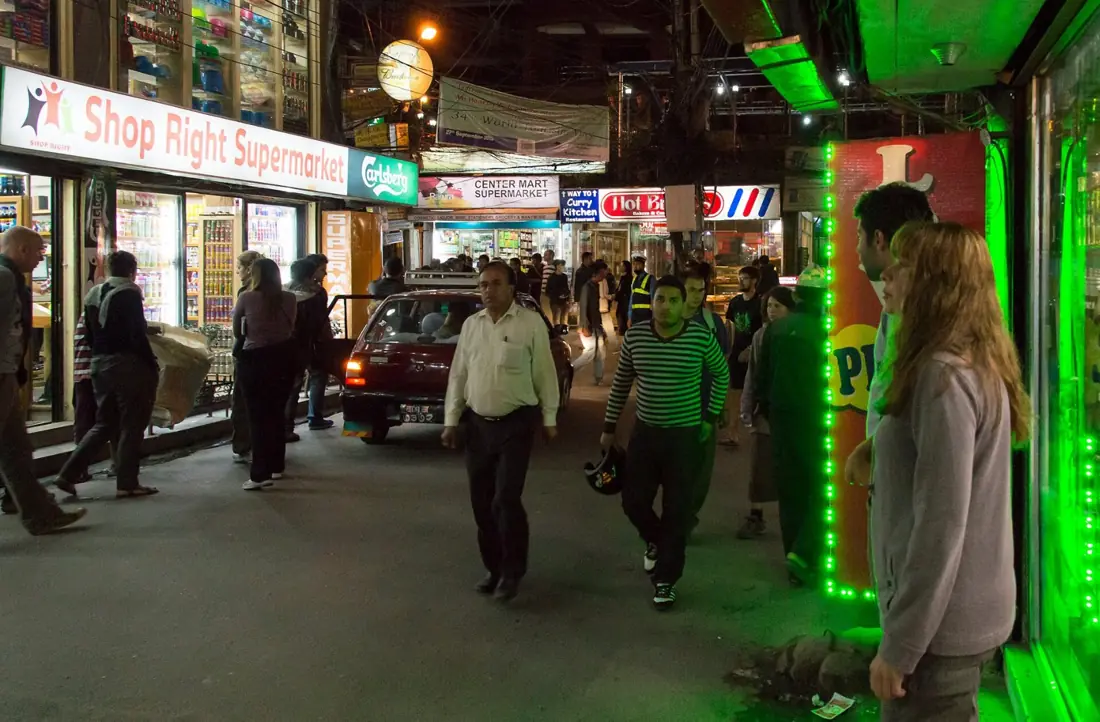
Thamel is Kathmandu's tourist quarter: trekking shops, bars, hotels, bookshops, neon and crowds. It is where the city shows its most prosperous and most international face — and where, at the same time, homeless children beg. Subedi chooses it precisely because of that collision. The children are not hungry in some remote district; they are hungry in the brightest, richest street in Nepal.
Kesharmahal (Keshar Mahal) is the Rana-era palace immediately adjoining Thamel, which houses the Kaiser Library and, in its grounds, the restored neo-classical Garden of Dreams. The poem's detail is literal: the compound has large old trees in which fruit bats roost, which is exactly what "the bat-bearing trees of Kesharmahal" means. So the children cry with hunger under the trees of a palace full of books and a garden built for pleasure. Subedi does not point this out. He puts the two things in one sentence and lets you do the arithmetic.
Many answers on this poem stay abstract. An examiner notices at once when a student knows that Kesharmahal is a Rana palace with a library and a pleasure garden, and that the bats are real. Two sentences of concrete local knowledge lift a whole answer.
12.3 The poem, stanza by stanza
The poem is in copyright, so short quotations only are given below. Keep the textbook open at pages 241–244.
Stanza 1 (21 lines) — how the softness began
The longest stanza opens with the line repeated immediately:
I became soft I became soft
Saying it twice, with no punctuation between, makes it sound less like a statement than like something the speaker is discovering as he says it.
The cause comes next: "after I heard the tumult and / crashed on the eerie stillness". Tumult is noisy violent commotion; what follows it is not peace but an eerie stillness — the frightening quiet after something terrible, which is worse than the noise. And he does not reach the stillness, he crashes on it, as a boat crashes on rock.
Then a strange, beautiful claim: "I inherited the soft / when the sky grew like crocuses / over stones". Inherited means it was handed down, not chosen — softness as something the times gave him. Crocuses are small flowers that push up in early spring, often through snow and over stony ground; they become the poem's recurring image of life insisting on itself in a hard place, and they return in stanza 7.
The moon enters — "when moon skidded down / your walls" — and the moon will stay for the rest of the poem. Note skidded: an uncontrolled, accidental movement, like a vehicle losing grip. Even the moon is not in command.
What the night speaks is "the language / of posters and politics / rituals and reasons" — four words in two pairs, all of them public, none of them personal. This is the noise a politicised city makes.
The stanza's second half repeats the refrain and gives the poem its governing paradox: "I became soft / as the softness rose like a gale / tearing my roofs". Softness behaves like a storm. It does not soothe him; it takes the roof off his house. The stanza closes with the moon singing "of / lampposts and gutters / in this seamless city" — seamless because Kathmandu has grown without joins, one quarter running into the next with no edge between rich and poor, old and new.
Stanza 2 (11 lines) — the children, and the ceremony
Two occasions, both public.
First the children: "homeless children in Thamel / cried with hunger under the bat-bearing / trees of Kesharmahal". Read §12.2 above for what those names carry. Note that Subedi gives the children no story, no names and no faces — only hunger and a location. The restraint is deliberate; he refuses to make a touching portrait out of them.
Then: "when I returned / from the melee" — a confused, jostling crowd — "where ceremony / dances with mad steps / on the unwedded gardens of history". This is the poem's most difficult phrase and a favourite exam question. Ceremony means the formal public occasions a country holds — speeches, rallies, inaugurations, commemorations — and here it is dancing madly, out of time and out of place. It dances on "unwedded gardens of history": unwedded means unmarried, unjoined, never brought together. Nepal's history has never been married to its present; the past and the country's actual life have not been joined. So the ceremonies are performed on ground that will not bear them, ground "growing around protruded rocks" — stones sticking out where flowers should be.
Stanza 3 (10 lines) — the writer, and the child with the radio
The stanza begins privately: "when I alone turned to you / leaving deep dents of words / on these white sheets". Here is the poet at his desk. The word dents is exact and unusual — not marks, not lines, but dents, as though the writing damaged the paper by being pressed in too hard. This is the first of the poem's two addresses to "you".
Then the poem's most quoted image. He becomes "soft storm" — the title phrase appears for the first time — "when I saw a forlorn child / carrying transistor radio around his neck / run around wailing / to find his mother / in the corridors of violent history."
Everything is in the detail of the radio. A cheap transistor radio hung round a child's neck: it is his only possession, it is probably his livelihood, and it is broadcasting the news of the very violence that has lost him his mother. The child carries the noise of history around his neck while running through it. And he is looking for his mother in "the corridors of violent history" — corridors are indoor, institutional, endless, and you can get lost in them.
Stanza 4 (7 lines) — the beating
The shortest stanza but one, and the harshest. A man is "beaten mercilessly / for no reason / before his family / by nobody for no reason / in no sensible times."
Count the negatives: no reason, nobody, no reason again, no sensible times. Four in five lines, and "for no reason" is repeated word for word inside two lines of itself. The repetition is not clumsiness — it is the sound of a mind unable to find an explanation and going round the same empty place again.
"By nobody" is the phrase to write about. The man is beaten by a real person, obviously; but the beater has no identity, no authority and no cause, and so he is nobody. In a collapsed time, violence stops having authors. It just happens. And it happens "before his family", which adds humiliation to injury and makes witnesses of the people who love him.
Stanza 5 (11 lines) — the blood-stained shirt
This is the stanza the textbook asks you to explain, so know it closely.
I became soft when I saw a blood-stained shirt speaking in the earth's ears with bruised human lips
There is no body. The shirt is alone, and the person who wore it is not mentioned — which is how the dead of a conflict are usually encountered: as a garment, a sandal, a photograph. The shirt is given the power of speech, but it can only whisper "in the earth's ears", to the ground, because no human authority is listening. And it speaks "with bruised human lips" — the lips are the shirt's, and they are injured, so even the testimony is damaged.
The rest of the stanza widens out: it lies "in the far corner / under the moon / of history and dreams / playing hide and seek / in open museums / of human times." History and dreams are the two children playing the game; the shirt lies under their moon. And the world is an "open museum" — a museum with no walls and no admission charge, in which the exhibits are not kept behind glass but left lying in the street. An open museum is also one nobody curates and nobody explains.
Stanza 6 (6 lines) — the reproach
Six lines, the shortest in the poem, and the only ones that carry a complaint against "you": "since you gave words / but did not listen to them, / gave storms / but didn't wait to see its Leela / over the silent stone."
Leela (लीला) is the one Sanskrit word in the poem, and it does not translate neatly. The textbook glosses it as "a divine play", and that is right: in Hindu thought līlā is the play or sport of the divine, the idea that creation is something God does the way a child does a game — for delight, without necessity. So Subedi's charge is that "you" started things and did not stay for them: gave words without listening to them, gave storms without waiting to see what beautiful divine game the storm would make over the silent stone.
Who is "you"? The poem does not say, and you should not pretend it does. Three honest readings: a person (a beloved, a friend, a reader); the country or its leaders, who make speeches and do not listen to them; or God, which the word Leela invites. The poem works with any of them, and probably wants all three at once.
Stanza 7 (19 lines) — what the softness does
The second-longest stanza, and the turn from witnessing to reflecting.
It opens by returning to the crocuses of stanza 1: "Crocuses have grown / over the stone— / I saw last moonlit night". The flowers have actually come up through the stone. This is the poem's one straightforwardly hopeful image, and Subedi puts it here, straight after the worst stanzas.
Then the walking: "storms have loitered / in the narrow lanes / where I too have walked alone / pensively in rain tears / and little chuckles of sun laughter". Loitered is a wonderful verb for a storm — to loiter is to hang about with no obvious purpose, which is what Kathmandu's violence did: it did not arrive and leave, it hung about in the lanes. And note the weather: rain is tears, sun is a chuckle, and both "have risen and melted / like rainbow" — introducing the rainbow that will end the poem.
The stanza's second half is the poem's great crescendo:
Soft is my storm that rages and rages over silent pages, silent stones, silent forlorn shirts carrying war memories, silent dilapidations of gods' abodes
Four times silent — pages, stones, shirts, dilapidations. The storm rages; everything it rages over says nothing. That is the condition of the poem: an enormous grief and total silence. Note that "rages and rages / over silent pages" is the one place where the free verse lets a rhyme slip in (rages/pages), and it lands exactly on the idea of writing.
"Dilapidations of gods' abodes" means ruined temples — and Kathmandu is a city of courtyards full of them. Inside these ruins "dances and songs / are buried under helpless divine debris / in human courtyards." The gods' rubble has fallen on the people's art. Note helpless: even the divine wreckage cannot do anything.
Stanza 8 (15 lines) — the mad time
"Soft is what you saw, / I honor your mooneyes" — a tender line, and the second address to "you". Mooneyes: eyes like the moon, or eyes that reflect it — gentle, distant, seeing by borrowed light. He does not contradict "you"; he honours what she saw and then says there is more.
"But the mad time spools / winding all that we see and live with" — a spool is the reel that thread or tape is wound onto, and spools is here a verb. Time is winding up everything we know onto its reel, mechanically, without choosing. What is wound up is a list of things that are all slightly wrong:
- "stone growing in flower" (the right elements, reversed — stone should grow a flower, or a flower grow in stone)
- "history rushing under the lamppost / and over deforested land"
- "birds singing of bizarre journeys / over the warming earth"
- "rhododendron blooming in winter"
That last one is the sharpest for a Nepali reader. The rhododendron — laligurans — is the national flower of Nepal and blooms in spring. A rhododendron flowering in winter is not a pretty image; it is a symptom. Together with "deforested land" and "warming earth", Subedi is putting environmental collapse beside political violence and treating them as one disorder — a remarkably early thing for a Nepali poem to do.
The stanza ends: "mother earth telling of the tumults / in the songs of the sad birds. / All in unison have created / this soft gale." Everything — the politics, the poverty, the violence, the climate, the birds — has together made one storm, and the storm is soft.
Stanza 9 (6 lines) — the ending
But in these hard times I want to melt like a rainbow my soft storm in your minuscule sky. My soft storm dances in ripples of your uneasy lake.
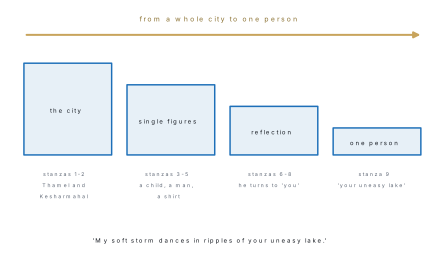
Six lines, and the poem shrinks from a whole city to a single person.
"These hard times" against "my soft storm": the final statement of the contrast that has run all the way through. The world is hard; his response is soft.
"Melt like a rainbow" picks up stanza 7's rainbow. A rainbow is beautiful, weightless, made of rain and light, and it cannot be held or kept. To melt his storm into her sky is to give it away in the gentlest possible form.
"Minuscule sky" — very small. He is not asking for the heavens; he is asking for one person's small private sky. After eight stanzas of a whole country's suffering, the poem's ambition contracts to this.
"Dances in ripples / of your uneasy lake." The last image is the softest in the poem and also the least settled. A lake with ripples on it is disturbed but not violent; uneasy means anxious, unable to rest. So the storm has not been resolved — it has been reduced to a tremor on the surface of somebody's troubled mind. That is where the poem leaves it, and it is an honest ending: nothing has been solved, but the enormous public violence has at last become something small enough for one person to carry.
12.4 Paraphrase in plain English
Stanza 1. I turned soft. I turned soft after I heard the violent noise and then ran aground on the frightening silence that followed it. The softness was handed down to me on the night when the sky opened over stony ground the way crocuses do and seemed to grow five inches taller, when the moon slid down your walls, and the whole night talked in the language of posters, politics, rituals and excuses. I turned soft as that softness came up like a gale and tore the roofs off me, on the night the moon sang about lampposts and gutters in this city that has no joins in it.
Stanza 2. I turned soft when homeless children in Thamel cried with hunger under the bat-filled trees of Kesharmahal. I turned soft when I came back from the jostling crowd, where public ceremony dances with crazy steps on the gardens of a history that was never joined to us, gardens growing up around stones that stick out of the ground.
Stanza 3. I turned soft when I turned to you by myself and pressed words like dents into these white sheets of paper. I became a soft storm when I saw a lost child with a transistor radio hanging round his neck running about crying, trying to find his mother in the endless passages of a violent history.
Stanza 4. I became a soft storm when I saw a man beaten without mercy for no reason at all, in front of his own family, by nobody, for no reason, in a time that made no sense.
Stanza 5. I turned soft when I saw a shirt with blood on it whispering into the ears of the earth through injured human lips, lying in a far corner under a moon that belongs to history and to dreams, while those two play hide and seek in the open, unguarded museums of human time.
Stanza 6. I turned soft because you gave me words and then did not listen to them; you gave storms and did not stay to watch the divine play they made over the silent stone.
Stanza 7. Crocuses have come up through the stone — I saw them last moonlit night. Storms have hung about with no purpose in the narrow lanes where I too have walked by myself, thoughtful and sad, through rain that is tears and small chuckles of sunlight, which have both risen and melted away like a rainbow. My storm is soft, and it rages and rages over silent pages, silent stones, silent abandoned shirts that carry the memory of war, and the silent ruins of the houses of the gods, where dancing and singing lie buried under helpless divine rubble in courtyards that belong to people.
Stanza 8. What you saw was soft, and I respect your moon-like eyes — but this insane age is winding everything we see and live among onto its reel: stone growing in a flower, the moon humming tunes, history hurrying under the lamppost and across land stripped of its trees, birds singing about strange journeys over an earth that is heating up, rhododendrons flowering in winter, and mother earth telling of the uproar through the songs of unhappy birds. All of these together have made this soft gale.
Stanza 9. But in this hard time, what I want is to melt my soft storm, like a rainbow, into your tiny sky. My soft storm dances in the ripples of your restless lake.
12.5 Central idea and themes
Central idea. Watching a city in a violent, senseless time — hungry children in the richest street, a lost child with a radio, a man beaten by nobody, a blood-stained shirt with no body — the speaker does not become angry or rebellious. He becomes soft, and his softness grows into a storm of its own: a grief so large that it rages, but rages only over silence and over pages. In the end he offers this soft storm to one person, as a rainbow melting into a small sky, leaving ripples on an uneasy lake. The poem argues that in a time that has lost its reasons, the honest response is not violence but a compassion strong enough to be called a storm.
Compassion as a form of power. The governing theme. Softness in this poem is not weakness: it "rose like a gale / tearing my roofs", it "rages and rages". The poem redefines gentleness as a force.
The senselessness of violence. Concentrated in stanza 4 — "by nobody for no reason / in no sensible times". The poem's horror is not that violence is cruel but that it has stopped having causes.
Urban poverty and inequality. Hungry children in Thamel, under the trees of a Rana palace. Subedi never comments; he simply places them there.
The silence of the victims. Four times "silent" in stanza 7. The shirt can speak only "in the earth's ears". Nobody with power is listening, which is exactly why the poem exists.
History as a place you get lost in. "Corridors of violent history", "unwedded gardens of history", "open museums of human times", "history rushing under the lamppost". History in this poem is never a story; it is always a building or a piece of ground that people wander in.
Environmental disorder. Deforested land, warming earth, birds on bizarre journeys, rhododendron blooming in winter. Subedi treats ecological breakdown and political breakdown as one derangement.
The poet's helplessness, and writing as the only act. "Deep dents of words / on these white sheets"; a storm that rages "over silent pages". The poem is honest that it can do nothing except record.
The turn to the personal. The last stanza abandons the city for "your minuscule sky" and "your uneasy lake". When public hope fails, what is left is one private relationship.
12.6 Form and structure
Free verse. No rhyme scheme, no metre, no fixed line length. Lines run from two words ("I became soft", "when I saw") to a dozen. The only rhyme in the poem is accidental and pointed: rages / pages in stanza 7.
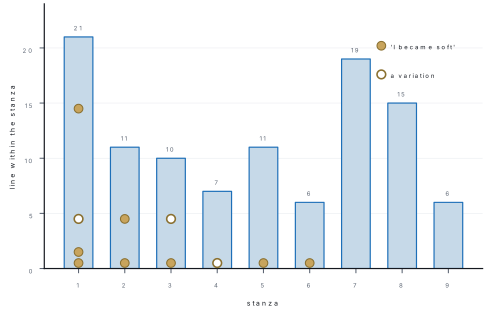
Nine stanzas, 106 lines, of very unequal length: 21, 11, 10, 7, 11, 6, 19, 15, 6. The shape is meaningful. The two longest stanzas (1 and 7) frame the poem's centre; the two shortest (6 and 9, both six lines) and stanza 4 (seven lines) are the moments where the poem has least to say and says it hardest.
Anaphora — the poem's main structural device. The exact line "I became soft" occurs eight times: twice at the very opening, again at line 15 of stanza 1, twice in stanza 2, and once each to open stanzas 3, 5 and 6. Three further variations extend it — "I inherited the soft" (stanza 1), "I became soft storm" (stanza 3) and "I became a soft storm" (stanza 4). That is eleven openings in all, and they stop completely after stanza 6.
Why the refrain stops. This is worth a mark or two. Stanzas 1–6 are the becoming: each begins "I became soft when…" and attaches the softness to a thing seen. From stanza 7 the verb changes — "Crocuses have grown", "Soft is my storm", "Soft is what you saw" — because the becoming is finished and the poem moves into the present tense of what the softness now does.
The two-part structure. Stanzas 1–6: witnessing, each a separate occasion. Stanzas 7–9: reflection, address to "you", and the private ending.
Enjambment everywhere. Almost no line in this poem is a complete unit; sentences spill over line endings ("under the bat-bearing / trees of Kesharmahal"). The effect is of speech that cannot stop, and of a world in which nothing has a clean edge — which is also what "seamless city" means.
Oxymoron as the organising figure. Soft storm, soft gale, and the supporting contradictions: an eerie stillness after tumult; softness that tears roofs; a storm that loiters; a shirt that speaks; a rhododendron blooming in winter; hard times met by a soft storm.
Circularity of imagery. Crocuses (stanzas 1 and 7), the moon (1, 3, 5, 7, 8 and "mooneyes"), the rainbow (7 and 9), storms and gales (1, 6, 7, 8, 9). The poem keeps returning, which is why a reader feels it circling rather than advancing.
12.7 Imagery, figures of speech and sound devices
| Device | Where it occurs | What it does |
|---|---|---|
| Oxymoron | "soft storm", "soft gale" | the poem's title and thesis: compassion with the force of weather |
| Anaphora | "I became soft" (8 times), plus 3 variants | the refrain that builds the poem; stops after stanza 6 |
| Paradox | "crashed on the eerie stillness" | the silence after violence is more violent than the noise |
| Simile | "the sky grew like crocuses / over stones" | life forcing itself up through hard ground |
| Symbol | crocuses (stanzas 1, 7) | resilience; small flowers that come up through stone |
| Personification | "moon skidded down your walls"; "the moon sang" | the moon as a helpless, singing witness throughout the poem |
| Metaphor | "the language / of posters and politics" | a city that can only speak politically |
| Metaphor | "softness rose like a gale / tearing my roofs" | compassion as destruction of one's own shelter |
| Transferred epithet | "this seamless city" | a Kathmandu with no joins between wealth and hunger |
| Juxtaposition | hungry children / the palace trees of Kesharmahal | inequality stated by placement, without comment |
| Personification | "ceremony / dances with mad steps" | public ritual as a deranged dancer |
| Metaphor | "unwedded gardens of history" | a past never married to the present |
| Metaphor | "deep dents of words / on these white sheets" | writing as pressure hard enough to damage the page |
| Symbol | the transistor radio round the child's neck | the news of the violence carried by its smallest victim |
| Metaphor | "corridors of violent history" | history as an endless institutional building one gets lost in |
| Repetition | "for no reason … by nobody for no reason" | a mind circling an absence of explanation |
| Synecdoche | "a blood-stained shirt" | the garment stands for the vanished body |
| Personification | shirt "speaking in the earth's ears / with bruised human lips" | testimony that only the ground can hear |
| Metaphor | "open museums / of human times" | a world whose atrocities lie unlabelled in the street |
| Allusion | "Leela" (लीला) | the divine play; the one Sanskrit word in the poem |
| Personification | "storms have loitered / in the narrow lanes" | violence hanging about with no purpose |
| Metaphor | "rain tears", "chuckles of sun laughter" | weather as human feeling |
| Anaphora | "silent pages, / silent stones, / silent forlorn shirts / silent dilapidations" | four silences; the storm rages over a world that says nothing |
| Internal rhyme | "rages and rages / over silent pages" | the poem's only rhyme, landing on the act of writing |
| Metaphor | "dilapidations of gods' abodes"; "divine debris" | ruined temples; the rubble of belief falling on human art |
| Coinage | "mooneyes" | eyes that see gently, by borrowed light |
| Metaphor | "the mad time spools" | time as a reel winding everything onto itself |
| Imagery of disorder | "deforested land", "warming earth", "rhododendron blooming in winter" | ecological collapse set beside political collapse |
| Simile | "melt like a rainbow" | the gentlest possible way of giving something away |
| Metaphor | "your minuscule sky", "your uneasy lake" | one person's inner world as the poem's final destination |
| Enjambment | throughout | speech that will not stop; a world with no clean edges |
12.8 Tone
Sad, tender, bewildered — and never angry.
That last point is the one to make in an exam, because it surprises people. A poem containing a beating, a hungry child and a bloodstained shirt does not contain a single word of accusation. Nobody is named, nobody is blamed, and the man in stanza 4 is beaten "by nobody". Subedi's speaker has decided that denunciation is not available to him.
The tone is bewildered in stanza 4, where the repetitions ("for no reason … for no reason … no sensible times") are the sound of somebody failing to understand.
It is elegiac in stanzas 5 and 7 — the long list of silences reads like a lament read over a grave.
It is reproachful, but only once and only gently, in stanza 6: "you gave words / but did not listen to them".
And it is tender at the end. "I honor your mooneyes"; "melt like a rainbow"; "dances in ripples". The poem's last movement is love, offered quietly, after everything else has failed.
There is also a thread of wonder that keeps the poem from being merely depressing: the sky growing like crocuses and becoming five inches taller, the moon singing of lampposts, the crocuses that have actually come up through the stone.
12.9 Critical appreciation
"Soft Storm" is the most modern poem in your course, and the one that most rewards a second reading.
Its central achievement is the redefinition of softness. In ordinary usage, softness is what you have instead of strength; the poem insists on the opposite. Subedi's softness tears roofs, rages and rages, and is finally called a gale. The oxymoron in the title is therefore not a decorative paradox but an argument, and it answers a real question: what should a decent, powerless person do in a country that has come apart? Subedi's answer is neither violence nor silence. It is to feel completely, see exactly, and write it down. That is a more demanding position than rebellion, and a more honest one.
The second achievement is the method of the four scenes. Stanzas 2 to 5 are almost journalism: children under trees, a child with a radio, a man being beaten, a shirt in a corner. Subedi adds no comment, no adjective of outrage and no politics. He does not tell us who beat the man or which side the shirt belonged to — and this refusal is deliberate, because in a civil conflict naming the side is how a reader escapes the horror. By leaving the violence unattributed ("by nobody"), the poem makes it everybody's.
The third is the ending, which is the riskiest thing in the poem. After a whole city's suffering, the last six lines shrink to one person's "minuscule sky" and "uneasy lake". A careless reader calls this an evasion — a public poem running away into a love poem. It is the opposite. Having established that his storm rages only "over silent pages", Subedi is admitting the limits of what a poem can do, and choosing the one thing still within reach: giving what he feels to one other human being. The final word is uneasy. Nothing has been resolved; the lake is still troubled; the storm has become a ripple. That is a far braver ending than consolation would have been.
Where the poem is vulnerable is in its abundance. Stanza 8 piles image on image — stone, moon, history, lamppost, deforestation, birds, warming earth, rhododendron, mother earth — and the accumulation blurs slightly; a reader may lose the thread that held stanzas 1 to 5 so firmly. Some phrases too ("the unwedded gardens of history", "open museums of human times") are so compressed that they need a paragraph of prose to unpack, which is a great deal to ask of a line of verse. But these are the faults of a generous imagination, and stanza 4, with its seven flat, bare lines, proves that Subedi can strip everything away when the subject demands it.
For a Nepali student the poem has a particular value: it is proof that the places you walk through — Thamel, a palace wall, a lane with a lamppost, a courtyard with a broken temple in it — are fit subjects for serious poetry in English, and that you do not have to borrow somebody else's landscape to write about your own time.
12.10 Glossary
| Word or phrase | Meaning as used here |
|---|---|
| tumult (n.) | violent, noisy commotion or uproar, especially of a crowd |
| eerie (adj.) | strange and frightening in a way that sends a chill through one |
| inherited (v.) | received from those who came before; not chosen |
| crocuses (n.) | small early-spring flowers of the iris family, pushing up through hard or stony ground |
| skidded (v.) | slid sideways out of control, as a vehicle does |
| gale (n.) | a very strong wind |
| seamless (adj.) | with no joins; running from one thing into another without a break |
| Thamel (n.) | Kathmandu's tourist quarter of hotels, shops, bars and neon |
| Kesharmahal (n.) | Keshar Mahal, the Rana palace beside Thamel, housing the Kaiser Library and the Garden of Dreams |
| bat-bearing (adj.) | carrying bats; the old trees of Keshar Mahal are a roost for fruit bats |
| melee (n.) | a confused, jostling crowd; turmoil |
| unwedded (adj.) | unmarried; here, never joined together |
| protruded (adj.) | sticking out from or through something |
| dents (n.) | hollows made by pressure; here, of words pressed into paper |
| forlorn (adj.) | pitifully sad, abandoned, lonely |
| transistor radio (n.) | a small, cheap portable radio |
| corridors (n.) | long passages inside a building, off which rooms open |
| mercilessly (adv.) | without any pity |
| bruised (adj.) | injured by a blow, without the skin being broken |
| Leela (n.) | (Sanskrit लीला) divine play or sport; the idea that creation is God's game |
| loitered (v.) | hung about in a place with no obvious purpose |
| pensively (adv.) | thoughtfully, usually with sadness |
| dilapidations (n.) | states of ruin and decay; ruined buildings |
| abodes (n.) | dwelling places, homes |
| debris (n.) | scattered rubble left after destruction |
| mooneyes (n.) | Subedi's coinage: eyes like the moon, gentle and seeing by reflected light |
| spools (v.) | winds onto a reel, as thread or tape is wound |
| bizarre (adj.) | very strange and unusual |
| rhododendron (n.) | laligurans, the national flower of Nepal; it blooms in spring |
| in unison (phr.) | all together, at the same time |
| minuscule (adj.) | extremely small |
| uneasy (adj.) | anxious, restless, unable to be at peace |
| oxymoron (n.) | a figure of speech joining two contradictory words, as in "soft storm" |
| anaphora (n.) | the repetition of the same words at the beginning of successive lines or stanzas |
Oxymoron (soft storm) · anaphora ("I became soft", eight times) · 9 stanzas, 106 lines, free verse · Thamel and Kesharmahal · the four scenes (children, child with radio, beaten man, bloodstained shirt) · "by nobody for no reason" · the ending: "ripples / of your uneasy lake."
Chapter summary
Abhi Subedi (born 1945 in Sabla, Terhathum; for about forty years a teacher in the Central Department of English at Tribhuvan University) writes in both Nepali and English; his collections include Manas, Chasing Dreams: Kathmandu Odyssey and Shabdara Chot, and his plays Dreams of Peach Blossoms and Fire in the Monastery. "Soft Storm" runs to nine free-verse stanzas and 106 lines (21, 11, 10, 7, 11, 6, 19, 15, 6). Its structural engine is anaphora: the line "I became soft" appears exactly eight times, with three variations, and stops after stanza 6. Stanzas 1–6 record the occasions of the softening — the tumult and the eerie stillness, homeless children crying with hunger in Thamel under the bat-bearing trees of Kesharmahal, a forlorn child with a transistor radio round his neck hunting for his mother "in the corridors of violent history", a man beaten "by nobody for no reason / in no sensible times", and a blood-stained shirt "speaking in the earth's ears / with bruised human lips". Stanzas 7–8 turn from witnessing to reflection: crocuses have come up through the stone, but the speaker's soft storm "rages and rages / over silent pages, / silent stones, / silent forlorn shirts carrying war memories", and the mad time winds up deforested land, a warming earth and rhododendron blooming in winter. The final stanza contracts the whole poem to one person: "in these hard times" the speaker wants to melt his soft storm like a rainbow into "your minuscule sky", where it "dances in ripples / of your uneasy lake." The poem's governing figure is the oxymoron of its title, and its argument is that in a senseless time the strongest available response is a compassion large enough to be a storm.
Practice questions
Understanding the text
a. When does the speaker grow soft? Enlist the occasions when he grows soft. [2]
He grows soft whenever he witnesses suffering or senselessness. The occasions, in order, are: (i) after hearing the tumult and crashing on the eerie stillness that followed it, on the night the moon skidded down the walls and the city spoke "the language / of posters and politics"; (ii) when homeless children in Thamel cried with hunger under the bat-bearing trees of Kesharmahal; (iii) when he returned from the melee where ceremony "dances with mad steps / on the unwedded gardens of history"; (iv) when he turned alone to "you", leaving "deep dents of words" on white sheets; (v) when he saw a forlorn child with a transistor radio round his neck running about wailing for his mother; (vi) when he saw a man beaten mercilessly before his family "by nobody for no reason"; (vii) when he saw a blood-stained shirt speaking in the earth's ears; and (viii) because "you" gave words but did not listen to them, and gave storms but did not wait to see their Leela.
b. What do you understand by 'this seamless city'? [2]
A city without joins or divisions — one thing running into the next with no visible edge. Kathmandu has grown so continuously that there is no boundary between the tourist neon of Thamel and the children starving beneath the trees a street away, between the old city and the new, or between the ceremonies of public life and the gutters the moon sings about. "Seamless" sounds like praise and is not: a city with no seams is also a city where nothing can be kept separate, and where suffering and prosperity sit in the same frame.
c. Describe the poor children portrayed in the poem. [2]
Two children appear. The first are the homeless children in Thamel, who "cried with hunger under the bat-bearing / trees of Kesharmahal" — nameless, faceless, given nothing but hunger and a location, starving in the richest and brightest street of the capital, beside a Rana palace. The second is the forlorn child "carrying transistor radio around his neck", who runs about "wailing / to find his mother / in the corridors of violent history" — a child separated from his mother by the conflict, whose single possession broadcasts the news of the very violence that took her.
d. What do you understand by 'the unwedded gardens of history'? [2]
Unwedded means unmarried, never joined. The phrase describes a national past that has never been properly married to the country's present life — a history that is celebrated in ceremonies but not actually connected to how people live. Public ceremony "dances with mad steps" on these gardens, performing on ground that has never accepted it, where instead of flowers there are "protruded rocks". It suggests a history that remains barren and unfruitful because nothing has ever been joined to it.
e. Why was the forlorn child wailing? [2]
Because he had lost his mother and was trying to find her. The poem says he "run around wailing / to find his mother / in the corridors of violent history" — the separation is the work of the conflict, not an accident in a crowd, and the "corridors" suggest an endless, bewildering place in which the search will not succeed. The transistor radio round his neck makes the cruelty sharper: he carries the broadcast noise of the violence that took her.
f. What do you understand by 'soft storm'? [2]
It is an oxymoron for the speaker's own state: a compassion so large and uncontrollable that it has the force of weather, but which harms nobody. It "rose like a gale / tearing my roofs" and "rages and rages / over silent pages" — so it is genuinely a storm in its power — yet it is soft because it expresses itself as grief, tenderness and writing rather than as violence or revenge. At the end it is reduced to a rainbow melting into a small sky and ripples on a lake.
g. Why does the speaker call our time 'mad time'? [2]
Because the age has lost its reasons. A man is beaten "for no reason … by nobody for no reason / in no sensible times"; children starve in the wealthiest street; ceremony dances "with mad steps"; and the natural order is deranged as well — "deforested land", the "warming earth", "birds singing of bizarre journeys" and "rhododendron blooming in winter". The time "spools", winding everything onto its reel mechanically, without sense or choice. It is mad because cause and effect no longer connect.
h. What does the speaker want to do in "hard times"? [2]
He wants to give his feeling away, gently, to one person: "in these hard times / I want to melt like a rainbow / my soft storm in your minuscule sky." He does not want to fight, punish or protest. He wants his soft storm to dissolve like a rainbow into someone's small private sky, where it "dances in ripples / of your uneasy lake" — that is, to turn an enormous public grief into something small enough to be shared with one human being.
Reference to the context
a. The poet uses the word 'soft' with words like 'storm' and 'gale', which generally refer to disorder and violence. What effect does the poet achieve through the use of such anomalous expressions? [5]
The figure is an oxymoron — two contradictory words yoked together — and Subedi gets at least five distinct effects from it.
It defines the speaker's response to violence. The poem's subject is an atrocious time, and the obvious poetic responses are rage or protest. By calling his response a soft storm, Subedi rules both out. He is saying that what rose in him had a storm's force and none of a storm's cruelty. The phrase names a position: overwhelming feeling that refuses to become violence.
It rescues softness from weakness. In ordinary usage soft is the opposite of strong. This poem will not allow that. The softness "rose like a gale / tearing my roofs", and later "rages and rages". By the end of the poem we have been taught to hear "soft" as a description of power, and that re-education is the poem's central intellectual act.
It mirrors the world the poem describes. Everything in this poem is internally contradictory. Tumult ends in "eerie stillness". Children starve in the richest street. A man is beaten "by nobody". Rhododendron blooms in winter. Storms "loiter" in the lanes. In a world where nothing fits together, a storm that is soft is the only accurate kind of storm.
It makes the reader slow down. "Soft storm" cannot be read past. The mind stops, holds the two words apart, and has to build a meaning for them — which is exactly the attention the poem's subject needs, and the reason the phrase is repeated so often that it eventually stops sounding like a contradiction at all.
It sets up the ending. Because we have accepted that a storm can be soft, we can accept the last image, where the storm has become a rainbow melting into a small sky and ripples on a lake. The oxymoron prepares us for a poem whose climax is a tremor on water.
The wider effect is a tone of compassion instead of accusation. A poem that called its own feeling a storm and left it at that would be a protest poem. Calling it a soft storm makes it an elegy, and that is what Subedi wanted.
b. What is the speaker's attitude towards the time he describes in the poem? [5]
His attitude has four layers, and a good answer separates them.
Bewilderment. More than anything, the speaker cannot understand the time. The clearest evidence is stanza 4, where a man is beaten "for no reason / before his family / by nobody for no reason / in no sensible times" — four negatives in five lines, and "for no reason" repeated within two lines of itself. That is not careless writing; it is the sound of a mind going round and round an absence of explanation. He calls it "mad time", and he means it literally: the age has lost its reason.
Grief, not anger. This is what makes the poem unusual. Not one person is accused. No party is named, no side is taken, the beaters are "nobody", and the blood-stained shirt is not assigned to a victim of either army. The dominant emotion is sorrow — "I became soft" — and the long litany of stanza 7 ("silent pages, / silent stones, / silent forlorn shirts carrying war memories") reads like a lament spoken over a grave.
Helplessness. He knows his response changes nothing. His storm "rages and rages / over silent pages" — silence four times in that stanza — and his only action anywhere in the poem is to leave "deep dents of words / on these white sheets". He is a witness, and he is honest about the limits of witnessing.
Reproach, once. In stanza 6 the speaker allows himself one complaint, and it is directed at "you": "you gave words / but did not listen to them, / gave storms / but didn't wait to see its Leela". Whether "you" is a beloved, the country's leaders or God, the charge is the same — of starting things and not staying for them. Even here the tone is quiet.
And underneath, an obstinate tenderness. The crocuses grow "over the stone", the moon sings, the sky becomes five inches taller, and the poem ends not in despair but in an offering. His final attitude to a hard time is to answer it with something soft.
c. What is the speaker like? Is he a rebel? Why? Why not? [5]
What he is like. He is a solitary, observant, thin-skinned man who walks the city and cannot stop noticing. He is "alone" when he turns to "you"; he has "walked alone / pensively" in the narrow lanes. He is a writer — we watch him at work, "leaving deep dents of words / on these white sheets". He is a person of enormous imaginative sympathy, who sees a shirt on the ground and hears it speaking. And he is capable of tenderness even while describing atrocity: "I honor your mooneyes."
Why he is not a rebel, in the usual sense. He takes no side and names no enemy. In a poem about a violent conflict he does not once identify who is fighting whom — the man in stanza 4 is beaten "by nobody". He proposes no action, organises nothing and calls for nothing. He does not even permit himself anger. His response to everything he sees is a single repeated verb: I became soft. And his final wish is not to overthrow anything but "to melt like a rainbow / my soft storm in your minuscule sky." A rebel wants power to change hands; this speaker wants to give his grief to one person.
Why he is, in a deeper sense, a rebel. Three arguments, and the best answers make all three.
First, he refuses the response his time demands. In a violent decade both sides require you to choose, to hate and to justify. Remaining soft is a disobedience, and the poem knows it: the softness "rose like a gale / tearing my roofs", which means it cost him his own shelter.
Second, he insists on seeing what the powerful would rather nobody saw. The hungry children in Thamel, the child with the radio, the shirt in the far corner — these are the things a state's ceremonies exist to cover up, and the poem places them beside those ceremonies "dancing with mad steps". Witness is a political act when the official version depends on nobody looking.
Third, he rejects the whole framework of force. To answer a storm with another storm is to agree that storms are how things are settled. Subedi answers with a soft storm, which is a refusal of the terms.
Conclusion. He is not a rebel in the sense of a revolutionary or an activist; he is a poet-witness. But his softness is chosen, costly and deliberately out of step with his time, and that is a quieter and more durable kind of rebellion.
d. Explain the stanza below in your own words: "I became soft / when I saw / a blood-stained shirt / speaking in the earth's ears / with bruised human lips / in the far corner / under the moon / of history and dreams / playing hide and seek / in open museums / of human times." [5]
The plain sense. I turned soft when I saw a shirt with blood on it lying in a distant corner, whispering into the ears of the earth with injured human lips, beneath a moon that belongs to history and to dreams, while those two play hide and seek in the unguarded, open-air museums of human time.
The shirt without a body. The most important fact in the stanza is what is missing. There is no corpse, no name, no news of the person who wore this shirt — only the garment. That is exactly how ordinary people encounter the dead of a conflict: as something left behind in a corner. By withholding the body, Subedi makes the loss both anonymous and universal; the shirt could have belonged to anybody, on any side.
A shirt that speaks, but only to the ground. The personification is precise and bitter. The shirt has "bruised human lips", so it can testify — but it speaks "in the earth's ears", not in anyone else's, because there is no human authority prepared to listen. Its evidence goes into the soil, which is where its owner has probably also gone. And even the lips are bruised: the testimony itself has been beaten.
"In the far corner." Out of the way, unswept, unvisited. Atrocity in this poem is never central or dramatic; it is something lying in a corner that people walk past.
The moon "of history and dreams". The moon has watched the whole poem — skidding down walls, singing of lampposts. Here it belongs jointly to history (what actually happened) and dreams (what we hoped for), and those two are "playing hide and seek": each keeps appearing and vanishing, so that we can never see both at once. A country trying to remember what was done to it while still imagining a future is playing precisely that game.
"Open museums of human times." A museum preserves what a society values and explains it on a label. An open museum has no walls, no door, no keeper and no labels — so the relics of human cruelty lie out in the street where anyone may see them and nobody has to account for them. The blood-stained shirt is an exhibit in that museum. The phrase condemns a society that leaves its atrocities lying about unexplained.
The effect of the whole. Eleven short lines move outwards from a single object to the whole of human time, and the speaker's reaction to all of it is one line long: I became soft. That disproportion — an enormous vision, a tiny, quiet response — is the stanza's real subject.
Reference beyond the text
a. Write an essay highlighting your dissatisfaction towards social, cultural, economic and political issues prevailing in Nepal at present. [5]
This must be your own essay about your own country as you see it. Below is a usable plan with one paragraph written out at full strength. Aim for 450–500 words, keep the tone critical but not abusive, and give concrete examples rather than slogans — that is what separates a good script from a shouting one.
Introduction. Open with a single concrete image rather than a general claim — the queue at the passport office, a load-shedding candle, a village school with three teachers for nine grades. Then state your thesis: that the problem is not a shortage of laws or of talent but a long failure to connect the two. Subedi's phrase is useful here: "the unwedded gardens of history".
Social. Caste discrimination that is illegal and still routine; the position of women in property, safety and inheritance; the treatment of the disabled; the way we speak about people from the Madhesh and from the eastern hills. A model paragraph:
We passed a law against untouchability in 1963 and wrote it into the constitution again in 2015, and a Dalit family in my district still cannot draw water from the upper tap. Nobody stops them with a stick. They are simply not served at the shop first, not invited to the wedding meal, not offered the room they answered the advertisement for. This is the kind of wrong that no court date can fix, because it never takes the form of an act — only of a thousand small absences.
Cultural. The hollowing out of festivals into expenditure; the loss of local languages and craft; the collapse of the difference between a ceremony and a display; the emptying of the villages so that the rituals continue with nobody under fifty present.
Economic. Dependence on remittance; land left uncultivated while we import rice; the absence of industry; unemployment that pushes the ablest young people onto an aeroplane; and the recruitment debt that many of them carry for years.
Political. Frequent changes of government and the resulting policy amnesia; appointments made by loyalty rather than competence; corruption in procurement and in the medical and education sectors; the gap between a genuinely progressive constitution and its non-implementation.
Conclusion. Refuse both despair and slogans. Name two or three specific, achievable changes — enforce one anti-discrimination law properly rather than passing a fourth; publish local budgets; make one hospital work — and end on the poem. Subedi's speaker responded to a broken time not with rage but by looking hard and writing it down. Dissatisfaction is only useful when it stays that precise.
b. Suppose you are a rebel who wants to change society by eliminating malpractices and anomalies prevailing in the society. Draft a speech outlining your vision for change. [5]
A speech, not an essay: use direct address, short sentences and repetition. Follow the format below.
Salutation. Respected Chairperson, honoured guests, teachers, and my friends —
The hook. Begin with one image, not a general statement.
Last winter I watched a boy of about nine selling boiled eggs outside a hotel in Thamel at ten o'clock at night. Inside the hotel a conference on child welfare had just finished. Nobody in this country planned that. Nobody wanted it. And that is exactly what frightens me — that the worst things among us are not done by villains. They are done, as the poet Abhi Subedi writes, "by nobody for no reason."
Name the malpractices — three, no more. Speeches fail by listing everything. Choose, for example: (i) corruption in public service, where a citizen's right becomes a favour to be purchased; (ii) caste and gender discrimination that survives every law we pass; (iii) an education system that trains young people for an examination and then for an aeroplane.
Say what kind of rebel you are. This is the heart of the speech and where the poem earns its place.
I am a rebel. But let me tell you what I will not do. I will not burn a tyre. I will not break a shop that took a family thirty years to build. I will not teach anybody to hate his neighbour in order to love his country. We have tried the hard storm in this country and we buried its results. What I am offering you is a soft storm — and do not mistake soft for weak. A soft storm is the one that keeps blowing after the loud one has passed.
The vision — make it specific. Three commitments with a measurable shape: a published ward budget that any citizen can read; one government school in each ward brought to a standard that a teacher would choose for her own child; and a rule that no public office may ask for a document it has already issued.
The call to action. Give the audience something to do tomorrow, not in principle: ask for the receipt; refuse to pay the speed-money once; attend the ward meeting; teach one child to read.
Close on the image you opened with.
I want to live in a country where that boy is inside the hotel — not selling eggs, and not being discussed. Not as a subject on a programme, but as a guest. Let us be the generation that was too soft to hate and too stubborn to look away. Thank you.
Practise more: English question bank