Unit 5 · Literature - Short Stories · 47 min read
My Old Home
What the syllabus asks for 8
- About the author
- The story
- Characters
- Themes
- Setting, structure and point of view
- Style and literary devices
- Glossary
- Textbook exercises
A man travels for days in the depth of winter to sell his family's old house and to take his mother and nephew away to a new place. On the way he remembers a boyhood friend, a boy with a silver necklet who once stabbed at a badger-like animal under a golden moon. Then the friend arrives — old before his time, shivering, and calling him "Master". Lu Xun's "My Old Home" is a short, quiet and moving story that turns a family's leaving into a picture of a whole country: the cruelty of class, the poverty of the peasant, and the faint, stubborn hope that the next generation may live differently. Its last paragraph, about hope and a road, is one of the most quoted in modern Chinese literature.
The story is about distance: the distance between the man who returns and the home he remembered, and, above all, the distance between two friends that poverty and class have opened up — the "thick wall". Lu Xun ends it not with despair but with a hope that is honest about its own uncertainty: a road is not found, it is made when many people walk the same way.
Chinese names are spelled differently in different translations. Your textbook writes Runtu (also Jun-tu, the spelling used in Yang Xianyi and Gladys Yang's 1960 translation, which many textbooks follow), Hongr (Hung-erh) and Shuisheng (Shui-sheng). The quotations below follow the Yang translation; if your textbook words a sentence slightly differently, quote your textbook's version in the examination.
5.1 About the author
Lu Xun (1881–1936) is the pen-name of Zhou Shuren, the founder of modern Chinese literature. He was born on 25 September 1881 in Shaoxing, a canal town in Zhejiang province in south-east China, into a family of scholars and landowners that was once prosperous. When he was a boy, his grandfather was jailed in an examination-bribery scandal and his father fell gravely ill, and the family's fortunes collapsed; the young Zhou spent years going between pawnshops and pharmacies, an experience that gave him a lifelong sympathy for the poor and a lifelong suspicion of traditional medicine and customs.
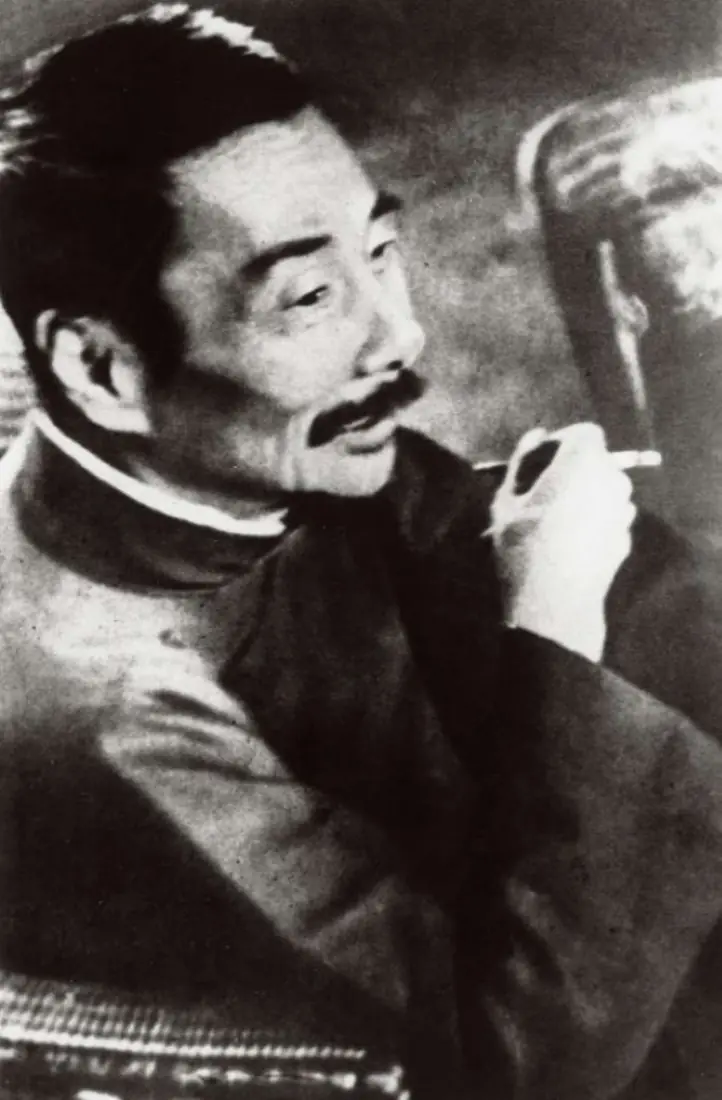
He studied at naval and mining schools in Nanjing, went to Japan on a scholarship in 1902 and in 1904 began to study medicine at Sendai. According to his own account, he gave up medicine after seeing a lantern slide of a Chinese man about to be executed as a Russian spy while a crowd of healthy Chinese looked on: he decided that the first need of his people was not healthy bodies but healthy minds, and that literature could help. He returned to China in 1909, taught, and after 1912 worked in the Ministry of Education in Beijing.
In 1918 he published A Madman's Diary in the magazine New Youth — the first short story in modern spoken Chinese — and it made him famous. His first collection, Call to Arms (Nahan, 1923), includes "A Madman's Diary", "Kong Yiji", "Medicine", The True Story of Ah Q and "My Old Home". His second, Wandering (1926), contains "The New Year Sacrifice". He also wrote prose poems (Wild Grass), memoirs (Dawn Blossoms Plucked at Dusk), a retelling of ancient legends (Old Tales Retold, 1935) and hundreds of sharp essays. In his later years he lived in Shanghai, supported young writers and woodcut artists, and died there on 19 October 1936.
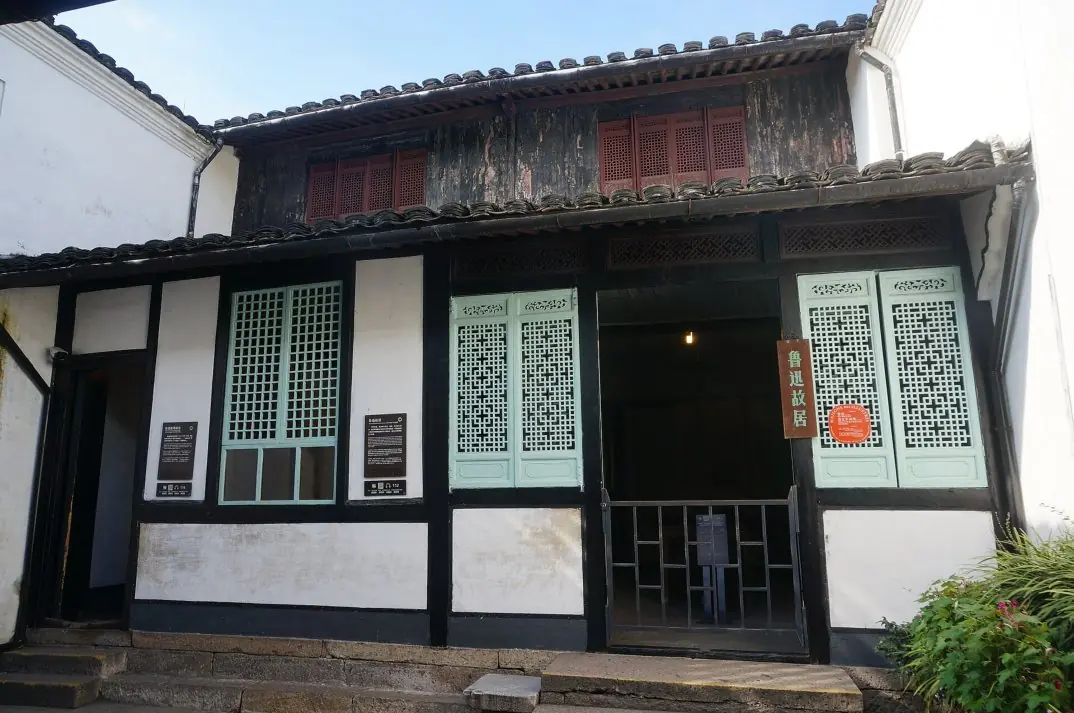
"My Old Home" (Chinese title Guxiang, "Native Place") was written in January 1921, published in New Youth that May and collected in Call to Arms. Its story is close to Lu Xun's own: in 1919 he returned to Shaoxing to sell the Zhou family house and to take his mother to Beijing.
- "Lu Xun" is a pen-name; the author's real name is Zhou Shuren.
- The story is fiction based on experience, not autobiography. Runtu and Mrs Yang are literary characters, and the narrator is "I", not "Lu Xun".
- "My Old Home" belongs to Call to Arms (1923), not Wandering (1926).
- The story is set not in Beijing but in the narrator's home town in the south; the narrator now lives and works far away and takes his family to join him there.
5.2 The story
The homecoming. Braving the bitter cold, the narrator travels more than seven hundred miles by boat to the home he left over twenty years before. It is late winter; the sky is overcast, a cold wind blows into the cabin, and through gaps in the bamboo awning he sees a few lifeless villages. He is depressed. Is this the home he has remembered for twenty years? The remembered place was much better, though he cannot say what was good about it, and he decides that it is his mood that has changed. He has come, he says, only to say goodbye: the old house the clan lived in for generations has been sold and must be handed over before New Year, and he is taking his family to the place where he now works.
Mother and Hongr. At dawn he reaches the gate. Dry stems of grass on the roof tremble in the wind and explain why the house had to change hands. His mother meets him, pleased but hiding her sadness, and his eight-year-old nephew Hongr, who has never seen him, stands watching from a distance. They talk about the move: rooms are rented elsewhere and half of what cannot be carried is already sold, though buyers are slow to pay. Then his mother says that Runtu always asks after him and wants to see him.
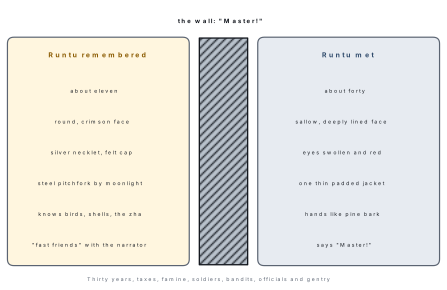
The picture in the mind. At that name "a strange picture" flashes into the narrator's mind: a golden moon in a deep blue sky; below it a seashore planted as far as the eye can see with jade-green watermelons; and in the middle a boy of eleven or twelve in a silver necklet, stabbing with a steel pitchfork at a zha, which slips between his legs.
The boy Runtu. This was Runtu. The narrator first met him thirty years earlier, when both were about ten and the family was still rich. It was their turn to host the great ancestral sacrifice that comes round once in thirty years; there were many valuable vessels to guard, and the family's part-time labourer offered to send for his son Runtu to watch them. (The narrator explains that labourers in his district are of three kinds: full-timers, who work all year for one family; dailies, hired by the day; and part-timers, who farm their own land and come only at festivals or rent time.) Runtu was born in a leap month when, by his horoscope, the element of earth was missing, hence his name "Intercalary Earth". He wore a felt cap and a silver necklet, a sign that his father doted on him and had pledged him to the gods. Shy with everyone else, he became the narrator's "fast friend" within hours.
The wonders of Runtu's world. Runtu knew marvels the town boys never dreamed of: how to trap birds in a propped-up threshing basket after snow; where to find shells of many colours on the seashore; how to guard the watermelons at night against badgers, hedgehogs and the zha; and that at high tide there were fish with two legs that jumped. The narrator's friends, like him, saw only "the four corners of the sky above the high courtyard wall". After a month Runtu had to leave. Both boys wept; Runtu later sent shells and feathers by his father, the narrator sent a gift or two, and they never met again.
Mrs Yang, the "Compass". Back in the present, the narrator hears neighbours in the house, who say they want to buy the furniture but really want to see what they can pick up. A shrill voice cries out: a woman of about fifty, all cheekbones and thin lips, with her hands on her hips and her trousered legs apart "like the compass in a box of geometrical instruments". She is Mrs Yang, once known as the "Beancurd Beauty" from the shop across the road. He does not recognise her and she is furious; she tells him he has grown rich, with an official's rank, three concubines and a sedan-chair, and should hand over the old furniture to poor people like her. He protests that he is not rich, falls silent, and as she leaves she pockets a pair of his mother's gloves.
Runtu arrives. After days of relatives and packing, one very cold afternoon Runtu comes in. The narrator knows him at a glance and yet he is "not the Runtu I remembered". The round crimson face is sallow and deeply lined, the eyes swollen and red like his father's (as with most peasants of the coast, exposed to the sea wind), the clothes a shabby felt cap and one thin padded jacket, the hand coarse and cracked "like the bark of a pine tree". The narrator is delighted and tongue-tied; everything he wanted to say about woodcocks, shells and jumping fish sticks in his throat. Runtu's lips move. Then, respectfully, he says: "Master!" The narrator shudders, for he knows at once what a "lamentably thick wall" now stands between them.
Shuisheng and the visit. Runtu brings his fifth child, Shuisheng, a shy boy who is the image of the young Runtu, without the necklet. The narrator's mother tells Runtu to call the narrator "brother" as he used to; Runtu refuses: he was a child then and did not understand. The two boys go off to play together. Runtu brings a gift of dried beans and, asked about his life, shakes his head: there are too many children, the harvests are bad, taxes swallow what he earns, and "all sorts of people want money". His face, for all its wrinkles, does not move, "as if he were a stone statue". He lights his pipe and smokes in silence.
What Runtu takes. After he has gone out to fry some rice for his lunch, the narrator and his mother sadly count what has worn him down: many children, famines, taxes, soldiers, bandits, officials and gentry. They offer him whatever they will not take away. Runtu picks two long tables, four chairs, an incense burner and candlesticks and a balance, and asks for the stove ashes, which local farmers use as fertiliser. Next morning he leaves with Shuisheng.
Departure. After nine more days it is time to go. Runtu comes again, without Shuisheng, who has sent a small girl to watch the boat. The house is full of callers; by evening everything in it, old or new, has been cleared away. As the boat pulls out in the dusk, the green hills on both sides turn deep blue and slide towards the stern. Hongr asks, "Uncle, when shall we go back?" because Shuisheng has invited him home. The narrator's mother then tells of Mrs Yang, who came daily during the packing and the day before dug a dozen bowls and plates from the ash heap, declaring that Runtu must have hidden them there to carry off; she ran away with the hens' dog-teaser, amazingly fast for a woman with such small feet.
The wall and the road. As the old house recedes, the narrator feels no regret — only "an invisible high wall" cutting him off from his fellows. The vision of the boy among the watermelons, once as clear as day, suddenly blurs. Mother and Hongr sleep; he lies listening to the water. Although a wall has grown between him and Runtu, the children still have much in common, and he hopes they will never be parted; but he does not want them to live as he has, nor as Runtu has, nor in dissipation. "They should have a new life."
Then the hope frightens him. He remembers laughing at Runtu for asking for the incense burner and candlesticks and still worshipping idols — yet what he now calls hope is "no more than an idol I had created myself", only more remote. Half asleep, he sees again the jade-green seashore and the round golden moon, and thinks that hope is like roads across the earth: there were no roads to begin with, but "when many men pass one way, a road is made".
5.3 Characters
| Character | Who they are | Role in the story |
|---|---|---|
| The narrator ("I") | An educated man who left home more than twenty years ago and now works far away; comes back to sell the family house | The consciousness through which everything is seen; his changing feelings are the story |
| Runtu | The narrator's boyhood friend; a peasant's son who grows into a poor, worn-out farmer with many children | The great contrast between memory and reality; the human face of rural poverty |
| Mother | The narrator's mother, who lives in the old house | A practical, kindly woman; the link between the narrator and his past |
| Hongr | The narrator's eight-year-old nephew | The child who still plays across the class line; a symbol of hope |
| Shuisheng | Runtu's fifth child, a shy boy | A copy of the young Runtu; the partner of Hongr; the other face of hope |
| Mrs Yang (the "Beancurd Beauty", the "Compass") | A neighbour in her fifties who once sat in the beancurd shop | The comic, sharp-tongued face of petty greed and envy in poverty |
The narrator. He is thoughtful, sensitive, educated and uncertain. He does not glorify his past: he admits that he cannot say what made his old home lovely. He is gentle with Runtu and Mrs Yang; when she insults him he simply falls silent. His pain is that he sees the wall between himself and Runtu and can do nothing about it. He is an intellectual torn between memory and the present, who finally puts his faith in the children. His closing confession — that his own hope may be "an idol" — shows both his honesty and his humility.
Runtu. In memory he is a heroic boy: bright-faced, quick, knowledgeable, brave with a pitchfork, teller of marvels. In reality he is bowed by years: a sallow, deeply wrinkled, cold and poor man who has at least six children to feed and cannot now say a word about the things he loved. He calls the narrator "Master", not out of flattery but because the habit of deference is part of the system that has crushed him. He is dignified, polite and proud in his poverty: he brings a gift of beans, he refuses the old familiar name, and he takes only what he is offered. He remains a religious man: the incense burner and candlesticks he asks for are the things he believes will bring comfort. In an important sense Runtu is not a person but a whole class.
Mrs Yang. She is the story's comedy, but the comedy has a dark side. She is sharp, mocking and clever ("You can't hide anything from me"), she flatters and accuses the narrator at once, and she pockets the gloves and later the bowls. Restraint is characteristic of Lu Xun: he does not condemn her; he lets the reader see that a woman who must live by picking up what others leave is being ground down by the same system as Runtu.
Hongr and Shuisheng. They are in the story for only a few lines, but they carry its hope. They take to each other at once, without any thought of master and servant; Hongr asks when they may return because "Shuisheng has invited me to his home".
5.4 Themes
The barrier of class (the "thick wall"). This is the central theme. As boys, the narrator and Runtu shared everything. As men they are separated by a wall built from habit, law, language and money: Runtu says "Master" and will not use the old name; the narrator cannot speak. Lu Xun does not blame either man: the wall is made by the society they live in, and it is "invisible" but "high".
Memory and reality. The narrator's memory of his home, and of Runtu, is bright — the golden moon, the jade-green watermelons — while the reality is bare: villages "void of any sign of life", an old house with grass on its roof, a beaten-down farmer. The story asks whether the past was ever as good as we remember it. "Perhaps it was always like this," the narrator says; "it is only my mood that has changed."
Rural poverty and social oppression. Through Runtu's complaint and the narrator's summing-up — "many children, famines, taxes, soldiers, bandits, officials and landed gentry, all had squeezed him as dry as a mummy" — Lu Xun gives a list of what crushed the Chinese peasant in the years after the 1911 revolution. There is no single villain; the pressure is systemic.
Hope and the future. The story ends on the children. Their friendship suggests that the wall is not natural and could be removed. But the narrator is careful: he does not want them to lead a life like his own or like Runtu's, he wants "a new life". His final image of hope as a road that is made by walking is not a promise; it is a call to action.
Superstition and idolatry. Runtu's silver necklet, his horoscope, his father's pledge to the gods, and his request for the incense burner and candlesticks all belong to a world of fatalistic belief. Lu Xun, who disliked superstition, treats it sadly rather than scornfully, and then turns the charge on himself when he calls his own hope an "idol".
Alienation and the intellectual's dilemma. The narrator is an educated man who has left his village for the wider world and cannot go back. His education has lifted him out of Runtu's world; it cannot lift Runtu. The story is a quiet confession of the intellectual's helplessness.
Change and home. "Home" is not a fixed place but a set of people and memories. Once the house is sold and Runtu has said "Master", the narrator realises that the home of his memory no longer exists. The story is also about what it means to leave a place for good.
A symbol is an object or image that stands for an idea: here, the wall stands for social division, the silver necklet for protected childhood, the idol for unexamined faith and the road for collective hope. An image is a picture in words: the golden moon over the watermelon field is the story's central image, appearing at the start and again at the end.
5.5 Setting, structure and point of view
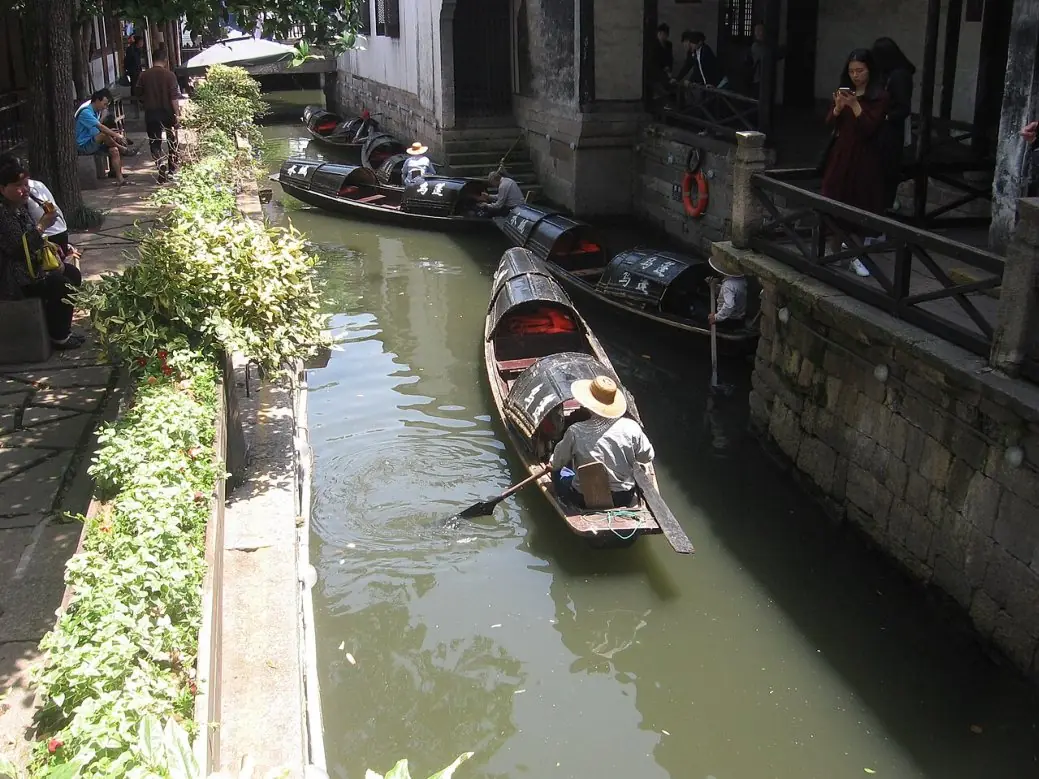
Setting. South-eastern China in the early twentieth century: a village or small town by a river and the sea, with a clan compound, a beancurd shop, a seashore of sandy soil planted with watermelons, and canals travelled by boat. The season is deep winter, with cold wind, grey sky and bare villages. The time frame is triple: the boyhood thirty years earlier (bright, summery); the present visit (cold, grey); and the imagined future (the road).
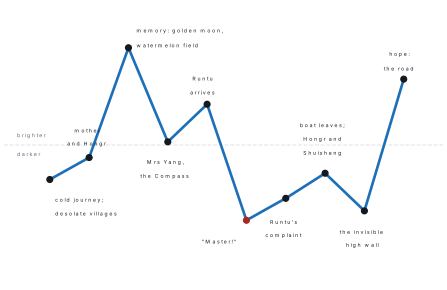
Structure. The story is built on a frame of two identical pictures and a set of contrasts.
| Part | Content | Mood |
|---|---|---|
| 1. The homecoming | The journey; the desolate village; mother and Hongr | Gloom |
| 2. The flashback | The golden moon, the watermelon field; the boy Runtu and his marvels | Warmth and wonder |
| 3. The present | Mrs Yang; Runtu's arrival; "Master!"; his complaint | Sadness, awkwardness |
| 4. The leave-taking | The last day; the boat; Hongr and Shuisheng | Quiet regret |
| 5. The reflection | The wall; hope as an idol; the road | Doubt, then hope |
The story opens with grey gloom and closes with the same golden moon that lit the flashback: the frame shows that the past survives, now as a dream of the future.
Point of view. First person, retrospective: the narrator tells what he saw, felt and thought. We see Runtu only as the narrator sees him, which is why Runtu's silence — "his lips moved, but not a sound did he utter" — is so powerful: the narrator cannot reach him, and neither can we. Because the narrator is honest, his own failings (he cannot answer Mrs Yang, he cannot speak to Runtu, and he laughs at Runtu's idol-worship) become part of the story's meaning.
5.6 Style and literary devices
| Device | Example | Effect |
|---|---|---|
| Frame / circular structure | The golden moon and watermelon field appear at the start of the flashback and again at the end | Gives the story unity and shows memory turning into hope |
| Contrast | The boy and the man; the bright memory and the grey present; the two hopes | The story's main method |
| Imagery | "a golden moon suspended in a deep blue sky"; "jade-green watermelons"; "desolate villages, void of any sign of life" | Colour and light against winter greyness |
| Symbol | The wall; the silver necklet; the idols; the ash heap; the road | Turn small things into large meanings |
| Simile | Runtu's hand "like the bark of a pine tree"; "as dry as a mummy"; Mrs Yang "like the compass in a box of geometrical instruments"; "like a stone statue" | Vivid, often harsh, always exact |
| Humour and satire | Mrs Yang, the "Beancurd Beauty", a Frenchman who had never heard of Napoleon; the dog-teaser | Lightens the story and exposes petty greed |
| Irony | Runtu says "Master" from love; the narrator laughs at the idols and then sees he has one too; Mrs Yang says he is rich and he cannot even keep his furniture | Shows the complexity of the characters |
| Understatement | "I was tongue-tied"; "Mother and I both felt rather sad" | Keeps the emotion quiet and strong |
| Metaphor | The "thick wall"; hope as a road | The story's two big abstractions given shape |
| Dialogue | Runtu's short, broken replies; Mrs Yang's rush of speech | Character through voice |
| First-person retrospective | "I" looking back from the boat | Gives honesty and intimacy |
Language. Lu Xun's prose is plain, concentrated and spoken-sounding; he writes in the vernacular, not in classical Chinese, which was itself a statement. There are few adjectives but each is exact, and he ends scenes at the moment of feeling rather than explaining it. His most famous technique, in this story, is to set a cold fact beside a warm memory and let the gap do the work.
5.7 Glossary
| Word | Meaning |
|---|---|
| clan | a large group of related families with a common ancestor |
| desolate | empty, bleak and without people |
| sombre | dark, gloomy |
| illusion | a false idea or belief |
| ancestral sacrifice | a ritual offering made to the family's dead ancestors |
| sacrificial vessels | the ritual bowls, cups and candlesticks used in such offerings |
| full-timer | a labourer who works for one family all year |
| daily (short-term hand) | a labourer hired by the day |
| part-timer | a peasant who farms his own land and works for another family only at certain times |
| intercalary month | an extra month added to a lunar calendar to keep it in line with the solar year |
| horoscope | a prediction of a person's life based on the position of the stars at birth |
| talisman | an object believed to protect its owner |
| necklet | a small necklace |
| zha | a small, fierce, slippery animal that eats melons, "something like a small dog"; the narrator never really identifies it |
| pitchfork | a long fork for lifting hay (here used against animals) |
| flabbergasted | extremely surprised |
| beancurd (tofu) | a soft food made from soya milk |
| compass (dividers) | a two-legged instrument for drawing circles |
| concubine | in old China, a woman who lived with a man as a secondary wife |
| sedan-chair | a covered seat carried on poles by bearers |
| intendant | a senior provincial official |
| stupefied | made dull and unable to think |
| dissipation | wasteful and self-indulgent living |
| treadmill existence | a life of tiring, repeated work that leads nowhere |
| idol | an image worshipped as a god; here also anything unthinkingly believed in |
| dog-teaser | a wooden cage in which hens can feed but dogs cannot reach the food |
Do not say that Runtu "became rich" or "refused to meet" the narrator. He comes willingly, brings a gift and is sad. What separates them is not dislike but habit and class. Do not say that Hongr and Shuisheng "will surely have a better life": the narrator says only that he hopes so, and warns that hope may itself be an idol. Quote the ending carefully — it is a hope, not a prophecy.
5.8 Textbook exercises
Before you read — warm-up discussion
a. Have you ever left your home for a long time? How did you feel when you came back?
A model answer: When I came home after two months at my uncle's house in Pokhara, I expected everything to be as I had left it. Instead the street looked smaller, my younger brother had grown taller and the tree in our courtyard had been cut. I was happy to be home and yet slightly a stranger, as if I had to learn it again. That feeling, that the place changes and we change too, is the feeling with which Lu Xun's narrator begins.
b. Do you think childhood friendship is different from adult friendship? How?
Usually yes. Children choose friends by play, honesty and kindness, without thinking about money, caste, or profit; they quarrel and forgive quickly. Adult friendships are shaped by work, status, family and the need to be useful, so they are more careful and more easily broken by inequality. The story shows exactly this: as boys, the narrator and Runtu become "fast friends" in a few hours; as men, they cannot speak.
Understanding the text
a. How does the narrator describe his feeling at the arrival at his old home?
With gloom and disappointment. Travelling in the bitter cold of late winter, he sees "a few desolate villages, void of any sign of life" under a "sombre yellow sky", and "could not help feeling depressed". He wonders whether this can be the home he has remembered for twenty years, because the remembered place was "much better", though he cannot say what its charms were. He explains his low spirits by his own mood — he is coming back "with no illusions" and "with the sole object of saying goodbye" — and at the gate, seeing the dry grass on the roof, he understands why the house had to change hands. Overall his feeling is a mixture of sadness, disillusionment and a sense of unavoidable loss.
b. What were the three kinds of servants in China then? What does it indicate about contemporary Chinese society?
The narrator tells us that labourers in his district fall into three classes: full-timers (long-term hands), who work all year for one family; dailies (short-term hands), who are hired by the day; and part-timers, who farm their own land and work for a family only at New Year, festivals or rent-time. The classification shows a rigid and layered society in which work and status were carefully ranked. Wealthy families such as the narrator's employed people according to need and paid them little; labourers had no security and often depended on the land, rent or a rich family's festival for a living. It also shows a society of landlords and tenants where the poor were tied to the rich by custom, and where a boy like Runtu could be sent for as a helper without any thought of his own wishes.
c. What makes the narrator nostalgic? What did he do with Runtu in his teenage years?
His mother's mention of Runtu makes him nostalgic: "a strange picture suddenly flashed into my mind" — a golden moon over a jade-green watermelon field and a boy with a silver necklet stabbing at a zha. The memory brings his "beautiful old home" back "like a flash of lightning". (Note that the friendship belonged to childhood, when both were about ten, not to their teens.) In the month that Runtu stayed with the family, the narrator talked with him, learned from him how to trap birds under a basket after snow, heard of the seashore shells and the watermelon watch, and became his "fast friend". When they had to part both cried; Runtu sent shells and feathers, the narrator sent a gift or two, and they never met again.
d. How did Runtu hunt a zha in his young age?
Runtu described it to the narrator: on summer nights he and his father would guard the watermelon field on the sandy seashore against badgers, hedgehogs and the zha. When you hear the zha crunching the melons in the moonlight, you creep up with your pitchfork, and when you see it, you strike. But the zha is a "very cunning creature": it rushes towards you and escapes between your legs, and its fur is "as slippery as oil". The narrator's memory pictures Runtu, a boy of eleven or twelve, in a silver necklet, thrusting his steel pitchfork "with all his might" at a zha "which dodged the blow and escaped between his legs".
e. How does the narrator make a humorous picture of Mrs Yang?
By exaggerated physical description and by his own embarrassment. She is a woman of about fifty with "prominent cheekbones and thin lips", standing with hands on her hips and trousered legs apart "just like the compass in a box of geometrical instruments" — the comic image that gives her the nickname "the Compass". Her greeting, "Oh! Like this! With such a long moustache!", surprises him; when he does not remember her she looks at him as one might look at a Frenchman who had never heard of Napoleon. She accuses him of having three concubines and a sedan-chair with eight bearers, casually pockets his mother's gloves as she goes, and at the end runs off with a dog-teaser "considering the size of her feet, how fast she could run". Yet the humour has a bitter side: she is poor and greedy for what she can pick up.
f. According to the narrator, what were the different factors that made Runtu a poor man throughout his life?
The narrator and his mother list them together: "many children, famines, taxes, soldiers, bandits, officials and landed gentry, all had squeezed him as dry as a mummy." Runtu adds his own: he has many children (five, six or more, still too young to earn much), the harvests are bad, "all sorts of people want money, there is no fixed rule", and every time he takes produce to market he must pay "several taxes and lose money", while if he does not sell, it goes bad. In short, family size, natural calamity, heavy taxes, lawlessness and the exploitation of officials and landlords together keep him poor.
g. How does the narrator help Runtu before leaving the old home?
On his mother's suggestion, he lets Runtu take whatever the family will not carry to their new home. Runtu chooses "two long tables, four chairs, an incense burner and candlesticks, and one balance", and asks for all the stove ashes, which are useful as manure for the sandy soil; the family agrees. The help is practical rather than generous: it is the furniture and ashes that they would have left or sold anyway. The narrator also pays attention to him, listens to his troubles and sits and talks with him that night — the only help he can offer.
h. How does the author differentiate two kinds of idols?
There are two idols in the closing paragraphs. The first is Runtu's: the incense burner and candlesticks he has chosen, physical objects of traditional worship; the narrator "had laughed up my sleeve at him" for still worshipping idols. The second is the narrator's own: hope — "no more than an idol I had created myself". The difference is not one of kind, since both are objects of faith in something better, but of distance: "what he desired was close at hand, while what I desired was less easily realized". The narrator's idol is abstract, modern and remote; Runtu's is concrete, ancient and near.
Reference to the context
a. While reading the friendship between the narrator and Runtu, Hindu readers remember the friendship between Krishna and Sudama. Which particular description reminds you of this mythological example?
In the Bhagavata Purana, Sudama, a poor Brahmin, visits his childhood friend Krishna, who is now a king, bringing only a small parcel of flattened rice (chiura) as a gift; Krishna welcomes him with tears and honour. The story reminds us of Runtu's visit in three details. First, Runtu is a poor peasant who comes to the house of a friend who has risen in the world. Second, he comes shyly with a poor man's gift: "these few beans we dried ourselves, if you will excuse the liberty, sir". Third, he leaves with useful things from the house. But there is a crucial difference: Krishna embraces Sudama as an equal, while the narrator can only stand tongue-tied and Runtu says "Master!". The myth shows friendship overcoming class; the story shows class defeating friendship — and that is exactly Lu Xun's point.
b. How does the story support the proposition that the relationships of childhood are innocent, impartial and disinterested?
In childhood, the narrator (the son of a rich family) and Runtu (a labourer's son) meet as strangers and are "fast friends" within hours; the narrator is "spoilt", Runtu "very shy", yet neither thinks of rank. They share stories — birds, shells, watermelons — and want nothing from each other but company. When Runtu must leave, both cry, and each sends the other gifts (shells and feathers) that are worth nothing in money. Even in the present, the children Hongr and Shuisheng repeat the pattern: they go out to play "entirely at ease", and Hongr asks to visit Shuisheng's home. Adult relationships, by contrast, are shaped by "Master" and servant, by taxes, by Mrs Yang's suspicions, and by money.
c. After reading the story, what inferences can you make about the contemporary Chinese economic and social system?
Several. Society was sharply divided by class: rich clans with servants and sedan-chairs, and poor labourers whose speech, name for each other and status were fixed. Peasants were heavily exploited: taxes, rent, officials and landed gentry, soldiers and bandits all took their share; harvests were unreliable; there was "no fixed rule". The economy was mainly agricultural and small-scale: watermelon fields, threshing baskets, straw and ashes for fuel and fertiliser, boats and canals as the way of travel. Poverty fed superstition and petty greed: horoscopes and pledges to the gods, and Mrs Yang picking up what she could. Old clan homes were breaking up: the house was sold, members had already left, and educated sons moved to work elsewhere. The overall picture is of a society in decay that badly needed change.
d. What does the story indicate about the geographical features of the narrator's hometown?
It is a south-eastern, low-lying region near the sea and rivers. The narrator travels home by boat; the river is flanked by green mountains on both sides; the coast has a sandy seashore where watermelons grow and where "the tide comes in" with jumping fish and shells of many colours. The soil is sandy, so people use straw ashes as manure. The winters are cold enough for heavy snow ("after a heavy snowfall" birds can be trapped) yet the summers are warm enough for watermelons. This is the watery, hilly country of Zhejiang, with canals and coastal farms, not the dry north.
Reference beyond the text
a. Human beings are on the road from time immemorial, always migrating to new places. Write an essay on "The Trend of Migration in Nepal" in about 300 words.
The Trend of Migration in Nepal
Migration has always been part of Nepali life. Long before roads, Nepalis walked between the hills and the Tarai in search of land, and the Gurkha soldier who left his village for a distant army is an old figure in our history. Today, however, migration has grown so large that it shapes our economy, our families and our villages.
There are three main streams. The first is internal migration: people move from the mountains and hills to the Tarai and to towns, above all to Kathmandu, in search of schools, hospitals, jobs and safety. Kathmandu's valley has grown fast for this reason, and many hill villages are now half empty. The second is migration to India, an open-border tradition in which young men work as labourers, guards and cooks. The third, and largest in recent decades, is foreign employment. Since the 1990s hundreds of thousands of young Nepalis have gone to Malaysia, Qatar, Saudi Arabia, the United Arab Emirates and Korea; others study in Australia, Japan, the United States and Europe. Remittances — money sent home — form a large part of Nepal's income and pay for food, land and children's school fees.
The causes are clear: poverty, few jobs, the desire for education, the effects of conflict and disaster, and the example of neighbours who have prospered. The results are mixed. Families gain money and new skills, but villages lose their young, farmland is left uncultivated, old people stay behind and children grow up without a parent. Many workers face dangerous work and low pay.
What Nepal needs is not to stop migration but to make it a choice rather than a necessity — by creating jobs at home, protecting workers abroad, and bringing skills back. Like Lu Xun's narrator, every migrant leaves a home behind and takes a wish for a better road ahead.
b. Find one of your relatives or friends who has migrated to a new place leaving his or her old home. Talk to him or her and prepare a report on what he or she felt while leaving the old home.
(This is a project task. Below is a sample report with an imagined interviewee; replace it with your own interview.)
A Report on Leaving the Old Home
Prepared by: (your name), Grade 12. Interviewed: my aunt, Mrs Sabitri Rai, who moved from Bhojpur to Biratnagar in 2010.
Purpose. To learn how a person feels on leaving the home in which she grew up.
Method. I interviewed my aunt for about forty minutes with five prepared questions and wrote down her answers.
Findings. (1) Why she left: to send her children to a good school, since there was no high school within two hours' walk. (2) What she felt on the day: "I laughed and cried at the same time. I was happy for the children, but I felt as if I was leaving a part of myself." (3) What she missed most: her neighbours, the courtyard, the morning mist and the sound of her own language in every house. (4) Difficulties: a small rented room, higher costs and loneliness in the first year. (5) Does she regret it? "No, but I still go back for Dashain every year; that house is still my home."
Conclusion. My aunt's experience matches Lu Xun's narrator: leaving a home is painful even when it is necessary, and the memory of the old place grows brighter with time. Yet like the narrator, she believes that her children's new life is worth the price.
Chapter summary
- "My Old Home" (Chinese title Guxiang) is a short story by Lu Xun (pen-name of Zhou Shuren, 1881–1936), written in January 1921, published in New Youth in May 1921 and collected in Call to Arms (1923).
- The narrator travels more than seven hundred miles in the cold of winter to sell the old family house and to take his mother and nephew Hongr to his new home. The village looks desolate and he feels depressed.
- His mother's mention of Runtu brings back a vivid picture: a golden moon, a jade-green watermelon field, and a boy with a silver necklet thrusting a pitchfork at a zha. The two boys had been "fast friends" thirty years earlier, during one month, and never met again.
- Mrs Yang, the "Beancurd Beauty" or "Compass", comes to demand furniture, accuses the narrator of being rich and pockets his mother's gloves.
- Runtu arrives: his face is sallow and lined, his hands like pine bark; he says "Master!" and the narrator feels "a lamentably thick wall" between them. Runtu lists his troubles — many children, famine, taxes, soldiers, bandits, officials and gentry — and takes tables, chairs, an incense burner, candlesticks, a balance and the stove ashes.
- As the boat leaves, Hongr asks when they will return because Shuisheng has invited him home. The narrator, hoping that the children will not be divided, sees that his hope may be an idol like Runtu's, and ends: hope is like roads across the earth — "when many men pass one way, a road is made".
- Themes: class barrier, memory and reality, rural poverty, hope and the future, superstition, alienation of the intellectual. Techniques: frame and contrast, imagery, symbol (wall, necklet, idol, road), humour and irony, first-person retrospective narration.
Practice questions
Short answer questions (2 marks each)
- Why has the narrator come back to his old home? [2]
- What picture flashes into the narrator's mind when his mother mentions Runtu? [2]
- Who is Mrs Yang and why is she called "the Compass"? [2]
- How has Runtu changed when the narrator meets him again? [2]
- What does Runtu ask to take from the house? [2]
- What question does Hongr ask in the boat, and why is it important? [2]
Model answers — short questions
1. He has come "with the sole object of saying goodbye". The old house, in which his clan had lived for many years, has been sold and must be handed over before New Year's Day; he has come to take his mother and nephew to the place where he now works.
2. He sees "a golden moon suspended in a deep blue sky", a seashore planted with jade-green watermelons, and in the middle a boy of eleven or twelve in a silver necklet thrusting a steel pitchfork at a zha, which dodges the blow and escapes between his legs. The boy is the young Runtu.
3. Mrs Yang is a neighbour of about fifty who used to sit in the beancurd shop across the road and was then called the "Beancurd Beauty". She is called "the Compass" because she stands with her hands on her hips and her trousered legs apart, "just like the compass in a box of geometrical instruments".
4. The round, crimson-faced boy of memory has become a sallow, deeply wrinkled man twice his former size, with swollen, red-rimmed eyes, a shabby felt cap, a single thin padded jacket and hands "like the bark of a pine tree". He is shivering, almost speechless and addresses the narrator respectfully as "Master".
5. He takes two long tables, four chairs, an incense burner and candlesticks, and a balance, and asks for all the ashes from the stove, which are used as fertiliser for the sandy soil.
6. Hongr asks, "Uncle, when shall we go back?" because Shuisheng has invited him to his home. It matters because the children, unlike the adults, show no class barrier between them; the question brings the narrator hope that the next generation will not be divided.
Long answer questions (5 marks each)
- Examine "My Old Home" as a story about the wall of class between two friends. [5]
- Discuss the theme of hope in the story, with special reference to the last paragraph. [5]
- What does Lu Xun show about rural China through the character of Runtu? [5]
Model answers — long questions
1. The heart of the story is the difference between the two meetings of the same two people. In childhood, the narrator, a rich man's "spoilt" son, and Runtu, a labourer's son, become "fast friends" in a few hours. They share stories of birds and watermelons and cry at parting. Thirty years later, Runtu stands in the doorway with swollen eyes and calls his friend "Master". The narrator feels "a shiver" and knows "what a lamentably thick wall had grown up between us". The narrator cannot speak; Runtu refuses the familiar name that the narrator's mother offers: "What bad manners that would be. I was a child then and didn't understand."
The wall is made by class. Runtu has been crushed by poverty, taxes and the habit of deference, and the narrator has been raised above him by money and education. Neither is at fault; the society they live in is. The story ends with the narrator feeling "an invisible high wall, cutting me off from my fellows". Lu Xun shows the wall as something made by people, and therefore something that can be taken down; the children Hongr and Shuisheng, who play together without hesitation, prove it.
2. Hope is the last theme of the story and is treated honestly. As the boat leaves, the narrator sees Hongr and Shuisheng as friends and hopes that "they will not allow a barrier to grow up between them"; he wants them to have "a new life, a life we have never experienced". But immediately he is "afraid": when Runtu asked for the incense burner and candlesticks, he had laughed up his sleeve at his idol-worship, yet now he sees that "what I now called hope was no more than an idol I had created myself", only more remote.
The closing sentences turn that doubt into a positive idea: "hope cannot be said to exist, nor can it be said not to exist", like roads across the earth: there were none to begin with, but "when many men pass one way, a road is made". Hope is not a fact or a promise but a direction; it becomes real only when many people walk the same way. The story's last image, the golden moon and the green seashore, returns to the picture of childhood and recasts it as a picture of the future.
3. Runtu is the story's portrait of the Chinese peasant. As a boy he is bright, brave and knowledgeable about nature; as a man he is "sallow", wrinkled, shivering in one thin jacket, with a hand "like the bark of a pine tree". His own words give the causes: many children, bad harvests, and taxes that mean that when he sells he loses money and when he does not sell his produce rots. The narrator adds "famines, taxes, soldiers, bandits, officials and landed gentry", all of which had "squeezed him as dry as a mummy".
Runtu has lost his voice as well as his health: his lips move without sound, he cannot express his bitterness, and his face is "just as if he were a stone statue". He is polite, dignified and religious, choosing the incense burner and candlesticks, which shows his need of consolation. Through him Lu Xun shows a people exhausted by poverty and oppression, yet still human — and still worth hoping for.
Reference to the context
- "I felt a shiver run through me; for I knew then what a lamentably thick wall had grown up between us."
(a) Who is "I" and who is "us"? (b) What has just happened? (c) What is the "wall"? (d) Why is this moment the turning point of the story? [5]
- "I thought: hope cannot be said to exist, nor can it be said not to exist. It is just like roads across the earth."
(a) Where is the narrator when he thinks this? (b) What has made him think of hope? (c) Explain the comparison with roads. (d) How does the sentence sum up the message of the story? [5]
Model answers — reference to the context
1. (a) "I" is the narrator of the story, a man who has come back to sell the family home; "us" means himself and Runtu. (b) Runtu has just come into the room after thirty years and, instead of greeting him by name, has said respectfully "Master!". (c) The "wall" is the invisible barrier of class and habit — rich and poor, master and servant — that has grown between two boyhood friends. It is not built of stone but of deference, poverty, and the way society has taught each man to treat the other. (d) It is the moment of recognition: until now the narrator had hoped to find his friend unchanged; with one word he understands that the boyhood of the golden moon is gone and that the wall cannot be crossed by goodwill alone. The rest of the story — Runtu's complaints, the furniture, Mrs Yang's suspicion, the narrator's sense of being cut off — follows from it.
2. (a) He is lying in the cabin of the boat that is carrying him and his family away from the old home at night, listening to the water under the boat and half asleep. (b) He has thought of his nephew Hongr and of Shuisheng, who already wish to meet again, and wondered whether the wall between their fathers will be repeated in their lives; then he has realised that his hope may be no more than an idol. (c) A road does not exist until people walk on the same ground again and again; in the same way, hope is not a fact but something made by the collective action of many people. (d) The sentence says that the future is not given but has to be made; it is neither naive optimism nor despair. The story's whole movement — from winter gloom and the wall between two men, to children who play without one — leads to this sentence: change is possible, but only if people walk together.
Practise more: English question bank