Unit 16 · Literature - Essays · 35 min read
Humility
What the syllabus asks for 7
- About the author
- The essay: shape and argument
- The essay, part by part
- Ideas and themes
- Style and devices
- Glossary
- Textbook exercises
Every group of people likes to believe that its story is the most important story ever told. Greeks say history began in Athens, Chinese nationalists say it began with the Yellow Emperor, some Hindu nationalists say aeroplanes were flying in the age of the sages, pious Muslims see all earlier history as irrelevant, and the Aztecs thought the sun would not rise without their sacrifices. Yuval Noah Harari collects these claims in one breezy, funny and unsettling essay, and then does something unusual: he turns the same lens on his own people. "Humility" is an essay about the most dangerous form of pride — the belief that my nation, my culture, my religion is the centre of the world. It is shorter than the other essays in this unit and very easy to read, but examiners like it because the claims are concrete and the question "Why is history a contested issue?" invites a good, thoughtful answer.
The thesis: you are not the centre of the world; no nation or religion invented human civilisation. The catalogue of claims: Greeks, Chinese nationalists, Hindu nativists, pious Muslims (with the Turkish, Iranian and Egyptian exceptions), British, French, Germans and others, and the Aztecs. The verdict: "All these claims are false" — they combine wilful ignorance of history with "more than a hint of racism". The truth: morality, art, spirituality and creativity are universal human abilities embedded in our DNA, born in Stone Age Africa. The method: Harari criticises his own people (the Jews) first, with the yoga example, because "it is more polite to criticise one's own people than to criticise foreigners". Short questions ask for a group's claim, the universal abilities or the yoga story; the long question is about why history is contested.
16.1 About the author

Yuval Noah Harari was born in 1976 in Israel. He studied history at the Hebrew University of Jerusalem and completed his doctorate at the University of Oxford in 2002, working on medieval and military history. He is now a professor of history at the Hebrew University of Jerusalem, where he teaches world history, and he is also known as a public thinker, who writes about the long past of humankind in order to ask what kind of future we are choosing.
His books have sold in tens of millions of copies in dozens of languages:
| Book | Year | Theme |
|---|---|---|
| Sapiens: A Brief History of Humankind | 2011 (Hebrew); 2014 (English) | how Homo sapiens came to dominate the planet: the cognitive, agricultural and scientific revolutions |
| Homo Deus: A Brief History of Tomorrow | 2015 (Hebrew); 2016 (English) | what humans may become with biotechnology and artificial intelligence |
| 21 Lessons for the 21st Century | 2018 | the present: work, liberty, nationalism, religion, truth, education, meaning |
| Sapiens: A Graphic History | 2020 onwards | a comic-book retelling of Sapiens (named in your textbook) |
| Nexus | 2024 | information networks from the Stone Age to artificial intelligence |
Your textbook's note adds that he is a co-founder of Sapienship, a social-impact company whose mission, the textbook says, is "to clarify the public conversation, support the quest for solutions and focus attention on the most important challenges facing the world". It also says that Harari "exemplifies the virtue of humility in that he debunks humanity's illusions of superiority and mastery". The essay "Humility" is taken from 21 Lessons for the 21st Century (2018): it is chapter 12 of the book, which has five parts and twenty-one short "lessons". The passage in your textbook is an extract from the opening of that chapter, under the heading "You are not the centre of the world".
When Harari writes "Did you know … that it was Maharishi Bhardwaj who invented rockets and aeroplanes …?" he is quoting what some nationalists claim, in order to show that the claim is absurd. He is not insulting Hinduism, Islam, Judaism, China or Greece. His point is that every group does this, and that all of them are wrong in the same way. He spends the most words on his own people. In an answer, write "some Hindu nativists claim …", never "Harari says that Indians invented aeroplanes".
16.2 The essay: shape and argument
"Humility" is an argumentative (persuasive) essay with a strong thread of satire. It is built like a good speech: a bold claim, a long series of examples, a one-line verdict, a positive truth, a personal confession, and a closing image. Seen as a list, the structure is:
| Step | What happens |
|---|---|
| 1. The claim | "Most people tend to believe they are the centre of the world, and their culture is the linchpin of human history." |
| 2. The catalogue | Greeks; Chinese nationalists; Hindu nativists; pious Muslims; Turkish, Iranian and Egyptian nationalists; British, French, Germans, Americans, Russians, Japanese; the Aztecs. |
| 3. The verdict | "All these claims are false." Reasons: they show wilful ignorance and a hint of racism; no present-day nation or religion existed when humans settled the world, tamed plants and animals, built the first cities or invented writing and money. |
| 4. The truth | Morality, art, spirituality and creativity are universal human abilities in our DNA, born in Stone Age Africa; to place them in a later time and place is "crass egotism". |
| 5. The confession | "I am all too familiar with such crass egotism": the Jews think they are the most important thing in the world. The yoga story. |
| 6. The escalation | Orthodox Jews think the cosmos exists so that rabbis can study; secular Jews too believe Jews are the heroes of history. |
| 7. The method | Harari uses his own people as the example, and leaves the reader to "puncture the hot-air balloons inflated by their own tribes". |

16.3 The essay, part by part
Part 1 — "You are not the centre of the world"
The heading is the thesis. "Most people tend to believe they are the centre of the world, and their culture is the linchpin of human history." A linchpin is the pin through the end of an axle that stops the wheel from coming off; without it everything falls apart. Each group thinks its culture is that pin. Then comes the catalogue:
- The Greeks. "Many Greeks believe that history began with Homer, Sophocles and Plato, and that all important ideas and inventions were born in Athens, Sparta, Alexandria or Constantinople."
- Chinese nationalists. They "retort that history really began with the Yellow Emperor and the Xia and Shang dynasties, and that whatever Westerners, Muslims or Indians achieved is but a pale copy of original Chinese breakthroughs."
- Hindu nativists. They "dismiss these Chinese boasts" and argue that "even airplanes and nuclear bombs were invented by ancient sages in the Indian subcontinent long before Confucius or Plato, not to mention Einstein and the Wright brothers". Harari gives examples, asking in mock surprise: "Did you know … that it was Maharishi Bhardwaj who invented rockets and aeroplanes, that Vishwamitra not only invented but also used missiles, that Acharya Kanad was the father of atomic theory, and that the Mahabharata accurately describes nuclear weapons?"
- Pious Muslims. They "regard all history prior to the Prophet Muhammad as largely irrelevant", and they consider all history after the revelation of the Quran "to revolve around the Muslim ummah" (the worldwide community of believers). The exceptions are Turkish, Iranian and Egyptian nationalists, who argue that even before Muhammad their nation was "the fountainhead of all that was good about humanity", and that after the Quran it was mainly their people who preserved the purity of Islam and spread its glory.
- Everyone else. "British, French, German, American, Russian, Japanese and countless other groups are similarly convinced that humankind would have lived in barbarous and immoral ignorance if it wasn't for the spectacular achievements of their nation."
- The Aztecs. Some peoples went so far as to think that political institutions and religious practices were essential to the laws of physics: "the Aztecs firmly believed that without the sacrifices they performed each year, the sun would not rise and the entire universe would disintegrate".
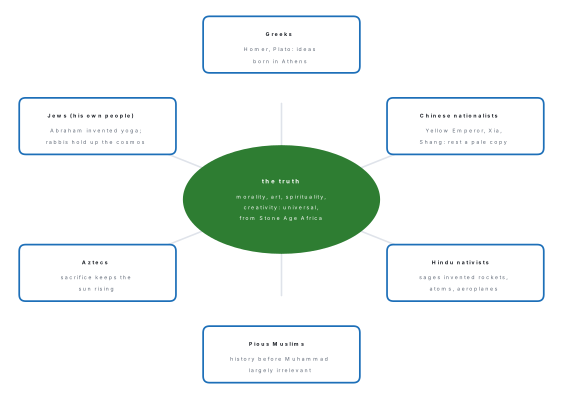
Part 2 — "All these claims are false"
The verdict is a short paragraph: "All these claims are false. They combine a wilful ignorance of history with more than a hint of racism." Harari's reasons are historical. "None of the religions or nations of today existed when humans colonised the world, domesticated plants and animals, built the first cities, or invented writing and money." Those steps, which made civilisation possible, were taken by peoples long before any of today's nations and faiths. Then the positive truth: "Morality, art, spirituality and creativity are universal human abilities embedded in our DNA. Their genesis was in Stone Age Africa." To place them later — "China in the age of the Yellow Emperor, Greece in the age of Plato, or Arabia in the age of Muhammad" — is "crass egotism".
Harari uses "DNA" as a vivid way of saying "part of what it is to be human", because these abilities are shared by all modern human groups and appear in very old human sites — cave paintings, burials and jewellery, for instance. You may quote him, but in an answer also say what he means: they are inborn, universal and ancient, not the invention of any single nation. (Homo sapiens itself appears in Africa some 300,000 years ago, according to fossils found in Morocco and elsewhere.)
Part 3 — "my own people" and the yoga story
Now Harari makes the essay personal. "Personally, I am all too familiar with such crass egotism, because the Jews, my own people, also think that they are the most important thing in the world. Name any human achievement or invention, and they will quickly claim credit for it." He knows, he says, that they are genuinely convinced.
Then the story. "I once went to a yoga teacher in Israel, who in the introductory class explained in all seriousness that yoga was invented by Abraham, and that all the basic yoga postures derive from the shape of the letters of the Hebrew alphabet." (The triangle posture trikonasana imitates the letter aleph, tuladandasana the letter daled.) Abraham taught the postures to the son of one of his concubines, who went to India and taught yoga to the Indians. Asked for evidence, the teacher quoted Genesis 25:6: "And to the sons of his concubines Abraham gave gifts, and while he was still living he sent them away from his son Isaac, eastward to the east country." Harari's punchline is a question: "What do you think these gifts were? So you see, even yoga was actually invented by the Jews." The joke lies in the leap from a gift mentioned in a verse to yoga — evidence that proves nothing, taken with total seriousness.

Part 4 — the escalation, and the method
The yoga story is "a fringe notion". But "mainstream Judaism solemnly maintains that the entire cosmos exists just so that Jewish rabbis can study their holy scriptures, and that if Jews cease this practice, the universe will come to an end. China, India, Australia and even the distant galaxies will all be annihilated if the rabbis in Jerusalem and Brooklyn stop debating the Talmud." This is "a central article of faith of Orthodox Jews, and anyone who dares doubt it is considered an ignorant fool". Secular Jews are a little more sceptical about so grand a claim, "but they too believe that the Jewish people are the central heroes of history and the ultimate wellspring of human morality, spirituality and learning".
Harari then explains why he chose this example. "What my people lack in numbers and real influence, they more than compensate for in chutzpah" (a Yiddish word for bold, shameless audacity). "Since it is more polite to criticise one's own people than to criticise foreigners, I will use the example of Judaism to illustrate how ludicrous such self-important narratives are, and I will leave it to readers around the world to puncture the hot-air balloons inflated by their own tribes." The last phrase hands the job to the reader: now check your own group's balloon.
Greeks; Chinese nationalists → ¶1. Hindu nativists → ¶2. Pious Muslims → ¶3. Other nations; the Aztecs → ¶4. "All these claims are false"; universal abilities → ¶5. The yoga story → ¶6. The cosmos and the rabbis → ¶7. Why he criticises his own people; the hot-air balloons → ¶8.
16.4 Ideas and themes
1. Egocentrism of nations and cultures. The essay's first theme is that every group thinks of itself as central. The repeated pattern — "X believe that history began with X" — shows that the belief is a human habit, not a fact about any one people. The habit is natural (we are born into one group and see the world from it) and dangerous (it justifies contempt for others).
2. Humility as honesty about evidence. Humility here is not shyness; it is intellectual honesty. To be humble about history means to check claims against evidence: Harari's "evidence" for the Jewish yoga story is a verse that mentions gifts and nothing more. The essay teaches the reader to ask, of any proud claim, "What is the proof?"
3. The shared human heritage. The positive message is that morality, art, spirituality and creativity are universal human abilities, born in Stone Age Africa. No nation owns them. This turns pride into a kind of kinship: if these abilities are ours together, then the achievements of others are also, in a real sense, ours.
4. Criticise yourself first. Harari's method is as important as his message. He does not pick on foreigners; he starts with "my own people". This is what gives the essay its authority: a critic who begins with himself cannot be accused of prejudice.
5. Why history is contested. History is not only a record of the past but a source of identity, pride and political claims. Whoever controls the story controls how people see themselves and others. As George Orwell put it in 1984: "Who controls the past controls the future." This is the idea behind the textbook's question about history as a "major contested issue".
6. Humility and danger. Beneath the humour is a warning. Nations convinced that they are the centre of history have often used that belief to justify wars, conquest and persecution. The essay suggests that a little humility is a condition of peace.
The two essays are neighbours in your book, and they fit together. Russell says the essence of wisdom is freedom from "the tyranny of the here and now"; Harari's essay is an example of that tyranny at the level of nations — people who cannot see beyond their own place and time. Both men say that a wise person learns to see from outside the self. If an exam question lets you compare essays, this link is an easy way to score.
Harari does not say that all cultures are identical, that nothing was invented in China, India, Greece or Arabia, or that religion is false. He says that no single group invented the basic human abilities, and that the exaggerated claims of priority are false. The Chinese, Indians, Greeks and Muslims made enormous real achievements; the essay complains about the inflation of those achievements, not about the achievements themselves.
16.5 Style and devices
Satire and irony. The essay is funny because it is serious about absurd things. The yoga teacher explains the origin of yoga "in all seriousness"; the Hindu nativist list is offered as fact ("Did you know …?"). The gap between the confident tone and the ridiculous claims is the irony.
Catalogue and parallelism. A long list — Greeks, Chinese, Hindus, Muslims, British, French, Germans, Americans, Russians, Japanese — with the same sentence pattern repeated. The repetition makes the point before any argument is offered: everyone says the same thing.
Rhetorical questions and direct address. "Did you know … ?" "What do you think these gifts were?" These address the reader as a partner in the joke and invite the reader to supply the judgement.
Hyperbole, understatement and sarcasm. "Even airplanes and nuclear bombs"; "the entire cosmos exists just so that Jewish rabbis can study"; and, later, "a bit more sceptical". The mock-gravity makes each claim look silly without Harari having to say so.
Metaphor. "Linchpin" (of history), "fountainhead" (source), "puncture the hot-air balloons inflated by their own tribes". The balloon image says that pride is inflation — full of air, and fragile.
Short verdict sentences. "All these claims are false." Four words after a long list; they sound like a judge's verdict and give the essay its force.
Strong evaluative words. "Wilful ignorance", "racism", "crass egotism", "ludicrous". After the light, joking catalogue, these heavy words tell the reader that the subject, however funny, matters.
Personal anecdote and confession. The yoga teacher, "my own people", "I know … they are genuinely convinced". The first person gives a voice, a face and a source of authority.
Foreign words. Ummah (Arabic: the community of Muslim believers) and chutzpah (Yiddish: audacity) are not translated in the text; they give local colour and show that Harari knows the groups from inside.
Tone. Conversational, ironic, then serious; it reads like a spoken lecture rather than a scholarly article.
16.6 Glossary
| Word | Meaning |
|---|---|
| linchpin | something essential that holds everything else together |
| retort | to reply sharply, often in a challenge |
| nativist | a person who defends the interests of the native-born or an "original" culture against outsiders |
| pious | deeply religious |
| ummah | (Arabic) the whole community of Muslim believers |
| fountainhead | the original source of something |
| barbarous | uncivilised and cruel |
| spectacular | very impressive |
| disintegrate | to break into pieces |
| wilful | deliberate and stubborn; done on purpose |
| embedded | fixed deeply in something |
| genesis | the origin or beginning of something |
| crass | stupid and insensitive; very obvious and tasteless |
| egotism | too much concern with oneself and one's own importance |
| concubine | in some societies, a woman who lives with a man as a partner, but with lower status than a wife |
| fringe | (as used here) at the edge of the mainstream; marginal. The textbook's gloss — "the front part of hair" — does not fit this sentence |
| annihilated | completely destroyed |
| grandiose | grand, larger and more impressive than is justified |
| chutzpah | (Yiddish) extreme self-confidence; nerve; audacity |
| ludicrous | so foolish as to be laughable |
| puncture | to make a hole in something so that the air escapes |
| tribes | (here) any group that thinks of itself as "us" against "them" |
16.7 Textbook exercises
Before you read
a. What do you know about the Chinese civilization?
Chinese civilisation is one of the world's oldest that has continued to the present day. It grew up along the Yellow River and the Yangtze, and it was ruled for some four thousand years by a succession of dynasties (Xia, Shang, Zhou, Qin, Han, Tang, Song, Ming, Qing and others) until the republic of 1912. Its contributions include paper, printing, gunpowder and the compass, silk, porcelain, the Great Wall and the philosophies of Confucius and Laozi. Its writing system, in continuous use for more than three thousand years, has helped hold together a very large and diverse country.
b. Are there any similarities between South Indian and Chinese civilizations? Discuss.
(The textbook labels this question "c"; there is no "b".) Yes, there are several similarities. Both are very old, continuous civilisations with their own classical languages and literature (Tamil and Sanskrit in the south of India; classical Chinese). Both developed rice-growing societies and great river and coastal trade; the ancient Tamil kingdoms traded with the Roman world and with South-East Asia, while China traded along the Silk Road and the sea. The two were in direct contact: Buddhism travelled from India to China, and the Chola kings of South India sent embassies to the Song court in the eleventh century. Both are also proud of their long history and value family, ancestors and ritual. The differences (language families, religions, writing) are equally important; the similarities show that great civilisations have long learned from one another, which is exactly Harari's point.
Understanding the text
a. Describe the claim of the Chinese nationalists about human history.
Chinese nationalists "retort that history really began with the Yellow Emperor and the Xia and Shang dynasties", and that whatever Westerners, Muslims or Indians achieved is "but a pale copy of original Chinese breakthroughs". That is, they believe that Chinese civilisation is the source of all human history and invention and everything else is an imitation.
b. What do pious Muslims believe about human history?
Pious Muslims regard all history before the Prophet Muhammad as largely irrelevant, and believe that all history after the revelation of the Quran revolves around the Muslim ummah. The main exceptions are Turkish, Iranian and Egyptian nationalists, who say that even before Muhammad their own nation was the fountainhead of all that was good in humanity, and that afterwards it was their people who kept Islam pure and spread its glory.
c. What did the Aztecs firmly believe about the universe?
They firmly believed that without the human sacrifices they performed each year, the sun would not rise and the entire universe would disintegrate. They thought their religious practices were essential to the working of physical laws.
d. What, according to the essay, are the universal human abilities?
Morality, art, spirituality and creativity. The essay says they are "embedded in our DNA" and that their genesis was in Stone Age Africa, long before any present-day nation or religion.
e. How are the basic yoga postures derived from the shape of the letters of the Hebrew alphabet?
According to a yoga teacher in Israel, whom Harari quotes, yoga was invented by Abraham, and its basic postures are copied from the shapes of Hebrew letters: trikonasana (the triangle posture) imitates the letter aleph, tuladandasana the letter daled. Abraham taught these postures to the son of one of his concubines, who travelled to India and taught the Indians. The "evidence" was Genesis 25:6, which says Abraham gave gifts to his concubines' sons and sent them away eastward. Harari treats this as a comic example of self-important history.
Reference to the context
a. How do Hindu nationalists refute the Chinese claim that human history really began with the Yellow Emperor and the Xia and Shang dynasties? Who do you agree with, and why?
The Hindu nativists "dismiss these Chinese boasts" by making an even bigger claim of their own: that even airplanes and nuclear bombs were invented by ancient sages of the Indian subcontinent long before Confucius or Plato, not to mention Einstein and the Wright brothers. As examples they say that Maharishi Bhardwaj invented rockets and aeroplanes, that Vishwamitra invented and used missiles, that Acharya Kanad was the father of atomic theory and that the Mahabharata describes nuclear weapons accurately.
I agree with neither, and I think Harari does not either. Each claim rests on national pride and not on evidence: there is no archaeological or documentary proof of ancient aeroplanes or atomic weapons, and the Chinese and Indian claims contradict each other. The real history is that writing, farming, cities, moral systems and art arose in many places and were shared and improved through trade and travel. Ancient China and India made great real achievements — Indian mathematics gave the world the zero and the decimal system, and China gave paper and printing — and they do not need to be exaggerated.
b. The author has dealt with a controversial debate on human history. Why do you think history has been a major contested issue in the present world?
History is contested because it is more than the past: it shapes identity, pride and power. A nation that can say it is the oldest or the most creative feels entitled to respect, territory and leadership, and its leaders often use the story to unite people or to justify politics. School textbooks, museums, monuments and festivals become battlegrounds, since whoever tells the story influences how the young see themselves and their neighbours. Colonial rule, wars and migrations have left many groups with memories of injury, each telling a different version. And in our age social media spreads simple, flattering stories much faster than careful research. The result, as Harari shows, is that every group thinks it is at the centre of history, and conflicts over history become conflicts over who matters.
Reference beyond the text
a. Write a short essay on The Conflicting History of Human Civilization.
Model essay (about 220 words).
The Conflicting History of Human Civilization. Human civilisation has many authors, but each people likes to think that it was the main one. The Greeks point to Homer and Plato; Chinese nationalists to the Yellow Emperor; some Indians to ancient sages and their flying machines; many Muslims see history as beginning with the Prophet; the Aztecs believed the sun itself depended on them. Every group tells a story in which it stands at the centre.
The evidence says otherwise. The first steps towards civilisation — language, art, religion, farming, cities and writing — were taken long before any present nation or religion existed. Modern humans arose in Africa, and their abilities to make art, to create myths and to ask moral questions belong to all. Civilisations grew through contact: numerals from India, paper from China, geometry from Greece, medicine from many lands.
Why, then, are histories in conflict? Because history gives pride, identity and political power. Nations use the past to justify the present. The remedy is humility — to test claims against evidence, to admit what we owe to others and to study other people's histories as seriously as our own. Human civilisation is a shared inheritance, not anyone's private property.
b. The author claims, "Since it is more polite to criticize one's own people than to criticize foreigners." Do you agree with his claim? Give your reasons.
I largely agree. First, criticising outsiders is easily heard as an insult, and the listeners stop thinking and start defending. Criticism of one's own people is heard as honesty, because it comes from someone who shares their fate. Second, a critic who starts at home has authority: he cannot be accused of prejudice, as Harari shows by starting with the Jews and only then inviting others to look at their own "hot-air balloons". Third, it is fairer: each of us knows our own group's faults best and is best placed to change them. However, politeness is not the only test. Honest criticism of others is sometimes necessary, for example when they do real harm, and self-criticism can become self-hatred or an easy way to avoid the truth about others. The best rule is Harari's own: begin with your own people, but do not stop there.
Chapter summary
- Yuval Noah Harari (born 1976) is a historian at the Hebrew University of Jerusalem and the author of Sapiens, Homo Deus and 21 Lessons for the 21st Century; "Humility" is an extract from chapter 12 of the last.
- Thesis: "You are not the centre of the world" — most people believe that their culture is the linchpin of history.
- Catalogue: Greeks (Homer, Plato, Athens); Chinese nationalists (Yellow Emperor, Xia and Shang; others a pale copy); Hindu nativists (Bhardwaj, Vishwamitra, Kanad, the Mahabharata); pious Muslims (pre-Muhammad history irrelevant; the ummah; Turkish, Iranian and Egyptian exceptions); British, French, Germans and others; the Aztecs (sacrifice keeps the sun rising).
- Verdict: "All these claims are false" — wilful ignorance of history and "more than a hint of racism". No present nation or religion existed when humans colonised the world, domesticated plants and animals, built the first cities, invented writing and money.
- Truth: morality, art, spirituality and creativity are universal human abilities embedded in our DNA; their genesis was in Stone Age Africa; to place them later is crass egotism.
- Confession: the Jews, his own people, also claim credit for everything — the yoga story (Abraham; Hebrew letters; Genesis 25:6) and the belief that the cosmos exists so rabbis can study the Talmud.
- Method: "more polite to criticise one's own people"; he leaves readers to "puncture the hot-air balloons inflated by their own tribes".
- Devices: satire, irony, catalogue, rhetorical questions, hyperbole, metaphor, personal anecdote, strong evaluative words.
Practice questions
Short answer questions (2 marks each)
- What are the universal human abilities according to Harari? (NEB 2079, Set A and Set E) [2]
- How do the Hindu nativists oppose the claim of Chinese nationalists about human history and civilisation? (NEB 2081, Set B) [2]
- The essayist calls on readers around the world to "puncture the hot-air balloons inflated by their own tribes". What do you think is the reason behind this? (NEB 2081, Set A) [2]
- Why is one not the centre of the world? Explain. (NEB 2080, Set C) [2]
- What makes the author conclude that morality, art, spirituality and creativity are universal human abilities embedded in our DNA? Give your opinion. (NEB 2080, Set D) [2]
- Do you agree with the author's view that history has been a major debatable issue in the present world? Give your opinion. (Model) [2]
- What did the Aztecs believe about the sun, and what does Harari think of such beliefs? [2]
- Why does Harari use the example of the Jews to illustrate his point? [2]
Model answers — short questions
1. According to Harari, the universal human abilities are morality, art, spirituality and creativity. They are "embedded in our DNA", he says, and they began in Stone Age Africa, long before any present-day nation or religion.
2. They "dismiss these Chinese boasts" by claiming something larger: that even airplanes and nuclear bombs were invented by ancient sages in the Indian subcontinent long before Confucius or Plato, not to mention Einstein and the Wright brothers — for instance, that Bhardwaj invented rockets and aeroplanes and Kanad was the father of atomic theory.
3. Harari means that every group inflates its own importance — "hot-air balloons" are full of air and nothing else — and that only the members of each group can best puncture their own pride. By criticising his own people first, he hopes to make readers honest about their own nation, culture or religion, so that they see how ridiculous exaggerated claims are.
4. Because no nation, culture or religion was the source of human history. Modern civilisation developed from abilities that all humans share and that arose in Stone Age Africa, long before any present-day nation; every group makes the same claim of centrality, so all the claims cancel out. Thinking otherwise is "crass egotism".
5. He says these abilities existed before any of today's nations or religions, when humans colonised the world, domesticated plants and animals, built the first cities and invented writing and money, so they cannot belong to any one of them; they are common to all human groups and have their genesis in Stone Age Africa. In my opinion the conclusion is convincing: people of every culture paint, pray, tell stories and distinguish right from wrong, which suggests a common, very ancient inheritance.
6. Yes, I agree. History is debated because it gives pride, identity and power. Each group wants to be seen as the oldest or the most creative, and tells the past in ways that flatter it. Disputes about textbooks, monuments and ancient achievements show this, and since each version contradicts the next, history becomes contested.
7. The Aztecs believed that without the human sacrifices they offered every year, the sun would not rise and the whole universe would fall apart. Harari uses this as an extreme case of a people imagining that their rituals were part of the laws of nature — an example of crass egotism.
8. Because, he says, "it is more polite to criticise one's own people than to criticise foreigners". He also knows the Jews best, and starting with them shows that he is not singling out anyone else. The yoga story and the belief that the cosmos exists for the rabbis' study show how ludicrous self-important narratives are, and he leaves readers to treat their own tribes the same way.
Long answer questions (5 marks each)
- How do Hindu nationalists refute the Chinese claim that human history really began with the Yellow Emperor and the Xia and Shang dynasties? (NEB 2080, GIE Set A) [5]
- "You are not the centre of the world." How does Harari support this thesis in his essay? [5]
- Why do you think history has been a major contested issue in the present world? Discuss with reference to the essay. (Model) [5]
- Discuss the title "Humility". Is it a suitable title for the essay? [5]
Model answers — long questions
1. In his catalogue of national claims, Harari first reports that Chinese nationalists say history began with the Yellow Emperor and the Xia and Shang dynasties and that whatever Westerners, Muslims or Indians achieved is a pale copy of Chinese breakthroughs. Then he reports the answer of Hindu nativists: they "dismiss these Chinese boasts" and argue that even airplanes and nuclear bombs were invented by ancient sages in the Indian subcontinent long before Confucius or Plato, not to mention Einstein and the Wright brothers. They give examples: Maharishi Bhardwaj is said to have invented rockets and aeroplanes; Vishwamitra invented and used missiles; Acharya Kanad was the father of atomic theory; and the Mahabharata is said to describe nuclear weapons accurately. So the Hindu nativists do not refute the Chinese claim by evidence; they answer it with a bigger claim of their own. Harari quotes all this in a mocking tone ("Did you know …?") to show that such claims rest on pride and not on proof, and he later says that all such claims "are false".
2. Harari supports the thesis in four steps. First, he shows by a long catalogue that every group believes it is at the centre: Greeks, Chinese nationalists, Hindu nativists, pious Muslims, Turkish, Iranian and Egyptian nationalists, British, French, Germans and others, and even the Aztecs, who thought the sun needed their sacrifices. Since all claim the centre, none can be right. Second, he gives a verdict and reasons: "All these claims are false"; none of today's nations or religions existed when humans colonised the world, domesticated plants and animals, built the first cities and invented writing and money. Third, he states the truth: morality, art, spirituality and creativity are universal human abilities embedded in our DNA and born in Stone Age Africa, so placing them in China, Greece or Arabia is "crass egotism". Fourth, he gives a personal example: the Jews, his own people, who claim to have invented yoga and believe that the cosmos exists for the rabbis' study. By criticising his own people first, he gains authority and invites every reader to puncture their own tribe's "hot-air balloons".
3. History is a contested issue first because it gives a group its identity and pride. Harari's catalogue shows that every group wants to be the origin of civilisation, because being first seems to give a right to respect and leadership. Second, history is used as a political tool: governments use the past to justify their authority, borders and policies, and to unite people against "others". Third, the memory of injury — conquest, colonialism, war — leaves different communities with different versions of the same events. Fourth, in the age of social media, flattering stories spread faster than careful research. Finally, because there is seldom a single complete record, many claims cannot be disproved easily, and emotion fills the gap. The result, as the essay shows, is that groups with contradictory claims each think they are the centre. The answer is the humility Harari recommends: test claims against evidence, admit our debt to others, and treat the human past as a common inheritance.
4. The title "Humility" is well chosen. Humility means not thinking oneself more important than one is, and the whole essay is about its opposite, pride in one's group, which Harari calls "crass egotism". The catalogue shows proud claims from many nations; the verdict shows that they are false; the positive message is that the great human abilities belong to everyone, so no group has reason for superiority; and the method of criticising his own people first is itself an act of humility. The title is also ironic: the essay never mentions humility in its text, but it teaches the virtue by showing the absurdity of its absence. The textbook's note, which says Harari "exemplifies the virtue of humility", supports the title.
Lines that make good "explain with reference to the context" questions: "All these claims are false. They combine a wilful ignorance of history with more than a hint of racism." "Morality, art, spirituality and creativity are universal human abilities embedded in our DNA." "I will leave it to readers around the world to puncture the hot-air balloons inflated by their own tribes." Say who speaks, what comes before and after, what it means in plain words, and how it supports the thesis that you are not the centre of the world.
Practise more: English question bank