Unit 22 · Grammar · 17 min read
Modal Verbs
What the syllabus asks for 5
- The nine modals and what each one means
- The meanings, one by one
- Semi-modals
- Past and perfect forms — modal + have + V3
- The mistakes Nepali speakers make most
Modal verbs are the nine little helpers — can, could, may, might, will, would, shall, should, must — that do not describe an action but comment on it: how possible it is, how necessary it is, how polite you are being. NEB Q7 sets them almost every year, usually as a gap to be filled with a suitable modal, or as a sentence to be corrected. Because each modal carries several meanings, the safe method is to read the whole sentence, name the meaning you need — ability, permission, obligation, deduction, advice — and only then pick the word.
- A modal takes no -s in the third person: He can swim, not ~~cans~~.
- A modal is followed by the bare infinitive (V1, no to): She must go, not ~~must to go~~. Only ought keeps to.
- Questions and negatives need no do: Can he drive? / He cannot drive.
- Two modals cannot stand together: ~~will can~~ → will be able to; ~~must have to~~ → must or have to, never both.
- Modals have no infinitive, no -ing and no participle; for the missing forms use a semi-modal: to be able to, having had to, will have to.
22.1 The nine modals and what each one means
| Modal | Meanings it carries | Example | Past / substitute form |
|---|---|---|---|
| can | ability; permission (informal); general possibility; request | She can speak Maithili. | could; was/were able to; be allowed to |
| could | past ability; polite request; present possibility; past permission | Could you lend me your notes? | could have + V3 |
| may | permission (formal); possibility (about 50 per cent); wish | You may leave after the bell. | might; was/were allowed to |
| might | weaker possibility; very polite request; past of may in reporting | It might rain this evening. | might have + V3 |
| will | future; willingness; promise; strong prediction; characteristic habit | I will carry your bag. | would |
| would | polite request/offer; past habit; unreal situations; past of will | Would you like some tea? | would have + V3 |
| shall | offers and suggestions with I / we; formal legal obligation | Shall I open the window? | should |
| should | advice; expectation; obligation (weaker than must) | You should see a doctor. | should have + V3 |
| must | strong obligation; prohibition (mustn't); confident deduction | He must be over sixty. | had to (obligation); must have + V3 (deduction) |
22.2 The meanings, one by one
Ability
Can for the present, could for general ability in the past, and be able to wherever a modal cannot go.
- Bishal can solve any sum in his head.
- At fourteen I could cycle from Butwal to Bhairahawa. (general past ability)
- After three attempts the team was able to reach the summit. (one specific success — here could is wrong)
- By next year she will be able to drive. (no two modals, so be able to)
✗ He can able to speak Chinese. → ✓ He can speak Chinese. / ✓ He is able to speak Chinese. You may use one of them, never both. ✗ We could not able to finish the paper. → ✓ We could not finish the paper. / ✓ We were not able to finish the paper. ✗ I will can help you. → ✓ I will be able to help you.
Permission and prohibition
| Function | Words used | Example |
|---|---|---|
| Asking permission | Can I …? (informal), Could I …? (polite), May I …? (formal), Might I …? (very formal) | May I come in, sir? |
| Giving permission | can, may, be allowed to | You may use the library after four. |
| Refusing permission | cannot, may not | You may not take the question paper out. |
| Prohibition (a rule, an order) | must not | Candidates mustn't carry mobile phones. |
| No obligation (free to choose) | needn't, don't have to | You needn't come on Saturday. |
You mustn't park here = it is forbidden. You needn't park here = you are free not to; there is no need. Every year a candidate writes needn't where the sentence means "forbidden".
Obligation and necessity
- must — the obligation comes from the speaker, or is felt inside: I must stop wasting time.
- have to / has to — the obligation comes from outside: rules, the timetable, other people: We have to wear the college uniform.
- had to — the past of both. Must has no past form: Yesterday I had to work late (never ~~I must worked~~).
- should / ought to — a duty that is weaker than must: A citizen ought to pay tax.
- be to — a formal instruction or arrangement: You are to report to the ward office at ten.
Advice and suggestion
| Strength | Form | Example |
|---|---|---|
| gentle | could, might | You could try the evening class. |
| normal | should, ought to | You should revise the whole unit. |
| strong, about now | had better (+ bare infinitive) | You'd better leave now or you'll miss the bus. |
| suggestion, including the speaker | shall we, let's, why don't we | Shall we start? |
| preference | would rather (+ bare infinitive) | I'd rather walk than wait. |
Had better is about one particular occasion and hints at a bad result if the advice is ignored; should is a general opinion. The negative is had better not: You'd better not tell him.
Possibility and deduction
This is where the exam separates candidates, so learn the scale.
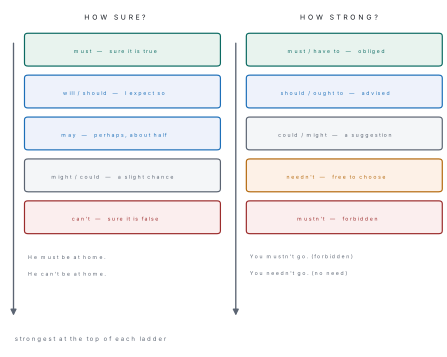
- must — the only possible explanation: The lights are off; they must have gone out.
- can't / cannot — the impossible explanation. It is the negative of deductive must, not mustn't: He can't be in Jumla; I saw him in Kathmandu an hour ago.
- may / might / could — one of several possibilities: She may be in the library. It might snow tonight.
- can for general possibility (what sometimes happens): Jumla can be bitterly cold in Magh. Compare the particular possibility: It may be cold in Jumla tomorrow.
Habit, willingness and characteristic behaviour
- used to + V1 — a past habit or state that has stopped: There used to be a wooden bridge here.
- would + V1 — a repeated past action in a description (not for states): Every Dashain grandmother would make selroti for the whole village.
- will for a present characteristic habit: He will sit reading for hours.
- be used to + V-ing — accustomed to (a different structure altogether): She is used to walking three kilometres to school.
22.3 Semi-modals
Semi-modals supply the forms the nine modals lack, and add meanings of their own.
| Semi-modal | Meaning | Example | Note |
|---|---|---|---|
| have to / has to / had to | external obligation | I had to renew my licence. | supplies the past and future of must |
| be able to | ability | He has been able to walk since March. | supplies the missing forms of can |
| be allowed to | permission | We were allowed to leave early. | past of permission can/may |
| ought to | duty, expectation | You ought to thank her. | the only modal with to |
| had better | urgent advice | We'd better hurry. | bare infinitive; negative had better not |
| would rather | preference | I'd rather not say. | bare infinitive |
| used to | discontinued past habit | He used to smoke. | question/negative with did: Did he use to smoke? |
| be supposed to | what is expected or arranged | You are supposed to wear a helmet. | often implies it is not being done |
| need | necessity | You needn't shout. (modal) / You don't need to shout. (main verb) | modal need has no -s and takes V1 |
| dare | courage | He dare not complain. (modal) / He didn't dare to complain. (main verb) | rare except in fixed phrases |
| be going to | intention, prediction from evidence | She is going to apply for the scholarship. | not a modal, but tested with them |
22.4 Past and perfect forms — modal + have + V3
A modal followed by have + past participle talks about the past. Each combination says something precise about whether the action actually happened.
| Perfect modal | Meaning | Did it happen? |
|---|---|---|
| must have + V3 | I am sure it happened | yes |
| can't / couldn't have + V3 | I am sure it did not happen | no |
| may / might have + V3 | possibly it happened | unknown |
| could have + V3 | it was possible, but it did not happen (or: unused ability) | usually no |
| should / ought to have + V3 | it was the right thing, and it was not done | no — and that was a mistake |
| shouldn't have + V3 | it was done, and it was wrong | yes |
| needn't have + V3 | it was done, but it was unnecessary | yes |
| didn't need to + V1 | it was unnecessary, so normally it was not done | usually no |
| would have + V3 | an unreal past result (see Unit 28) | no |
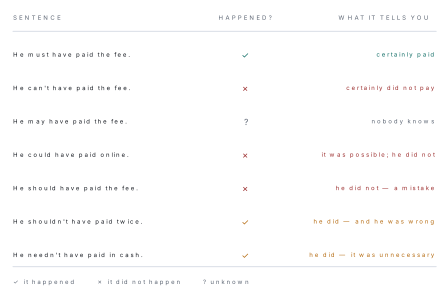
Compare the pair the board loves:
- I needn't have taken an umbrella — it did not rain. (I took it; it was a waste)
- I didn't need to take an umbrella, so I left it at home. (no need, so I did not take it)
22.5 The mistakes Nepali speakers make most
| ✗ Wrong | ✓ Right | Rule broken |
|---|---|---|
| I must have to go now. | I must go now. / I have to go now. | never two obligation words together |
| You should have to submit it today. | You should submit it today. | should is complete by itself |
| He can able to drive. | He can drive. / He is able to drive. | can + bare infinitive |
| She could not able to attend. | She could not attend. / She was not able to attend. | same rule in the negative |
| I will can meet you. | I will be able to meet you. | two modals are impossible |
| He cans play the madal. | He can play the madal. | a modal takes no -s |
| We should to respect our teachers. | We should respect our teachers. | no to after should |
| You had better to consult a doctor. | You had better consult a doctor. | had better + bare infinitive |
| Does he can swim? | Can he swim? | modals need no do |
| May be he is at home. | Maybe he is at home. / He may be at home. | maybe (one word) = perhaps |
| Yesterday I must submit the form. | Yesterday I had to submit the form. | must has no past |
| I am used to go there on foot. | I used to go there on foot. / I am used to going there on foot. | two different structures |
| Would you mind to open the door? | Would you mind opening the door? | mind + V-ing |
| He mustn't worry, there is no hurry. | He needn't worry, there is no hurry. | mustn't forbids; needn't releases |
Problem. Fill in with the correct form: The house was burning fiercely, but the fire brigade ____ rescue everyone inside.
Solution — step by step.
- Name the meaning. This is about ability in the past.
- General ability or one particular success? The sentence describes one difficult occasion on which the rescue actually succeeded.
- Apply the rule. Could is used for a general past ability ("I could swim at five"). For a single achievement — managing to do something on one occasion — English uses was / were able to or managed to.
- Fit the subject. The fire brigade is singular → was.
Answer. … but the fire brigade was able to rescue everyone inside.
(In the negative, couldn't is perfectly correct even for a single occasion: They couldn't rescue the cat.)
Problem. Rewrite using a modal: I am sure Rita did not take my umbrella, because she left before the rain started.
Solution — step by step.
- Name the meaning. The speaker is sure about something in the past, and the certainty is negative.
- Choose the modal. Certainty that something is false is can't (or couldn't), never mustn't. Mustn't means "it is forbidden".
- Make it past. A modal is made past by adding have + past participle.
Answer. Rita can't have taken my umbrella; she left before the rain started.
The positive twin would be: Rita must have taken my umbrella.
Problem. Correct: Since I must have to reach the airport by six, I think I will can book a taxi, but you should to come with me, isn't it?
Solution — one fault at a time.
- must have to stacks two obligation forms. Keep one: have to (the deadline is external).
- will can stacks two modals. Replace the second with its semi-modal: will be able to — but here the plain future is simpler: I will book a taxi.
- should to come — should takes the bare infinitive: should come.
- The tag must match the statement. The main clause is you should come, so the tag is shouldn't you?
Answer. Since I have to reach the airport by six, I think I will book a taxi, but you should come with me, shouldn't you?**
Chapter summary
- The nine modals are can, could, may, might, will, would, shall, should, must; they take no -s, no do, and a bare infinitive.
- Two modals never stand together: use a semi-modal (will be able to, have to).
- Ability: can / could for general ability, was/were able to for a single past success, be able to for the missing forms.
- Permission: can < could < may < might in formality. Prohibition is mustn't; absence of obligation is needn't / don't have to.
- Obligation: must (from the speaker) vs have to (from outside); the past of both is had to.
- Advice: should / ought to, and had better + bare infinitive for urgent advice on one occasion.
- Certainty scale: must (sure it is true) > will / should > may > might / could > can't (sure it is false).
- Past habit: used to + V1 (habits and states), would + V1 (repeated actions only); be used to + V-ing means "accustomed to".
- Perfect modals: must have (it happened), can't have (it did not), may/might have (unknown), should have (it did not, and should have), needn't have (it did, unnecessarily).
Practice questions
Fill in the blanks with a suitable modal or semi-modal (1 mark each)
- She ____ speak three languages fluently. [1]
- ____ I use your pen for a moment, sir? [1]
- Students ____ not use mobile phones in the examination hall. [1]
- You ____ hurry; there is still half an hour left. [1]
- The lights are on, so somebody ____ be inside. [1]
- He ____ be in Pokhara — I met him in Bhaktapur this morning. [1]
- Yesterday I ____ stay late at the office to finish the report. [1]
- There ____ to be a big pipal tree at this corner, but it was cut down. [1]
- You ____ better see a doctor before the swelling gets worse. [1]
- After two hours of digging, the rescuers ____ to reach the trapped miners. [1]
Answers
1. can — present ability.
2. May (or Could) — asking formal permission.
3. must — must not states a prohibition.
4. needn't — there is no necessity; mustn't would wrongly forbid hurrying.
5. must — the only likely explanation, so a confident deduction.
6. can't — certainty that something is false is can't, not mustn't.
7. had to — must has no past form.
8. used — used to be is a discontinued past state.
9. had — had better + bare infinitive gives urgent advice.
10. were able — one particular success in the past, so were able to.
Correct the errors in the following sentences (1 mark each)
- I must have to submit the assignment before Friday. [1]
- My younger brother can able to recite the whole poem. [1]
- She cans drive a scooter. [1]
- We should to help the flood victims. [1]
- Does he can come with us tomorrow? [1]
- He had better to apologise to his teacher. [1]
- I will can finish the work by evening. [1]
- They could not able to solve the last question. [1]
- I am used to go to school on foot when I was a child. [1]
- You mustn't buy a ticket; entry is free today. [1]
Answers
11. I have to (or must) submit the assignment before Friday. — one obligation word only.
12. My younger brother can recite (or is able to recite) the whole poem.
13. She can drive a scooter. — a modal never takes -s.
14. We should help the flood victims. — no to after should.
15. Can he come with us tomorrow? — modals form questions without do.
16. He had better apologise to his teacher. — bare infinitive after had better.
17. I will be able to finish the work by evening. — two modals cannot stand together.
18. They could not solve (or were not able to solve) the last question.
19. I used to go to school on foot when I was a child. — a discontinued past habit.
20. You needn't buy a ticket; entry is free today. — no necessity, not prohibition.
Rewrite as instructed (1 mark each)
- It is not necessary for you to attend the rehearsal. — Rewrite using needn't. [1]
- I am sure he has forgotten the meeting. — Rewrite using a perfect modal. [1]
- It was wrong of you to shout at the conductor. — Rewrite using shouldn't. [1]
- Perhaps she missed the last bus. — Rewrite using might. [1]
- It is forbidden to pluck flowers in this garden. — Rewrite using mustn't. [1]
- I took a raincoat, but there was no rain at all. — Rewrite using needn't have. [1]
Answers
21. You needn't attend the rehearsal. — needn't + bare infinitive shows absence of necessity.
22. He must have forgotten the meeting. — certainty about the past is must have + V3.
23. You shouldn't have shouted at the conductor. — the act was done and it was wrong.
24. She might have missed the last bus. — a past possibility.
25. You mustn't pluck flowers in this garden. — mustn't states a prohibition.
26. I needn't have taken a raincoat. — the action was done, but it turned out to be unnecessary.
Practise more: English question bank