Unit 28 · Grammar · 14 min read
Conditional Sentences
What the syllabus asks for 5
- The four types in detail
- Mixed conditionals
- Conditionals without if
- Four places where will, would and should may follow if
- Wish, if only and other unreal patterns
A conditional sentence has two parts: an if-clause, which states the condition, and a main clause, which states the result. If it rains, the match will be cancelled. The whole of the grammar lies in one question — how real is the condition? English answers that question by choosing a tense, and the tense it chooses is often not the tense of the time being talked about: a sentence about the future can use the present, and a sentence about the present can use the past. That is why conditionals are worth learning as four fixed patterns rather than reasoning them out each time.
| Type | If-clause | Main clause |
|---|---|---|
| 0 general truth | if + present simple | present simple |
| 1 real / likely | if + present simple | will / can / may / must + base verb |
| 2 unreal present or future | if + past simple (were for all persons) | would / could / might + base verb |
| 3 impossible past | if + past perfect | would / could / might + have + past participle |
Two rules hold for all four: never use will or would in the if-clause, and the if-clause takes a comma only when it comes first.
28.1 The four types in detail
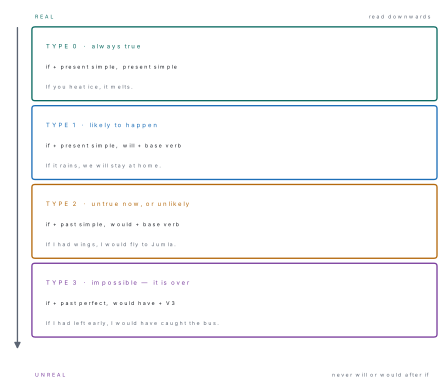
Type 0 — a fact that is always true. Here if can be replaced by when or whenever. If you mix blue and yellow, you get green. If the temperature falls below zero, water freezes.
Type 1 — a real possibility in the present or future. If you work hard, you will pass. If she calls, tell her I am out. (imperative in the main clause) If you have finished the paper, you may leave. (present perfect in the if-clause is allowed) If he misses the bus, he can take a taxi.
Type 2 — the condition is untrue now, or very unlikely. The past tense here has no past meaning; it is a signal of unreality. With be, formal English uses were for every person. If I knew his number, I would ring him. (I do not know it) If I were you, I would apologise. (the fixed advice formula) If we had more time, we could visit Lumbini.
Type 3 — the condition was not fulfilled, and the time is finished. Nothing can change it now. If she had revised, she would have scored better. (she did not revise) If the driver had been careful, the accident would not have happened. If I had known you were ill, I would have visited you.
28.2 Mixed conditionals
Real life does not always keep the two clauses in the same time. A mixed conditional takes the if-clause from one type and the main clause from another.
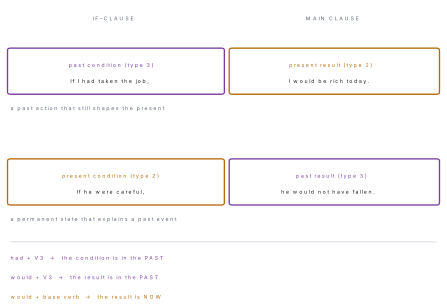
| Mix | Example | Meaning |
|---|---|---|
| Type 3 if-clause + Type 2 main clause | If I had studied medicine, I would be a doctor now. | past cause, present result |
| Type 2 if-clause + Type 3 main clause | If he were honest, he would not have cheated in the test. | present state, past result |
28.3 Conditionals without if
Inversion. In formal English the if can be dropped and the auxiliary moved in front of the subject. This is available in three patterns only.
| With if | Inverted |
|---|---|
| If I were you… | Were I you… |
| If he had told me… | Had he told me… |
| If you should need help… | Should you need help… |
✗ If had I known… — once if is removed, it must not come back.
Other conditional connectives.
| Connective | Meaning | Example |
|---|---|---|
| unless | if … not | You will fail unless you work hard. |
| provided (that) / providing | on the single condition that | I will lend it provided that you return it by Friday. |
| as long as / so long as | on condition that | You may stay as long as you keep quiet. |
| on condition that | formal condition | He was released on condition that he reported weekly. |
| in case | as a precaution (not the same as if) | Take an umbrella in case it rains. |
| even if | the result holds anyway | I will go even if it rains. |
| suppose / supposing | imagine that | Supposing you lost your passport, what would you do? |
| but for | if it had not been for | But for your help, I would have failed. |
| otherwise / or else | if that does not happen | Hurry up, otherwise you will be late. |
| whether … or not | both conditions | I shall go whether it rains or not. |
28.4 Four places where will, would and should may follow if
The rule "no will after if" applies to conditions. There are four recognised exceptions, and knowing them stops you from over-correcting.
| Case | Meaning of the auxiliary | Example |
|---|---|---|
| Willingness | will / would = "be kind enough to" | If you will wait here, I will call the manager. · If you would sign here, please. |
| Insistence | stressed will = "insist on doing" | If you will eat so much sugar, you must expect toothache. |
| Remote possibility | should = "by any chance" | If you should meet him, give him my regards. · If I were to fail, I would try again. |
| Not a condition at all | if = whether, after ask, wonder, know, see | I wonder if he will come. · Ask her if she will join us. |
In every other case the if-clause of a type 1 sentence takes the present simple, however clearly it refers to the future.
✗ If it will rain, we will stay at home. → ✓ If it rains, we will stay at home. (no will in the if-clause) ✗ If I would have known, I would have come. → ✓ If I had known… ✗ If I was you, I would accept. → ✓ If I were you… ✗ Unless you don't hurry, you will miss it. → ✓ Unless you hurry… (unless already contains the negative) ✗ Take a coat in case it will be cold. → ✓ …in case it is cold. ✗ If he would be here, he would help us. → ✓ If he were here…
28.5 Wish, if only and other unreal patterns
Wish and if only behave like a type 2 or type 3 if-clause: the tense goes one step back to show that the thing is not so.
| Pattern | Meaning | Example |
|---|---|---|
| wish + past simple | regret about now | I wish I knew the answer. (I don't) |
| wish + were | regret about a present state | I wish I were taller. |
| wish + could | regret about present ability | I wish I could swim. |
| wish + past perfect | regret about the past | I wish I had listened to you. |
| wish + would | annoyance, or a wish for change | I wish you would stop shouting. |
| if only | the same, but stronger | If only* I had known* earlier! |
| It is (high) time + past | something overdue | It is high time we left. |
| would rather + past | preference about someone else | I would rather you came tomorrow. |
| as if / as though + past | an untrue comparison | He talks as if he knew everything. |
✗ I wish I would have gone. → ✓ I wish I had gone. ✗ It is time we go. → ✓ It is time we went. (or It is time for us to go**.)
Problem. Put the verbs into the correct form. (a) If you (boil) water, it (turn) into steam. (b) If she (come) tomorrow, I (meet) her at the airport. (c) If I (be) the mayor, I (ban) plastic bags. (d) If they (start) earlier, they (reach) the summit. — (d) refers to a climb that failed yesterday.
Solution — identify the reality of each condition.
- (a) A scientific fact: type 0, present simple in both clauses. → If you boil water, it turns into steam.
- (b) A real future possibility: type 1, present simple in the if-clause, will in the main clause. → If she comes tomorrow, I will meet her at the airport.
- (c) I am not the mayor: type 2, past simple (were) + would. → If I were the mayor, I would ban plastic bags.
- (d) The climb is over and they did not start early: type 3, past perfect + would have + past participle. → If they had started earlier, they would have reached the summit.
Problem. Rewrite each sentence as instructed. (a) If you do not apologise, he will not forgive you. — Use unless. (b) If your brother had not warned me, I would have signed the paper. — Begin But for … (c) If I had seen the notice, I would have applied. — Begin Had …
Solution — step by step.
- (a) Unless already means if … not, so the negative in the if-clause is dropped and nothing else changes. → Unless you apologise, he will not forgive you.
- (b) But for is followed by a noun phrase, not a clause. Your brother had not warned me becomes your brother's warning. The main clause is unchanged. → But for your brother's warning, I would have signed the paper.
- (c) For inversion, delete if and move the auxiliary had in front of the subject I. → Had I seen the notice, I would have applied.
Problem. Complete: He missed the train this morning, so he is not at the meeting now. — Rewrite as a conditional beginning If he …
Solution — two different times.
- When is the condition? Missing the train happened this morning — it is finished. A finished unreal past takes had + past participle: If he had not missed the train…
- When is the result? He is not at the meeting describes now. A present unreal result takes would + base verb, not would have: …he would be at the meeting now.
- Check the polarity. The facts are negative (he missed it, he is absent), so the unreal version reverses both.
Answer. If he had not missed the train, he would be at the meeting now.
Chapter summary
- Type 0: if + present, present — a general truth.
- Type 1: if + present, will / can / may + base verb — a real possibility.
- Type 2: if + past (were for all persons), would / could / might + base verb — untrue or unlikely now.
- Type 3: if + past perfect, would / could / might have + past participle — impossible, because the time is past.
- Never put will or would in the if-clause; a fronted if-clause takes a comma.
- Mixed conditionals join a past condition to a present result (had + V3 … would + base) or a present condition to a past result.
- If can be dropped in three inverted patterns: Were I…, Had I…, Should you…
- Unless = if not; in case means "as a precaution" and takes the present; but for takes a noun phrase.
- Wish / if only + past = regret about now; + past perfect = regret about the past; + would = annoyance or a wish for change.
- It is high time and would rather (with a new subject) both take the past tense.
Practice questions
Put the verbs in brackets into the correct form (1 mark each)
- If you (heat) iron, it expands. [1]
- If it rains tomorrow, we (postpone) the picnic. [1]
- If I (be) you, I would consult a doctor. [1]
- If she had taken the medicine, she (recover) by now. [1]
- If the bus (not come) on time, we would have missed the flight. [1]
- I wish I (know) how to drive. [1]
- If only he (listen) to his teachers when he was young! [1]
- It is high time you (start) revising for the examination. [1]
- Unless you (hurry), you will miss the last bus. [1]
- He behaves as if he (own) the whole building. [1]
Answers
1. heat — type 0; both clauses in the present simple.
2. will postpone — type 1; will goes in the main clause.
3. were — type 2; were is used for all persons in the unreal past.
4. would have recovered — type 3; the condition and the result are both past and unfulfilled. (would be well by now would be the mixed form.)
5. had not come — type 3 if-clause; past perfect.
6. knew — wish + past simple for a present regret.
7. had listened — if only + past perfect for a past regret.
8. started — It is high time takes the past tense.
9. hurry — unless already means "if not", so no extra negative.
10. owned — as if + past simple for an untrue comparison.
Correct the errors (1 mark each)
- If it will rain, the programme will be cancelled. [1]
- If I would have known, I would have told you. [1]
- Unless you don't work hard, you cannot succeed. [1]
- If I was a bird, I would fly over the Himalayas. [1]
- I wish I would have attended the seminar. [1]
- Take a torch in case the power will go off. [1]
- If had he apologised, she would have forgiven him. [1]
- It is time we go home. [1]
Answers
11. If it rains, the programme will be cancelled. — no will in the if-clause.
12. If I had known, I would have told you. — type 3 uses the past perfect.
13. Unless you work hard, you cannot succeed. — unless carries the negative.
14. If I were a bird, I would fly over the Himalayas. — unreal were.
15. I wish I had attended the seminar. — wish + past perfect for a past regret.
16. Take a torch in case the power goes off. — in case takes the present simple.
17. Had he apologised, she would have forgiven him. — with inversion, if is deleted.
18. It is time we went home. — It is time + past tense.
Rewrite as instructed (1 mark each)
- If you do not water the plants, they will die. — Use unless. [1]
- If she had not helped me, I would have been in trouble. — Begin: But for … [1]
- If I were rich, I would build a school in my village. — Begin: Were … [1]
- He did not take my advice, so he is in difficulty now. — Rewrite as a conditional. [1]
- I am sorry I did not book the ticket in advance. — Begin: I wish … [1]
Answers
19. Unless you water the plants, they will die. — the negative disappears with unless.
20. But for her help, I would have been in trouble. — but for is followed by a noun phrase.
21. Were I rich, I would build a school in my village. — if is deleted and were moves in front of the subject.
22. If he had taken my advice, he would not be in difficulty now. — a mixed conditional: past condition, present result.
23. I wish I had booked the ticket in advance. — regret about the past takes wish + past perfect.
Practise more: English question bank