Unit 7 · Literature - Short Stories · 47 min read
A Very Old Man with Enormous Wings
What the syllabus asks for 8
- About the author
- The story
- Characters
- Themes
- Setting, structure and point of view
- Style and literary devices
- Glossary
- Textbook exercises
After three days of rain, a man throwing dead crabs into the sea comes back to find a filthy, toothless old man lying in the mud of his courtyard — with the enormous, dirty wings of a buzzard. A neighbour says he is an angel; a priest says he is an impostor; a doctor says he is a wonder of nature; and a village that has never seen anything like him first gapes, then pays five cents to stare at him, and then drifts off to a show about a woman changed into a spider. Gabriel García Márquez's story is funny, sad and strange, and it is built on a simple trick: the most extraordinary event in the world is told in the tone of a village rumour. It is the standard example of magical realism in your course.
The story asks how human beings treat the marvellous when it arrives among them. Instead of awe, the villagers show curiosity, greed, cruelty and boredom. The angel is neither honoured nor driven away; he is exploited until the crowd finds something newer, and then he is ignored until he leaves. Márquez does not condemn anyone. He simply shows ordinary people who can make a miracle into a sideshow, and an "angel" who turns out to be only a very old man who needs a blanket.
7.1 About the author
Gabriel José García Márquez (1927–2014) — "Gabo" to his readers — was born on 6 March 1927 in Aracataca, a small banana-growing town in the northern Caribbean lowlands of Colombia. His father moved to another city soon afterwards, and Gabriel was raised in his first years by his maternal grandparents, Colonel Nicolás Márquez, a veteran of Colombia's civil wars who told him stories of war and of the banana company, and Tranquilina Iguarán, who filled the house with tales of ghosts, omens and prophecies, told in a flat, matter-of-fact voice. That voice — the calm telling of marvels — later became his own.

He studied law in Bogotá, but dropped it to work as a journalist for El Espectador and other papers, and then as a correspondent in Rome and Paris. His first novella, Leaf Storm, appeared in 1955, followed by No One Writes to the Colonel (1961). His masterpiece, One Hundred Years of Solitude (1967), tells the story of the Buendía family in the imaginary town of Macondo, and has sold over fifty million copies. Other major works are The Autumn of the Patriarch (1975), Chronicle of a Death Foretold (1981), and Love in the Time of Cholera (1985). He won the Nobel Prize in Literature in 1982 and died in Mexico City on 17 April 2014.
"A Very Old Man with Enormous Wings" (Spanish: Un señor muy viejo con unas alas enormes), subtitled A Tale for Children, was written in 1968 and first appeared that year in the Cuban magazine Casa de las Américas. The English translation by Gregory Rabassa appeared in 1971 and in the collection Leaf Storm and Other Stories (1972). Rabassa also translated One Hundred Years of Solitude.
A style of fiction in which magical or impossible events are told in the same matter-of-fact tone as ordinary ones, so that the magic seems part of everyday life. The narrator does not explain or apologise for it, and the characters usually accept it, or find it a nuisance, rather than marvel. It is especially associated with Latin American writers such as García Márquez, Isabel Allende and Jorge Luis Borges. In this story, an angel arrives with an old man's smell and is fed eggplant mush; nobody is astonished for long.
- The angel is called a "very old man", not a young, glowing angel; his wings are those of a "huge buzzard", "dirty and half-plucked".
- Pelayo and Elisenda are husband and wife; the child is their newborn baby (not the angel's child). The neighbour woman is never named.
- The story is not set in Europe or in a particular named town; it is in a coastal village in a Caribbean-type country.
- The "woman changed into a spider" is not the angel's companion but a rival attraction at a travelling carnival.
- It is not a religious story: the Church appears as a slow bureaucracy, and the old man is never proved to be an angel.
7.2 The story
The third day of rain. After three days of rain, so many crabs have been killed inside the house that Pelayo has to carry them across his flooded courtyard and throw them into the sea, because the newborn child has had a fever all night and they blame the smell. The world, the narrator says, "had been sad since Tuesday": sea and sky are one ash-grey mass, and the beach, which glows on March nights "like powdered light", has turned to a stew of mud and rotten shellfish. At noon Pelayo finds something groaning at the back of the courtyard: a very old man face down in the mud, unable to rise because his enormous wings are in the way.
The discovery. Pelayo fetches his wife, Elisenda, who is nursing the child, and the two stare in silence. The man is dressed like a ragpicker, nearly bald and nearly toothless, and the pity of his drenched old age takes away any grandeur. His huge wings are like a buzzard's, dirty and half-plucked. They look at him so long that their surprise wears off and he begins to look familiar. When they speak to him he answers in an incomprehensible dialect in a strong sailor's voice, and so they decide, sensibly enough, that he is a castaway from some ship wrecked by the storm. Still, they call in a neighbour woman who "knew everything about life and death". She needs one look: he is an angel, she says, who had probably come for the child, and the rain knocked him down because he is so old.
The chicken coop. By next day the whole village knows that a flesh-and-blood angel is held in Pelayo's house. The neighbour thinks angels are fugitives from a celestial conspiracy and advises clubbing him, but Pelayo and Elisenda cannot bring themselves to do it. Pelayo guards him with his bailiff's club, then drags him out of the mud and locks him in the wire chicken coop with the hens. That night the rain stops and the child's fever breaks. In a generous mood, the couple plan to put the angel on a raft with three days' food and water and leave him to the sea. But at dawn they find the neighbourhood round the coop, throwing food through the wire as if he were a circus animal.
Father Gonzaga. The parish priest arrives before seven, alarmed. The crowd is already debating the captive's future: one party would make him mayor of the world, another a general to win every war, some dreamers would breed from him a race of winged sages. Father Gonzaga, a woodcutter before he was a priest, goes into the coop and greets the old man in Latin. The old man does not understand, and the priest has his first suspicion: an angel would know the language of God. Seen close up, the creature is "much too human": he smells of the outdoors, his wings are full of parasites, and nothing about him matches the dignity of angels. In a short sermon the priest warns the crowd that the devil likes carnival tricks, and that wings no more make an angel than they make a hawk an aeroplane. He will write to his bishop, who will write to his primate, who will write to the Pope for a final ruling.
The crowd and the five-cent fence. Nobody listens. The news spreads so fast that the courtyard becomes a marketplace and soldiers with bayonets have to disperse the mob. Elisenda, aching from sweeping up the litter, has an idea: fence the yard and charge five cents to see the angel. Pilgrims come from far away, among them a travelling carnival and a host of strange invalids — a woman who has counted her heartbeats since childhood until she ran out of numbers, a man who cannot sleep for the noise of the stars, a sleepwalker who undoes at night what he did by day. Within a week the couple's rooms are crammed with money and the queue stretches beyond the horizon.
The patient angel. The angel alone takes no part in the show. Hot from the oil lamps and candles set along the wire, he tries to get comfortable in his borrowed nest. He refuses mothballs, which the neighbour says are angels' food, and the lunches the penitents bring, and eats only eggplant mush. His only supernatural virtue seems to be patience. Hens peck at his wings, cripples tear out feathers to touch their sores, and even the kind throw stones to make him stand. Only once is he roused: when he has lain so still that they fear he is dead, they burn his side with a branding iron. He wakes with tears in his eyes, shouting in his "hermetic language", and beats his wings, raising a storm of dung and dust. From then on the crowd is careful; they see that his passivity is not that of a hero at ease but of "a cataclysm in repose".
Waiting for Rome. The letters from Rome come slowly. The clergy meanwhile investigate whether the prisoner has a navel, whether his dialect resembles Aramaic, how many of him can stand on the head of a pin, and whether he is only a Norwegian with wings. The priest's troubles end only when a "providential event" arrives.
The spider woman. A travelling show comes to town with a woman who was changed into a spider for disobeying her parents. Admission is cheaper than for the angel, and spectators may question her and examine her. She is a tarantula the size of a ram with the head of a sad girl, and what moves the crowd is the sincerity with which she tells her story: as a child she slipped out to a dance, and walking home through the woods after dancing all night she was struck by lightning and turned into a spider. She lives on meatballs thrown into her mouth. A spectacle with so much human truth and so clear a moral easily defeats the aloof angel. The miracles ascribed to the angel also seem faintly absurd: a blind man who grows three new teeth instead of sight, a paralytic who does not walk but nearly wins the lottery, a leper whose sores sprout sunflowers. These "consolation miracles" make the angel look like a joke, and the spider woman finishes him. Father Gonzaga is cured of his insomnia, and the courtyard is as empty as when it rained.
The new house. The couple have no complaints. With their savings they build a two-storey mansion with balconies, gardens, high netting against crabs and iron bars on the windows to keep out angels. Pelayo gives up his job as a bailiff and keeps rabbits; Elisenda buys satin shoes and silk dresses. Only the chicken coop is left untouched; if they scrub it with disinfectant and burn myrrh in it, the narrator says, it is not in honour of the angel but to drive out the stench.
The child and the old man. As the child grows, the parents' fear of the coop fades, and he goes in to play, where the wire is rotting. The angel is as aloof with him as with everybody but tolerates his mischief "with the patience of a dog who had no illusions". They catch chicken pox together. The child's doctor cannot resist listening to the angel's chest and finds so much whistling in the heart and noise in the kidneys that he seems impossible alive; but it is the wings that amaze him, so natural on such a human body that he wonders why other men lack them.
Decline. By the time the child goes to school the coop has collapsed in sun and rain, and the angel drags himself about the house like a stray dying man. They drive him out of the bedroom with a broom and find him in the kitchen. Elisenda, exasperated, cries out that it is awful to live in a hell full of angels. His eyes are foggy, his feathers almost gone; Pelayo throws a blanket over him and lets him sleep in the shed, and they find he has a fever and raves in what sounds like Norwegian. They fear he will die, and not even the wise neighbour can tell them what to do with a dead angel.
The flight. But he survives the winter and revives with the first sun. Stiff, big feathers grow on his wings, scarecrow feathers, and he takes care that nobody sees them or hears the sea songs he sings under the stars. One morning, while Elisenda is cutting onions for lunch, a wind from the high seas blows into the kitchen. She looks out and sees the angel's first clumsy attempts at flight — his nails plough a furrow in the vegetable patch and he almost knocks down the shed — and then he gains height. Elisenda sighs with relief, "for herself and for him". She watches until he is only "an imaginary dot on the horizon of the sea", no longer an annoyance in her life.
7.3 Characters
| Character | Who they are | Role in the story |
|---|---|---|
| The old man (the "angel") | A very old, filthy man with buzzard's wings; speaks an unknown dialect in a sailor's voice | The mystery at the centre; a mirror in which everyone shows their nature |
| Pelayo | The householder; a bailiff by trade | Practical, half-kind, half-greedy; the first to find the angel |
| Elisenda | Pelayo's wife, mother of the newborn child | The business brain: she thinks of the fence and the fee; the last to see the angel go |
| The neighbour woman | A wise woman who "knew everything about life and death" | The first to say he is an angel; the voice of folk knowledge |
| Father Gonzaga | The parish priest, formerly a woodcutter | The voice of the Church: cautious, sceptical, slow |
| The doctor | Treats the child during chicken pox | The voice of science: puzzled but admiring |
| The crowd | Neighbours, pilgrims, invalids, the curious | Curiosity, greed and cruelty |
| The spider woman | A carnival attraction, changed into a tarantula for disobeying her parents | The rival wonder that wins the crowd |
| The child | Pelayo and Elisenda's baby, who grows up during the story | The only one who comes near the angel without fear |
The old man. He never speaks in a language we understand, and we never learn who he is: an angel, a castaway, a sailor, a "Norwegian with wings". He is described in detail as human — smelly, toothless, verminous, feverish — and it is this humanity that makes him touching. His chief quality is patience. He suffers being caged, poked, plucked, stoned, branded and ignored without revenge, except for one moment of pain when he beats his wings. He is helpless, but not a victim in spirit: at the end he grows new feathers in secret and leaves alone, on his own terms.
Pelayo and Elisenda. They are ordinary, not wicked. They are kind enough not to club the angel and frightened enough to lock him in a coop; they want to send him to sea, then find they can make money from him; and they use the money to build a house with "iron bars on the windows so that angels wouldn't get in". Elisenda is quicker and harder than her husband: she thinks of the fence and the fee, she is the one who shouts at the angel in the kitchen, and, when he flies, she is the one who feels relief "for herself and for him". Both are ordinary human beings, neither hero nor villain.
Father Gonzaga. A cautious man of the Church who tests the old man in Latin, distrusts the crowd's excitement and refers the case to Rome. He is not cruel, and his suspicion is the story's only serious attempt at an answer. But his reasoning — an angel would speak Latin and look dignified — shows how a mind can be too closed to see. Rome's silence turns the Church into an institution that is slow, formal and out of touch; the spider woman "cures" him of insomnia.
The neighbour woman. She makes the first identification of the angel and gives the first advice: he is an angel and should be killed. She is confident and wrong in half of it; and her wisdom fails at the end, for she cannot tell them what to do with a dead angel.
The crowd. Most of the story's cruelty comes from the crowd: they treat the angel as a circus animal, throw stones and pull feathers, brand him with an iron, and then lose interest when a better show comes to town. They have faith without reverence and curiosity without kindness.
7.4 Themes
The treatment of the marvellous — wonder turned into spectacle. The story's main irony is that a miracle is met not with awe but with entertainment and profit. The angel is a prisoner, an exhibit, a nuisance and finally an empty space in the yard. Márquez suggests that people cope with the extraordinary by making it ordinary or commercial.
Greed and commercialism. It is Elisenda's idea to charge admission; the pilgrims' money builds a mansion. Faith is turned into a business, and the house is finally protected from angels as well as from crabs.
Cruelty and indifference to the weak. The old man is helpless, unwanted and old, and is treated as a curiosity. The crowd's cruelty (stones, branding) and the family's indifference (neglect in the yard, "a hell full of angels") are two sides of the same failure to treat a suffering being as a person.
Religion, authority and the limits of knowledge. Father Gonzaga and the Church cannot decide whether the old man is an angel; their questions (does he have a navel? does he speak Aramaic?) are absurd. The story mocks a kind of religion that is bureaucratic and forgets the suffering in front of it, while leaving open whether the old man is really divine.
Appearance and reality. What is an angel? The story reverses the picture: this "angel" is filthy, verminous, old and sick, and the "miracles" he works are comic. He is called an angel by those who see wings and a captive by those who see an old man; the doctor sees a heart that should not be beating.
Human nature, fickleness and gullibility. The crowd flocks to the angel and then turns to a woman who has become a spider, because her tale is "full of so much human truth". The people believe whatever shows them a lesson, whether an angel who cannot heal or a girl punished for a dance.
Old age and dignity. The old man is described as a "great-grandfather" in decay, and the last third of the story is a portrait of decline and unexpected recovery. His slow flight is a kind of triumph of the old.
Freedom. The angel's escape at the end is the story's only moment of release. He does not thank his captors or punish them; he simply goes.
7.5 Setting, structure and point of view
Setting. A poor coastal village, apparently on the Caribbean coast of a Latin American country, with a beach, crabs, constant rain, a courtyard, a chicken coop, a parish church and a bishop far away. The story is timeless ("in those times"). The setting is described with dreamlike precision: sea and sky one ash-grey thing, sands "like powdered light". It moves from a damp, sad world of mud and crabs to a dry, successful world of a mansion, then back to a courtyard from which the angel finally flies.

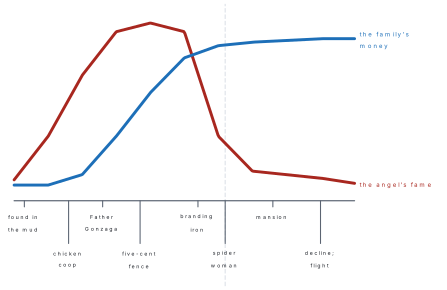
Structure. The story is a chain of scenes in which the angel is passively transferred from one owner (or opinion) to the next.
| Stage | Events | Attitude to the angel |
|---|---|---|
| Exposition | Rain, crabs, the sick child | — |
| Discovery | The old man in the mud; the neighbour: "an angel" | Astonishment, then familiarity |
| Captivity | The chicken coop; the crowd; Father Gonzaga; the fence | Curiosity and cruelty |
| Turning point | The spider woman arrives | Interest collapses |
| Aftermath | The mansion; the child; illness; the decline | Neglect |
| Resolution | New feathers; the flight; Elisenda's sigh | Relief |
Point of view. Third person, told in a calm, slightly ironic voice by a narrator who knows everything but comments little. He moves freely between Pelayo, Elisenda, the crowd, the priest and the doctor, and he never tells us whether the old man is an angel. The tone is the tone of a village tale told by an old woman: plain, humorous and sure of itself. The narrator describes each marvel — and each cruelty — in the same level voice, which is exactly the method of magical realism.
7.6 Style and literary devices
| Device | Example | Effect |
|---|---|---|
| Magical realism | An angel with buzzard's wings in a chicken coop, told in the tone of a village rumour | Makes the marvellous ordinary and the ordinary strange |
| Irony | The "angel" is a filthy old man; the family builds iron bars "so that angels wouldn't get in"; Father Gonzaga is "cured of insomnia" by a spider | Turns the miracle upside down |
| Satire | The Church's letters (Norwegian? navel? Aramaic?); the crowd's proposals (mayor of the world; general) | Mocks institutions and human credulity |
| Understatement / deadpan | They "found him familiar"; "the inconvenience of the wings" | Makes the fantastic comic |
| Hyperbole | "The line of pilgrims reached beyond the horizon"; "the woman who had counted her heartbeats and run out of numbers" | Exaggerates for humour and to show the size of the fuss |
| Imagery | "sea and sky were a single ash-gray thing"; "sands like powdered light"; "the feathers of a scarecrow" | Grey, damp, dreamlike pictures |
| Simile | "like a huge decrepit hen among the fascinated chickens"; "like a stray dying man"; "with the patience of a dog who had no illusions" | Comic, precise comparisons that reduce the angel |
| Symbol | The wings (freedom, transcendence, decay); the chicken coop (the way we cage the strange); the iron bars; the onions Elisenda cuts as he flies | Gives objects several meanings |
| Allusion | The Pope, the bishop, "how many can fit on the head of a pin" | Parodies medieval theology |
| Contrast | Rain and sun; poverty and the mansion; wonder and boredom | The story's basic pattern |
| Frame | The story opens and ends with a household routine (killing crabs; cutting onions) | Puts the miracle inside the everyday |
| Subtitle | "A Tale for Children" | An ironic label: the story is comic and cruel, like an old fairy tale |
Language. The prose is plain and precise, in long, unhurried sentences that pile up specific details (the mothballs, the eggplant mush, the branding iron, the meatballs). Márquez writes as if reporting facts, and the most extraordinary sentences are the flattest. The tone is comic, and yet the pity underneath is real: the last paragraph, in which Elisenda watches the old man become a dot on the horizon while she chops onions, is deliberately unemotional, and so it moves us.
7.7 Glossary
| Word | Meaning |
|---|---|
| stench | a strong, unpleasant smell |
| courtyard | an open space enclosed by walls next to a house |
| ragpicker | a person who collects and sells rags and rubbish |
| stupor | a state of near-unconsciousness; being too astonished to act |
| castaway | a person shipwrecked and stranded |
| bailiff | an officer who enforces court orders |
| magnanimous | generous and forgiving, especially towards a weaker person |
| conjecture | an opinion formed without proof; a guess |
| catechism | a summary of the principles of Christian belief in question-and-answer form |
| decrepit | worn out and weak with age |
| antiquarian | (of the eyes) very old-looking, like an ancient object |
| impostor | a person who pretends to be someone else |
| ingenuous | innocent and trusting, too willing to believe |
| primate | the chief bishop of a church province |
| Supreme Pontiff | the Pope |
| sterile | unable to produce anything; here, unresponsive |
| sidereal | of the stars |
| pilgrim | a person who travels to a holy place |
| befuddled | confused |
| hermetic | obscure and difficult to understand; sealed |
| cataclysm | a violent upheaval or disaster |
| providential | happening at a fortunate moment, as though arranged by God |
| tarantula | a large hairy spider |
| brimstone | sulphur; in the Bible, the fuel of hell |
| creolin | a strong disinfectant |
| myrrh | a fragrant gum used in incense |
| infamy | a wicked or shameful act |
| cannula (plural cannulae) | a hollow tube; here, the hollow shafts of feathers |
| chantey | a sailors' work song |
| senile | showing the weakness of old age |
Do not turn the story into an ordinary religious tale or say that the old man "was proved to be an angel". Márquez never answers the question; the point is how the people treat him. When you write about magical realism, always name the magical event and then describe the tone: for example, "an old man with buzzard's wings falls into the mud, and the narrator reports it as calmly as the weather". And be specific: quote the crabs, the five cents, the spider woman and the onions, not just "the angel".
7.8 Textbook exercises
Understanding the text
a. How does the narrator describe the weather and its effects in the exposition of the story?
The story opens after three days of rain. "The world had been sad since Tuesday": sea and sky have merged into "a single ash-gray thing", and the beach, which on March nights "glimmered like powdered light", is now "a stew of mud and rotten shellfish". The light is so weak at noon that Pelayo can hardly see what is moving in the courtyard. The effects are practical as well as moody: crabs have invaded the house and have to be killed and thrown into the sea, the stench is blamed for the newborn child's fever, and the courtyard is flooded. The weather gives the story a grey, damp, slightly unreal atmosphere in which the arrival of an angel seems almost natural.
b. Describe the strange old man as Pelayo and his wife first encounter him in their courtyard.
He is lying face down in the mud, groaning and struggling in vain to get up because his enormous wings are in the way. He is "dressed like a ragpicker", with only a few faded hairs on his bald skull and very few teeth. His condition is that of a "drenched great-grandfather", so pitiful that it takes away any grandeur. His huge wings are like a buzzard's, dirty and half-plucked, and tangled in the mud. When they speak to him he replies in an incomprehensible dialect in a strong sailor's voice. After watching him for a long time, Pelayo and Elisenda find him "familiar" and decide that he is a castaway from a foreign ship.
c. Why did Pelayo and Elisenda imprison the old man in the chicken coop?
They did not know what to do with him. The wise neighbour woman had told them he was an angel, and they did not have the heart to club him to death as she advised; but they could not leave him loose in the mud. Pelayo watched him all afternoon with his bailiff's club, and before bed he dragged him out of the mud and locked him in the wire chicken coop with the hens, probably to keep him safe and in one place. The imprisonment was also a mark of their uncertainty: they treated a supposed angel like an animal. Later, when the child recovered, they planned to set him adrift on a raft, but the crowd had already gathered round the coop.
d. Why was Father Gonzaga not sure about the old man being a celestial messenger?
Because the old man did not look or behave like an angel. When the priest greeted him in Latin, he did not understand "the language of God" and did not know how to greet "His ministers". Close up he was "much too human": he had an unbearable smell of the outdoors, the back of his wings was strewn with parasites, his main feathers had been mistreated by the wind, and "nothing about him measured up to the proud dignity of angels". The priest also reminded the crowd that the devil sometimes uses carnival tricks to confuse the unwary, and he decided to write to his bishop, and through him to the Pope, for a verdict.
e. Many people gathered at Pelayo's house to see the strange old man. Why do you think the crowd assembled to see him?
Mainly from curiosity and love of sensation. News of a "flesh-and-blood angel" spread quickly in a village where nothing much happened, and people wanted to see the marvel for themselves; some came to have fun with him (they tossed him food through the wire as though he were a circus animal), others hoped for a miracle or a cure (the invalids), and others, such as the crowd's "visionaries", had grand dreams of making him mayor of the world or the father of a race of winged wise men. Once Elisenda charged five cents, the crowd also became a market. In short, they came for entertainment, hope and gossip rather than reverence.
f. Some miracles happened while the crowd gathered to see the strange man. What are these miracles?
The "miracles" are comic and imperfect: a blind man who did not recover his sight but grew three new teeth; a paralytic who did not walk but almost won the lottery; and a leper whose sores sprouted sunflowers. The narrator calls them "consolation miracles, which were more like mocking fun". They do not heal people as a real angel might; they work in strange, sideways ways, and they made the angel's reputation look ridiculous.
g. State the irritating things that the people did to the strange old man.
They tossed him scraps of food through the wire as if he were a circus animal; the hens pecked at him to find the "stellar parasites" in his wings; cripples pulled out his feathers to touch their own sore places; "even the most merciful threw stones at him", trying to get him to stand up; they held oil lamps and candles along the wire so that he was half-cooked by the heat; they tried to make him eat mothballs and "papal lunches" that he did not want; and, when he lay so still that they thought he was dead, they burned his side with an iron for branding steers. Later the child played "ingenious infamies" on him, and Elisenda drove him out with a broom.
h. How and why was the woman changed into a spider?
She was a young girl who sneaked out of her parents' house, without permission, to go to a dance. While she was coming back through the woods after dancing all night, "a fearful thunderclap rent the sky in two" and a bolt of lightning, "the lightning bolt of brimstone", struck her and turned her into a giant spider, "a frightful tarantula the size of a ram and with the head of a sad maiden". She was changed because she disobeyed her parents; it is a fairy-tale punishment, told by her as a moral lesson. She now lives on meatballs tossed into her mouth and exhibits herself at a travelling show.
i. Describe how Elisenda saw the strange man flying over the houses.
One morning Elisenda was cutting onions for lunch when a wind that seemed to come from the high seas blew into the kitchen. She went to the window and saw the angel's first attempts at flight: they were so clumsy that his fingernails opened a furrow in the vegetable patch and he nearly knocked the shed down. But he gained height and passed over the last houses, flapping "like a senile vulture". Elisenda "let out a sigh of relief, for herself and for him". She went on watching until he was only "an imaginary dot on the horizon of the sea" — "no longer an annoyance in her life".
Reference to the context
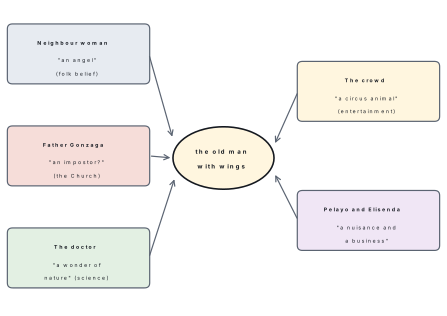
a. The arrival of a strange old man in Pelayo's courtyard arouses many suspicions and explanations. Explain how the neighbour woman, Father Gonzaga and the doctor speak of the strange man. Why do you think these three people give three different kinds of interpretations?
The neighbour woman, who "knew everything about life and death", says at once that he is an angel, who must have been coming for the child but was knocked down by the rain because he is so old. She speaks from folk belief and personal authority, and advises killing him. Father Gonzaga, the priest, doubts it. The old man cannot understand Latin, smells of the outdoors, is covered with parasites and is "much too human"; he must be an impostor or a carnival trick, and the Church will decide. The doctor, who examines him during the child's chicken pox, finds "so much whistling in the heart and so many sounds in his kidneys" that he should be dead, yet is amazed by "the logic of his wings", which seem so natural that he cannot see why other men lack them. He speaks as a scientist.
They differ because each looks at the old man through his or her own training and authority: popular belief, institutional religion and science. Each sees what its own system of thought is prepared to see, and none can account for the whole. Márquez is also satirising human claims to know: even the experts have no answer, and each wants to appear wise before a gullible public.
b. This story belongs to the genre of "magical realism", a genre perfected by Gabriel García Márquez in his novels and short stories. Magical realism is a narrative technique in which the storyteller narrates commonplace things with a magical colour and the events look both magical and real at the same time. Collect five magic-realist happenings from the story and argue why they seem magical to you.
- An old man with buzzard's wings falls into a muddy courtyard. It is impossible, yet the narrator notes his rags, his few teeth and his pity-arousing age, and the couple conclude that he is a castaway, "skipping over the inconvenience of the wings".
- The neighbour identifies him as an angel who "must have been coming for the child". A supernatural visitor is explained in a domestic sentence by a neighbour, and nobody argues.
- The angel eats eggplant mush, is pecked by hens for "stellar parasites", and is branded with an iron. A heavenly being is given mundane needs and cruelties.
- The consolation miracles: a blind man grows three teeth, a paralytic nearly wins the lottery, a leper's sores sprout sunflowers. They are fantastic, and described like news items.
- A woman is changed into a spider for disobeying her parents, and lives on meatballs. A fairy-tale punishment is shown as a show at a carnival with an admission fee.
- Others: the sea and sky "a single ash-gray thing"; sand "like powdered light"; Father Gonzaga writing to the Pope about the angel's navel; the angel growing scarecrow feathers and flying away as Elisenda cuts onions.
They seem magical to me because the impossible is given ordinary, practical treatment: there is no awe, no explanation, only the next domestic problem. That mixture of a wonder and a matter-of-fact tone is what makes the events "both magical and real".
c. The author introduces the episode of a woman who became a spider for having disobeyed her parents. This episode at once shifts people's concentration from the strange old man to the spider woman. What do you think is the purpose of the author in bringing about this shift in the story?
The shift does several things. (1) It shows the fickleness of the crowd: the people abandon the angel not because he has disappointed them in any serious way but because a newer attraction has arrived. (2) It shows what the crowd really wants: the spider woman is cheaper, may be questioned and examined, tells a moral story and is "full of so much human truth"; the angel is silent, aloof and slightly dull. People prefer a lesson they can understand to a mystery they cannot. (3) It criticises commercial entertainment and religion: both the angel and the spider are shows, and the rivalry is a competition for customers. (4) It provides a comic turning point that rescues Father Gonzaga from his theological trouble and ends the angel's fame without any act of violence. (5) It is a further example of magical realism: the marvellous is reported as a travelling show. Finally, it prepares the ending: the angel, left alone, becomes once again an unwanted old creature in a courtyard.
d. The story deals with common people's gullibility. How do Pelayo and his wife take advantage of common people's whim?
They turn the crowd's belief and curiosity into money. Seeing the mob, Elisenda has the idea of fencing in the yard and charging five cents to see the angel. Within a week the couple have "crammed their rooms with money", though the line of pilgrims still reaches "beyond the horizon". They do nothing to cure or help the angel: the admission fee is for looking at him. They also profit from the sufferers who come for cures and from the carnival atmosphere that the crowd brings. With the savings they build a two-storey mansion with balconies and gardens, Pelayo gives up his work as a bailiff and keeps rabbits, and Elisenda buys satin shoes and silk dresses. They use, and do not question, the crowd's gullibility.
Reference beyond the context
a. An irresistible crowd queues at Pelayo's house for many days simply to look at the strange old man. Narrate an episode from your experience or from another story where people assemble in crowds, not for any noble cause.
The Crowd at the Accident (a sample narrative — replace it with your own experience)
One afternoon last year a minibus skidded on the wet road near our town and ended up half in a ditch. Nobody was badly hurt, but within ten minutes a crowd of nearly a hundred people had gathered. Shopkeepers left their counters; boys on bicycles stopped; a man selling roasted corn began to do good business. Few were helping. Most were standing on the road and holding up their phones to take pictures and videos, pointing and talking loudly about what the driver should have done. When the police arrived and asked them to move back, they moved only a few steps. A woman who was trying to reach a child trapped in the front seat had to push through the crowd with her elbows.
When the passengers had been taken away, the crowd did not break up at once; it waited for the tow-truck and then drifted away looking slightly disappointed that nothing more had happened. The scene reminded me of the crowd in García Márquez's story: people coming to look, not to help, treating a person's misfortune as a show. It taught me that curiosity without compassion can be cruel, and I decided that the next time I am at an accident, I will offer help or walk on.
b. The taste of children is different from that of grown-ups. What are the elements in the story that make "A Very Old Man with Enormous Wings" a children's story?
The subtitle is "A Tale for Children", and several elements of a children's story are present. Fantasy: an angel with wings, a woman changed into a spider, miracles with sunflowers and teeth. Simple, clear characters: the kind neighbour, the stern priest, the greedy couple, the patient old man. Animals and everyday objects: crabs, hens, a chicken coop, rabbits, onions, eggplant mush. A fairy-tale moral: the spider woman is punished for disobeying her parents — a warning that any child will recognise. Humour and exaggeration: the queue "to the horizon", a hen pecking at an angel's parasites, a priest writing to the Pope about an angel's navel. A child in the story who goes into the coop to play, and is the only one to treat the old man without fear. Repetition and simple language, and a story-like opening and ending. A release at the end: the old man flies off, and the child's world is safe again.
But it is also a children's story in an ironic sense: it has cruelty, greed and old age that children would not normally meet, and it leaves questions unanswered. Márquez's "tale for children" is one that adults can read on another level.
Chapter summary
- "A Very Old Man with Enormous Wings" (Spanish: Un señor muy viejo con unas alas enormes) is a short story by the Colombian writer Gabriel García Márquez (1927–2014; Nobel Prize 1982), written in 1968, subtitled A Tale for Children, and translated into English by Gregory Rabassa.
- After three days of rain, Pelayo finds a very old, filthy man with huge buzzard's wings in his muddy courtyard. His wife Elisenda and he first think him a castaway; a neighbour woman calls him an angel; Father Gonzaga, who greets him in Latin, doubts it and writes to Rome.
- They lock the old man in the chicken coop, and Elisenda charges five cents to see him. Crowds come, torment and exploit him; the family grows rich. The angel's only supernatural virtue is patience; his "miracles" are comic.
- A travelling show with a woman changed into a spider for disobeying her parents takes the crowd away. The couple build a mansion with iron bars on the windows.
- The angel grows ill and old in the yard and shed, survives a winter, grows new feathers and flies away; Elisenda watches him become "an imaginary dot on the horizon of the sea", no longer an annoyance.
- Themes: the way people turn a wonder into a spectacle, greed and commercialism, cruelty to the weak, the limits of religious and scientific knowledge, old age and dignity. Techniques: magical realism, irony, satire, deadpan humour, hyperbole, symbol and a calm third-person narrator.
- The old man is never proved an angel; the story's interest is in how people treat him.
Practice questions
Short answer questions (2 marks each)
- Why did Pelayo go out into his courtyard at the beginning of the story? [2]
- What did the neighbour woman say about the old man? [2]
- How did Father Gonzaga test whether the old man was an angel? [2]
- How did Pelayo and Elisenda make money from the angel? [2]
- Why did the crowd leave the angel for the spider woman? [2]
- How does the story end? [2]
Model answers — short questions
1. After three days of rain the house was full of dead crabs, and the newborn child had a fever that the family blamed on the smell. Pelayo crossed the flooded courtyard to throw the crabs into the sea, and on his way back found the old man.
2. The neighbour woman, who "knew everything about life and death", said the old man was an angel who had probably come for the sick child but had been knocked down by the rain because he was so old. She also advised killing him.
3. He went into the chicken coop and greeted the old man in Latin. The old man did not understand, which made the priest suspect an impostor, since an angel should know "the language of God". He also noticed that the old man smelled, was full of parasites and was "much too human".
4. Elisenda fenced in the courtyard and charged five cents admission to see the angel. Pilgrims and curious visitors came from far away, and in less than a week the couple had "crammed their rooms with money"; they later built a two-storey mansion.
5. The spider woman's show cost less, she answered questions, and her story of disobeying her parents was a clear moral lesson "full of so much human truth". The angel, by contrast, was silent and aloof, and his "miracles" (three new teeth for a blind man, sunflowers for a leper) were absurd.
6. After a hard winter, the old man grows new feathers and, one morning, flies away clumsily but successfully. Elisenda, cutting onions, feels relief "for herself and for him" as she watches him become "an imaginary dot on the horizon of the sea".
Long answer questions (5 marks each)
- "A Very Old Man with Enormous Wings" is a story of magical realism. Discuss. [5]
- How do the people in the story treat the old man, and what does this show about human nature? [5]
- Explain the symbolism of the angel and of the ending. [5]
Model answers — long questions
1. Magical realism tells extraordinary events in the plain, matter-of-fact voice of everyday life. García Márquez's story opens with real, unpleasant details — three days of rain, dead crabs, a feverish baby — and in the middle of them puts an impossible event, a very old man with buzzard's wings lying in the mud. The narrator does not gasp. Pelayo and Elisenda "found him familiar" and skip "the inconvenience of the wings". The neighbour identifies him as an angel in one practical sentence, and the priest's first worry is that he cannot speak Latin.
Other marvels are treated in the same tone: the "consolation miracles" (teeth for a blind man, sunflowers for a leper), the woman changed into a spider who lives on meatballs, the woman who counts her heartbeats and runs out of numbers, sea and sky as "a single ash-gray thing", and the angel's flight seen by a woman chopping onions. Magic and reality are mixed in every paragraph, and the effect is both funny and moving. The technique lets Márquez show that people react to wonders as they react to anything else: with curiosity, business sense and boredom.
2. The people treat the old man badly in many ways. The neighbours toss him food as if he were a circus animal; the crowd lets the hens peck his wings, pulls out his feathers, throws stones and burns him with a branding iron. Pelayo and Elisenda lock him in a chicken coop, sell tickets, neglect him and later chase him out of the bedroom with a broom, shouting that it is "hell full of angels". Father Gonzaga treats him as a theological question and leaves him in the coop while waiting for Rome. Only the child and the doctor come close to treating him as a living being.
This shows human nature in several lights: curiosity without kindness, greed that turns a wonder into a business, cruelty towards anyone weak or different, fickleness (the crowd leaves for a cheaper show), and self-interest disguised as faith. Yet the couple are not monsters: they are kind enough not to club him and they feel relief at the end, so Márquez shows ordinary people, not villains, as the source of cruelty.
3. The angel is a symbol with many possible readings, and Márquez fixes none. He may stand for the helpless stranger or the refugee, caged and exploited; for the aged and unwanted, who are a burden when they are no longer useful; for the artist or the divine, whom society admires as a spectacle but does not understand; or for faith itself in a world of commerce and bureaucracy. He is both holy and human: verminous, feverish, deaf to Latin, but patient and dignified.
The ending is ambiguous too. His flight is a release, for him and for the family. Elisenda's sigh of relief "for herself and for him" shows that she is free of a nuisance and feels, perhaps without knowing it, something like gladness that he is free. The "imaginary dot on the horizon" suggests that a marvel that has been treated as an annoyance has left the world unchanged, and the house with its iron bars remains closed to angels.
Reference to the context
- "His only supernatural virtue seemed to be patience."
(a) Who is being described? (b) What things did the people do to test or use this patience? (c) Why does the narrator call it his "only supernatural virtue"? (d) What does the sentence show about the narrator's tone? [5]
- "...he was no longer an annoyance in her life but an imaginary dot on the horizon of the sea."
(a) Who is "he" and who is "her"? (b) What has just happened? (c) What does the sentence tell us about Elisenda's feelings? (d) Why is this a fitting ending? [5]
Model answers — reference to the context
1. (a) The old man with enormous wings, whom the neighbour woman calls an angel. (b) The hens pecked at him, cripples pulled out his feathers to touch their sores, the merciful threw stones to make him stand, and the crowd burned his side with a branding iron to see whether he was dead. Others tried to make him eat mothballs and papal lunches and heated him with lamps and candles. (c) Because, apart from his wings, nothing about him was supernatural: he smelled, he had parasites, he was ill and old. The only thing that set him apart from ordinary men was the endless calm with which he endured cruelty. (d) The tone is dry, deadpan and ironic: the narrator speaks of the marvellous as if it were a minor fact and uses the word "virtue" lightly, yet the sentence carries a real pity.
2. (a) "He" is the old man, the angel; "her" is Elisenda, Pelayo's wife. (b) After a difficult winter the old man has grown new feathers and, while Elisenda is cutting onions in the kitchen, has flown away from the shed. She has watched him until he vanished over the sea. (c) Elisenda feels relief: she is rid of the annoyance he had become; but her sigh is "for herself and for him", so there is also a trace of sympathy, perhaps gladness that he has escaped. (d) The ending is fitting because it is quiet and unsentimental: the most marvellous thing in the story ends with a household chore, a sigh and a tiny dot in the distance. It returns the story to the ordinary life from which it began, and it leaves the reader to decide what has been lost.
Practise more: English question bank