Unit 6 · Literature - Short Stories · 48 min read
The Half-closed Eyes of the Buddha and the Slowly Sinking Sun
What the syllabus asks for 8
- About the author
- The story
- Characters
- Themes
- Setting, structure and point of view
- Style and literary devices
- Glossary
- Textbook exercises
Most stories tell you what happened. This one lets two men talk. A foreign tourist, warmed by whisky in a Kathmandu guest-house, tells his guide how wonderful Nepal is — its peace, its gods, its carved windows, its momos, its smiles. The next day the guide takes the tourist up a hill to a farmer's house and shows him what the tourist's words have left out. Shankar Lamichhane's story has almost no action: it is two speeches, each addressed to a silent listener, and a pair of eyes. Yet by the last sentence it has asked a question that every Nepali reader knows: what do visitors see when they look at us, and what do they not see?
A romantic outsider sees a peaceful, harmonious, "giving" East; a Nepali insider sees the poverty and helplessness beneath the postcard. The two halves of the story are joined by the image of eyes — the Buddha's half-closed eyes, the carved eyes on windows and stupas, the "samyak gaze" of monks — and end in the eyes of a paralysed boy, which the guide calls "just as beautiful as the setting sun's reflection in the eyes of the Buddha". Beauty and suffering are shown to be one picture.
The Nepali title is Ardhamudit Nayan Ra Dubna Lageko Gham. Michael Hutt translated it as "The Half-Closed Eyes of the Buddha and the Slowly Setting Sun" in Himalayan Voices (University of California Press, 1991), and your textbook uses this translation with the wording "Slowly Sinking Sun". The story was first published in 1962. Quote the wording your textbook uses.
6.1 About the author
Shankar Lamichhane (1928–1975/76) is one of Nepal's best-loved essayists and a pioneer of the modern Nepali short story. He was born on 17 March 1928 (5 Chaitra 1984 BS) in Jaisidewal, Kathmandu, to Hari Prasad and Raj Kumari Lamichhane. The family was poor, and his mother took her sons to Banaras (Varanasi), where she worked as a teacher and raised him; she died about a decade later, and he came back to Kathmandu. He studied science at Tri-Chandra College and, at twenty-two, took his first job; he worked for several government and cultural institutions and in his later years managed a handicrafts store, where he met many foreign visitors — a background that gave him first-hand knowledge of tourists like the one in this story. (Sources differ on the year of his death: Michael Hutt gives 1975; most Nepali sources say 24 January 1976, at the age of forty-seven.)
Lamichhane admired modern American fiction and wrote in a lyrical, musical, conversational Nepali that freed the essay from the heavy style of earlier writers. His stories are "heavy with symbolism", as Michael Hutt puts it, "often lacking a conventional plot and more closely resembling essays". His best-known books are the essay collections Abstract Chintan Pyaj (which won the Madan Puraskar, Nepal's premier literary prize), Godhuli Sansar (1970) and Bimba Pratibimba; the story collection Gaunthaliko Gund ("The Swallow's Nest", 1968); and an autobiography. His Nepali essays are still studied in schools and celebrated in an annual essay society in his name.
- The title is a long title; do not shorten it to "The Buddha's Eyes".
- The tourist and the guide are two speakers, and each speaks to the other without being answered. The story has no narrator in the usual sense.
- The guide lies to the parents (he says the tourist is a doctor), and he does so on purpose. The tourist does not know it until the guide tells him.
- The sick child is not a "symbol" in the guide's own words ("my intention is not to show him to you as any kind of symbol"), though the story uses him as one. Notice that contradiction.
- One popular study guide calls the tourist a woman. In the text the guide calls him "my guest" and "my friend", and his own comparisons ("as if you were their eldest son", "your wife") treat the tourist as a man.
6.2 The story
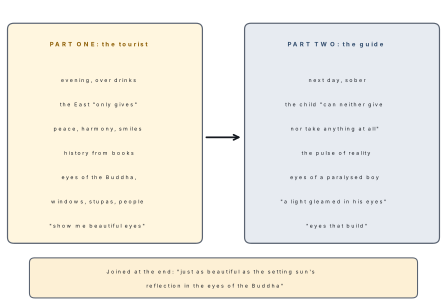
The story has two parts. Part One is the tourist's monologue, spoken to the guide over drinks before dinner; Part Two is the guide's monologue, spoken to the tourist the following day.
Part One: the tourist's speech
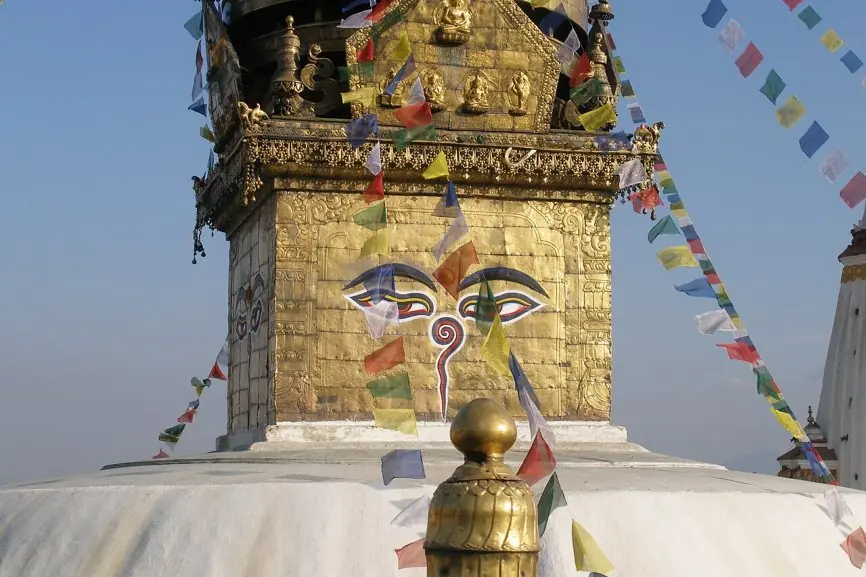
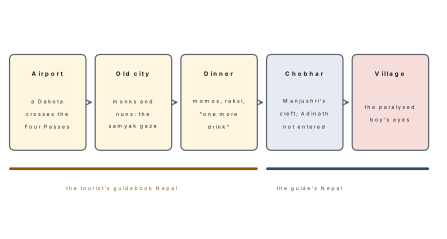
Arrival. The tourist begins by telling his guide that he cannot understand the joy Westerners feel on first setting foot in Nepal. He describes the view from the aeroplane, a Dakota crossing the "Four Passes": a green valley of geometric fields and earthen houses in red, yellow and white, the smell of soil and mountains, an age-old peace. The guide, born here, may find the blue hills' embrace confining; but the tourist comes from plains or seashore, where the eye is lost on a vast horizon, and to him the enclosed valley is comforting. Even at the airport, he says, the half-closed eyes of the Buddha seemed to welcome him, as if he were returning to a resting place.
The East as giver. The East, he declares, has only ever given to the West: religion and the Puranas, brass images, ivory ornaments, palm-leaf manuscripts, copperplate inscriptions, civilisation, even garlands of jasmine. It has given "innocent of the notion of ownership"; the very word indulgence is unknown to it. He claims to know the country's history from years in libraries. The guide may lead him through the present, but he can lead the guide along the ancient ways.
The tourist's version of history. He pictures the valley as a lake with a lotus blooming where Swayambhunath now stands, Manjushri's sword cutting the gorge at Chobhar, and monks and nuns receiving alms near the Kasthamandapa. He tells the guide that their gaze is the samyak gaze, a perception "pure and without contamination". Then he pours himself "one more drink before dinner". His speech will be punctuated by drinks.
Art and coexistence. He admires the wooden houses like temples, where he hears "the flowing music of a chisel", and imagines village artists who worked in the fields by day and carved their gods in spare hours. He tells a little legend of an artist whose wife poured him raksi, whose foam bubbled over and set, and asks whether this inspired the tiled roof. The valley, he says, is a land where Aryans, non-Aryans, Hindus and Buddhists have all found rebirth, made possible by the soil itself.
Food and family. He thanks the guide for Nepali and Newari food — "Ah, mo-mos!" — and imagines a winter evening: an old man telling his grandson about the things Princess Bhrikuti took to Tibet when King Amshuvarman sent her; the old woman smoking a bamboo hookah and making momos; the old man burning his tongue and cursing cheerfully. Such scenes, he says, are not in libraries, which is why he had to come.
The smile and the eyes. He praises the smile of the people: a smile of welcome, as if the meeting were no accident, as if he were a farmer's son returning from the fields, or were greeted by his mother at the door. He drinks to it. Then the eyes: the carved lattice windows, the painted door panels, the stupas, the people, the Himalaya peeping between the hills like a neighbour's boy looking at a peach tree. Nepal is "a land of eyes", guarded by the half-closed eyes of the Buddha. His appetite for eyes is not satisfied: tomorrow he wants to go to a lonely stupa and watch the light of sunset reflected in the Buddha's eyes. "Show me beautiful, full eyes," he says, and ends: "Come, let's go to eat dinner."
Part Two: the guide's speech
The transition. "Come, my guest; today I am to show you some eyes." The guide now speaks. He takes the tourist up Chobhar hill, where visitors come to see the cleft made by Manjushri's sword and the outflow of the Bagmati River, and further, to a place where no tourist's car can go. On a worn rock a village artist has drawn birds and a temple without saying to which religion it belongs. Higher up stands the temple of Adinath, with a Shiva shrine, Buddha images and prayer wheels marked Om mani padme hum, where children play unconcerned by the variety of gods. The tourist calls this a living example of tolerance — but the guide says he will not take him there. The visitor has seen such things already, understood them and even preached them.
The farmer's house. Instead the guide takes him to a farmer's family who pay half their harvest to a landlord in the city. No smoke fills their upstairs room, they cook no momos, and nobody talks about Bhrikuti's dowry. There is a child in the house, no divine incarnation but a boy with polio, born poor and "incapable of spreading the law". The guide insists that he does not mean to show him as a symbol. He has brought the tourist, he says, because yesterday — swept up by his "Black and White" whisky — the tourist asked to be shown eyes he would never forget. He offers the tired visitor filtered water from a thermos flask.
The child's eyes. The boy cannot speak, move his hands, chew or even spit; only his eyes are alive, and his face shows no feeling. The guide does not know whether his gaze is the samyak gaze, since he does not understand the term; he sees only a blank, listless look.
"Give" and "take". A living creature, the guide says, gathers many abilities: it smiles, weeps, seeks warmth, finds food, learns. The tourist had said that Easterners are always giving to the West. "Here is a child who can neither give nor take anything at all." The tourist is asked to imagine it — a finger that will not move, words that will not come, and yet life. The guide adds that the disease exists in the West too, and then delivers the bitter irony: the ability to endure it without complaint "can surely only be found in an Easterner!" He is repeating the tourist's romantic praise and showing what it would mean.
The lie. The guide then tells the tourist that he has lied to the parents and said he is a doctor. Their faces show faith and gratitude, as if his coming had been foretold; the smile the tourist praised is on their lips, as if he were their eldest son returning with a remedy from across the seven seas. But it will last only as long as he is there, and when he goes they will "sink back into the same old darkness". The guide is turning the tourist's own similes inside out.
The sister. The boy has a healthy little sister who crawls about, puts everything in her mouth, knocks over the beer and overturns the cooking stone. For a moment his eyes show an ambition to copy her, and then it fades into indifference. When their mother scolds the girl, a light gleams in the boy's eyes, and the guide imagines what he would say: how sweet it would be to fall, scrape a knee, cry out, break a picture and feel guilty, and to learn that fire burns and water wets. His sister learns words, and in her speech a history and a culture are carried forward; in him, the chain of human development ends. "The future ends and is broken abruptly."
The last lines. The guide ends: these are the eyes that look at you but see nothing; beauty complete in itself. They are eyes surrounded by mountains, their lashes the rice and wheat fields; eyes that welcome and eyes that build; and "in these eyes hides the end of life". And then the final sentence: "Look! They are just as beautiful as the setting sun's reflection in the eyes of the Buddha!"
6.3 Characters
| Character | Who they are | Role in the story |
|---|---|---|
| The tourist | A foreign (Western) visitor, well read in "libraries", who drinks whisky and speaks in raptures | The speaker of Part One; stands for the outsider's romantic view of the East |
| The guide | A Nepali who guides the tourist through Kathmandu and speaks for the insider | The speaker of Part Two; the voice of reality, irony and suppressed anger |
| The paralysed boy | A polio-stricken child of a poor farmer, unable to speak, move or chew | The story's centre; his eyes are the "eyes" the tourist wanted to see |
| The boy's parents | A farmer and his wife, in a small upstairs room | Hospitable, hopeful and deceived; their smile is the story's cruellest image |
| The boy's sister | A healthy small girl crawling about the house | The mirror in which the boy sees what he cannot do |
The tourist. He is not a villain. He is generous, well meaning and eager to love the place; he thanks the guide for the food, praises the artists and drinks to the "sweet smile" of the Nepali people. But he has met the country in books and hotels, and he sees only what he expected: a land of peace, wisdom, "giving" and eyes. His compliments turn people into a picture — they "give", they are "innocent of the notion of ownership", they have a "smile peculiar to this place". He also drinks steadily, so that his speech grows more and more emotional ("I'll have just one more drink", "cheers once again"). His weakness is not cruelty but sentimentality, which is another kind of blindness.
The guide. In Part One he does not speak at all; we know him only through the tourist's remarks. In Part Two he takes control of the story. He is educated, ironic, sober and patient, careful with the visitor's comfort (filtered water, a thermos) and, beneath his politeness, angry. He does not preach; he lets the tourist look. He is also morally complicated: he tells the parents a lie, and he uses the child to teach the tourist a lesson while insisting that the child is not a "symbol". He is uneasy about what he does, and that unease is part of the story's honesty.
The child. He cannot speak, so the guide speaks for him: "Mother, how can you appreciate what fun it is to fall over?" His imagined speech shows an inner life as rich as anyone's — he longs for pain, for mischief, for words — and this is the most moving passage in the story. He is helpless, but he is not passive in spirit.
The parents. They are "innocent" — the guide's word for the peasant's kind of hope. They believe the visitor is a doctor because he is foreign and well dressed and because they need to believe it. Their faith is real, and so is the guide's deception.
6.4 Themes
Appearance and reality — seeing and not seeing. The whole story is about vision. The tourist looks at Nepal and sees beauty; the guide looks at the same country and sees the "pulse of our reality". The "samyak gaze" — a perception "pure and without contamination", samyak meaning "right" or "complete" — is a Buddhist ideal of seeing things as they are. The tourist claims to have it; the guide shows that it belongs to whoever looks at the whole picture.
East and West. The tourist's claim that the East "gives" and the West "takes" is flattering but false, since it turns the East into a symbol of spirituality and turns a person into a type. Lamichhane's guide answers with irony: what the East can "give" is helplessness and endurance. The story is an early Nepali criticism of what later critics call Orientalism — the habit of foreigners to picture "the East" as timeless, spiritual and passive.
Poverty and suffering behind the picture. The tourist speaks of momos and Bhrikuti's dowry; the farmer's family has no smoke, no momos and no stories. Their land pays "half the proceeds to someone in the city". The story shows the rural poor whom tourism, and often literature, leave out.
Harmony and coexistence. Both speakers agree, in different tones, that Nepal is a place where "Aryans, non-Aryans, Hindus, and Buddhists" have lived together. The temple of Adinath, with its Shiva shrine, Buddha images and prayer wheels, is the proof, and children play there "unconcerned by the variety of their gods". This is the story's sincere, positive theme; the guide accepts it but will not stop there.
Endurance, silence and the end of life. The tourist admires the East's ability to remain "speechless, inactive, powerless, and immobile, and yet to survive without complaint"; the guide shows a child in whom that ability is the end of the human story: "an unbroken cycle of historical and human development has come to its conclusion". The setting sun of the title is that end.
Compassion, complicity and moral responsibility. The guide's lie to the parents is a small act of cruelty done for a large purpose. The story does not tell us whether it is justified. Neither the tourist nor the guide does anything for the boy; both "look", and the story leaves the reader to ask what he or she would do.
A term made famous by the critic Edward Said (1978) for the way Western writers and travellers describe Asia and the Middle East as exotic, spiritual, unchanging and passive. A tourist who admires an entire people as "peaceful" or "innocent" is often practising a gentle form of it. The guide's irony in this story answers it directly.
6.5 Setting, structure and point of view
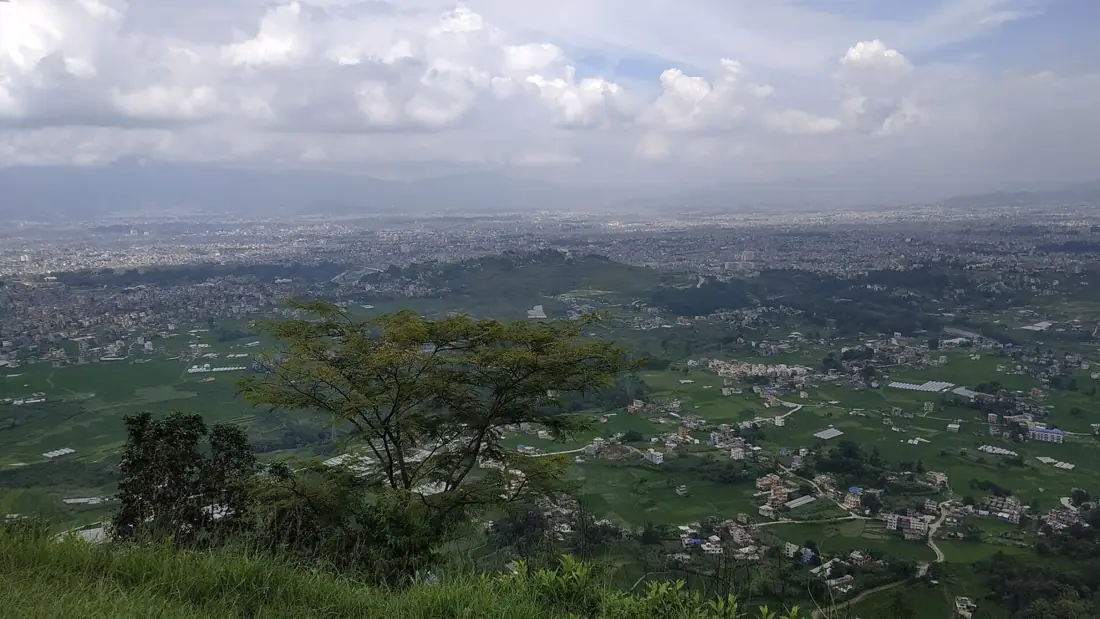
Setting. The Kathmandu Valley in the early 1960s: the airport where a Dakota lands, guest-house and dinner tables, the streets of the old city (Kasthamandap), Chobhar hill and Adinath temple on the south-west edge of the valley, and a farmer's upstairs room in a village nearby. The legends are the older setting: a valley that was once a lake, Manjushri's sword-cut at Chobhar, Bhrikuti's journey to Tibet.
Structure. Two speeches, of unequal tone, joined by a repeated image.
| Part | Speaker | Time | Mood | Key image |
|---|---|---|---|---|
| One | The tourist | Evening; over drinks | Rapturous, romantic, drunk | Eyes of the Buddha; the "samyak gaze" |
| Transition | (silence) | Night | — | "Come, let's go to eat dinner" → "Come, my guest; today I am to show you some eyes" |
| Two | The guide | The next day; up the hill | Ironic, controlled, angry | The eyes of the paralysed child |
| Last line | The guide | — | Bitter beauty | "just as beautiful as the setting sun's reflection in the eyes of the Buddha" |
Point of view and form. There is no narrator. The story is two monologues, each spoken to someone who never replies; we hear the guide's words only when his turn comes, and the tourist's words only in his. Your textbook describes this as stream of consciousness, a technique in which the writer records the natural flow of a mind's thoughts, associations and memories with little of the usual plot; more exactly, each speech is a dramatic monologue in which the speaker reveals himself. Both speeches wander: the tourist from arrival to history to food to smiles to eyes; the guide from a hill, to a temple, to a house, to a child, to the child's imagined thoughts.
The two halves are one. The story joins its halves in five ways: (1) the image of eyes runs through both; (2) the guide's speech answers the tourist's, quoting his own phrases back ("yesterday you said", "samyak", "Black and White"); (3) the tourist's request ("show me beautiful, full eyes") is answered by the guide's promise ("today I am to show you some eyes"); (4) the tourist's sunset wish returns in the last line; (5) both speeches address a silent listener as "my friend" or "my guest".
6.6 Style and literary devices
| Device | Example | Effect |
|---|---|---|
| Monologue / stream of consciousness | Both parts | Reveals character from inside; the thoughts jump by association |
| Irony | "this can surely only be found in an Easterner!"; "the samyak gaze" as the boy's blank stare; "beauty that is complete and has no other expression" | The guide turns the tourist's praise into a criticism |
| Symbol | The Buddha's half-closed eyes (calm, partial sight); the setting sun (ending, transience); the child's eyes; the smile | Objects carry the story's ideas |
| Imagery | "earthen houses of red, yellow, and white"; "eyes of the Himalaya... like those of a neighbour's boy"; "lashes are rows of fields where rice ripens in the rains" | Rich visual images, often turning landscape into a face |
| Repetition | "eyes", "smile", "one more drink" | Builds a rhythm and shows obsession and intoxication |
| Contrast | Tourist against guide; postcard against reality; the healthy sister against the boy | Structural principle of the story |
| Allusion | Manjushri, Bhrikuti, Amshuvarman, Puranas, the eightfold path | Gives the story cultural depth (and the tourist's "library" knowledge) |
| Parenthesis | "(Shall I give you some water? Are you out of breath?)" | Reveals the guide's politeness and control |
| Simile and metaphor | The smile "as if you were their eldest son"; "the pulse of our reality"; the eyes as landscape | Turns feeling into pictures |
| Anti-climax (bathos) | The tourist's rapture ends with "Come, let's go to eat dinner" | Punctures his romanticism |
| Second-person address | "my guest", "my friend" | Puts the reader in the listener's place |
Language. Lamichhane's prose is lyrical and fast, with long sentences full of pictures and short, sharp ones for the crucial statements. The tourist's speech is rich, ornate and full of "as if"; the guide's is plainer and slower, and he explains at each step what he is showing. The change of style from Part One to Part Two is part of the meaning.
6.7 Glossary
| Word | Meaning |
|---|---|
| Dakota | a type of propeller aeroplane (the Douglas DC-3) widely used in the 1950s–60s |
| the Four Passes | Char Bhanjyang, the hills and passes around the Kathmandu Valley |
| geometric | shaped in regular lines and angles |
| indulgence | giving way to one's desires for pleasure |
| Puranas | ancient Hindu texts of myths and legends |
| palm-leaf manuscript | a book written on dried palm leaves |
| copperplate inscription | writing engraved on a sheet of copper, often recording a royal grant |
| Manjushri | a Bodhisattva of wisdom, said to have cut the gorge at Chobhar and drained the Kathmandu Valley lake |
| Chobhar | a hill and gorge on the south-west rim of the valley |
| Kasthamandapa | "wooden pavilion", the ancient public rest-house in central Kathmandu that gave the city its name |
| samyak | (Sanskrit) right, complete, perfect; as in "right view" in the Buddhist eightfold path |
| multifarious | of many kinds |
| chisel | a tool for carving wood or stone |
| raksi | a strong local liquor |
| mo-mo | a steamed dumpling |
| Bhrikuti | a Nepali princess who, according to tradition, married the Tibetan king Songtsen Gampo |
| King Amshuvarman | a seventh-century Licchavi king of Nepal, traditionally said to be Bhrikuti's father |
| hookah | a tobacco pipe in which smoke passes through water |
| ribald | rude or coarse in a humorous way |
| eightfold path | the Buddha's eight steps to end suffering (right view, right intention, and so on) |
| polio | poliomyelitis, an infectious disease that can cause paralysis |
| incarnation | a person or thing embodying a god or quality |
| preordained | decided beforehand by fate |
| emulate | to try to equal or copy |
| self-manifestation | showing oneself or one's thoughts to others |
| Adinath | a temple on Chobhar hill sacred to both Hindus and Buddhists (Adinath Lokeshwar) |
Never call this a "story about a tourist visiting Nepal" and stop there. The examiners want you to say that it is a story in two voices, that the guide's voice corrects the tourist's, and that the "eyes" motif holds the halves together. Always use both examples: the eyes the tourist admires (Buddha, window, stupa, Himalaya) and the eyes the guide shows (the child). And always say what the last line does: it makes the boy's eyes as "beautiful" as the Buddha's, so that beauty and suffering become one.
6.8 Textbook exercises
Understanding the text
a. How does the tourist describe his initial impression of the Kathmandu Valley?
With delight. As the aeroplane crosses the "Four Passes" he sees "this green valley with its geometric fields, its earthen houses of red, yellow, and white". The scent of soil and mountains is in the air, and there is "an age-old peacefulness in the atmosphere". The blue hills seem to stretch out their arms round the valley in an embrace; to the tourist, who comes from the plains or the seashore where the eye is lost on a vast horizon, that enclosure is comforting rather than confining. Even at the airport the half-closed eyes of the Buddha seem to welcome him: "as if one acquires a calmness, as if one is returning once more to a resting place."
b. According to the tourist, why is the West indebted to the East?
Because, in his view, the East has "always known only how to give to the West". It has given religion and the Puranas, images of brass, ornaments of ivory, manuscripts of palm leaves and inscriptions on copperplate; it has given civilisation and its wisdom, and even "garlands of jasmine flowers around our necks". It has given continuously, "ignorant of what others call 'taking', innocent of the notion of ownership"; the very word indulgence is unknown to it. The tourist therefore feels that the West owes the East a debt of gratitude — though the guide will later show how empty this compliment can be.
c. How does the tourist interpret the gaze of the monks and nuns?
As the samyak gaze. Looking at the shaven-headed monks and nuns receiving alms and spreading the law at Kasthamandapa, the tourist tells the guide that it is called the samyak gaze, a perception "pure and without contamination", a sight that sees "everything in its true form". He treats their eyes as a sign of spiritual purity and of an Eastern power to see things as they really are.
d. Why does the tourist think Nepali people are wonderful and exceptional?
For several reasons. They live in houses "like a temple", full of wood-carving in which, he says, one hears "the flowing music of a chisel in the hands of an artist"; their artists carved their gods in their spare time after working in the fields; they gave the West religion, art and civilisation without any thought of ownership; they welcome strangers with "a smile of welcome, as if our meeting were neither accidental nor our first" — "a smile from the soul, a smile peculiar to this place"; and they have lived together in peace with many races and religions. He believes that these virtues are natural to "an Easterner". (The guide will later answer that some of these virtues, such as endurance without complaint, are also what poverty and helplessness look like.)
e. What are the different kinds of communities in the Kathmandu Valley and how do they co-exist with each other?
The tourist names Aryans, non-Aryans, Hindus and Buddhists: "all came and obtained a rebirth here". They co-exist peacefully, he says, because "it must be the effect of your country's soil... it was the soil that enabled all these races to flourish together". The guide later gives an example: at the temple of Adinath, "a shrine of Shiva, several Buddha images, and many prayer wheels" stand together and "children play happily there, unconcerned by the variety of their gods, religions, and philosophies". Harmony, in this story, means shared sacred places, shared festivals and shared art.
f. What does the tourist feel about the temple of Adinath?
It is the guide who describes Adinath, and he says that the tourist regards it as "a living example of Nepalese tolerance and coexistence". The temple courtyard has a Shiva shrine, several Buddha images and many prayer wheels inscribed Om mani padme hum, and children play there without caring for the differences between religions. The tourist therefore feels admiration and approval; he has "understood" and even "preached" this lesson already. The guide will not take him there, however, because the tourist has already seen many such things and understood them.
g. Why does the guide take the tourist to the remote village?
To show him "the pulse of our reality" — something that is not on any postcard. The tourist had asked to be shown "beautiful, full eyes, eyes without equal" that would make the journey unforgettable. Instead of a temple, the guide takes him to a farmer's house where a polio-stricken child lies unable to move, speak or chew. The guide wants the tourist to see the poverty and helplessness behind the "peaceful", "giving" East which he has been praising; this is what the tourist's picture omitted. He also wants to show that the "endurance" the tourist admires can be the endurance of suffering.
h. What does the innocent village couple think of the doctor?
They believe that he is a real doctor who has come to help their son, because the guide has lied to them and told them so. Their faces show "intimacy, kindliness, and gratitude" as if his coming "were preordained". They greet him as if he were "their eldest son who has brought a life-restoring remedy across the seven seas for your brother", and the old woman smiles as if she were "rejoicing at the birth of her first grandchild". Their hope is complete and childlike. The guide knows that it will vanish when the visitor leaves.
i. What are the differences between the paralysed child and his sister?
The boy is completely paralysed: he cannot speak, move his hands, chew his food or even spit; his eyes are the only living part of his body and his face shows no emotion. He "can neither give nor take anything at all". His sister is healthy and active: she crawls about, picking up everything and putting it in her mouth, knocking over the beer, overturning the cooking stone; she will learn words, fall, bleed, weep, laugh and grow up. She "embodies a history, a tradition, and a culture" and in her ability to speak "the future is born". The boy looks at her with a flicker of ambition to copy her, which is "reabsorbed into the same old indifference".
j. Why does the guide show instances of poverty to the tourist?
Because the tourist has seen only what he expected: art, temples, food, smiles. The guide takes him to a poor farmer's house to show what those pictures leave out — a family that pays half its crop to a city owner, that cooks no momos and tells no stories of princesses, and in which a child is left to lie unhelped. He wants to give the tourist a glimpse of the whole of Nepal, not of its ornaments. He also wants to answer the tourist's belief that the East only "gives"; here is someone who "can neither give nor take". There is anger in his purpose, but also honesty.
Reference to the context
a. Which narrative technique is used by the author to tell the story? How is this story different from other stories you have read?
The author uses stream of consciousness (also called interior monologue): instead of a narrator describing events, the story records the thoughts and speech of two characters, the tourist in Part One and the guide in Part Two, as they flow from one idea to the next, through sensory impressions, memories, half-finished thoughts and shifts of subject. The tourist moves from the view of the valley to history, art, food, smiles and eyes; the guide from a hill to a temple, a house, a child and the child's imagined speech.
It differs from conventional stories in several ways. (1) There is almost no plot: the only "events" are a car journey and a visit. (2) There is no narrator: we hear the characters, not a storyteller. (3) The interest is in ideas and attitudes — two views of one country — rather than in what happens next. (4) The ending is an image, not a resolution. (5) The two halves are in different voices and moods. Most stories I have read follow a single character's actions from start to finish; this one shows a picture and its opposite.
b. How is the author able to integrate two fragments of the narration into a unified whole?
Mainly by the image of eyes. The tourist's speech ends with his wish: "Show me beautiful, full eyes, eyes without equal." The guide's speech begins: "today I am to show you some eyes." Every kind of eye in the first part (the Buddha's, the monks', the windows', the stupas', the Himalaya's) is answered by one pair of eyes in the second. The last line completes the pattern: the child's eyes are "just as beautiful as the setting sun's reflection in the eyes of the Buddha" — the same image that the tourist had said he wanted to see. There are other links: the guide quotes the tourist ("yesterday you said"; "the samyak gaze"; "Black and White"; "momos"; "Bhrikuti"); the same locations (Chobhar, Adinath) appear in both; both speakers address a silent listener as "friend" or "guest"; and the title unites the two images, the half-closed eyes of the Buddha and the slowly sinking sun. The story's structure is a speech and its answer.
c. The author brings some historical and legendary references to the story. Collect these references and show their significance in the story.
| Reference | What it is | Significance |
|---|---|---|
| Valley as a lake; the lotus at Swayambhu | Legend that Kathmandu was a lake and a lotus bloomed where the stupa now stands | Gives the valley a sacred, mythical origin; the tourist's romantic picture |
| Manjushri's sword at Chobhar | Legend that the Bodhisattva cut the gorge and drained the lake | Explains how the valley became habitable; the guide returns to it in Part Two |
| Kasthamandapa and the monks and nuns | The ancient wooden pavilion and the Buddhist tradition of alms | Setting for the "samyak gaze" |
| Puranas, palm-leaf manuscripts, copperplate inscriptions | Written treasures of the East | The tourist's evidence that the East "gives" |
| Legend of the raksi foam and the tiled roof | A folk story of artistic invention | Shows the tourist's love of romantic anecdote |
| Aryans, non-Aryans, Hindus and Buddhists | Historical mixing of peoples and religions in the valley | The theme of coexistence |
| Princess Bhrikuti and King Amshuvarman | The Licchavi-era marriage that linked Nepal and Tibet | Shows the tourist's book-learning and the old man's storytelling |
| The Aryan eightfold path; Om mani padme hum | Buddhist teaching and mantra | Provides the terms (samyak, right view) that the tourist misuses and the guide questions |
Together the references show a country rich in stories and meaning — and also show how easily a visitor can live in those stories and ignore the present.
d. The author talks about eyes in many places: the eyes of the shaven monks and nuns, eyes in the window and door panels, the eyes of the Himalayas, the eyes of the paralysed boy, the eyes of the welcoming villagers, and above all the half-closed eyes of the Buddha. Explain how all the instances of eyes contribute to the overall unity of the story.
The eyes give the story its unity of image. In the first part they are all beautiful and symbolic: the Buddha's half-closed eyes are calm and welcoming; the monks' eyes have the samyak gaze; the eyes carved on windows and painted on door panels and stupas are guardians of the land; the Himalaya "peeps" like a neighbour's boy; the villagers' eyes and smile express welcome. Together they make Nepal "a land of eyes", guarded by the Buddha. In the second part the eyes become concrete: the paralysed boy's eyes are "the only living parts of his body", "devoid of all emotion", yet full of unspoken longing when he watches his sister. The welcoming eyes of the parents, based on a lie, are the tourist's own "smile of welcome" turned into a moment of pain. In the last lines the different eyes are brought together. The boy's eyes are "eyes surrounded by mountains", "eyes that welcome you, and eyes that build", and "in these eyes hides the end of life", as beautiful as "the setting sun's reflection in the eyes of the Buddha". Because every eye in the story is linked to every other, the story becomes one long act of looking.
Reference beyond the context
a. Write an essay on "Living Proximity to Nature".
Living in Proximity to Nature
For most of human history people lived close to nature — drinking from streams, planting by the seasons, walking to the forest for fuel and fodder. In much of Nepal this is still true. Yet the modern world, with its cities and machines, has separated many of us from the natural world, and a growing number of people believe that we should live nearer to it again.
The benefits of living near nature are many. It is good for health: fresh air, walking, sunshine and fresh food lower stress and disease; hospitals in cities now recommend parks and green spaces. It is good for the mind: a hillside, a river or a sky calms the restless mind, and the tourist in Lamichhane's story feels "an age-old peacefulness" in the very air of the valley. It teaches respect: farmers who watch the rain and read the soil know that people depend on the earth, and they take only what they need. And it builds community: village fairs, festivals and rituals follow the natural year.
But nature can also be harsh. The farmer's family in the story lives close to the land yet is poor, cold and helpless before disease. Living near nature without health care, roads and schools is not a paradise. The aim, therefore, is not to return to the past but to live with nature and development: planting trees in cities, protecting forests and rivers, using solar and hydro power, reducing waste, and teaching children to know and love the natural world.
If we live close to nature and care for it, nature will care for us. If we forget it, the mountains, rivers and forests that make Nepal beautiful will not survive for our grandchildren.
b. The story talks about ethnic and religious co-existence of different communities in Nepal, where the Buddhists and the Hindus and the Aryans and non-Aryans have lived in communal harmony for ages. In your view, how have the Nepali people been able to live in such harmony?
In my view, several causes work together. Geography and history: the small valleys and hills of Nepal brought many peoples close to each other and made trade and intermarriage natural over centuries. Shared religious practice: Hindus and Buddhists worship at the same temples (Swayambhu, Pashupati, Budhanilkantha, Adinath) and celebrate each other's festivals, and the same god or goddess is often known by two names. Tolerant beliefs: both Hinduism and Buddhism teach respect for other paths, and Nepal's rulers historically protected many faiths. Common culture and language: Nepali as a shared language, shared foods, dress and music make daily life easy. Economic interdependence: farmers, artisans, traders and priests of many groups depend on each other. And the practice of daily courtesy: greetings, feasts and neighbourly help across castes and religions keep quarrels small.
This harmony is precious but not perfect; discrimination and conflict have also existed. To keep it, we must keep our shared sacred spaces, teach children about other religions, treat all citizens equally, and respect differences as Lamichhane's children do at Adinath, "unconcerned by the variety of their gods".
Chapter summary
- "The Half-closed Eyes of the Buddha and the Slowly Sinking Sun" (Nepali: Ardhamudit Nayan Ra Dubna Lageko Gham, 1962) is a story by Shankar Lamichhane (1928–1975/76), translated into English by Michael Hutt.
- It consists of two monologues: the tourist's speech, spoken over drinks, and the guide's speech the next day. Your textbook calls the technique stream of consciousness.
- The tourist praises the valley's beauty and peace, the East that "only gives" to the West, the Buddha's half-closed eyes, the "samyak gaze" of monks, carved wood, momos, Bhrikuti's story, the welcoming smile and the "land of eyes". He asks to see "beautiful, full eyes" and the sunset in the Buddha's eyes.
- The guide takes him up Chobhar hill (Manjushri's sword-cut; the Adinath temple of tolerance) but not into the temple; he takes him to a farmer's house where a polio-stricken boy lies unable to speak, move or chew. The guide has lied to the parents and said that the tourist is a doctor; their smile will vanish when he leaves.
- The boy cannot give or take anything; his only life is in his eyes, which the guide imagines envying his healthy sister. "In these eyes hides the end of life. Look! They are just as beautiful as the setting sun's reflection in the eyes of the Buddha!"
- Themes: appearance and reality, East and West (a critique of a romantic, Orientalist view), poverty behind the picture, religious harmony, endurance and the end of life, compassion and complicity. Devices: monologue, irony, symbol (eyes, sun, smile), imagery, repetition, allusion.
- The eyes link the two halves; the last line makes the boy's eyes one with the Buddha's.
Practice questions
Short answer questions (2 marks each)
- What does the tourist mean when he says that the West is indebted to the East? [2]
- What is the "samyak gaze"? [2]
- Why does the guide not take the tourist into the temple of Adinath? [2]
- What lie does the guide tell the child's parents, and why? [2]
- What does the guide say the paralysed child "can neither give nor take"? Why does he say it? [2]
- How does the story end? [2]
Model answers — short questions
1. He means that the East has given the West religion, the Puranas, brass images, ivory ornaments, palm-leaf manuscripts, copperplate inscriptions, civilisation and wisdom, and has done so "innocent of the notion of ownership", while the West has taken. It is an admiring speech, but it treats the East as a giver and not as an equal.
2. It is the gaze of perception "pure and without contamination; sight that perceives everything in its true form". The tourist attributes it to the shaven-headed monks and nuns; samyak is Sanskrit for "right" or "complete", as in the Buddhist "right view".
3. The tourist has already seen and "understood" such sights and even "preached" them; the temple, with its Shiva shrine, Buddha images and prayer wheels, is an example of tolerance he already admires. The guide wants to show him the reality that is not on the tourist's map: a poor farmer's house.
4. He tells them that the tourist is a doctor, so that they welcome him with hope and a smile that the tourist had praised the day before. The guide lies in order to show the tourist what a smile based on hope alone is worth, since it will be "extinguished" when the visitor goes.
5. The child, says the guide, "can neither give nor take anything at all". He says it in answer to the tourist's claim that Easterners "always" give to the West: here is an Easterner who cannot give, and his "endurance" is not a virtue but the silence of a helpless body.
6. The guide says that the child's eyes are "eyes surrounded by mountains", eyes that "welcome you" and "build", and that "in these eyes hides the end of life". He ends: "They are just as beautiful as the setting sun's reflection in the eyes of the Buddha!" — uniting the boy's eyes with the image from the title.
Long answer questions (5 marks each)
- Discuss the significance of the image of "eyes" in Lamichhane's story. [5]
- Compare and contrast the tourist's view of Nepal with the guide's. [5]
- "The story is experimental in form." Discuss the narrative technique of "The Half-closed Eyes of the Buddha and the Slowly Sinking Sun". [5]
Model answers — long questions
1. Eyes are the story's central image and its unifying thread. In Part One the tourist sees Nepal as "a land of eyes": the half-closed eyes of the Buddha, the eyes of the carved windows and the painted door panels, the eyes on the stupas, the eyes of the people, and the Himalaya "peeping" through the hills. He admires the "samyak gaze" of the monks and asks to be shown "beautiful, full eyes". The eyes stand for calm, wisdom, welcome and spiritual sight.
In Part Two the guide shows a different pair: the eyes of a paralysed child, "the only living parts of his body", unmoved and expressionless, though they light up with longing when he sees his sister. They too are "the eyes you wanted", he tells the tourist. By answering the tourist's romantic eyes with a suffering child's, the story asks what it really means to see: the samyak gaze, he hints, is not a visitor's rapture but a look at the whole truth.
The image also joins the two halves, and the last line unites them: the boy's eyes are "just as beautiful as the setting sun's reflection in the eyes of the Buddha". Beauty, the story says, and the end of life are in the same eyes.
2. The tourist sees Nepal as a beautiful, peaceful, spiritual country: a green valley with earthen houses, a place of carved temples and eternal calm, inhabited by smiling, generous people who have always "given" to the West. He is happy, romantic, and a little drunk; he knows it from books; and he praises the country for qualities (innocence, endurance, harmony) that are comforting to a visitor. He wants the "eyes without equal" that will make his journey unforgettable.
The guide knows the same places but sees "the pulse of our reality". He does not deny the harmony of Adinath, but he refuses to show it. He shows instead a poor farmer's family, taxed by a city landlord, who cook no momos and tell no stories; a child paralysed by polio and without help; and parents whose smile depends on a lie. His tone is ironic, controlled and angry. He tests the tourist's praise — "this can surely only be found in an Easterner!" — by showing what "endurance" means in a helpless body.
The two views are not wholly opposed. Both love the country and both speak of harmony. The difference is that the tourist sees the surface and the guide sees what is under it; one looks at a picture, the other at a person.
3. Your textbook describes the story's technique as stream of consciousness. Instead of a narrator telling what happened, the story consists of two long speeches, each a flow of thought, image and memory addressed to a silent listener. The tourist moves by association from the aeroplane view to history, art, food, smiles and eyes, and his speech is broken by drinks; the guide moves from a hill to a temple, a house, a child and the child's imagined words. There is very little plot; what matters is the contrast between two ways of seeing.
The technique has several effects. It lets us know each speaker from within: the tourist's sentimentality and the guide's irony and discomfort. It shows how a mind moves from one picture to another, in the way of a drunk man's rapture and a sober man's anger. It makes the reader the silent listener and therefore a participant. And it gives the story a pattern of speech and answer, joined by the image of eyes. The form is unconventional, but the pattern is exact: the tourist asks for eyes and the guide shows them.
Reference to the context
- "Here is a child who can neither give nor take anything at all. Just put yourself in his position for a moment."
(a) Who is speaking, to whom, and where? (b) What had the listener said the day before? (c) What point is the speaker making? (d) What is the tone of the sentence? [5]
- "I have lied to his parents; I have told them that you are a doctor."
(a) Who says this and to whom? (b) Why has the speaker lied? (c) What is the effect of the lie on the parents? (d) What does it reveal about the speaker? [5]
Model answers — reference to the context
1. (a) The guide speaks to the tourist in the farmer's house on the hill near Chobhar, looking at the paralysed child. (b) The day before, the tourist had said that "we Eastern peoples were always making contributions to the West"; he had praised Easterners as givers who know nothing of taking. (c) The guide is pointing out that the tourist's compliment is empty: here is an Easterner who can give nothing and take nothing, who is helpless, and whose "endurance" is merely survival. He asks the tourist to imagine how it feels to be unable to move a finger or speak. (d) The tone is quiet, controlled and bitterly ironic, with an undercurrent of anger; the guide is polite ("Shall I give you some water?") but every word is an answer to the tourist's romantic phrases.
2. (a) The guide says it to the tourist, at the farmer's house, before bringing him to the child. (b) He wants the tourist to see what a smile of welcome can mean: the tourist had praised the Nepali smile as "a smile from the soul", and the guide wants to show that in the village it is a smile of hope that a stranger can cure a child; he also wants the tourist to see the parents' faith with his own eyes. (c) The parents welcome the visitor "as if your coming here were preordained", like an eldest son who has brought a remedy across seven seas; they smile with gratitude. The guide knows the smile will last only while the tourist is there and then they will "sink back into the same old darkness". (d) It shows that the guide is angry and disillusioned, able to use deceit to make a point, and uneasy about it: he is not simply a spokesman but a man who has done something ambiguous, and the story does not excuse him.
Practise more: English question bank